
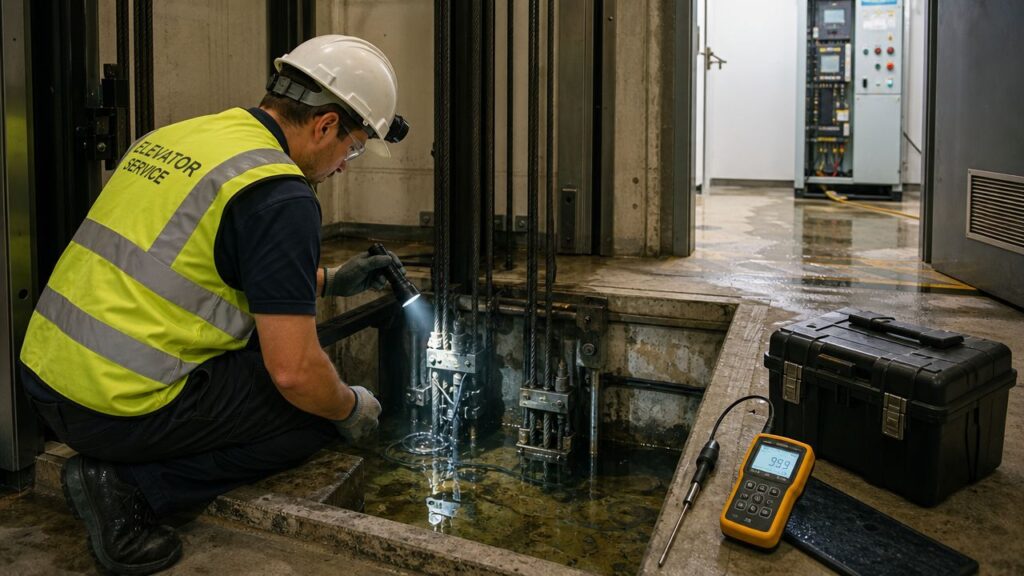
You get the call on a rainy Michigan morning. A tenant says the hall station is acting strange, or maintenance notices a damp smell near the lobby doors. Then someone opens the lower landing and sees water where it never belongs. At that point, this isn't a housekeeping problem. It's an elevator emergency.
In Detroit high-rises, Ann Arbor medical buildings, Lansing municipal properties, and apartment communities across Lower Michigan, water intrusion can shut down access, create a life-safety hazard, and turn a repairable event into a replacement job if the response is sloppy. Elevator water damage assessment has to be fast, disciplined, and documented. The order matters. The shutdown matters. The proof matters.
The High Cost of Water in Your Elevator System
The expensive part of water damage usually isn't the puddle you can see. It's the moisture that reached a controller cabinet, got behind insulation, washed lubricant off moving parts, or sat in the pit long enough to start corrosion. That's why experienced elevator people treat any water event as a systems problem, not a cleanup problem.
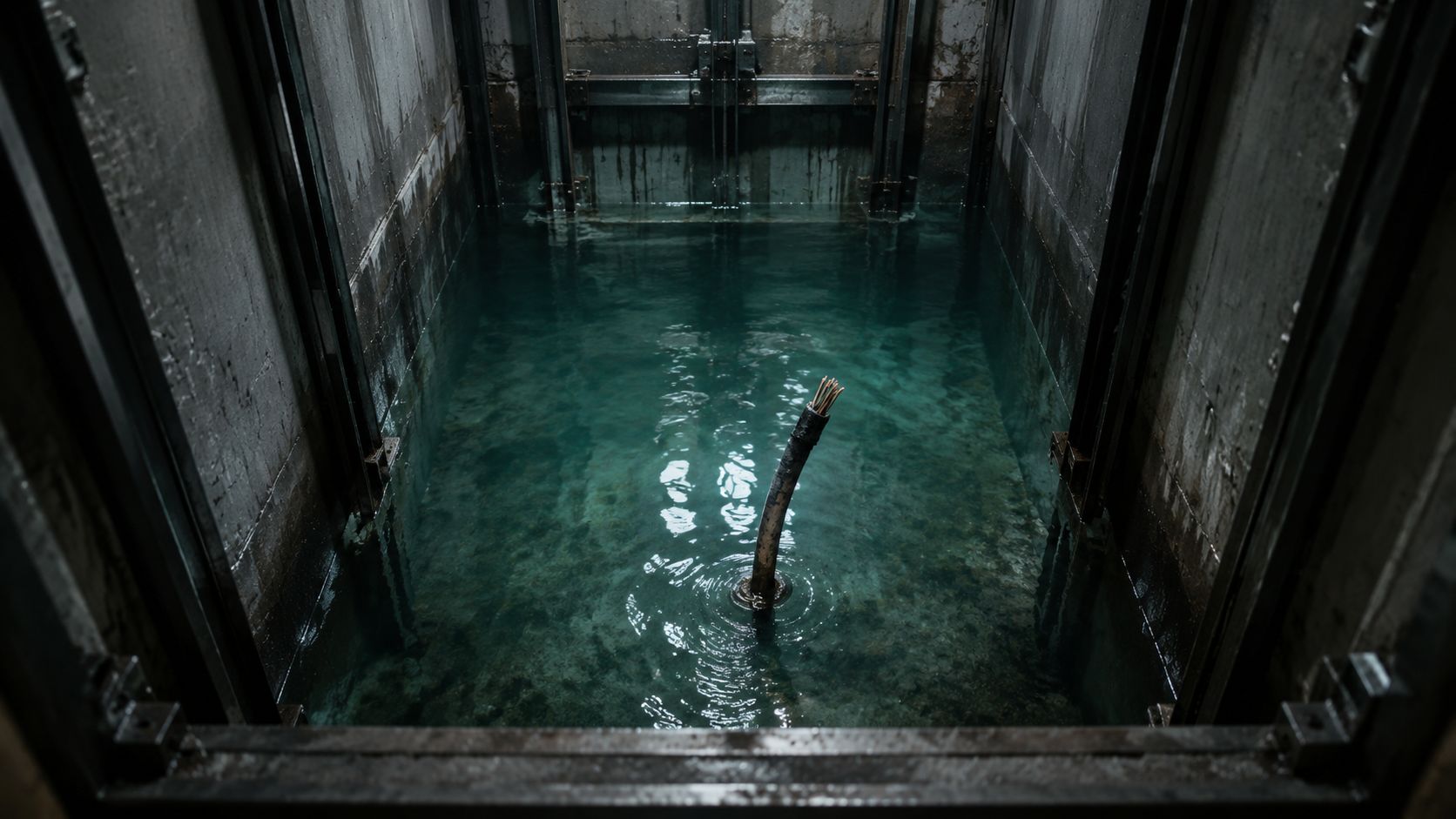
Envista Forensics reports that water damage is the single most prevalent cause of elevator claims, accounting for 47% of incidents, with an average water-related claim of $306,890.06. It also notes that this is more than $200,000 higher than the average mechanical breakdown claim in its vertical transport equipment damage assessment analysis.
That number gets a building owner's attention, but the practical lesson is more important. Water doesn't just disable one component. It moves. It finds the pit, door equipment, selector circuits, wiring terminations, brakes, machine components, and any unsealed opening that gives it a path. In older Michigan buildings, especially where machine rooms, pits, or adjacent basements have seen years of moisture exposure, the damage scope can widen fast.
Why Michigan properties get caught off guard
A lot of local water events aren't dramatic floods. They're pipe failures during winter freezes, backed-up drains, snowmelt migration, sprinkler discharge, roof leaks, or groundwater entering lower levels after heavy rain. In Southeast Michigan, that means the elevator may still appear usable right after the event.
That's where owners make the wrong call. If the cab still answers a call, they assume the exposure was minor. It might not be.
A running elevator after water intrusion may still be a damaged elevator.
The financial trade-off is simple. If you treat it like a nuisance, you risk converting a manageable drying and inspection scope into controller replacement, repeated shutdowns, and claim friction later. If you treat it like a protected asset and move early, you preserve evidence, improve salvage decisions, and control downtime better. That's also why many owners review broader elevator maintenance cost factors after a water event, because deferred care makes water losses much more expensive.
Immediate Safety Protocols Before Assessment
Before anyone starts inspecting, photographing, or pumping out water, the first job is to make the elevator safe. Water and energized elevator equipment are a bad combination. The car, controller, machine, traveling cable, pit devices, and door circuits can all become part of the hazard.
First actions that can't wait
Take the elevator out of service immediately. Block public access at every landing. If the building has multiple cars in a bank, identify the affected car clearly so staff, tenants, and contractors don't assume the entire group is available or, worse, accidentally try to use the damaged unit.
Then isolate power under proper lockout and tagout procedures. That step isn't paperwork. It's what prevents someone from restoring power while a technician is in the hoistway, on the car top, or in the pit.
Use a simple field sequence:
- Remove the car from service: Post clear warnings at each landing and notify building staff.
- Shut down electrical power: Follow lockout and tagout procedures through the proper disconnect.
- Secure the area: Keep unauthorized personnel out of the machine room, hoistway access points, and lower landing.
- Confirm no one is in the car or hoistway: Don't assume.
- Call elevator service support: Minor-looking water events often aren't minor once cabinets are opened.
If your team needs a reference for occupant communication and shutdown handling, a clear elevator out of service notice process helps keep the building response organized.
What facility staff should and shouldn't do
Facility teams can absolutely help in the first hour. They can isolate the area, stop access, identify the likely water source, and preserve conditions for inspection. They should not restart the elevator, open electrical enclosures casually, or send maintenance personnel into the pit without proper training and protection.
A good immediate response includes:
- Stop the water source if possible: Close the leaking valve, isolate the pipe, or involve plumbing and building engineering.
- Record the basic facts: Time discovered, who found it, where water appears to be entering, and whether the elevator was running during exposure.
- Protect the scene: Don't clean up evidence before photos are taken.
- Coordinate with other trades carefully: Restoration contractors, plumbers, and electricians all have a role, but elevator equipment needs elevator-specific judgment before restart.
Practical rule: If water may have reached the controller, machine, pit devices, or door equipment, assume the elevator is unsafe until a qualified elevator technician clears it.
Why speed matters before inspection
Delay creates two problems. First, corrosion starts early and lubrication loss doesn't reverse itself. Second, the longer you wait, the harder it becomes to prove what was exposed. In commercial buildings around Flint, Dearborn, Jackson, and Kalamazoo, that delay often comes from a well-meaning decision to "see if it dries out." That's one of the costliest mistakes owners make.
A Systematic Top-Down Inspection Process
A proper elevator water damage assessment doesn't happen by walking around with a flashlight and checking what looks wet. The strongest field method is a fixed sequence. Industry guidance supports a machine room/controller first, then top of car, car interior, and finally the pit because that order reduces the chance of missing water migration into critical systems, as noted in CBA Consultants' guidance on post-flood elevator inspection order.
That sequence matters because water rarely stays where it first appears.
Start where the controls live
Open with the machine room, controller, and drive equipment if the elevator has them. Hidden damage in these areas often carries the most significant consequences. You are looking for visible moisture, corrosion, staining, residue lines, tripped protective devices, compromised insulation, and any sign that water entered the cabinet or reached terminal points.
Questions that matter in the machine room include:
- Was any equipment energized during the event?
- Did water come from above, from a wall penetration, or from below through conduits?
- Is there residue that suggests contaminated water rather than clean water?
- Are fans, vents, and cabinet openings positioned where they could have pulled moisture in?
If a controller got wet while energized, the salvage conversation changes. If contamination is involved, the cleaning scope changes too.
Follow the water path through the hoistway
The next stop is the top of car and the hoistway overhead. Here, a rushed inspection commonly overlooks significant details. Water can travel down guide rails, along wiring paths, across door equipment, and into devices mounted where they aren't obvious from the landing.
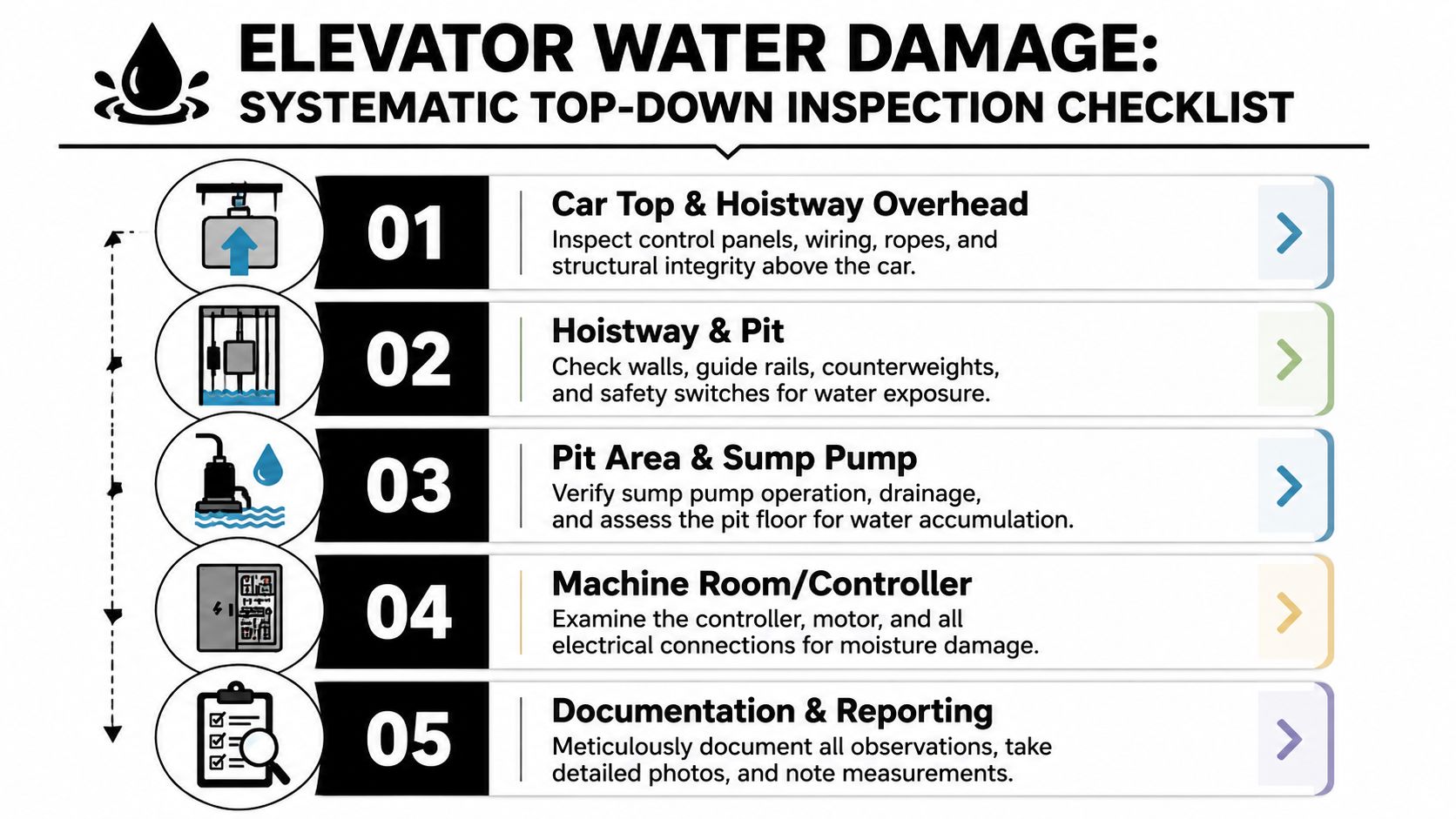
On the car top and in the hoistway, focus on these areas:
- Control and junction components: Check covers, enclosures, terminations, and harnesses for moisture or corrosion.
- Ropes, chains, and related moving parts: Look for rust, contamination, and evidence that lubrication was stripped away.
- Door operators and interlocks: These components don't tolerate contamination well and often become the source of later nuisance faults.
- Governor and safety-related hardware: Any sign of corrosion or washout needs serious attention.
- Guide rails and structural surfaces: High-water marks tell you where water traveled.
A lot of Michigan buildings have mixed conditions. The lower landing may show obvious exposure, while upper hoistway components only show subtle signs like dried residue or mineral tracking. That's why the sequence has to be disciplined.
If you inspect only where the water pooled, you'll miss where the water traveled.
Check the car interior without assuming it's clean
The passenger car or freight car can fool people. Dry flooring and working fixtures don't prove the car escaped damage. Inspect the operating panel, thresholds, sill areas, lower return panels, cab wiring access points, and any finish materials that can trap moisture.
A short comparison helps:
| Area | What often fools people | What actually matters |
|---|---|---|
| Car operating panel | Buttons still light up | Moisture behind panel, corrosion at terminations |
| Cab floor | Surface looks dry | Water trapped below finish or at sill edge |
| Door opening | Door still cycles | Operator contamination and latent door faults |
| Car lighting and fans | Still functioning | Exposure in wiring runs and hidden connections |
If you're dealing with a hydraulic unit, don't ignore how water may have affected lower-level components and pit equipment differently than a traction system. The visual clues aren't always the same.
Finish in the pit where damage collects
The pit is usually where water exposure is most obvious and where the worst assumptions get made. People see standing water, pump it out, and think the emergency is over. It isn't. The pit is where prolonged contact, contamination, and corrosion often become claim-driving damage.
Inspect buffers, switches, wiring, pit ladders, rails at lower sections, compensation equipment where present, and any sump or drainage components. Verify the source of water if possible. Groundwater, stormwater, sewage backup, and domestic water leaks don't carry the same restoration implications.
For owners and facility teams that want a structured reference after the event, a detailed elevator pit inspection checklist is useful because pit conditions are where many hidden issues remain after the visible cleanup is done.
Documenting Damage for Insurance and Reporting
Most claim problems start with weak documentation, not weak damage. If you can't show what was exposed, when it was exposed, and what condition the equipment was in before cleanup started, the argument shifts from repair scope to proof. That's a bad place to be.
Envista's maintenance guidance makes the point clearly. A key challenge is proving what was wetted versus what was not, especially when inspection is delayed. It also stresses that a functioning elevator after water intrusion isn't necessarily a recovered elevator because latent corrosion in wiring, brakes, and pit equipment can surface later in its elevator and escalator maintenance damage prevention guidance.
Build an evidence file, not a photo folder
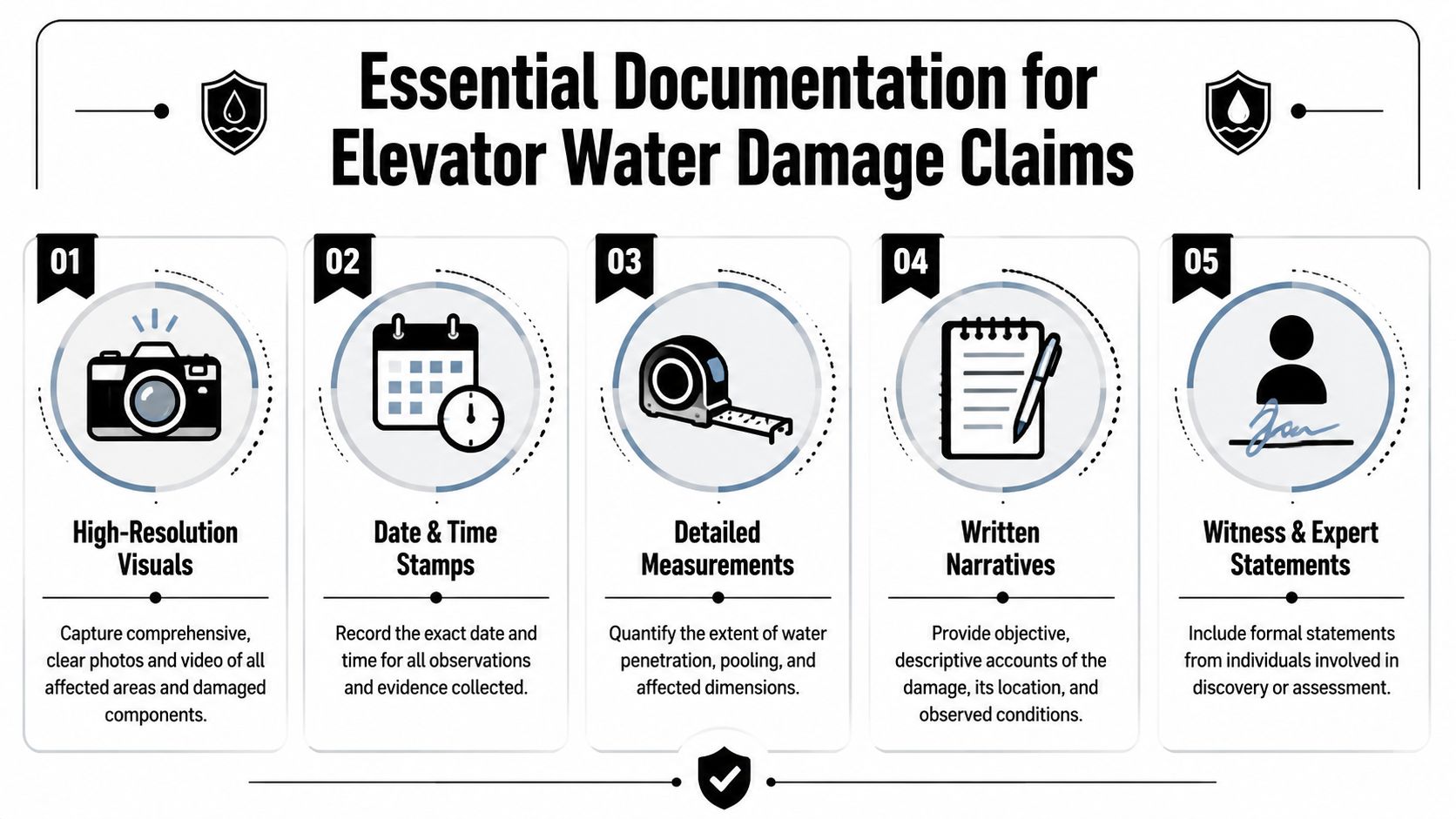
A usable claim record includes more than wide shots of standing water. It should show the event from discovery through stabilization.
Capture these elements:
- Overall scene images: Landings, machine room entry, pit conditions, and the water source if visible.
- Component-level photos: Controller interiors, drives, motors, door operators, ropes or chains, switches, pit devices, and any residue lines.
- High-water evidence: Mark and photograph water lines, staining, splash patterns, and pooled areas.
- Status notes: Record whether the elevator was operating, shut down, or energized when discovered.
- Timeline records: Who found it, when it was reported, when shutdown occurred, and when each contractor arrived.
Video can help, especially when showing water movement, active leaks, or equipment condition before drying starts. Still photos remain essential because they're easier to compare later.
Document for delayed failures, not just immediate repairs
A common mistake is writing the report as if the only question is whether the elevator runs today. Insurance disputes often arrive later, after corrosion, intermittent door faults, brake issues, or control problems appear. Your initial report should preserve the possibility of latent damage.
That means your written narrative should include observations like these:
- Water was present in or near electrical enclosures.
- Moisture, residue, or corrosion was observed on specific components.
- Lubrication appeared washed off or contaminated.
- The equipment should not be considered fully evaluated until drying, cleaning, and supervised re-test are complete.
Documentation should answer two questions. What got wet, and how do you know?
What owners in Michigan should insist on
In hospitals, schools, senior housing, and public buildings around Michigan, claims can become more complicated because access and service interruption matter alongside repair cost. Owners should insist on objective records from the first day.
A good field report includes:
- Source identification: Pipe leak, groundwater, roof leak, sprinkler discharge, drain backup, or unknown.
- Water classification note: Especially important if contamination is suspected.
- Affected component list: Specific, not generic.
- Operational status: Before shutdown and after inspection.
- Restart restrictions: Who must clear the unit, and what testing remains open.
That level of detail protects both safety decisions and claim position.
Mitigation and When to Call Crane Elevator Company
After shutdown, inspection, and documentation, mitigation starts. During this phase, good intentions often create bad outcomes. Owners want the building back. Tenants want service restored. Restoration crews want to dry the area fast. All of that is understandable. None of it changes the correct order of work.
Industry restoration guidance describes the right workflow as identifying the water category, removing standing water, using commercial dehumidification, sanitizing, and only then testing. It also warns that skipping steps, especially restarting without qualified verification, leads to unsafe recommissioning and avoidable replacement costs in this post-flood elevator inspection and maintenance guidance.
What facility staff can handle early
Some actions belong to the building team or restoration contractor, provided the elevator remains secured and de-energized.
Those early actions include:
- Stop active intrusion: Fix the leaking pipe, control drainage, or stabilize the nearby building condition.
- Remove standing water around the area: Do it carefully and without energizing equipment.
- Set up drying support: Commercial dehumidification and controlled airflow are appropriate once the scene is safe.
- Protect nearby finishes and access routes: Keep water from spreading into occupied spaces.
What they should not do is open up elevator equipment for improvised cleaning, apply power to "see what works," or assume that dry surfaces mean safe components.
The triggers for professional elevator intervention
Call qualified elevator professionals when any of the following is true:
- Electrical exposure is suspected: Controllers, drives, disconnects, junction boxes, traveling cables, or door circuits may have been wetted.
- The pit took water: Even if the water is already pumped out.
- Contamination is possible: Drain backup, stormwater, or any unknown source changes the cleanup and salvage decision.
- There are signs of corrosion or washout: Rust, residue, stripped lubricant, or binding movement.
- The elevator was running during the event: Energized exposure raises the risk profile.
- You need restart clearance: Re-energizing without qualified verification is a mistake.
For property owners in Detroit, Ann Arbor, Lansing, Flint, Kalamazoo, and surrounding communities, Crane Elevator Company is one local option for repair, inspection support, testing, and emergency elevator service after water exposure.
What proper recommissioning looks like
The elevator shouldn't go back into service because the pit is dry and the lights come on. It goes back when a qualified technician has verified operation under supervision, including normal travel, door performance, emergency functions, and floor response.
A practical decision table helps:
| Condition found | Common bad decision | Correct response |
|---|---|---|
| Standing pit water only | Pump it out and restart | Inspect pit devices, wiring, corrosion, and source first |
| Controller cabinet dampness | Dry exterior and monitor | Internal inspection, drying, and evaluation before power-up |
| Minor leak near landing | Ignore if car still runs | Inspect for hidden migration into hoistway and door equipment |
| Contaminated water event | Treat like clean water | Sanitize, assess salvageability, and delay restart until cleared |
Wet elevator equipment doesn't become safe because the building needs it back online.
From Reactive Assessment to Proactive Prevention
A single successful response doesn't solve the larger problem. If the building only reacts after water is already in the hoistway or pit, the owner is still carrying the same risk into the next storm, freeze, leak, or drain failure.
Industry analysis cited by VDA Global states that 70% of critical elevator maintenance issues arise unexpectedly, including issues tied to undetected water intrusion. That finding matters because it shows why standard schedules alone aren't enough without water-specific protocols in its discussion of managing elevators after water damage.
What prevention looks like in Michigan buildings
Preventive work is usually less dramatic than emergency work, but it has more value. In Michigan, that means paying attention to the conditions that lead to repeat exposure:
- Pit drainage and sump function: Test and verify operation before heavy weather exposes the weakness.
- Machine room protection: Keep water out through roof, wall, and conduit penetrations.
- Hoistway openings and lower-level leakage points: Seal and monitor them.
- Housekeeping in pits and machine rooms: Clean spaces reveal new moisture faster than dirty ones.
- Post-event protocols: Any pipe leak, sprinkler discharge, or basement water event should trigger elevator-specific review.
Why break-fix costs more
Reactive owners usually pay twice. First for the emergency call. Later for the repeated door faults, wiring issues, corrosion-related shutdowns, and harder insurance conversations that come after a rushed restart.
The better approach is a maintenance program that includes real pit, machine room, and car top attention, not just basic ride checks and callback response. Water problems often give off early signs. Residue, dampness, nuisance trips, and unusual corrosion don't fix themselves.
The cheapest water event is the one the building catches before the elevator ever sees it.
If your building in Detroit, Ann Arbor, Lansing, or anywhere in Lower Michigan has had water near an elevator, don't rely on a visual guess or a temporary restart. Crane Elevator Company works on repairs, inspections, testing, maintenance, and modernization for all makes and models of vertical transportation, and can help owners determine whether equipment is safe to dry, repair, document, and return to service properly.