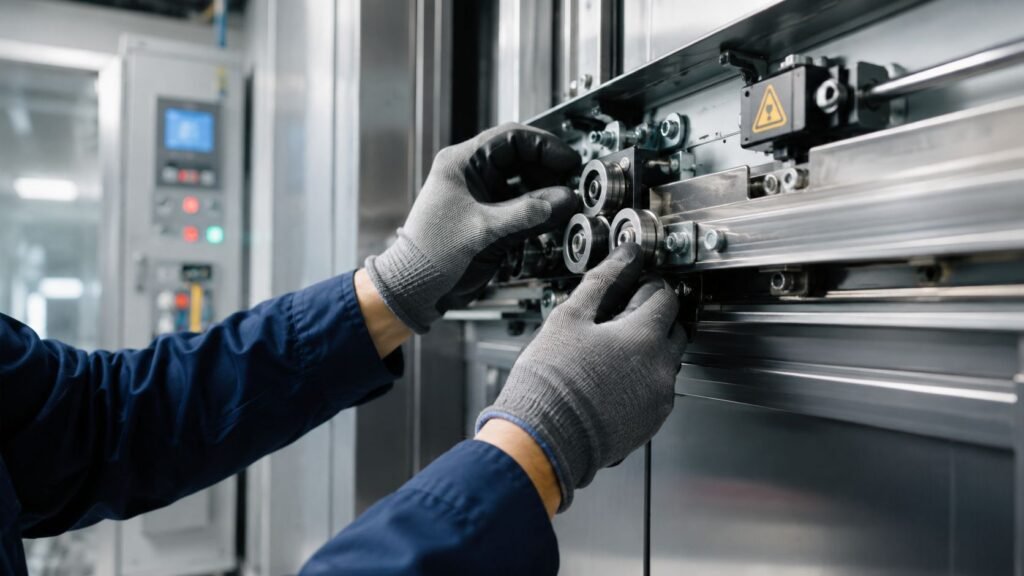
Door faults account for a large share of elevator downtime, and building managers usually feel the impact before they see the cause. The first sign is often a tenant complaint, a delivery delay, or an elevator taken out of service during a busy part of the day.
Building managers often first suspect the visible door panels, locks, and sensors. Those parts do fail, but recurring door trouble often traces back to the conditions that support the whole system. The machine room affects controller performance, door timing, power stability, and fault response. If that space runs hot, dirty, poorly lit, or out of code, the same door call can keep coming back.
That is why a sound elevator door maintenance program has to include more than the entrance itself.
Elevator door repair service means keeping the full operating system within safe mechanical and electrical tolerances so door operators, interlocks, and protective devices work as intended every day. For properties in Detroit, Ann Arbor, Lansing, Flint, Kalamazoo, and the rest of Southern Michigan, that approach cuts repeat shutdowns, supports code compliance, and lowers the cost of after-hours service. Crane Elevator applies that local maintenance model with the machine room and the door system treated as one reliability problem, not two separate line items.
The Hidden Cause of Most Elevator Service Calls
A large share of elevator trouble starts with the doors, but the repeat callback usually comes from a larger system problem. In Southern Michigan properties, the pattern is familiar. The car goes out of service on a door fault, the entrance gets attention, the unit returns to operation, and the same complaint comes back days or weeks later.
Door faults spread fast through building operations. A dirty sill, worn interlock, failing detector, or poor tracking can stop traffic flow, delay freight movement, trigger tenant complaints, and push service into overtime hours. In medical offices, schools, and multi-tenant commercial buildings, even a short outage creates operational problems that cost more than the repair itself.
Why the machine room is part of the door problem
Recurring door calls are often diagnosed too narrowly. The entrance hardware may be where the fault appears, but the machine room often explains why it keeps appearing. The controller manages door timing and response logic. Unstable power, heat, dust, loose connections, and poor housekeeping all affect how the operator and safety circuit perform.
I have seen buildings replace door components that were not the underlying cause of the callback. The actual issue was a hot machine room, contaminated controller cabinet, or inconsistent preventive service. That is an expensive way to maintain an elevator.
Practical rule: If the same door problem keeps returning, inspect more than the landing equipment. Check the machine room condition, controller environment, and service records.
A sound elevator door maintenance program covers the entrance components people see every day, but it also includes the equipment and room conditions that keep those components within proper operating limits. That broader approach is where a localized maintenance program pays off for Southern Michigan building managers. Fewer repeat shutdowns, fewer emergency calls, and fewer code-related surprises.
What frequent door calls usually tell you
Recurring door service calls usually point to one of three conditions:
- Maintenance is reactive instead of scheduled: Parts are addressed after a shutdown rather than adjusted or replaced during routine service.
- The equipment room is contributing to the fault: Dust, debris, moisture, poor ventilation, or housekeeping problems keep reintroducing the same issue.
- The repair stopped at the symptom: The reset cleared the fault, but alignment, wear, timing, or control problems were left in place.
Building managers who treat door performance as part of the full elevator system usually spend less over time. That is the practical value of tying machine room conditions and door maintenance together, especially for properties across Detroit, Ann Arbor, Lansing, Flint, Kalamazoo, and the rest of Southern Michigan where Crane Elevator can support a site-specific service plan instead of another temporary fix.
Understanding Your Elevator's Machine Room
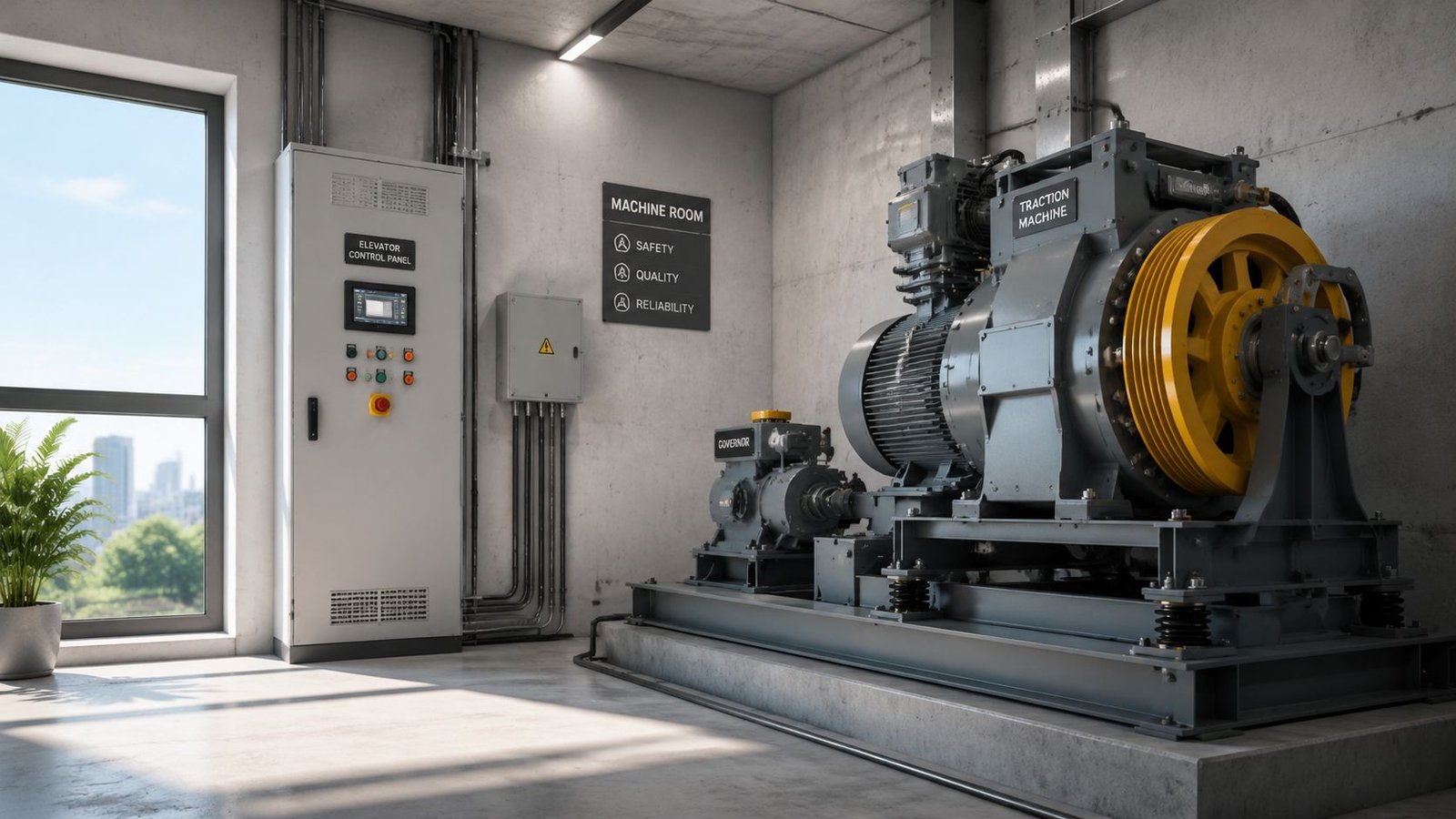
Think of the machine room as the elevator's brain and muscle in one space. The controller makes decisions. The drive equipment or hydraulic power unit performs the heavy work. When those systems are stable, the doors tend to operate with consistent timing, proper sequencing, and fewer nuisance faults.
The parts that matter most
Most building managers don't need to troubleshoot boards or trace circuits. They do need to know what they're looking at.
- Controller: This is the logic center. It handles car calls, hall calls, door sequencing, safety inputs, and fault responses.
- Motor or hydraulic pump unit: This provides the force that moves the elevator. In traction systems, the motor drives the hoisting machinery. In hydraulic systems, the pump moves fluid that raises the car.
- Drive and associated power components: These regulate motion and help determine ride quality, leveling, and response.
- Related support equipment: Disconnects, lighting, and room conditions all affect safe service access and long-term reliability.
Traction and hydraulic systems work differently
A traction elevator uses a machine that moves the car through hoisting equipment. These systems are common in taller buildings and require close attention to machine condition, control performance, and service access.
A hydraulic elevator relies on a power unit and fluid pressure to move the car. These are common in low-rise applications and often seem simpler to owners, but they still depend on solid housekeeping, proper inspections, and reliable control equipment for good door performance.
A machine room that looks neglected usually tells you something about the maintenance program behind it.
That's why facility teams should ask direct questions during service reviews. Is the room being cleaned? Are covers in place? Are terminals tight? Are technicians documenting conditions that affect door performance, not just resetting faults? A manager who understands the machine room can have a more productive conversation with any service provider and can spot the difference between cosmetic service and actual preventative maintenance.
Code Requirements for Michigan Machine Rooms
Machine room rules exist for a reason. They protect technicians, support reliable operation, and reduce the kinds of environmental problems that shorten equipment life. In Michigan, a building manager doesn't need to memorize every code line, but they do need to understand what a compliant machine room looks like and why it matters.
The business pressure behind this is only increasing. The global elevator maintenance market is projected to grow from $38.33 billion in 2026 to $68.25 billion by 2034, driven largely by evolving safety codes and the need to modernize aging infrastructure, according to Fortune Business Insights on elevator maintenance market growth.
Access and security
Machine rooms aren't general storage spaces. They must remain secure, controlled, and accessible to qualified personnel. If unauthorized people can enter, or if janitorial supplies and building storage start crowding the room, both safety and service quality suffer.
A technician needs clear access to disconnects, controllers, and moving equipment. Delayed access during a shutdown or entrapment event creates risk no owner wants.
Working clearances and physical space
Safe service work requires room to move, inspect, and test. That sounds basic, but crowded machine rooms create bad maintenance habits fast. When panels can't be opened fully, when ladders and tools can't be positioned correctly, or when parts are stacked around equipment, inspection quality drops.
What managers should look for
- Clear floor area: The room shouldn't be used for unrelated storage.
- Reachable equipment: Disconnects, controllers, and service points must be accessible.
- Safe service posture: Technicians need enough room to inspect, tighten, clean, and test without improvising around obstacles.
Ventilation and environmental control
Heat, humidity, and airborne debris affect electronics and electrical connections. Controllers and power components don't tolerate poor room conditions forever. If a machine room runs hot, accumulates dust, or shows signs of moisture, the owner should expect more nuisance problems over time, including control behavior that can show up at the doors.
Field note: When door faults seem random, inspect the room temperature, dust load, and overall housekeeping before assuming the problem is a bad component.
Electrical safety and room condition
Lighting, dedicated power, and equipment integrity all matter. A dim machine room leads to missed defects. Missing controller covers expose sensitive components. Loose terminals and corrosion create avoidable failures.
The same maintenance standards that apply to doors also point back to room condition. ASME-based service expectations include routine examination, cleaning, lubrication, adjustment, and replacement of worn parts, with monthly inspections for vertical sliding hoistway doors and semi-annual inspections aligned with ASME A17.1/CSA B44 Section 8.11.2.1. Those practices are part of broader safe operation, not isolated door work.
For Michigan property teams, a useful reference point is elevator code requirements for commercial properties. The practical takeaway is simple. If the room is hard to access, overcrowded, dirty, overheated, or electrically neglected, the elevator will usually tell you through repeated faults.
Machine Room Elevators vs MRL Systems
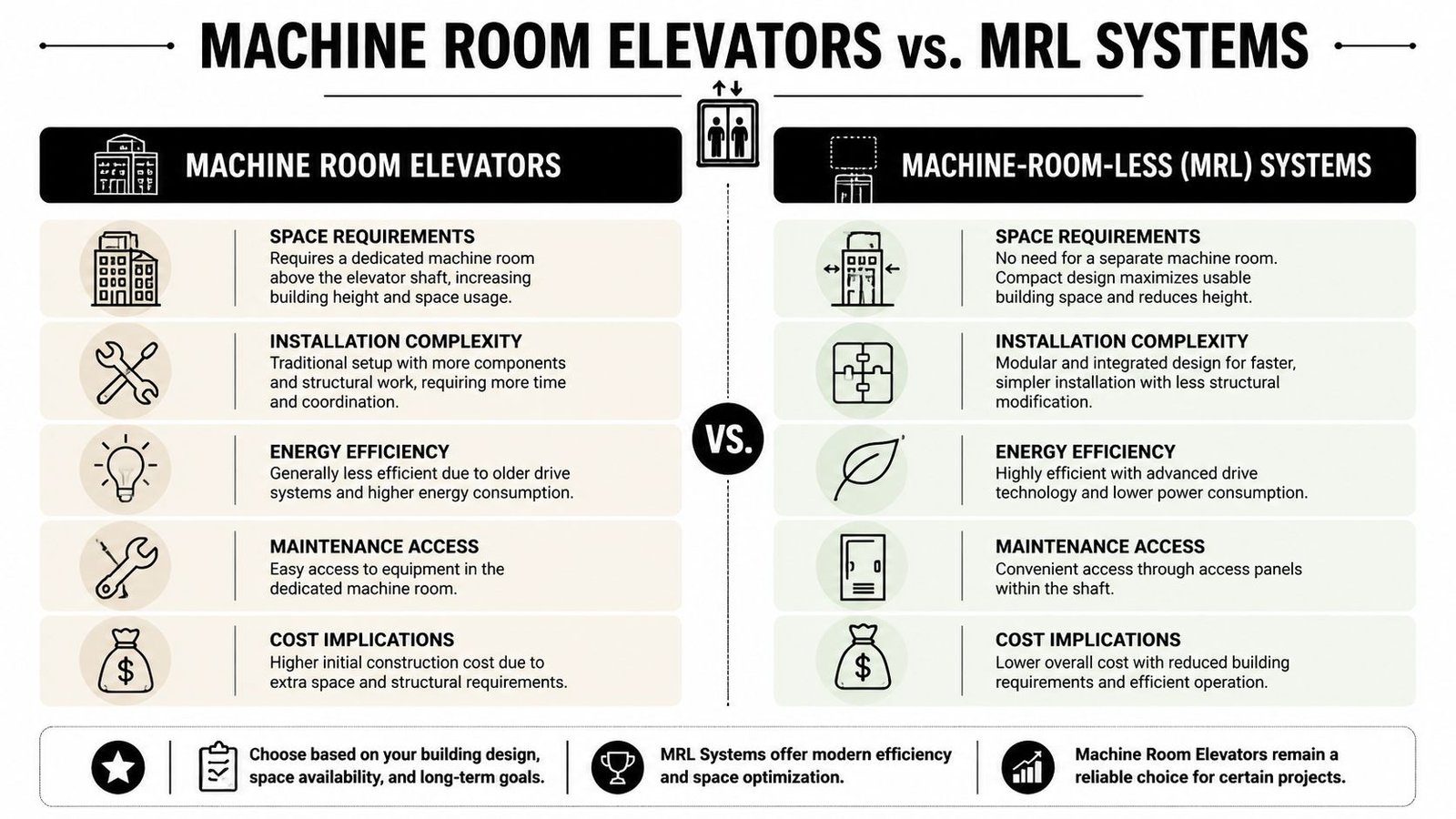
Choosing between a traditional machine room elevator and a machine-room-less system is usually less about trend and more about serviceability. Both can work. The better fit depends on space, building use, modernization goals, and how much control the owner wants over future maintenance options.
The short version
A traditional machine room system places major equipment in a separate dedicated room. An MRL system integrates key equipment into the hoistway or adjacent structure, eliminating that separate room.
That sounds like a pure space-saving win, and sometimes it is. But service access changes, and that affects maintenance strategy for years after installation.
Side by side trade-offs
| Decision factor | Machine room elevator | MRL system |
|---|---|---|
| Space use | Requires a separate room | Frees up building space |
| Service access | Equipment is generally easier to access | Access can be tighter and more specialized |
| Modernization flexibility | Often easier to phase and service | Can depend more heavily on system-specific design |
| Long-term maintenance | Familiar layout for many technicians | May involve access constraints |
| Parts strategy | Often easier to align with non-proprietary goals | Some systems increase proprietary dependence |
For owners who are early in planning, this overview of machine-room-less elevator options is a useful starting point.
Later in the decision process, seeing the physical differences helps clarify the trade-off.
What matters for door repair
Door reliability depends on more than where the machinery sits, but service accessibility still matters. If technicians can inspect and diagnose control and operator issues efficiently, recurring faults are easier to solve. If access is restricted or the system pushes the owner toward proprietary parts and provider lock-in, even ordinary door work can become more cumbersome.
For many Michigan buildings, the right answer comes down to three questions:
- How valuable is the saved floor area?
- How important is long-term service flexibility?
- Will your maintenance strategy rely on non-proprietary support?
Neither layout is automatically better. The wrong fit becomes expensive when the building discovers that a space-saving decision created harder maintenance later.
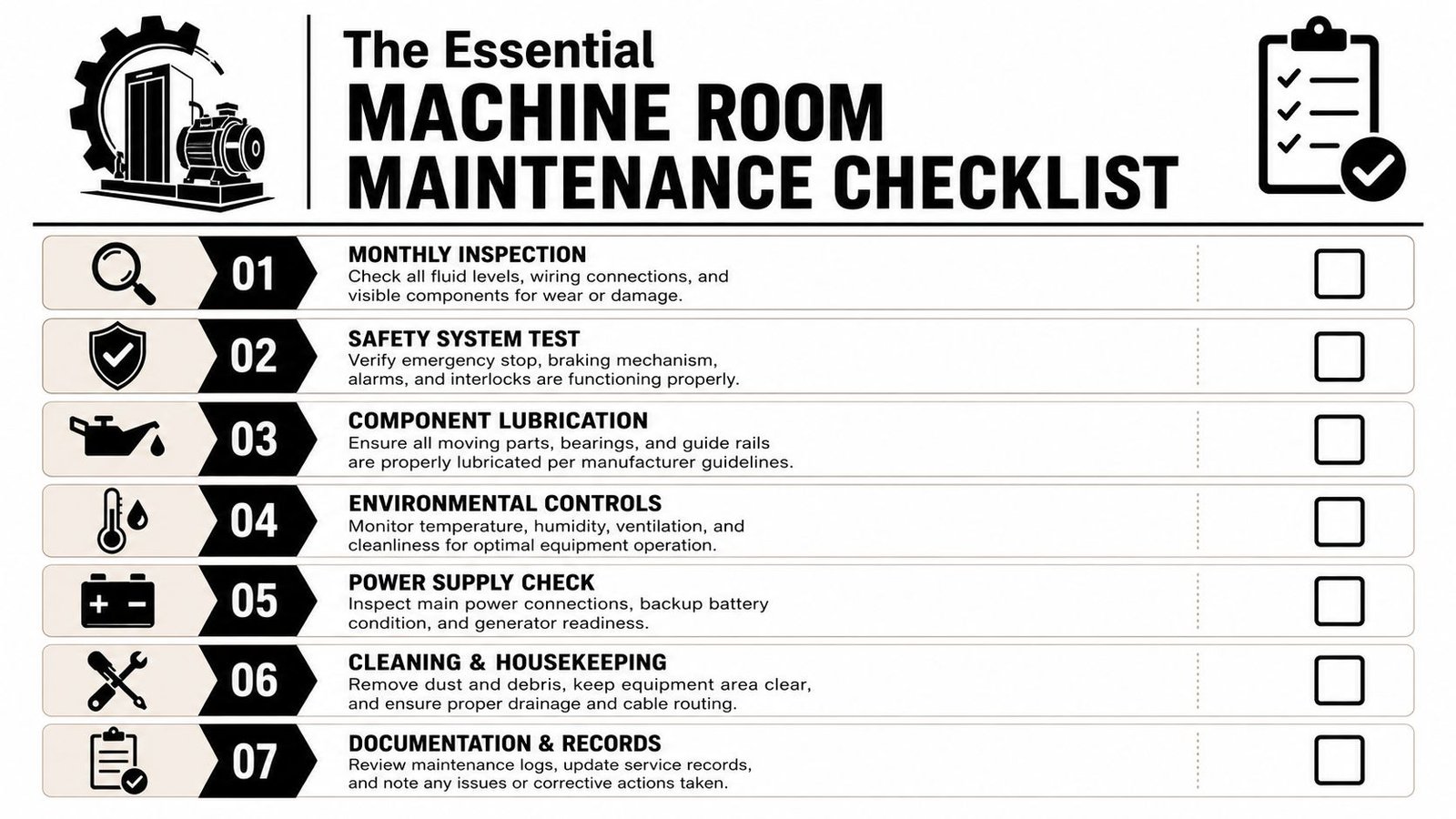
The Essential Machine Room Maintenance Checklist
A reliable elevator door usually comes from routine discipline, not emergency heroics. The most useful maintenance checklist is the one a building manager can verify during site walks and service reviews.
Cleaning that prevents callbacks
Sill debris and misaligned tracks account for over 60% of all elevator door service calls. Structured cleaning schedules and periodic alignment inspections are the most effective preventative measures. That means basic housekeeping around the door tracks is not cosmetic. It is one of the most practical ways to cut recurring shutdowns.
The technical standard matters too. Tracks must be aligned within ±0.015 inches, and maintenance guidance calls for regular cleaning and periodic alignment verification.
What to check every month
- Door sills and tracks: Remove debris, hardened dirt, and anything that can bind the carrier.
- Machine room housekeeping: Keep the room free of storage, dust buildup, and loose material.
- Visible oil leaks or residue: Leaks don't fix themselves and often point to larger wear issues.
- Controller condition: Confirm covers are in place and the area is kept clean and dry.
Keep grease and silicone off door rails when the specification calls for light oil. The wrong lubricant traps dust and creates the very binding you're trying to prevent.
Lubrication and adjustment
Proper door maintenance includes routine examination, cleaning, lubrication, adjustment, and replacement of worn parts. Rails should be lubricated lightly with elevator hydraulic oil or automotive #10 oil, while grease and silicone-based lubricants should be avoided because they attract dust and can cause binding.
Doors should also open and close fully without creeping. If a door creeps open by itself, the condition may indicate missing counterweights, damaged fire lintels, or failed toe guards. Those aren't “watch it for now” issues. They require direct correction.
Inspection points managers should ask about
A good maintenance visit should include more than a ride check and a reset. Ask whether the technician is reviewing these items:
- Structural condition: Broken, bent, or sprung members, missing guide shoes, and damaged vision panels.
- Safety compliance details: Door openings in car panels must reject a 50-mm ball.
- Electrical integrity: Missing covers on VVVF and PLC controllers should be replaced, and terminals should be tightened where humidity can drive corrosion.
- Inspection interval compliance: Vertical sliding hoistway doors require monthly inspection, with semi-annual inspection benchmarks tied to ASME A17.1/CSA B44 service expectations.
If a provider can't explain what was cleaned, adjusted, lubricated, and checked, the program is probably too thin to support dependable Elevator Door Repair Service over the long haul.
Planning for Elevator Modernization or Relocation
Some elevators don't need more patchwork. They need a modernization plan. If a building keeps seeing chronic door faults, repeated controller issues, or parts that are increasingly hard to source, continued reactive repair starts costing more in disruption than a planned upgrade.
Modernization often solves problems owners have accepted as normal. Doors that hesitate, reopen unpredictably, or close roughly can improve when the controller, operator-related controls, and supporting equipment are updated. Better control logic usually translates into smoother door timing, more consistent operation, and fewer nuisance shutdowns.
Signs the system may be ready
A building should start discussing modernization when several of these conditions are showing up at once:
- Breakdowns are recurring: The same faults return after service.
- Parts support is getting difficult: Repairs take too long because replacement components are obsolete or hard to obtain.
- Code-driven upgrades are entering the conversation: Requirements such as Door Lock Monitoring can change the economics of keeping an aging system in place.
- Maintenance quality is no longer enough to stabilize performance: Even good service has limits when core equipment is worn out or outdated.
Relocation is possible, but it isn't minor work
Machine room relocation comes up during major building renovations, additions, and repurposing projects. It can be done, but it affects access, power, control layout, and service planning. Owners should expect close coordination between elevator, electrical, and construction teams. This isn't a cosmetic remodel item.
When modernization is timed before the equipment becomes a constant emergency source, owners usually get a cleaner project, better tenant communication, and fewer operational surprises.
The right way to evaluate modernization is as a business decision, not just a repair line item. A stable elevator protects tenant confidence, helps with compliance, reduces emergency calls, and supports the property's long-term operating plan.
Choosing Your Elevator Service Partner in Michigan
The contractor matters almost as much as the equipment. A weak maintenance program can make a decent elevator look unreliable. A disciplined one can keep an aging system serviceable far longer, provided the core equipment is still worth maintaining.
What to look for
Start with practical questions, not sales language.
- Local coverage: Can the company respond in Detroit, Ann Arbor, Lansing, Flint, Kalamazoo, and nearby towns without long delays?
- Maintenance depth: Do they clean machine rooms, pits, and car tops, or do they just ride the car and reset faults?
- Non-proprietary mindset: Will the building keep flexibility on future service and modernization?
- Compliance awareness: Can they explain code-related recommendations in plain language?
In Michigan, commercial elevator maintenance costs average $510 per year for basic door lock monitoring and hydraulic packing services, with a range of $300 to $700 depending on system age and violation frequency, according to Angi's elevator repair cost overview. That doesn't replace a project-specific quote, but it does remind owners to compare scope, not just price.
One local option is Crane Elevator Company, a family-owned contractor with over 25 years of experience in Lower Michigan. The company uses a No Show, No Pay policy and includes full clean-downs of machine rooms to help prevent recurring breakdowns in places such as Kalamazoo and Detroit. For owners trying to reduce repeat door calls, that kind of maintenance scope is more relevant than a low monthly number with thin service behind it.
If you're dealing with recurring door faults, aging equipment, or a machine room that needs a second set of eyes, Crane Elevator Company is a practical next call for Southern Michigan properties. They handle preventative maintenance, repairs, inspections, and non-proprietary modernization work across commercial, residential, healthcare, education, and municipal buildings, and they offer free second opinions when you need to verify what your current contractor is recommending.