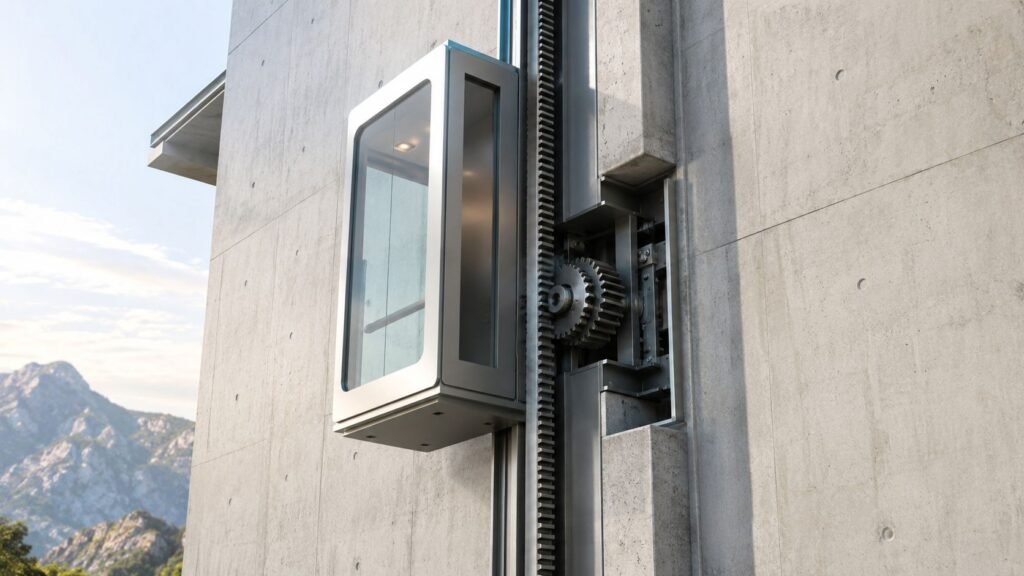
You're trying to solve a vertical transportation problem that doesn't fit a standard elevator package. The building has no easy shaft path, the exterior conditions are rough, or the freight load is too demanding for a conventional setup. That's where rack and pinion elevators enter the conversation, not as a novelty, but as a practical answer when space, access, and durability matter more than architectural convention.
The Unconventional Lift for Demanding Environments
A property owner usually starts with the same frustration. The building needs vertical access, but the site will not cooperate. There may be little room for a pit or overhead machinery, the lift may need to serve an exterior wall, or the environment itself may be the problem, dust, moisture, heat, or corrosive air.
In those situations, a rack and pinion elevator often makes more sense than forcing a traction or hydraulic layout into a poor fit. The category relies on direct gear engagement, not ropes or hydraulic cylinders, which makes it structurally different from the systems most owners know best. That difference matters because the system is often chosen for sites where the lift has to keep working in difficult conditions instead of polished interior shafts.
One practical way to look at it is this, the lift carries its own drive system, so the project depends less on a conventional machine-room arrangement. That is why the technology shows up in construction hoists and some service elevators, and why it keeps appearing in industrial and specialty access work. It is also why the total cost picture has to include more than the initial install, because the primary issue for a permanent building is how much upkeep the drive, mast, and safety devices will demand over time.
Practical rule: if the building design forces the elevator to adapt to the site, rather than the site adapting to the elevator, rack and pinion belongs on the shortlist.
For owners comparing lift types, a good starting point is this overview of different lift types and where they fit best. The main question is not whether the system is unusual. Rather, the question is whether that layout solves a permanent operational problem better than a standard elevator would, without creating a heavier maintenance burden or a safety profile the property team cannot support.
How Rack and Pinion Elevators Work
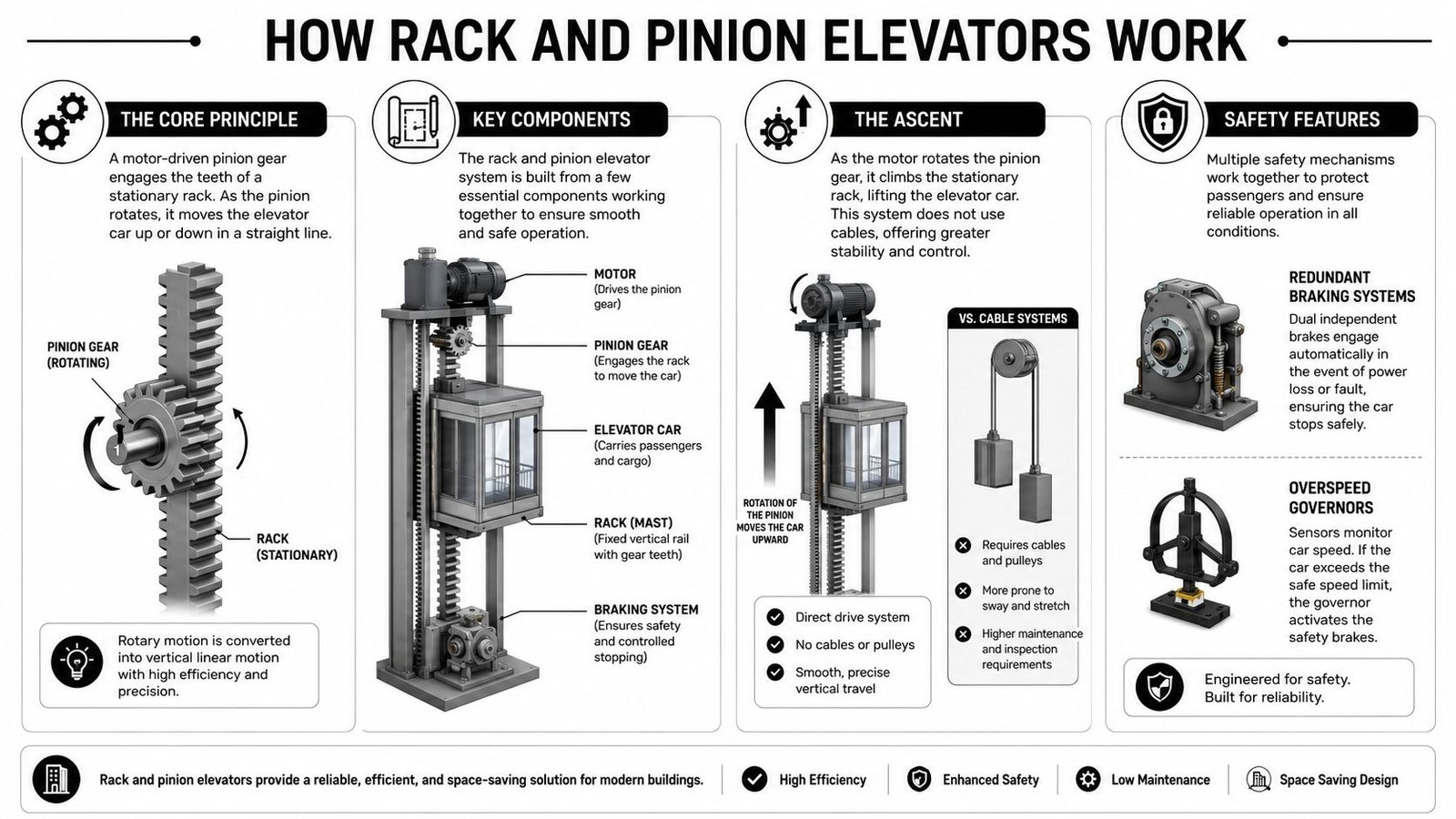
A rack and pinion elevator moves by direct gear engagement. A fixed toothed rail, the rack, is mounted to the mast or supporting structure. A motor turns the pinion gear, and that gear climbs the rack tooth by tooth, converting rotary motion into vertical travel.
The core parts
The arrangement is simple in concept, even though the installation is specialized. The elevator car carries the drive components, including the motor and pinion, while guide rollers keep the car aligned against the structure. That car-mounted drive is one of the biggest practical differences from traction and hydraulic systems, because the lift is not waiting for a remote machine room to pull it or a cylinder to push it.
The system climbs on its own mast, which is why it shows up in construction and industrial work. It also means there is no hoist rope assembly to tension and no hydraulic fluid system to manage. For some buildings, that reduces one set of maintenance tasks while adding another set tied to the drive package and mast-mounted components.
Why the design matters in the field
The direct gear drive gives rack and pinion systems their place in the market. A motor-driven pinion meshes directly with a fixed rack, so lifting force comes from gear engagement rather than ropes or fluid pressure, as shown in the rack and pinion mechanism overview with converting rotary motion into vertical travel. That makes the system practical where long travel distances, temporary setups, or uneven outdoor conditions are part of the job.
The trade-off is straightforward. The drive package lives on the car, not in a separate machine room. That changes how service crews reach components, how noise is managed, and how maintenance planning gets done over time. For a property owner, that affects access, downtime, and who has to work on the equipment when parts wear out.
The embedded video below gives a visual reference for the gear-driven movement if you want to see the motion in context.
Common Applications and Use Cases
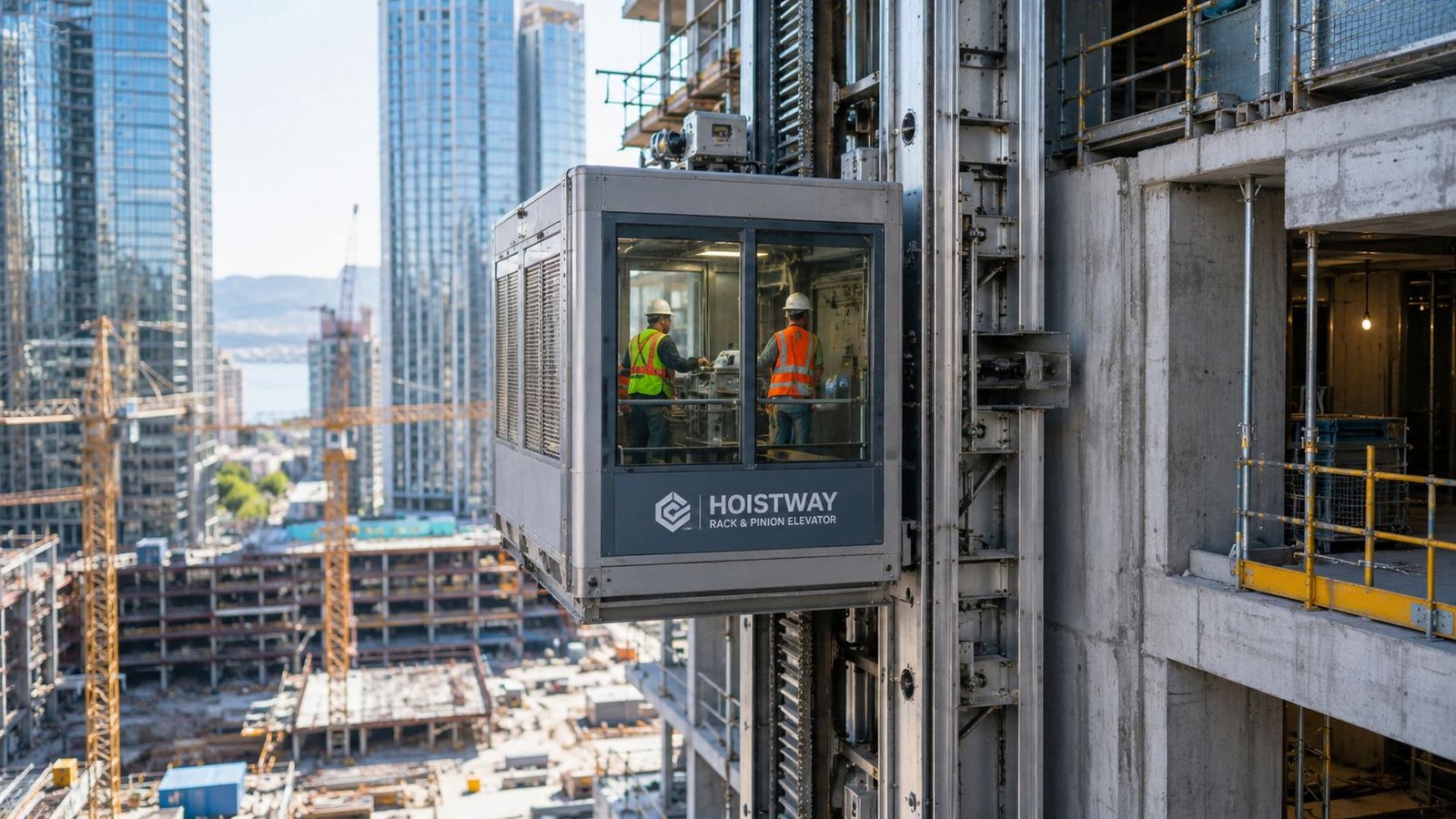
A rack and pinion elevator makes the most sense when the building owner needs direct vertical access in a tough setting. Exterior installation, uneven ground, exposed weather, and limited room for a conventional shaft all push the decision toward a system that can work without a traditional rope package or a separate machine room. In practice, that is why these lifts show up on industrial sites, building facades, and infrastructure projects where access has to work in demanding environments, not just on a drawing.
Where the system earns its keep
These lifts are a strong fit for temporary installations and vertical lift applications where site conditions are not ideal. They are also used where the travel requirement is longer than what many owners first expect from this type of equipment, and the format can handle travel ranges from short single-floor movement to much taller industrial runs, depending on the project.
That matters for total cost of ownership. If a conventional elevator would need a new shaft, extra structure, or a machine-room arrangement that takes space the building does not have, the rack and pinion option can reduce the amount of construction work tied to the lift itself. In older buildings, that can be the difference between a project that fits the property and one that forces a major redesign.
What they're good at, and what they're not
For freight and material handling, the direct gear drive is a practical advantage because the lift is built around mechanical engagement that can stand up to exposed service conditions. The maintenance profile is different from traction or hydraulic equipment, and that difference matters when the lift is operating in dirt, weather, or repeated-use industrial service. Owners still need a real maintenance plan, but the system is well matched to sites where the environment would be hard on more conventional equipment.
Rack and pinion also makes sense for permanent industrial service, not only for jobsite use. When a building regularly deals with weather exposure, debris, heavy loads, or awkward access for technicians, the system starts to look less specialized and more like a practical choice. For owners comparing lift types, traction versus hydraulic elevators and how their maintenance burden differs gives a useful framework for the trade-offs.
Rack and Pinion vs Traction and Hydraulic Elevators
A building owner usually feels the difference between elevator types long before the first service call. Rack and pinion, traction, and hydraulic systems all move people or freight, but they do it with very different installation demands, service routines, and long-term ownership costs. The right choice depends on shaft space, access for technicians, downtime tolerance, and how the lift will be used after the project is finished.
Installation and building impact
Rack and pinion lifts avoid the usual rope-and-machine-room layout because the drive motor rides with the car instead of sitting in a separate machine space. That can make a real difference in buildings with limited room for a shaft, pit, or overhead clearance, and it can also simplify retrofits where structural changes would otherwise drive the project cost up. In those cases, the elevator is not just a mechanical purchase, it is part of the building work itself.
Traction elevators still make sense in passenger buildings where owners want a familiar ride and a large pool of service providers. Hydraulic systems are easier to grasp at a basic level, but they bring fluid, cylinder, and space considerations that change both installation and upkeep. None of these systems wins every time. The site decides the best fit, and the wrong match usually shows up later in extra construction, service access problems, or slower maintenance work.
Lifecycle cost and maintenance burden
The first quote rarely tells the full story. The larger question is what the lift costs to own, inspect, and keep available year after year. With rack and pinion equipment, the drive system on the car changes access, noise, and service planning, and those factors shape total cost of ownership over the life of the installation. For a closer look at how that differs from other lift types, the maintenance differences between traction and hydraulic elevators gives a useful reference point.
Owner takeaway: if technicians cannot reach the equipment easily, the savings you expected can disappear into labor time and coordination.
That is why permanent installations deserve a careful review before anyone signs off on the design. A system that looks straightforward on paper can be harder to support in the field if routine service needs special access, more shutdown time, or a maintenance plan the building team was not expecting. On a harsh site, or on a property where shaft changes would be expensive, rack and pinion can still be the better business decision. On a cleaner passenger job with normal access and a conventional shaft layout, traction may be easier to support over time. Hydraulic systems can work well too, but the owner has to accept their own maintenance profile and the space they require.
A practical side-by-side view
| Decision point | Rack and Pinion | Traction | Hydraulic |
|---|---|---|---|
| Best fit | Industrial, exterior, specialty access | Passenger-focused buildings | Low-rise and freight-focused settings |
| Drive layout | Car-mounted gear drive | Rope-driven | Fluid-based |
| Site flexibility | Strong | Moderate | Moderate |
| Maintenance planning | Site-specific | Familiar for many providers | Different fluid and cylinder concerns |
| Retrofit friendliness | Often strong where space is tight | Depends on shaft design | Depends on pit and space conditions |
Rack and pinion is not the default answer. It is the choice that makes sense when the building's constraints, access limits, and service expectations matter more than using the most familiar elevator type.
Safety Systems Codes and Inspection Requirements
A building owner should not assume every elevator handles safety the same way. Rack and pinion systems do not hang the car from ropes, so the safety layout has to be judged on its own terms. The motor and gearbox ride on the car, which changes inspection access and rescue procedures compared with machine-room designs, especially during power loss and rescue considerations handled under OSHA emergency planning guidance.
What happens when things go wrong
The system is built with safety devices to stop uncontrolled descent and overspeed conditions. Braking and other fail-safe measures are tied to the gear-driven layout, and the building owner needs to understand that emergency response for this equipment is not the same as a traction elevator plan.
Power loss is the first scenario to work through. Rescue access can be different because technicians are dealing with components mounted on the car instead of a remote machine room. That does not make the system unsafe, but it does mean the building team, the contractor, and the inspector need the same rescue procedure before the lift is put into service.
Code and inspection are not optional
A rack and pinion elevator still needs code compliance and local inspection attention. The equipment may be specialized, but the owner's obligation stays the same, keep it compliant, documented, and serviceable. If the site depends on the lift for freight movement, industrial access, or operations that cannot stop easily, those details matter even more.
Owners should ask practical questions before acceptance:
- How is rescue handled during a power outage?
- Who has the training to inspect the car-mounted drive components?
- What does the emergency plan look like for repeated high-cycle use?
- How are overspeed events prevented and documented?
A system can be mechanically suitable and still become a management problem if the team does not understand how it fails, how it is recovered, and how inspections are performed. That is where specialized knowledge matters, not marketing language.
Maintenance Modernization and Common Failure Modes
Rack and pinion lifts reward owners who stay ahead of wear. Because the motor, gearbox, and controller are part of the car-mounted package, service work takes a different path than it does on a conventional machine-room system. The best-maintained units are the ones where the owner understands what needs checking before a problem becomes downtime.
What service crews actually watch
The first job is lubrication and gear inspection. The rack and pinion teeth need to stay in good condition, and the guide rollers have to be watched for wear, alignment issues, and noise. If those parts drift, the ride quality and the system's efficiency start to suffer.
The second job is access. When the drive package is on the car, the service technician has to approach maintenance differently. That affects lockout procedures, inspection planning, and the time it takes to complete routine checks. It's one reason maintenance burden should be discussed at the proposal stage, not after the first breakdown.
The failures that matter most
Wear usually shows up first in predictable places. Gear teeth can degrade, rollers can loosen, and the drive assembly can start to sound or feel different before a major fault appears. That's exactly why preventative maintenance matters. A strong maintenance program is not about fixing one dramatic failure, it's about catching the small ones early.
For owners who already have an installed unit, preventative elevator maintenance is the practical tool that protects uptime. Modernization is the next step when parts become hard to support or the controls no longer fit current operational needs.
Upgrades can extend service life, improve control behavior, and bring the equipment in line with present code expectations. The key is not to assume an older rack and pinion system should be replaced just because it's older. In many cases, targeted modernization is the smarter path if the structure still suits the lift.
Making the Right Choice for Your Building
Use a rack and pinion elevator when the building needs space efficiency, outdoor durability, or specialized access more than it needs a conventional passenger-elevator setup. It's often the right call for industrial sites, exterior applications, heavy freight movement, and buildings that can't realistically absorb a traditional shaft and machine-room layout.
A simple decision checklist helps:
- Extreme height or unusual travel path, rack and pinion deserves attention.
- Outdoor exposure or harsh conditions, the direct-drive design is often a better fit.
- Heavy or bulky loads, the system's mechanical engagement can suit the job.
- Tight space for a pit or machine room, this is one of the strongest reasons to consider it.
- Long-term service planning, compare access, downtime, and parts support before you commit.
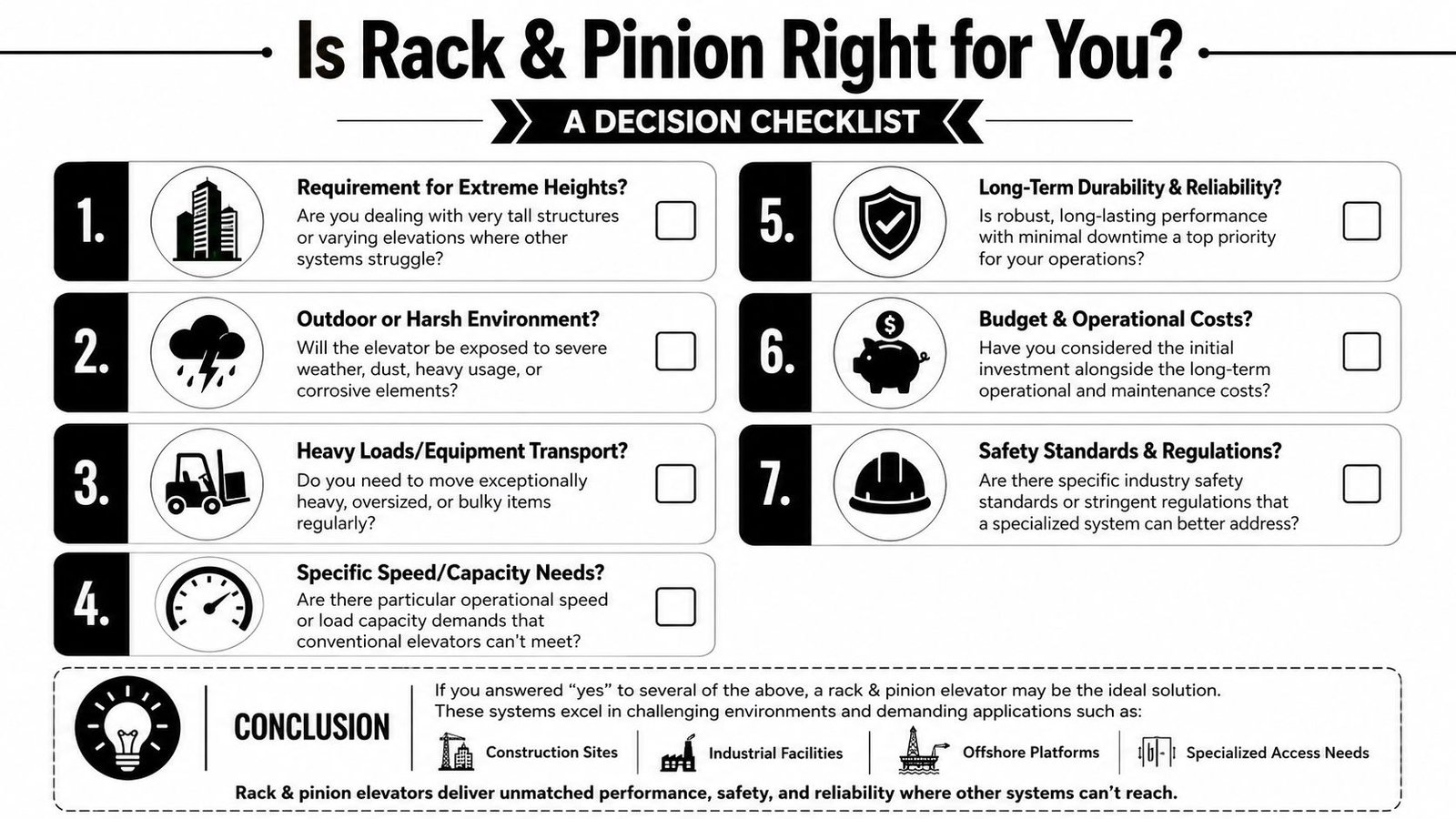
The best applications are still the ones where conventional elevator assumptions don't hold. Construction platforms, industrial sites, offshore-style access problems, and other specialized environments are where this technology usually makes the most sense. If that sounds like your building, the next step is a serious site evaluation, not a guess.
If you're weighing a new installation or trying to reduce the lifetime cost of an existing lift, contact Crane Elevator Company for a free second opinion and a practical assessment of whether a rack and pinion solution באמת fits your building.