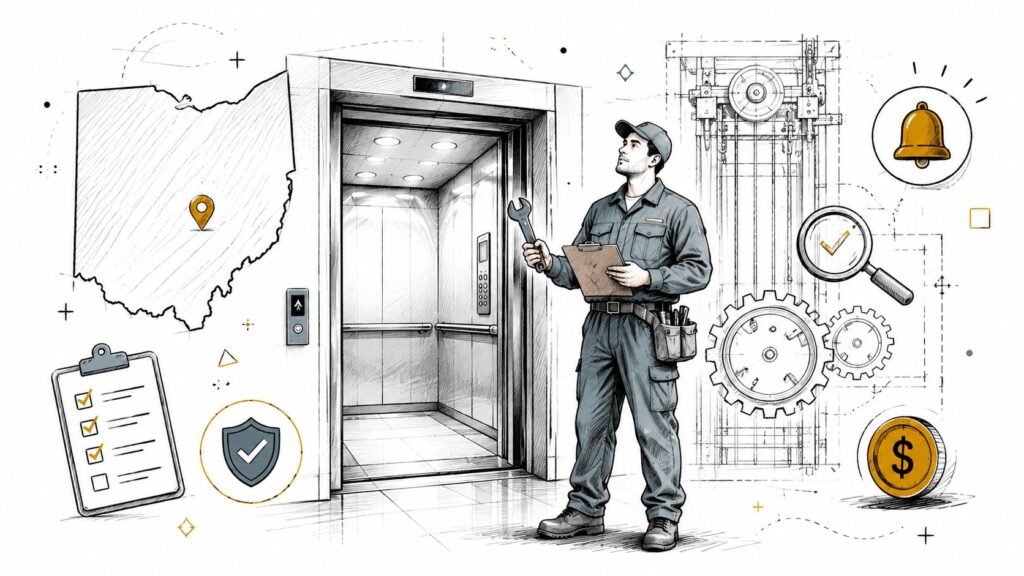
The call comes in on a Monday morning. A property manager in Toledo has a car sitting dead at the lobby landing, tenants are asking for answers, and the maintenance log doesn't make it clear whether the issue is a quick repair, a code problem, or the start of a bigger modernization decision. That's the reality behind Ohio elevator services, the part most owners only think about after the building starts missing stops or an inspector starts asking questions.
In Ohio, elevator work isn't just about getting a cab moving again. It's maintenance, repair, inspection support, code compliance, emergency response, and, in the right situation, a modernization plan that keeps the system serviceable for the long haul. For building owners in Toledo and surrounding cities, Crane Elevator Company fits into that reality as a regional service contractor for maintenance, repair, and modernization across Michigan and Ohio.
What Ohio Elevator Services Actually Cover
A broken elevator usually reveals the size of the job that was already waiting underneath it. The outage is visible, but the larger service need is usually spread across the machine room, pit, car top, controller, and compliance paperwork. That's why a good service relationship has to cover more than a one-time fix.
The work starts before something fails
Preventive maintenance is where most buildings either stay ahead of trouble or fall into repeat callbacks. In practice, that means machine-room clean-downs, pit and car-top service, door-lock monitoring, hydraulic packing checks, and COP or PI bulb replacements, all the small tasks that keep nuisance failures from becoming shutdowns. If those items don't get touched consistently, the building pays for it later in missed uptime and failed inspections.
Emergency repair is the other side of the same coin. A contractor has to be ready to troubleshoot motor problems, sheave wear, cable or jack issues, tank and power unit faults, and controller problems without treating every visit like a guess-and-return job. If the equipment is older or mixed-brand, the ability to work on non-proprietary systems matters even more because the building can't afford to be trapped in one vendor's parts pipeline.
A complete service relationship also includes modernization planning. That doesn't always mean replacing the whole system. Sometimes it means making the equipment serviceable by qualified contractors, improving code performance, and avoiding the kind of proprietary lock-in that makes every future repair more expensive and slower to schedule.
Practical rule: if a provider only shows up when the cab is down, you don't really have a maintenance program, you have a reaction plan.
Crane Elevator Company works in that broader service model across Toledo and surrounding cities, with field work that ties maintenance, repair, and modernization together instead of treating them as disconnected jobs. For owners, that matters because the best service contract is the one that prevents repeat failures, not the one that merely responds to them.
Core Service Types Every Property Owner Should Understand
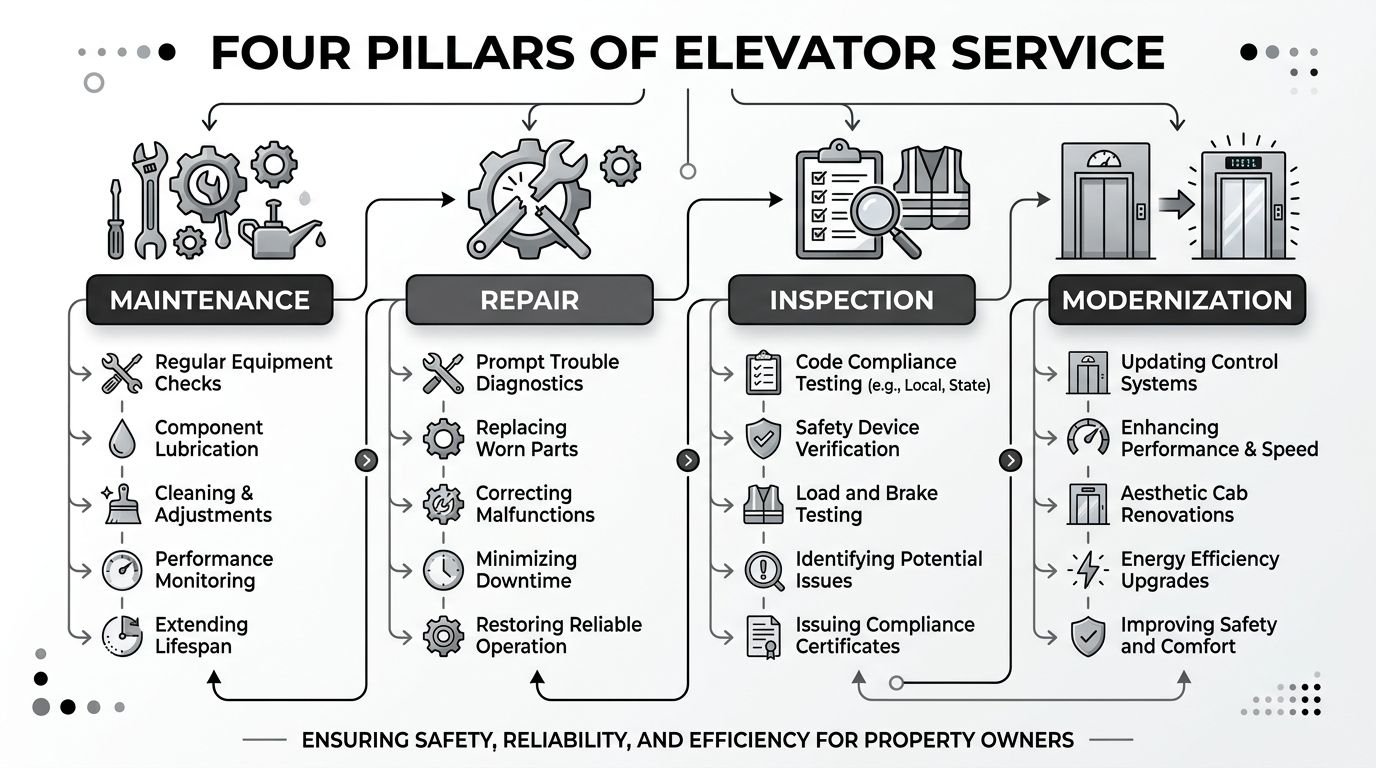
The four service pillars sound simple, but they behave differently in the field. Owners who lump them together usually end up overpaying for emergency work that should have been prevented, or delaying modernization long after the system stopped being economical to keep alive.
Maintenance keeps the system serviceable
Maintenance is the day-to-day discipline that keeps a vertical transportation system usable. On a typical building, that means cleaning, inspection of wear points, lubrication where needed, adjustment checks, and looking for small failures before they cascade into car shutdowns. It also includes details many owners never see, like door monitoring and accessory replacements that keep the cab from developing the same nuisance issues month after month.
Crane Elevator Company's No Show, No Pay approach is important here because it puts accountability on the scheduled visit itself. A maintenance program only works if the technician shows up, completes the work, and leaves behind a cleaner and more predictable system. If a provider skips routine attention, the building usually finds out later through a complaint, a shutdown, or a failed inspection.
Repair deals with failed components
Repair is what happens when the equipment has already crossed from wear into failure. That can mean a motor replacement, sheave replacement, cable work, jack work, tank or power unit service, or controller troubleshooting. It can also mean sorting through a series of symptoms before the fault is found, which is why experience on older systems matters.
A repair call shouldn't be treated as a substitute for maintenance. If the same door issue, leveling issue, or power problem keeps returning, the building is paying for the same failure in pieces. A good contractor will separate what needs a correction today from what needs to be monitored or upgraded before the next outage.
Inspection and modernization are not optional extras
Inspection support is a separate discipline because Ohio's compliance system doesn't care whether the building owner was busy. The state's inspection cadence and certificate process are recurring duties, not one-time paperwork. Modernization, meanwhile, is the point where the owner decides whether to keep patching old hardware or make the system maintainable by qualified providers for the next cycle of ownership.
The trade-off is straightforward. Maintenance preserves. Repair restores. Inspection validates. Modernization resets the service model.
Service categories at a glance
| Service type | What it does in practice | What owners usually get wrong |
|---|---|---|
| Maintenance | Prevents wear, adjusts components, checks critical subsystems | Treating it as a paperwork visit |
| Repair | Fixes failed parts and recurring faults | Waiting too long and increasing damage |
| Inspection | Confirms code condition and certificate status | Assuming the building will pass on routine alone |
| Modernization | Rebuilds the system for long-term serviceability | Thinking it's only a cosmetic upgrade |
For owners comparing elevator service in Ohio, the question isn't whether they need one of these categories. They need all four at different points, and the contract should make that clear.
Ohio Compliance and Inspection Requirements
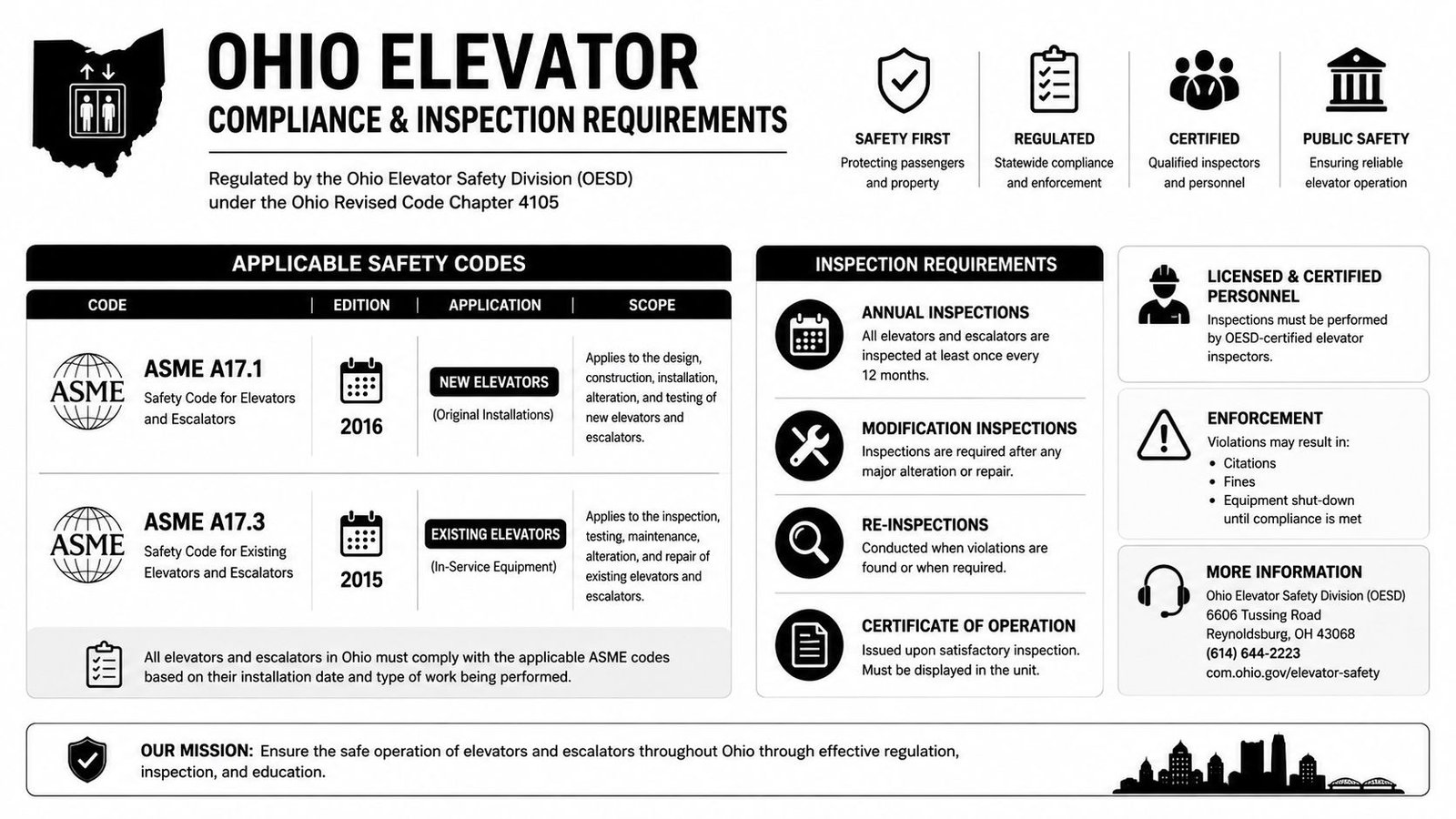
A building owner in Ohio usually learns the compliance problem the hard way, through a failed inspection, a delayed certificate, or a repair that looked simple until the inspector reviewed the file. Ohio's elevator framework is built around recurring oversight, not occasional check-ins. The state legislature has cited around 33,000 elevators, escalators, and commercially installed accessibility units in Ohio, and the Ohio Department of Commerce says its Elevator Section issues over 32,000 certificates of operation while performing two inspections per year on most elevators statewide, outside Cincinnati and Cleveland, which handle their own inspections (Ohio legislative analysis, Ohio Department of Commerce Elevator Section). That is why preventive maintenance matters here. It is how owners stay ahead of violations, missed corrections, and the downtime that follows when a system is not ready for the inspector.
The code baseline shapes the service call
Ohio's regulatory framework is built around ASME A17.1 (2016), ASME A17.3 (2015) for existing elevators, and ASME A17.6 for suspension, compensation, and governor systems, with compliance treated as prima facie evidence of acceptable engineering practice (Ohio Administrative Code reference). That changes what a service visit has to accomplish. A technician cannot just make the car run and leave the rest for later. The work has to hold up under the technical code the inspector uses when the installation is reviewed.
Ohio's building requirements also affect modernization scope in practical ways. In buildings served by four or more stories, at least one elevator has to fit a 24-inch by 84-inch stretcher with 5-inch radius corners and be marked with the emergency medical services symbol, and a building with only one elevator must transfer automatically to standby power within 60 seconds of a normal-power failure (Ohio code summary). Ohio also requires Phase I emergency recall and Phase II in-car emergency operation under ASME A17.1/CSA B44, plus a machine room with a self-closing, self-locking door, minimum 7-foot headroom, and landing-sill illumination of at least 10 foot-candles (Ohio code summary).
A system can be operational and still be a problem. Legacy controls, older door equipment, or a patched-together retrofit history can leave the elevator moving while the code gaps stay open.
The code does not reward good intentions. It rewards documented, repeatable maintenance that survives inspection day.
Licensing and inspection cadence change the owner's risk
Ohio's statewide licensing reform, effective April 3, 2024, created a regime for elevator contractors and mechanics with licenses valid for 2 years and renewable, and contractors must carry at least $1 million in liability coverage for injury or death in any one occurrence and $500,000 for property damage in any one occurrence, along with workers' compensation coverage (Ohio licensing reform). Owners should read that as a service filter. The contractor on site has to work inside a real compliance and insurance framework, because a cheap truck call does not help if the provider cannot stand behind the work after an incident.
The law and the administrative rules also separate commercial and residential obligations. Ohio revised the inspection regime for private residences so they get an initial certificate of inspection and then another only when title transfers, while commercial equipment stays on the recurring inspection cycle. That difference matters because the service plan has to match the device's legal category, not just its physical size.
For owners who want a practical reference point on what these code issues look like in the field, elevator code requirements is a useful baseline. It matches the same reality inspectors enforce on site, maintenance has to be built around the inspection calendar, not after it.
Choosing a Non-Proprietary Elevator Contractor
Ohio owners with legacy equipment have one question that marketing pages rarely answer cleanly, who can maintain the system without forcing an OEM lock-in? That question matters in older commercial stock, mixed-vendor buildings, and properties where the original manufacturer no longer owns the relationship the way it used to.
Proprietary service narrows your options
A proprietary agreement can be fine when the building wants a single-vendor ecosystem and accepts the trade-offs. The downside is easy to see in the field. Parts access can be restricted, service turnaround can slow down when a specific manufacturer has to approve work, and the long-term cost picture often gets less flexible as the equipment ages.
That problem is bigger on legacy systems because the owner may already be dealing with discontinued components, previous retrofit layers, or a controller that doesn't match the rest of the elevator's life history. In those buildings, proprietary dependence can turn a repair into a waiting game. The contractor can diagnose the issue, but the schedule still depends on one supplier's availability.
Non-proprietary service keeps the equipment open
A non-proprietary contractor keeps the system serviceable by qualified providers across makes and models. That doesn't mean parts magically become cheap or old equipment becomes easy. It means the building isn't boxed in by one brand's service rules when the goal is uptime, code compliance, and maintainability.
That model is especially relevant in Toledo and surrounding cities, where older stock often needs flexible service rather than a branded sales pitch. Crane Elevator Company positions its modernization and repair work around non-proprietary solutions, which is useful when a building owner wants to protect future service access instead of surrendering it to a single OEM channel. You can see the same logic discussed in their non-proprietary elevator approach.
What to verify before signing anything
A strong contract review should cover a few practical items.
- Parts pathway: Ask how parts are sourced for older or mixed-brand equipment.
- Field qualification: Confirm the crew fits Ohio's licensed-personnel rules for conveyance work.
- Insurance status: Verify the contractor meets Ohio's current liability and workers' compensation thresholds.
- Emergency access: Make sure the agreement covers after-hours response and entrapment support.
- Modernization intent: Check whether future upgrades preserve serviceability or deepen vendor lock-in.
If a provider can't explain how they'll keep a legacy system maintainable three years from now, the contract isn't finished.
A contractor's license and truck fleet matter, but the long-term question is simpler. Will this company make your elevator easier to maintain, or harder? In Ohio, that answer affects both uptime and compliance exposure.
Crane Elevator Company fits the market for owners who want maintenance, repair, and modernization across Michigan and Ohio without being trapped in a narrow OEM model. The company's field approach is built around serviceability, not just installation.
Emergency Response and Hidden Maintenance Burdens
Most elevator owners think about service only when the cab stops moving. That's usually too late, because the expensive part of an outage often happens after the call, during the follow-up testing, documentation, and correction work that the failed condition triggered.
The hidden work starts after the rescue
Entrapment response is only the first step. The building still has to verify that the emergency phone works, that fire-service logic responds properly, and that any generator-backed or standby-power system transfers as intended. Those systems can sit for months, then become a major problem the first time an inspector, tenant, or emergency event exposes a gap.
The same is true for failed inspection items. A building doesn't just “fix a violation.” It has to identify the issue, correct it, and make sure the same defect doesn't reappear at the next semiannual checkpoint. That is why deferred service costs more than the visible repair. It creates repeated exposure to the same failure path.
Accessibility lifts need different attention
Wheelchair lifts and other accessibility equipment don't behave exactly like passenger elevators, even though building owners often lump them together. Their service obligations, testing needs, and downtime impact can differ, especially when they're used to preserve access in smaller or mixed-use facilities. If the building treats them like a standard passenger unit, it can miss the specific maintenance burden that keeps them dependable.
The broader market is moving toward more connected and safety-focused equipment, which makes post-installation upkeep more important, not less. More features mean more things that must be checked, documented, and kept in working order. Owners who wait until a failure event almost always end up paying for the consequences in disruption, not just parts.
Crane Elevator Company's round-the-clock field operations and free second-opinion policy fit that reality because they recognize how often owners need an answer outside normal business hours. For an owner comparing response models, that's the test, not whether a provider says they're available, but whether they can stabilize the system, explain the compliance implications, and return the building to service without guesswork. Their emergency elevator service page reflects that operational focus.
Fast response matters. So does a technician who knows the difference between restoring service and clearing the problem that caused the outage.
Your Elevator Service Evaluation Checklist
A good elevator provider should be able to answer direct questions without drifting into sales language. If the answers get vague, the contract usually is too.
Use this checklist before you renew or switch
- Maintenance scope: Does the agreement spell out what gets cleaned, adjusted, and monitored on each visit?
- Repair clarity: Are parts and labor rules clear when a failure happens?
- Inspection support: Does the provider help prepare for Ohio's recurring compliance work?
- Emergency response: Is after-hours entrapment support included, and who answers the phone?
- Contract flexibility: Can the owner end the relationship without getting trapped in a long, unclear add-on structure?
- Non-proprietary compatibility: Will the provider maintain legacy and mixed-brand equipment without forcing OEM dependency?
- Documentation quality: Do the reports make it easy to track defects, corrections, and recurring issues?
- Modernization path: If the system is aging, does the contractor offer a realistic rebuild path instead of endless patching?
If a provider can't answer those items in plain language, keep looking. Ohio elevator service isn't won by the slickest brochure, it's won by the contractor who can keep the equipment compliant, serviceable, and predictable under real building conditions.
If your building in Toledo or the surrounding area needs a straightforward review of maintenance, repair, or modernization needs, Crane Elevator Company can look at the equipment, the compliance picture, and the long-term serviceability of the system. Visit Crane Elevator Company to discuss Ohio and Michigan elevator service with a contractor that works on non-proprietary systems and understands what owners need to keep running.