
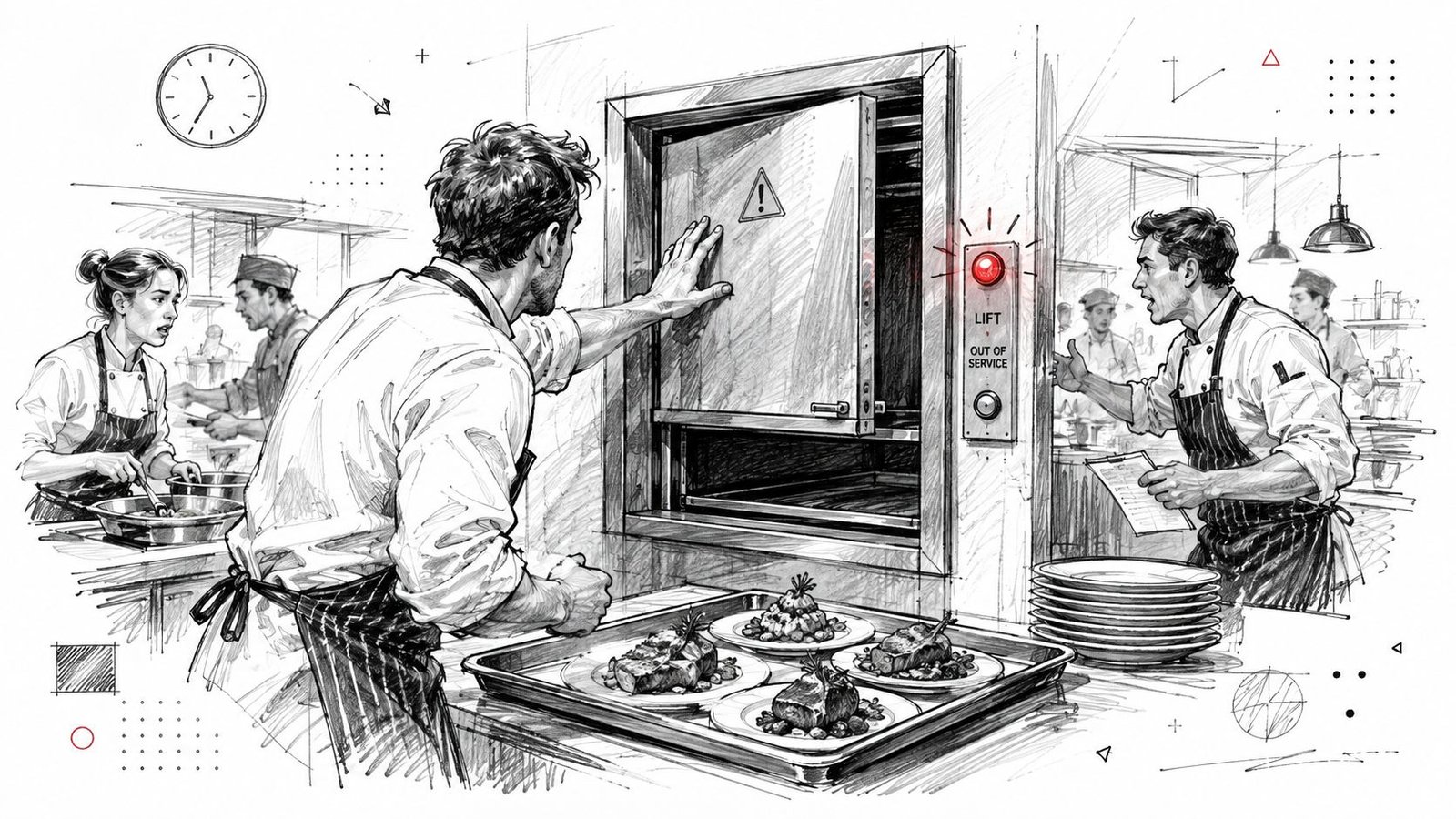
The call comes in at the worst possible time. The kitchen is in the middle of service, a tray is waiting to go upstairs, and the dumbwaiter has stopped halfway with the door locked and the staff staring at it like it betrayed them. That’s the moment most owners realize the lift wasn’t “just a little service item,” it was part of the building’s operating system.
Dumbwaiter maintenance works best when you treat it like a scheduled compliance and reliability program, not a cleanup task after something sticks. The best programs reduce emergency calls, keep inspections cleaner, and give you a predictable service rhythm instead of surprise breakdowns. They also match how the equipment is regulated, used, and worn in restaurants, hospitals, and older buildings.
Why Dumbwaiters Need Scheduled Service
A dumbwaiter usually gives trouble at the worst time because that is when it is under real load. In a kitchen, one stalled lift can slow plating and throw off the whole service line. In a hospital, the same failure can interrupt supply movement. In an apartment building or older mixed-use property, the result is often a string of nuisance calls, confused tenants, and a technician arriving after the problem has already disrupted the day.
Simple machines still wear out in specific places
Dumbwaiters may look compact, but they still depend on moving parts that need regular attention. Cables or chains stretch, door interlocks drift, guide rails go out of alignment, and controllers can overheat or misread a fault. Those problems usually do not start with a dramatic breakdown. They show up first as a slow door, a flickering light, an odd sound, or a unit that only runs after someone tries it twice.
Usage drives the service interval. New York State’s OGS appendix, citing ASME A17.1 and A18.1, requires dumbwaiters to be inspected every 6 months and tested annually. The same guidance points to lubrication and chain-tension checks every 3 months for heavy-use units and every 6 months for light-use units, while other commercial guidance calls for quarterly preventive maintenance and, in busy restaurants, even monthly visits. A building that runs food, supplies, or laundry all day needs tighter service and cleaner records than a lift that only sees light use. New York State OGS appendix on miscellaneous lift equipment
Practical rule: if the dumbwaiter moves food, supplies, or laundry all day, the building should expect tighter service intervals and better documentation.
Scheduled service protects the budget, not just the lift
Reactive repair usually costs more because the failure has already spread to other parts. Preventive maintenance is far easier to plan for, and one maintenance source places annual preventive cost at only 2% to 3% of a unit’s investment value, while major failures can cost 5 to 10 times more than routine care. That changes the conversation for owners. The question is not only how often the lift should be serviced, but how much outage and repair risk the building is willing to carry.
Scheduled service also makes inspections easier to pass because the unit is already being watched for wear, level, rope condition, lubrication, and safety-device response. That matters in buildings where the dumbwaiter is part of daily operations, not just a convenience. Treat it like a critical asset and the building gets fewer surprises. Treat it like an afterthought and downtime will remind everyone that the machine had a schedule whether the owner did or not.
The same logic applies across different lift types, even though each one has a different duty cycle and inspection burden. how different lift types are used in real buildings helps owners see why a small service lift still deserves a formal maintenance plan.
What a Dumbwaiter Is and How It Works
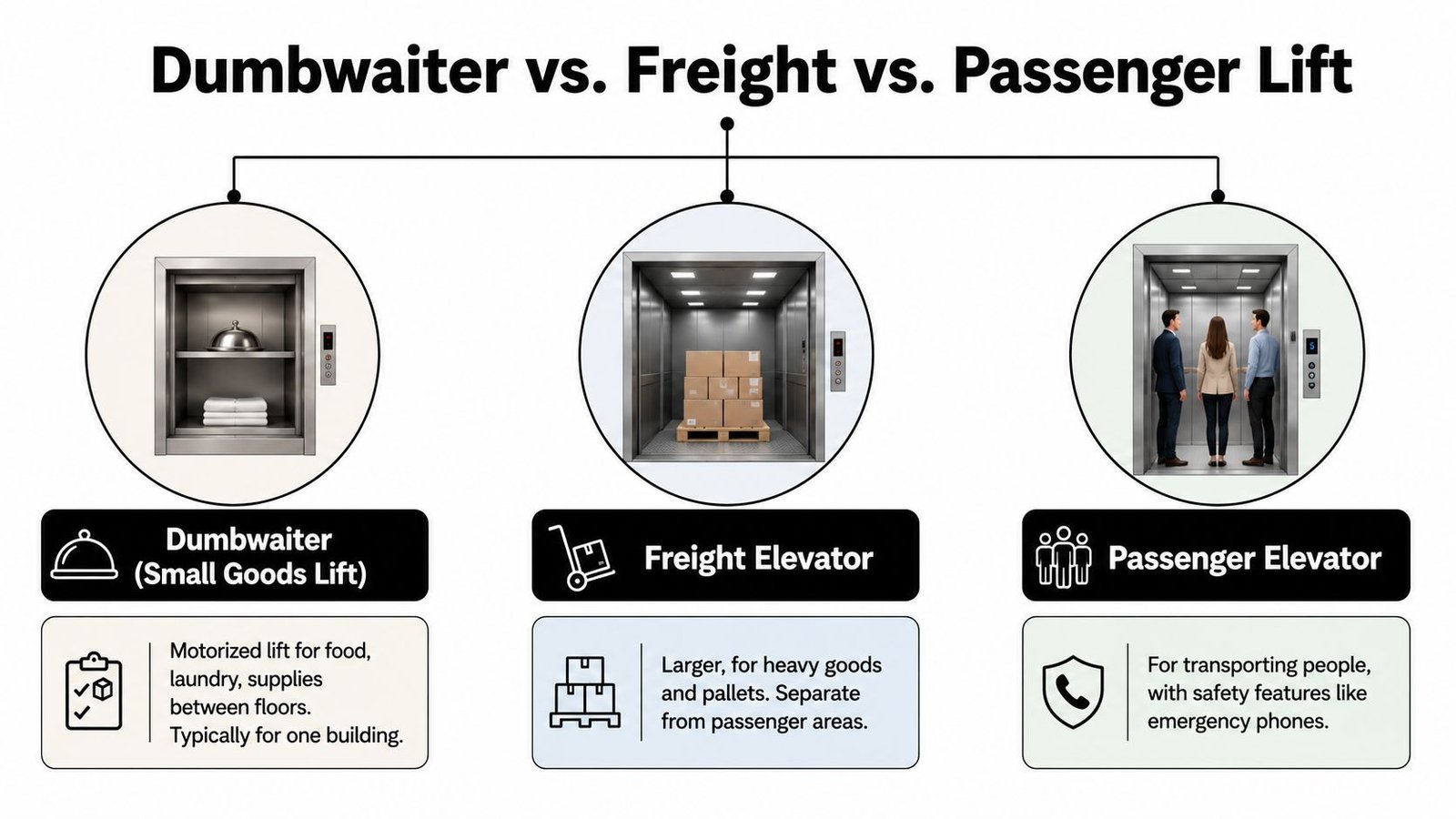
A dumbwaiter is a small motorized lift that moves goods between floors. It’s designed for food, laundry, supplies, books, or similar items, not passengers. That distinction matters because the load pattern, safety expectations, and maintenance profile are different from a passenger elevator.
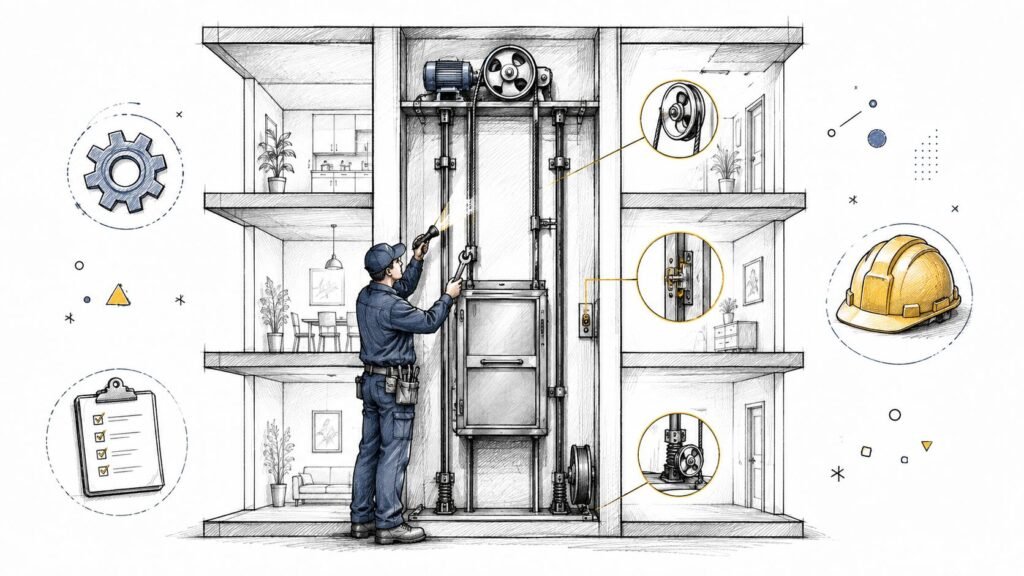
The easiest way to picture it is as a compact lift car riding on guide rails inside a hoistway. The car is moved by a drive machine through a rope or chain system, and it’s controlled by a cabinet or logic board that tells it when to move, stop, and respond to door and gate conditions. Most systems also include a door or gate interlock, which prevents the unit from running when the opening isn’t secured.
The parts that matter most
The owner doesn’t need to know every fastener, but the main assemblies are worth understanding. The car and frame carry the load, the guide rails keep it aligned, the hoisting rope or chain transfers motion, and the drive machine does the lifting. The controller interprets calls and safety inputs, and the door or gate interlocks are what keep the unit from operating in an unsafe condition.
That’s why dumbwaiters show up in places where goods move more often than people do. Restaurants use them to move plates and prep between levels. Hotels use them in service corridors. Hospitals use them for supplies. You’ll also find them in libraries, residential homes, and older buildings where vertical access was added long after the structure was built. Even when the unit sits beside other vertical-transport equipment, it follows its own code pathway under ASME A17.1 and A18.1, which is why the maintenance approach can’t just be copied from a passenger lift program. Guide to different types of lifts
The machine looks small. The consequences of neglect aren’t.
For owners, that means the dumbwaiter should be viewed as a service lift with its own wear pattern, not a mini elevator that can be ignored until it breaks. The maintenance work later in this article makes more sense once you can picture the moving parts, because each task is tied to a failure mode. If the car doesn’t track straight, the rails need attention. If it won’t close or run cleanly, the interlocks or controller may be involved. If it rattles or drifts, the rope, chain, or drive components may be telling you they’re worn.
Core Dumbwaiter Maintenance Tasks Explained
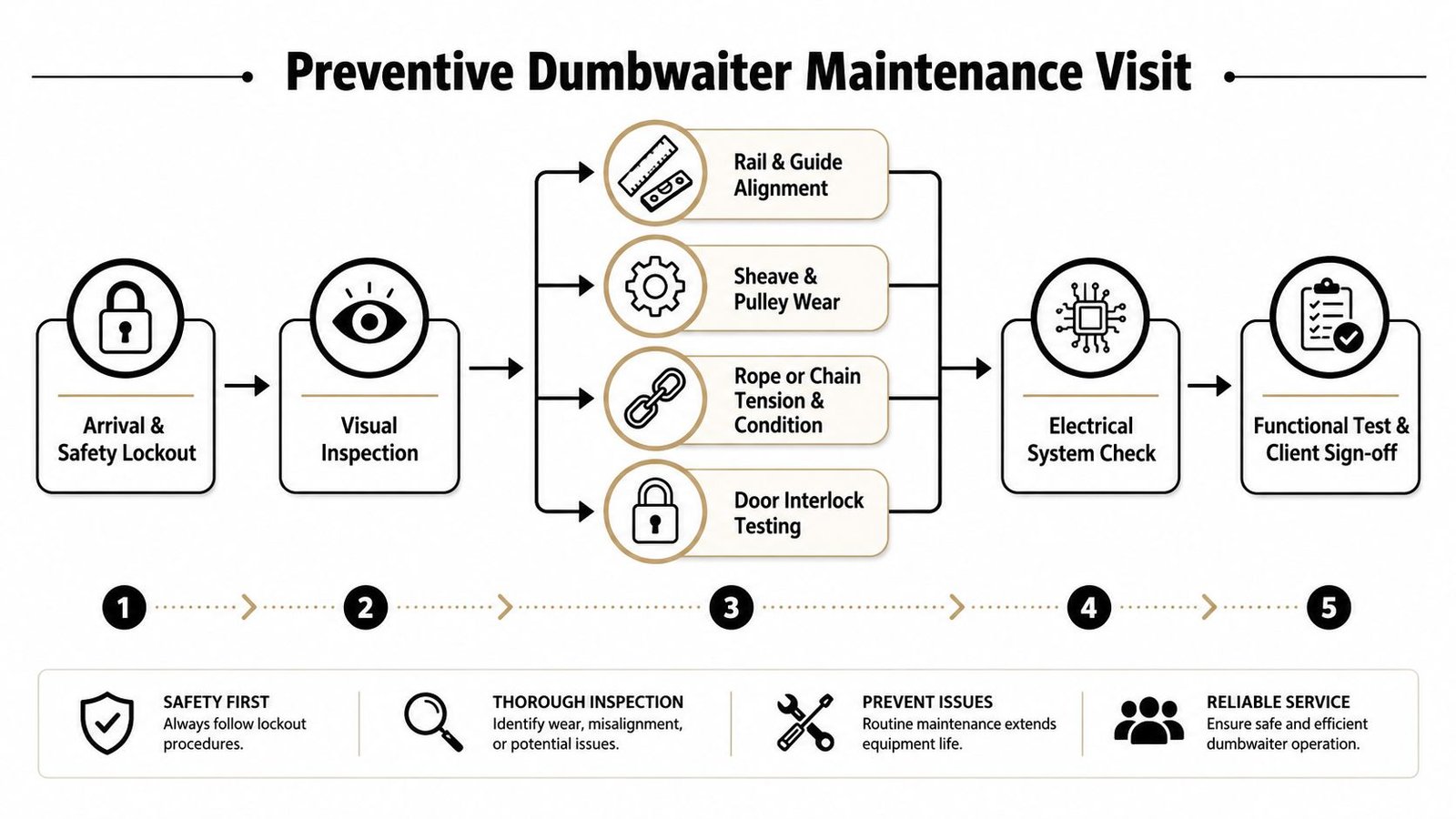
A preventive visit should be organized around the lift’s systems, not a generic checklist. The technician is checking the parts that keep the car tracking straight, the safety devices ready to act, and the drive components inside their normal operating range.
Mechanical checks keep small drift from turning into shutdowns
The first job is usually mechanical alignment and wear inspection. That means looking at the rails, sheaves, rope or chain tension, and the condition of the drive path. One maintenance procedure set says post-1955 installations should not be out of level by more than 3/8 inch per foot in any direction, while pre-1955 units allow up to 1/2 inch per foot. It also requires rail-gripping safety clearance of at least guide-rail thickness + 9/64 inch and at least 1/16 inch clearance on either side for newer units, which gives the technician a real benchmark for whether the safety gear and guide equipment are still in range. Maintenance procedures for dumbwaiters and material lifts
Those measurements matter because they point to the problems owners notice before the equipment gives up. A car that is drifting out of level starts missing landing alignment. Safety gear with the wrong clearance may not behave correctly if there is an overspeed or broken-rope condition. Rope attachment wear is another item that should be managed on schedule, not left to chance. The same procedures call for hoisting-rope re-socketing or repositioning at no longer than 1 year for machines over the hoistway and 2 years for machines below or beside it. That is a reliability control tied to service history, not a cosmetic detail. Maintenance procedures for dumbwaiters and material lifts
Electrical and lubrication work protects uptime
The electrical side matters just as much. Controllers, contactors, relay logic, door-lock monitoring, and emergency communication equipment all need inspection because they can drift out of tolerance before they fail outright. A unit that feels a little hot, trips intermittently, or hesitates on startup often has a controller or contact problem that is still early enough to correct without major disruption.
Lubrication is where many owners get misled. Under-lubrication does more than make a lift noisy. It creates metal-on-metal wear at rails, bearings, hinges, and door hardware, and that wear speeds up the rest of the system. A proper service visit should include cleaning, lubrication at the right points, and a functional test at the end, not just a quick wipe-down and a signature. Maintenance guidance and preventive service practices crane elevator maintenance guidance
A dumbwaiter that is still running can still be wearing itself out.
The practical goal of the visit is straightforward. Catch rope stretch before it affects leveling. Catch door-interlock wear before it becomes a nuisance shutdown. Catch controller heat or brake trouble before the unit stops in service. Owners do not need to perform these checks themselves, but they do need to know what a technician is measuring, because that is how you separate real service from a surface-level visit.
Recommended Service Intervals by Environment
A dumbwaiter in a quiet office is not under the same strain as one serving a busy kitchen or a hospital floor. The maintenance interval should follow how many trips the unit makes, how often doors cycle, and how much downtime the building can tolerate when something slips out of adjustment.
| Environment | Suggested PM Cadence | Notes |
|---|---|---|
| Light-use residential or office | Every 6 months | Works best when use is occasional and logs are kept current. |
| Standard commercial building | Quarterly | Matches common preventive guidance for most commercial dumbwaiters. |
| Busy restaurant kitchen | Monthly | Better for high-cycle service where door and drive wear show up faster. |
| Hospital or institutional setting | Monthly or tighter, based on use | Needs closer attention because service interruptions affect logistics and compliance. |
The compliance calendar needs to sit next to the service calendar. In covered New York facilities, the OGS appendix calls for 6-month inspections and annual testing, so the owner should plan PM visits with those checkpoints in mind. A service call that lands near an inspection window does more than keep the lift running, it gives the owner a cleaner record of what was checked, adjusted, and tested. See the earlier note on the New York State OGS appendix on misc lift equipment.
Match the cadence to the building's real workload
Healthcare facilities are where loose scheduling shows up fast. Healthcare maintenance guidance says dumbwaiters are often left out of PM planning even though they still need full ASME A17.1 compliance, and it calls for monthly door-interlock tests, quarterly mechanical inspections, and annual third-party inspection with certificate renewal. That is a different operating pattern from a lift that only sees occasional use, and it is why the building's actual traffic matters more than a generic service slogan. Healthcare maintenance checklist guidance
The rule of thumb is simple. More cycles per day means shorter time between visits, and fewer cycles lets the work be spaced out without losing control of the recordkeeping. Less use still means the unit needs documented service, because a quiet machine can still drift out of adjustment, and those records are what let an owner show the lift was watched, not just used.
Common Failure Modes and Warning Signs
Most dumbwaiter failures announce themselves before they stop the unit cold. The problem is that staff often write off the early signs as quirks. By the time a lift starts failing consistently, a small adjustment has usually turned into a larger repair.
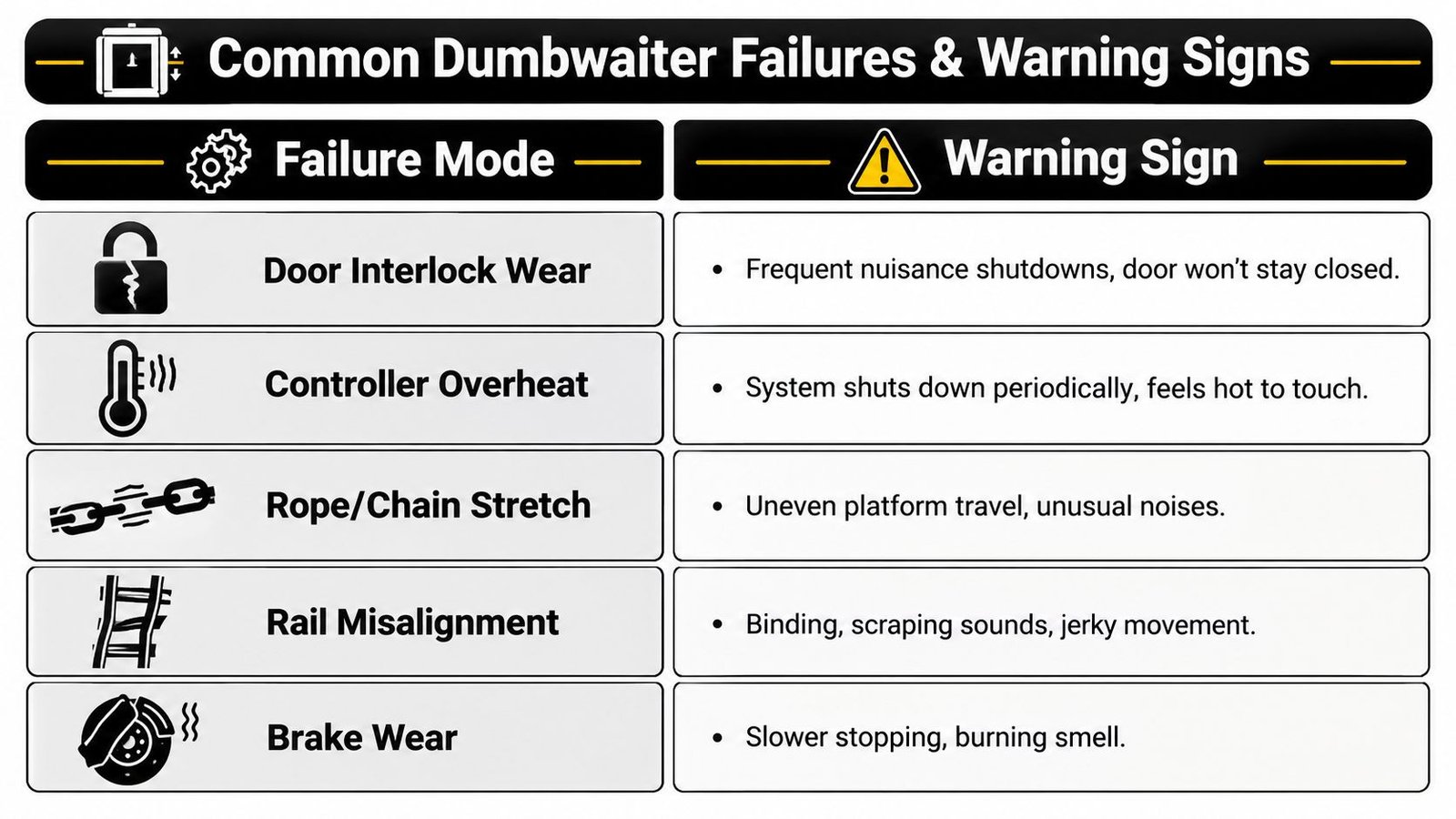
The warning signs usually show up in plain sight
A worn door interlock often shows up as nuisance shutdowns or a door that won't stay closed. A controller overheating problem may look like a system that stops periodically, then runs again after it cools down. A rope or chain stretch issue can create uneven platform travel or odd noises, and rail misalignment tends to show up as binding, scraping, or jerky movement. Brake wear can make stopping slower and may come with a burning smell, which is one of those cues nobody should ignore.
The maintenance data makes the stakes clearer. In one field report covering more than 500 dumbwaiter units, properly maintained systems were said to achieve 98% uptime and 60% lower operating costs than units without routine maintenance. That's the difference between catching a part before it fails and waiting for a stopped car, a service disruption, or an overtime callout. The same report also ties preventive care to long-term lifecycle improvement, which is why the early warning signs are worth acting on quickly. Field report on dumbwaiter maintenance outcomes
What owners and staff should report right away
When a dumbwaiter starts acting up, staff don't need to diagnose it. They need to report what they saw. The most useful observations are the ones that describe the symptom, not the guess.
- Frequent resets or beeping, often points to a door lock, interlock, or controller issue.
- Grinding or scraping sounds, often point to guide wear, misalignment, or an issue in the drive path.
- Slow starts or uneven travel, often point to rope, chain, or brake wear.
- Doors that need a second try to close, often point to interlock drift or a gate alignment problem.
- Intermittent shutdowns during busy periods, often point to heat, load, or electrical control trouble.
Owners who train staff to report those symptoms early usually spend less time in emergency mode. That's because the technician arrives with something specific to verify instead of a vague complaint about “the lift acting weird.” The lift tells on itself if someone is paying attention.
Code, Inspections, and Maintenance Documentation
Dumbwaiter maintenance gets messy fast when the records are thin. The machine may run fine today, but if the paperwork does not match the inspection cycle, the owner can still end up with a compliance problem. I tell owners to treat documentation as part of the service program, not as something that sits in a cabinet until somebody asks for it.
What codes and records matter
The rules depend on the age of the installation and the jurisdiction that oversees it. Newer units are typically governed by ASME A17.1, some legacy dumbwaiters fall under A18.1, and existing installations may also be addressed under ASME A17.3. The inspection calendar, test path, and recordkeeping expectations still come from the authority having jurisdiction, so the local code picture has to drive the maintenance plan. Code requirements overview
A useful maintenance log should include the date, technician, parts replaced, measurements taken, and any code-relevant observations. If a technician checked door interlocks, rope condition, controller heat, or levelness, that should be clear in the record. If the unit was found outside a tolerance or with a worn component, the log should show what was measured and what corrective action was taken.
Paperwork is a liability tool, not a nuisance
The Transit Training Network guide notes that each transit authority keeps its own maintenance schedule and documentation requirements, which is a good reminder that one standard checklist does not fit every site. The same point shows up in government-facility practice, where dumbwaiters are covered by formal preventive-maintenance specifications rather than treated as an informal asset. Owners who keep clean records can show the equipment has been cared for. Owners who cannot prove it usually spend more time explaining than fixing. Transit Training Network guide on maintenance documentation
If it isn't written down, it usually didn't help you when the inspector asked.
Good records also make contractor accountability easier. They show whether the same fault keeps returning, whether parts were replaced instead of adjusted, and whether the equipment is drifting toward a bigger problem. That is not bureaucracy. It is the difference between owning a lift with a history and owning a lift with a memory hole.
Choosing a Maintenance Partner and Planning for Modernization
A building owner who waits until a dumbwaiter stops moving is already behind. The better approach is to choose a contractor who can keep the unit in service, document what was done, and flag when the equipment is moving from routine maintenance into repair-heavy territory. That means looking for a team that understands inspection cycles, uses parts and methods that do not box the owner into a single supplier, and keeps records clear enough to hold up when an inspector asks questions.
What to ask before you sign a service agreement
Keep the conversation practical. You are buying service, documentation, and response time, not a polished sales pitch.
- Ask about service records, because the log should show what was checked, what was measured, and what was replaced.
- Ask who can service the equipment, because non-proprietary parts and methods matter when the unit ages.
- Ask how inspections are coordinated, because maintenance and compliance should be managed together.
- Ask what happens after hours, because a lift that serves a kitchen, hospital, or busy building cannot sit idle until the next business day.
- Ask whether modernization planning is part of the conversation, because a tired unit needs a lifecycle plan, not just repeated repairs.
A good contractor should also be able to translate code language into day-to-day decisions. If the maintenance history shows recurring door faults, slow leveling, controller heat, or repeated rope issues, the question is not just what failed this month. The question is whether the unit still makes sense to keep patching or whether a planned upgrade would reduce downtime and inspection headaches. In older buildings, that is often the trade-off, spend a little on recurring service or spend more once on work that resets the equipment for the next stretch of use.
Modernization belongs in the maintenance discussion when repairs keep landing on the same components. New controllers, door lock monitoring, hoist machines, and rope packages can extend useful service life and cut down on chronic faults, but only if the work is planned around the building's usage and inspection schedule. Financing matters for the same reason. It turns a disruptive capital decision into a scheduled project instead of an emergency call after a unit fails.
A contractor should be able to talk through those choices without pushing the same answer for every site. A restaurant dumbwaiter that sees constant use has different priorities than a hospital service lift or an older multi-story building with limited access to parts and equipment. The right partner will explain what can be repaired, what should be monitored, and where modernization starts to make more sense than another round of band-aid fixes.
If you want a maintenance partner, look for one that treats the dumbwaiter as an operating asset with an inspection record, not just a piece of hardware that gets cleaned and greased. That is the difference between a program that stays ahead of failures and one that only reacts after a shutdown.