
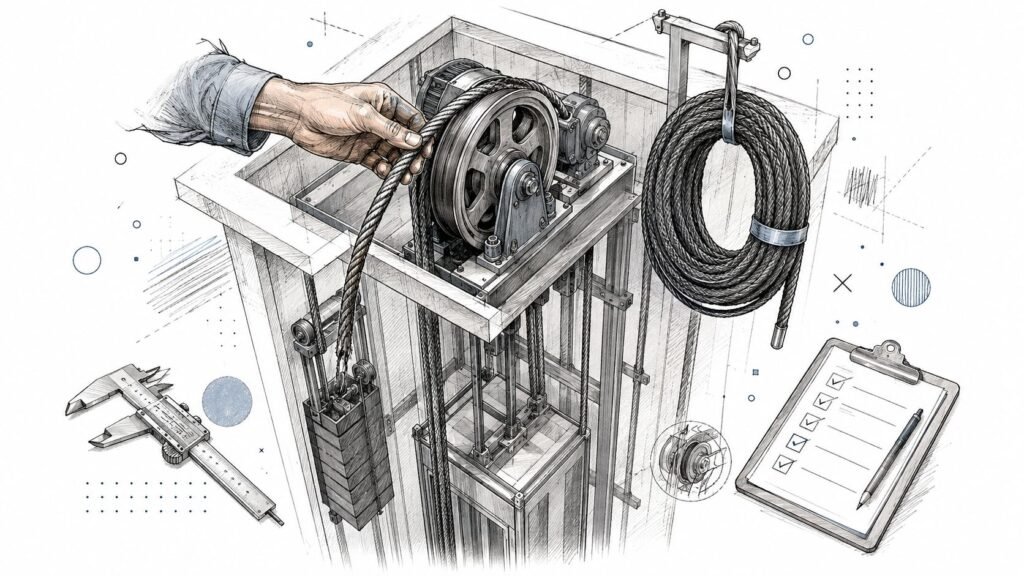
You're standing in front of a lift that still runs, but it doesn't sound right. Maybe a technician pointed out fraying on a hoist rope, maybe the car feels uneven, or maybe an inspector left a note that the cable condition needs attention. That's the point where a building owner has to make a real decision, not just schedule “some maintenance.” The wrong call can waste money on a fix that doesn't solve the problem, while the right call protects the equipment and keeps the building out of trouble.
When Cable Problems Become Real Decisions
A noisy elevator often sends people down the wrong path first. They hear the sound, see a little wear, and assume the answer is either a quick adjustment or an immediate full replacement. In practice, the choice depends on what's worn, where the wear shows up, and whether the problem is in the hoist ropes or the traveling cable.
A maintenance manager usually wants three answers at once. Is this a small correction, is it a partial repair, or is the whole set coming out. How urgent is it. And is the issue mechanical, electrical, or both. Those questions matter because a rope problem and a traveling-cable problem don't fail the same way, and they don't get solved the same way.
Practical rule: If you can't name the cable type, you can't make a smart replacement call.
The confusion gets expensive fast. A lift can run “fine” while hidden deterioration is building at bend points, sheaves, or the car-top loop. That's why cable work has to be based on condition, not on a vague impression that the system is getting old. For a useful primer on how elevator motion and mechanical loading create these problems, see this explanation of elevator physics and problem behavior.
One more thing catches owners off guard. Cable symptoms overlap with other faults. A noisy ride can come from rope wear, but it can also come from sheave issues, misalignment, or counterweight problems. If you rush to replace cables before measuring anything, you can end up paying for the wrong repair.
What Counts as an Elevator Cable Today
The term elevator cable gets used loosely, and that's where a lot of bad decisions start. In the field, there are two different systems to keep separate. One is the steel suspension rope that carries the car and counterweight. The other is the traveling cable, the flexible harness that moves with the car and carries power, signals, and sometimes data.
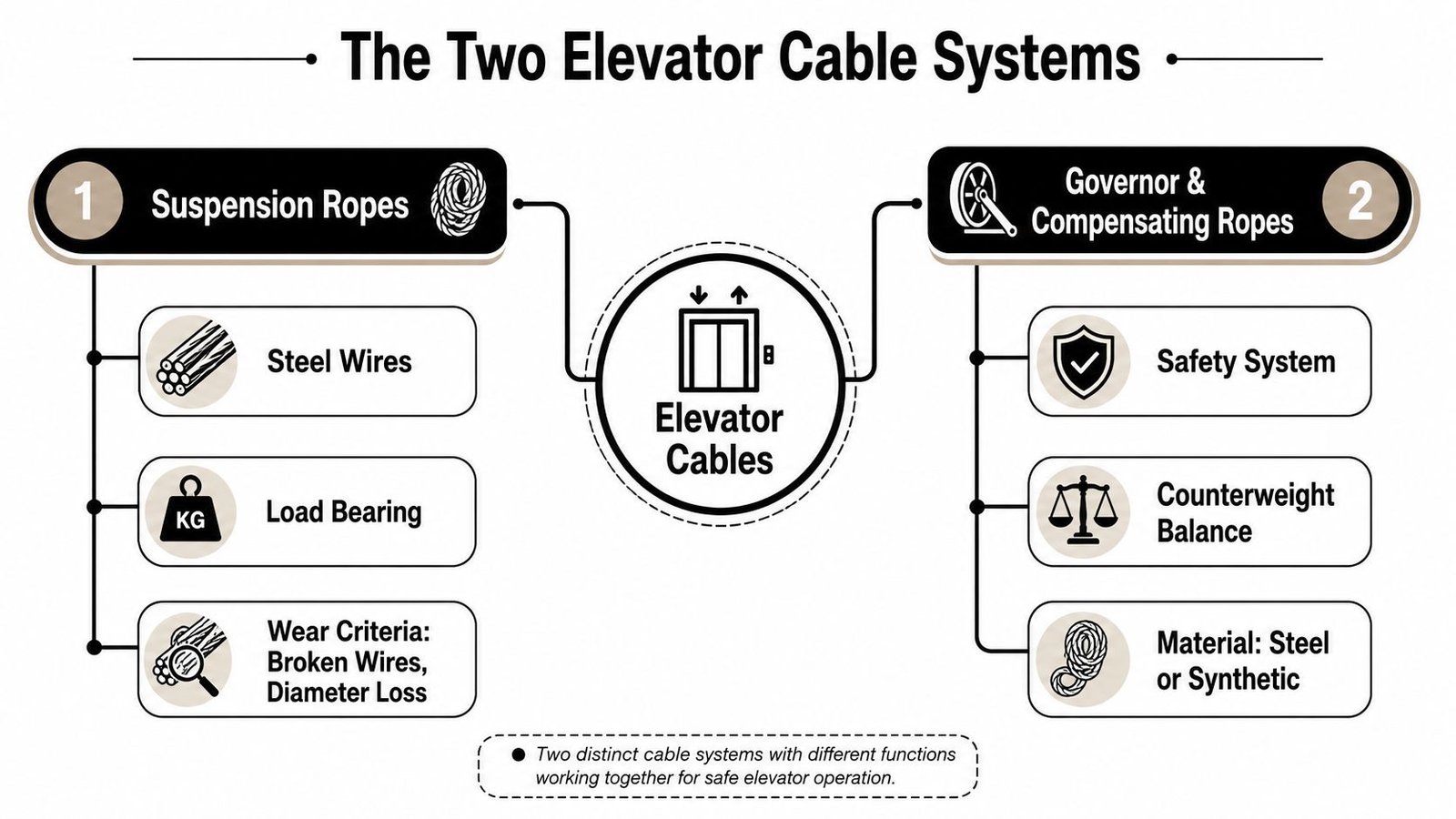
A useful way to organize the decision is as a simple stack of priorities. At the top sit the suspension ropes, because they are the load path. Below that are the traveling cables, which are flexible service lines that have to survive constant motion. If those two systems get lumped together, the inspection notes read like a generic cable problem, and the repair quote often follows the wrong logic.
Suspension ropes carry the load
Steel suspension ropes are the parts owners usually mean when they say “the cables.” They physically support the elevator car and counterweight, so their condition is judged as a structural matter, not a convenience item. A rope that has lost section, developed broken wires, or started to deform does not get the same treatment as a worn wire bundle in a moving harness.
The inspection mindset here is different because the failure modes are different. Rope wear shows up in the steel itself, in the way the rope runs over sheaves, and in how the rope holds its shape under load. For a practical look at how motion and loading create those stresses, see this explanation of elevator physics and problem behavior.
Traveling cables carry the communication
Traveling cables are the other half of the job. They hang in the hoistway and move with the car, so they flex every time the elevator runs. That makes them closer to a moving harness than a load-bearing rope, and their failure signs look different, usually insulation cracks, broken conductors, shield damage, or connector problems.
That difference changes the repair decision. Rope sets are usually treated as a matched system once wear reaches the replacement threshold. Traveling cables can sometimes be repaired or re-terminated if the damage stays localized and the remaining flex life still makes sense. Separate the two systems first, and the inspection report, the quote, and the next repair step all make more sense.
The Triggers That Force Hoist Rope Replacement
Steel suspension ropes don't come out because of age alone. They come out when inspection shows measurable deterioration that crosses code-based limits. The technician is looking for broken wires, diameter loss, permanent kinks, deformation, and wire breakage concentrated in one or two strands. The replacement decision is based on the worst section of the rope, not the prettiest one.
One North American standard also states that the remaining rope diameter must not fall below nominal minus 0.4 mm, or 0.015 in. Prysmian's technical tip on rope replacement criteria ties that to the practical inspection routine, measuring diameter and broken-wire counts in the highest-wear zones where the rope passes over sheaves and bend points. Those are the places that usually fail first.
What technicians actually measure
A serious rope inspection isn't a glance from the floor. It involves checking the rope at the zones where fatigue builds fastest, then comparing the condition against replacement criteria. That includes the worst section of the rope, not just the most visible section.
If a rope is kinked, deformed, or showing concentrated breakage, the question isn't whether it'll run today. The question is how long it'll keep running before it starts creating a bigger mechanical problem.
The reason the criteria are so strict is simple. A degraded rope can create sudden traction loss, car imbalance, and extra wear on the adjacent ropes if one rope starts taking more load than the others. That's why rope replacement is not a one-at-a-time decision. Once one rope in the set qualifies for replacement, the full set has to go together.
The point of all this is not to scare anyone into unnecessary work. It's to avoid pretending a visibly worn rope is “close enough” for another season. When the measurement says the rope is out, it's out.
How Long Ropes Actually Last
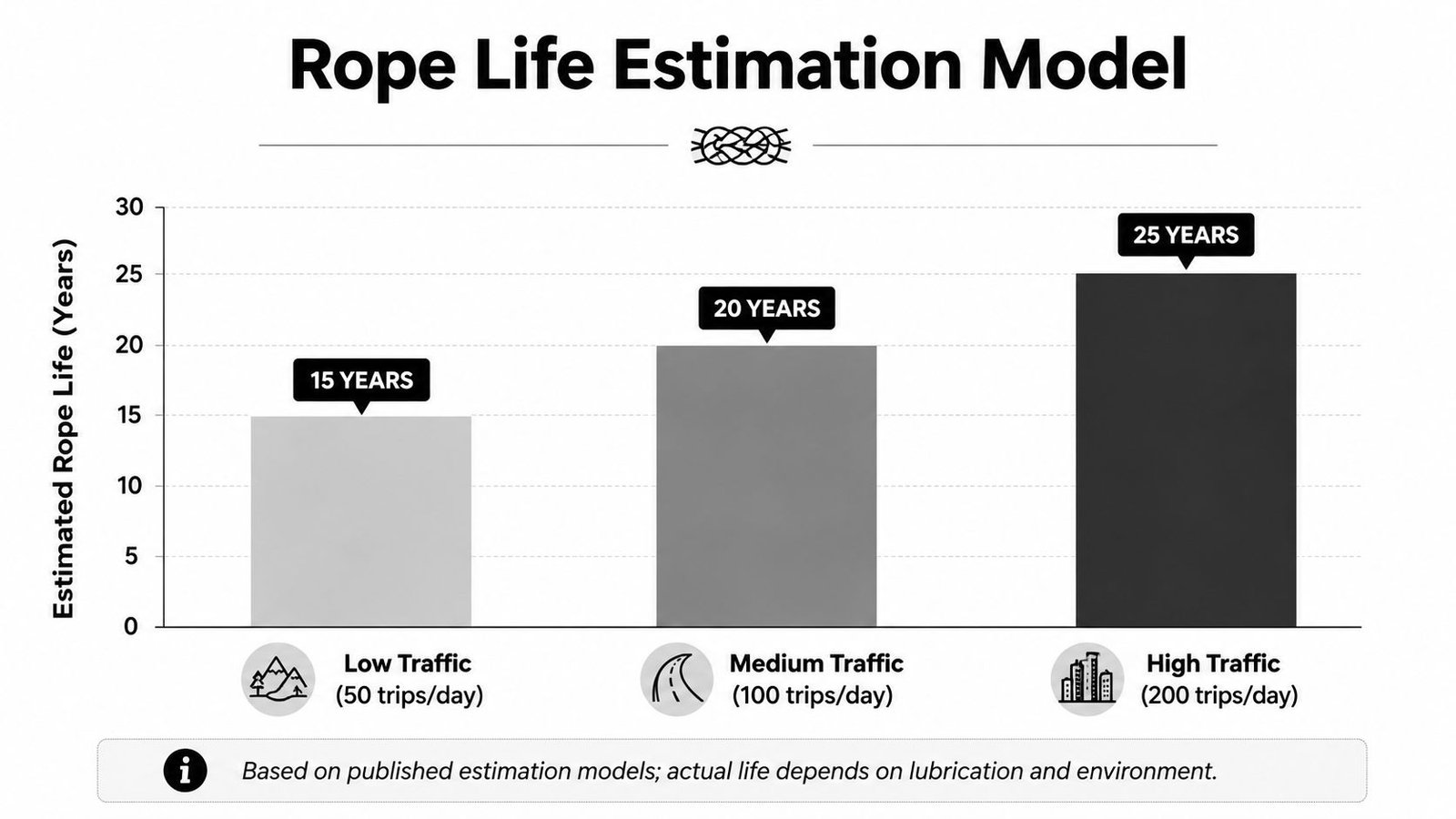
Service life for suspension rope isn't fixed by age. It's driven by traffic, loading, and how hard the ropes flex through the system. A published estimation model breaks rope life into traffic bands that are useful for planning. At about 50 trips per day, expected life is roughly 9 years. At 125 trips per day, it drops to about 3 years and 7 months. At 300 trips per day, it falls to about 1 year and 6 months. At 750 trips per day, it's about 7 months, and at 1,500 trips per day, about 4 months. Those figures come from the rope-life estimation model.
The same source shows something owners often miss. Increasing the factor of safety can materially extend life estimates. In the very low-use category, modeled life rose from about 9 years at a safety factor of 8 to about 16 years at a safety factor of 16. That's why modernization choices and design assumptions matter long before a rope ever wears out.
Turning the model into a planning range
For owners, the most useful takeaway is the practical window, not the model details. High-use commercial elevators often land in a 2 to 5 year replacement rhythm. Normal service commonly sits in the 3 to 5 year range. Low-use residential units can stretch toward 8 to 10 years. That's not a guarantee, just a planning range that matches how the equipment is used.
The thing to budget for is not “rope age” in the abstract. It's traffic plus condition. A quiet elevator can still be wearing faster than expected if the geometry is poor or the usage is heavier than the owner assumed.
A rope that looks acceptable on paper can still be a bad candidate in service if the traffic pattern is harsh enough.
That's why a budget line for cable work should be based on observed duty, not on hope that the original ropes will last forever.
Partial Fix, Re-Tension, or Full Rope Replacement
Owners usually want a cheaper answer than the machine can provide. Re-tensioning, sheave work, and full replacement are not interchangeable. They solve different problems. If the ropes are still within wear limits but the set is riding unevenly, re-tensioning can bring the system back into balance. If the issue is mechanical wear that crosses the limits, the ropes have to come out.
A good technician starts by measuring. If diameter loss, broken wires, or deformation exceed the allowable criteria, the rope set is done. If the ropes are within limits but the ride is rough, the next question is whether the sheave grooves, alignment, or counterweight run-by are creating the symptom. That's the trap. A noisy ride does not automatically mean the ropes are bad.
Why the wrong repair happens
Ropes, sheaves, and alignment problems can feel the same from the passenger car. The building hears noise and assumes wear. But worn sheaves or misalignment can create uneven loading that makes good ropes behave badly. If you replace the ropes first and leave the geometry wrong, the new set can start wearing out early.
The field rule is blunt. If the ropes pass measurement, correct the tension and inspect the supporting hardware. If the ropes fail measurement, replace the whole set. Trying to salvage one rope in a set doesn't work. The set has to be changed together.
For a service-focused look at replacement work and what it involves, this elevator cable replacement service overview is useful as a reference point for the kind of coordinated work contractors plan around.
| Decision point | What you're checking | What usually happens |
|---|---|---|
| Re-tensioning | Uneven stretch, but wear still within limits | Adjust the set and monitor |
| Partial hardware fix | Sheave grooves, alignment, run-by issues | Repair the cause of the symptom |
| Full rope replacement | Broken wires, diameter loss, kinks, deformation | Replace all ropes in the set together |
The decision pattern that holds up
The order matters. Measure rope diameter and broken wires first. Rule out sheave and geometry issues second. Commit to a full rope-set change only when the data forces it. That sequence keeps you from paying for a full replacement when a correction would have worked, but it also keeps you from gambling on a rope that's already out of spec.
Traveling Cables and When They Must Be Replaced
Traveling cables deserve their own decision tree because their failure mode is different from hoist ropes. They're selected by flexing duty, hang length, and geometry, not by conductor count alone. An Otis product specification lays out traveling-cable variants by AWG size, core type, maximum hang length, weight, and dimensions, and a separate lift-cable specification sets a minimum bending radius of cable thickness times 10, with recommended loop diameter around 60 to 70 times thickness depending on cable size. That same class of design allows free-suspension lengths up to 45 m and traveling heights up to 80 m. See the design limits in Otis's traveling-cable specification.
Those geometry limits matter because tight loops and undersized bend radii punish the cable every time the car moves. The result is insulation cracking, conductor fatigue, and shield damage at the loop and hang points. In high-cycle commercial equipment, a cable can look intact from the outside while failing electrically inside.
Repair is sometimes acceptable
Traveling-cable damage isn't always an automatic replacement. A neutral government health source notes that some issues, such as insulation breaches, conductor damage, and connector problems, may be repaired by splicing or re-terminating. That's useful when the damage is localized and the rest of the cable still has healthy flex life. The source also makes clear that traveling cable issues can sometimes be repaired.
Replacement becomes the right call when
- The jacket is brittle throughout, not just nicked in one spot.
- Conductors are intermittent, especially if the fault comes and goes with car movement.
- The modernization changes the car equipment, so the old cable no longer matches the job.
- The bend geometry is wrong, which keeps damaging the same section again.
| Function | Failure mode | Typical trigger | Common fix |
|---|---|---|---|
| Hoist ropes | Broken wires, diameter loss, deformation | Wear criteria exceeded | Replace the full rope set |
| Traveling cables | Insulation cracks, conductor fatigue, connector damage | Flex damage or intermittent signals | Repair locally or replace, depending on condition |
The main mistake owners make is treating these as the same item. They aren't. Traveling cables can sometimes be repaired. Hoist ropes, once out of limits, usually can't.
A Practical Planning Checklist Before Replacement
Good cable work starts before anyone opens a toolbox. Pull the last five years of inspection records and maintenance notes. Look for recurring complaints, rope adjustments, nuisance shutdowns, and any open violations. Then confirm the elevator's actual usage pattern so the replacement plan matches the duty, not just the label on the old part.
On-site checks that matter
- Measure rope diameter at the high-wear points, not just at the easiest access spot.
- Count broken wires in the worst section of each rope.
- Inspect the sheave grooves for wear, mismatch, and alignment issues.
- Check the traveling-cable loop geometry and connector condition.
- Verify controller and drive type before ordering anything.
- Flag any code items already open so the outage solves as much as possible at once.
The order matters because cable replacement often gets bundled with other work. If the modernization will change the car equipment, the traveling cable has to be matched to the new load and geometry. If the sheaves are worn, changing ropes without fixing the sheave just buys the problem a new set of parts. The best planning also includes tenant impact, permit timing, and inspector access so the outage doesn't get stretched by paperwork.
Build the outage around the building, not the other way around
Owners usually underestimate how much coordination these jobs need. The contractor needs access, the inspector needs time, and the building needs a shutdown window that doesn't create chaos. That's why the prework should include bids from licensed elevator contractors, a clear equipment survey, and a realistic plan for the shutdown period.
For Michigan projects, the timing pressure is real because ASME A17.3 retrofits and door-lock monitoring deadlines often push cable-adjacent work into the same outage window. If you're already opening the machine space or car-top area, don't waste that access on a partial plan.
For a broader modernization context, this elevator cable replacement page is a useful reference point when you're building the scope with a contractor.
Crane Elevator Company handles the kind of rope and cable work building owners need when the decision can't stay theoretical any longer. If you're sorting out inspection findings, planning a replacement window, or trying to tell the difference between re-tensioning and full replacement, visit Crane Elevator Company to line up a practical next step for your building.