
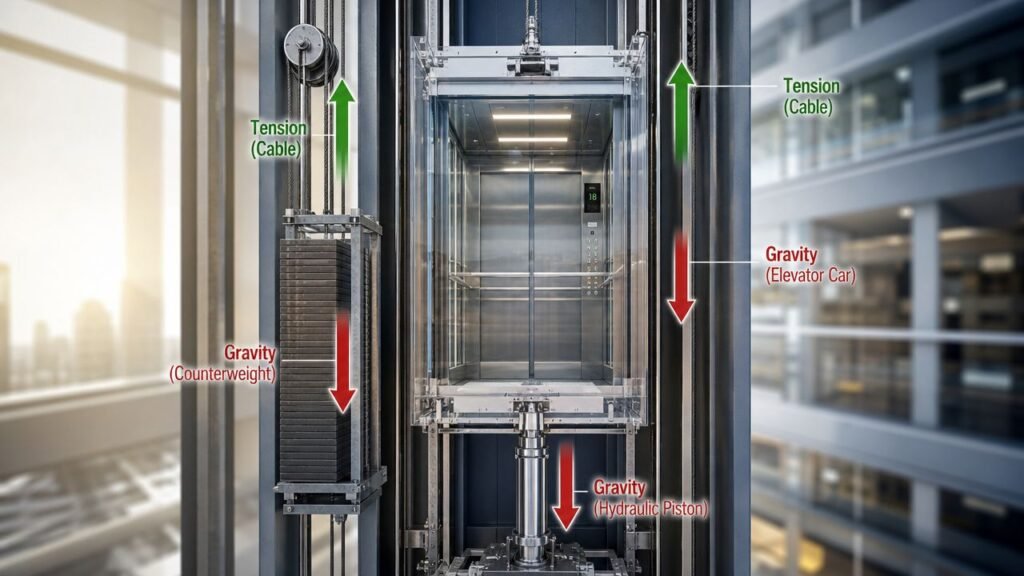
You're standing in the lobby or machine room, and the elevator gives you the kind of clue nobody likes. It starts with a shudder, the ride feels rougher than last month, or a door that used to close cleanly now hesitates just long enough to make people glance up. Those symptoms look different on the surface, but they all point back to the same place, the physics of how the car moves, balances, and stops.
For a facility manager, elevator problems physics isn't just classroom material. It's the language that turns “it feels off” into a useful description your contractor can act on. Once you can connect a symptom to force, tension, acceleration, and pressure, you can ask sharper questions, spot patterns sooner, and separate a harmless nuisance from a mechanical issue that needs attention.
Why Physics Matters When Your Elevator Acts Up
A manager calls me and says, “The car feels heavy for the first second after startup, then it smooths out.” That's not a mystery sentence to a technician. It's a clue that the car's acceleration changed, and the riders felt the difference as a change in apparent weight.
The same thing happens when someone says the elevator “drops a little” before it catches or that it “bumps” on the stop. Those words map to a physical event, not a mood. The car, the counterweight, the ropes, the controller, and the guide system are all sharing the work, and if one part stops behaving the way the others expect, the rider feels it.
Use symptoms as physics clues
A rough ride can come from more than one place, but the symptom still narrows the field. If the issue appears only during startup or slowdown, the motion problem is probably tied to acceleration or braking. If the complaint shows up at steady speed, the physics points somewhere else, often to guidance or alignment rather than raw lifting force.
That's why textbook elevator physics problems matter in building scenarios. A student solves for force, tension, or apparent weight on paper. A property manager uses the same logic to describe what changed in the car, what stayed normal, and when it happens.
Practical rule: describe the symptom by when it happens, how long it lasts, and whether it changes with load. That simple habit gives your contractor better diagnostic information than “it's acting weird.”
The goal isn't to turn every manager into an engineer. It's to make sure the next service conversation starts with the right words. If you can say, “It feels heavier on startup, but only on the upper floors,” you're already speaking in a way that matches how a technician thinks.
Newton's Laws and Free-Body Diagrams for Elevators
The easiest way to understand an elevator car is to treat it like a single object and ask what forces are acting on it. That's what Newton trained people to do, even if he never had to ride a car between floors. The car obeys the same laws as a cart, a crate, or a suspended load in any other mechanical system.
Start with the car at rest
When the elevator is sitting still, the forces are balanced. Gravity pulls down, and the hoisting force, usually through cable tension in a traction system, pulls up. If the car isn't moving and no one is accelerating it, those forces are equal in size.
That's the first mental picture to keep: balanced forces mean no change in motion. If the car is already moving at a steady speed, the same idea still applies. The speed may be different, but the upward and downward forces are still in balance.
Add motion one step at a time
When the car accelerates upward, the upward force must be greater than the downward weight. That extra upward push is what passengers feel as a brief increase in apparent weight. If the car accelerates downward, the situation flips, and the riders feel lighter.
A free-body diagram makes this visible. Draw a box for the car, add an arrow down for weight, an arrow up for cable tension, and, when needed, smaller arrows for guide-rail friction or other resisting forces. Technicians think this way because it helps separate the force that moves the car from the forces that merely resist it.
Using a 1000 kg elevator car as a mental model keeps the discussion concrete without making it complicated. The car's mass stays the same, but the forces acting on it change depending on whether it's starting, cruising, or stopping. That's why ride quality problems often sound like force problems once you translate them into physics.
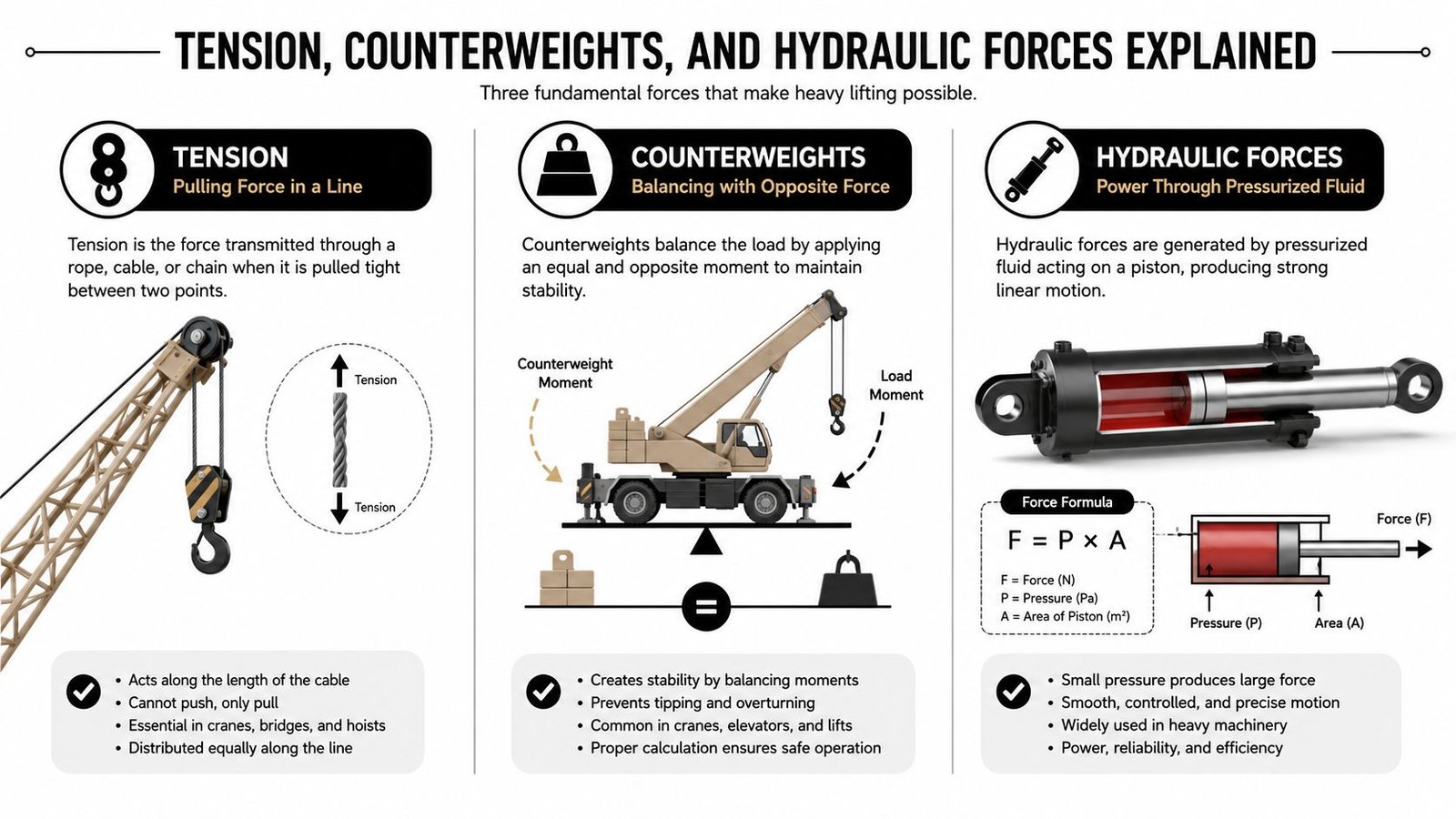
Tension, Counterweights, and Hydraulic Forces Explained
A rough elevator ride often starts with a force problem, even before anyone checks the controller. In a traction system, tension in the ropes or cables changes as the car starts, stops, and settles into motion. The motor is not asking the ropes to do exactly the same job at every moment, because the load on the car side and the counterweight side shifts with acceleration and direction.
A counterweight changes the whole arrangement. In many traction systems, it is set near the car weight plus part of the rated load, so the motor does not have to lift the full car and passenger load from rest on every trip. The balance is closer to a level seesaw, with one side already helping support the other. The motor then works on the difference between the two sides, not on the entire load by itself.
Why counterweights matter in the machine room
That balance is why a traction system feels efficient when it is tuned correctly. If the counterweight is out of alignment, rope condition changes, or the sheave does not track the way it should, the motor no longer sees the balance it expected. A technician may hear harder starts, notice odd noises, or feel a ride that changes when the car carries different loads.
Hydraulic elevators work on a different force path. Instead of rope tension doing the main lifting, a piston raises the car with fluid pressure. A syringe gives the clearest everyday comparison, pressure applied to the fluid moves the plunger and the load with it. The ride often feels different because the lifting force comes from pressurized fluid rather than a rope-and-counterweight arrangement.
That difference matters in diagnosis. Hydraulic units tend to show their own weak points around the pump, fluid condition, and seals. For a closer look at the machine-room side of that system, this internal guide on how hydraulic elevator pumps work connects the pumping hardware to the lift itself.
The system you are looking at determines the failure pattern you should expect. A traction problem and a hydraulic problem can both create a bad ride, but they do not usually fail in the same way.
Step-by-Step Solved Elevator Physics Problems
A lot of elevator physics becomes easier when you stop treating it like a mystery and start treating it like a set of force balances. The math is plain once you know what to draw. The trick is keeping the setup clean before you calculate anything.
Problem one, cable tension on an upward start
Take a 1000 kg car accelerating upward at 1.5 m/s². The knowns are mass, acceleration, and gravity. The unknown is the cable tension.
For the free-body diagram, draw the car with weight downward and tension upward. Apply Newton's second law in the vertical direction, T – mg = ma. Solve for tension, so T = m(g + a).
Using the car mass of 1000 kg, and treating gravity in the standard physics way, the tension must be greater than the car's weight because the car is accelerating upward. That's the whole reason riders feel a brief “heavier” sensation at startup. The cable has to do more than hold the car, it also has to create the upward acceleration.
Problem two, what a passenger feels
Now use a 70 kg passenger in the same upward acceleration. The passenger's apparent weight is the normal force from the floor, and it changes with motion. Apply the same idea, N = m(g + a) for upward acceleration.
The rider feels heavier because the floor must push up harder than it would at rest. That doesn't mean the passenger gained mass. It means the floor force increased to produce the elevator's upward acceleration.
Problem three, motor force with a counterweight
Use an 800 kg rated load and a counterweight sized at the car weight plus 40 percent of that rated load. The motor doesn't lift the full passenger load alone, because the counterweight already offsets much of the car side. What matters is the difference between the two sides of the system.
If you want the setup in plain language, the motor only supplies the imbalance, plus whatever extra force is needed to accelerate the system. That's why counterweight selection matters so much in design and troubleshooting. A system that is close to balanced will usually place a smaller burden on the motor than one that is badly off.
| Problem | Given Values | Key Equation | Result |
|---|---|---|---|
| Cable tension on startup | 1000 kg car, upward acceleration | T = m(g + a) | Tension exceeds the car's weight |
| Passenger apparent weight | 70 kg passenger, same acceleration | N = m(g + a) | Passenger feels heavier |
| Motor force with counterweight | 800 kg rated load, counterweight plus 40 percent of load | Force balance on both sides | Motor handles the imbalance, not the full load |
When the algebra feels abstract, go back to the diagram. If the upward arrow has to get bigger for the car to speed up, the ride will feel heavier. If that doesn't match what riders describe, the problem may not be acceleration at all.
Connecting Physics Symptoms to Mechanical Causes
A good diagnosis starts with a symptom, not with a guess. If passengers say the car feels heavy on startup, the first physics question is whether the system is accelerating too hard or too abruptly. That points toward controller behavior, drive response, or a torque delivery problem rather than a door issue.
The opposite complaint, a car that feels light or seems to dip slightly, often points to lost balance somewhere in the system. Cable stretch, sheave groove wear, or counterweight misalignment can change the tension relationship the motor expects. The car still moves, but the force balance no longer feels smooth.
Match the symptom to the part of the cycle
Roughness at steady speed is a different clue. If the ride feels bumpy when the car is already cruising and load hasn't changed much, the physics points toward guidance rather than lift force. Worn roller guides, guide rail irregularities, or alignment problems can make the car vibrate even when the main lifting forces are doing their job.
Door faults live in their own little physics world. Interlocks, safety circuits, and closing forces don't affect the ride the same way rope tension does, but they still depend on correct motion and timing. If a door bounces, hesitates, or reverses unexpectedly, the contractor needs a description of when it happens, not just a label like “bad door.”

For a manager, the payoff is communication. You don't need to diagnose the failed part yourself, but you can tell the contractor whether the symptom tracks with startup, constant travel, stopping, or door movement. That one distinction saves time because it narrows the field before anyone opens a panel.
The internal guide on elevator cable replacement service fits into that same thinking. Cables don't just wear out visually, they change the force balance the system has to manage, and that shows up in ride quality before it becomes obvious to the eye.
If a symptom changes with car motion, think forces. If it appears only while the car is moving smoothly, think guidance, alignment, or another part of the system that isn't carrying the main lift load.
Maintenance and Safety Takeaways for Property Managers
A car that starts feeling rough is usually telling you something about force balance, not just “wear and tear.” In the machine room, at the pit, or on the car top, the parts that carry load are the ones that deserve the closest attention. If ropes, sheaves, counterweight components, or hydraulic seals drift away from spec, the ride changes before the failure becomes dramatic.
That is why regular inspection of cables and sheaves matters so much. In a traction elevator, those parts set the tension relationship that lets the car move predictably. A worn rope groove or a rough sheave surface can change how the load travels through the system, and riders usually feel that change before anyone sees a broken part.
Focus on the parts that change force balance
Counterweight components need the same kind of discipline. If chains, ropes, or attachment points start to deteriorate, the balance the motor expects shifts with them. The drive has to work harder, the machine sees more strain, and the car may no longer start, stop, or level as cleanly as it should.
Hydraulic systems call for a different check list. Fluid condition and packing seal integrity affect whether pressure reaches the cylinder at the right time and in the right amount. When pressure delivery turns uneven, the car can feel sluggish, uneven, or noisy during travel and stopping, and that is the kind of symptom a manager should pass along clearly to the contractor.
Machine room clean-downs, pit inspections, and car top examinations are not cosmetic tasks. They reveal debris, leakage, wear, and alignment problems before those conditions disturb the force path. A clean space also helps the service technician see what changed and confirm that the right components are still doing their jobs.
The maintenance takeaway is simple. Preventative work catches force-imbalance issues while they are still manageable, and our preventative maintenance program gives property managers a structured way to keep those checks on schedule. Emergency repairs usually cost more, disrupt more people, and leave less room for controlled troubleshooting.
Key Physics Principles Every Facility Manager Should Remember
Newton's second law is the backbone of elevator motion. If the force balance changes, the car accelerates differently, and riders feel it right away. That's why the same car can seem smooth one day and abrupt the next, even if no one has changed the schedule.
A few rules stay reliable. Upward acceleration requires more upward force than weight alone, counterweights reduce the motor's burden by balancing much of the car side, and hydraulic systems trade cable tension for fluid pressure. Apparent weight changes during acceleration are normal, but they become a problem when they're excessive, inconsistent, or paired with noise and vibration.
Good service conversations start with physics language, not guesswork. Say when the symptom happens, what the riders feel, and whether the issue tracks with startup, travel, stopping, or doors.
That habit makes you a better partner to the technician. It also helps you evaluate repair proposals because you can ask whether a recommendation addresses the force balance, the guidance, or the control side of the elevator. The more clearly you connect the symptom to the physics, the faster the right fix comes into view.
If any of these symptoms sound familiar, don't wait for the next rough ride to become a larger problem. Schedule a proactive inspection, ask for a force-based explanation of what the technician finds, and keep the discussion tied to what the car is doing, not just what it looks like.
Crane Elevator Company helps property managers turn those symptoms into clear next steps with preventative maintenance, repairs, inspections, and modernization support for elevators across Lower Michigan. If your car is riding rough, starting hard, or making noise that doesn't fit the usual pattern, visit Crane Elevator Company and ask for a physics-minded review of the system.