
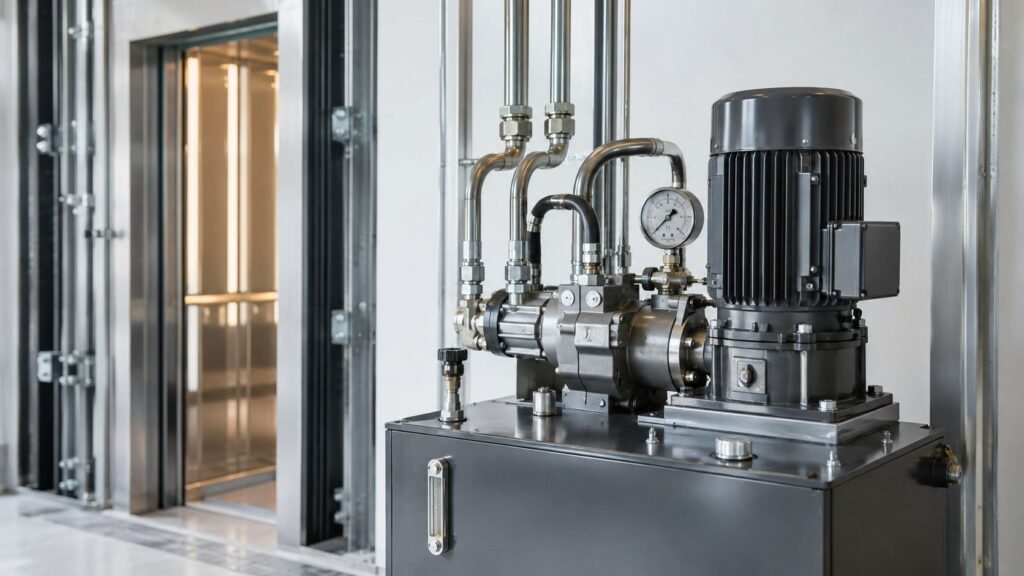
On a cold Monday in Detroit, the elevator starts its trip with a faint shudder, then takes longer than usual to level at the floor. A building manager notices it first, then hears the complaint from tenants, then starts wondering whether the problem is the pump, the oil, or something deeper in the system. That's the kind of moment that turns a hydraulic lift pump from a line item into a real operational concern.
A hydraulic elevator doesn't raise the car with magic. It uses pressurized fluid, a pump, and a cylinder to move weight in a controlled way. When the system is healthy, the ride feels steady and predictable. When it isn't, you get slow starts, uneven motion, heat, noise, and eventually downtime that usually arrives at the worst possible time.
Introduction to Hydraulic Lift Pump Systems
The first sign of trouble is often small. A manager notices that the elevator used to settle smoothly and now hesitates, or that the machine room runs warmer than it should on a cold day. Those changes don't always mean the pump is failing, but they do mean someone needs to look closely before a nuisance becomes a shutdown.
A hydraulic lift pump is the part of the system that pressurizes hydraulic oil and sends it to the cylinder so the elevator car can rise. The pump acts as a strong hand pushing liquid into a sealed tube. The fluid does the work, but only because the pump gives it the pressure and flow it needs to move the load.
Why the pump matters more than most people realize
Building owners sometimes focus on the car, doors, or controls because those are the visible parts riders notice. The pump sits out of sight, yet it strongly affects ride quality, holding ability, and service life. When the pump, oil, and valves are in sync, the elevator feels ordinary in the best possible way.
Practical rule: if the ride has become slower, hotter, noisier, or less consistent, don't assume the answer is just “add fluid.” The symptom matters as much as the level.
This guide keeps the language plain because hydraulic systems get confusing fast. The same phrase, hydraulic lift pump, can point to a building elevator, an industrial unit, or even oilfield equipment, and those are not interchangeable uses. For a Detroit property manager, the relevant question is not how a remote oilfield lift works, it's what keeps a passenger elevator dependable in daily building service.
The history matters too. Hydraulic lift principles have been used for centuries in water systems, and the modern oilfield use dates much later. That long track record is one reason the technology still has a place in buildings that need controlled lifting, predictable maintenance, and serviceable parts.
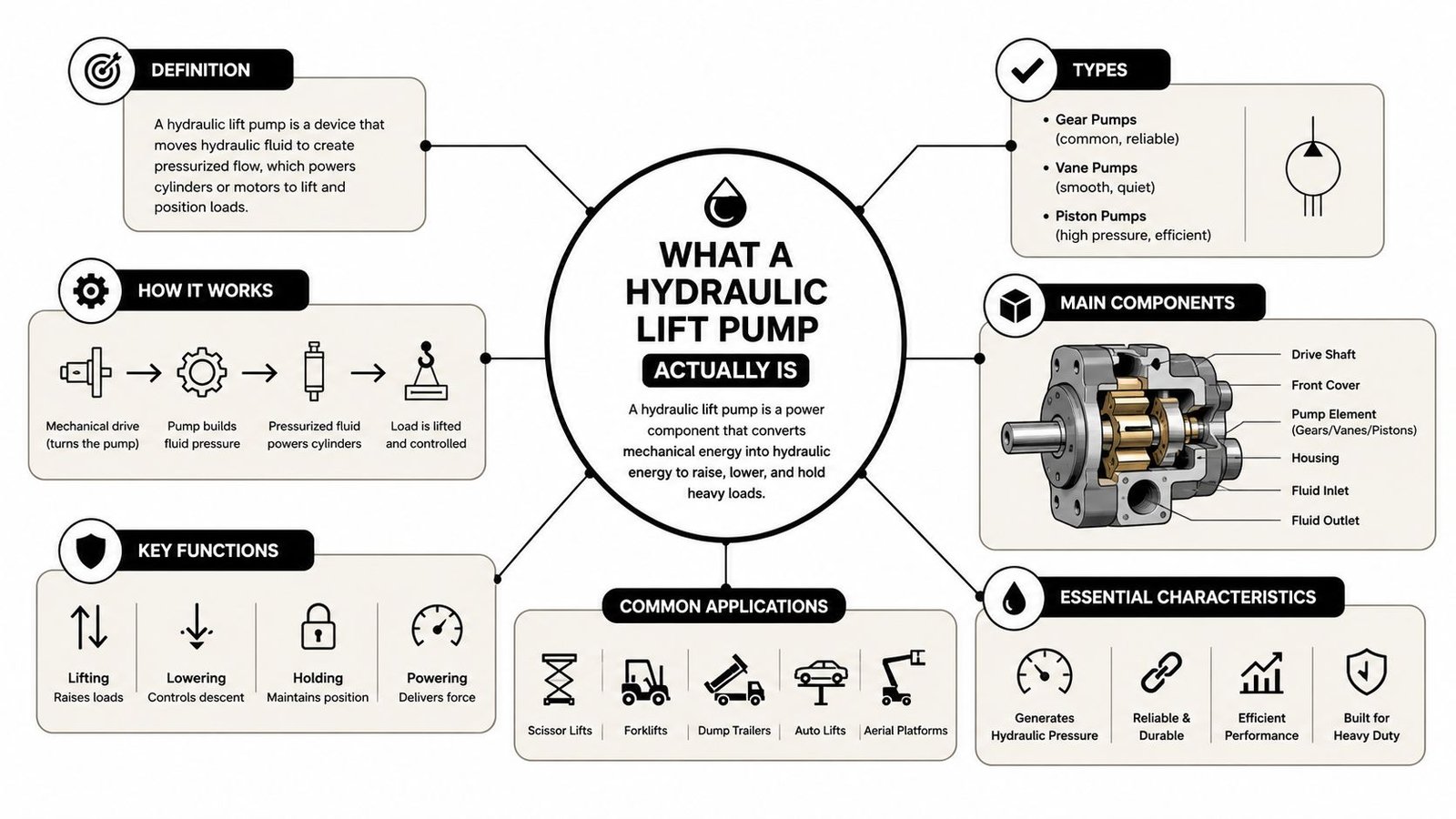
What a Hydraulic Lift Pump Is
A hydraulic elevator pump unit is the power source that converts electrical energy into fluid pressure. In a building system, the pump moves oil from a reservoir into the cylinder, and that pressure raises the car. The process is straightforward, but the system's behavior depends on both pressure and flow, not just one of them.
The picture is simpler if you compare it to a bicycle hydraulic brake. Your hand applies modest force, the fluid carries that force through the line, and the caliper multiplies it at the wheel. An elevator uses the same broad principle in reverse, with controlled lifting instead of stopping. The pump starts the chain, and the rest of the system turns that input into motion.
Building elevators are not oilfield lifts
One common source of confusion is that the phrase hydraulic lift pump gets used across very different industries. Oilfield artificial-lift systems can operate at depths up to 18,000 feet and production rates as high as 50,000 bpd in technical references, which is a completely different duty than a building elevator serves (ScienceDirect topic overview). An elevator machine room has a shorter duty cycle, different safety rules, and a different failure profile.
That difference matters when you compare advice online. An oilfield system may be judged by output over long intervals, while a building elevator is judged by ride quality, reliable leveling, heat control, and code-compliant serviceability. If a guide mixes those uses together, the maintenance advice can sound technical and still miss what a residential or commercial lift needs.
Crane Elevator's hydraulic elevator pump service details
A building elevator pump is closer to a carefully tuned utility system than a high-output industrial machine. You need enough pressure to lift the car, enough flow to make the motion feel smooth, and enough thermal control to keep the unit from heating itself during repeated use. If one part of that balance is off, the whole system starts to feel out of sync.
The major parts that make the system work
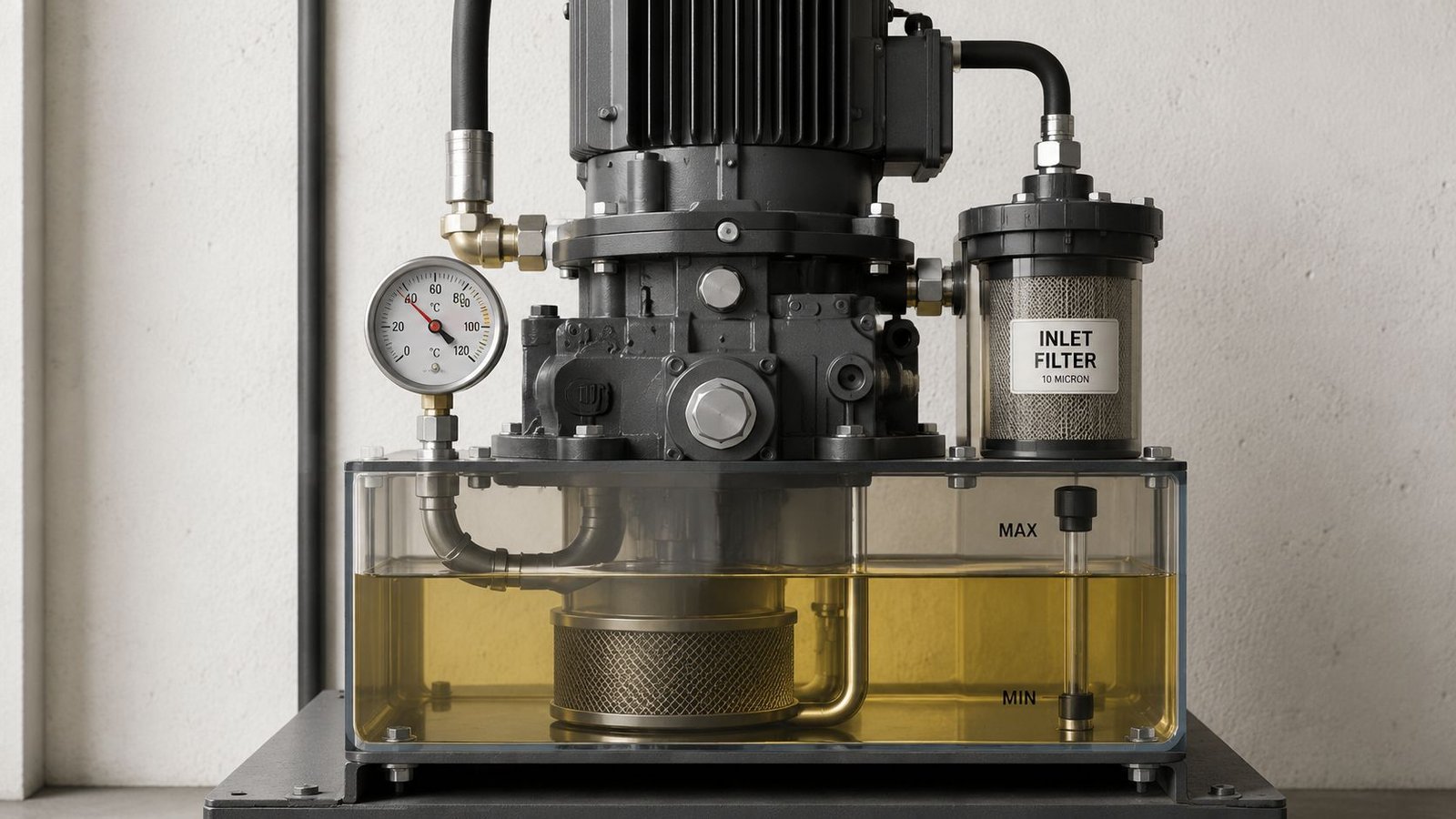
A typical hydraulic elevator power unit includes a motor, pump, reservoir, valves, and cylinder. The reservoir stores fluid. The pump moves it. The valves control direction and release. The cylinder turns pressure into motion.
The fluid does the lifting, but the pump decides whether the system feels smooth or strained.
That is why technicians look at the entire package instead of blaming one component too quickly. A weak motor, an overworked pump, poor reservoir sizing, or a valve issue can all make the elevator feel sluggish. The building manager usually notices the result first, but the cause can sit anywhere in that chain.
Hydraulic Lift Pump Types and Components
A hydraulic lift pump in an elevator room is judged by how well it balances pressure versus flow. Too much pressure without the right flow can make the car feel hesitant. Too much flow without enough pressure leaves the system unable to raise the load cleanly. The pump, motor, valves, and reservoir have to work as one package, the way a water line needs both steady force and enough volume to move water to the top floor without surging.
Technical references for hydraulic power units show that many modern systems operate around 14 to 18 MPa, or about 2,030 to 2,610 psi, while heavier-duty arrangements can be built for different pressure ranges depending on the drive and design. A manufacturer example and specification discussion on a standard hydraulic power unit shows how a 3 kW motor can be paired with a 2.1 cc/rev pump and roughly 6 L/min flow at a 2,950 psi relief setting, which illustrates how speed, load, and heat rise have to stay in balance (manufacturer example and specification discussion).
Choosing the right pump type
Pump type matters because different designs handle pressure in different ways. The same source distinguishes gear pumps, which are generally used below 3,000 psi, from piston pumps, which are preferred above 3,000 psi because they handle higher pressure more efficiently. That distinction matters in elevator work, where a pump has to do more than move oil. It has to support repeated starts, smooth travel, and stable leveling without pushing the unit into excess heat.
| Pump Type | Pressure Capability | Typical Lift Use |
|---|---|---|
| Gear Pump | Generally below 3,000 psi | Compact, lower-pressure hydraulic units |
| Piston Pump | Preferred above 3,000 psi | Higher-pressure lift applications |
| Other matched power-unit designs | Varies by pump and drive arrangement | Systems where pressure and flow must be balanced |
For a building manager, the important question is how the pump was matched to the rest of the unit. A pump by itself does not tell the full story. Motor size, relief setting, reservoir capacity, and duty cycle all shape how the elevator feels in use. If a contractor describes only the pump and leaves out the rest, the specification is incomplete.
Why component matching protects the elevator
A properly matched elevator pump system behaves like a tuned plumbing line, not a brute-force machine. The reservoir stores fluid and helps manage heat. The valves direct flow and release pressure at the right moment. The cylinder turns that hydraulic energy into car movement. If one part drifts out of range, the symptom may show up as slow starts, rough leveling, unusual noise, or a unit that runs hotter than it should.
That is also where elevator hydraulics differ from industrial or oilfield systems. An industrial pump may be judged mostly by output or raw pressure, but a building elevator is judged by ride quality, consistent leveling, and serviceability in a confined machine space. Crane Elevator's non-proprietary service model fits that reality because it keeps attention on the whole system, not a closed parts list. For local owners, that means the diagnosis can stay practical, with the pump, motor, valves, and reservoir checked as connected pieces instead of isolated parts.
Rule of thumb for managers: ask how the motor, pump displacement, and relief setting were chosen together. If the answer is vague, the design probably is too.
A building owner may hear “higher pressure” and assume it automatically means a better lift. It does not. The right elevator unit needs the correct mix of pressure and flow for the car weight, building use, and machine-room conditions. When that balance is wrong, the problem usually shows up first in the ride, then in the service call.
Hydraulic Lift Principles Through History
A hydraulic lift pump can feel modern in a machine room, but the core idea behind it is much older than elevator equipment. The basic lesson appeared early in documentary history, when John Whitehurst is credited with a manually operated hydraulic ram in 1772 (Water Works History). The device was simple, yet it proved a point that still matters in building service, fluid energy can move a load with steady force when the system is arranged correctly.
The history continued through public water projects before it ever reached elevator duty. A French patent from 1797 led to the first known public-water use in late 1798 at the Portsmouth, New Hampshire aqueduct, where the ram was said to lift “a barrel of water every minute”. By 1850, a municipal installation reportedly supplied 20,000 gallons of water per day to Naples, New York. Those examples show that hydraulic lift principles were already doing useful work in public systems long before they were adapted for building transportation.
What that history tells a building owner
Old hydraulic rams were self-acting, which differs from a modern elevator power unit, but the operating lesson is the same. Fluid under pressure can do practical work for a long time if the system is designed well and kept in good condition. A pressure line works a bit like a carefully sized plumbing run, if the flow path is clean and the pressure control is set correctly, the load moves predictably. If the flow is restricted or the pressure is badly matched, the system may still run, but the result is noisy, slow, or uneven.
That history matters to a building manager because it explains why hydraulic systems often reward preventive care instead of waiting for a failure. The parts are mechanical, yet their behavior depends heavily on fluid condition, cleanliness, and heat. A ram could keep working because it was simple. A modern elevator pump can keep working because it is maintained with attention to those same fundamentals.
The difference is the operating standard. Today's elevator system also has tighter expectations for ride quality, noise, and serviceability in a confined machine space, so the old lesson has to be applied with more precision. For local owners, a preventive maintenance approach for elevator systems helps keep that balance visible before wear turns into a service call.
Why longevity still matters today
Hydraulic lift systems have stayed relevant because they adapt well to different uses. PETEX describes hydraulic pumping as one of the most flexible forms of artificial lift, and that flexibility helped the technology spread after the early 1930s in oil production (PETEX). In 1932, C.J. Coberly installed the first hydraulic piston pump in Inglewood, California, to produce oil without a sucker-rod string, and jet pumps were later proven in the field as well.
That oilfield history is not the same as elevator service, and that distinction matters. Industrial and oilfield systems often focus on production output or raw pressure, while an elevator hydraulic lift pump has to deliver controlled movement, repeatable leveling, and dependable service in a building environment. The common thread is not identical equipment, but the same principle, controlled fluid force remains useful wherever steady motion and dependable operation are needed.
Diagnosing Hydraulic Lift Pump Failures
Most troubleshooting advice starts and ends with “check the fluid” or “replace the filter.” That's useful, but it's not enough when the elevator is already misbehaving. The harder question is what kind of fault is developing, because the symptoms of cavitation, suction restriction, air ingress, and wear can overlap.
The contamination problem is real. In hydraulic systems, particles, water, and air are reported to cause 80 to 90% of pump failures (hydraulic failure guide). That doesn't mean every failure is contamination alone, but it does mean dirty fluid often starts the chain that ends in downtime.
Reading the symptoms correctly
Cavitation usually shows up as noise, rough operation, and sometimes foam or a harsh sound from the pump inlet area. Suction-line restriction tends to make the lift slow because the pump isn't getting the fluid it needs. Air ingress often creates erratic motion, a spongy feel, or unstable performance from one cycle to the next.
Internal wear is trickier because it can look like a general loss of strength. The system may still move, but it can't hold the expected pressure or repeat the same speed under load. That's where flow testing and temperature checks become more useful than a visual glance at the reservoir.
Practical rule: don't let anyone stop at “the fluid looks okay.” A pump can fail with fluid that looks fine from the top.
For a building manager, the job is to narrow the problem instead of guessing. If the elevator is slow, ask whether it's slow at startup, slow all the time, or slow only after repeated trips. If it's noisy, ask whether the noise comes during lift, during lowering, or at the end of the cycle. Those distinctions help a technician decide whether the fault is on the suction side, inside the pump, or in the air and fluid conditions around it.
How a technician localizes the fault
A disciplined diagnosis usually uses three kinds of evidence. Flow testing shows whether the pump is moving what it should. Temperature checks reveal whether heat is building up in the system. Performance thresholds tell the technician whether the lift has drifted far enough from normal operation to justify rebuild or replacement.
That matters because elevator downtime is expensive in inconvenience even when the fix itself is modest. Replacing the wrong part wastes money. Rebuilding a pump that was only starved for fluid also wastes money. The right diagnosis is what prevents repeated service calls.
The best maintenance teams don't ask, “Is the fluid dirty?” They ask, “What fault pattern is the machine showing, and how fast is it progressing?” That's the question that separates a quick correction from a recurring problem.
Preventing Hydraulic Lift Pump Breakdowns
A hydraulic elevator can run smoothly for a long time, then begin to slow, hesitate, or sound different with no obvious warning. That usually means the trouble is not one big failure, but a chain of small changes in fluid condition, temperature, and inlet design. The pump matters, but it cannot keep performing well if the oil is too thin, too thick, overheated, contaminated, or poorly supplied at the inlet. CIRCOR's hydraulic elevator pump data also stresses staying within the manufacturer's pressure and viscosity envelope, which means the pump's operating range belongs in the maintenance plan, not in the fine print (CIRCOR hydraulic elevator pump data).
The data book lists 60 SSU at operating temperature as the viscosity benchmark, with acceptable oil temperatures ranging roughly from 0°F to 180°F depending on the pump family. That matters because thin oil acts like water in a garden hose, it slips past internal clearances more easily and reduces volumetric efficiency. Thick oil does the opposite, it resists movement, raises suction losses, and increases cavitation risk. Real-world volumetric efficiency is typically 85% to 95%, so even a healthy unit gives up some theoretical displacement to leakage and slip.
What building staff should check
- Oil condition: watch for darkening, foaming, unusual odor, or visible contamination. Those signs show the fluid has changed enough to affect performance.
- Heat build-up: check whether the machine room or reservoir area runs hotter after repeated trips. Heat changes viscosity, and viscosity changes how the pump behaves.
- Inlet design and suction path: make sure the pump is not being starved at the inlet. Restriction here can create cavitation even when the reservoir looks full.
- Service records: compare current ride behavior with earlier checks. A slow change over time is often more useful than a dramatic breakdown.
- Oil analysis: do not treat it as optional. It gives a better picture of wear and fluid condition than a quick visual inspection.
Preventive maintenance for elevator systems
Heat deserves the same attention as leaks. It is not just a nuisance, it changes the oil's behavior and shifts pressure and ride quality at the same time. If oil thins from overheating, the pump can lose holding capability and cycle speed. If oil becomes dirty or aerated, valve and seal wear usually follow.
Maintenance mindset: fluid can look harmless while it slowly changes speed, pressure, and ride quality all at once.
Many breakdowns become expensive because the pump usually does not fail in one dramatic event. It declines as contamination and heat slowly erode its ability to hold pressure and move fluid cleanly. That is why a building manager benefits from looking beyond generic low-fluid advice and asking whether the pattern points to inlet starvation, heat stress, contamination, or a pump that is out of step with the elevator system it serves.
Modernizing Your Hydraulic Lift Pump System
At some point, repair stops being the best use of money. Repeated failures, old parts, and code issues can make modernization the smarter path. In building hydraulics, the likely upgrade scope may include the jack, cable, tank or power unit, motor, sheave, and related controls, depending on the elevator's design and condition.
Modernization also has a compliance side. Safety and code work can involve door lock monitoring under ASME A17.3 and Michigan rule R. 408.7030, along with required safety testing and inspection work. Those issues matter because an elevator can be mechanically functional and still not be a good candidate for continued operation without updates.
Why non-proprietary service matters
A non-proprietary system gives qualified providers a real path to service the unit without being locked into one vendor's parts or support structure. That's valuable for long-term maintenance because it keeps repair options broader and can reduce the risk of waiting on a single source for critical components. It also makes the elevator easier to support over time as staffing changes or buildings change hands.
Hydraulic elevator pump replacement options
That service model matters most when the equipment is older or the failures keep returning. If a building keeps paying for the same symptom, the issue may no longer be a repair problem. It may be a design or modernization problem.
What to look for before approving an upgrade
A good modernization conversation should include how the new unit will handle pressure, heat, access for service, and code compliance. It should also cover testing, emergency functions, and whether the system can be maintained by more than one provider. Those details protect the building from future lock-in and future surprises.
The smart move is to compare the cost of recurring repairs with the cost of a cleaner long-term system. If the elevator is failing often, or if the parts have become hard to source, modernization often buys back predictability. That matters just as much as the technical improvement itself.
For Michigan properties, local service capacity matters too. Faster response, clearer quotes, and documented maintenance can make the difference between a manageable upgrade and a long series of interruptions.
Keeping Your Hydraulic Lift Pump Reliable
A hydraulic elevator stays dependable when the pump is treated as a monitored asset, not a mystery box. The key ideas are simple. Pressure and flow must be matched, fluid condition changes performance, and failure diagnosis should go beyond “low fluid”.
The biggest mistake is waiting for a full breakdown before paying attention. A slow car, a noisy pump, or a warmer machine room usually gives warning first. Those warning signs are useful because they let a technician distinguish between contamination, cavitation, inlet restriction, air ingress, and wear before the unit stops service entirely.
A practical yearly routine works better than random reaction. Spring is a good time for fluid review and oil analysis. Fall is a good time to inspect components, verify operating behavior, and make sure the system still behaves the way it should. If the elevator starts drifting from normal operation in between, that's the moment to call for a professional assessment instead of waiting.
The best hydraulic systems are not the ones that never need attention. They're the ones that get the right attention before small problems turn into building-wide complaints.
For building owners and facility managers, the takeaway is straightforward. A hydraulic lift pump is only one part of the elevator, but it's a part that shapes ride quality, reliability, and repair cost. If you understand the pressure-flow balance, the failure signs, and the difference between elevator hydraulics and industrial or oilfield systems, you can make better service decisions and avoid expensive guesswork.
If your elevator is showing slow starts, uneven motion, or recurring hydraulic trouble, Crane Elevator Company can help with preventative maintenance, diagnostics, and non-proprietary modernization for a wide range of lifts. Visit Crane Elevator Company to request a review and get a clear plan for your hydraulic system before the next breakdown forces the issue.