
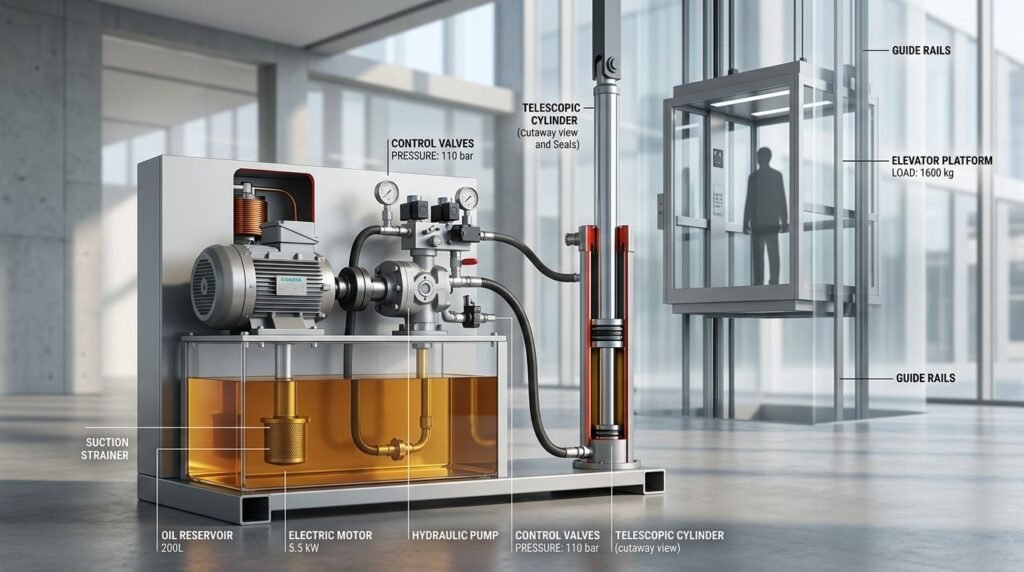
A tenant calls to say the elevator feels slow again. Someone else says it shuddered leaving the lobby. By the afternoon, your maintenance staff has noticed a louder-than-usual hum from the machine room, and now you're trying to answer the expensive question. Is the hydraulic elevator pump failing, or is something else making it look that way?
That's where many building owners lose money. A hydraulic system can show the same outward symptoms for very different internal reasons. Slow travel might be a weak pump. It might also be a valve issue, fluid viscosity problem, heat buildup, or restriction in the piping. If the diagnosis is wrong, the repair bill gets big fast, and the elevator still doesn't run right.
Hydraulic elevators have stayed common for a reason. They served as the market's dominant design for 50 consecutive years, and they still held about 40% of the worldwide elevator market share as of 2010 in applications where simplicity and lower capital cost matter most, according to this hydraulic elevator market overview. For low-rise and mid-rise buildings, they're still practical, durable machines when the power unit is understood and maintained properly.
The Unsung Hero of Your Building
The cab, the buttons, or the doors are what is typically noticed. The part that does the hard work sits out of sight in the machine room. The hydraulic elevator pump is what gives the system muscle.
In a typical low-rise building, the elevator can seem fine for years, then gradually start acting different. It may take longer to leave the floor. It may sound rough during the up run. It may stop leveling as cleanly as it used to. Those are usually early warnings from the power unit, not random quirks.
Why the pump matters so much
When a hydraulic elevator starts up, the pump has one basic job. It has to move oil consistently and under the right pressure so the car rises smoothly and predictably. If that flow becomes unstable, everything downstream suffers. Ride quality changes first. Reliability issues usually follow.
That's one reason hydraulic systems remain common in schools, medical buildings, municipal facilities, apartments, and smaller commercial properties. Their design is straightforward, proven, and well suited to the kinds of travel and loading these buildings need. If you want a quick background on the broader system type, this overview of hydraulic elevators is a useful companion.
Practical rule: When an elevator starts feeling “old” before it starts outright failing, the power unit is often where the real story begins.
What building managers usually get wrong
The mistake isn't noticing a problem too late. The mistake is assuming the loudest component is the failed component. A noisy machine room doesn't automatically mean the pump is bad. A rough ride doesn't always point to worn rotating parts. In hydraulic work, symptoms overlap.
That's why pump knowledge matters even if you're not turning wrenches yourself. You don't need to rebuild a unit. You do need to know enough to ask the right questions, approve the right repair, and avoid paying for the wrong one.
How a Hydraulic Pump Lifts Your Elevator
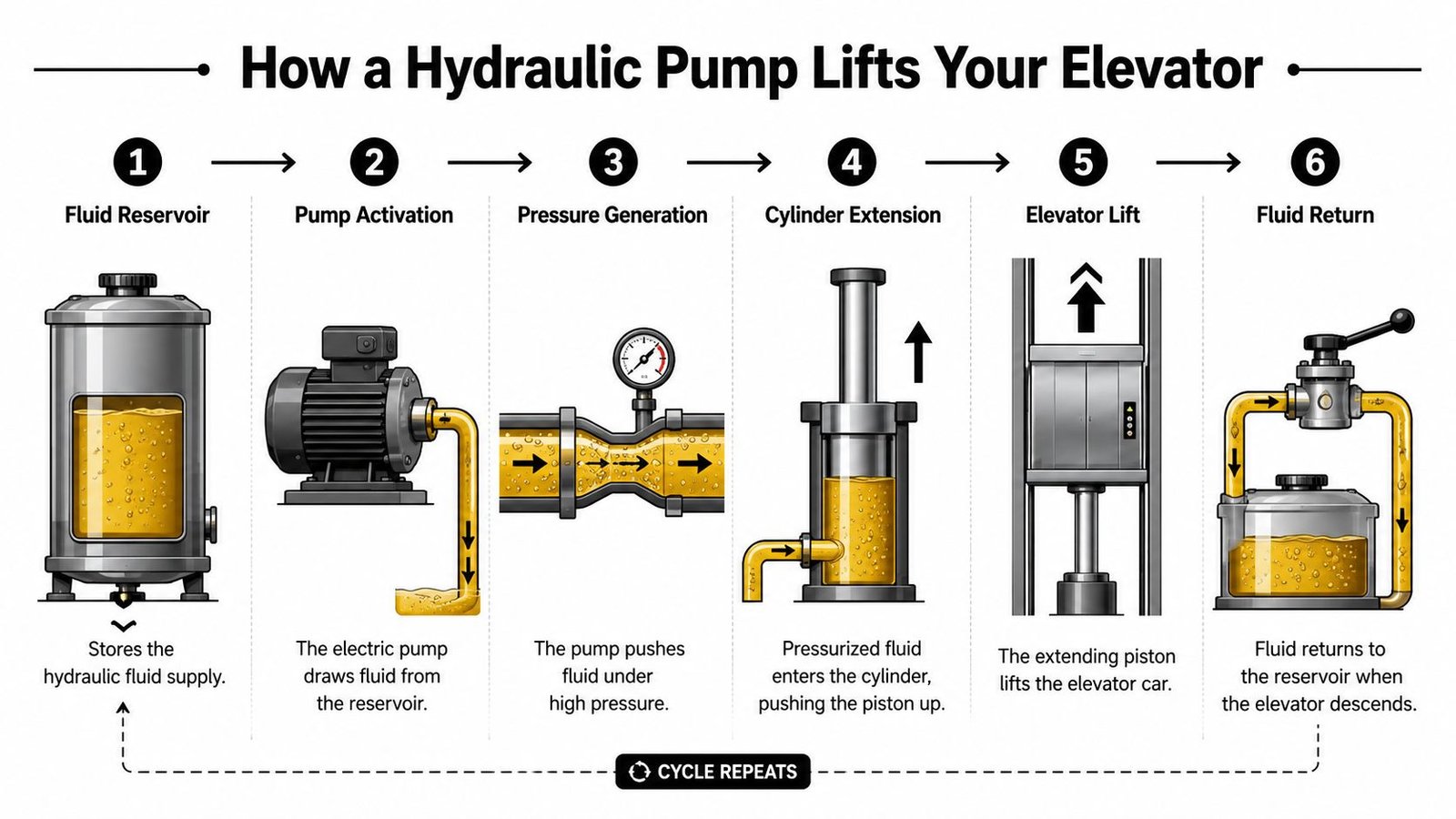
Think of the system like a giant, carefully controlled syringe. Oil moves from a reservoir into a cylinder. That pressure pushes a piston. The piston lifts the cab.
The basic idea is simple. The details are where ride quality, safety, and service life are won or lost.
Here's the process visually:
What happens on the way up
The up run is the pump's working cycle. The electric motor starts, drives the pump, and draws hydraulic fluid from the tank. The pump then pushes that fluid into the cylinder at pressure. As pressure builds in the cylinder, the piston rises and carries the elevator car upward.
This basic operating principle has deep roots. Hydraulic force in industrial lifting traces back to Sir William Armstrong's hydraulic crane in 1846, and elevator development later moved from water-based systems to oil in 1937 with the “Oildraulic” elevator, a shift noted in the history and development of elevator hydraulics. That move to oil made hydraulic elevators smoother and reduced problems tied to corrosion and freezing.
What happens on the way down
The down run works differently. The pump usually isn't lifting the car on descent. Instead, a control valve manages the return of oil from the cylinder back to the reservoir. That controlled release lets the cab descend smoothly.
This distinction matters. Up performance is strongly tied to pump and motor output. Down performance is strongly tied to valve behavior and fluid control. If a building manager understands only that one point, future troubleshooting gets much easier.
A smooth descent with a rough ascent usually points your attention in a different direction than a rough descent with good upward power.
Later in this article, that split between pump-driven ascent and valve-controlled descent becomes the key to sorting out misdiagnosis.
A short video helps make the movement clearer in real time:
The four parts that work together
Most building managers think of “the pump” as one part. In practice, the lifting side of the system is a group of parts working in sync:
- Tank or reservoir holds the hydraulic oil.
- Motor provides the mechanical power.
- Pump converts that power into fluid flow.
- Valve assembly directs and meters that flow.
If one of those parts falls out of tune, the elevator can feel weak, hot, noisy, or inconsistent even when the others are still serviceable.
Decoding the Hydraulic Power Unit Components
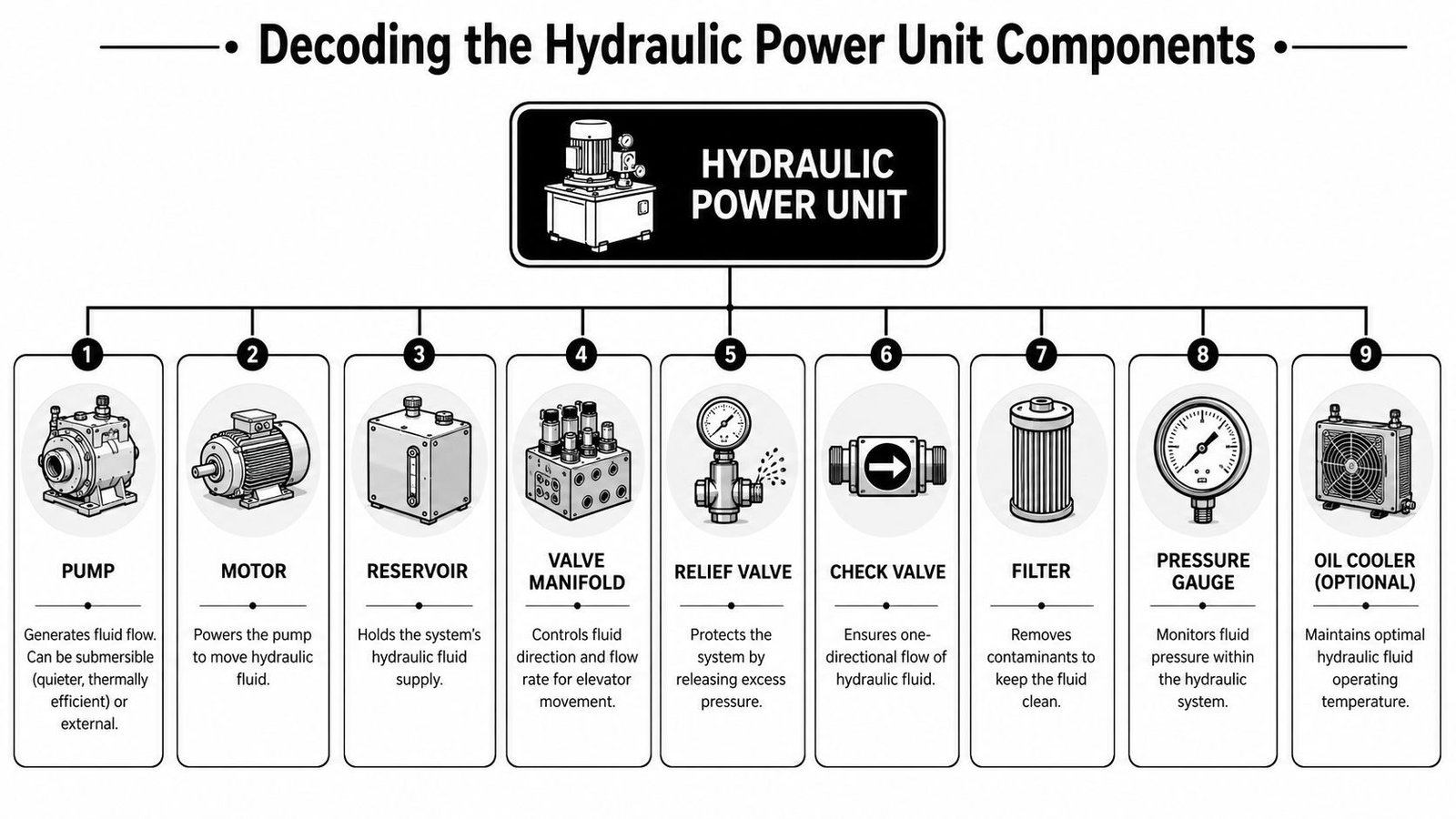
When technicians talk about a hydraulic elevator problem, they often say “power unit” instead of just “pump.” That's the better way to think about it. The pump is critical, but it's only one part of the assembly that determines how the elevator performs.
This diagram shows the parts most building managers should recognize by name:
Motor and pump are not the same thing
The motor turns the pump. The pump moves the oil. Those jobs are related, but they aren't interchangeable.
That distinction matters during service calls. A technician may find that the motor is starting properly, drawing as expected, and staying stable, while the pump itself is worn internally and no longer maintaining strong flow under load. The opposite can happen too. A weak electrical side can make a healthy pump look bad.
The motor also has to be built for repeated starts. Hydraulic elevator pump motors are typically designed with dual-rated nameplates for 80 to 120 starts per hour, and one example in industry reference material shows a motor delivering 76 liters per minute (20.07 gpm) requiring 6.9 kW (9.25 horsepower) for efficient operation, according to this hydraulic elevator motor and pump reference.
Reservoir and fluid management
The reservoir stores the system's oil supply, but it also affects heat control and fluid condition. Dirty, overheated, or aerated oil won't behave like clean oil at the right temperature. Even a good pump can't deliver clean performance with poor fluid conditions.
For a building manager, this is one of the simplest mindset shifts that pays off. Don't think of the tank as passive storage. Think of it as part of system health.
Valves decide how refined the ride feels
The valve manifold is where many ride-quality complaints begin. The valve controls direction, flow rate, and how smoothly the car starts, stops, and levels. Relief valves protect the system from excess pressure. Check valves keep flow moving the right way. Small valve issues can create symptoms that look dramatic from the lobby.
That's one reason a clean explanation from your service provider matters. “Pump issue” is too vague unless someone has ruled out the control side first. If you want a more detailed breakdown of how these assemblies are built, this page on the hydraulic elevator power unit is worth reviewing.
Field note: When the ride is inconsistent rather than simply weak, I get more suspicious of control and fluid behavior than raw pump output.
Stable flow is the real benchmark
A healthy power unit doesn't just make pressure. It makes consistent pressure and flow across changing load conditions. One specification source notes that pump output should vary no more than 10% between no-load and full-load conditions to preserve consistent car movement, and it also notes dry-mounted pump performance for belt-driven applications up to 600 psi with viscosity standardized at 100 SSU, as detailed in these modular hydraulic elevator specifications.
That's the practical takeaway:
- The motor's job is repeated, dependable starts.
- The pump's job is steady flow.
- The valve's job is controlled motion.
- The reservoir and fluid's job is to support all of it without contamination or heat problems.
When one part falls behind, the system tells on itself. You just need to know how to read the symptoms.
Diagnosing Common Hydraulic Pump Problems
Many repair budgets falter because a hydraulic elevator shows one symptom. People replace the most expensive part in sight. The elevator improves a little, or not at all, and the original problem comes back.
The biggest source of confusion is overlap. A bad pump, a poorly adjusted valve, and degraded fluid can all produce slow travel, excess heat, vibration, or leveling complaints. According to this hydraulic power unit troubleshooting analysis, valve chatter and pressure inconsistencies often mimic pump growling, and in over 50% of “pump failure” complaints, the actual cause is valve adjustment or fluid viscosity, not the pump itself.
Start with the symptom cluster, not a single complaint
One complaint rarely tells you enough. “It's noisy” is too broad. “It's noisy only going up, worse when cold, and leveling drifts later in the day” is useful.
That's how technicians separate likely causes. Patterns matter more than isolated impressions.
Elevator Symptom Diagnostic Chart
| Symptom | Possible Pump Issue | Possible Valve Issue | Possible Fluid/Other Issue |
|---|---|---|---|
| Slow upward travel | Worn pump internals, weak flow under load, cavitation | Valve not opening or regulating correctly | Oil too thick or contaminated, restriction in piping |
| Rough or shuddering start | Pump struggling to establish smooth flow | Valve chatter, poor adjustment | Aerated oil, temperature-related viscosity problems |
| Excess machine room heat | Pump working inefficiently or recirculating internally | Pressure drop through control path or valve issues | Oil condition problems, routing restrictions, poor cooling |
| Loud growling noise | Cavitation or pump wear | Valve pressure instability sounding like pump distress | Low oil condition, wrong viscosity, air in system |
| Leveling errors | Pump output inconsistency affecting lift performance | Valve misadjustment on stopping and landing | Fluid temperature changes altering response |
| Good down ride, poor up ride | More likely pump-side issue | Less likely primary cause, but still possible through control interaction | Fluid condition still possible |
| Good power up, rough down ride | Less likely primary pump failure | Stronger valve suspicion | Fluid contamination or temperature effects |
What pump trouble usually sounds and feels like
A pump problem often shows itself most clearly on the up run. The motor starts, but the cab hesitates, sounds strained, or rises with poor consistency. Cavitation can create a growling sound. Internal wear can leave the system unable to hold the same performance under heavier passenger loads.
True pump faults usually get worse under demand. A unit may seem acceptable with a light car, then struggle when the car is loaded. That's because worn hydraulic components often reveal themselves when pressure demand rises.
What valve trouble gets mistaken for
Valve issues are famous for impersonating pump failure. A chattering valve can sound mechanical and ugly enough that people assume the rotating equipment is failing. Poor low-temperature adjustment can create rough behavior when the system is cold, then partly disappear as oil warms.
That last point matters because it changes how you talk to your service company. If the elevator is worst at the first few runs of the day and improves later, don't leave that detail out. It may point the technician toward adjustment and fluid behavior before they condemn the pump.
If the machine is “bad in the morning, better by noon,” that's a diagnostic clue, not a coincidence.
Fluid issues are often the hidden third cause
Hydraulic oil gets overlooked because it's less dramatic than motors and pumps. But fluid condition changes how the entire system behaves. Viscosity affects startup feel, speed consistency, and valve response. Contamination can accelerate wear and interfere with smooth operation.
Other non-pump factors can mislead the diagnosis too:
- Pipe restrictions: Extra pressure drop can create heat and poor performance.
- Air in the system: Aeration can produce erratic motion and noise.
- Temperature swings: Cold oil behaves differently than warm oil.
- Machine room conditions: Dirt, neglect, and heat buildup shorten component life.
What to observe before you authorize a replacement
If you manage the building, your job isn't to diagnose like a mechanic. Your job is to give accurate observations.
Use a short checklist before the service call:
- Direction matters: Is the problem only on the up run, only on the down run, or both?
- Temperature matters: Is it worse first thing in the morning, after repeated use, or all day?
- Load matters: Does the elevator act differently with more passengers or freight?
- Sound matters: Is it a steady hum, a rough growl, a chatter, or a vibration through the floor?
- Pattern matters: Has it become gradually worse, or did it change suddenly?
Those details help separate a pump replacement from a valve adjustment, fluid correction, or broader power-unit service.
Essential Maintenance and Basic Troubleshooting
Most hydraulic elevator pump failures don't start as dramatic failures. They start as ignored warning signs. A little heat, a slightly different noise, a slower launch from the floor. Buildings that catch those changes early usually avoid the worst service calls.
A facility team can do useful observation without crossing into technician work. The line is simple. Staff should inspect, listen, document, and report. They shouldn't adjust hydraulic settings or open up components they aren't trained to service.
What your staff can safely check
A practical routine doesn't need to be complicated:
- Watch the oil level: If your system has a visible way to verify level, note any obvious change from normal operating condition.
- Listen during startup: A new hum, harsher vibration, or intermittent growl is worth logging.
- Check machine room housekeeping: Dust, debris, and storage clutter make service harder and can contribute to heat retention.
- Notice temperature conditions: If the machine room is unusually hot or cold, elevator performance may change with it.
- Track ride behavior: Write down whether issues occur on ascent, descent, or leveling.
A simple logbook beats memory. If three different people report the same symptom at the same time of day, that pattern has value.
What basic troubleshooting is reasonable
Before placing a service call, building staff can check a few non-invasive basics:
- Confirm power is available. A tripped breaker or power issue can imitate equipment failure.
- Verify the elevator is in the service mode you expect. Sometimes what looks like erratic behavior is tied to operating mode or access control.
- Check for environmental changes. Recent heat, cold, flooding, cleanup work, or nearby construction can affect hydraulic performance.
- Compare with recent history. If the elevator has had repeated leveling or heat complaints, that trend matters more than a single event.
Maintenance reminder: The machine room should support the elevator, not double as a storage closet.
When to stop and call for professional service
Some symptoms should move straight to a qualified elevator contractor:
- Repeated leveling errors
- Noticeable overheating
- Persistent machine room noise
- Oil leaks
- Rough starts that are becoming more frequent
- Any change that affects passenger confidence or safe operation
Preventive service is usually cheaper than emergency work because it catches the root issue before a secondary failure starts. In hydraulic systems, one unresolved problem often stresses several parts at once.
Repair Modernize or Replace Your Pump System
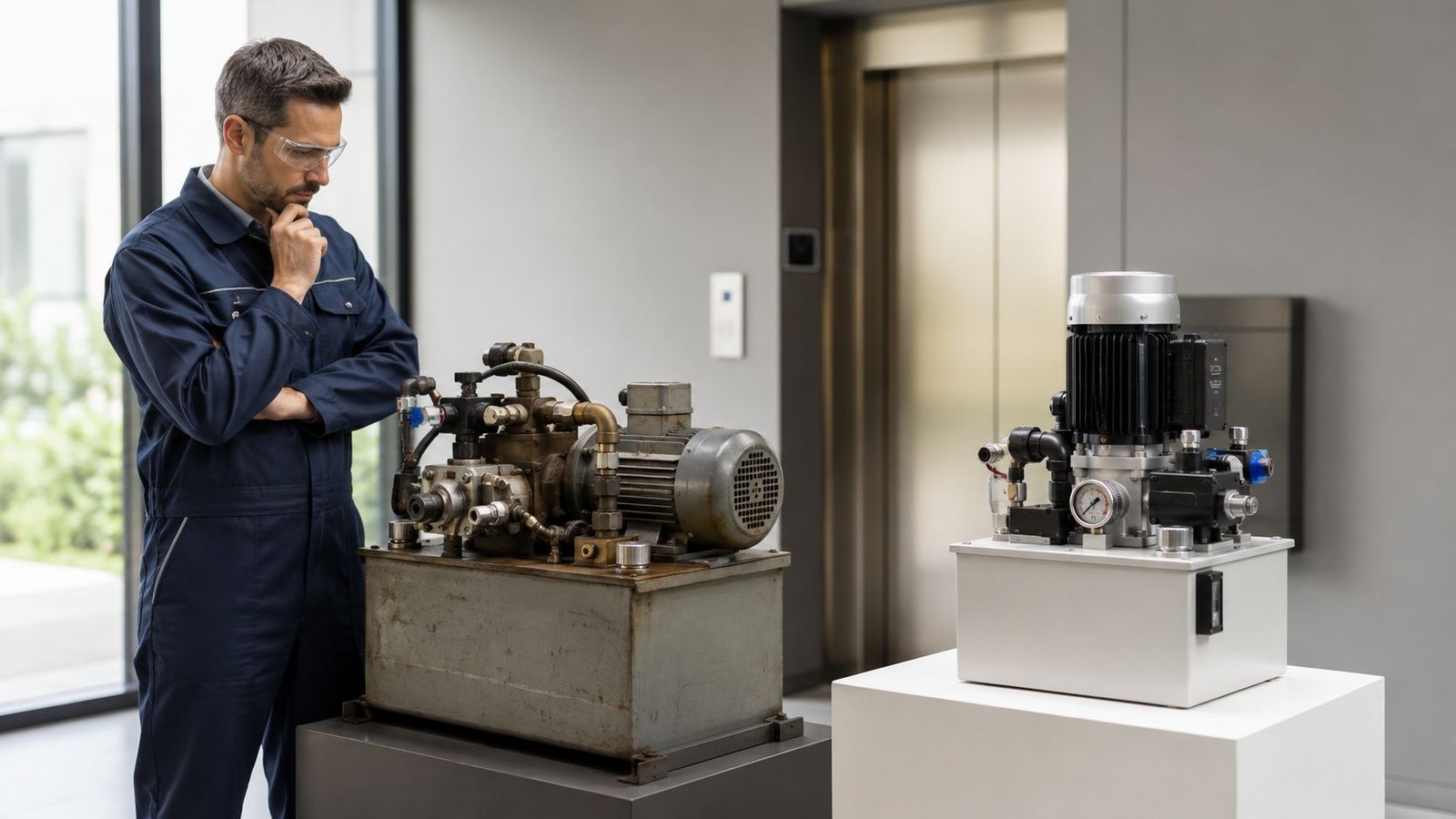
At some point, every building owner reaches the same fork in the road. Keep repairing individual hydraulic components, modernize the power unit, or replace the system more broadly.
The wrong answer is usually the one driven by frustration alone. If a pump has failed once after years of normal service, repair may make sense. If the building keeps paying for repeat callbacks, heat issues, rough starts, and aging controls, replacing one part at a time may only stretch out the cost.
When repair still makes sense
A targeted repair is often reasonable when the rest of the power unit is in good condition and the problem is clearly isolated. A failed motor, a specific valve issue, or a pump with obvious wear can sometimes be addressed without reworking the whole hydraulic package.
That approach works best when the elevator has otherwise been dependable and parts remain serviceable. It works poorly when the machine has become a chain of aging compromises.
When modernization is the smarter financial move
For many low-rise buildings, the better answer is a non-proprietary modernization. That means replacing the pump, motor, and valve while keeping major structural hydraulic elements such as the jack and tank when they're still suitable. Recent analysis found that this kind of modernization can reduce lifetime operational and service costs by 30 to 40% compared with a full proprietary system replacement, according to this review of the cost trade-offs in hydraulic elevator modernization.
That matters because repeat service costs rarely show up as one giant event. They show up as nuisance shutdowns, tenant complaints, emergency calls, and one more repair approval every few months.
If you're comparing options, this page on hydraulic elevator pump replacement outlines the practical scope of power-unit replacement work.
A simple decision filter
Use these questions when deciding what to do next:
- Has the same symptom returned more than once after repair? Repetition usually means the original fix was too narrow.
- Are multiple power-unit parts aging together? A new pump paired with an old motor and unstable valve may not deliver the result you expect.
- Do you want proprietary or open-service equipment? That decision affects future service flexibility.
- Is ride quality becoming a tenant issue? Reliability is only part of the equation. Confidence matters too.
Buildings rarely regret modernizing too early when the old unit has become unpredictable. They often regret waiting until the next failure forces the decision.
The best long-term hydraulic systems aren't the ones patched forever. They're the ones rebuilt at the right moment, with serviceability and lifecycle cost in mind.
If you're dealing with a noisy, slow, or unreliable hydraulic elevator and want a practical second opinion before approving a major repair, Crane Elevator Company can help. Crane serves Lower Michigan with preventative maintenance, repair, inspections, and non-proprietary modernizations for all makes and models. For building owners who want clarity instead of guesswork, their team offers responsive field service, modernization options, and free second opinions that can help you decide whether to repair, modernize, or replace with confidence.