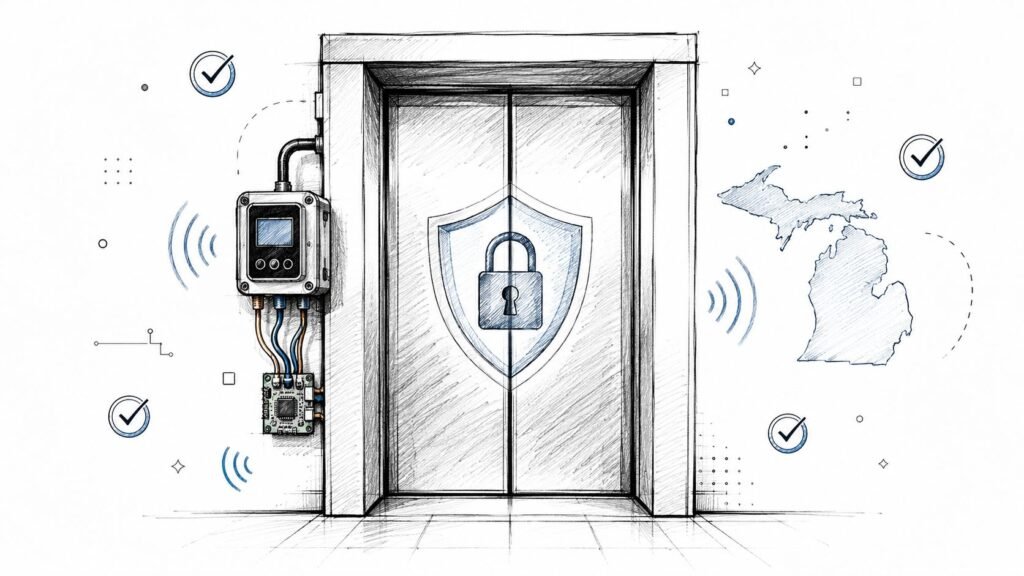
You're standing in a mechanical room with a correction notice in one hand and a service log in the other, and the elevator inspector just said the part that makes everybody tense up, door lock monitoring. That's the point where owners in Detroit, Ann Arbor, Lansing, Flint, Kalamazoo, and the rest of Southern Michigan usually want a straight answer, not a sales pitch, because the core question isn't what DLM sounds like. It's whether the elevator can be brought into compliance without turning a manageable upgrade into a bigger modernization than the building needs.
What Door Lock Monitoring Means for an Elevator
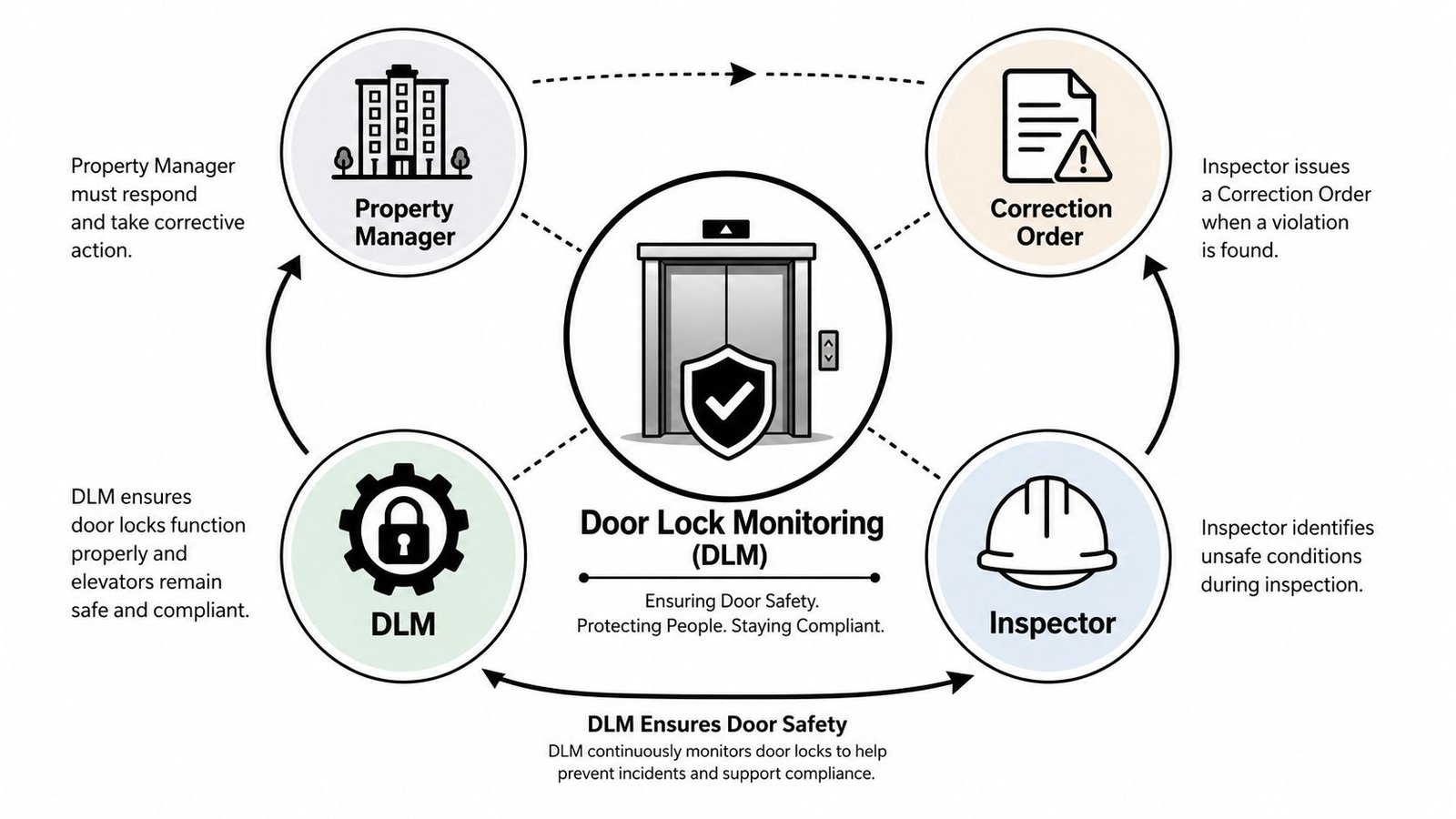
A manager gets the correction order. An inspector says the car needs DLM. The first reaction is usually confusion, because the elevator still opens and closes, and nothing looks obviously broken.
What the monitor is actually doing
Door Lock Monitoring watches the door circuit and refuses automatic operation if the system sees an unsafe condition. That includes a door not fully closed, a shorted circuit, or a jumper that defeats the lock path. In plain English, it's the safety layer that says the car doesn't get to move when the door circuit can't prove it's safe.
That matters because DLM is not the same thing as a door obstruction sensor or a basic interlock. A standard interlock helps prove the door is closed. DLM goes further by watching for the kinds of faults that older relay logic could miss, especially when someone has tampered with the circuit or a wiring fault has compromised it. The code language around a faulty door contact circuit matters because liability follows the condition that allowed motion, not the label on the component.
Practical rule: if the door circuit can be bypassed, defeated, or misread, DLM is there to stop the car from moving until the fault is cleared.
That safety purpose is why DLM became a code milestone instead of a niche add-on. ASME A17.1 added a form of DLM in 1996, and later retroactive requirements pushed owners of existing elevators into the conversation, especially in cities and states that tied enforcement to inspections and compliance windows. New York City's DOB materials say the function monitors the door position and hall door lock or gate switch so faults such as a ground, short, or jumper can't allow unsafe automatic operation, which is exactly why owners need to treat it as a code safeguard, not a convenience feature Elevator World on DLM and code history.
In practice, DLM is the difference between “the door looks fine” and “the controller has verified the door circuit is safe.” That's the distinction inspectors care about, and it's the distinction that protects owners when a maintenance issue turns into an incident.
Sensors, Circuits, and Monitoring Devices Explained
A retrofit DLM device sits in the control path and watches the signals that tell the controller whether the door system is healthy. Those signals usually come from the door position, the hall door lock, and the gate switch, and a proper elevator door sensor setup keeps those inputs visible to the monitor. When one of those inputs does not line up with the others, the monitor blocks automatic operation.
Why retrofit hardware has to be flexible
Legacy elevators do not all speak the same electrical language. That is why the electrical envelope on a retrofit monitor matters more than people think on an older controller. The Argus A100-DLM is rated for a 90V to 300V AC/DC supply, accepts 12 isolated inputs rated from 0 to 400V AC/DC, and has an input bandwidth from DC to 240Hz Argus A100-DLM datasheet. Those numbers show the unit can read a broad range of old and newer control schemes without forcing a full rewiring job.
That wide range is what separates a clean retrofit from a messy one. If the monitor can read the existing field signals reliably, it can interrupt the circuit when the door path is compromised. If it cannot, the project turns into an interface problem, then a control problem, then often a modernization conversation. In Michigan, that matters because older controllers still show up in the field, and the retrofit path has to match the equipment that is in the machine room, not the one someone hoped was there.
Overlay monitor versus built-in logic
There are two ways DLM shows up on a job. One is an overlay device wired into the existing control path. The other is built-in logic inside a newer controller. They handle the same safety function, but the service work behind them is different.
| Overlay DLM | Built-in controller logic |
|---|---|
| Added to the existing control path | Programmed into the controller |
| Useful when the legacy controller still has life left | Common when the controller is newer or already being modernized |
| Depends on clean signal integration | Depends on correct firmware and parameter setup |
| Can be a targeted retrofit | Usually part of a larger controls package |
The practical point is simple. Integration is what matters. The DLM device has to see the door signal, interpret the fault correctly, and stop automatic motion before the fault becomes an event. On a retrofit, that usually means the monitor has to fit the controller that is already on site, the wiring has to land cleanly, and the inspection path has to make sense for the owner and the authority having jurisdiction.
Michigan Code Requirements and the 2028 Deadline
Michigan owners don't need a generic national explanation. They need the local rule set that determines whether the elevator passes inspection in Lansing, Kalamazoo, Flint, or anywhere else in the state.
What the code says in practical terms
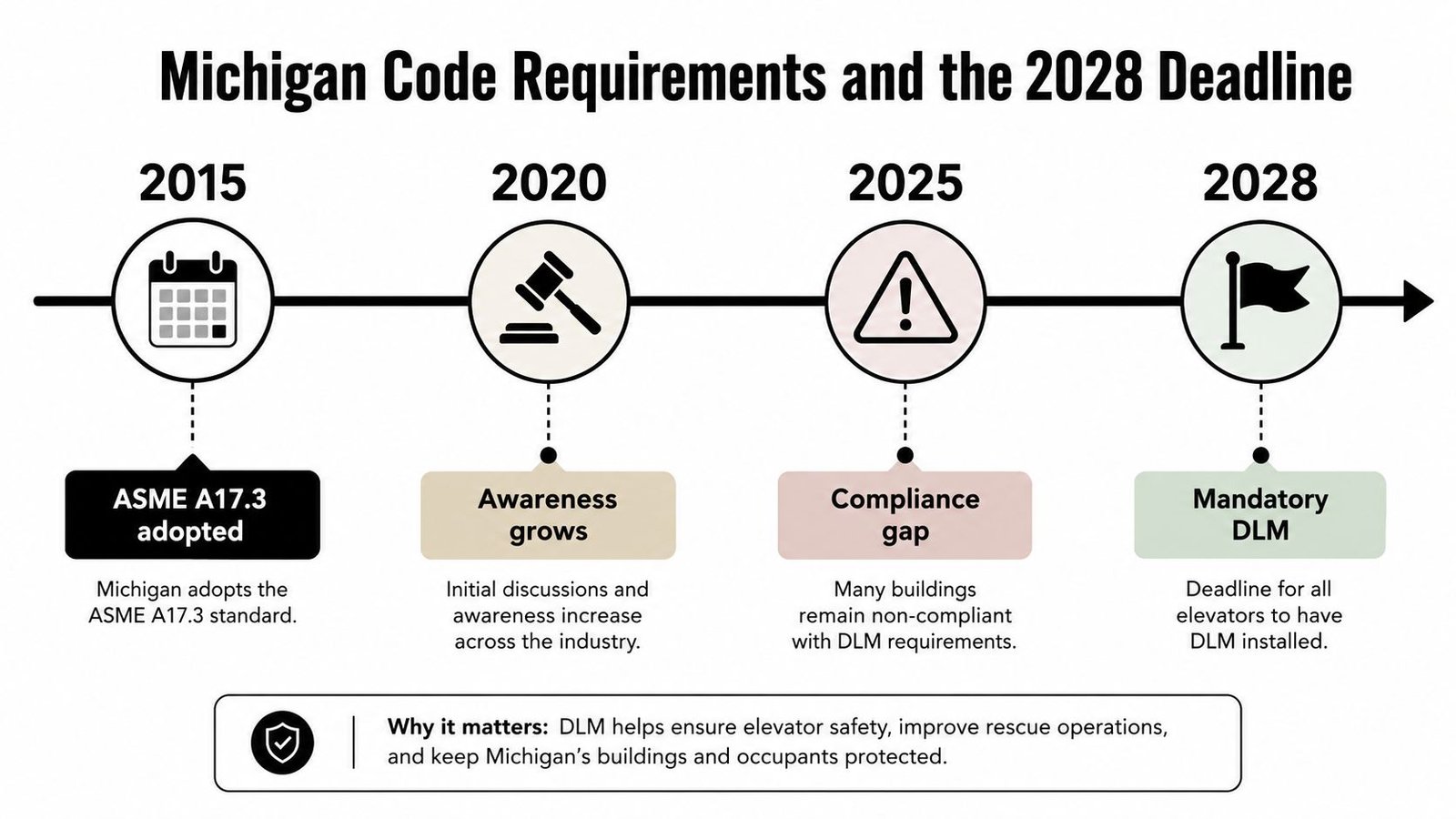
Michigan adopted the 2015 edition of ASME A17.3, and Section 3.10.12 requires a system that monitors and prevents automatic operation when the door contact circuit is faulty. Michigan Administrative Code R. 408.7030 allows remote monitoring, but it does not allow the system to reset or bypass safety devices. That distinction matters, because a device that only reports a fault isn't enough if it can't stop unsafe movement.
The compliance window to keep in mind is January 1, 2028 Michigan elevator code deadline guidance. On a job site, that means existing elevators need a demonstrable path to compliance before the deadline, and for many older units that means a retrofit project, a permit, and an inspection by a state-accepted elevator inspector. It's not paperwork for later, it's the proof that the safety function exists and works.
Waiting turns a planning problem into a scheduling problem, and scheduling problems are where owners lose leverage.
The reason that deadline matters is the same reason code enforcement matters everywhere else. Once the correction cycle starts, owners are competing with everyone else who waited. That's when vendor bottlenecks show up, inspections get pushed, and otherwise ordinary upgrades start looking like emergency work.
What to verify before you call it done
A building owner should ensure the system interrupts automatic motion, the controller logic is correct, and the installer has accounted for any required software revision. If the monitor is installed but the controller still allows the elevator to move through a fault condition, the project isn't compliant. It's only installed.
Choosing the Right Retrofit Path for Older Controllers
Older elevators usually fall into one of three buckets, and owners do not always hear that clearly in the first proposal. The choice usually comes down to a controller software or parameter upgrade, an overlay DLM device, or a full modernization that replaces the controller entirely.
How the age of the controller drives the decision
Pre-2007 equipment often needs an individual review because the controller platform may not have the right logic path for a simple software fix. Some of those units can accept an overlay monitor cleanly, but others are already at the point where the owner is paying to patch a control system that has little room left to grow. Post-2009 units may only need a software revision if the hardware already supports the function and the manufacturer's logic can be updated correctly.
A DLM project passes or fails on whether the monitor can interrupt automatic movement when a lock or gate circuit is abnormal. Bolting a box onto a backplane does not satisfy that requirement by itself. The controller has to react to the signal the way the code expects, and that is where older equipment either cooperates or forces a larger retrofit.
| Installation Era | Most Likely Path | Why |
|---|---|---|
| Pre-2007 | Overlay monitor or full modernization | Older controllers often need individual evaluation |
| 2007 to 2009 | Overlay monitor or software revision | Some systems can be upgraded, some need added hardware |
| 2009 to 2014 | Software or parameter upgrade | Many units may already have the architecture for compliance |
| 2015 and newer | Verification and testing | Often already designed around modern DLM expectations |
New York City's compliance materials put the scale of the issue in perspective. The DOB estimated that about 40,000 of the city's roughly 65,000 elevators could be affected, meaning more than 60% of the inventory potentially needed some level of upgrade or verification NYC DOB DLM compliance presentation. That is a good reminder that this is not a rare edge case. It is a broad retrofit wave that hits owners differently depending on the controller era.
For older equipment in Michigan, the decision usually starts with what the controller can do, not what a sales sheet says it should do. That means checking whether the logic can be changed in place, whether an overlay device can be tied into the existing safety chain, or whether the job is really a modernization in disguise. On some buildings, the smartest first move is to review the control package against elevator controls so the retrofit path matches the hardware instead of forcing the hardware to fit a one-size proposal.
If you are reviewing bids, ask a contractor which path fits the building and why. A good answer will mention controller logic, signal integration, and whether the system can prove actual interruption, not just installation.
How Crane Elevator Handles Maintenance, Repair, and Modernization
A DLM issue doesn't live by itself. It sits inside the bigger reality of whether the elevator is maintained by a company that understands the whole machine room, not just the one code item on the report.
What a non-proprietary service model changes
Crane Elevator Company's non-proprietary approach matters because it keeps the equipment serviceable by any qualified provider later. That's important after a DLM retrofit, since owners don't want to discover that a proprietary control package has boxed them into a single service path for years. In practical terms, long-term maintenance gets easier when the hardware and controls aren't locked behind a closed system.
Their maintenance program pairs that philosophy with work that's directly relevant to DLM-equipped elevators. That includes full clean-downs of machine rooms, pits, and car tops, COP and position indicator bulb replacements under the contract, and a No Show No Pay policy that holds the contractor accountable for missed visits. Those aren't marketing extras. They're the kind of basics that keep door equipment, contacts, and controller areas in shape so the DLM system isn't fighting avoidable dirt, wear, or neglected adjustments.
Where DLM fits in the broader service picture
Door work, hydraulic packing, jack and cable replacement, controller modernization, and code-required safety tests all intersect with the same operating reality. If the door operator is out of tune, the locks are sloppy, or the controller needs a revision, DLM can start tripping for reasons that point back to maintenance, not just hardware age. That's why the best service path looks at the whole system.
Crane also runs 24/7/365 field operations, offers free second opinions, a price-beat guarantee, and financing options for modernization work. For owners in Southern Michigan, that matters because DLM compliance is rarely the only line item on the table, and a transparent service model makes it easier to separate a targeted retrofit from an unnecessary full replacement.
Maintenance Checklist for DLM-Equipped Elevators
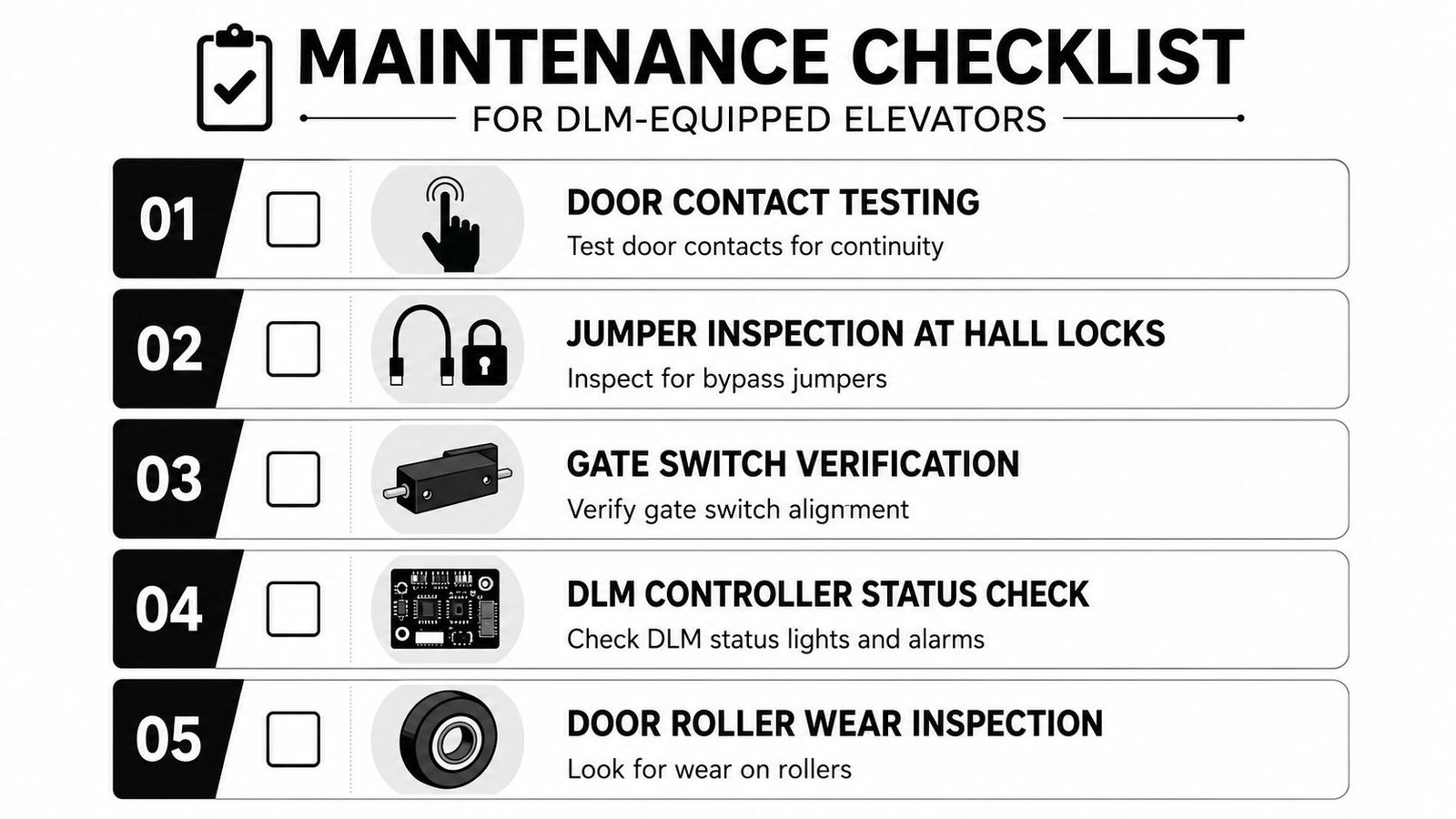
A DLM system is only as reliable as the door equipment around it. If the door circuit drifts, the monitor will keep doing its job, which is exactly why the inspection routine has to stay disciplined.
The checklist that belongs on every walkthrough
- Door contact testing. Test for continuity and make sure the circuit behaves consistently when the door is opened and closed.
- Jumper inspection at hall locks. Look for bypass jumpers or evidence that someone tried to defeat the safety path.
- Gate switch verification. Confirm the gate switch is aligned and reporting correctly.
- DLM status check. Verify fault indicators, trip behavior, and controller response.
- Door roller wear inspection. Watch for roller wear that creates nuisance faults and abnormal door movement.
That list should live as a recurring document, not a one-time signoff. Door operators drift, contacts loosen, and the condition of the hoistway door system changes over time. If you only look at DLM when the inspector shows up, you're already behind.
The items people forget
Door closer adjustment matters because a sloppy closer can make a healthy lock circuit look unstable. Rollers and guides matter because they change how the door reaches and holds its position. Hoistway door restrictors matter because they affect the way the door behaves under load.
Pit cleanliness gets overlooked all the time, and it shouldn't. A dirty pit can hide the same kinds of maintenance problems that eventually show up as door-circuit faults. If the space around the equipment is neglected, the monitor ends up exposing a maintenance problem that could've been addressed earlier.
For owners, the value of the checklist is documentation. It shows the building has a preventive program, not just reactive service, and that matters when code-required inspections and correction orders come into play.
Common Faults, Troubleshooting, and ROI of Early Compliance
A lot of DLM trouble tickets are really maintenance tickets wearing a code label. Once you've seen a few, the pattern gets obvious.
The faults that show up most often
Nuisance trips usually point to worn door rollers or a door operator that needs adjustment. The elevator isn't failing because DLM is too sensitive, it's failing because the door hardware isn't holding a steady, reliable position. The typical fix is mechanical, not mystical, and it starts with the door operator, rollers, and guides.
Intermittent faults tend to come from loose hall lock contacts or wiring that's drifting under vibration. Those are harder to chase because they don't always show up on command. A technician may need to replace a contact block or correct the wiring path before the monitor will behave predictably.
False alarms from aging power supplies show up when voltage drifts and the monitor starts reading the signal poorly. In those cases, the fix can be the DLM power supply itself, not the door hardware.
The cheapest DLM repair is the one done before a failure becomes a correction order.
The ROI case for early compliance is pretty straightforward. Routine upkeep is almost always cheaper than emergency work, and downtime irritates tenants fast. Once a deadline passes and contractors are busy, the building pays twice, once in rush conditions and again in schedule disruption.
Why timing matters now
Owners who wait too long usually lose options first, then pricing power. That's when a project that could have been scoped cleanly becomes a rushed response to an inspection failure. If another vendor has already quoted a full modernization, a free second opinion can be the difference between a targeted DLM path and an overbuilt proposal.
For Southern Michigan owners, the practical move is to schedule the DLM assessment while labor and parts lead times are still manageable. Treat the January 1, 2028 deadline as the planning anchor, not the day you start shopping.
If you're trying to sort out whether your elevator needs a software revision, an overlay monitor, or a larger modernization, Crane Elevator Company can help you read the equipment and keep the work non-proprietary. Visit Crane Elevator Company to talk through DLM compliance, maintenance, repair, or modernization for your building in Michigan.