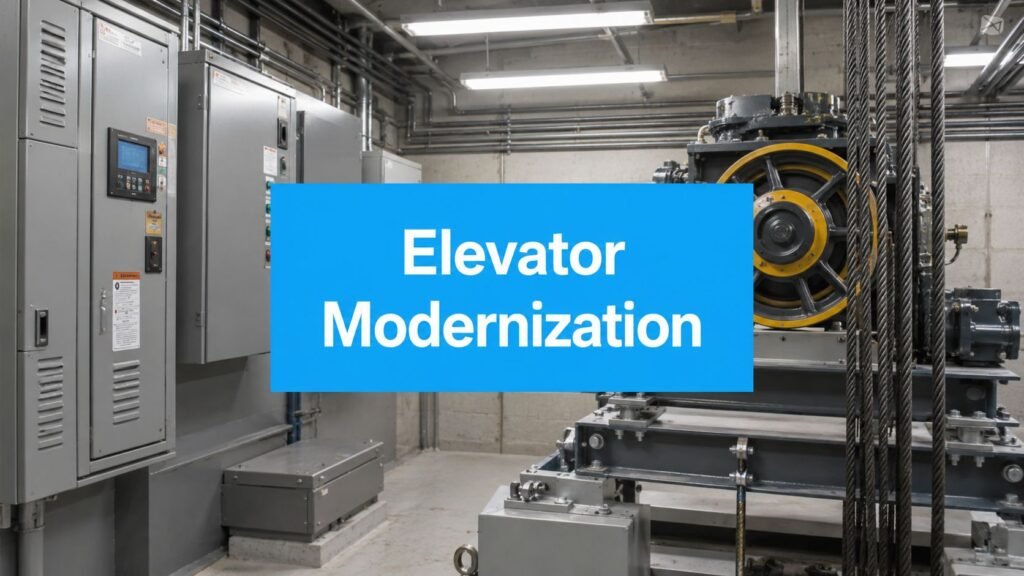
You usually don't wake up one morning and decide to modernize a passenger elevator. The call comes after the same car has been down twice this month, parts are getting harder to source, tenants are asking why the ride feels rough, or a code deadline is suddenly closer than it looked on last year's budget. In Michigan and Ohio, that's the point where modernization stops being a someday project and starts looking like a risk decision.
For a facility manager, the primary question isn't whether the elevator is old. It's whether the building can keep absorbing the downtime, callback volume, and compliance exposure that come with aging equipment. A good modernization plan protects operations first, then improves ride quality, energy use, and long-term serviceability. A bad one looks cheap on paper and expensive everywhere else.
What Passenger Elevator Modernization Actually Means
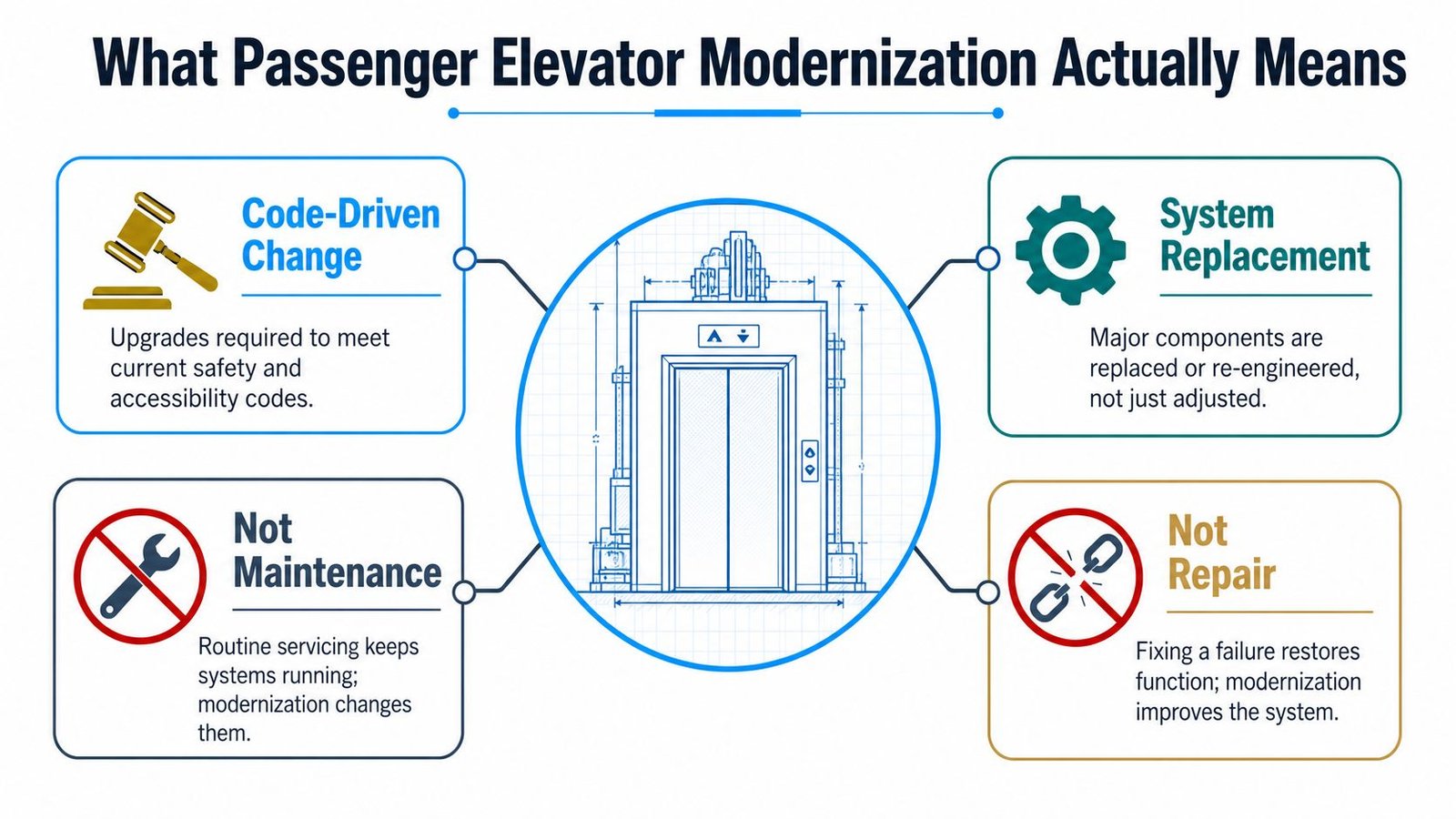
A lot of owners use modernization, maintenance, and repair as if they mean the same thing. They don't. Under ASME A17.1, modernization or alteration means changing elevator equipment, parts, components, or subsystems beyond ordinary maintenance, repair, or replacement, which is why it usually turns into a code review and permitting event instead of a simple service call. That distinction matters because the paperwork, inspection path, and budget treatment are completely different.
A 30-year-old office car in Detroit is a good example. If the door operator is noisy, the leveling is sloppy, and the controller is still running outdated logic, a mechanic can keep patching problems for a while. But once the control system, drive, and door equipment are all aging together, the building is no longer paying for isolated fixes, it's carrying a system-level risk.
What gets changed in a real modernization
The most common modernization levers are practical, not flashy. A project might replace the controller, upgrade the drive, refresh door systems, renew cab interiors, or swap out other hoistway equipment that no longer supports reliable service. Each one solves a different problem, and not every building needs all of them at once.
Practical rule: if the equipment can still be maintained predictably with available parts and stable logic, keep it in service. If service is starting to depend on workarounds, scavenged components, or repeated callbacks, modernization is already on the table.
The capital-project label matters because it changes how owners plan the work. Maintenance keeps the car running. Repair restores a failed component. Modernization changes the system itself, and that's why the building team has to think about scope, permitting, traffic impact, and future serviceability, not just the price of the next truck roll.
When a Passenger Elevator Is Ready for Modernization
Age gives you the first signal, but it shouldn't be the only one. Industry guidance often starts at about 20 years of service, and that lines up with the way OEMs describe the aging installed base. Otis says more than 7 million of the world's 21 million elevators are already more than 20 years old, and expects that number to more than double to 15 million within the next decade, while TK Elevator reports that over 50% of elevators in North America and Europe are more than 20 years old, according to Roland Berger's modernization market overview.
The triggers that matter more than age
Age tells you when to look. Failure patterns tell you when to act. If the building keeps seeing repeated entrapments, rising callback frequency, or parts that are discontinued, the elevator is already sending a maintenance bill that's really a modernization warning.
Code pressure can move the decision forward too. In Michigan and Ohio, existing-elevator work can be pulled into compliance timing through current standards, especially where door protection, safety testing, or monitoring requirements are involved. When the compliance clock and the reliability clock hit together, waiting usually costs more than planning.
A building owner doesn't need a perfect failure to justify modernization. Repeating trouble, hard-to-find parts, and code exposure are enough.
The most useful triage rule is simple. If the car is aging but stable, continue maintenance and plan ahead. If the car is aging and the calls are getting more frequent, schedule a modernization assessment. If the car is aging, failing often, and part availability is uncertain, fast-track the project before downtime becomes the project manager.
Modernization Costs by Scope and Building Type
Owners usually ask for one number, but passenger elevator modernization does not work that way. The price depends on what is being changed, how much downtime the building can absorb, and whether the car is a light-duty unit or a heavily used traction elevator serving a busy public building. A controller-only project is a different job from a full modernization, and a full replacement is different again.
| Passenger Elevator Modernization Cost Ranges by Scope | |||
|---|---|---|---|
| Scope | Typical Cost per Elevator | Best Fit For | Downtime Impact |
| Controller-only upgrade | USD 75,000 to USD 150,000 | Older cars with good mechanical structure but outdated logic | Lower, usually shorter shutdown windows |
| Partial modernization | Qualitative range only, depends on selected systems | Buildings that need reliability gains but can't justify full replacement yet | Moderate, often phased |
| Full modernization | USD 250,000 to USD 500,000 per elevator | Cars with multiple worn subsystems, rising callbacks, or major compliance gaps | Higher, because more systems are touched |
| Full replacement | USD 400,000 to USD 750,000+ | Units that are too far gone for efficient rehabilitation | Highest, usually the longest interruption |
Those ranges come from a cost-planning guide for elevator modernization and replacement, which also notes that modernized elevators can reduce annual repair costs by 60% to 75% in the first five years, largely by cutting emergency callouts and exposure to discontinued parts, an elevator modernization cost guide from OxMaint.
For many owners, the smartest move is not the biggest project. It is the scope that cuts the highest operating risk first. A controller upgrade often gives the best reliability return per dollar, while cosmetic work can wait until the car is mechanically stable. That trade-off is why I point owners to the full breakdown of elevator modernization expenses on Crane's modernization cost overview, because the budget has to match the building's traffic pattern and the amount of downtime it can tolerate.
Michigan and Ohio Codes That Shape Your Project
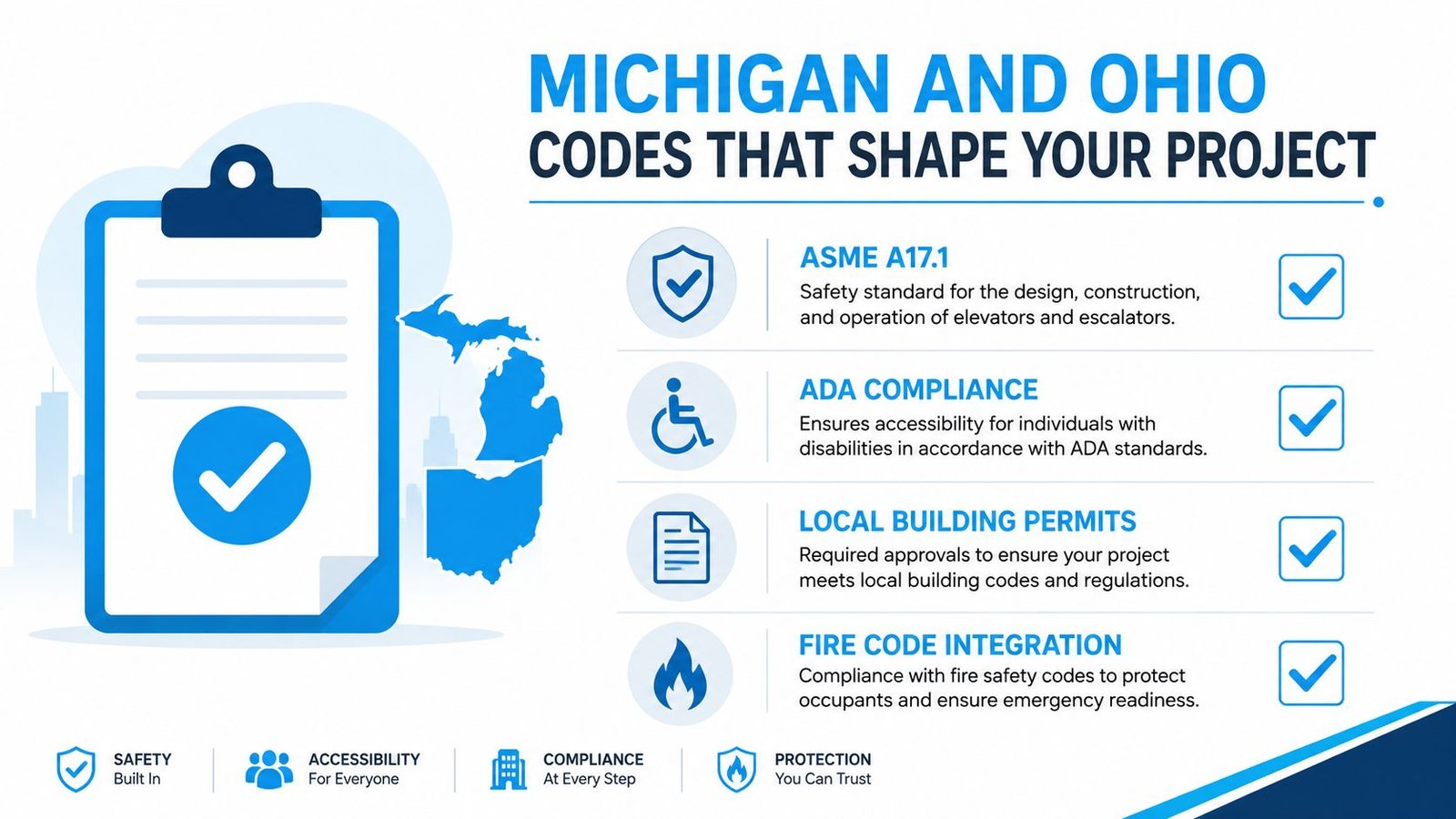
A modernization job gets expensive fast when an owner treats it like a parts swap. In the field, it is a code-compliance event with hardware attached. The maintenance side, the alteration side, and the inspection side all come together during the project, and a good contractor plans for that from day one.
The code items that change the schedule
ASME A17.1 requires a documented Maintenance Control Program, or MCP, that spells out the examinations, tests, cleaning, lubrication, and adjustments for each conveyance. For traction elevators, that same framework calls for a five-year full-load safety test in addition to annual inspections, so modernization has to be coordinated with the building's maintenance records and testing history, as noted in this maintenance control reference.
Michigan and Ohio owners also need to account for existing-elevator requirements under ASME A17.3 and state-level rules such as Michigan Administrative Code R. 408.7030 for door lock monitoring. Ohio projects follow parallel Bureau of Elevator Inspection expectations, which means the paperwork burden does not disappear just because the car still runs. For a practical overview, see a complete guide to elevator code requirements.
What inspectors actually measure
A modernization spec from a county project shows the tolerances that matter in the field. The car speed has to stay within ±3% of contract speed under any loading condition, the car has to safely lower, stop, and hold 125% of rated load, and the stopping zone has to remain within ±1/4 inch under any loading condition, as stated in this modernization specification.
Code does not just ask whether the elevator looks updated. It asks whether the car behaves correctly when loaded, monitored, and inspected. Owners who budget only for equipment usually miss the inspection work, and the inspection process is what determines whether the modernization is complete.
Where Modernization Delivers the Most Operating Value
Not every upgrade changes the day-to-day experience in the same way. Some projects look impressive in a brochure and barely move the maintenance needle. Others change how the building runs every single day.
Traffic control and dispatch
Destination dispatch and intelligent group control are the biggest functional leap for busy buildings. Instead of simple up-and-down calls, the system groups riders by destination and assigns cars more efficiently, which cuts wasted stops and improves throughput in office, healthcare, and residential settings. In a building with rush periods, that means fewer complaints about slow service and less pressure on staff to explain why everyone is waiting at the same time.
Energy and electrical efficiency
A second high-value path is regenerative drives paired with LED lighting and efficient motors. Regenerative drives capture braking energy during descent and feed it back into the building's electrical system, which helps lower operating energy use. That doesn't replace good maintenance, but it does give owners a measurable operating improvement that lives with the elevator for years.
Monitoring and maintenance quality
The third lever is IoT sensors and remote monitoring. These tools shift maintenance away from purely reactive repair and toward condition-based servicing, so fault diagnosis happens earlier and troubleshooting gets shorter. In healthcare, schools, and municipal buildings, that matters because availability is part of the service promise, not just a nice-to-have.
Owner takeaway: the biggest gains usually come from the control system, the drive, and the monitoring package. Cosmetic work improves perception, but it rarely changes how often the building calls for service.
Non-proprietary controls matter here too. If the modernization leaves the owner locked into one vendor for every future adjustment, the building inherits a long-term cost problem. If the controls and drives can be serviced by any qualified provider, the owner keeps options open and avoids paying monopoly pricing for routine support.
Modernizing Without Shutting Down an Occupied Building
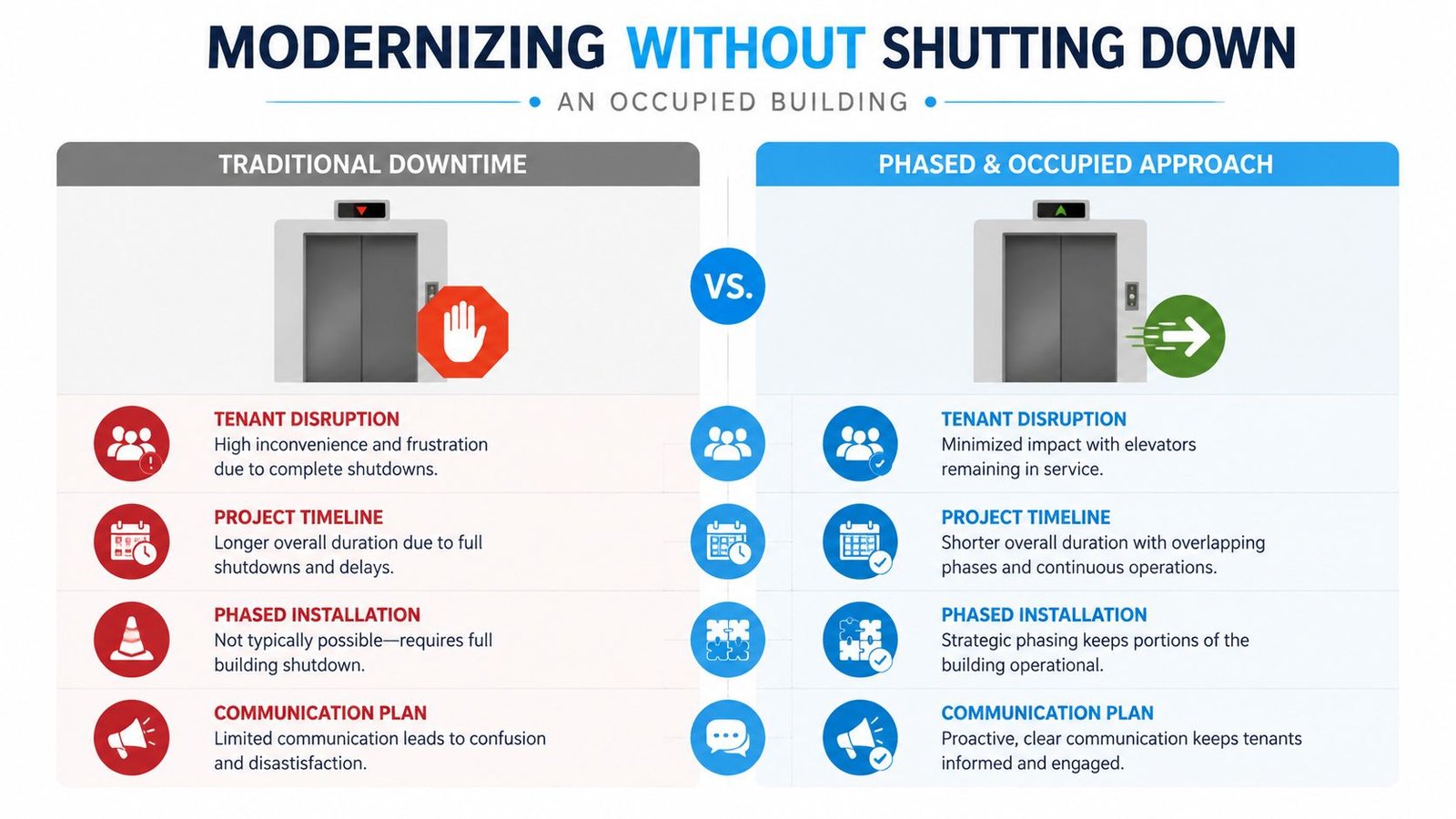
Most owners never get the easy version of modernization. Hospitals still move patients. Schools still change classes. Mixed-use buildings still have tenants who need access, deliveries still come in, and a dead elevator quickly turns into a building-wide complaint. That is why the downtime plan matters as much as the equipment list.
Three ways to stage the work
A full shutdown gives the contractor the cleanest access, and it creates the most disruption. It can make sense when several subsystems are failing together, or when the building can shift traffic to other cars and other routes for a short window. In practice, that option is best when the owner can absorb the pain all at once and wants the fastest path through the work.
A phased modernization splits the job into logical stages, such as the controller first, then the drive, then doors or cab finishes later. That approach usually fits occupied buildings best because it spreads risk, keeps one part of the system usable while another part is being rebuilt, and lets the owner see operating gains before the cosmetic work is finished. A partial targeted upgrade is narrower still. It works when the main goal is to stop repeat failures without taking on a full rehab.
The right scope usually comes down to occupancy patterns, not pride. In a healthcare building, the project has to protect patient movement and staff flow. In a school, the schedule may need to fit breaks or low-traffic windows. In a mixed-use tower, you may have to work around office peaks in the morning and tenant traffic later in the day. The wrong sequence can create more disruption than the old equipment ever did.
The most expensive modernization is often the one that keeps a building functioning poorly for too long.
A good occupied-building plan also starts with serviceability after the project is done. A guide to modernizing elevator systems in occupied buildings should cover that part plainly, because the owner should not be locked into one vendor for every future adjustment. Non-proprietary service keeps the building easier to maintain and keeps future costs more predictable. Good phasing protects the building during the work and keeps support practical afterward.
What to Expect From an Inspection and Quote Visit
A proper inspection visit starts with the maintenance record, not the sales pitch. The field team looks at the machine room, pit, hoistway, door locks, controller, drive, and cab, then compares what's on site with what the building has been seeing in service. If the car is due for a five-year safety test, that history needs to be in the file too.
In practice, a representative Michigan office building gets a very matter-of-fact visit. The mechanic wants to know which callbacks keep repeating, whether the controller has known obsolescence issues, and what the building can tolerate in downtime. A good quote follows that reality, with options that separate immediate reliability work from cosmetic work and from full modernization.
What to have ready before the visit
- Service records: Bring maintenance logs, callback notes, and any prior violation paperwork.
- Building schedule: Share occupancy peaks, delivery windows, and any blackout dates for tenants or staff.
- Known issues: Note entrapments, leveling problems, door faults, and anything that seems to happen repeatedly.
- Access details: Confirm who can provide machine room, roof, pit, and security access.
- Budget guardrails: Give a realistic ceiling so the quote comes back with usable options.
Crane's maintenance program also includes a No Show, No Pay policy, full clean-downs of machine rooms, pits, and car tops, plus COP and PI bulb replacements, so owners should already know what's covered before modernization gets priced separately. That makes the quote conversation more useful because it starts with the building's actual condition, not a generic assumption.
Smart Ways to Reduce Lifetime Modernization Costs
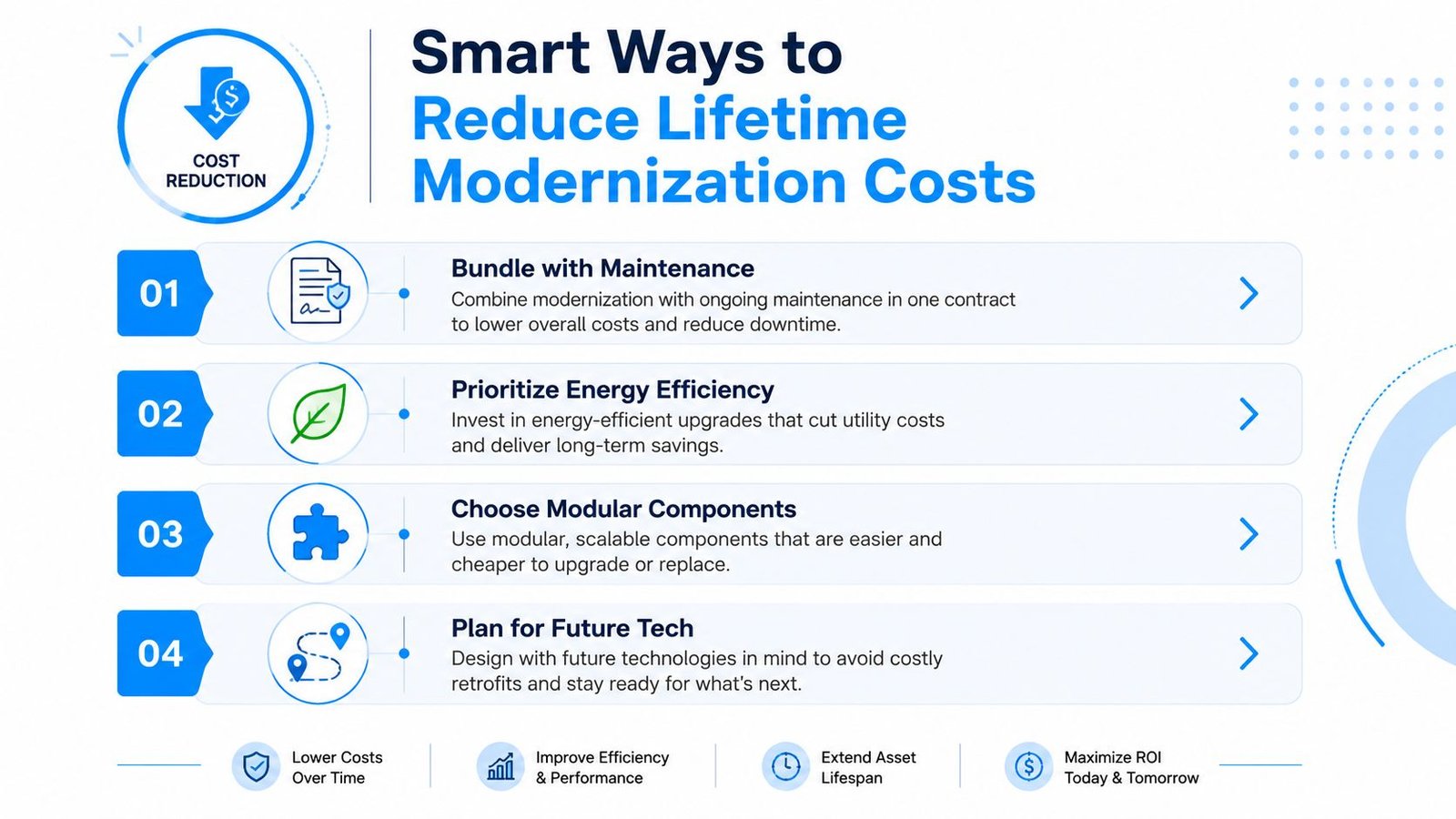
Sticker price is only part of the cost. The owner who thinks only about the first invoice usually misses the decisions that shape the next ten years of service.
The decisions that hold costs down
- Bundle with Maintenance: Keeping modernization aligned with an existing service relationship can reduce duplicated mobilization and make post-project support simpler.
- Prioritize Energy Efficiency: Regenerative drives, efficient motors, and LED lighting make the electrical side of the project work harder for the owner.
- Choose Modular Components: Modular parts are easier to replace later, which helps keep downtime and labor complexity down.
- Plan for Future Tech: Non-proprietary controls and drives make it easier to keep the elevator serviceable as technology changes.
The biggest mistakes are just as predictable. A cosmetic-only mindset leaves the expensive reliability problems untouched. Ignoring door lock monitoring deadlines creates compliance pressure later. Skipping a documented MCP after the work is done leaves the owner without a maintenance roadmap, which means the old chaos comes back under a newer panel.
A good contract makes the future easier to manage, not harder. If the proposal doesn't explain how the system will be serviced, who can service it, and what parts strategy is being used, the owner should ask for a better one. That's especially true in Michigan and Ohio, where building teams need predictable costs more than they need fancy language.
If you're weighing passenger elevator modernization in Michigan or Ohio, especially in Toledo and the surrounding cities, Crane Elevator Company can help you sort out maintenance, repair, and modernization with a non-proprietary plan that fits the building instead of forcing the building to fit the equipment. Visit Crane Elevator Company to talk through your elevator's condition, your downtime limits, and the smartest way to keep it reliable for the long run.