
A hotel elevator rarely gets noticed when it works. Guests check in, load their luggage, press a button, and reach their rooms without thinking about the equipment carrying them through the building. When a lift stops at the wrong time, however, the entire property feels it. A stalled car can delay a wedding party, prevent housekeeping from moving carts, disrupt room service, and leave a guest with limited mobility waiting for a workable route.
That's why lifts for hotels should be managed as critical infrastructure, not as a building accessory. The right system supports guest comfort, staff productivity, accessibility, fire-service operations, and long-term control of repair costs. The wrong system creates recurring callbacks, difficult inspections, obsolete parts, and avoidable disruption.
The Critical Role of Lifts in Hotel Operations
A Friday evening arrival period at a downtown Detroit hotel places unusual pressure on vertical transportation. Guests arrive with luggage at the same time that employees are moving linens, banquet supplies, food, and maintenance equipment. If the main passenger lift becomes unavailable between floors, the front desk has to manage complaints while engineering staff coordinate a response and other departments try to work around the outage.
The operational problem extends beyond waiting time. Housekeeping may not be able to move carts efficiently, room-service deliveries take longer, and a property may struggle to provide practical access to rooms on upper floors. Guests might never know which internal department caused the delay, but they'll associate the entire experience with the hotel.
Passenger lifts became a defining feature of large urban hotels during the mid-19th century. New York's Fifth Avenue Hotel is widely credited with installing the first hotel passenger elevator in 1859, and luxury hotels in New York, London, and Paris helped establish upper floors as desirable guest space rather than an inconvenience, as documented in the history of the passenger lift's first decade. By the 1860s, passenger lift use was expanding in Great Britain, reinforcing the idea that hotels were early adopters of vertical transportation.
The lift affects every department
A well-planned elevator group supports more than the lobby:
- Front desk operations: Reliable service reduces the need to explain delays, redirect guests, or manage repeated complaints.
- Housekeeping: Service access keeps carts, linen, waste, and supplies out of guest circulation where possible.
- Food and beverage: Banquet kitchens, restaurants, and room-service areas often create concentrated movement between floors.
- Events: Wedding parties and conference groups can produce sharp demand peaks that a lightly occupied weekday doesn't reveal.
- Accessibility: Guests with mobility or visual impairments need dependable access, clear controls, and usable emergency communication.
- Engineering: Complete service records and predictable maintenance make it easier to identify recurring faults before they become disruptive failures.
Practical rule: If a hotel's lift strategy only considers guest room counts, it's missing the movement created by staff, luggage, events, parking, restaurants, and service areas.
Downtime also carries indirect costs. A hotel may provide concessions, absorb emergency labor, rearrange rooms, or postpone planned work so a failed unit can be returned to service. The larger cost is often operational uncertainty. Owners can't manage lifecycle spending well when every repair is treated as an isolated emergency instead of part of an asset plan.
Types of Lifts Used in Modern Hotels
A hotel lift system should match the property's daily movement, not just its height or room count. A compact boutique hotel may need one passenger lift and a small service solution. A convention property may need separate passenger, service, and freight capacity. The wrong mix can create long waits, damaged finishes, staff conflicts, and higher maintenance costs during arrivals, breakfast, checkout, and event changes.
The main categories serve different purposes:
| Lift Type | Typical Capacity | Primary Application | Key Features |
|---|---|---|---|
| Passenger lift | Sized for expected guest traffic and luggage | Guest rooms, lobby, amenities, and public floors | Finished cab interiors, accessible controls, smooth ride quality |
| Service lift | Sized around carts and staff movement | Housekeeping, linen, waste, and back-of-house circulation | Durable finishes, wider doors, impact resistance |
| Freight lift | Selected for heavy equipment and materials | Banquet operations, loading areas, construction, and major deliveries | Reinforced protection, commercial-grade door systems, heavy-duty operation |
| Limited-use or platform lift | Determined by the route and application | Short vertical connections and accessibility retrofits | Compact installation options, barrier-free access |
| Wheelchair or mobility lift | Determined by device and route requirements | Areas where a conventional elevator is difficult to install | Accessible controls, appropriate transfer space, safety restraints where applicable |
| Dumbwaiter | Sized for items rather than passengers | Food, laundry, documents, and small supplies | Compact shaft, interlocked doors, controlled loading |
The passenger lift is the most visible part of the system. Guests notice door movement, leveling accuracy, lighting, noise, cleanliness, and call response. A car can remain technically operational while still feeling unreliable if it vibrates, levels poorly, or closes against luggage. Cab finishes and controls also need to meet accessibility requirements rather than serving only as design details.
A service lift should be specified as a working machine, not as a smaller passenger car. Housekeeping carts, linen loads, waste containers, and maintenance equipment produce different wear at entrances, sills, walls, and car floors. Wall protection, suitable door clearances, durable flooring, and direct back-of-house routes help keep staff traffic away from guest lifts.
Freight equipment handles a separate class of work. Convention rooms, banquet kitchens, loading docks, and renovation projects may involve materials that can damage a standard passenger cab. Planning should cover delivery routes, staging areas, fire separation, and the movement of large items without sending carts through crowded public spaces. In Michigan and Ohio, the selected equipment and installation must also align with the applicable building, accessibility, and fire requirements for the project.
Design choices that affect guest flow
Destination-dispatch systems group passengers traveling to similar floors. They can improve traffic organization, but only when the lobby layout, controls, signage, and staff procedures support them. Dispatch software cannot correct an undersized group, poor door performance, or unrealistic traffic assumptions.
In some hotels, improving door operation, leveling, dispatch settings, or service traffic separation produces more useful results than specifying a higher rated speed. Owners should also ask whether replacement controls, drives, and fixtures can be sourced through non-proprietary channels. That choice can affect future parts availability, contractor options, and lifecycle cost.
A practical overview of different types of lifts helps owners compare equipment categories before planning a new installation or modernization. The right question is which combination supports guest, staff, and material movement while meeting local requirements and keeping future maintenance manageable.
Capacity Planning and Traffic Analysis
Elevator sizing starts with traffic, not sales literature. A hotel can have enough nominal car space and still produce unacceptable waits if guest luggage, door dwell, stops, and event surges aren't included in the analysis.
A commonly used hotel planning benchmark is 12% to 17% five-minute handling capacity, with desired average intervals of roughly 25 to 40 seconds for good service, according to a CIBSE-based hotel traffic planning reference. Separate elevator-industry guidance notes that resort hotels may tolerate around 10% handling capacity in five minutes, because resort demand patterns differ from dense business and event properties. These figures are planning benchmarks, not promises. The building's population, room distribution, amenities, and operating schedule still control the result.
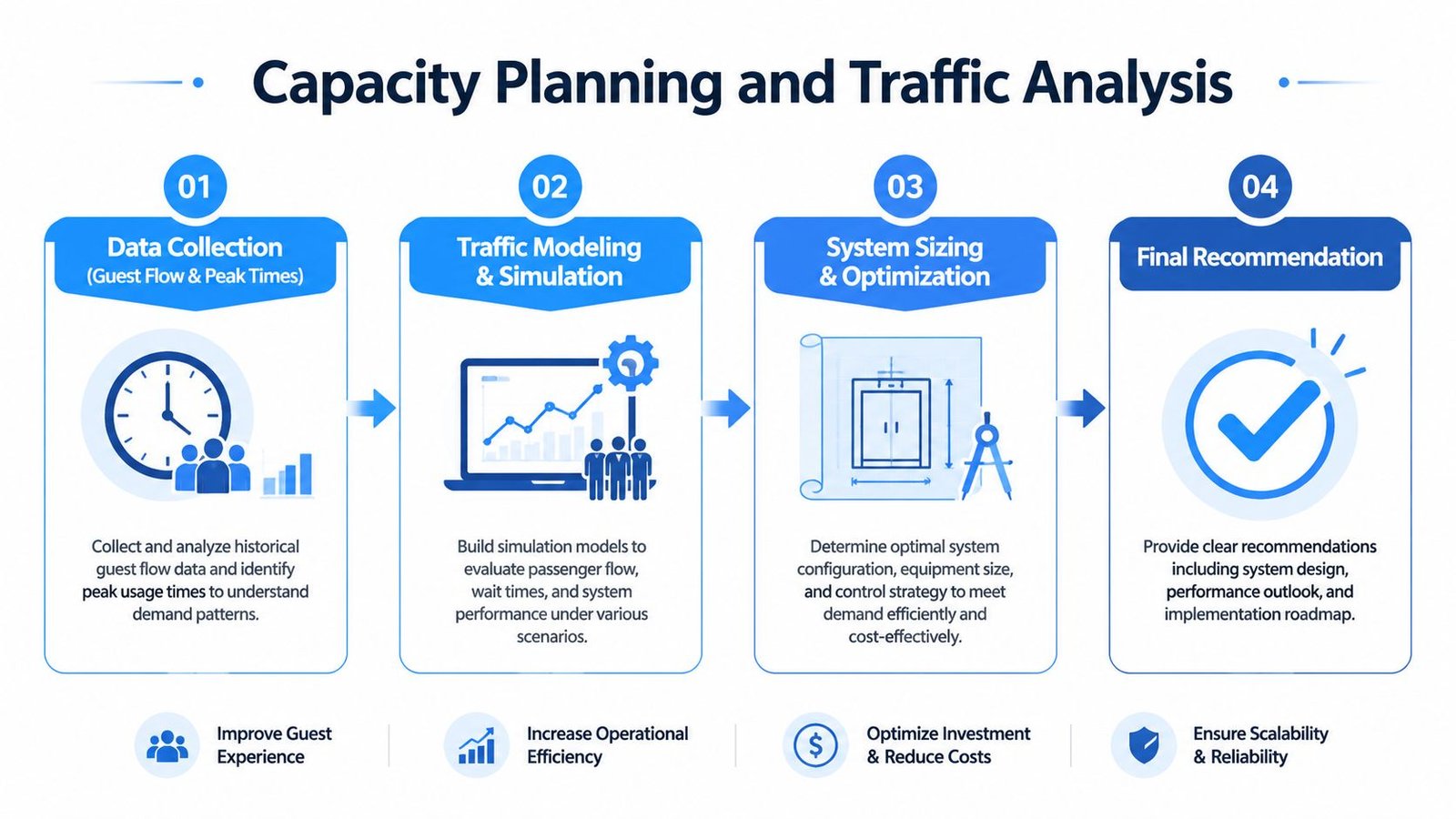
Build the analysis in four steps
Collect actual movement data. Review room count, expected occupancy patterns, staff circulation, luggage movement, parking connections, restaurant locations, meeting spaces, and arrival schedules. Guest complaints and front-desk observations can reveal problems that a design drawing won't show.
Separate the traffic patterns. Model up-peak arrivals, down-peak departures, interfloor guest travel, breakfast movement, and event changes. A hotel with meeting rooms above the lobby may experience a very different demand profile from a property where amenities are spread across several floors.
Calculate usable loading. Hotel guests carry bags, push carts, and leave personal space between passengers. Expert guidance recommends planning around approximately 40% to 55% of nominal car load, rather than assuming office-style loading, as explained in the same hotel lift traffic modeling reference.
Model the full round trip. Round-trip time includes floor travel, passenger stops, door opening and closing, door dwell, and passenger transfer. The reference gives the relationships UPPINT = RTT/L and UPPHC = (300 × L × P)/RTT, which illustrate why reducing stops and door losses can matter as much as increasing speed.
A 150-room business hotel in Ann Arbor and a 300-room resort near Traverse City shouldn't be sized from the same template. The resort may have sharp group arrivals, luggage surges, and movement between lodging, dining, recreation, and parking. The business property may see more predictable weekday peaks but still need strong performance at check-in and checkout.
Speed is only one input. A fast car with excessive stops, long door dwell, or poor dispatching can deliver worse service than a properly configured moderate-speed system.
Navigating ADA and Fire Code Requirements
Hotel lift compliance involves overlapping obligations. Accessibility affects cab layout, controls, indicators, door operation, and the route to the elevator. Fire-service requirements affect emergency operation, recall behavior, power arrangements, signage, and coordination with building systems. A design that satisfies one requirement can still fail when the complete operating environment is reviewed.
The Americans with Disabilities Act is a federal requirement for public accommodations, but hotel owners also need to coordinate state rules, local enforcement, adopted building codes, and applicable elevator safety standards. The ADA requirements for elevators should be reviewed alongside project-specific code documents, not treated as a substitute for them.
| Requirement Category | ADA Standard | Fire Code Mandate | Impact on Hotel Operations |
|---|---|---|---|
| Cab access | Usable space, accessible entrance, and appropriate maneuvering | Emergency operation must preserve required responder functions | Affects shaft planning, room layout, and renovation feasibility |
| Controls | Reachable buttons, tactile or Braille identification, and usable placement | Fire-service controls and operating modes must be clearly identified | Requires coordinated panel design and staff awareness |
| Communication | Emergency communication must be usable by guests with disabilities | Emergency systems must support response and building procedures | Requires testing, documentation, and clear escalation protocols |
| Floor information | Audible and visual information supports independent use | Emergency modes may change normal indications and operation | Staff must understand what guests will experience during an event |
| Doors and leveling | Door timing, reopening, and level accuracy affect access | Fire and smoke conditions can change elevator operation | Poor adjustment can create both accessibility complaints and safety concerns |
| Power and recall | Normal access depends on reliable operation | Firefighter operation, recall, and emergency power may apply | Requires coordination among elevator, fire alarm, generator, and building teams |
Modernization projects create common trouble spots. A replacement controller may affect fire-service operation. New finishes can reduce clearances. A door operator adjustment may improve reliability but still need verification against accessibility expectations. A property that adds rooms, changes amenity floors, or reconfigures a lobby should review lift access as part of the building project rather than after construction is underway.
Michigan and Ohio owners also need to track inspection and maintenance obligations that apply to the equipment category. The safest approach is to maintain a compliance file containing inspection reports, test results, callbacks, repairs, alterations, and communication with the authority having jurisdiction.
Accessibility is also a guest-experience issue. A lift that technically runs but has confusing controls, poor leveling, unreliable emergency communication, or inadequate space around the entrance can still create an exclusionary experience. Compliance is the baseline. Usability is the standard guests remember.
Maintenance Strategies for Reliability and Compliance
Reactive repair is unavoidable when a component fails, but it shouldn't be the operating strategy. Hotels run lifts in public view, under luggage loads, with frequent door cycles and little tolerance for disruption. Preventative maintenance gives the contractor a chance to identify deteriorating doors, leaking hydraulic equipment, weak batteries, dirty machine rooms, control faults, and safety-system issues before guests encounter them.
Independent hospitality maintenance guidance recommends a layered program that includes daily visual checks, monthly lubrication and brake or door review, quarterly rope and controller diagnostics, semi-annual safety-device testing, and annual full-load code inspections, as described in this hotel elevator maintenance guide. Those intervals should be adapted to equipment type, traffic, environment, manufacturer requirements, and local authority rules.
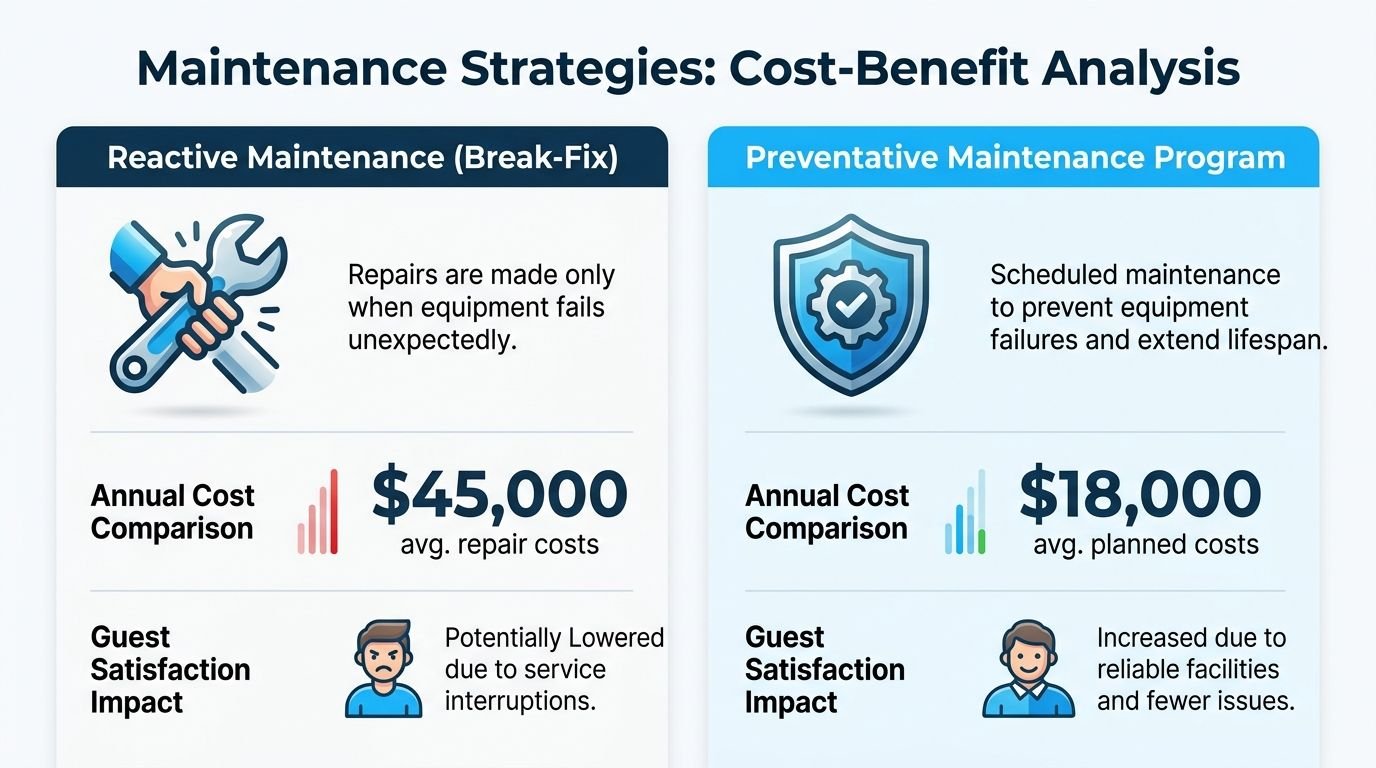
What a useful hotel program includes
A competent maintenance visit should go beyond checking whether the car moves:
- Door systems: Inspect locks, rollers, tracks, operators, reopening devices, and alignment. Door faults are highly visible to guests and often create recurring callbacks.
- Hydraulic equipment: Look for packing deterioration, oil leaks, tank condition, valves, cylinders, and power-unit performance.
- Traction equipment: Review ropes, sheaves, brake operation, machine condition, guide components, and ride quality.
- Safety circuits: Test applicable safeties, interlocks, limit devices, emergency stops, and communication systems.
- Environmental conditions: Keep pits, hoistways, machine rooms, and car tops clean and free of contamination that can affect equipment.
- Records: Document callbacks, repairs, replacements, inspections, testing, and recommendations in a format the hotel can audit.
Michigan requires power elevators, with certain exceptions, to be maintained at least once every 90 days by a state-licensed elevator journeyperson. Lower-risk devices, including dumbwaiters, one-person elevators, platform lifts, and stairway chairlifts in non-private-residence buildings, are maintained at least every 180 days, under Michigan's maintenance rule. The same rule requires an ongoing written record of maintenance, repairs, replacements, inspections, callbacks, and testing to remain on-site or in the machine room.
Ohio's maintenance rules require hoistways and pits to remain clean and free of dirt, rubbish, and standing water. Machine-room floors and car tops must be free of oil or grease, while valves and cylinders must be properly packed to prevent leaks, as set out in Ohio's elevator maintenance requirements.
A service agreement should state what's included, how callbacks are handled, which parts are excluded, and how emergency response is managed. The cheapest monthly agreement often becomes expensive when every adjustment, test, or return visit is billed separately.
Modernization vs Repair Decision Framework
Repair makes sense when the equipment has a stable control system, parts remain available, failures are isolated, and ride quality and safety performance remain acceptable. Modernization becomes more compelling when the same faults return, obsolete components delay restoration, or the existing system can't support current accessibility, fire-service, or operational needs.
Recent modernization guidance identifies several practical triggers, including discontinued controls with lead times exceeding 3 months, callback rates above once per month despite maintenance, degraded ride quality, and safety components approaching end of life, as outlined in hotel elevator modernization guidance. These are decision signals, not automatic replacement rules. A qualified assessment should connect them to the property's traffic, occupancy, operating budget, and planned renovations.
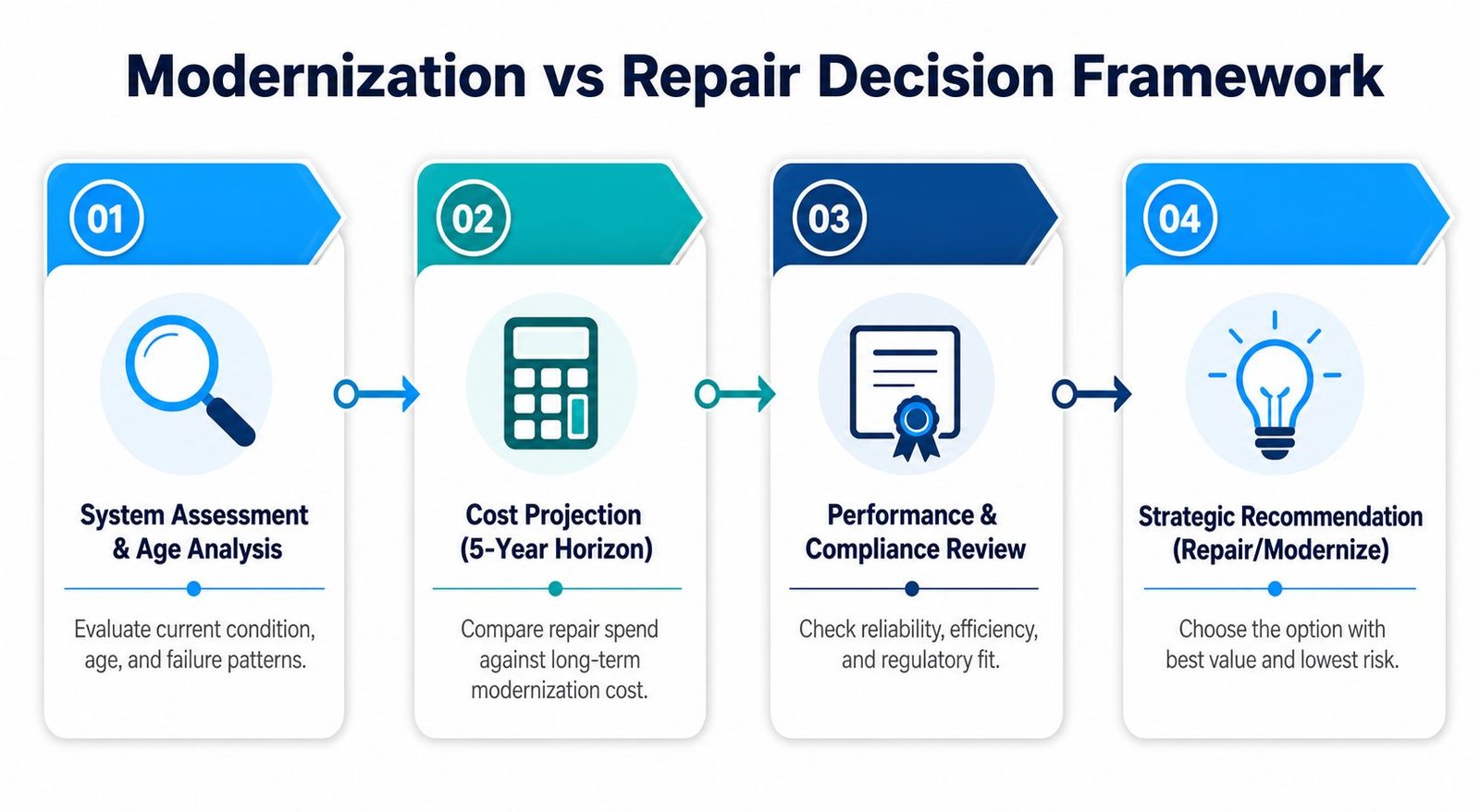
Assess the whole lifecycle
Start with the equipment condition and service history. Then compare the likely cost of continued repairs with a modernization plan that includes lost service during construction, temporary operating arrangements, code work, finishes, controls, and future parts availability.
Public-safety reporting shows why owners shouldn't treat inspection performance as an abstract concern. Hong Kong's EMSD reported 29,084 lift and escalator inspections in the period covered by its contractor ratings release, while Ontario's 2025 public safety reporting documented 2,772 failed elevator-related inspections among the cases reviewed, according to the modernization source linked above. Those figures don't determine a Michigan or Ohio project, but they reinforce the value of documented inspections, competent maintenance, and early planning.
Non-proprietary modernization deserves careful consideration. A proprietary controller or specialized component can tie the hotel to one supplier for service and parts. A non-proprietary approach can preserve service flexibility by allowing qualified providers to maintain the system, provided the selected equipment is appropriate, documented, code-compliant, and supported by a capable contractor.
Match the project to the property
A hotel doesn't always need a complete replacement. Options may include:
- Targeted repair: Appropriate for a localized failure with no broader pattern.
- Phased modernization: Useful when the property has several cars and can remove units from service in sequence.
- Controller and door modernization: Often considered when dispatch, leveling, door reliability, or parts access are the main problems.
- Full equipment replacement: More suitable when major safety, machine, hydraulic, structural, or obsolescence issues converge.
- Financed modernization: Can align project payments with capital planning instead of forcing an unplanned cash outlay.
A board-ready proposal should show condition, service history, code exposure, operational effect, alternatives, and lifecycle implications. The cheapest immediate repair isn't always the lowest-cost ownership decision.
The following video provides additional visual context for evaluating elevator modernization and repair decisions:
Actionable Next Steps for Hotel Owners
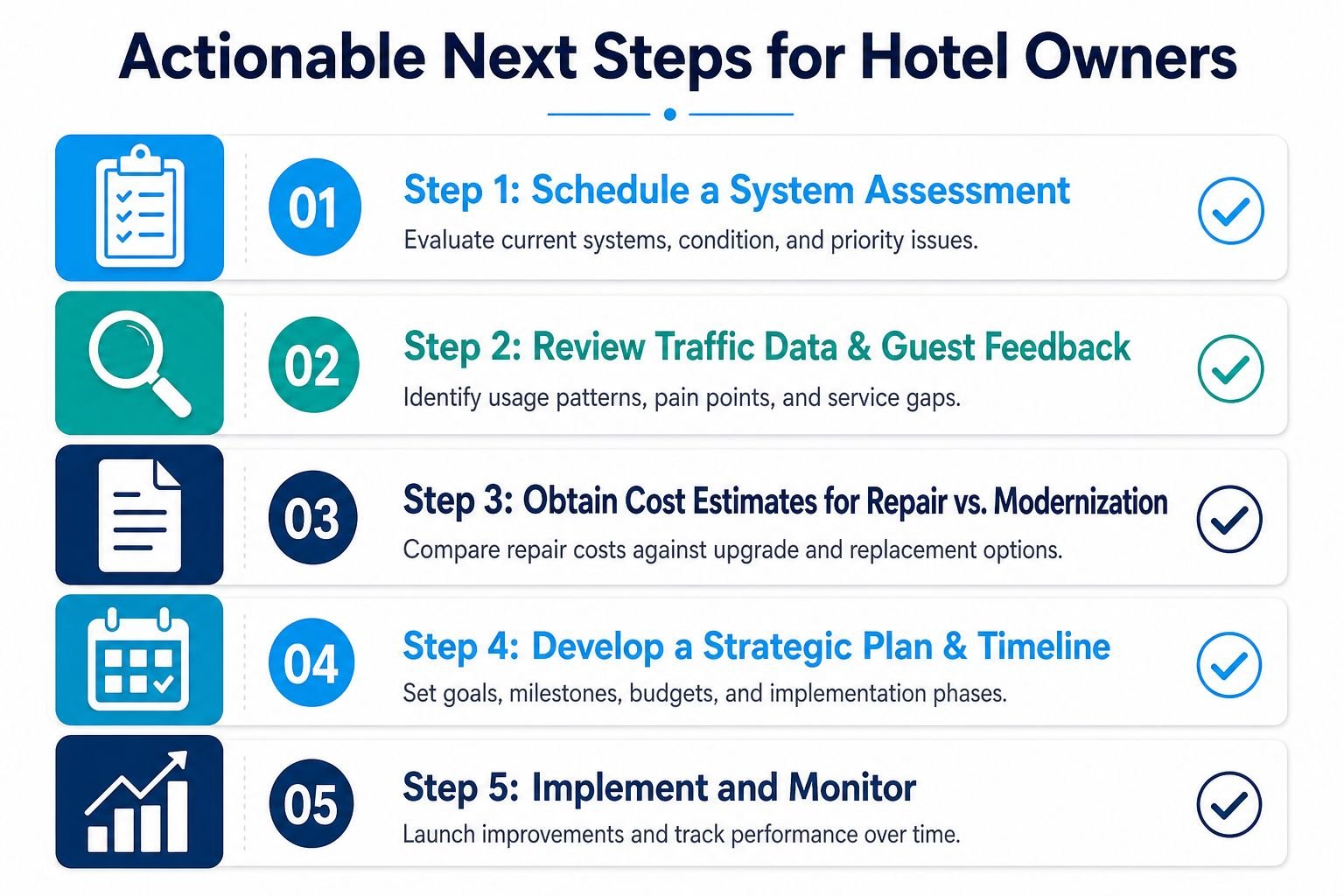
Hotel owners and facility managers in Detroit, Toledo, Ann Arbor, Lansing, Flint, Kalamazoo, Perrysburg, and surrounding communities can begin with a focused system review. The objective isn't to order new equipment immediately. It's to replace uncertainty with documented condition, operational evidence, and a defensible plan.
Start with the records
Gather equipment inventories, installation and alteration documents, inspection reports, maintenance reports, callback history, violation notices, emergency-phone test records, and guest complaints. Ask engineering and front-desk teams when failures occur, which cars are avoided, and whether problems cluster around doors, leveling, controls, or communication.
Then request an independent condition assessment. It should identify immediate safety and compliance concerns, recurring faults, parts-obsolescence exposure, accessibility issues, and the difference between a repairable defect and a system-level problem.
Compare providers on more than price
A useful bid should identify the exact scope, exclusions, response process, testing responsibilities, documentation, warranty terms, and anticipated downtime. Ask whether the proposed modernization uses non-proprietary equipment and whether qualified providers can service it in the future.
Michigan's inspection schedule generally requires covered passenger elevators and related devices to be inspected at least every 12 months, while certain lower-risk devices have a 24-month inspection interval, according to Michigan's inspection rules. Ohio requires passenger elevators, escalators, moving walks, and freight elevators to be inspected twice every twelve months, while permanently installed power dumbwaiters and other non-person-carrying lifting equipment generally require inspection at least every 12 months, under Ohio's inspection statute. Confirm the exact application with the relevant authority and licensed professionals.
Use a practical 90-day sequence
- Early assessment: Inspect equipment, review records, interview staff, and identify urgent corrections.
- Planning period: Collect comparable repair and modernization proposals, including downtime assumptions and financing options.
- Approval stage: Present ownership with lifecycle alternatives, guest-impact controls, and a recommended schedule.
- Implementation setup: Coordinate permits, inspections, shutdown notices, guest communication, contractor access, and contingency arrangements.
- After completion: Verify testing, documentation, staff procedures, warranty obligations, and a continuing maintenance schedule.
Ohio properties should also confirm that cleaning and leak-control practices remain part of the routine program, not just a response to an inspection comment. Michigan properties should maintain the written records required by the state rule.
A strong plan protects the guest experience while giving ownership a clearer view of future spending. It also lets the hotel schedule disruptive work around occupancy and events instead of waiting for a failure to make the decision.
Crane Elevator Company provides preventative maintenance, repairs, code-required inspections, and full non-proprietary modernization services for hotel lifts across Michigan and Ohio, including Toledo and surrounding cities. Visit Crane Elevator Company to request a system assessment, free second opinion, competitive quote, or modernization financing discussion for your property.