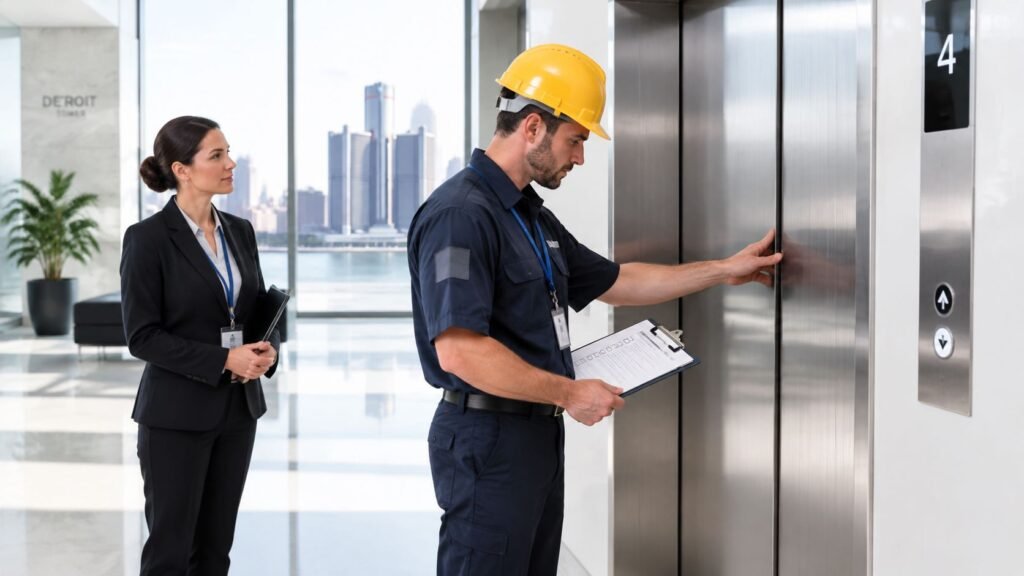
A yellow correction notice on the elevator room door changes the day quickly. So does a property manager's realization that the current contractor has stopped returning calls. In Detroit, the problem isn't only getting a car moving again. The owner also has to understand which rule applies, who must inspect the equipment, what paperwork must remain current, and whether the service contract covers compliance work.
Detroit Elevator Services operate under a municipal code layered over Michigan requirements and technical elevator standards. That local overlay affects inspection timing, service responsibility, permits, testing, and the way a building returns an elevator to operation. The practical guidance below is written for owners and managers of commercial buildings, multifamily properties, healthcare facilities, schools, industrial sites, and homes with lifts.
What Detroit Elevator Services Actually Cover
A Midtown owner may call after finding a correction notice taped to the elevator room door. A Troy property manager may call while comparing bids because the existing contractor no longer answers callback requests. In both situations, the first mistake is treating elevator service as a single repair visit.
A complete Detroit elevator service program can include preventive maintenance, troubleshooting, code testing, modernization, emergency response, and documentation. The city code covers the design, installation, registration, maintenance, alteration, inspection, testing, repair, and decommissioning of elevators, escalators, dumbwaiters, and moving walks, as described in the Detroit elevator code provisions.
Maintenance is more than lubrication
A technician should inspect the complete system, not just grease guide rails and leave. Depending on the equipment, the work may involve:
- Traction equipment: Controller diagnostics, brake checks, sheave and cable evaluation, machine-room cleaning, and adjustment of door and leveling functions.
- Hydraulic equipment: Hydraulic packing, tank and power-unit work, jack evaluation, oil-related checks, and inspection of valves and fittings.
- Safety systems: Door lock monitoring, emergency phones, fire service operation, generator testing, and required safety tests.
- Passenger access: Audible signals, button braille, car operating fixtures, lighting, and other accessibility-related upgrades.
- Building records: Maintenance logs, inspection reports, violation corrections, permit material, and the documentation supporting a current Certificate of Operation.
A service agreement should state what happens after a callback, what parts and testing are included, whether clean-downs cover the machine room, pit, and car top, and who handles correction notices. Some contracts cover routine labor but bill testing, emergency generator work, replacement parts, or after-hours response separately.
Practical rule: Ask for the contract exclusions before you compare the monthly price. A cheaper agreement can become expensive if every compliance task is treated as an extra.
Detroit's shorter service cadence makes continuity especially important. The city requires covered equipment to be maintained under its elevator code, and most covered equipment must be inspected and serviced at least quarterly. Power elevators, escalators, and moving walks face a more frequent requirement, discussed below. A contractor that maintains the equipment, documents the work, and follows violations through closure gives the owner a stronger compliance process than a company that only responds after a shutdown.
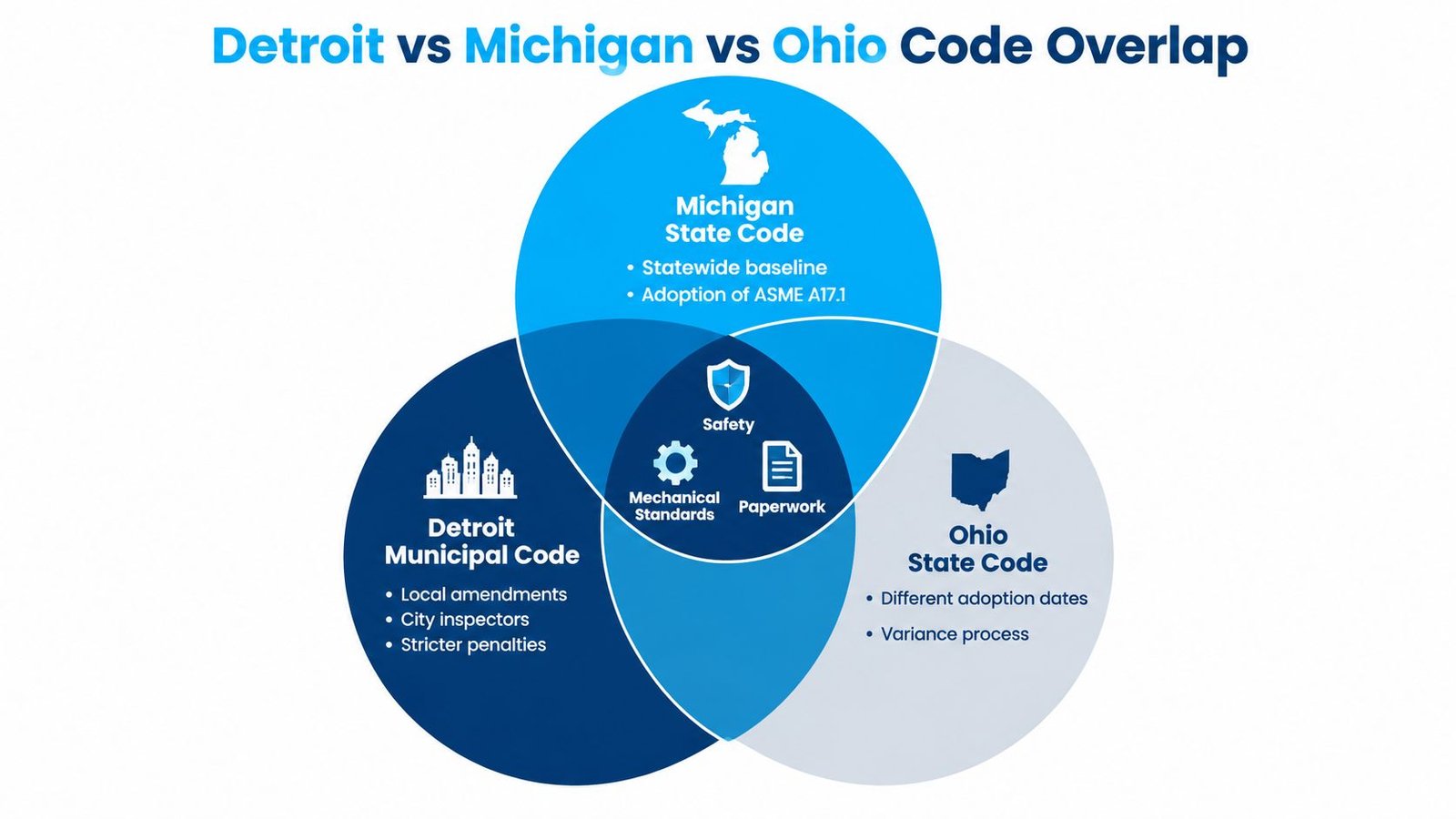
Detroit vs Michigan vs Ohio Code Overlap
A Detroit elevator project can satisfy Michigan requirements and still fail a city review. The reason is the local overlay. Detroit has its own elevator code, inspection process, and administrative requirements, while Michigan and Ohio apply their own state-level frameworks.
The City of Detroit Elevator Code is Article IX of the 2019 city code, adopted on October 1, 2019. It addresses installation, registration, maintenance, inspection, testing, repair, alteration, and decommissioning. Detroit also maintains an Elevator Inspection Team for licensing, complaint investigations, elevator code questions, and accident reporting, according to the City of Detroit elevator inspection information.
Michigan requirements remain part of the Detroit compliance picture. Covered elevators need a current certificate of operation, supported by the required inspections and records. The state also separates equipment by category, so a passenger elevator, platform lift, dumbwaiter, or stairway chairlift may follow a different inspection route.
Ohio has its own elevator code and certificate process through the Ohio Department of Commerce. A filing package prepared for a Michigan building cannot be copied unchanged to a Toledo or Cleveland property. The equipment may be similar, but the authority, forms, inspection path, and certificate procedure can differ.
Reading the overlap in practice
Start with the property address. Detroit brings the city code and city inspection process into the job. Other Michigan properties generally use the statewide pathway, subject to local administration. Ohio work follows Ohio's process.
Then classify the equipment and confirm the applicable technical rules. Installation, alteration, and testing requirements depend on the device configuration and the adopted standards. The paperwork must match that classification. A permit, inspection report, certificate of operation, test record, and correction notice each document a different part of compliance.
The practical risk is usually administrative, not mechanical. A contractor can understand the elevator equipment and still miss a Detroit filing requirement or use the wrong certificate procedure elsewhere. Use this Detroit elevator code requirements guide as a starting reference, then confirm the current requirement with the authority having jurisdiction before work begins.
Inspection and Service Frequencies Explained
Detroit's schedule is tighter for power equipment than the routine cycle many owners associate with elevator maintenance. The city requires power elevators, escalators, and moving walks to be inspected and serviced at least every 30 days by a city-licensed unlimited-elevator journeyperson. Special permission may extend the interval to 90 days for very low-use equipment, but that exception isn't automatic, as stated in the Detroit inspection and service provisions.
Other covered equipment is generally serviced at least quarterly. Michigan's rules also distinguish device categories. Walks, belt manlifts, and special elevating devices require inspection at least once every 12 months, while stage lifts, dumbwaiters, stairway chairlifts, one-person elevators, hand-powered one-person elevators, platform lifts, and power sidewalk elevators require inspection at least once every 24 months, according to the Michigan Elevator Code document.
| Jurisdiction | Routine Service Cycle | Code Inspection Frequency | Authority |
|---|---|---|---|
| Detroit | Power elevators, escalators, and moving walks at least every 30 days, unless an approved extension applies; other covered equipment generally quarterly | City and state requirements depend on the equipment and certificate pathway | City of Detroit Elevator Inspection Team and applicable Michigan authority |
| Michigan outside Detroit | Varies by equipment and applicable state requirements | Annual or biennial cycles can apply by device category | Michigan state elevator authority and applicable local authority |
| Ohio | Follow the applicable Ohio service and inspection requirements for the device | Ohio certificate and inspection process | Ohio Department of Commerce and applicable certified inspectors |
A routine service visit is maintenance work. It can include cleaning, lubrication, adjustment, door checks, and operating observations. A code inspection is an authority-facing examination that produces a formal result and may require written correction work. One doesn't replace the other.
A Detroit portfolio therefore requires more scheduling discipline than a portfolio made up only of equipment in jurisdictions with longer routine intervals. The contract should identify the visit frequency, assigned journeyperson, callback response, test scope, reporting process, and responsibility for elevator testing services.
What Inspectors Check on Site
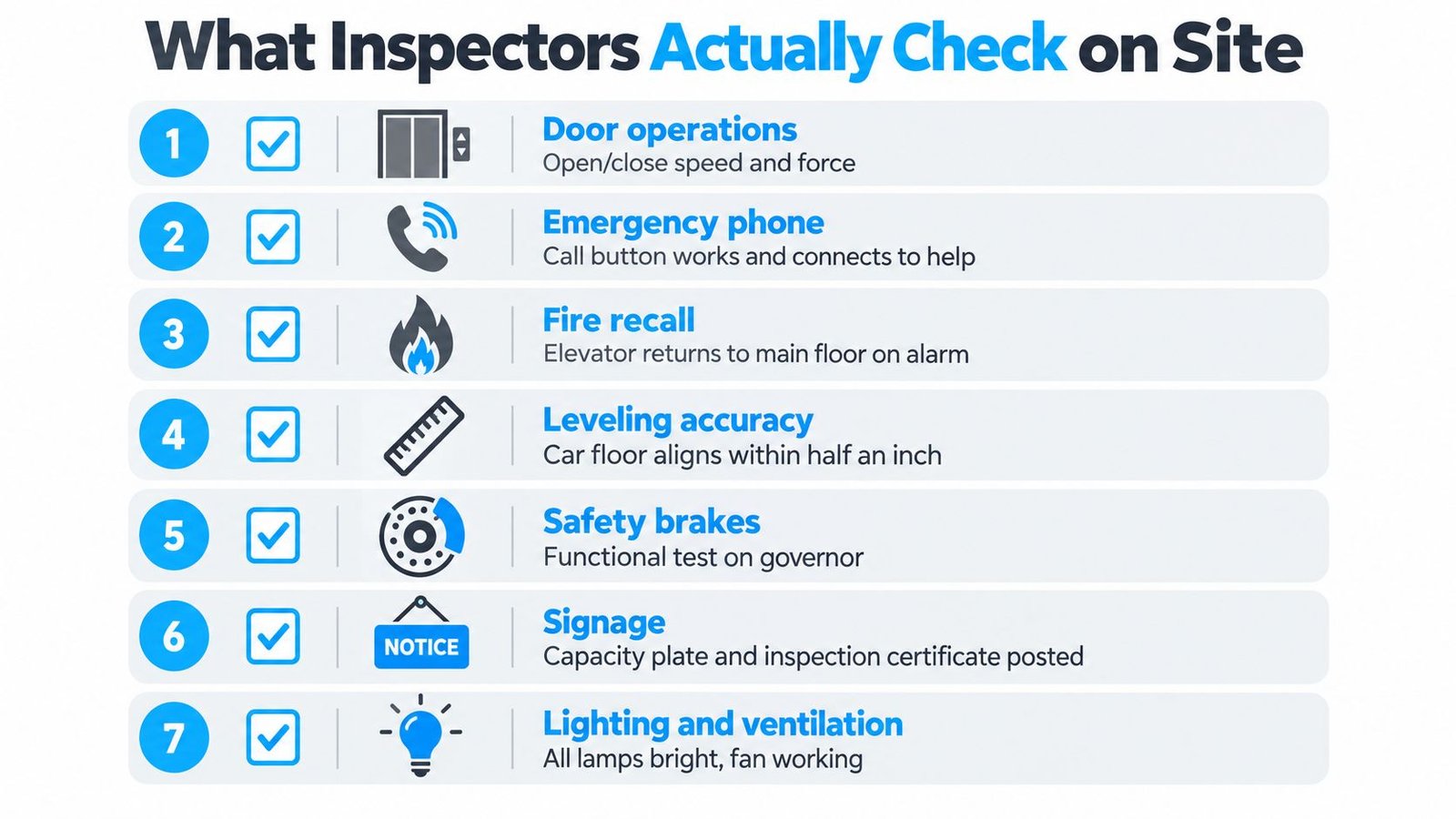
A Detroit inspection reaches beyond the cab. The inspector may ride the elevator, watch door operation, enter the pit and machine room, test safety functions, review posted information, and compare performance with the equipment's required records. Detroit's inspection team is checking whether the installation operates safely and whether the documentation supports that conclusion.
Passenger-facing functions receive close attention. Door interlocks must prevent operation when landing doors are unsecured. Reopening devices must respond correctly, while the door system should avoid excessive force, erratic timing, and nuisance reversals. Leveling also matters. A car that stops above or below the landing creates a trip hazard, particularly for older adults and wheelchair users.
A manager's pre-inspection walk
Before the appointment, a building manager can check these conditions:
- Door operations are consistent: The doors open, close, reopen, and lock without unusual hesitation or noise.
- Emergency communication works: The car phone or two-way device connects occupants with the designated help point.
- Fire service functions: Phase I recall and Phase II in-car operation respond to the building fire alarm interface and key switches.
- Leveling remains accurate: The car floor meets the landing without a noticeable step. The infographic below identifies the expected half-inch alignment check.
- Safety equipment is accessible: Pit stop switches, governor-related equipment, limit switches, and other safety components are not blocked or visibly damaged.
- Machine-room conditions are suitable: Ventilation, lighting, housekeeping, and access remain acceptable.
- Signs and records are posted: Capacity information, inspection certificates, operating instructions, and required notices are present and legible.
Door locks, emergency phone faults, and expired certificates commonly lead to corrections. These problems can remain unnoticed during ordinary cleaning because the elevator still travels between floors. A technician should test the functions and record the results, not just report that the car runs.
Before the inspector arrives, operate every elevator under normal and emergency conditions. A quiet cab does not prove that the phone, recall, leveling, and door protection work.
Service Coverage Across Michigan and Ohio
Regional service coverage matters because an elevator contractor has to understand both the equipment and the authority having jurisdiction. A Detroit high-rise, a Lansing medical office, an Ann Arbor institutional building, and a converted industrial property near Kalamazoo may use similar mechanical principles, but the filing and inspection path can differ.
Crane Elevator Company serves Detroit, Lansing, Ann Arbor, Grand Rapids, Toledo, Cleveland, and surrounding areas. That footprint also reaches communities such as Perrysburg, Flint, Kalamazoo, Howell, Monroe, Pontiac, Jackson, Battle Creek, Saginaw, and smaller industrial towns across Michigan and Ohio. The service scope includes passenger and freight elevators, hydraulic and traction equipment, residential elevators, wheelchair and platform lifts, material lifts, dumbwaiters, escalators, and moving walks.
Coverage is a code question too
A single service account can be useful for an owner with properties in different cities, but only if the contractor keeps the jurisdictional records separate. Detroit's municipal process shouldn't be confused with the Michigan state certificate process, and Ohio documentation shouldn't be copied from a Michigan file without review.
| Region | Primary Code Authority | Typical Buildings Served |
|---|---|---|
| Detroit and Southeast Michigan | City of Detroit and applicable Michigan elevator authorities | High-rises, multifamily buildings, hospitals, schools, municipal properties, industrial sites |
| Lansing and central Michigan | Michigan state and applicable local authorities | Government buildings, offices, healthcare, education, mixed-use properties |
| Ann Arbor and Grand Rapids | Michigan state and applicable local authorities | Hospitals, universities, apartments, offices, retail, and manufacturing |
| Toledo and northwest Ohio | Ohio elevator authority and applicable local authorities | Industrial facilities, hospitals, apartments, offices, and commercial buildings |
| Cleveland and surrounding Ohio communities | Ohio elevator authority and applicable local authorities | Commercial towers, healthcare, education, multifamily, and industrial buildings |
| Smaller Michigan and Ohio towns | Applicable state and local authority | Older freight installations, rural facilities, homes with lifts, and adaptive-reuse buildings |
The practical advantage is continuity. The same service team can maintain a century-old freight car, troubleshoot a newer passenger unit, plan a non-proprietary modernization, and support a wheelchair lift, while the office staff tracks the local paperwork separately. That combination helps owners avoid the common failure of treating every jurisdiction as though it uses one universal checklist.
Who Is Allowed to Inspect and Service Your Elevator
A contractor arrives for a callback, opens the machine-room door, and starts work. Before that happens, the building owner should know who is authorized to enter, what task is covered, and which authority receives the resulting record. Detroit's Elevator Inspection Team handles municipal inspections, licensing matters, complaints, code questions, and accident reports. Private maintenance and testing require an appropriately licensed contractor and qualified personnel.
Detroit rules identify a city-licensed unlimited-elevator journeyperson for the required inspection and service cadence covering power elevators, escalators, and moving walks. A building engineer or general maintenance worker may support routine operations, but that role does not automatically authorize every elevator inspection, test, repair, or adjustment.
Michigan has its own licensing and certificate structure. Ohio uses the Department of Commerce elevator system and certified inspection pathways. Requirements can vary by device and project, so a general construction, electrical, or machinery-repair license should not be treated as elevator authorization.
Verify the assignment before work starts
Ask for the contractor's license information and the mechanic's qualifications. Have the written scope identify:
- The person doing the work, including state-issued identification and role.
- The task being performed, whether maintenance, code testing, repair, alteration, or acceptance testing.
- The record recipient, such as the owner, manager, inspector, or authority.
- The party closing corrections, since the company repairing a violation may not submit completion evidence.
- The after-hours contact, including dispatch and escalation procedures.
The scope should match the equipment and jurisdiction. A Detroit elevator company can also clarify whether its team handles inspection coordination, testing records, or only mechanical service. Before access is granted, confirm insurance, lockout procedures, machine-room and pit access rules, and whether subcontractors will perform any portion of the work. Those details prevent a qualified mechanic from arriving without the authorization or documentation needed for the specific assignment.
Permits, Fees, and Paperwork You Should Expect
A Detroit elevator job can be mechanically complete and still fail administratively. The owner may be dealing with a local permit, a state operating certificate, inspection records, and correction paperwork at the same time. Keeping those documents tied to the correct elevator prevents a simple filing gap from delaying approval.
Detroit's published schedule lists a $25.00 elevator code fee, an inspector rate of $134.00 per hour, a $36.00 replacement fee for an elevator capacity sign, and a $235.00 fee for a permanent elevator used temporarily. Emergency generator and fireman return service tests are listed at $134.00 per hour, as shown in the Detroit BSEED elevator fee schedule.
Public fees are separate from the contractor's maintenance or repair price. The owner may also pay for labor, parts, engineering, permit preparation, reinspection support, testing coordination, and corrections after a failed inspection. Have the contract state which public fees are passed through and which paperwork the contractor prepares.
Build the file around each elevator
Use a separate file for every unit. Include:
- Current certificate of operation and renewal records.
- Detroit permit material or applicable state documentation.
- Routine maintenance reports and callback history.
- Code inspection reports and correction notices.
- Test records for safety equipment, fire service, emergency communication, and generators.
- Equipment data, controller information, capacity details, and modernization records.
- Insurance certificates and contractor credentials.
The Detroit elevator permit and the Michigan certificate of operation document different parts of compliance. The permit addresses local administration, while the certificate confirms operating status through the applicable state process. Michigan and Ohio may use different state or local records, so do not assume a Detroit filing satisfies an Ohio or Michigan requirement.
A correction notice deserves a line-by-line review. Record the affected unit, cited condition, required action, response deadline, and any reinspection requirement. Missing controller data, an expired certificate, an absent capacity sign, or outdated insurance paperwork can delay the file even when the mechanical repair is straightforward.
| Item | Detroit BSEED | Michigan and Ohio typical |
|---|---|---|
| Elevator code fee | $25.00 | Varies by authority and filing |
| Inspector time | $134.00 per hour | Varies by authority |
| Replacement capacity sign | $36.00 | Varies by authority |
| Permanent elevator used temporarily | $235.00 | Varies by authority |
| Emergency generator and fireman return service tests | $134.00 per hour | Varies by authority |
| Operating documentation | Detroit permit and applicable certificate records | State or local certificate records, depending on jurisdiction |
Compliance Tips for the Next Inspection Cycle
A reliable compliance routine starts with the logbook, not the inspection appointment. Record every callback with the date, time, car number, reported symptom, technician response, temporary action, and permanent repair. Patterns become visible when the manager can compare repeated door faults, leveling complaints, phone failures, and shutdowns against the service history.
Run the cycle as a working checklist
Q1 should establish the baseline. Review door safety tests, update maintenance logs, and confirm that machine-room and pit clean-downs are documented. Check that the certificate and posted capacity information match the equipment.
Q2 should focus on communication and fire response. Test the emergency phone according to the maintenance procedure, review the fire recall menu, and confirm that Phase I and Phase II key-switch functions are included in service records. Verify the two-way communication power supply and building alarm tie-ins.
Q3 should catch wear before it becomes a shutdown. Measure leveling, inspect cables and visible components for wear, lubricate guide rails where required, and review recurring callbacks with the service contractor. A callback log is valuable only when someone uses it to change the maintenance plan.
Q4 should prepare the authority-facing file. Schedule the inspector, assemble permits and certificates, collect test reports, and set a repair budget for known deficiencies. Owners should plan the inspection early enough to leave time for corrections and reinspection before a certificate expires.
The most overlooked items are often small but consequential. Check fire service Phase I and Phase II switches, emergency phone batteries, lobby smoke-detector connections, door-restrictor force settings, pit stop switches, machine-room ventilation, and certificate postings. For a townhouse or home with a residential lift, confirm the applicable state certificate and local permit pathway rather than assuming commercial elevator rules apply unchanged.
Crane Elevator Company provides preventive maintenance, repairs, testing, inspections, emergency response, violation corrections, and non-proprietary modernization for elevator equipment across Michigan and Ohio. If your Detroit property needs a review, gather the current certificate, recent service records, open correction notices, and equipment list before requesting a scope of work.
Contact Crane Elevator Company for a Detroit elevator service review covering maintenance, testing, emergency communication, fire service, documentation, and correction work. Ask for a practical assessment of your equipment and a written plan that fits Detroit's local inspection requirements and your building's operating needs.