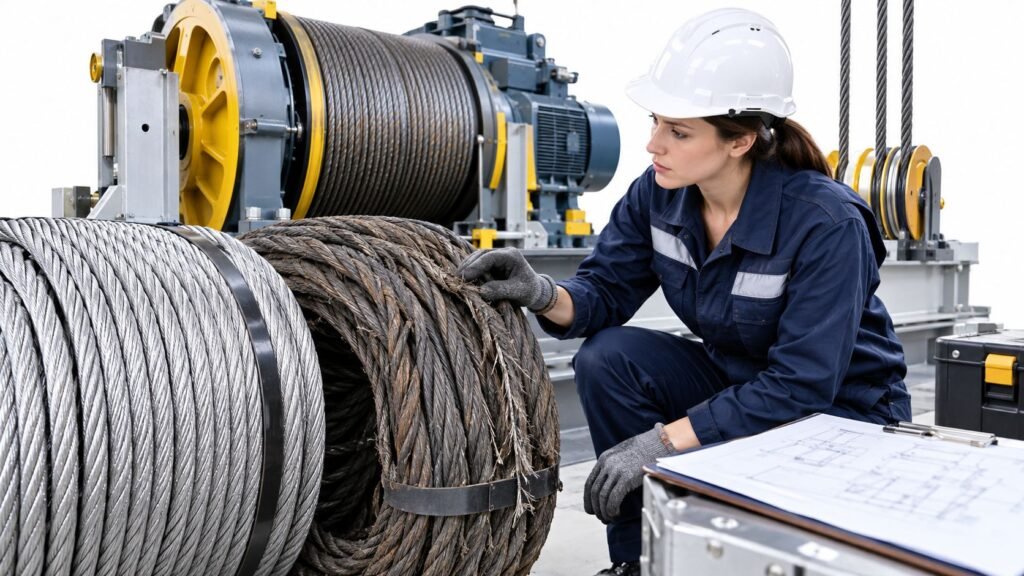
A freight elevator goes down, and the problem starts with a machine-room inspection. The ropes look worn, the inspector has flagged deterioration, and the quote on your desk is far higher than the cost of “new cables” you expected. That surprise is common because freight elevator cable replacement is usually a whole-equipment decision, not a simple parts swap.
The ropes may be the immediate reason for the shutdown, but the work can expose worn sheaves, tired bearings, governor issues, damaged structural supports, outdated controls, and deferred pit or overhead repairs. Facility managers in Detroit, Lansing, Ann Arbor, Grand Rapids, Toledo, Cleveland, and surrounding communities need a scope that explains those costs before approving the job.
Why Freight Elevator Cable Replacement Is Never Just a Rope Job
A facility manager stands in the machine room with a flashlight aimed at frayed hoist ropes. The elevator still moves, but the inspector’s note has changed the decision. The first quote covers a full rope set, reeving labor, setup, testing, and an outage. It’s already much higher than the manager expected.
Then the technician points to the drive sheave.
The grooves are worn. The bearings have play. The governor rope shows deterioration, and the machine-room beams need closer review. None of those items appeared in the phrase “replace the cables,” yet each can affect whether the elevator can safely return to service.
The ropes reveal deferred work
Removing a rope set changes access to parts that may have been difficult to inspect during normal maintenance. Technicians can examine the sheave grooves, bearings, brake components, governor, rope attachments, and machine alignment more thoroughly. In an older freight installation, that access often reveals work that has been postponed because the elevator was needed every day.
Structural conditions deserve equal attention. Pit corrosion, damaged guide-rail supports, inadequate overhead clearance, and weakened machine-room framing can turn a planned replacement into a broader repair project. A freight elevator takes concentrated loads, repeated impacts, and demanding service, so the supporting structure matters as much as the ropes.
Practical rule: A cable quote is only useful when it states what happens if the sheaves, bearings, governor, structure, or controls fail inspection during the same outage.
Treat replacement as a project trigger
The right budget separates required work, recommended work, and optional modernization. Required work gets the elevator compliant and safe. Recommended work addresses components that are already near failure or difficult to access later. Optional work improves reliability, operation, or maintainability but shouldn’t be disguised as a code requirement.
A preventive maintenance program can reduce this shock by tracking rope condition, lubrication, sheave wear, machine-room cleanliness, and recurring callbacks. Facility managers can review Crane Elevator’s freight elevator preventative maintenance services when building a longer-term plan.
Ask for a written scope that identifies the rope type, diameter, length, number of ropes, governor-rope condition, sheave findings, structural observations, controller condition, testing responsibilities, permit handling, and expected outage. If the contractor can’t explain those items, you don’t have a dependable project price yet.
When the Code Says Replace the Whole Set
A freight elevator can be operating normally when an inspection condemns one rope. The practical consequence is larger than that visible defect. Suspension ropes are a set, so replacing only the failed rope usually leaves an unmatched group with different wear, stretch, and load behavior.
California Title 8 sets a clear benchmark. If wear, corrosion, broken wires, or another condition materially reduces breaking strength below the manufacturer’s rating, the ropes must be renewed. When hoisting or counterweight ropes are renewed, the entire set must be replaced. Suspension and compensating ropes also cannot be lengthened or repaired by splicing under California Title 8 rope requirements.
What inspectors measure
A proper inspection records more than visible fraying. The technician should document diameter readings, broken-wire locations and counts, corrosion, nicking, crushing, uneven wear, lubrication, rope lay, and contact with the sheaves. Diameter loss deserves particular attention. Federal wire-rope criteria identify a 6% reduction from baseline diameter as a removal threshold, providing a measurable reference for evaluating deterioration (federal wire-rope diameter criteria).
Another federal mine-hoisting retirement rule removes a rope when broken wires exceed 5% of the total wires in a rope lay or 15% of the wires in one strand. It also identifies more than one-third loss of outer-wire diameter, more than 6% reduction in rope diameter, or more than 10% loss of rope strength as retirement triggers (federal mine-hoisting retirement criteria). These mining criteria do not replace the elevator code for your installation. They do show why a defensible decision relies on measured deterioration, not elevator age alone.
Read the condemnation note correctly
A condemned rope set is not a recommendation to change one visibly damaged cable. It calls for a defined replacement scope, a controlled shutdown, qualified installation, and the testing required before return to service.
Comparable ASME A17.6-based criteria in the cited federal retirement rules require replacement within 3 months when the applicable conditions are met. Excessive wear can require immediate removal from service under those criteria. The local authority and licensed elevator contractor must confirm the deadline and enforcement path for the specific equipment and jurisdiction.
| Trigger | Code Reference | Action Required |
|---|---|---|
| Material loss of breaking strength from wear, corrosion, broken wires, or another condition | California Title 8 | Renew the ropes |
| Hoisting or counterweight rope renewal | California Title 8 | Replace the entire set |
| Suspension or compensating rope damage requiring repair | California Title 8 | Do not lengthen or repair by splicing |
| Diameter reduction reaching the applicable retirement threshold | Federal rope criteria | Remove from service and evaluate replacement |
| Broken-wire concentration exceeding the applicable threshold | Federal mine-hoisting criteria | Remove from service and replace as required |
Do not approve a proposal that inserts one new rope into an existing set unless the authority and applicable standard specifically permit that scope. For most freight elevators, budget for the complete set first, then separate any structural, sheave, controls, or permit work identified during the same outage.
The Five Cost Drivers Behind Every Cable Replacement
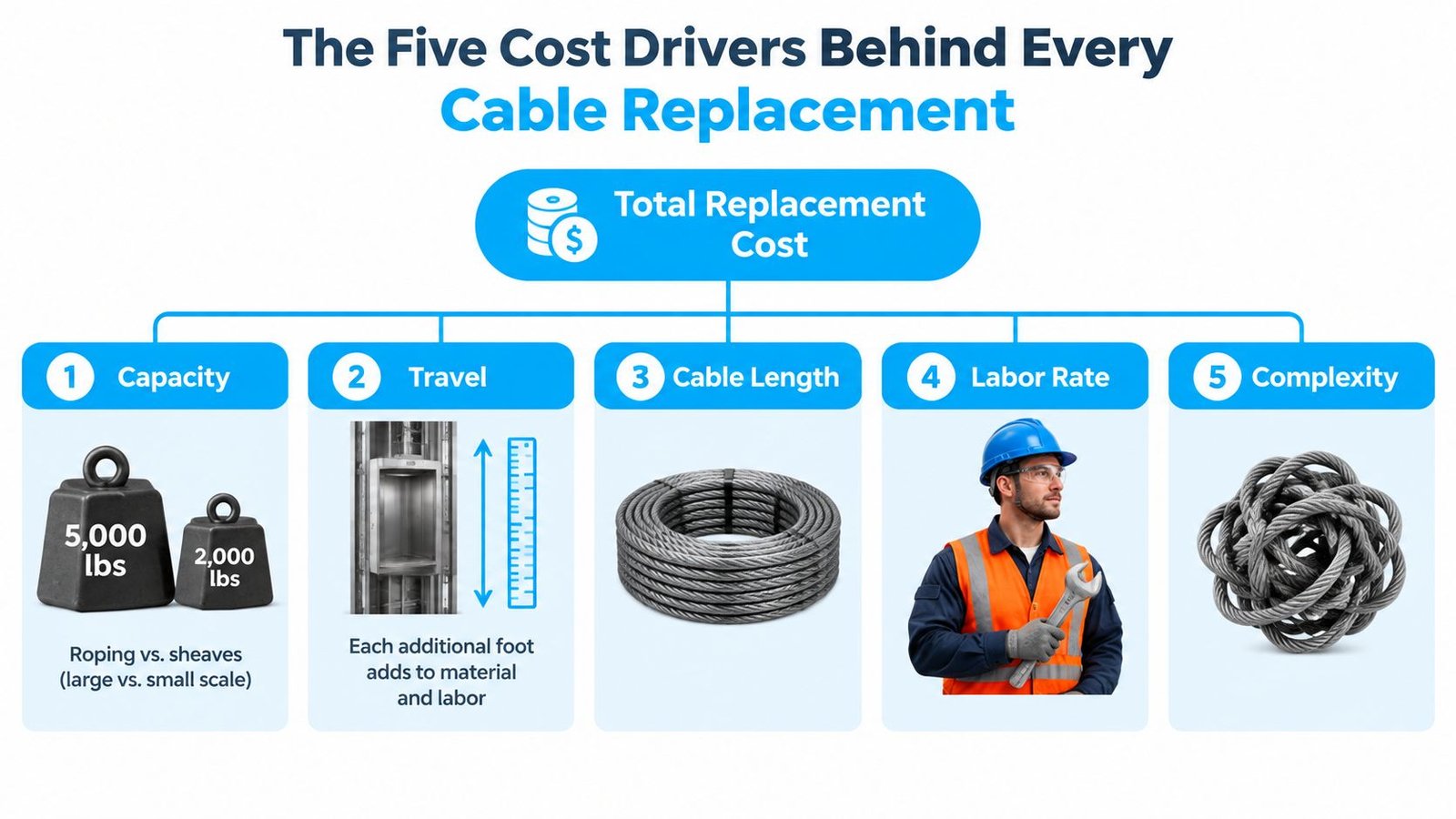
A useful quote explains five movable levers. Capacity, travel, cable length, labor rate, and complexity determine far more than the rope material alone. Two elevators can have similar appearances and still require very different replacement budgets.
Capacity changes the hardware
A 5,000-pound freight elevator typically needs heavier roping, larger attachment hardware, and stronger sheave arrangements than a 2,000-pound unit. Those capacity examples are also shown in the required cost-driver infographic. Rated load isn’t the only consideration. Loading class, concentrated forklift loads, duty cycle, counterweight arrangement, and existing machine design all affect the selected rope and installation method.
Travel increases material and labor
Every additional foot of hoistway adds rope footage, handling, setup, and reeving time. A tall building may also require more staging, fall protection, access coordination, and work above the car. Ask the bidder to identify the travel and rope length used in the proposal, not just the elevator capacity.
Cable length is its own check
Rope length must match the actual installation, including the machine arrangement, car travel, counterweight path, terminations, and any governor-rope requirements. An incorrect length can create rework, delays, or an unsafe installation. Your quote should list the rope construction and diameter, not merely “freight elevator cable.”
Labor rate reflects risk and access
Rope replacement is skilled work performed around suspended equipment, rotating machinery, shafts, counterweights, and restricted access. A low labor number may exclude rigging, protection, cleanup, night work, or testing. Ask whether the proposal includes mobilization, hoisting equipment, temporary barriers, disposal, and return visits.
Complexity drives the final gap
Structural repairs and controls often create the largest difference between a basic replacement and a major project. A deteriorated beam, inaccessible machine room, outdated relay logic, damaged sheave, or controller that can’t support the required testing can extend the outage. Permits and inspections also vary by jurisdiction, so the proposal should identify who handles applications, scheduling, witnessed tests, and corrections.
Read the quote from the bottom up. Confirm exclusions before comparing totals. The cheapest bid isn’t cheaper if it leaves sheave replacement, structural repair, testing, or permit work outside the contract.
Replacement Repair or Full Modernization
A rope replacement makes sense when the rest of the elevator is in sound condition. Modernization makes sense when the ropes are only the most visible failure in a system that has reached the end of its practical service life.
Start with the inspection report and maintenance history. If wear is confined to the ropes, the machine, drive, controller, governor, doors, guide rails, and structure are in good condition, and the unit has moderate duty, a standalone replacement may be the disciplined choice. If several systems are deteriorating, spending heavily on ropes alone can lock you into another disruptive outage soon afterward.
Three paths, three different decisions
A standalone cable replacement preserves the existing system. It suits a newer or well-maintained elevator with a healthy controller, drive, machine, sheaves, and governor. The scope should still include a full inspection of adjacent components because the ropes can’t be evaluated in isolation.
A partial modernization bundles one or more aging components into the same shutdown. A governor, selector, door operator, machine, drive, or controller may be added when the technician has already opened access and set up the work area. This can be practical when the added component is clearly approaching failure, but don’t accept a vague “upgrade allowance.” Name each component and its reason.
A full modernization replaces the major operating systems together, potentially including the cab, controller, drive, and ropes. It fits an old freight elevator with heavy shift use, repeated breakdowns, obsolete controls, poor parts availability, or a history of inspection violations. Crane Elevator’s freight elevator modernization services provide one option for evaluating that broader scope.
| Path | Typical Price Band | Outage Window | Best Fit Building |
|---|---|---|---|
| Standalone cable replacement | Varies by rope set, access, travel, and adjacent repairs | Set by rope removal, installation, testing, and inspection | Sound equipment with rope wear confined to the set |
| Partial modernization | Varies by selected components and project conditions | Longer than rope replacement because added systems require setup and testing | Older controls or operating components that can be bundled intelligently |
| Full modernization | Varies widely with cab, controller, drive, machine, structure, and code scope | Planned as a major capital project | Older, heavily used equipment with multiple aging systems |
The table intentionally avoids fake precision. No contractor can price these paths responsibly without seeing the machine room, hoistway, pit, car, ropes, controller, and maintenance records. Your decision should follow condition and duty cycle, not the name of the package.
Price Ranges and Lifecycle Cost Reality
Price ranges need evidence behind them. The figures often circulated for freight elevator projects, such as $15,000 to $40,000 for standalone rope replacement, $60,000 to $150,000 for partial modernization, or $150,000 to $400,000-plus for full modernization, aren’t supported by the verified data available for this article. I won’t present them as reliable market facts.
That doesn’t make budgeting impossible. It means you should treat any online price band as a screening estimate, then replace it with a site-specific proposal. Travel, capacity, rope configuration, access, structural condition, controls, permit scope, testing, and regional labor conditions can move the final number substantially.
Build a lifecycle comparison without invented savings
A rope-only repair on an older elevator may be the right decision, but it doesn’t reset the condition of the controller, drive, doors, machine, or structure. A modernization may reduce exposure to obsolete components, but its value depends on the actual equipment, service requirements, energy profile, parts availability, and future building use.
Don’t accept unsupported claims that a modern drive will automatically cut energy use by a particular percentage or that a controller will fail within a specific period. Ask the contractor to document expected maintenance changes, available parts, warranty terms, operating sequence, electrical requirements, and testing obligations.
| Scope Option | Upfront Cost | Projected 20-Year Cost | Key Driver |
|---|---|---|---|
| Standalone rope replacement | Site-specific written quote | Depends on future controller, machine, door, structural, and callback work | Condition of everything outside the rope set |
| Partial modernization | Site-specific written quote for named components | Depends on which aging systems remain | Whether bundled work removes the next likely outage |
| Full modernization | Site-specific capital proposal | Depends on equipment selection, maintenance, energy, inspections, and future repairs | System age, duty cycle, parts support, and building strategy |
Use the proposal to create three internal budgets: the approved base scope, a contingency for discovered conditions, and a separate capital option for modernization. Keep those categories distinct. A contractor should explain the engineering reason for every added component, and your consultant or facility engineer should verify that the recommendation matches the building’s operating needs.
Michigan and Ohio Inspection Rules That Affect Your Plan
Inspection planning affects both the budget and the outage. Michigan requires covered passenger and freight elevators, along with several other elevating devices, to be inspected at least once every 12 months (Michigan elevator code). Temporary passenger or freight elevators used during construction have tighter requirements, including maintenance every 30 calendar days and inspections every 90 calendar days under the cited Michigan rules.
Michigan also requires maintenance inspections and tests after installations are placed in service. Safety tests for car and counterweight safeties and governors must occur at intervals of not more than 12 months, and chain links must be inspected at no fewer than 3 randomly selected points (Michigan maintenance and testing rule).
Local schedules can be stricter
Detroit requires power elevators, escalators, and moving walks to be inspected and serviced at least once every 30 days by a licensed unlimited-elevator journeyperson in many cases. A special permission process can extend that interval to no more than 90 days, while other covered equipment generally requires quarterly service under the cited Detroit ordinance (Detroit elevator inspection requirements).
Michigan’s maintenance rule also identifies a 90-day maintenance interval for power elevators and 180-day intervals for certain other devices, including dumbwaiters and platform lifts. It requires written records of maintenance, repairs, replacements, inspections, callbacks, and testing to remain in the machine room or on site (Michigan maintenance records rule).
For Detroit, Grand Rapids, Lansing, Ann Arbor, Toledo, Cleveland, and nearby Ohio communities, confirm the local permit, inspection, acceptance-test, and certificate requirements before setting the outage. Include those tasks in the bid, assign responsibility, and schedule the authority’s visit early. Crane Elevator provides Detroit elevator services as one local resource for evaluating the required work and compliance path.
Financing Free Quotes and Second Opinions
Owners usually have more financial options than they first assume, but each option needs to match the building and the tax or lending structure. Equipment financing can spread the cost of ropes, sheaves, controls, or other approved equipment over time. Capital leasing can preserve working capital when the owner prefers scheduled payments rather than an immediate capital outlay.
For owner-occupied commercial property, an SBA 504 loan may be worth discussing with a qualified lender when the project fits program requirements. Property-assessed clean energy style municipal programs may apply in some locations, but eligibility depends on the jurisdiction and the improvement. HOAs and co-ops should also examine reserve accounts before treating an urgent rope project as an operating expense.

Make competing quotes comparable
Most contractors serving Michigan and Ohio can provide a site assessment and written proposal, but the documents aren’t comparable unless the request for proposal is specific. Give each bidder the same inspection report, rope specifications, elevator capacity, travel, number of stops, machine type, operating schedule, known violations, access restrictions, and required completion date.
Request separate lines for:
- Rope work: Set size, construction, diameter, length, sockets, shackles, and installation.
- Adjacent components: Sheaves, bearings, governor, brakes, machine, guide components, and structural repairs.
- Controls: Testing of the existing controller and clearly priced replacement options.
- Project administration: Permits, inspections, acceptance tests, cleanup, disposal, and documentation.
- Commercial terms: Warranty, exclusions, payment schedule, financing availability, and change-order process.
Bring in an independent elevator consultant when the modernization recommendation feels disproportionate, the owner has only one available service provider, or the inspection note doesn’t explain the proposed scope. Time the bid before the fiscal-year budget closes, and ask the accountant how the project should be treated under the building’s depreciation schedule. A rushed approval is expensive; a documented scope gives lenders, boards, and finance teams something they can review.
Your Next Steps and Quick Decision Checklist
Start with documents, not a sales conversation. Pull the last inspection report, maintenance records, violation notices, previous rope measurements, operating certificate, and any recent callback history. Then ask a qualified elevator contractor to confirm whether the existing set has reached its retirement condition and whether the machine room, hoistway, pit, overhead, controller, governor, and sheaves can support a rope-only scope.
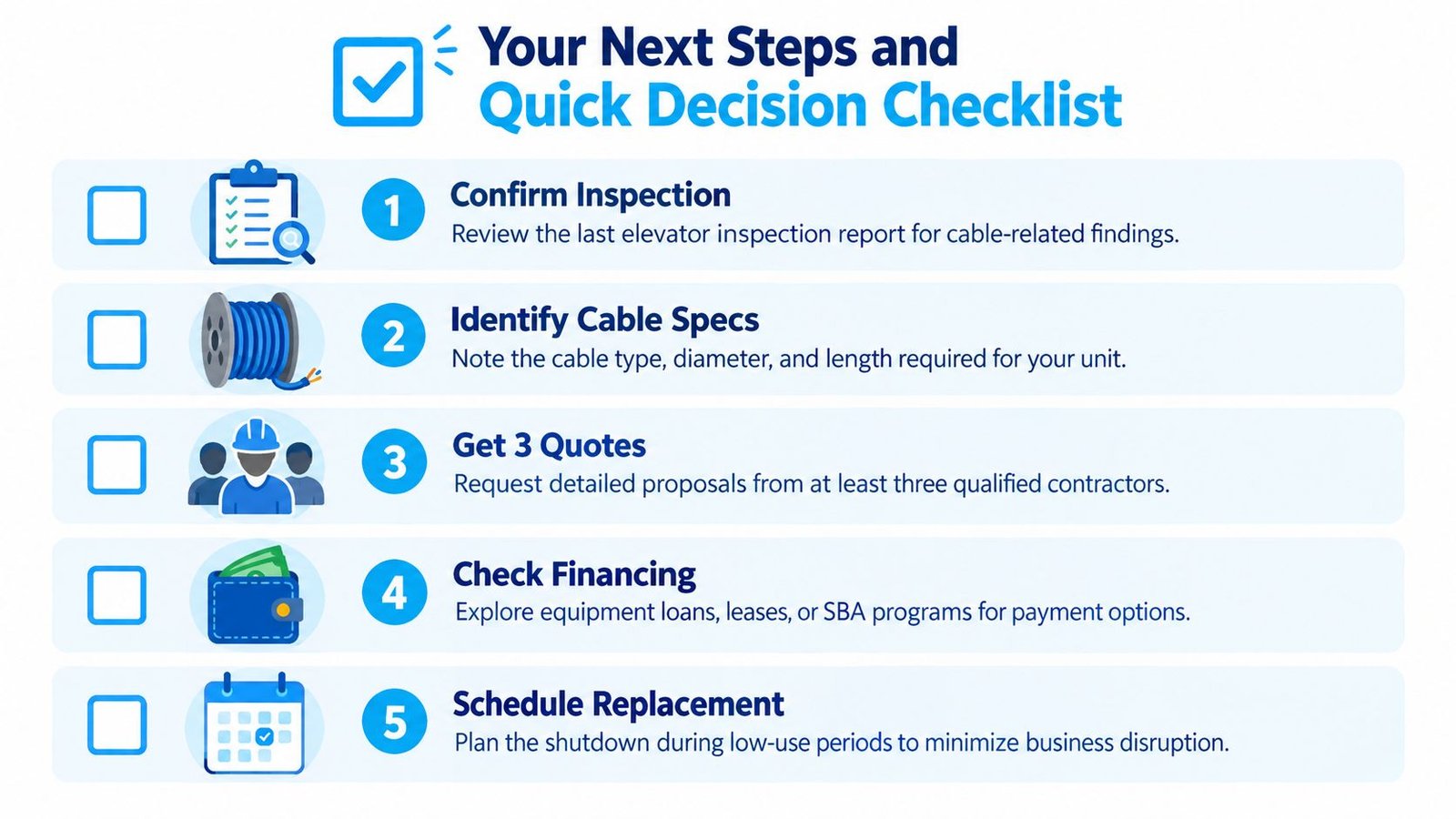
Use this decision checklist
- Confirm the inspection finding: Identify the exact rope condition, affected ropes, retirement basis, and return-to-service requirement.
- Record the cable specifications: Note rope type, diameter, length, number of ropes, terminations, and governor-rope requirements.
- Gather comparable proposals: Request itemized quotes from qualified contractors with the same access, testing, permit, and schedule assumptions.
- Verify operating status: Confirm the Michigan or Ohio certificate, open violations, local inspection requirements, and documentation needed after the work.
- Choose the scope deliberately: Decide whether the elevator needs a standalone replacement, partial modernization, or a broader capital project.
- Review funding: Check reserves, equipment financing, capital leasing, applicable SBA options, and any local property-assessed programs.
- Schedule the outage: Plan the shutdown during a low-use period and coordinate loading, deliveries, tenants, staff, fall protection, and alternative material-handling routes.
The decision branches are straightforward. If the cables are within 2 years of retirement, plan the replacement instead of waiting for an emergency, as reflected in the requested planning framework. If the controller is also aging, price a bundled modernization. If the building is small or lightly loaded and the rest of the equipment is sound, a targeted repair may be the most responsible use of capital.
For service across Detroit, Lansing, Ann Arbor, Grand Rapids, Flint, Kalamazoo, Toledo, Perrysburg, and surrounding Michigan and Ohio communities, Crane Elevator Company provides freight elevator cable replacement, repairs, preventative maintenance, inspections, modernization, and other elevator services for commercial, industrial, healthcare, education, municipal, residential, wheelchair lift, material lift, and dumbwaiter equipment. Request a documented site assessment and itemized quote through Crane Elevator Company, then use that scope to decide whether your elevator needs cables alone or a larger reliability plan.