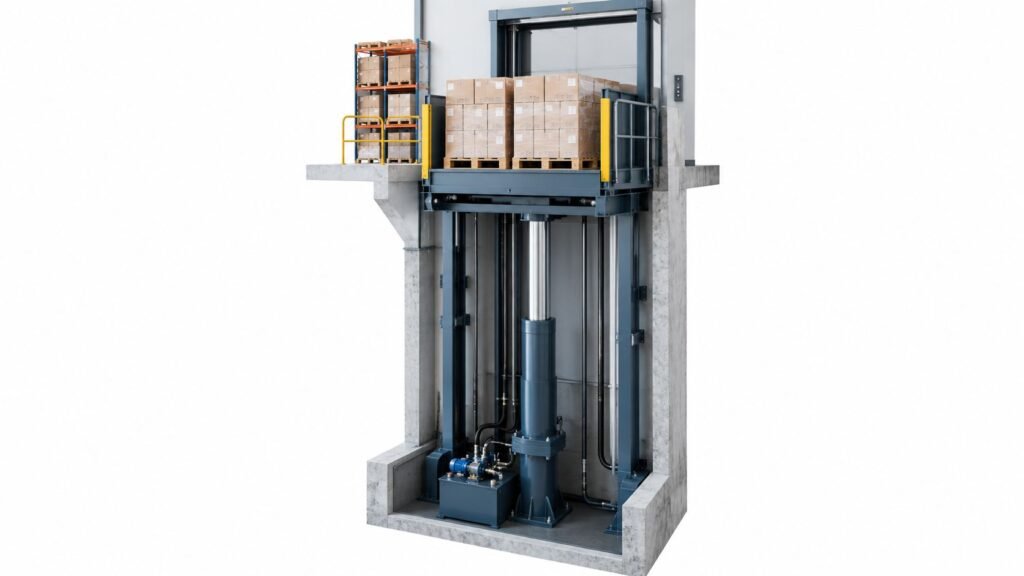
The dock is backed up, a pallet is waiting on the next level, and the hydraulic freight elevator has started leveling low at one landing. Production can't wait, but neither can a facility manager responsible for safe operation, inspection records, and a repair decision that won't create another outage next month. That situation is common in industrial, healthcare, education, and municipal buildings across Michigan.
A hydraulic freight elevator earns its place through lifting force, durability, and practical low-rise service, but it also carries lifecycle costs that generic maintenance advice often misses. Pump duty, oil heat, packing wear, cylinder condition, testing triggers, local inspection intervals, and the availability of replacement controls all affect whether the equipment remains a dependable asset or becomes a recurring operational liability.
The Role of Heavy Duty Freight Lifts in Michigan Facilities
At a Detroit loading dock, the freight elevator may be the only practical route for pallets, maintenance equipment, and replacement machinery between floors. In a Grand Rapids manufacturing plant, it can connect production areas without forcing workers to move heavy material around an inefficient route. In a hospital service core, the same type of equipment may support supplies, facilities work, and back-of-house logistics while passenger elevators remain dedicated to patients and visitors.
The machine rarely gets attention when it works. It becomes the center of the facility's schedule when it stops.
The equipment behind daily operations
A freight elevator isn't a passenger elevator with a higher rated load. Its platform, car enclosure, doors, sills, guide components, controls, and loading arrangements must tolerate concentrated and repeated material-handling stresses. A facility manager needs to consider not only total weight, but also how that weight arrives, whether a pallet jack or industrial truck enters the car, how loads are distributed, and how frequently the unit cycles.
A hydraulic design often fits buildings where the travel is limited and the payload is substantial. It can be a sensible choice for a loading dock, industrial floor, institutional service area, or other low- to mid-rise application. It becomes less attractive when the building needs fast, frequent, long-rise movement and the equipment's heat and stroke limitations begin to control operations.
Practical rule: Treat the freight elevator as production infrastructure, not as a background building accessory.
Service coverage across Michigan
Crane Elevator serves Detroit, Lansing, Ann Arbor, Grand Rapids, and surrounding areas, with field coverage extending to communities such as Flint, Kalamazoo, Toledo, Perrysburg, Ypsilanti, Jackson, Saginaw, Traverse City, Royal Oak, and Warren. That footprint matters because a hydraulic freight elevator problem rarely fits neatly into a convenient schedule. A leaking packing, failed pump motor, damaged gate component, or inspection violation can affect shipping, maintenance access, inventory movement, or patient-support operations.
The company provides every type of elevator service, from work on century-old freight cars to modern material lifts, passenger elevators, residential elevators, wheelchair lifts, and dumbwaiters. Its family-owned operation brings over 25 years of hands-on experience, with a 24/7/365 responsive field operation for facilities that can't wait for the next business day.
What facility managers should expect
Reliable service starts with a record of the installed equipment, its permitted use, recurring defects, testing requirements, and operating environment. It also requires a contractor who can distinguish a repairable hydraulic issue from a condition that points toward modernization.
The right question isn't only, “Can the car run today?” It's, “Can this equipment keep moving the loads our building depends on while meeting the inspection, documentation, and safety obligations attached to its configuration?”
Understanding Hydraulic Freight Elevator Mechanics
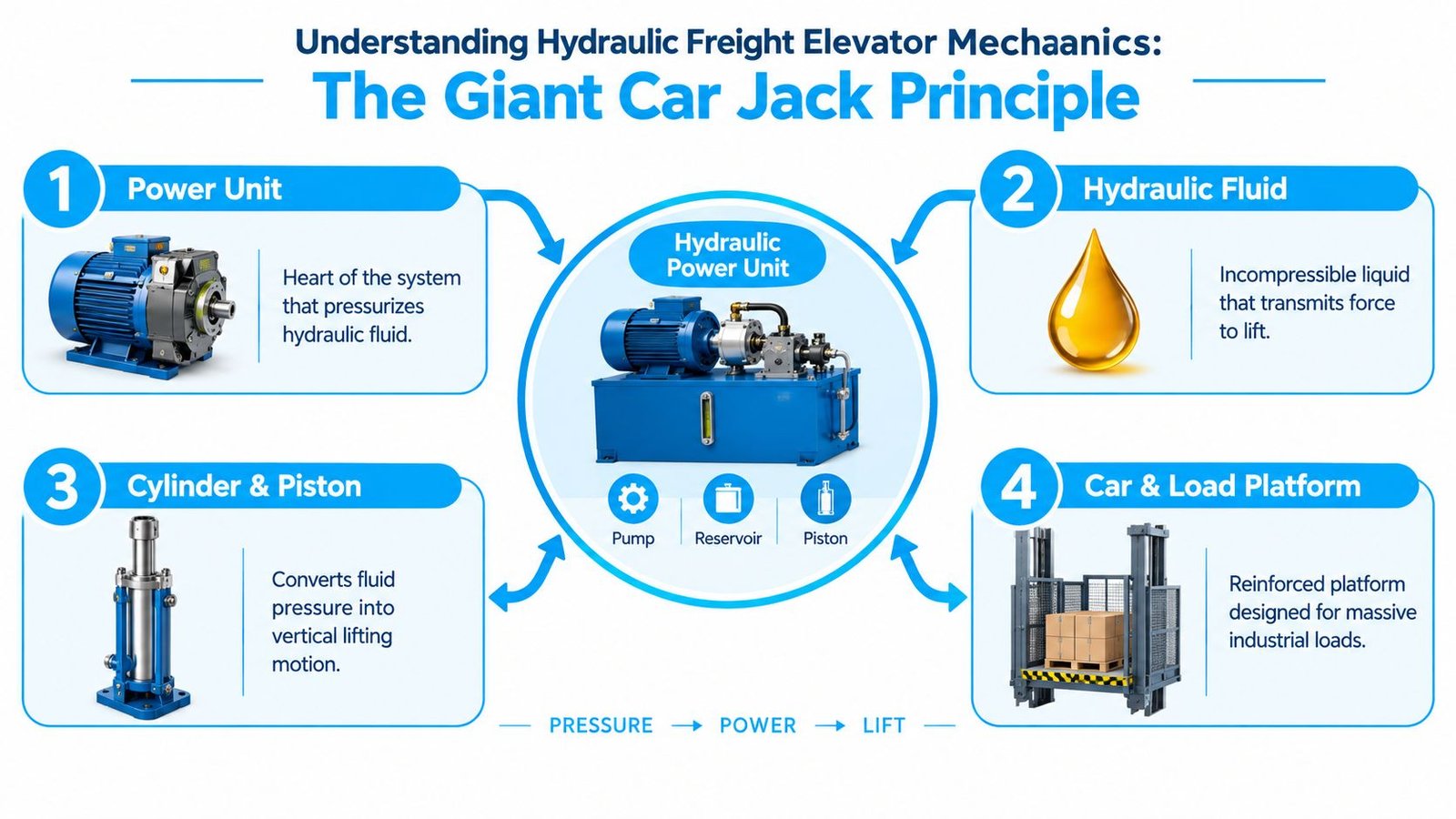
A hydraulic freight elevator works on the same basic principle as a hydraulic car jack, but with an engineered power unit, cylinder, piston, control valves, guide system, and reinforced car designed for vertical transportation. The pump sends pressurized oil into the cylinder. That pressure acts on the piston, and the piston pushes the elevator car upward.
Lowering usually happens through controlled fluid release rather than by reversing the lifting process in the same way. Valves regulate the descent, while the controller manages door operation, leveling, stops, and safety interlocks. The result is a system that turns fluid pressure into controlled vertical motion.
Four components determine performance
Power unit: The motor drives a pump that moves oil from the reservoir into the hydraulic circuit. Correct sizing affects acceleration, speed, duty cycle, and heat generation.
Hydraulic fluid: Oil transmits pressure through the system. Contamination, incorrect level, leakage, or degraded fluid can affect valve response, pump performance, and leveling.
Cylinder and piston: The cylinder contains the pressure and guides the piston's lifting action. Packing and jack integrity matter because a seal problem can create leakage, poor leveling, or an eventual shutdown.
Car and load platform: The car carries the freight, but the platform and frame must also manage loading impact, uneven distribution, and the building's permitted loading conditions.
The defining trade-off is force versus speed. Hydraulic systems produce very high lifting force at relatively low speed. That makes them well suited to short-rise, heavy-load work, where lifting a pallet or piece of equipment matters more than moving occupants rapidly between many floors.
Why the historical design still matters
Hydraulic elevators were first demonstrated in a widely influential form at the 1867 Paris World's Fair, where a cab attached to a piston below ground level was pushed upward by water under pressure. That milestone helped hydraulic systems spread through France and then Germany, with passenger installations appearing in Berlin hotels and commercial buildings during the 1870s. By the late nineteenth century, hydraulic systems had become central to vertical transport in major markets because they handled heavy freight and passengers effectively in low- to mid-rise buildings, as described in this historical account of hydraulic elevator development.
Electric traction systems later gained ground where higher travel and speed were more important. In Boston, elevators under water-department supervision peaked at 592 in 1904 and declined to just above 510 by 1919, a 14% drop over 15 years, while new service-pipe requests had fallen to zero and new installations to two by 1919. That record illustrates the early shift toward electric systems, although hydraulic equipment remained useful for heavy-duty freight applications, as documented in this Smithsonian record on Boston elevator development.
For a practical look at pump operation, facility teams can review Crane Elevator's hydraulic elevator pump service information.
Typical Specifications and Engineering Tradeoffs
A hydraulic freight elevator should be specified around the building's actual loading pattern, not a generic capacity label. A palletized load, a concentrated machine component, and an industrial truck can impose very different stresses even when their combined weight appears similar. The installed data plate, manufacturer documentation, approved design, and local requirements control what the equipment may carry.
Independent technical literature identifies common hydraulic freight configurations around 1,250 to 10,000 kg rated load, with speeds commonly near 0.2 to 0.63 m/s and travel heights often limited to roughly 2.5 to 26 m, depending on design and jurisdiction. These figures are representative technical ranges, not permission to load a particular elevator beyond its marked rating. The relationship between load, speed, travel, and hydraulic arrangement is summarized in this hydraulic freight elevator specification sheet.
| Parameter | Typical Range | Operational Impact |
|---|---|---|
| Rated load | 1,250 to 10,000 kg | Supports heavy freight, but loading method and concentration still matter. |
| Speed | 0.2 to 0.63 m/s | Favors controlled, low-rise movement over rapid cycling. |
| Travel height | Roughly 2.5 to 26 m | Cylinder stroke, jack arrangement, oil volume, and shaft conditions constrain rise. |
| Compact goods-only speed | 0.15 m/s | Reflects short-rise applications where load handling outranks speed. |
| Compact short-rise limit | Around 11.5 m | Shows how smaller hydraulic configurations can be constrained by travel and duty. |
| Selected model ride frequency | About 30 to 60 rides per hour | Requires attention to pump duty cycle and thermal loading. |
Heat is an operating cost
A traction elevator can be designed to recover energy in some operating conditions. A hydraulic unit generally uses pump energy during upward travel and dissipates much of that energy as heat in the oil and power unit. The elevator may continue to run while the oil temperature rises, but repeated operation under thermal stress can affect performance and availability.
That's why machine-room equipment, piping, valves, reservoir capacity, and component data must be sized and documented carefully. A unit that looks adequate during occasional use may struggle when a distribution or manufacturing schedule demands repeated trips.
The components that deserve attention
Oil condition and level: Low, contaminated, or deteriorated oil can affect pressure, valve response, and pump operation.
Packing and jack integrity: Worn packing can allow leakage and reduce the system's ability to hold consistent pressure.
Pump and motor performance: A tired motor, damaged coupling, worn pump, or restricted intake can produce slow starts, weak leveling, or nuisance shutdowns.
Cylinder stroke and arrangement: Longer travel requires more piston movement, oil volume, and physical planning. Those constraints become more difficult as rise increases.
The United States government hydraulic freight elevator specification connects these design constraints with practical maintenance concerns. Oil condition, packing wear, jack integrity, and pump-motor performance aren't isolated technical details. They directly influence leveling accuracy, ride availability, and downtime risk.
A facility manager should track changes in leveling, motor sound, operating temperature, pump run time, and leakage rather than waiting for a complete failure. Replacing fluid or a seal may be a manageable intervention. Replacing a damaged jack, power unit, or control system during an emergency is usually far more disruptive.
Navigating Maintenance and Code Compliance Requirements
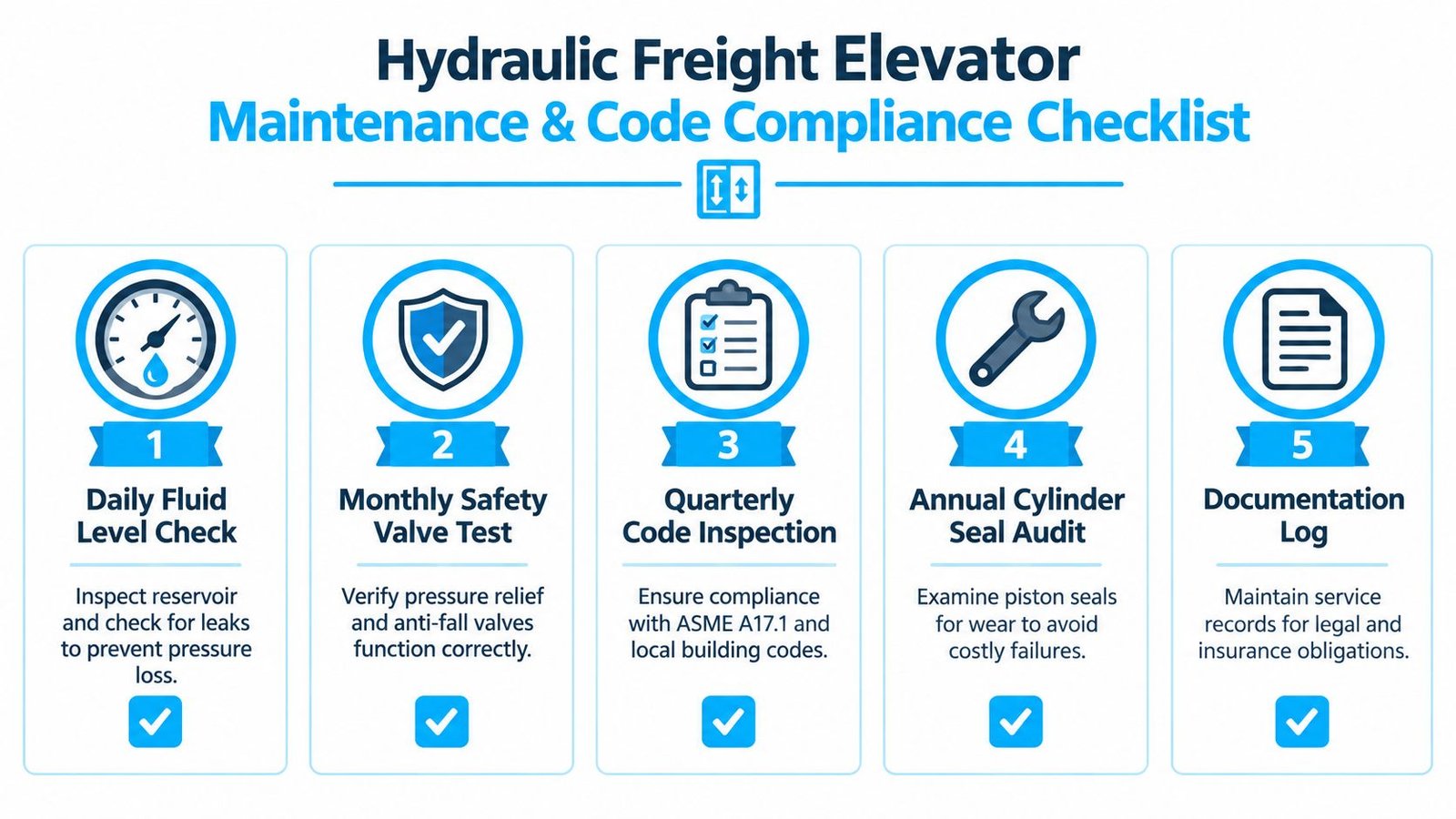
“Check the oil and look for leaks” is not a complete maintenance program. A hydraulic freight elevator's obligations depend on its installed safety equipment, jurisdiction, use, and inspection history. The owner needs a service plan that connects physical maintenance with testing, records, firefighter service, and correction of documented violations.
Testing triggers depend on configuration
Recent rules in major markets identify annual Category 1 testing and 5-year Category 5 testing as potential requirements for hydraulic elevators. Category 5 testing applies to hydraulic units equipped with specific features, including a safety, plunger gripper, governor, oil buffer, or overspeed valve, according to the adopted conveyance rules.
That distinction changes the planning conversation. Two hydraulic freight elevators may look similar from the loading dock but carry different testing obligations because their safety configurations differ. A facility manager should verify the equipment inventory, identify which triggers apply, and retain the test results with the maintenance record.
Monthly firefighter-service checks and logged oil-level verification may also form part of the recordkeeping burden. The exact obligation depends on the applicable rule and equipment, so the service provider should match the log to the installed system instead of handing over a generic checklist.
Michigan intervals require local planning
Michigan requires passenger, freight, inclined, limited-use/limited-application, special-purpose personnel, rooftop elevators, material lifts, escalators, moving walks, belt manlifts, and special elevating devices to be inspected at least once every 12 months, as stated in the Michigan elevator code rules.
Michigan also requires a power elevator, except certain private-residence devices, to be maintained at least once every 90 days by a licensed elevator journeyperson. Dumbwaiters and some small or special-use devices follow a 180-day interval, and the owner must keep a written record of maintenance, repairs, replacements, inspections, callbacks, and testing on-site under the Michigan administrative maintenance rule.
Detroit adds a stricter local burden. Power elevators, escalators, and moving walks must be inspected and serviced at least once every 30 days, with an extension to 90 days possible by special permission when usage is low. Detroit also requires car and counterweight safeties, governors, and oil buffers to be tested every 30 months, using approved test weights, under the Detroit elevator code.
The practical comparison is clear:
Statewide Michigan operation: Plan for annual inspection and the applicable licensed-maintenance interval.
Detroit operation: Plan around the 30-day inspection and service requirement unless an authorized extension applies.
Configured hydraulic safeties: Confirm whether Category 5 testing is triggered.
Every facility: Keep records on-site and make sure callbacks, repairs, testing, and oil checks are traceable.
Crane Elevator's freight elevator preventative maintenance service can be structured around these operational and documentation needs. Full clean-downs of machine rooms, pits, and car tops help technicians see developing conditions, while a No Show, No Pay policy addresses the practical frustration of missed scheduled service. The program also includes COP and PI bulb replacements, alongside maintenance attention to hydraulic packing, jacks, tanks, power units, motors, safeties, emergency phones, fire service, generator testing, and violation corrections.
Audit readiness isn't paperwork added after the work. It's part of the work.
Modernization Strategies for Aging Freight Systems
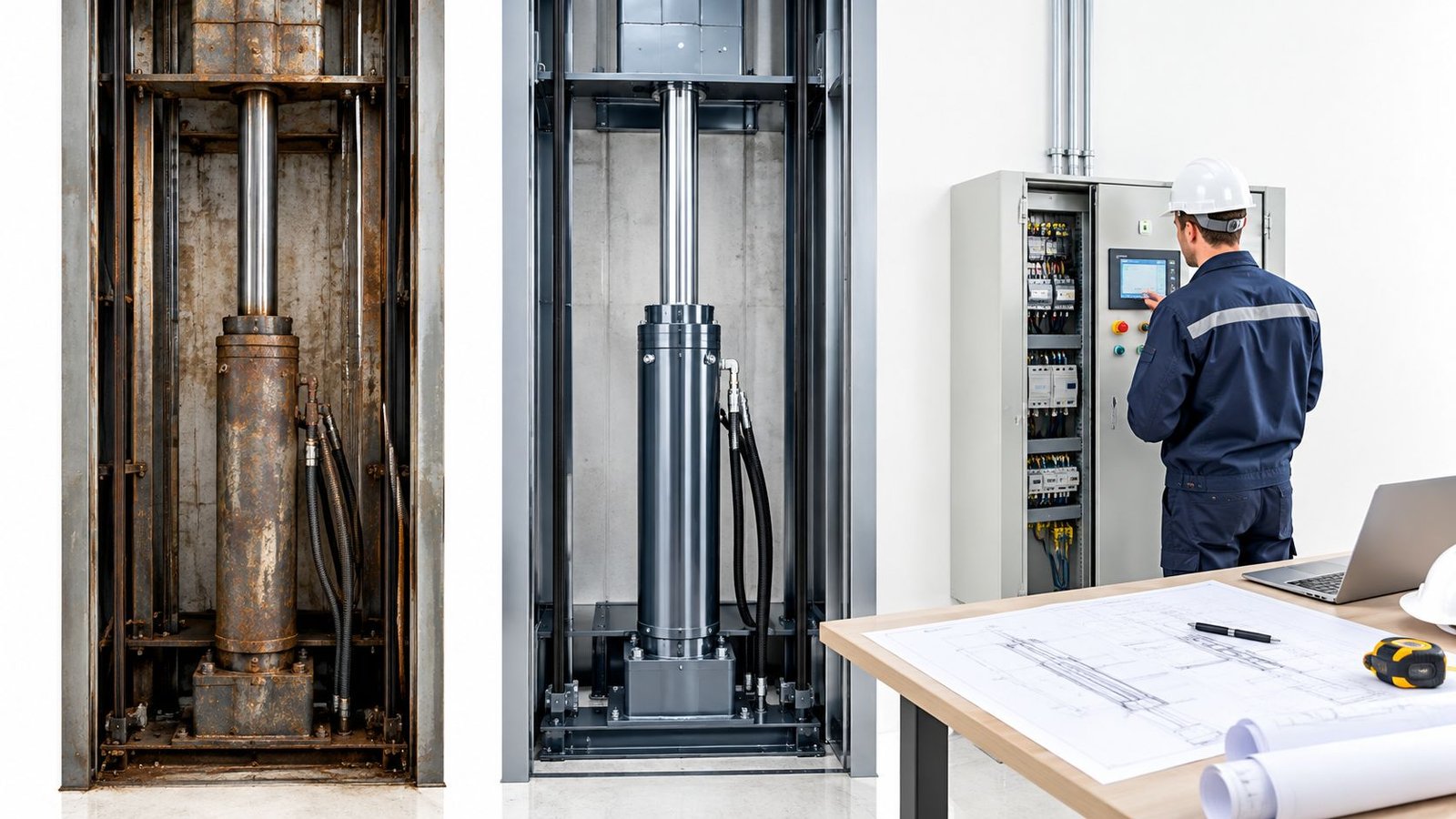
An older hydraulic freight elevator doesn't become a modernization candidate only when it stops. Repeated callbacks, unavailable proprietary components, deteriorating jacks, obsolete controls, recurring leveling problems, code violations, and excessive downtime can all justify a capital review while the car is still operating.
The repair-versus-modernize decision should compare more than the immediate invoice. A repair may restore a single failed component, but it won't solve a control system that no longer communicates reliably, a power unit nearing the end of its practical service life, or a building owner's growing dependence on hard-to-source parts.
Repair when the system still has a sound foundation
Repair is often reasonable when the cylinder, car frame, guide system, doors, and machine-room arrangement remain suitable for the building's use. A targeted repair can address packing, valves, pump components, controls, door equipment, or electrical faults without disturbing serviceable infrastructure.
That approach stops making sense when the same failure returns, when the equipment can't meet current requirements without extensive rework, or when the downtime risk exceeds the value of another isolated repair. A low initial repair cost can become expensive if it repeatedly interrupts shipping, production, clinical support, or building access.
Modernize around the building's future use
Public procurement activity during 2025 and 2026 shows projects bundling hydraulic freight elevator modernization with passenger elevator work, indicating that owners are treating freight upgrades as part of broader capital planning rather than isolated repairs, as reflected in this public modernization procurement record.
A modernization assessment should address:
Code and safety: Fire protection, shunt-trip coordination, machine-room enclosure requirements, safety testing, and maintenance control documentation.
Operational demand: Load pattern, travel, door use, cycle frequency, and the consequences of an outage.
Parts strategy: Whether future service can use non-proprietary components rather than locking the owner into one source.
Energy and heat: Pump and motor performance, oil management, duty cycle, and power-unit condition.
Capital timing: Whether the work can be coordinated with other building upgrades or planned before an emergency forces the schedule.
Non-proprietary modernization can reduce future service lock-in and make qualified-provider access more practical. Crane Elevator offers freight elevator modernization services for owners evaluating hydraulic systems, including competitive quotes, free second opinions, and commercial elevator financing or modernization financing across Michigan and Ohio.
The best modernization plan isn't automatically the largest replacement. It's the one that aligns code, safety, serviceability, operating demand, and long-term ownership cost.
Securing Reliable Vertical Transport for Your Building
A hydraulic freight elevator can be the right machine for a low- or mid-rise facility that needs substantial lifting force and dependable material movement. It isn't the right machine for every travel height, speed requirement, or duty cycle. Facility managers protect operations by matching the equipment to the load pattern and recognizing the limits created by stroke length, oil volume, pump duty, and heat.
Compliance needs the same level of planning. Michigan's annual inspection requirement, licensed-maintenance interval, on-site records, and Detroit's stricter service schedule should be built into the facility calendar. Testing triggers also depend on the equipment installed, particularly where hydraulic safeties, governors, oil buffers, plunger grippers, or overspeed valves are present.
A practical ownership strategy
Document the machine: Keep the capacity, configuration, safety equipment, service history, and testing requirements together.
Watch operating changes: Track leveling, leaks, unusual pump or motor behavior, door problems, and recurring callbacks.
Plan before failure: Review modernization when parts obsolescence, violations, downtime, or repeated repair costs begin to outweigh the value of the existing arrangement.
Specify serviceability: Favor solutions that qualified providers can maintain and that don't create unnecessary future lock-in.
Crane Elevator is a family-owned contractor serving Michigan and Ohio, with over 25 years of hands-on experience and 24/7/365 field response for freight elevators and other vertical-transport equipment. Whether the building is a hospital in Royal Oak, a distribution center in Warren, a school in Lansing, or an industrial facility near Grand Rapids, proactive maintenance and a documented modernization plan give owners more control over safety, uptime, and capital decisions.
A freight elevator shouldn't be judged only by whether it moves today. Its real value lies in dependable service, predictable maintenance, clear compliance records, and a modernization path that protects the building's operations.
For hydraulic freight elevator inspections, preventative maintenance, repairs, code testing support, and non-proprietary modernization planning, contact Crane Elevator Company. Ask for a service review or second opinion that examines the equipment's condition, Michigan compliance obligations, and the most practical path to reliable long-term operation.