At 2 a.m., an elevator stops between floors with a patient's family inside, a senior resident waiting on the next landing, or a hospital team trying to move equipment. The night manager calls the contractor and reaches a voicemail tree. Fifteen minutes later, nobody can say whether a mechanic has been dispatched, what the arrival window is, or who will notify the fire service if the car can't be returned to operation.
That's the operational test for responsive elevator companies. A polished website and a modernization brochure won't tell you how a provider behaves during an entrapment. Michigan building owners need measurable response standards, disciplined records, and a contractor who understands that statewide requirements and Detroit rules can affect whether a building stays open.
What Responsive Elevator Companies Actually Mean in Michigan
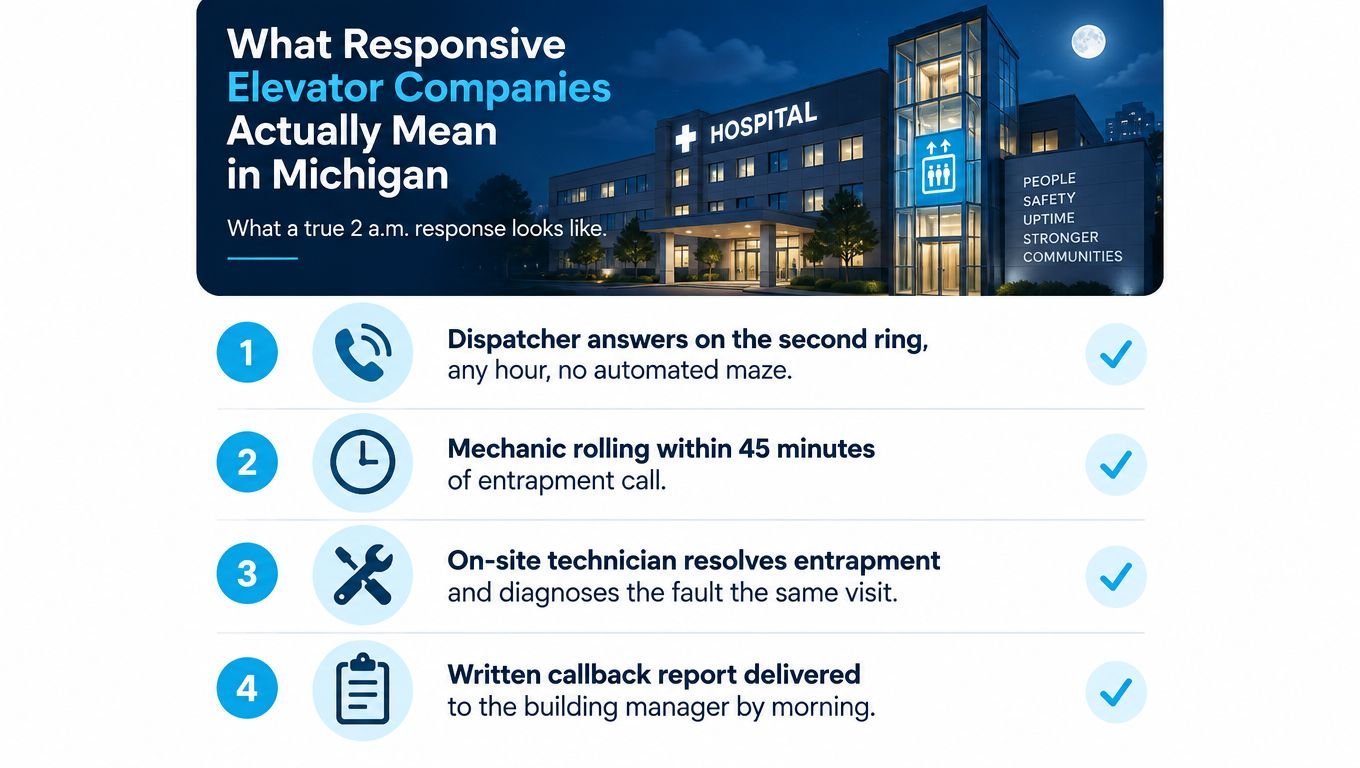
A Detroit hospital reports an entrapment during the night shift. In a responsive operation, a live dispatcher answers promptly, confirms the car location and occupant condition, sends a qualified mechanic, and keeps the building engineer informed. The mechanic doesn't just reset a fault and leave. The visit ends with a safe release, a diagnosis, and a written callback record that tells management what failed and what happens next.
That standard applies just as much to a senior living building in Grand Rapids. A resident stuck between floors needs more than reassurance. The building needs an accountable chain from the first call through arrival, repair, testing, tenant communication, and return to service.
Four behaviors owners should demand
Live dispatch means a person can act. An answering service that only takes a message isn't the same as a dispatcher who can identify the unit, reach the on-call mechanic, and escalate when conditions change.
Arrival windows belong in the agreement. Emergency response benchmarks commonly target 30 to 60 minutes for passenger entrapments, 1 to 2 hours for emergency failures without entrapment, and 2 to 4 hours for standard business-hour breakdowns, according to documented elevator response benchmarks. Contracts should define whether the clock measures dispatch to arrival or dispatch to resolution.
Callback closure needs a deadline. A technician arriving quickly doesn't help if the car remains out of service while parts, engineering support, or approval waits in another queue. Require a written update when the repair is complete, deferred, or transferred to a modernization recommendation.
Communication must extend beyond the mechanic. Building engineers, tenants, emergency personnel, the authority having jurisdiction, and fire-service contacts may all need accurate status information.
Practical rule: Treat responsiveness as a contract term, not a slogan. Define escalation steps, missed-window remedies, and who owns communication when a car remains down.
The common failure pattern is familiar: voicemail loops, vague estimates, no compatible parts on the truck, and service tickets that disappear after the technician leaves. A useful agreement separates dispatch-to-arrival from dispatch-to-resolution, because routing, diagnosis, and parts staging create different delays. After-hours coverage also needs clear language, since surcharges or next-day limitations can create downtime that wasn't obvious during the sales call.
Michigan Codes and Inspection Schedules You Cannot Ignore
Michigan owners shouldn't treat an inspection as a single pass-or-fail appointment. The inspection is one link in an evidence chain that includes maintenance records, test results, certificates, corrective work, and communication with the authority having jurisdiction.
Michigan's current rules require many elevating devices, including passenger, freight, inclined, limited-use, special-purpose personnel, rooftop elevators, material lifts, escalators, and moving walks, to be inspected at least once every 12 months. Stage lifts, dumbwaiters, platform lifts, stairway chairlifts, and certain other devices generally fall under a 24-month inspection interval. The Michigan Elevator Code also requires a Maintenance Control Program to be available when the device is inspected.
The schedule has to match the equipment
A power elevator, except for certain private-residence devices, must be maintained at least once every 90 days by a licensed elevator journeyperson. Dumbwaiters, one-person elevators, platform lifts, and stairway chairlifts in non-private-residence buildings have a 180-day maintenance interval under Michigan rules. The code also requires an ongoing written record covering maintenance, repairs, replacements, inspections, callbacks, and testing, kept in the machine room or on-site when no machine room exists. The Michigan maintenance record requirement is practical protection when ownership changes or an incident prompts a records review.
| Requirement | Michigan Statewide | Detroit (City Rule) | ASME A17.3 |
|---|---|---|---|
| Routine inspection | Covered devices inspected at least every 12 or 24 months, depending on category | Covered power elevators, escalators, and moving walks inspected and serviced at least every 30 days unless an approved extension applies | Existing-equipment safety provisions may trigger upgrades based on the adopted code and equipment condition |
| Maintenance | Power elevators generally maintained at least every 90 days, with defined exceptions | Monthly service is the city baseline for covered power equipment | Existing systems must be evaluated against applicable retroactive safety requirements |
| Records | Maintenance Control Program and written service history available for inspection | Service and inspection activity must support the city's operating requirements | Testing, corrections, and retained evidence help demonstrate compliance |
| Periodic testing | Required tests follow the applicable device and code requirements | Car and counterweight safeties, governors, and oil buffers tested at least every 30 months | Testing and safety provisions depend on the applicable edition and adopted requirements |
Detroit's rule is notably stricter. Power elevators, escalators, and moving walks must be inspected and serviced at least every 30 days, with an extension to no more than 90 days possible only by special permission when low usage justifies it. Detroit also requires quarterly inspection and service for other covered equipment, plus testing of specified safety devices at least every 30 months, as set out in the Detroit elevator ordinance.
Keep the inspection certificate, maintenance log, controller prints, test documentation, and correction history together. Missing logs, expired certificates, fire-service problems, or an emergency phone that doesn't work can derail an inspection even when the car runs normally. The Michigan elevator code requirements should be reviewed alongside the equipment's actual records and the local AHJ's expectations.
Comparing Service Contract Models That Hold Up
The cheapest monthly proposal can become the most expensive arrangement when a high-traffic building loses service. Contract models differ less in their labels than in the obligations hidden behind them. Read the callback language, parts exclusions, testing responsibilities, documentation terms, and after-hours rates before comparing totals.
| Contract Model | What's Covered | Main Risk | Best Fit |
|---|---|---|---|
| Full-service | Labor, routine maintenance, callbacks, testing, and defined parts may be bundled | A low fee can conceal weak response, exclusions, or slow parts approval | Hospitals, senior facilities, high-rise residential, and buildings where uptime is critical |
| Preventive maintenance only | Scheduled lubrication, adjustments, inspections, and planned service | Parts and emergency labor can create large unplanned invoices | Lower-risk buildings with strong in-house oversight and budget reserves |
| Time-and-material | Visits, labor, and parts billed as used | No guaranteed response or predictable repair cost during a major outage | Low-use equipment where downtime has limited operational impact |
A full-service agreement holds up when it includes a real dispatch commitment, clear exclusions, and a process for resolving failures that need more than a reset. It burns an owner when “full service” covers routine labor but excludes the controller, door operator, hydraulic equipment, or the very parts most likely to end an older car's availability.
Preventive-only service can work for a low-rise commercial building with alternate access and a manager who understands the equipment. It fails in a five-car residential building when parts are billed separately, callbacks aren't prioritized, and a control failure becomes an emergency capital request. The elevator maintenance program information should be compared with the actual contract, not just the service label.
Match the model to the building
A hospital or senior facility needs defined entrapment response, escalation, parts planning, and documented closure. A Class A office may accept preventive service if the agreement protects tenant access and handles peak-hour failures. A low-rise commercial property can sometimes use time-and-material, but only after confirming that an outage won't affect accessibility, production, or a regulatory obligation.
Ask for a sample callback report and a sample invoice. The first shows whether the contractor records the cause and corrective action. The second shows whether travel, minimum charges, after-hours labor, testing, and parts are transparent.
Your Pre-Hire Checklist for Elevator Contractors
A contractor's sales promise has little value if the agreement can't be enforced during a failure. Before signing, put the operational details in writing and make the provider prove that its field operation can support them.
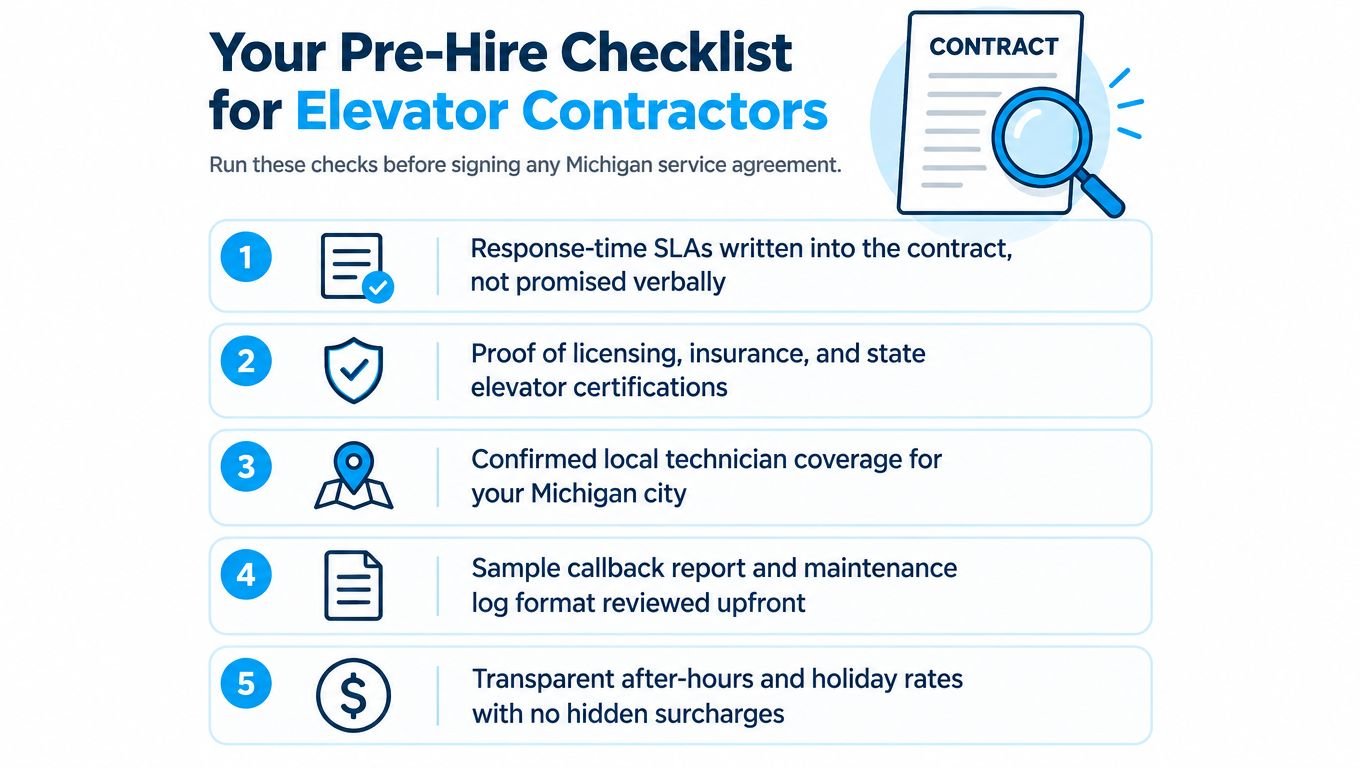
Start with the response clause. Define an emergency as an entrapment, fire-service failure, unsafe ride condition, or other event that requires immediate action. For healthcare and senior facilities, require an on-site arrival window of two hours or less for entrapments, then identify the remedy if the provider misses it. The agreement should distinguish arrival from repair completion and set a separate update deadline when parts or specialist support are required.
Verify the operation, not just the paperwork
Use this checklist during the bid review:
- Dispatch access: Confirm who answers after hours and whether managers can see dispatch status through a portal, text update, or direct escalation line.
- Parts readiness: Ask which controller, drive, door operator, and hydraulic components are supported from local inventory. A truck that lacks the right board can turn a short callback into a long shutdown.
- No Show No Pay: Require language that protects the owner when a promised visit doesn't occur and no approved exception exists.
- Non-proprietary disclosure: Any proprietary part or limitation should be identified and approved in writing before installation.
- Credentials and insurance: Verify Michigan contractor registration, mechanic licensing, applicable ASME training, general liability coverage, and workers' compensation.
- Inspection filing: Confirm who completes the required inspection certificates, submits them to LARA, and retains proof of filing.
- Comparable references: Speak with building managers who operate similar equipment under similar traffic and access conditions.
- Escalation ownership: Get the names of the dispatcher, field supervisor, project manager, and decision-maker for repair versus rebuild.
A contractor should also show its maintenance log format. The record should identify the unit, date, technician, work performed, observed defects, callbacks, testing, and deferred items. “Checked elevator” isn't a useful record when an inspector or incident investigator needs to understand what happened.
The right question isn't “Can you service this elevator?” Ask, “Show me how you manage the unit when the first repair doesn't solve the failure.”
Don't let a proposal hide after-hours surcharges, holiday minimums, travel charges, or parts markups. Put those terms beside the response SLA so the operating cost is visible before the first emergency call.
Realistic Costs for Inspections, Repairs, and Modernization
Elevator invoices vary because the equipment, travel requirements, parts availability, testing scope, and building access vary. A hydraulic car in a low-rise building doesn't carry the same repair exposure as an older traction unit with a specialized controller and a heavily used door system.
The figures often repeated in proposals for 2024 and 2025 should be treated as budgeting ranges, not promises. The brief does not provide verified cost data for these line items, so a responsible owner should request itemized local quotes rather than rely on unsupported dollar estimates. A useful quote identifies labor, travel, minimum charges, testing, parts, engineering, permit or filing work, cleanup, and exclusions.
| Service Item | Low Estimate | High Estimate | Frequency |
|---|---|---|---|
| Routine maintenance | Request a building-specific quote | Request a building-specific quote | Based on Michigan equipment category and contract |
| Emergency callback | Request business-hour and after-hours rates separately | Confirm minimum trip and parts charges | As needed |
| Inspection and testing | Request the applicable device and test scope | Confirm filing and correction costs | Based on the inspection schedule |
| Controller or drive repair | Require equipment-specific diagnosis | Separate repair from replacement recommendation | As needed |
| Modernization | Require a written scope and work-by-others schedule | Compare equivalent equipment, testing, and warranty terms | Planned capital work |
Compare the five-year exposure
A monthly preventive agreement may look more expensive than time-and-material when the elevator is operating normally. The comparison changes once you include repeated callbacks, emergency labor, diagnostic visits, rush freight, unavailable parts, tenant disruption, and management time.
Build the comparison from your own records. Pull the last six months of invoices, then separate planned maintenance from breakdown labor, parts, testing, and modernization proposals. Multiply the recurring service obligations across the planned ownership period, add a realistic reserve for excluded components, and compare that result with a full-service proposal that has equivalent response and documentation terms.
Market context still matters. The global elevator maintenance and repair market was valued at $92.5 billion in 2025 and is projected to reach $156.8 billion by 2033, with modernization representing about 20.5% of revenue, or roughly $19.0 billion in 2025, according to global elevator maintenance and modernization market data. That scale reflects broad demand for upgrades, but it doesn't determine what your building should buy.
Financing can include municipal lease-purchase structures, commercial lending, or manufacturer programs. Compare interest, security requirements, payment timing, warranty terms, and what happens if the project uncovers work by others. A low monthly payment doesn't make an incomplete scope affordable.
Why Non-Proprietary Service Beats the Original Installer
The original installer isn't automatically the only safe service choice. Existing elevators can often be maintained, tested, repaired, and modernized by a qualified contractor with the right licenses, training, tools, parts knowledge, insurance, and documentation practices.
The comparison is not brand name versus independent label. It's capability versus restriction. A non-proprietary provider should disclose what it can support, identify any access limitations, use components that meet the applicable safety and listing requirements, and explain when a manufacturer-specific part is necessary.
Where independent service earns its place
A multi-brand mechanic can bring useful experience to mixed portfolios, especially when a property has older equipment from different manufacturers. That experience matters during diagnosis, because a technician who understands controllers, door systems, governors, hydraulic power units, and signaling equipment can separate a correctable fault from a proposal that jumps straight to replacement.
Non-proprietary service also gives owners a clearer basis for parts decisions. Ask whether the proposed component is original, equivalent, refurbished, or third-party, then require compatibility, warranty, and code documentation in writing. A cheap substitute that creates nuisance faults isn't a saving.
The risk is choosing an independent contractor without the necessary testing capability or compliance discipline. A provider must be able to support required inspections, periodic tests, records, emergency phones, fire service, and violation corrections. Verify those abilities before awarding the work, rather than discovering a gap when an inspector asks for evidence.
A non-proprietary contract should expand your options, not lower your safety standard.
Crane Elevator Company's non-proprietary elevator service is one example of a Michigan service model covering multiple makes and types, with maintenance, repairs, inspections, and modernization handled under a non-proprietary approach. Owners should still compare its written scope, response terms, parts policy, and credentials against other qualified proposals.
Your Next Step to Faster, More Reliable Elevator Service
Start with evidence from your own building. Pull six months of callback logs, invoices, inspection records, and tenant complaints. Flag missed arrival windows, repeat faults, unresolved parts issues, and callbacks where the ticket closed without a useful diagnosis.
Then issue the same short RFP to qualified contractors serving your area. Keep the questions identical so the responses can be compared rather than interpreted through sales language.
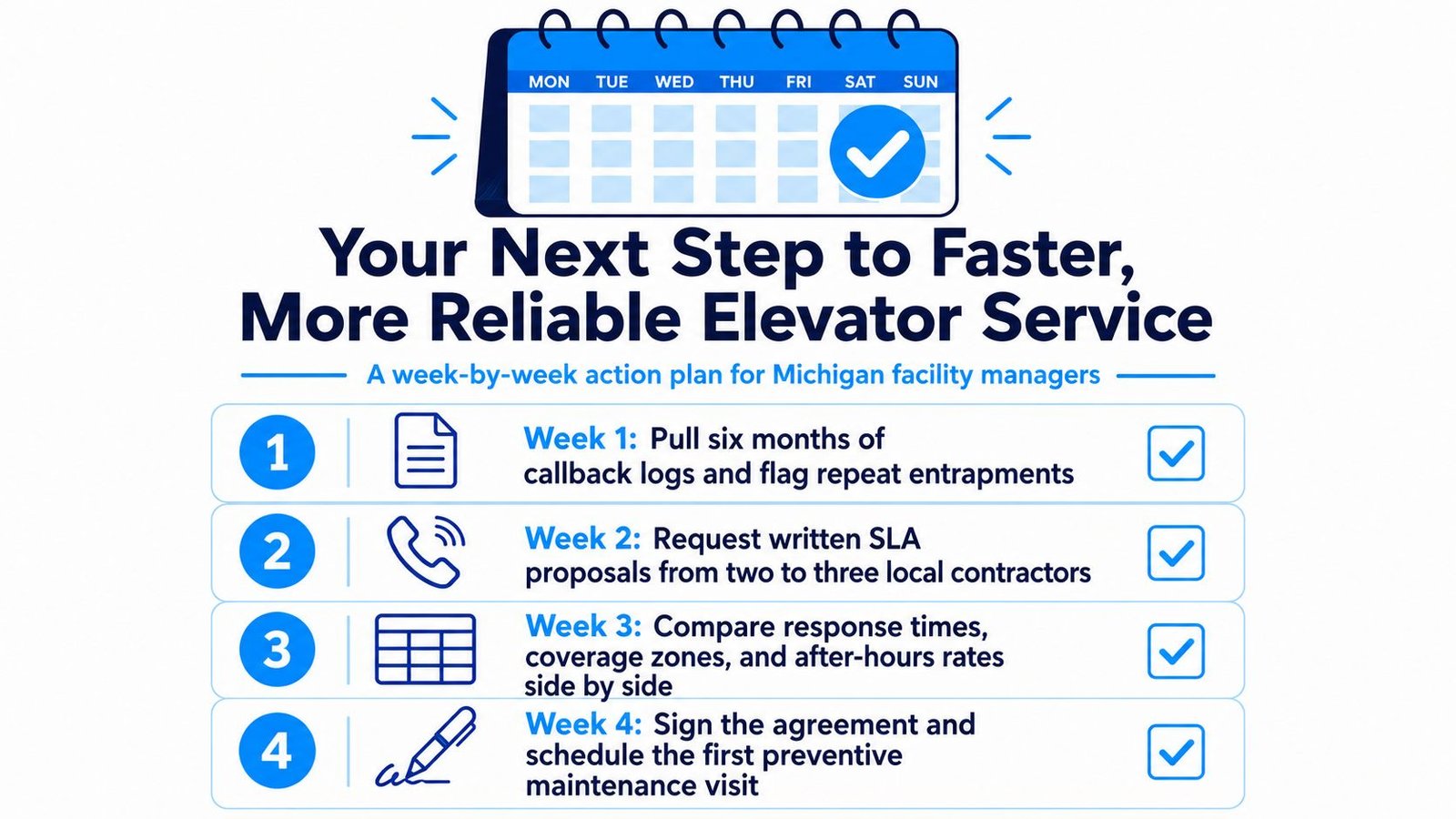
A practical four-week sequence
Week one, document the baseline. Record the equipment type, age, controller, door operator, current contract, inspection status, recurring faults, and actual response history. Ask the existing provider for missing logs before you make a decision.
Week two, request written proposals. Require response times in hours, dispatch tracking, No Show No Pay language, after-hours rates, non-proprietary parts terms, inspection responsibilities, sample reports, and a clearly separated modernization scope.
Week three, conduct site walks. Have each bidder inspect the machine room, pit, car top, controller, doors, safety systems, emergency phone, and records. Ask why the proposed repair is needed, what evidence supports it, and what work by others could affect schedule or cost.
Week four, onboard the selected contractor. Confirm insurance certificates, contact lists, escalation authority, inspection dates, Maintenance Control Program access, emergency procedures, tenant communication, and the first preventive visit. Put a 90-day performance review on the calendar and measure arrival, resolution, documentation, repeat callbacks, and missed commitments.
A responsive provider isn't the one with the smoothest presentation. It's the one that answers, dispatches, documents, carries the right parts, communicates limitations, and accepts measurable accountability when the car is out of service.
Crane Elevator Company provides 24/7/365 emergency response, preventive maintenance, code-required inspections, repairs, non-proprietary modernization, and service for passenger, freight, residential, wheelchair, material lift, and dumbwaiter equipment across Detroit, Lansing, Ann Arbor, Grand Rapids, and surrounding Michigan communities. Visit Crane Elevator Company to request a quote, schedule a service review, or ask for a free second opinion on an inspection, repair, or modernization proposal.