The elevator is down again. Your tenant is asking when it'll run, the inspector's paperwork is due, and the service invoice includes a callback, labor, and parts that your “affordable” contract never covered. That's the point where a low monthly fee stops looking like a bargain.
For Michigan property managers, affordable elevator maintenance means controlling the total annual ownership cost. That includes scheduled service, inspections, testing, callbacks, excluded parts, emergency labor, documentation, and the downtime risk attached to an aging or heavily used unit. The right contract can cost more on paper and less over the year. The wrong one can do the opposite.
Why Affordable Elevator Maintenance Is About Total Cost Not Just Monthly Fees
A property manager in Detroit might approve a lean maintenance agreement for an older passenger elevator. The price looks manageable until the unit begins generating repeat door faults, leveling complaints, and after-hours shutdowns. The contractor still visits, but each callback falls outside the contract. The building pays again for labor, then pays for parts, then explains another outage to tenants.
That scenario is common because buyers often compare monthly contract rates instead of comparing what each provider will absorb. A contract that excludes callbacks, parts, testing, or overtime may transfer nearly all financial risk back to the owner. A broader plan may carry a higher recurring fee while reducing surprise invoices and giving the contractor a reason to correct recurring faults rather than repeatedly reset them.
The problem matters more in healthcare, education, municipal, industrial, and mixed-use buildings. A shutdown affects patient movement, deliveries, accessibility, tenant operations, and public confidence. The operational cost may be difficult to express in a single invoice, but the property still pays through disruption and staff time.
Practical rule: Compare annual ownership cost, not the price of the next scheduled visit.
The Michigan maintenance reality
Crane Elevator Company serves Detroit, Lansing, Ann Arbor, Grand Rapids, and surrounding areas, where property portfolios can include older freight cars, busy passenger units, residential elevators, wheelchair lifts, material lifts, and dumbwaiters. A maintenance strategy that works for a newer low-traffic unit in Ann Arbor may be a poor fit for a heavily used institutional elevator in Detroit.
Non-proprietary equipment also changes the decision. Owners should understand whether the contractor can maintain and modernize the installed system without locking the property into one manufacturer's repair path. Crane's non-proprietary elevator services are relevant to that evaluation because open serviceability can support competitive bids and longer-term planning.
A useful comparison asks four questions:
- What is included? Scheduled visits, labor, lubrication, adjustments, testing, clean-downs, and routine replacements should be clearly listed.
- What is excluded? Parts, callbacks, overtime, inspections, code corrections, and modernization work can materially change the yearly total.
- Who carries the risk? Full-service agreements shift more repair risk to the contractor. Time-and-materials agreements leave more risk with the owner.
- What happens when faults repeat? A good program tracks patterns and corrects causes instead of treating every visit as an isolated event.
The cheapest contract can be reasonable for a newer, lightly used elevator with a strong repair reserve. It's rarely the right default for an older unit that already produces recurring service calls.
What Affordable Elevator Maintenance Covers and Why Compliance Matters
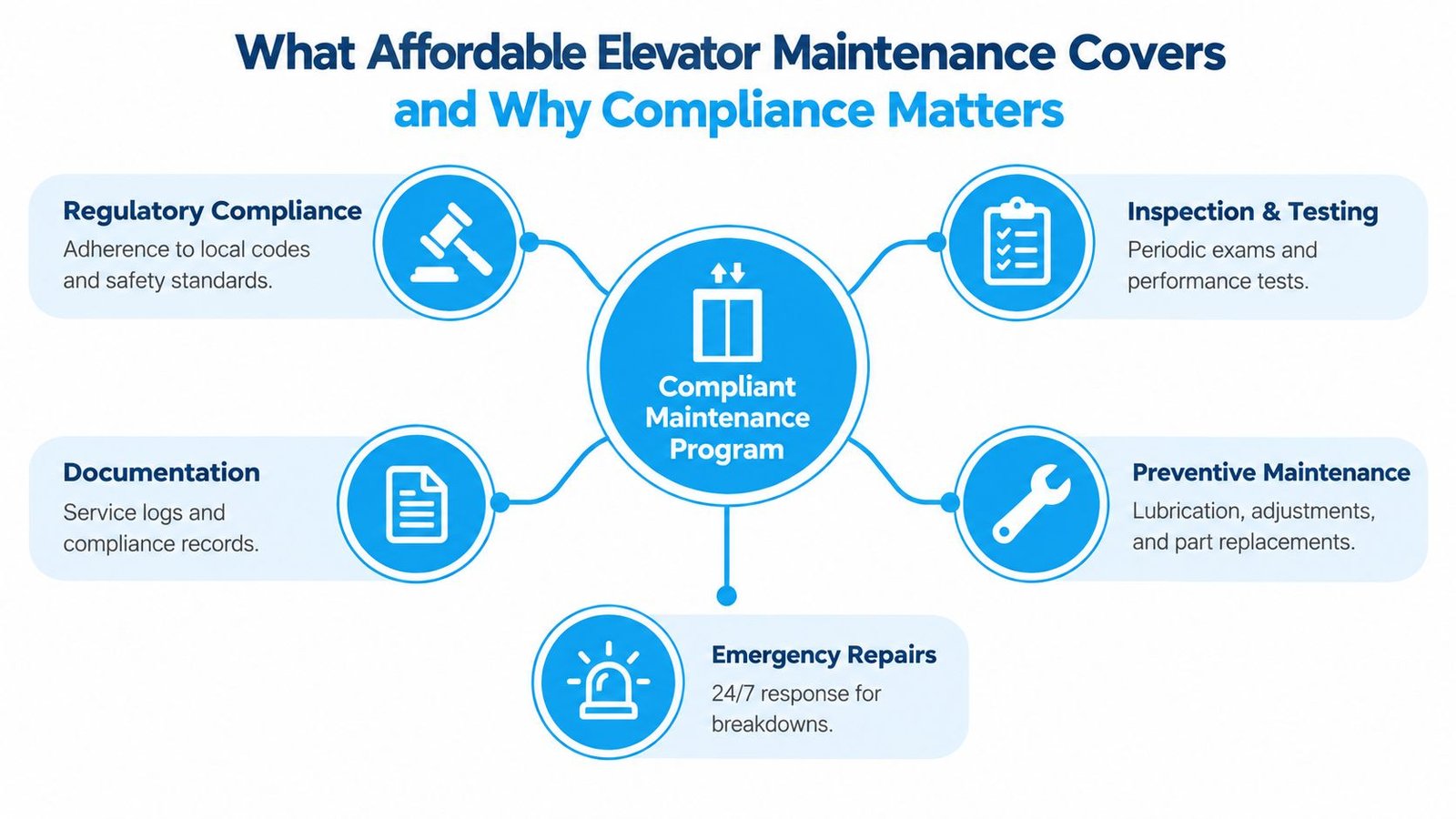
Affordable elevator maintenance starts with a compliant maintenance program, not a bare promise that a technician will visit periodically. The work should protect passengers, preserve equipment condition, support inspections, and create records that show what happened at the unit.
Modern elevator maintenance became regulated rather than informal. The first issuance of the ASME Safety Code for Elevators, later known as A17.1, occurred in January 1921, and an inspector-focused manual followed in the same era, according to the historical account of elevator safety-code development. Four successive editions of the American Standard Safety Code for Elevators, Dumbwaiters, and Escalators appeared in 1921, 1925, 1931, and 1937, showing how quickly inspection and maintenance expectations became embedded in the industry.
The core of a practical program
A Maintenance Control Program, or MCP, should identify required maintenance tasks, inspection responsibilities, repair history, and callback activity. The owner needs readily available records for the authority having jurisdiction, but the records also serve a daily management purpose. They reveal repeat door faults, incomplete work, recurring leveling problems, and parts that are being adjusted instead of replaced.
A properly documented visit should cover the components that create nuisance failures and safety concerns, including:
- Doors and entrances: Check operation, locks, sensors, interlocks, and abnormal noise.
- Travel and leveling: Verify smooth movement, stopping accuracy, and ride quality.
- Lubrication: Service moving components according to the equipment and manufacturer requirements.
- Machine components: Inspect the motor, brake, sheaves, machinery, selector, and controller for wear or damage.
- Fixtures and communication: Replace failed lamps when covered, check controls, and verify emergency communication equipment.
- Housekeeping: Remove contamination and debris from machine rooms, pits, and car tops where included in the service scope.
For elevator mechanics, a federal maintenance specification calls for semiannual inspection of elevator parts and components in accordance with ANSI A17.2, as described in the federal elevator maintenance specification. The exact obligations for a property depend on the equipment, jurisdiction, inspection program, and contract language, so the owner should confirm requirements with the authority having jurisdiction and the responsible elevator professional.
Crane's preventive elevator maintenance approach reflects the practical side of affordability. Routine checks, clean equipment spaces, documented service, and early correction of wear can cost less than repeated emergency response. A program should also distinguish scheduled preventive work from code-required tests, repair work, and modernization. Those categories often appear as separate charges unless the agreement says otherwise.
Compliance isn't paperwork added after the work. It's part of the work. If the contractor can't show what was inspected, adjusted, replaced, or deferred, the owner can't reliably manage safety, cost, or contractor performance.
Comparing Elevator Maintenance Contract Types Side by Side
The contract type determines where financial risk sits. Two proposals may use similar language about preventive service while treating labor, parts, callbacks, testing, and emergency response very differently.
| Contract Type | Coverage Scope | Cost Predictability | Best Fit Scenario |
|---|---|---|---|
| Full-service | Scheduled maintenance, routine labor, many repairs, and broad callback coverage, subject to exclusions | Highest predictability when parts and response terms are clearly defined | Older, busy, or mission-critical elevators |
| Preventive | Planned inspections, adjustments, lubrication, and routine service, with repairs often priced separately | Moderate predictability | Newer or stable equipment with a repair reserve |
| Time-and-materials | Technician time, travel, parts, and repairs billed as used | Lowest predictability | Low-use units, temporary coverage, or owners with strong in-house oversight |
| Parts-excluded or shared-risk | Regular labor and defined service included, major parts or selected repairs excluded | Predictability depends on the exclusion schedule | Buildings seeking a middle ground and willing to budget for capital repairs |
Full-service agreements
A full-service contract makes sense when an outage has a high operational cost or when equipment condition is uncertain. The owner pays for broader coverage in exchange for fewer separate repair invoices. The critical question is whether “full service” includes major components, after-hours response, callbacks, testing, and code corrections. Many agreements do not include everything a buyer assumes.
Preventive agreements
Preventive coverage is effective when the equipment is relatively stable and the owner maintains a realistic repair reserve. The contractor performs scheduled work, but the owner pays separately for parts and corrective repairs. This structure can work well for a newer residential elevator or a lightly used commercial unit. It becomes less attractive when the same fault returns repeatedly.
Time-and-materials arrangements
Time-and-materials service offers flexibility, but it puts the budget risk on the property. A small recurring issue can become expensive when the owner pays for diagnosis on every visit. This model suits owners who can monitor equipment closely, approve work quickly, and tolerate variable invoices.
Parts-excluded contracts
Parts-excluded agreements require the most careful reading. Ask for a component-by-component list rather than accepting a general phrase such as “wear items excluded.” Door operators, controllers, motors, brakes, hydraulic components, ropes, sheaves, and safety devices can carry very different financial consequences. The proposal should state whether labor remains included when an excluded part fails.
Preventive programs are most useful when they operate through an MCP with documented visits, inspections, repairs, and callbacks. ASME A17.1 recordkeeping guidance requires owners to keep those records readily available for the authority having jurisdiction. The same records help verify completed work and identify repeat-call labor.
The right contract doesn't eliminate repairs. It makes repair responsibility and cost visible before the elevator fails.
Pricing Models and Hidden Costs That Determine Affordability
A low monthly fee can produce an expensive elevator year. Compare the full annual cost, including callbacks, testing, excluded parts, travel, overtime, and code-related work. Commercial elevator maintenance pricing varies with equipment type, traffic, age, jurisdiction, service level, and parts coverage, so use the equipment's actual history rather than a generic quote. Broader planning guidance places annual commercial maintenance for many installations at roughly $3,600 to $8,400. For context, current elevator maintenance cost guidance lists home elevator maintenance at about $510 per year, with a typical range of $300 to $760, and commercial contracts often estimated at $1,800 to $15,000 per elevator per year.
Use a total-cost decision matrix
| Contract approach | Best fit | Main budget risk |
|---|---|---|
| Full-service contract | Older, busy, or mission-critical equipment | Higher fixed fee, with coverage limits to verify |
| Preventive maintenance with defined repairs | Buildings with stable equipment and predictable use | Exclusions can shift repair costs to the owner |
| Time-and-materials service | Closely monitored, lightly used equipment | Every diagnosis, callback, and repair increases the invoice |
| Parts-excluded agreement | Owners with a funded repair reserve | Major components may remain outside the base rate |
Even well-maintained elevators can generate 3 to 5 service calls per year outside scheduled visits. Equipment older than 15 years may experience callback rates 40% to 60% higher, and direct callback charges can run $300 to $800 each. Treat those figures as planning inputs, then confirm the contractor's actual callback history for the unit.
Budget charges outside the base rate
Require a separate line for each item:
- Callback labor: Confirm whether routine callbacks are included and whether after-hours visits cost more.
- Parts: List covered and excluded components. State whether labor remains covered when an excluded part fails.
- Testing: Category 1 tests can cost $400 to $1,500 annually, while Category 5 tests can cost $1,500 to $5,000 every five years. The elevator cost guide provides these planning ranges.
- Code corrections: Separate maintenance from violations, modernization, and inspection-required work.
- Overtime and emergency response: Confirm response windows and billing for nights, weekends, and holidays.
- Administrative items: Check for added charges for certificates, reports, travel, permits, and inspection coordination.
Ask each bidder for an annualized estimate based on age, use, recent callbacks, inspection timing, and known deficiencies. Keep a separate modernization reserve because maintenance does not make obsolete controls, worn machinery, or unavailable parts economical to repair.
Key Contract Clauses Every Property Manager Should Require
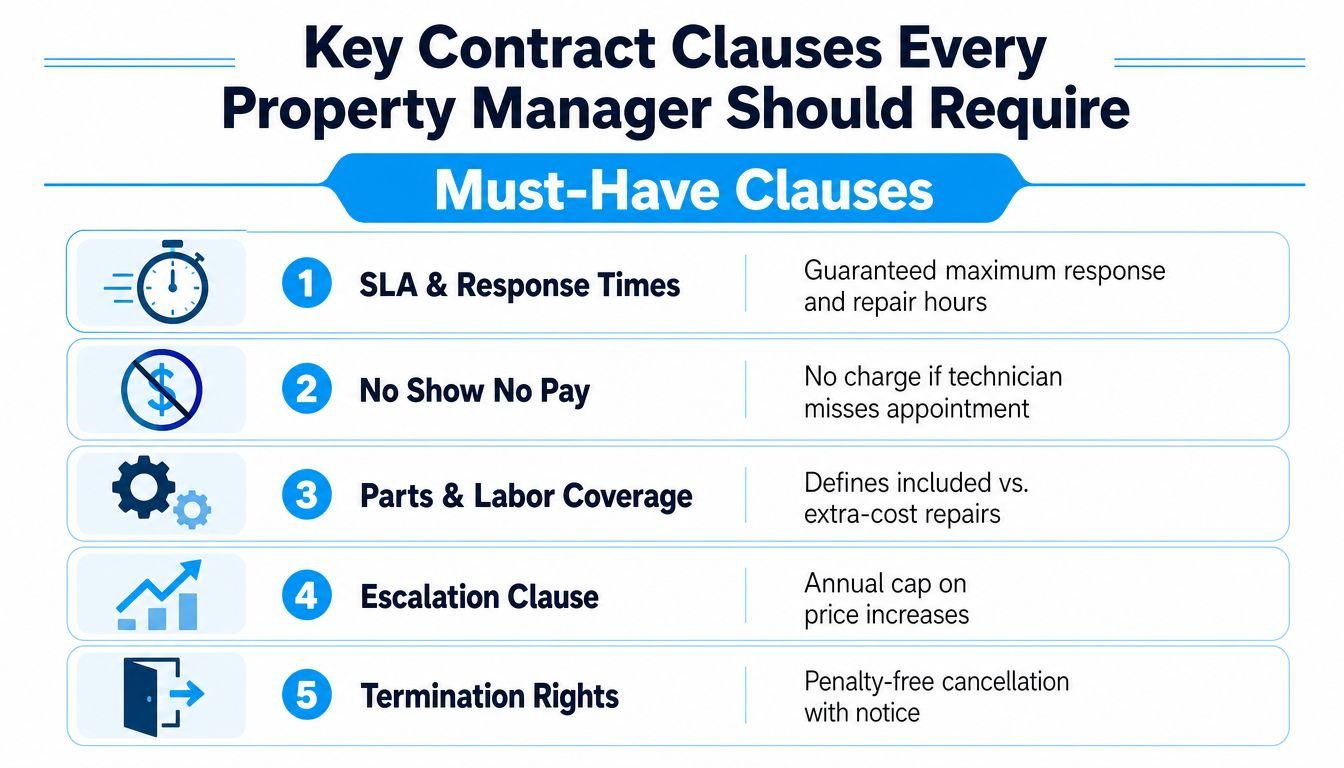
A proposal becomes useful only when its responsibilities are specific. Property managers should redline vague phrases such as “regular service,” “reasonable response,” and “parts at customer expense.” Those words leave room for disagreement when the elevator is down and the invoice arrives.
Response and attendance terms
The agreement should state how the contractor receives an emergency call, what response means, and how quickly the technician must arrive or begin remote triage. Separate passenger entrapment, shutdown, nuisance fault, and routine service requests. A promise of 24/7/365 availability is useful only if the contract also explains escalation and communication.
Demand this in writing: Define the maximum response time, the contact method, the escalation path, and the reporting required after an emergency visit.
A No Show, No Pay clause protects the owner from paying for a scheduled visit that wasn't performed. It should explain what counts as a completed visit, what documentation the technician must provide, and how missed appointments are credited.
Scope, parts, and testing
Require a detailed task schedule. It should identify door checks, leveling verification, lubrication, machine inspections, clean-downs, fixture checks, emergency phones, fire service, generator testing, and other agreed work. Separate ordinary maintenance from Category 1 and Category 5 testing, inspection coordination, violation corrections, and modernization.
The parts clause deserves more attention than the base price. Require a list of included and excluded components, labor treatment for excluded parts, approval thresholds, markup rules, and emergency purchasing procedures. If the contractor can install a temporary repair, the contract should state how the owner approves a permanent replacement.
Price changes and exit rights
Set an annual price-adjustment method and a cap or approval process. The contract should also allow termination for repeated missed visits, poor documentation, unacceptable response, or failure to correct recurring faults. Include notice requirements and clarify ownership of service records when the agreement ends.
Michigan property managers may need these protections across very different markets. Detroit has about 645,705 residents, Grand Rapids about 200,117, Ann Arbor about 122,925, and Lansing about 114,336, according to Michigan city population data. Those markets include different building ages, traffic patterns, and operating demands, so a single generic contract won't fit every property.
Crane Elevator serves those four cities and surrounding Michigan areas, including Warren, Sterling Heights, Dearborn, and Flint. Its described service scope includes clean-downs, bulb replacements, repairs, testing, emergency phones, fire service, generator testing, violation corrections, and non-proprietary modernization. Treat those items as proposal checkpoints, and require the final agreement to state exactly what is included.
Negotiation Tips and Your Sample Contract Checklist
Negotiation should focus on measurable service, not just a lower rate. Start by giving every bidder the same asset list, equipment age, callback history, inspection schedule, known deficiencies, traffic profile, and desired response coverage. If one contractor receives less information, the bids won't be comparable.
Track mean time between callbacks, or MTBC, across each unit and the portfolio. Elevator industry literature defines MTBC as the number of units multiplied by a time period divided by the number of callbacks, as explained in this maintenance diagnostics benchmark. The metric normalizes service demand, allowing you to compare a single elevator with a larger portfolio and determine whether preventive work is reducing emergency events.
Negotiate around evidence
Ask the contractor to tie invoices to documented visits, completed tasks, technician notes, and callback history. Request a monthly or quarterly review for units with repeated faults. Use the trend to adjust service intervals, replace a failing component, or begin modernization planning before the equipment becomes unreliable.
You can also negotiate:
- Callback treatment: Set a clear annual allowance or require approval before repeated diagnostic visits become billable.
- Second opinions: Secure the right to obtain an independent opinion before approving major repairs or modernization.
- Price competition: Ask whether the provider offers a price-beat policy and identify the conditions in writing.
- Parts approval: Set a dollar threshold for automatic repair and require written authorization above it.
- Record ownership: Require copies of MCP records, inspection documents, test results, and repair history.
Use this bid checklist
Before selecting a contractor, confirm:
- Asset coverage: Every elevator, lift, dumbwaiter, and related system is listed.
- Visit schedule: The agreement states the planned service frequency and required tasks.
- Callback rules: Included, excluded, emergency, and overtime visits are separated.
- Parts schedule: Included components, exclusions, markups, and labor treatment are clear.
- Testing responsibility: Category 1, Category 5, fire service, generator, and other tests have named owners and budgets.
- Documentation: Each visit produces usable service records and callback notes.
- Performance review: MTBC and recurring faults are reviewed at agreed intervals.
- Exit terms: The owner can terminate for documented service failures under defined conditions.
This checklist works for industrial plants, hospitals, schools, municipal buildings, residential properties, and mixed-use portfolios. It also gives a contractor enough information to price the actual risk instead of adding a vague contingency to the proposal.
Choosing the Right Affordable Maintenance Plan for Your Building
Choose the plan based on consequence of failure, equipment condition, and traffic. A busy hospital, school, municipal building, or apartment property usually needs broader coverage and dependable response because a shutdown affects more people and operations. Full-service or shared-risk coverage is generally easier to defend when the elevator is old, heavily used, or already producing repeat callbacks.
A newer, lightly used passenger elevator may be better served by preventive maintenance plus a dedicated repair and testing budget. That structure keeps routine work organized without paying for broad risk transfer the equipment may not need. Time-and-materials service belongs with low-use equipment, temporary arrangements, or owners prepared to manage variable costs closely.
Residential elevators and wheelchair lifts need the same disciplined approach, even when the system is smaller. Homeowner guidance places average home elevator maintenance around $300 to $760 per year, while commercial contracts can range from roughly $1,800 to $15,000 per car per year, depending on scope, equipment type, and building complexity, according to commercial and residential elevator maintenance cost guidance.
For older equipment, don't keep buying short-term repairs without a modernization view. Ask for a condition assessment, parts-availability review, non-proprietary options, and financing alternatives. A newer passenger unit in Kalamazoo, a freight elevator in Detroit, and a residential lift in Perrysburg may need completely different plans. Crane Elevator Company provides every type of elevator service across Michigan and Ohio, including preventive maintenance, repairs, inspections, testing, modernization, and emergency response for properties in Detroit, Lansing, Ann Arbor, Grand Rapids, Toledo, Flint, and surrounding communities.
Crane Elevator Company can review your current agreement, identify excluded costs, provide a second opinion, and build a maintenance or modernization plan around your equipment and building use. Visit Crane Elevator Company to request a competitive quote and discuss affordable elevator maintenance that controls total ownership cost, not just the monthly fee.