
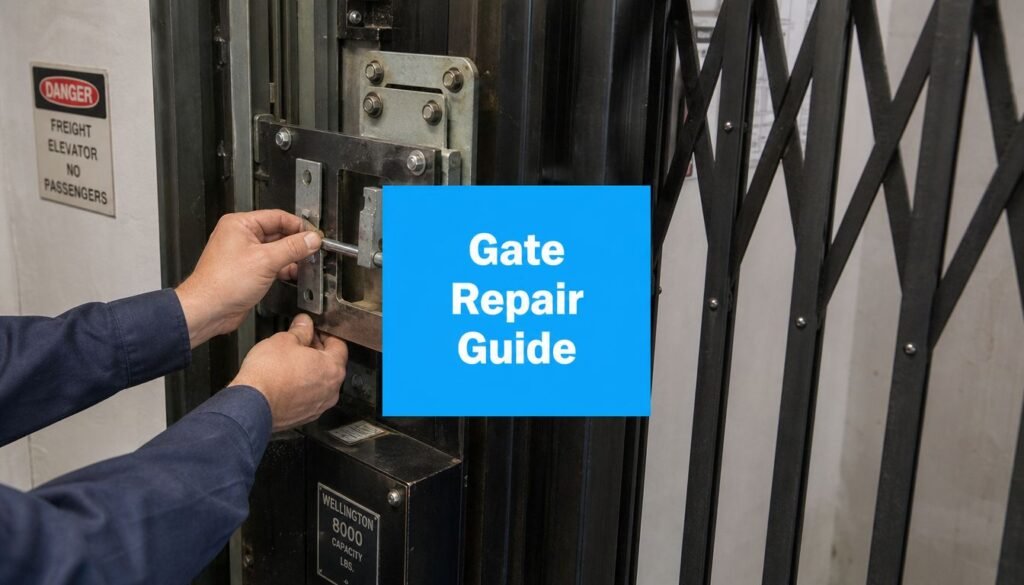
A freight elevator gate rarely fails at a convenient time. A forklift operator may be waiting with a pallet, a hospital loading team may have a cart staged at the landing, or a building manager may hear the same gate rattle that has been getting worse for weeks. Then the gate sticks, the latch misses, or the elevator refuses to run.
That moment is more than an inconvenience. A bent frame, worn roller, broken guide, or unreliable interlock can create downtime, injury exposure, and a code problem at the same time. Freight elevator gate repair must restore the complete safety function, not make a metal panel slide again.
This guide treats the gate as part of a larger system. You'll see how the barrier, latch, interlock, dimensions, inspection schedule, and lockout process fit together, with practical compliance considerations for Michigan and Ohio facilities served by Crane Elevator across Detroit, Lansing, Ann Arbor, Grand Rapids, and surrounding areas.
When a Freight Elevator Gate Stops Your Building
A warehouse supervisor calls after the freight elevator gate begins scraping the sill. The car still travels, but the landing gate no longer closes smoothly. Someone has forced it until the latch catches, and production continues because the building depends on that elevator.
That choice is understandable under pressure. It also creates a dangerous assumption: if the car moves, the elevator must be safe. A gate can lose alignment, a frame can deform, or an interlock can engage at the wrong point while the car remains operational. The inspection therefore has to cover the gate, its guides and latch, and the connected locking circuit before anyone authorizes normal service.
The gate is part of a code-driven safety system, much like a door, latch, and permission signal working together. Its height, resistance, deflection, guide retention, and breakage limits all affect whether it can protect the landing opening. California rules illustrate the point. Existing freight elevator gates generally must be at least 66 inches high, although certain top-terminal landings may use gates 41 to 45 inches high when structural conditions make the greater height impractical. The same rule addresses resistance to 100 lbf and 250 lbf forces, including limits on deflection, guide retention, and breakage in California's freight-elevator landing-opening requirements.
Appearance alone cannot show that the system is safe. A gate may look straight while its latch, interlock timing, or mounting points fail under use.
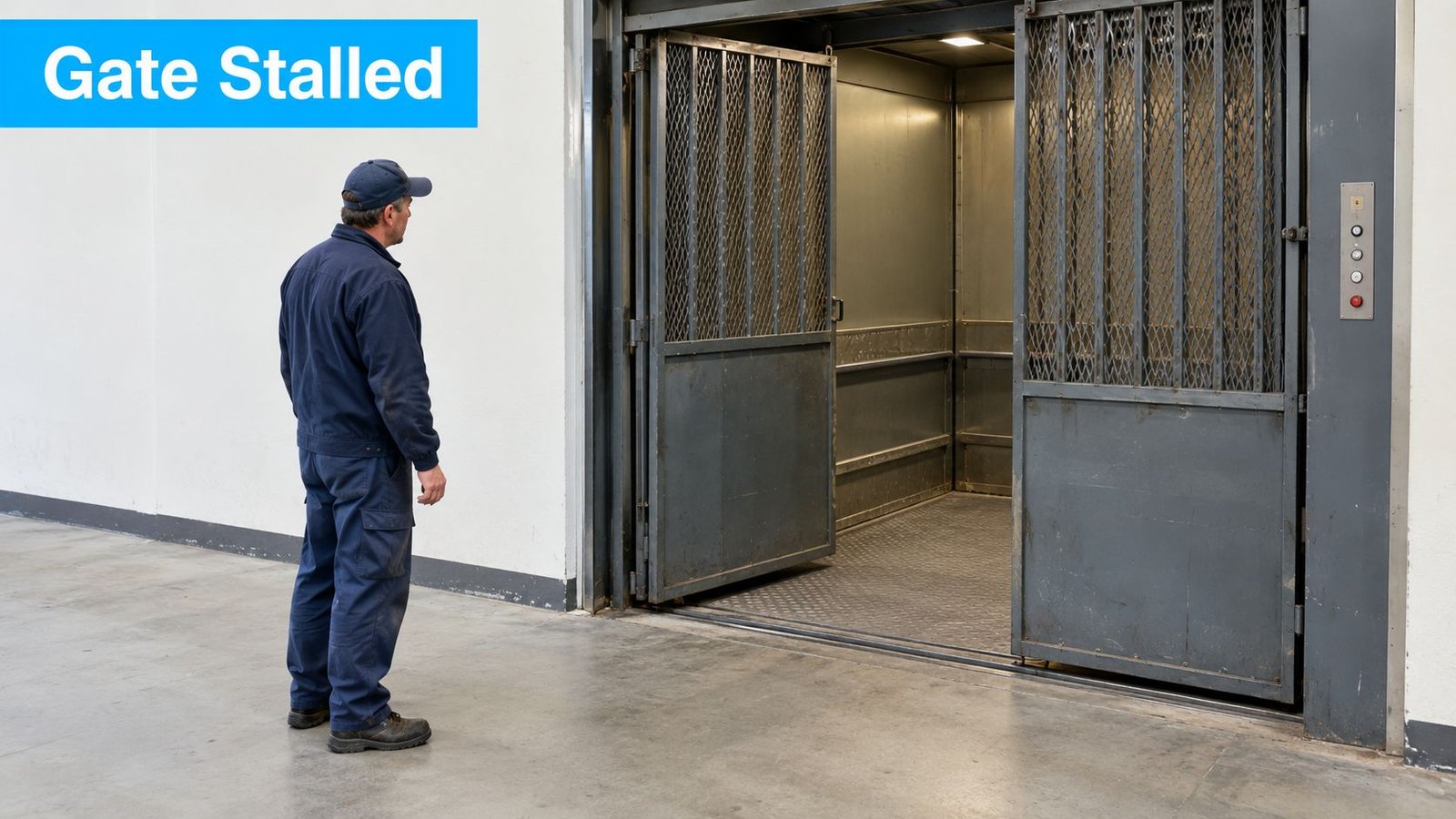
The first decision is service status
If the gate does not latch securely, remove the elevator from service until a qualified person evaluates it. An elevator placed out of service needs clear signs, controlled access, and a documented plan. In industrial, healthcare, education, and municipal buildings, that responsibility includes preventing staff from bypassing the gate or resetting the unit without authorization.
The assessment should answer four practical questions:
- What failed: Is the fault in the gate, guides, rollers, latch, frame, interlock, or wiring?
- What changed: Did a forklift strike the gate, or did wear develop gradually?
- Can it be repaired safely: Are suitable parts available, and can the original assembly still meet applicable requirements?
- Should it be upgraded: Would an approved interlock or modern gate assembly address recurring risk?
Freight Elevator Gate Repair is urgent because the gate protects an open shaft and helps determine whether the elevator may run. Treating it as a loose panel produces the wrong repair scope from the start.
How Freight Elevator Gates Protect People and Loads
A freight gate works like a seatbelt and latch used together. The gate is the physical restraint. The interlock is the latch that confirms the restraint is secured before the elevator can operate. Either part can look acceptable by itself while the complete protection system remains unreliable.
The gate blocks access to the shaft at the landing. It also helps contain cargo while the car travels, particularly when carts, pallets, or equipment are loaded and unloaded repeatedly. A gate that bends inward, develops excessive play, or leaves an opening around its frame can compromise both people protection and load control.
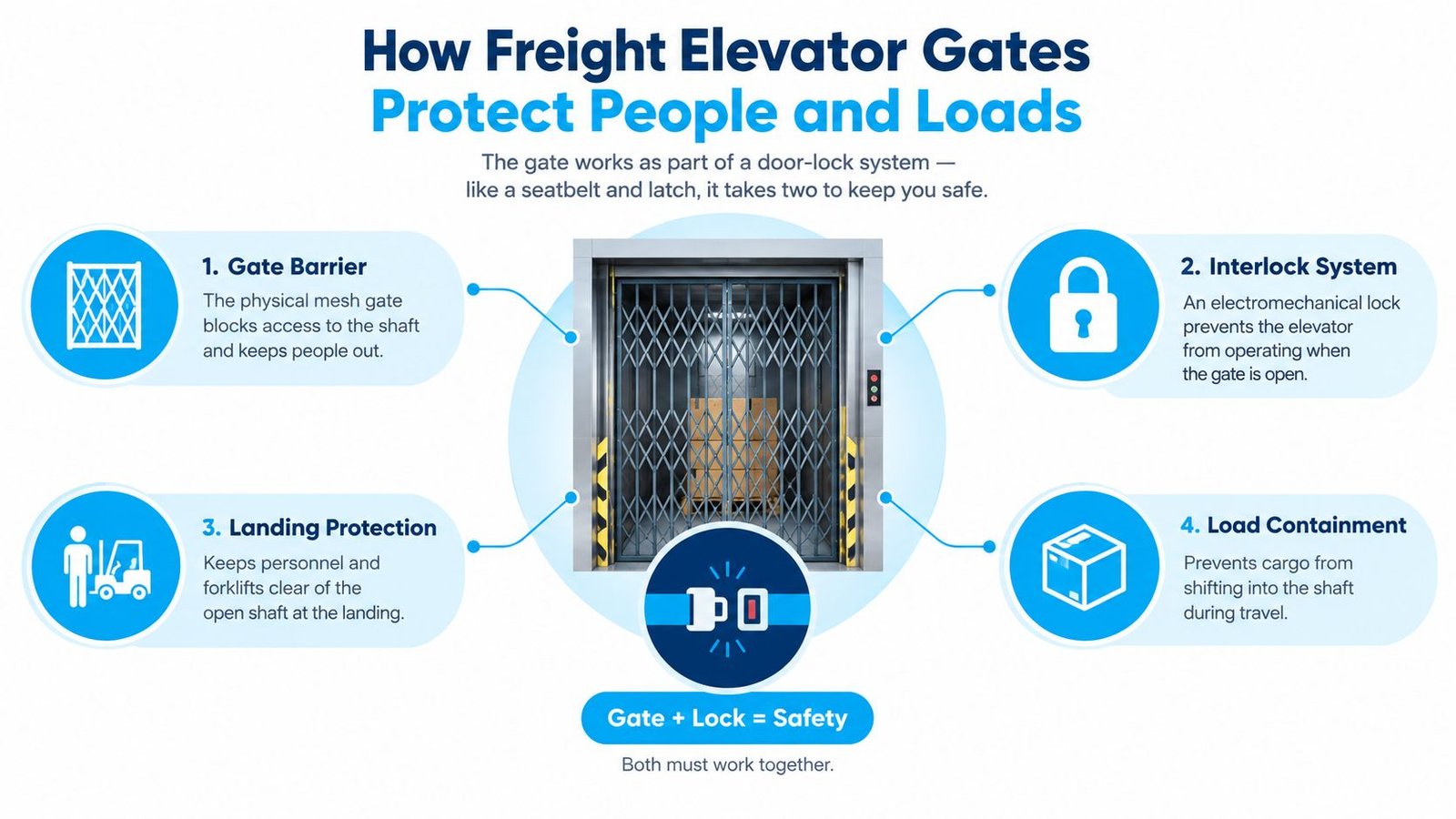
Four parts work as one
- Gate barrier: A rigid metal or high-strength wood assembly creates the physical separation between the landing and shaft.
- Interlock system: The mechanical and electrical components prevent elevator operation unless the gate is properly closed and locked.
- Landing protection: The closed gate keeps employees, visitors, and forklifts away from an open shaft.
- Load containment: The gate helps keep freight positioned inside the car during travel.
Industry code material describes freight gates with requirements for rigid construction, openings through which a 2-inch ball cannot pass, and resistance to 150 pounds of pressure at mid-span without permanent deformation. It also requires latching arrangements that prevent a landing gate from opening unless the car is at that landing, as reflected in this freight elevator safety-code draft.
That last function explains why latch alignment matters so much. A worn hinge, sagging frame, or damaged guide can keep the mechanical lock from reaching its intended position. A technician may need to correct the gate geometry before testing the electrical contact, because an interlock cannot compensate for a gate that physically fails to seat.
The gate isn't the whole door system
Freight equipment can use sliding gates, swing arrangements, auxiliary chains, or other legacy configurations. The exact design changes the inspection points, but the principle stays the same: the elevator must not run when the protective opening is unsecured.
A gate may close visually while the contact remains open, causing a nuisance shutdown. The reverse condition is more serious, because a poorly adjusted or bypassed contact can suggest that the gate is safe when it isn't. That's why a proper assessment includes the mechanical lock, contact timing, wiring, guides, rollers, and frame.
For a visual explanation of related door protection hardware, see Crane Elevator's guide to the elevator door restrictor.
ADA and ANSI Dimensions Every Facility Manager Should Know
A gate can meet one dimension and still create a hazard if the surrounding equipment is wrong. A raised threshold can catch a pallet jack like a curb. A narrow opening can turn an otherwise usable lift into a bottleneck. Facility managers should identify the equipment category first, then confirm the requirements for that installation with the authority having jurisdiction.
Accessible equipment must be reviewed as a complete route, not only as a platform. The clear platform area should suit the intended mobility device, while the entrance provides a usable opening and the threshold allows a safe transition without catching wheels or creating a trip point. Controls also need to stay reachable, with enough separation from unsafe areas for the user to operate the lift safely.
Freight landing gates follow a different protection logic. They may require substantial height, controlled openings, rigid construction, and a latch that proves the gate is secured. Those dimensions do not automatically become ADA dimensions, and an accessible lift's measurements do not automatically approve a freight-gate alteration.
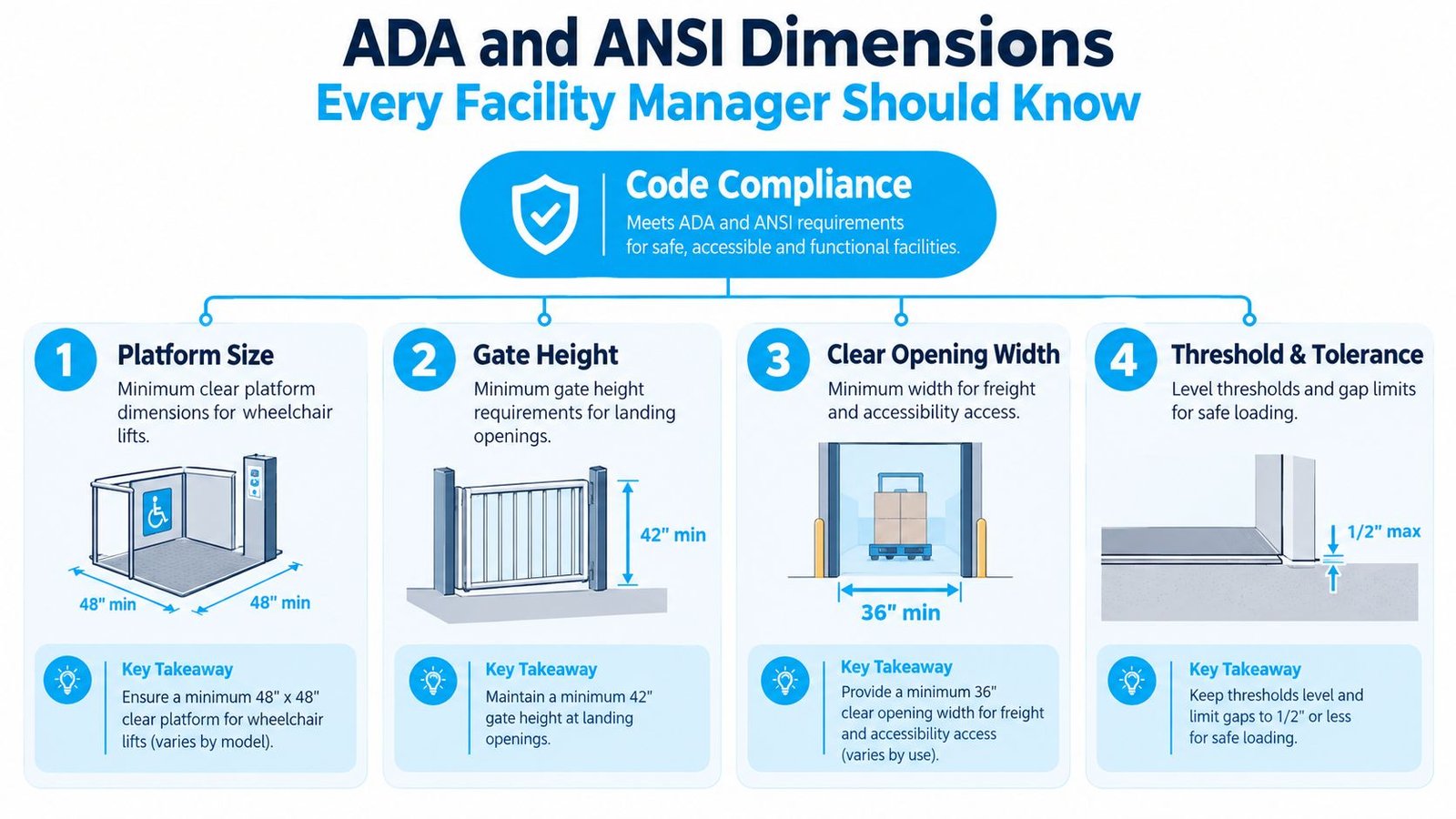
Use the right measurement for the right equipment
Before service begins, record the measurements that define both access and protection:
- Platform size: Measure the clear, usable platform area. Exclude space blocked by fixtures, posts, or gate hardware.
- Gate height: Confirm that the landing gate matches the applicable freight-elevator rule and site conditions. California provisions distinguish common existing-gate height from certain top-terminal exceptions, with 66 inches, 41 inches, and 45 inches appearing in those provisions as cited earlier.
- Clear opening width: Measure the unobstructed passage rather than the nominal frame width. Rollers, guides, stops, and replacement hardware can reduce the space available to people or loads.
- Threshold and gap: Inspect the transition between the landing and car floor. A damaged sill or raised threshold can obstruct carts, pallet jacks, wheelchairs, and other mobility devices.
The tape measure supplies the starting facts. Code interpretation supplies the answer. A historic shaft, restricted landing, unusual terminal condition, or mixed-use modernization may require review by an engineer, inspector, or code official.
Why “close enough” causes repeat repairs
A gate adjusted only to stop rattling may still leave its latch partly engaged. A replacement panel can fit the frame yet reduce clearance or change when the interlock contacts close. These small changes affect the safety sequence, much like a misaligned bolt that appears shut but has not entered the strike.
Use the measurements to define the repair, then test the entire sequence. The gate must close, latch, and prove its locked condition before the elevator is permitted to operate. For accessibility planning, Crane Elevator's ADA requirements for elevators overview can help facility teams prepare questions before a site assessment.
Repair or Retrofit Deciding What Your Old Gate Really Needs
An old gate can sometimes be restored. That doesn't mean restoration is always the responsible choice.
Legacy freight elevators may contain chain guards, older latches, worn counterweights, discontinued rollers, or hardware assembled during several different repair eras. New York City rules for existing hand-powered freight elevators still recognize auxiliary gates or chains, but those components must remain locked or secured and cannot project into the shaft. California distinguishes between approved interlocks for new gates and approved interlocks or contact locks for existing installations in its freight-elevator gate provisions.
The practical question is whether the existing assembly can return to service with a defensible safety function. If the frame is sound, parts are available, and the interlock can be adjusted and tested correctly, repair may be reasonable. If the gate has repeated impacts, distorted guides, unavailable components, or incompatible mixed hardware, a retrofit may produce a safer and more maintainable result.
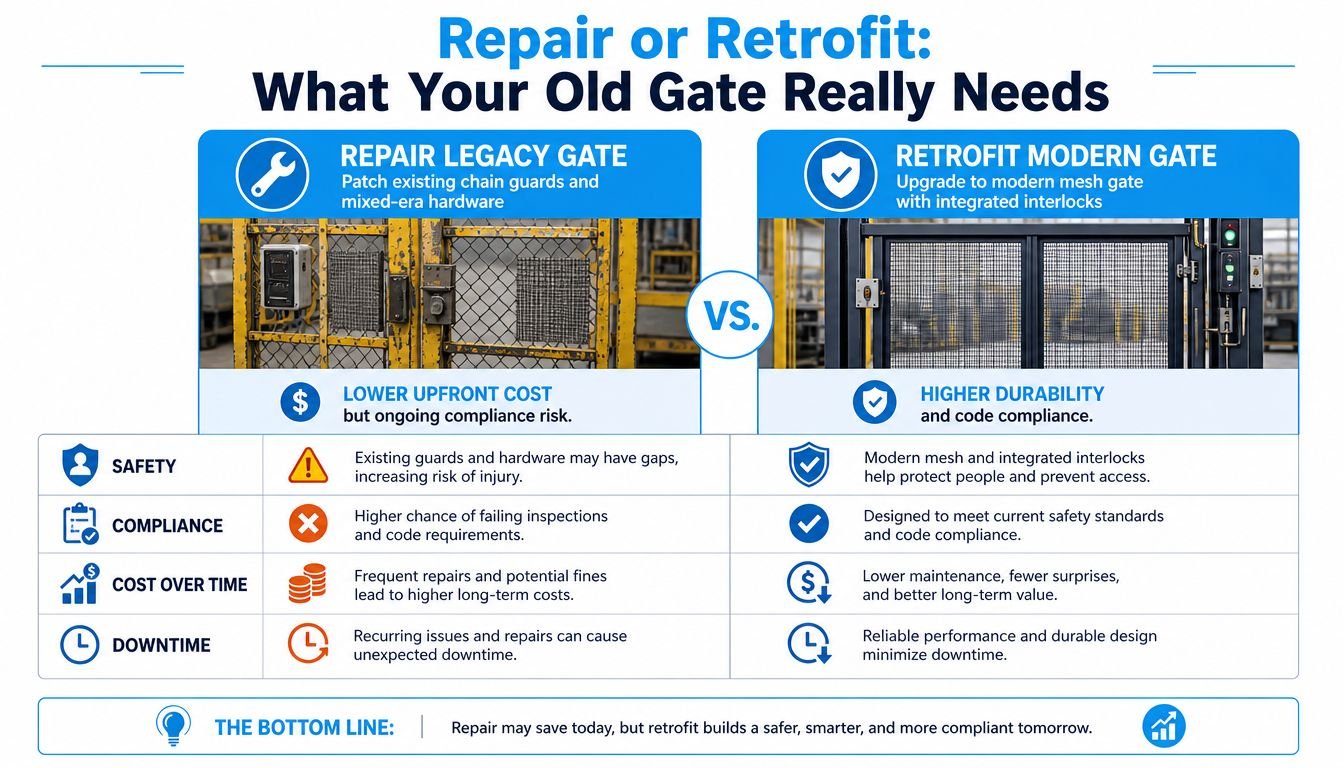
Compare the two paths
| Factor | Restore As-Is | Upgrade to Modern Standard |
|---|---|---|
| Safety | Corrects specific worn or damaged parts | Replaces weak points with a coordinated assembly |
| Compliance | Depends heavily on the legacy design and approved components | Can be specified around current applicable requirements |
| Cost Over Time | May involve recurring adjustments and callbacks | May reduce repeated component failures |
| Downtime | Often shorter if parts are available | Usually requires more planning and installation work |
Modern mesh construction and counterbalanced vertical-slide gates can offer a more coordinated design, particularly when paired with approved interlocks. But “modern” alone isn't a compliance determination. The replacement must fit the shaft, landing, car, controls, and governing requirements.
Treat repeated repairs as evidence
A gate that needs frequent roller replacement may have a bent frame or damaged track. A latch that keeps missing may reflect settlement, impact, or incorrect geometry rather than a bad latch alone. Replacing one visible part without identifying the underlying cause can turn a repair into a cycle.
This decision affects portfolios in Detroit, Lansing, Ann Arbor, Grand Rapids, Toledo, Perrysburg, and surrounding Michigan and Ohio towns. A facility team managing several older cars should compare condition, parts availability, repair history, inspection findings, and future modernization plans. The right question isn't, “Can we make this gate work?” It's, “Which option gives the building a reliable, testable, supportable gate system?”
Diagnosing Common Gate Failures and Fixing Them Safely
A good technician diagnoses from the outside in. Start with the movement and structure, then inspect the locking sequence and electrical proof. That order prevents a contact adjustment from hiding a mechanical problem.
Begin with the physical assembly
Look for impact marks, bowed stiles, loose fasteners, damaged mesh, worn rollers, broken guides, and debris in the sill or track. A gate that drags at one point may have a bent frame. A gate that rattles after closing may have excessive roller play or a guide that no longer controls the panel.
Next, check the latch and landing frame. The latch should engage cleanly without forcing the gate upward, sideways, or beyond its normal travel. If an operator has to slam or lift the gate to make it lock, the assembly needs correction before anyone relies on the interlock.
Practical rule: A gate that doesn't lock safely should be taken out of service immediately.
Verify the interlock and contact timing
Field maintenance guidance calls for interlock contacts to be inspected at least twice a year, and for the contact point to be checked at least annually by slowly closing the door and confirming that the interlock engages only within the permitted closing range (maintenance guidance).
The inspection should include:
- Contact condition: Look for pitting, burning, contamination, loose terminals, and damaged wiring.
- Mechanical engagement: Confirm that the lock reaches its intended position without excessive force.
- Closing range: Slowly close the gate and verify that the safety circuit proves closure only at the correct point.
- Lubrication and adjustment: Use the manufacturer's approved method. Excess lubricant can attract debris, while poor adjustment can produce nuisance trips or unsafe conditions.
Control the repair before touching the gate
Lockout/tagout responsibility is often the most overlooked part of gate work. An OSHA-related case involving freight elevator gate repair upheld the need for mechanical blocking to prevent unexpected movement, as described in this OSHA lockout/tagout case report.
The unit should be placed under a controlled shutdown procedure, with the car secured against movement and the work area protected from building traffic. After repair, keep records of the reported failure, parts changed, measurements taken, interlock tests, operational tests, and the person who authorized return to service. That record helps the owner explain what happened if the original incident involved a forklift impact, employee complaint, or inspection violation.
Planning for Michigan and Ohio Inspections and Maintenance Cycles
Gate repair planning works better when owners connect the work order to the equipment's inspection and maintenance calendar. A freight elevator that operates in Michigan may follow a different schedule from a platform lift or dumbwaiter in the same portfolio, while Ohio imposes its own recurring inspection obligation.
Michigan requires maintenance records to remain on site and requires most power elevators to be maintained at least every 90 days. Dumbwaiters, one-person elevators, platform lifts, and stairway chairlifts in nonprivate residences follow a 180-day maintenance cycle under Michigan maintenance rules.
Michigan inspection intervals also vary by equipment type. Passenger, freight, mine, inclined, limited-use/limited-application, special purpose personnel, and rooftop elevators must be inspected at least once every 12 months, while dumbwaiters, stairway chairlifts, one-person elevators, and platform lifts are inspected every 24 months, according to Michigan inspection requirements.
Ohio and Detroit require tighter scheduling
Ohio law requires every passenger elevator, escalator, moving walk, and freight elevator, including gravity elevators, to be inspected twice every 12 months under Ohio Revised Code Section 4105.10. A Toledo-area facility that waits for a gate to fail before scheduling work risks competing with an inspection deadline and an operational shutdown.
Detroit adds a more frequent service requirement. The municipal code calls for power elevators, escalators, and moving walks to be inspected and serviced at least every 30 days by a licensed elevator journeyperson, with extensions up to 90 days available only by special permission. It also requires Firefighters' Emergency Operation systems to be tested every 30 days through Phase I recall and at least one floor of Phase II operation, as set out in Detroit's elevator service and inspection code.
Build the repair into the portfolio plan
Crane Elevator Company serves Detroit, Lansing, Ann Arbor, Grand Rapids, Flint, Kalamazoo, Toledo, Perrysburg, Holland, Saginaw, Findlay, and surrounding Michigan and Ohio communities. Its service scope covers every type of elevator service, including freight and passenger elevators, residential units, wheelchair and material lifts, and dumbwaiters, with non-proprietary maintenance, repair, inspection, and modernization options.
Owners should schedule gate assessments before the next inspection window, preserve service records on site, and ask for a clear distinction between a repair, a code correction, and a modernization recommendation. Commercial and modernization financing can also help turn a sudden gate problem into a planned capital decision rather than an unbudgeted emergency.
Your Practical Checklist for Compliant Gate Repairs
Use this checklist before approving Freight Elevator Gate Repair:
- Identify the equipment: Confirm whether the unit is a freight elevator, platform lift, wheelchair lift, dumbwaiter, or another category.
- Record the failure: Note impacts, sticking, rattling, incomplete latching, nuisance shutdowns, or visible frame and guide damage.
- Verify dimensions: Measure gate height, clear opening, platform space, threshold condition, and any relevant landing clearances.
- Inspect the mechanics: Check rollers, guides, hinges, sill, frame rigidity, latch alignment, and counterbalance components.
- Test the safety circuit: Inspect interlock contacts, wiring, mechanical engagement, and closing-range timing.
- Control the work: Take the elevator out of service, apply the required lockout/tagout procedure, and mechanically block against unexpected movement.
- Choose the right scope: Decide whether the existing gate can be restored safely or whether an approved modern gate and interlock retrofit is more defensible.
- Document return to service: Keep measurements, test results, parts information, incident notes, and authorization records with the maintenance file.
- Coordinate the calendar: Align repair completion with Michigan, Ohio, or Detroit maintenance and inspection requirements.
Crane Elevator Company supports facilities across Michigan and Ohio with 24/7/365 service, major and minor repairs, code-required inspections, non-proprietary modernization, and service for all makes and models. For a gate that is sticking today or a legacy elevator that needs a planned upgrade, contact a qualified elevator contractor and request a documented assessment rather than a quick adjustment.
Contact Crane Elevator Company to schedule a freight elevator gate assessment, interlock test, repair quote, or modernization review in Detroit, Lansing, Ann Arbor, Grand Rapids, Toledo, and surrounding Michigan and Ohio communities. Their team provides every type of elevator service, including emergency response, preventative maintenance, code corrections, and non-proprietary solutions for freight elevators and related equipment.