In Michigan, most power elevators require maintenance at least once every 90 days by a licensed elevator journeyman, while passenger elevators need inspections at least once every 12 months. These are documented compliance baselines, not suggestions.
A facility manager in Ann Arbor usually doesn’t ask about maintenance on a quiet day. The question comes after a rough stop, a door that takes too long to close, a callback from a tenant, or a state inspection notice sitting beside an already crowded calendar. At that point, the real issue isn’t just getting the elevator moving again. It’s knowing whether the equipment is being maintained, tested, and documented well enough to protect passengers, operations, and the building owner.
Understanding the Baseline for Ann Arbor Elevator Maintenance
Michigan’s elevator requirements give Ann Arbor owners a practical starting point. Most passenger and freight elevators must be inspected at least once every 12 months, while power elevators generally must be maintained at least once every 90 days by a licensed elevator journeyperson, according to the current Michigan elevator rules.
Those intervals apply to different obligations. An inspection checks the system against required safety conditions. Maintenance involves the recurring work that keeps the equipment operating, including examining wear, adjusting components, cleaning critical areas, and identifying defects before they become a shutdown. Treating both activities as one annual appointment is a common way for owners to miss the actual workload.
Why reactive service creates exposure
A service call after a failure can restore operation, but it doesn’t replace a maintenance program. Elevators have several systems that can degrade gradually, including door operators, interlocks, leveling equipment, safety circuits, brakes, controllers, and hydraulic components. A car may continue making trips while one of those systems is becoming less reliable.
Michigan also requires an ongoing written record to remain on-site. That record covers maintenance, repairs, replacements, callbacks, inspections, and testing. The paperwork is part of the operating system, not an administrative afterthought. It gives the facility team a history of recurring faults and gives inspectors a way to verify that the owner has managed the equipment consistently.
Practical rule: If a technician performs work but the building can’t produce a clear service history, the maintenance program is incomplete.
Match the program to the equipment
A blanket schedule fails because elevator types don’t experience the same stresses. A busy passenger elevator in a healthcare or education building may accumulate heavy door cycles and frequent stops. A freight elevator may face loading impacts, contamination, and uneven use. Older hydraulic equipment may need close attention to packing, oil condition, leveling, and the power unit, while a newer traction system may require detailed controller and door diagnostics.
A properly structured elevator maintenance program should identify the equipment type, usage pattern, known defects, inspection dates, callbacks, and parts that need monitoring. The objective is straightforward: turn unpredictable failures into scheduled work that a manager can review and budget for.
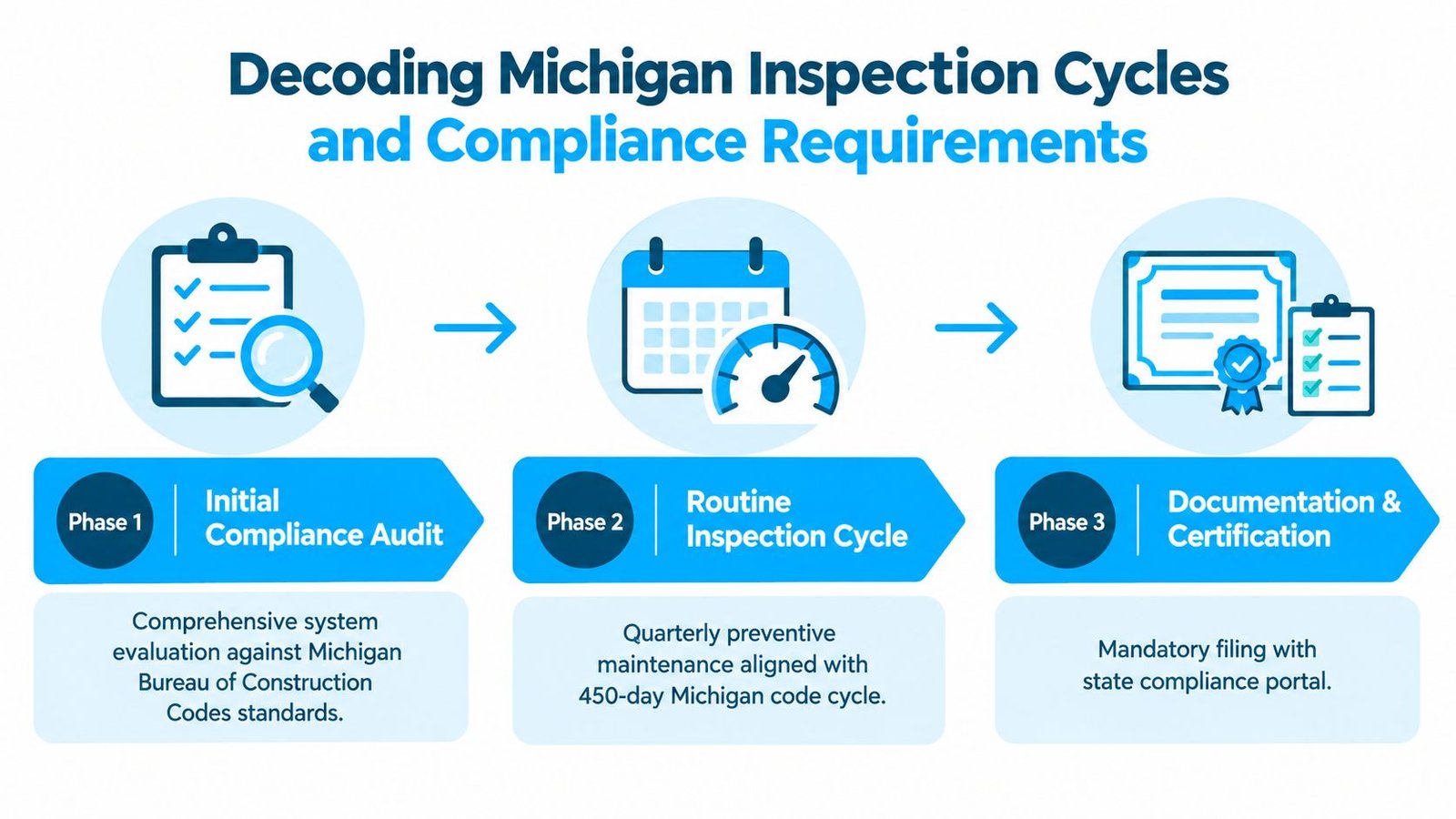
Decoding Michigan Inspection Cycles and Compliance Requirements
Compliance becomes easier to manage when the owner separates three activities: the required inspection, the recurring service visit, and the documentation that proves both occurred. Start by identifying every elevating device in the building, its classification, its last inspection, and the applicable service interval.
Build the calendar around the strictest requirement
Michigan law states that power elevators must be serviced and examined for defects by a licensed elevator journeyman at least every 60 days, while the newer administrative rule for most power elevators requires maintenance at least once every 90 days, with an ongoing written record kept on-site. The Michigan elevator statute is the right reference for understanding the statutory requirement and its relationship to current administrative rules.
For most owners, the sensible operational approach is to confirm the applicable requirement with the elevator contractor and the state authority, then schedule the work to satisfy the controlling obligation. Don’t assume that an informal quarterly visit automatically resolves every inspection or service duty.
The inspection cycle also varies by device. Most passenger and freight elevators generally require inspection at least every 12 months, while private-residence elevating devices require inspection upon installation. Some low-rise devices, including certain dumbwaiters and platform lifts, generally follow 24-month inspection cycles, as described in Michigan’s current elevator rules.
Make the record useful
A compliant log should do more than show a technician’s signature. It should let a facility manager answer practical questions:
- What changed: Record repairs, replacements, adjustments, and tests, not just the date of arrival.
- What repeated: Track callbacks involving the same door operator, safety circuit, leveling issue, or controller fault.
- What remains open: Note recommendations, violations, parts on order, and temporary measures.
- What was verified: Confirm inspections, safety testing, emergency phone checks, fire service functions, and other required work where applicable.
The record creates an audit trail, but it also improves troubleshooting. A technician who can see a pattern of intermittent leveling faults or repeated door lock callbacks can investigate the underlying cause instead of treating every visit as an isolated complaint. That’s how documentation supports reliability rather than merely satisfying an inspection request.
Use Michigan elevator code requirements as part of the planning conversation, then keep the building’s own equipment records current and accessible. A clean file reduces confusion when ownership changes, a new facility manager takes over, or the state inspector asks how recurring issues have been handled.
Traditional Maintenance Versus Predictive Smart Technology
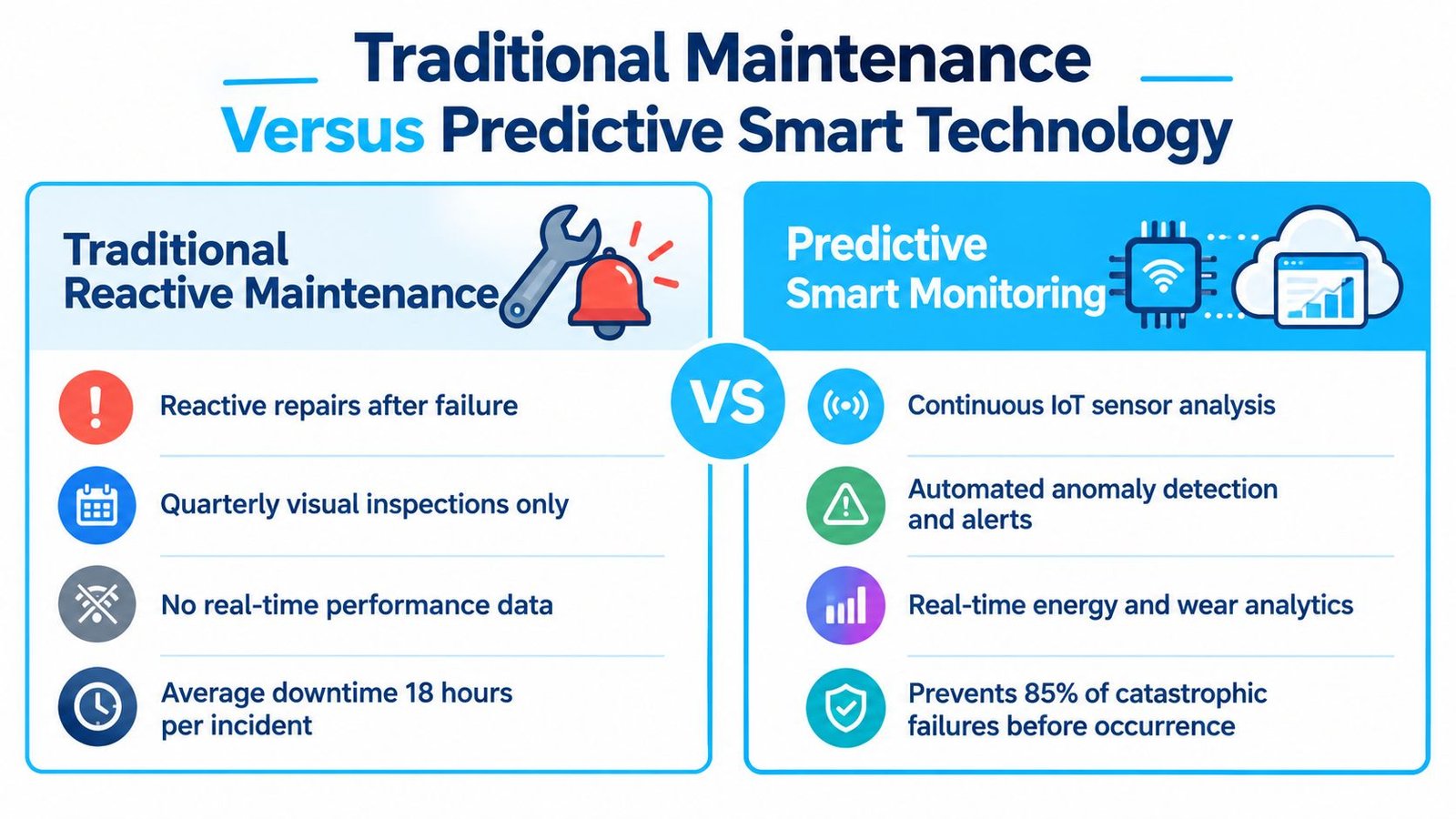
Traditional maintenance still does the work that keeps an elevator safe. A journeyman has to inspect physical components, operate the equipment, listen for abnormal sounds, check clearances, examine wear, and verify that repairs were completed correctly. Sensors can report a developing pattern, but they can’t replace a hands-on inspection or the code-driven testing schedule.
Predictive technology adds a different layer. Industry reporting in 2025 and 2026 describes a shift toward IoT- and AI-enabled monitoring that collects real-time telemetry from motors, brakes, doors, and controllers to identify faults before failure. Market coverage of smart elevator predictive maintenance estimates the segment at $4.2 billion in 2025, with a projection of $15.8 billion by 2034 and a 14.8% CAGR.
What conventional maintenance does well
Hands-on preventive maintenance works especially well when the equipment is accessible, the service history is reliable, and the contractor understands the specific controller, drive, door equipment, and safety devices. A technician can spot a loose connection, contaminated machine room, deteriorating belt, leaking hydraulic component, or poorly adjusted door system that may not generate a useful digital signal.
This approach also has a clear compliance advantage. Required inspections and written records remain necessary whether the elevator has sensors or not. Predictive monitoring supports the maintenance program, but it doesn’t remove the owner’s obligation to arrange code-required inspections and qualified service.
Where predictive monitoring earns its place
Smart monitoring makes more sense when a building has critical uptime requirements, repeated intermittent faults, multiple elevators, difficult access, or an aging system that produces symptoms between scheduled visits. Continuous data can help the service team identify changes in motor behavior, brake performance, door movement, controller activity, or energy use. The value comes from earlier investigation, not from a dashboard by itself.
Retrofitting older non-proprietary systems requires careful evaluation. The owner should ask whether the sensors can collect useful data without interfering with the controller, whether the platform can export records, who owns the data, and how the system handles privacy in healthcare and education buildings. A low-cost device that produces alerts nobody reviews isn’t predictive maintenance. It’s another notification stream.
Smart monitoring is an early-warning tool, not a substitute for a licensed technician, a maintenance log, or a state inspection.
For a newer elevator with stable performance and a strong service history, traditional preventive maintenance may deliver the better return. For an older or operationally critical asset, predictive elevator maintenance can be worth assessing during modernization rather than adding as a disconnected technology purchase.
How Crane Elevator Serves the Ann Arbor and Michigan Region
A typical regional service call starts with a building report: the elevator is out of service, the doors are cycling incorrectly, or the car is stopping unevenly. The technician’s first job isn’t to replace the most obvious part. It’s to secure the equipment, understand the failure, inspect related systems, and determine whether the problem is an isolated repair or evidence of a larger condition.
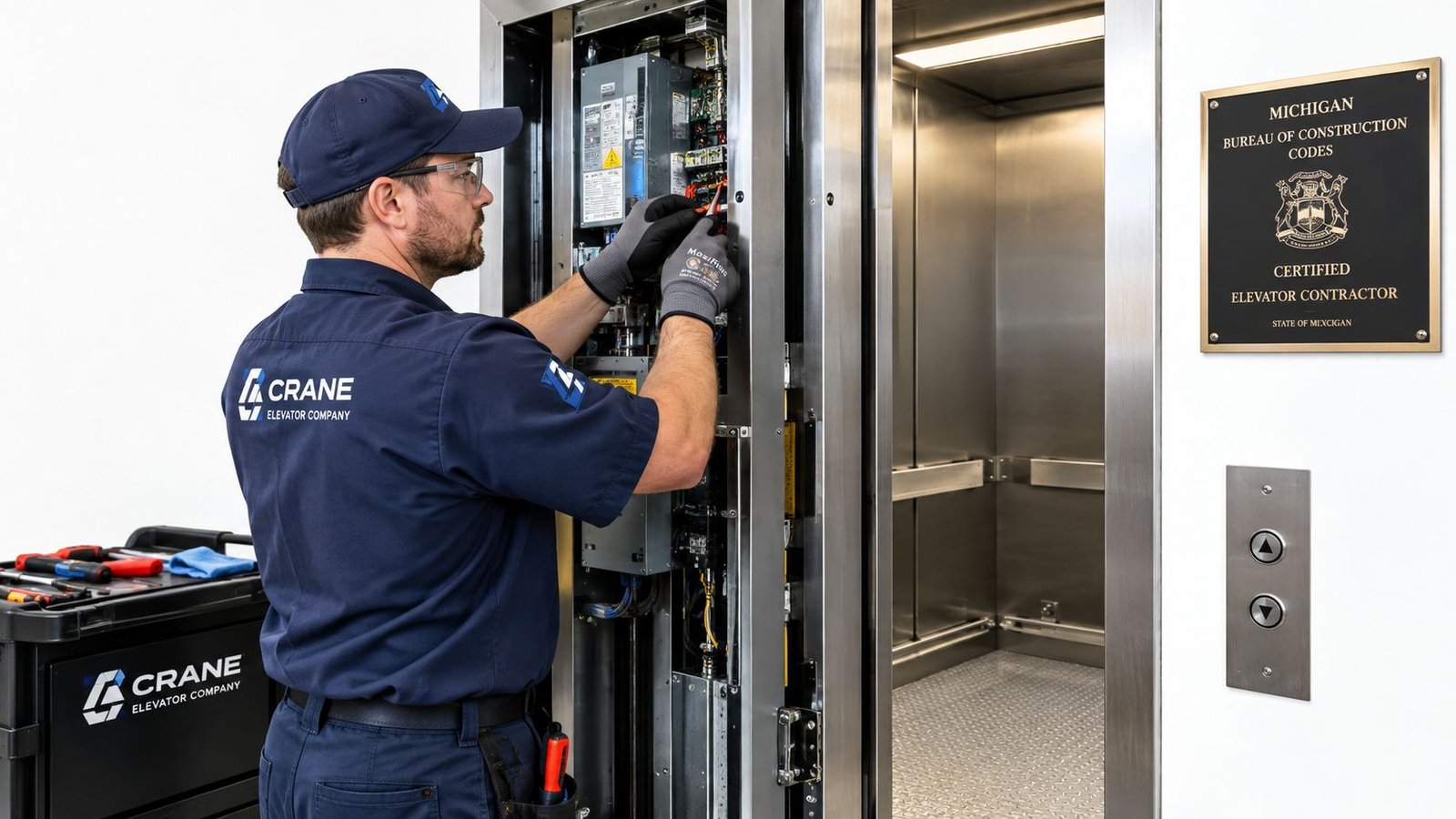
Crane Elevator Company operates from Whitmore Lake and states that it serves Detroit, Lansing, Ann Arbor, and Grand Rapids, along with surrounding areas. Its listed coverage includes Toledo, Flint, Kalamazoo, Livonia, Ypsilanti, Monroe, Saginaw, Port Huron, Battle Creek, and Howell, giving building owners access to a regional service footprint across Michigan and Ohio, as described on its Michigan service coverage page.
One service history should tell the whole story
The practical advantage of a regional contractor is continuity. The same service relationship can cover routine preventive maintenance, emergency repairs, state testing, safety work, and modernization planning instead of treating each need as a separate transaction.
That matters in buildings with mixed equipment. A municipal facility may have a passenger elevator, a freight car, a wheelchair lift, and a dumbwaiter. An older industrial site may combine a century-old freight elevator with a later passenger unit. A residential property may need service for a home elevator or platform lift. The contractor has to understand the equipment in front of them rather than forcing every asset into one manufacturer-specific process.
Crane provides services that include door lock monitoring, hydraulic packing, jack, cable, tank and power unit work, motor, sheave, and machine replacements, as well as safety tests, emergency phones, fire service, generator testing, and violation corrections. It also handles non-proprietary modernizations for different makes and models, which can give an owner more flexibility when an older controller or drive reaches the end of its useful service life.
The field process should leave the manager with more than a verbal diagnosis. It should identify the immediate repair, the safety status, the code issue if one exists, the parts or modernization work needed, and the next maintenance action.
A short visual overview can help owners understand the relationship between service work and long-term equipment planning.
Coverage beyond Ann Arbor matters when a company operates facilities in multiple places. A manager may oversee sites in Detroit, Lansing, Grand Rapids, Ypsilanti, or random Michigan towns such as Howell, Monroe, or Battle Creek. A consistent maintenance process across those locations reduces the risk that each building keeps a different standard for records, inspections, and emergency response.
The Financial Impact of Proactive Maintenance Contracts
Elevator costs rarely come from the failed part alone. A shutdown can disrupt deliveries, accessibility, patient movement, tenants, staff routines, and scheduled building activities. The longer the equipment remains unavailable, the more pressure falls on the facility team to explain a problem that may have been visible in earlier callbacks or inspection notes.
A maintenance contract creates a more predictable operating rhythm. It gives the contractor scheduled access to the equipment, gives the owner a defined record of work, and creates a place to address small defects before they become a major repair. It doesn’t eliminate capital spending. It helps the owner decide when spending is justified.
Compare the cost of delay
A practical contract review should ask what the service includes. Look for clear treatment of machine room, pit, and car-top clean-downs, door equipment, hydraulic packing, emergency phones, fire service, generator testing, safety devices, and callback documentation. The details matter because a low price can conceal a narrow scope.
Statewide rulemaking tied to Michigan’s elevator code listed annual and biennial inspections at $175, with an additional $25 per hoistway opening or floor traveled for certain inspection items, according to the University of Michigan elevator design guidance. Those figures show that upkeep includes recurring technical work and direct inspection charges. They shouldn’t be treated as a complete quote for every building or service agreement.
Spend on information before replacement
Owners often face a choice between repairing a component and planning a modernization. A recurring door fault may justify deeper door lock monitoring or operator work. Hydraulic leakage may lead to packing or jack evaluation. A failing motor, sheave, machine, tank, or power unit may require a larger capital discussion.
The right question is not, “Can we get it running today?” It’s, “What repair restores safe operation, what condition caused the failure, and what work should we budget next?” A contractor who documents those answers helps the owner avoid both extremes, replacing equipment prematurely or repeatedly funding temporary repairs with no long-term plan.
Financing and modernization options can also make a large project easier to schedule, but the technical scope should come first. Owners should receive a clear description of the work, testing requirements, parts, exclusions, expected disruption, and post-project maintenance needs before comparing payment terms.
Selecting a Reliable Local Elevator Contractor
The contractor’s first qualification is technical and legal. Ask who performs the work, whether licensed elevator journeymen are involved where required, how inspections are coordinated, and where the on-site records will be kept. A polished proposal doesn’t compensate for weak field documentation.
A reliable provider should also explain what happens during a normal visit. The answer should include more than lubrication and a signature. It should cover operating checks, safety-related components, doors, machine rooms, pits, car tops, callbacks, identified defects, and follow-up recommendations appropriate to the equipment.
Questions that reveal the operating standard
- Service scope: Ask whether the agreement includes preventive work, repairs, testing, clean-downs, and documentation, or only labor for emergency calls.
- Equipment flexibility: Confirm that the contractor can service all makes and models and can evaluate non-proprietary modernization options.
- Emergency coverage: Establish how the company handles after-hours failures and how the building receives status updates.
- Pricing clarity: Request competitive quotes, exclusions, parts policies, and approval requirements before non-emergency work begins.
- Second opinions: A free second opinion can help an owner distinguish an urgent safety correction from a repair that deserves further investigation.
- Accountability: Policies such as No Show, No Pay can signal that the contractor has defined expectations for scheduled appointments, but read the terms carefully.
The best local relationship is not the one that promises the fewest repairs. It’s the one that tells you which work is necessary, which work can be planned, and which condition requires immediate attention. That approach protects the elevator, the passengers, and the building’s operating budget.
Crane Elevator Company provides preventive maintenance, emergency repairs, code-required inspections, testing, violation corrections, and non-proprietary modernization for elevators, wheelchair and material lifts, residential elevators, and dumbwaiters. Visit Crane Elevator Company to request service, a free second opinion, or a practical maintenance plan for your Ann Arbor building.