A freight elevator fails on a Monday morning, and the building owner suddenly has three problems instead of one: tenants can't move materials, someone may be waiting inside the car, and the inspection file has to explain what happened. In Monroe, that phone call often starts with a simple request for a repair, but a responsible response involves diagnosis, safe recovery, documentation, and a plan to prevent the same failure from returning.
That's the practical meaning of Monroe elevator services. The work covers equipment in Monroe and nearby communities, but it also has to fit Michigan's inspection rules, varied building stock, severe seasonal weather, and the different needs of passenger, freight, residential, and accessibility lifts. Crane Elevator serves Detroit, Lansing, Ann Arbor, Grand Rapids, and surrounding areas, including smaller towns such as Adrian, Dundee, Temperance, Flint, Kalamazoo, Holland, Jackson, Muskegon, Saginaw, Troy, and Port Huron.
What Elevator Service Really Covers in Michigan
A property manager in Monroe watches a freight car stop short of the landing. The doors won't open, the motor has gone quiet, and a tenant reports that the car is occupied. The first useful response isn't a guess about a replacement part. It's a controlled callback, confirmation of the car's location and condition, and a qualified technician who can make the equipment safe before troubleshooting begins.
A full-service contractor then works through several responsibilities:
- Emergency response: Dispatch must distinguish an occupied car, an out-of-service unit, and a safety-related shutdown. Those situations need different priorities and communication.
- Scheduled maintenance: The mechanic inspects the equipment on a written program instead of waiting for a breakdown. Door operation, lubrication, electrical connections, brakes, hydraulic equipment, ride quality, and emergency systems all need attention.
- Testing and records: Michigan assigns responsibility for safe operation, maintenance, and required tests to the certificate holder or authorized agent. Safety tests must be performed by licensed elevator journeypersons, and the Maintenance Control Program must be available during inspection. Michigan's administrative rule on maintenance responsibility and MCP requirements explains those obligations.
- Modernization planning: A worn controller, obsolete door operator, leaking hydraulic jack, or difficult-to-source relay may justify an upgrade, but a repairable defect isn't automatically a reason to replace the entire elevator.
- Inspection coordination: Work that changes safety-critical components can require re-inspection before the elevator returns to service. Maintenance records, test results, and operating documentation should be organized before the inspector arrives. Independent maintenance and compliance guidance describes why documentation-ready O&M packages matter.
Michigan's freeze-thaw cycles add practical complications. Moisture and corrosion can affect door equipment, pit components, wiring, and machine-room conditions. Older buildings outside Detroit may have equipment that's dependable but no longer supported by the original manufacturer, so the contractor has to understand the system rather than rely on a brand-specific parts list.
Practical rule: A repair ticket should tell the next technician what failed, what was tested, what was adjusted, and what still needs attention.
Elevator service is a relationship across the equipment's life. Owners need inspections, records, preventive work, modernization advice, and a dependable emergency number, not just a mechanic after every failure.
The Five Main Lift Types and How They Work
The lift type determines how the car moves, where the equipment lives, and what maintenance problems are likely to appear. A building owner doesn't need to design the machine, but understanding the basic arrangement makes proposals easier to evaluate.
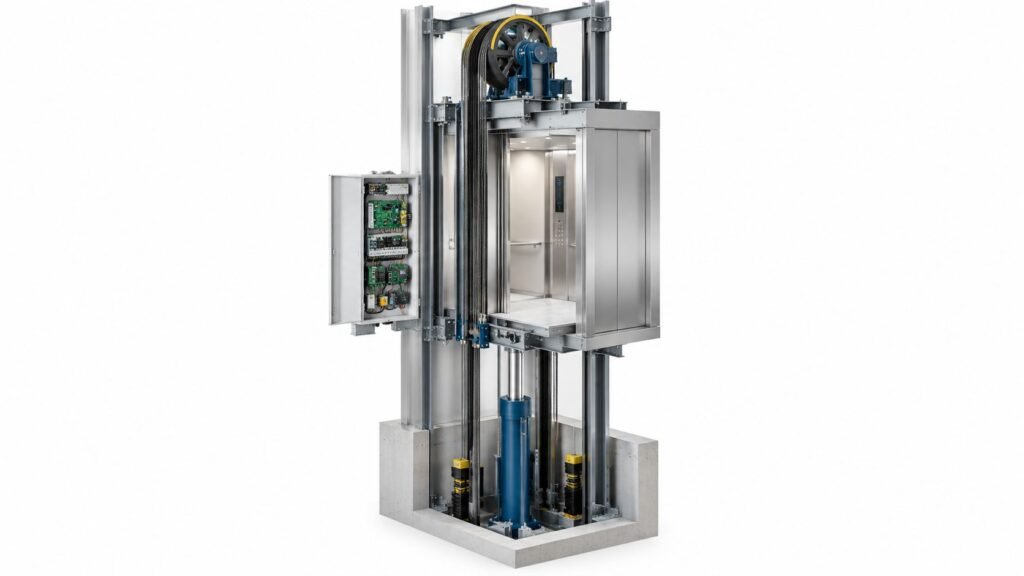
Traction equipment
A traction elevator works like a large pulley. Steel ropes pass over a sheave, with the car balanced by a counterweight while a geared or gearless motor turns the sheave. This arrangement suits taller commercial buildings, hospitals, offices, and apartment buildings in Detroit, Ann Arbor, Lansing, and Grand Rapids.
Geared traction can be practical where moderate speed and serviceability matter. Gearless traction is used for taller, faster installations, but the machinery and controls demand careful maintenance. Owners should weigh ride performance against machine-room needs, rope and sheave wear, brake condition, and modernization cost.
Machine-room-less systems
An MRL elevator places the traction machine inside the hoistway instead of using a separate machine room. That can preserve rentable or mechanical space in newer retail and apartment construction. The trade-off is access. A compact installation may be efficient, but technicians still need safe, practical access to the motor, controller, and rescue equipment.
Hydraulic elevators
A hydraulic elevator uses a pump and fluid to push a piston, much like a powerful jack lifting a vehicle. It's common in low-rise offices, schools, medical buildings, and small commercial properties across Monroe County and other Michigan communities.
Hydraulic systems can be straightforward to service and fit buildings with limited rise. They're usually slower than traction systems, and owners must watch for oil leaks, packing wear, pump noise, valve problems, and pit conditions.
Pneumatic vacuum lifts
A pneumatic lift moves the car through a sealed tube using air pressure. Clear-tube designs often appear in residential renovations and small storefronts where a conventional shaft would be difficult to build. They can reduce construction disruption, but capacity, travel, noise, and service arrangements need careful review before installation.
Screw and chain-driven residential lifts
Screw-driven and chain-driven residential lifts can provide an accessible route in a private home or small building where a full commercial elevator would be excessive. They may need less structural work, but owners should compare speed, enclosure requirements, backup operation, and long-term parts availability.
The useful comparison is not “which lift is cheapest.” It's whether the design matches the building's rise, traffic, space, accessibility needs, climate exposure, and future service requirements. A plain-language overview of different types of lifts can help owners frame that conversation before approving equipment.
Key Components Inside Every Elevator
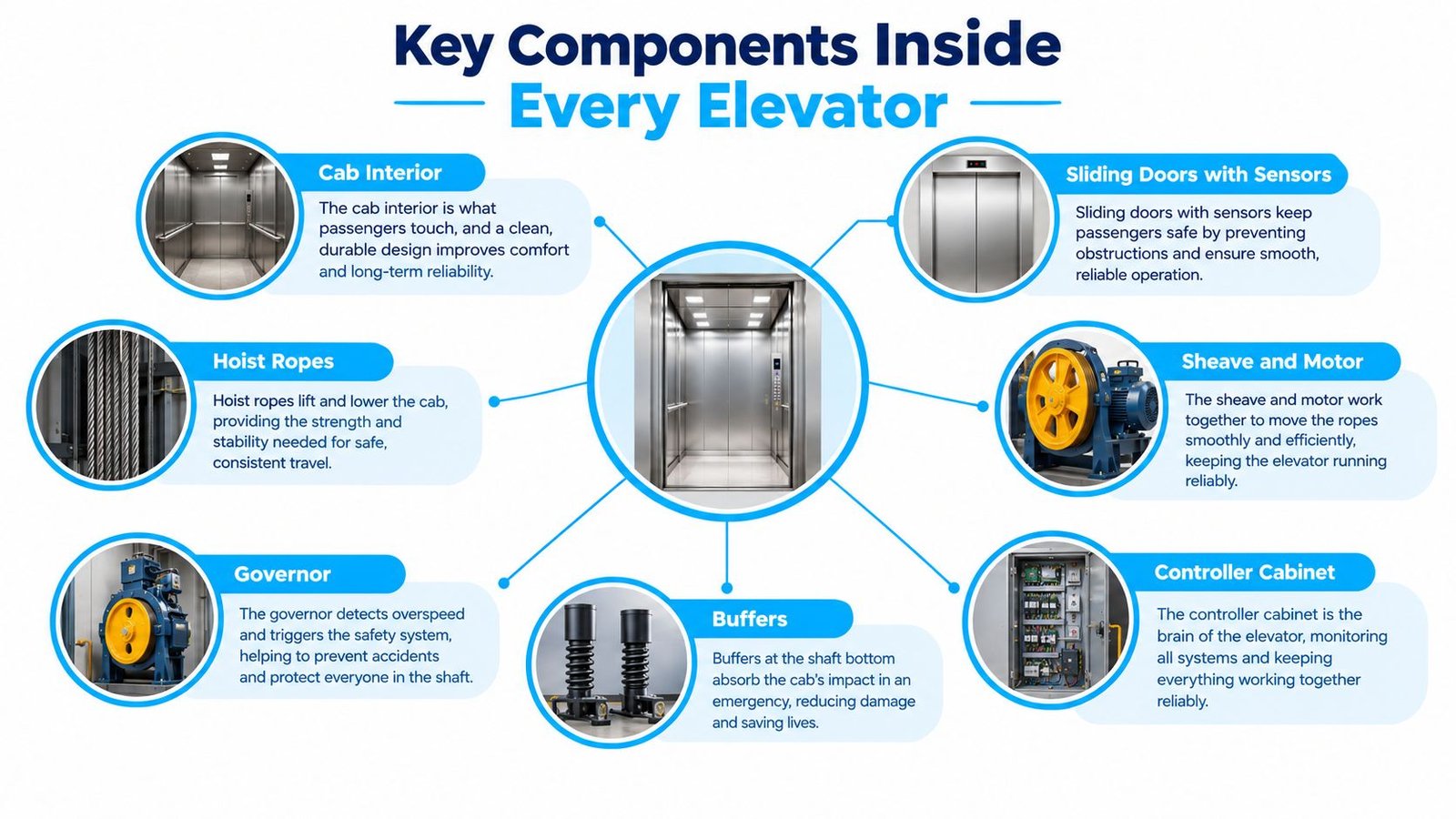
A reliable elevator is a chain of systems that must agree with one another. The car has to move, stop, level, open its doors, communicate with passengers, and prove that its safety circuits are intact before the controller allows normal operation.
The car and cab interior are the parts passengers see and touch. The floor, handrails, fixtures, operating panel, lighting, alarm, and emergency phone need inspection because damage or poor operation affects both usability and safety. A loose fixture, failed light, or damaged sill may look minor, but it can reveal neglected maintenance.
Above or beside the car, the counterweight balances much of the car's mass. On traction equipment, that reduces the work the motor must do. Technicians inspect the frame, guide shoes, ropes, and clearances because wear in one area can show up as vibration or rough leveling.
The moving force comes from either a motor and sheave or a hydraulic pump, valve, and jack. Mechanics check lubrication, alignment, bearings, brake operation, oil condition, leaks, and electrical connections. A hydraulic packing leak and a traction brake problem produce very different repair paths, which is why a symptom alone doesn't justify a replacement recommendation.
The control and door systems
The controller cabinet acts as the elevator's brain. It receives calls, monitors safety inputs, controls acceleration and stopping, and records fault information. A technician uses the diagnostic panel and service history to identify patterns instead of changing parts at random.
The door operator and interlocks deserve particular attention. Door equipment cycles constantly, and dirt, worn rollers, misalignment, loose wiring, corrosion, or mechanical wear can cause nuisance shutdowns. A door-lock fault isolated to one landing usually sends the mechanic toward that landing's lock contact, roller, vane, sill clearance, or lock-hook position. A fault recurring at multiple floors points more often to shared circuitry such as the door-lock loop, traveling cable, relay, or controller input. This door-lock fault guide explains that diagnostic distinction.
The safety chain
Buffers at the bottom of the hoistway provide final protection if the car or counterweight travels beyond its normal stopping area. The governor detects overspeed, while safety devices and rope-gripping equipment help stop or hold the car when required. Brakes, limits, door interlocks, emergency communication, and fire-service functions complete the protective chain.
A technician checks these systems during routine visits and formal tests. An inspector may flag failed communication, incorrect door-lock operation, poor leveling, safety-device deficiencies, or incomplete records during a Michigan inspection or witness test.
A Typical Service Visit From Start to Finish
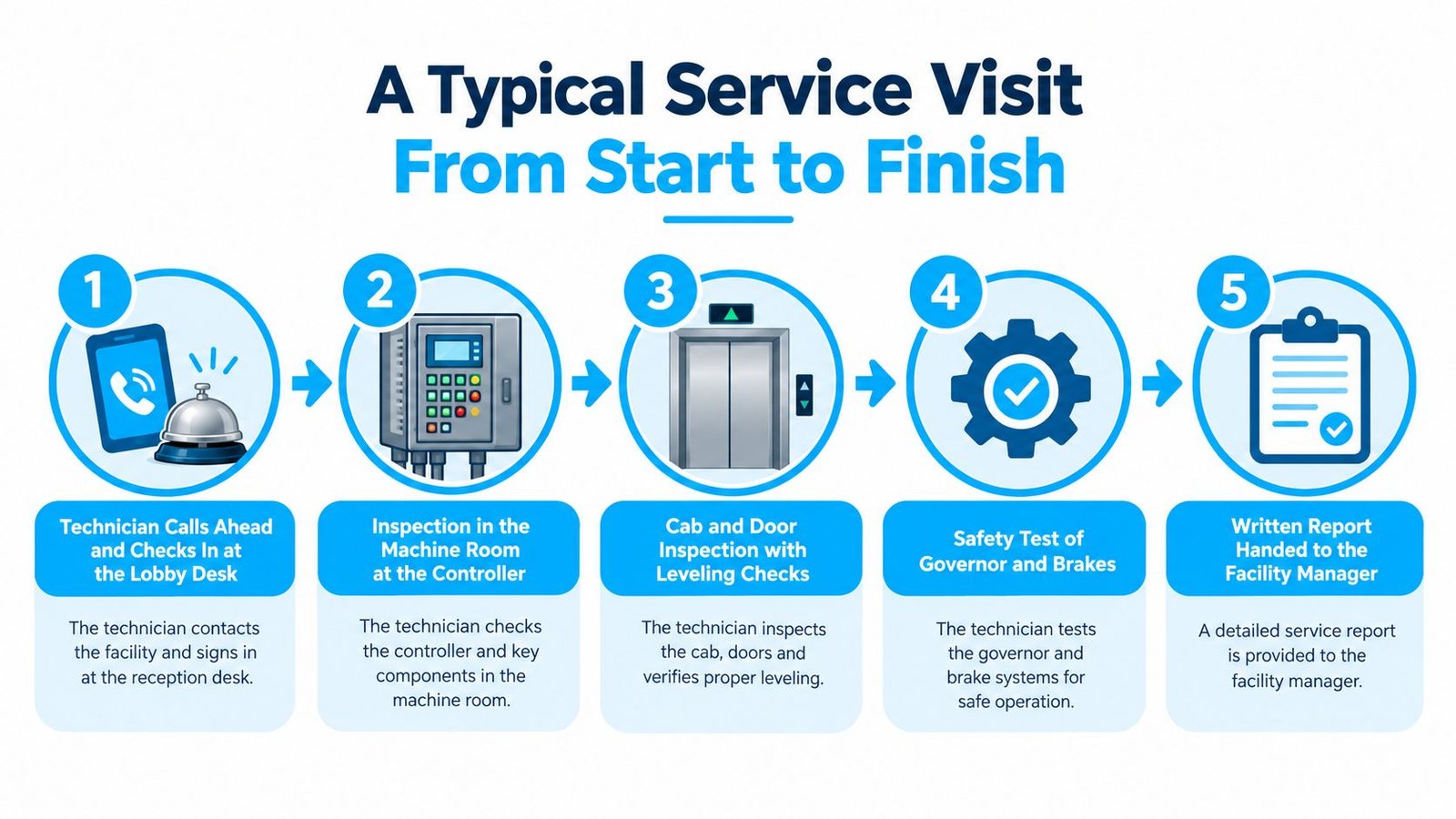
A productive service visit begins before the mechanic opens the machine-room door. The technician calls ahead, confirms access, and checks in with the lobby desk so the facility manager knows which car is being taken out of service and why.
The first stop is usually the machine room or controller closet. The mechanic reviews fault logs, checks disconnects and electrical conditions, listens for abnormal motor or pump sounds, and compares the diagnostic history with the operator's description. That comparison often separates a recurring control problem from a one-time obstruction or door event.
The cab inspection follows. The mechanic watches door opening and closing, checks the interlocks, observes leveling at each landing, evaluates ride quality, and verifies the operating panel. If the car is noisy, drifting, or stopping unevenly, the technician records the conditions rather than relying on a vague “rough ride” note.
The car top and pit provide the next evidence. The mechanic checks hoistway clearances, guide components, door equipment, pit conditions, buffers, wiring, oil levels where applicable, brake adjustment, and lubrication points. The phone, alarm bell, emergency lighting, and related communication functions also need a live test.
What a good ticket should answer: What did the technician find? What was repaired or adjusted? What remains open? What should the owner budget for next?
The visit ends with a sign-off conversation. The facility manager gets a written service ticket, an explanation of any immediate restriction, and a clear distinction between a required correction, a recommended repair, and a modernization option.
That distinction matters. A contractor who documents the evidence gives the owner a defensible maintenance record and a better basis for deciding whether to repair, monitor, or upgrade.
Common Warning Signs and Basic Troubleshooting
Most breakdowns give the building clues first. Monroe owners commonly notice uneven leveling, sluggish doors, unusual shaft sounds, flickering cab lights, or an error code on the controller. The safe response is to separate observations a manager can record from conditions that require a qualified mechanic.
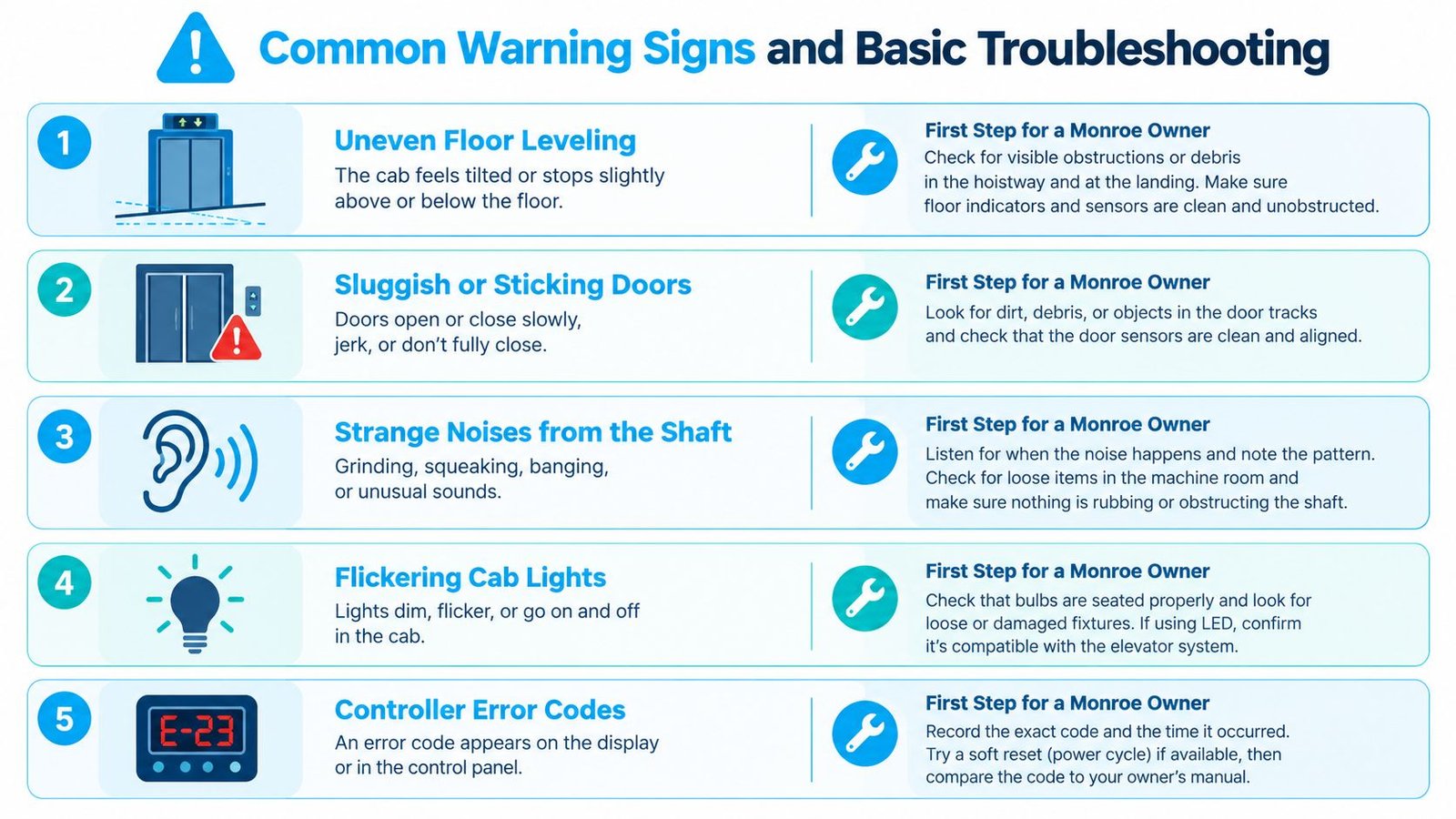
Checks owners can make safely
An owner or manager can confirm whether the elevator has power at the normal user controls, look for visible debris in the landing sill, and verify that the machine room hasn't become unusually hot or wet. They shouldn't enter the hoistway, pit, or car top, defeat a door interlock, reset a safety device repeatedly, or work inside the controller.
The goal is useful information, not amateur repair. Record the landing, direction of travel, time of occurrence, load condition, and whether the issue happens on every trip or only at one floor.
Symptoms worth logging
- Uneven leveling: The car may have a leveling sensor, door-zone, brake, valve, or control issue. Note whether the mismatch occurs at one landing or throughout the building.
- Sluggish or sticking doors: Look for visible sill debris from the public side, then report the landing and whether the door reverses, stalls, or fails to close.
- Strange shaft noises: Grinding, scraping, clicking, or a new vibration can point to guide components, door equipment, ropes, bearings, or loose hardware. Don't try to locate the sound from inside the shaft.
- Flickering cab lights: Record whether the lights flicker during travel, at rest, or when doors operate. The cause may involve fixtures, connections, power quality, or the controller.
- Controller error codes: Photograph or write down the exact code and time. Repeatedly clearing it destroys useful diagnostic history.
Do not wait on a safety symptom. Jerking, drifting, an elevator that moves with doors not properly secured, or a safety device engaging calls for taking the car out of service and contacting a qualified elevator contractor.
Door-lock faults deserve accurate reporting because they can be isolated or systemic. Telling the dispatcher that the problem occurs only at the third-floor landing is more useful than saying the elevator “keeps going down.” That detail can shorten diagnosis and reduce unnecessary parts replacement.
Michigan Codes, Inspection Cycles, and Detroit Rules
Michigan's inspection calendar depends on the device. The state code requires inspections at least every 12 months for passenger, freight, inclined, limited-use, special-purpose personnel, rooftop elevators, hoists, material lifts, escalators, moving walks, belt manlifts, and special elevating devices. Stage lifts, dumbwaiters, stairway chairlifts, one-person elevators, platform lifts, and power sidewalk elevators have a minimum inspection interval of 24 months. The current Michigan Elevator Code also requires elevator car and counterweight safeties and governors to be tested at intervals of not more than 12 months.
Owners often use “annual inspection” as shorthand, but the equipment category and test type still matter. A full maintenance file should identify the device, certificate status, required inspection, test results, open violations, and the person responsible for correction.
Michigan Elevator Inspection Cycles at a Glance
| Inspection Type | Frequency | Performed By | Applies To |
|---|---|---|---|
| Periodic device inspection | At least every 12 or 24 months, depending on device type | Qualified inspection authority under Michigan requirements | Elevating devices covered by the state code |
| Safety and governor testing | Not more than every 12 months | Licensed elevator journeyperson | Elevator car and counterweight safeties and governors |
| Maintenance inspection and testing | Per the applicable device program and code requirements | Licensed elevator personnel | Existing and new installations |
| Re-inspection after covered alteration or replacement | Before return to service when required | Authorized inspector and qualified elevator personnel | Equipment affected by qualifying work |
Michigan also requires a Maintenance Control Program, or MCP, for all elevating devices. The program needs to be available at inspection, and it should identify the maintenance, tests, examinations, and procedures applicable to the equipment. Owners can use this Michigan elevator code requirements guide as a starting point, but the contractor and certificate holder must keep the actual equipment records current.
Detroit adds a more frequent local requirement. Power elevators, escalators, and moving walks must be inspected and serviced at least every 30 days by a licensed unlimited-elevator journeyperson. Special permission and low-use justification may extend that interval up to 90 days. Other covered equipment generally requires service at least quarterly, with firefighters' emergency operation tested at least every 30 days, subject to the ordinance's exclusions. Detroit's elevator inspection and service ordinance is the controlling reference for those local requirements.
Smaller Monroe County jurisdictions commonly work from state rules but may add local permit or administrative steps. Confirm the authority having jurisdiction before scheduling alterations, and never operate equipment with an expired certificate or unresolved safety restriction.
Choosing a Full-Service Contractor Across Michigan
The contractor should match the equipment and the geography. A provider that only understands one manufacturer's controller may struggle with a century-old freight car in Monroe, an MRL system in Ann Arbor, or a hydraulic medical-building elevator in Lansing. A non-proprietary full-service contractor can inspect and maintain traction, hydraulic, MRL, pneumatic, screw-driven residential, wheelchair, material, and dumbwaiter equipment without making the owner dependent on one equipment line.
Ask for evidence, not broad promises.
- License verification: Keep Michigan mechanic license information and responsible personnel contacts in the contract file.
- Inspection capability: Confirm that the provider performs the applicable safety tests, coordinates inspections, and supplies complete reports.
- Emergency expectations: Get the callback process and response commitments in writing. “Available” isn't the same as a defined dispatch procedure.
- Parts strategy: Ask how the contractor supports multiple manufacturers and older controls. A realistic repair plan should identify alternatives before an obsolete part becomes a crisis.
- MCP support: The contractor should be willing to build, update, and maintain the Maintenance Control Program for each device.
- Regional coverage: Service routes should include Monroe, Adrian, Dundee, Temperance, Detroit, Lansing, Ann Arbor, Grand Rapids, and surrounding towns without treating smaller communities as an afterthought.
The trade-off is straightforward. A low monthly price can look attractive until every callback becomes a special trip, reports arrive late, or the contractor recommends replacement without showing why repair won't satisfy the code. A higher-quality proposal explains equipment condition, urgency, parts availability, downtime, inspection implications, and the difference between a correction and an optional upgrade.
Red flags include refusing to provide inspection records, resetting recurring faults without diagnosis, pushing a complete replacement for a code-compliant repair, or lacking appropriate Michigan Bureau of Construction Codes credentials. Owners comparing providers can also review what to ask in a reliable elevator company evaluation.
For one factual example of a Michigan service option, Crane Elevator Company provides preventive maintenance, repairs, inspections, testing, and non-proprietary modernization for multiple elevator and lift types across Michigan and Ohio. The right choice still depends on the building's equipment, contract terms, response expectations, and documented qualifications.
Key Takeaways for Building Owners
Start with the equipment list. Traction systems suit taller commercial buildings, MRL designs conserve machine-room space, hydraulic units fit many low-rise properties, pneumatic lifts serve specialized residential or small commercial projects, and screw or chain-driven lifts can support certain residential accessibility upgrades. Each type carries different trade-offs in speed, noise, access, parts, and long-term maintenance.
Next, treat warning signs as maintenance information. Uneven leveling, slow doors, new noises, flickering lights, and recurring controller codes deserve a written log and a service call. Jerking, drifting, uncontrolled movement, or a safety device engaging should take the car out of service until a qualified elevator mechanic evaluates it.
Michigan's calendar must be tied to the device type, not a generic reminder. Many major equipment categories require inspection at least every 12 months, while certain residential and specialty devices have a 24-month minimum under the state code. Safeties and governors require testing at intervals of not more than 12 months. Detroit's local ordinance can require much more frequent servicing for power elevators, escalators, and moving walks.
Keep the Maintenance Control Program available and current. It should align with the actual controller, door equipment, safety devices, emergency communication, fire-service operation, and maintenance history. Missing records can delay approvals and make it difficult to prove that safety-critical systems were tested properly.
The practical decision is to use a licensed, full-service contractor that understands every device category, supports equipment from different manufacturers, documents inspections, and answers when a car stalls between floors. Your next step is simple: request the current inspection report and MCP from your provider, then verify that open corrections, certificates, and upcoming tests are accounted for before the next state cycle.
Crane Elevator Company provides preventive maintenance, repairs, code-required inspections, safety testing, emergency response, and non-proprietary modernization for elevators and accessibility equipment across Michigan and Ohio. If your Monroe-area property needs a documented service plan or a second opinion on repair versus replacement, visit Crane Elevator Company to discuss the equipment and the next compliance step.