It’s 8:45 on a Monday in Michigan. Tenants are lined up in the lobby, the main car is tagged out of service, and the phones start ringing before your elevator contractor even gets onsite. Someone from the third floor is late to a medical appointment. A delivery is stuck at the loading entrance. Building staff are trying to direct traffic while everyone asks the same question: how long is this going to take?
That moment is when elevator maintenance stops feeling like a routine budget line and starts feeling like risk management. A failed elevator affects tenant confidence, staff productivity, accessibility, and building reputation all at once. If the building serves healthcare, senior housing, municipal use, or heavy office traffic, the pressure is even worse.
That’s why preventative elevator maintenance matters. Not the checkbox version where a mechanic signs a ticket and disappears, but the kind that reduces surprise shutdowns, catches wear before it turns into entrapments or service interruptions, and keeps a building compliant with the code and inspection environment Michigan owners have to live with.
The True Cost of a Failed Elevator
A failed elevator rarely shows up as one simple repair. It shows up as disruption.
The first cost is obvious. You pay for the service call, the troubleshooting, the parts, and sometimes overtime if the shutdown hits at the wrong hour. The second cost is harder to track but just as real. Your staff gets pulled off regular work, tenants lose patience, and management starts fielding complaints that have nothing to do with the monthly maintenance budget and everything to do with whether the building feels professionally run.
In Lower Michigan, weather and building use patterns make this worse. Snow, salt, moisture, temperature swings, and heavy boot traffic all find their way into entrances, pits, sills, and door tracks. In older properties, that grime mixes with years of wear on rollers, contacts, guides, bulbs, and door hardware. In industrial or healthcare settings, the elevator may also deal with carts, stretchers, freight loads, or nonstop cycling through the day. If service is reactive, small defects pile up until one of them finally stops the car.
Reactive service always costs more in practice
Owners often ask whether they can save money by stretching service intervals or skipping small replacements until something fails. In the field, that approach usually backfires.
A worn door lock doesn’t just stay a worn door lock. A dim COP or PI bulb isn’t just cosmetic if it hides an operating issue from staff or riders. Hydraulic packing that’s showing its age won’t improve by waiting. Dirt in the pit doesn’t remain harmless if it starts affecting operation or inspection results. The problem with delayed action is that the repair usually gets handled during a breakdown, when the building has the least flexibility and the contractor has to respond under pressure.
A cheap month of maintenance can become an expensive afternoon of emergency repair.
A stable building runs on predictability
Good preventative maintenance changes the whole rhythm of ownership. Instead of reacting to outages, you’re planning around known wear points, scheduled testing, and documented service. The elevator still needs repairs. Every machine does. But the work becomes more controlled, more visible, and easier to budget.
That’s the business value. You’re not buying grease and checklists. You’re buying fewer bad surprises, fewer lobby incidents, and a better chance that the elevator is ready when the building needs it.
Beyond the Checklist What True Preventative Maintenance Means
At 8:10 on a Monday, the car is still running, but the doors are hesitating on every stop, the floor leveling is starting to drift, and tenants are already telling the front desk that something feels off. That is the stage where a real maintenance program saves money. If the only work being done is a quick look, a grease gun, and a signed ticket, the building is still headed toward a shutdown.
Four maintenance approaches owners should know
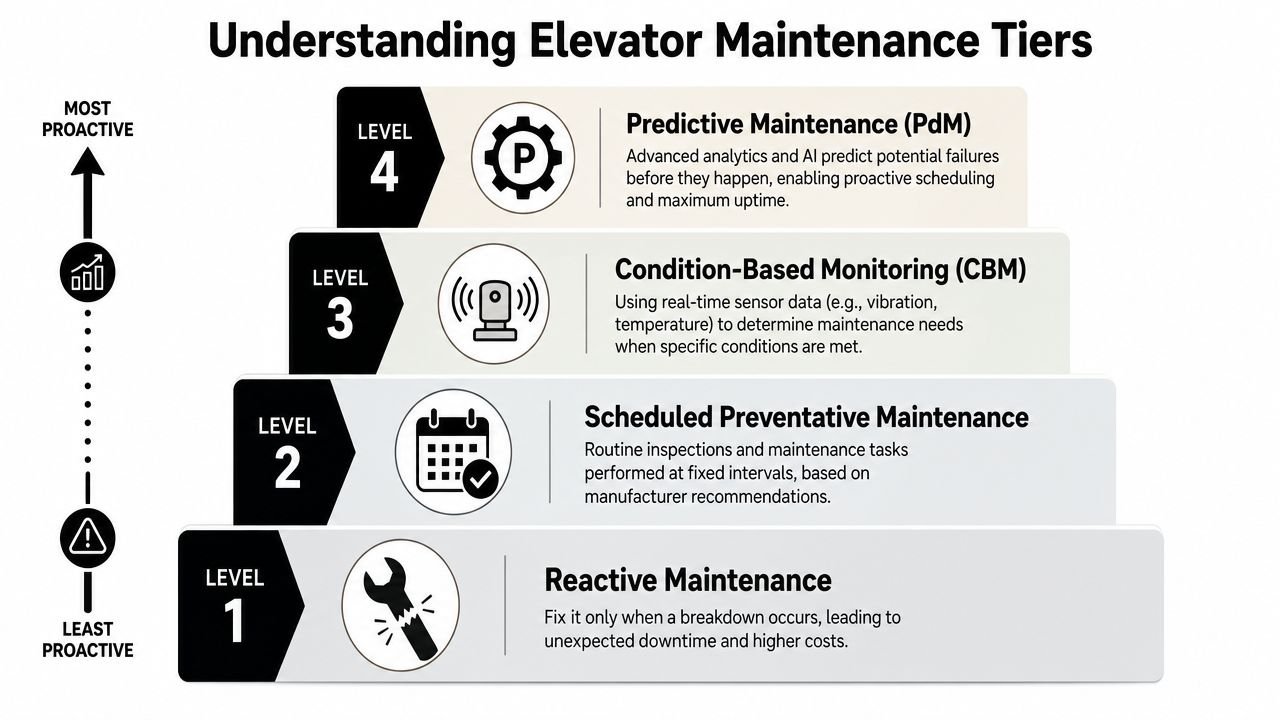
Owners usually hear maintenance sold as one thing. In practice, there are four very different approaches, and they produce very different service histories.
| Maintenance approach | What it looks like in practice | What usually happens |
|---|---|---|
| Reactive maintenance | You wait for a shutdown, noise complaint, leveling issue, or door fault | Downtime is unpredictable and repairs hit when the building can least absorb them |
| Scheduled preventative maintenance | A mechanic services the unit at planned intervals and handles cleaning, adjustment, testing, and routine repair planning | Reliability improves if the visits are thorough and the work is documented |
| Condition-based monitoring | Service decisions are tied to actual equipment condition, such as heat, vibration, door cycles, or recurring fault patterns | Wear can be caught earlier, before riders notice a problem |
| Predictive maintenance | Data trends are used to forecast failures before the unit trips out of service | Repairs can be scheduled with less disruption and better parts planning |
The table matters because many contracts are sold as preventative maintenance when they are really light inspection service. Building owners should know the difference.
Inspection is only one part of the job
A proper visit includes hands-on correction, not just observation. The mechanic should be cleaning door equipment, checking contacts, verifying operation, adjusting what has drifted, and documenting what is wearing out. In Michigan, that discipline matters because elevators are subject to state inspection and enforcement through the Bureau of Construction Codes, and recurring deficiencies can turn into avoidable violations, shutdowns, or pressure to modernize before the owner is ready.
For a building manager, the practical question is simple. What changed after the visit?
If the answer is vague, the service probably was too. A useful maintenance record should show what was cleaned, what was adjusted, what was tested, and which wear items are nearing replacement. Owners who want fewer surprises should also expect visit verification. A No Show, No Pay policy is one of the clearest ways to force accountability, because it ties the invoice to confirmed service instead of assumptions.
Preventative maintenance is not the same as preventative replacement
This is the gap that gets missed all the time.
Preventative maintenance keeps the elevator running within proper operating limits. Preventative replacement deals with the low-cost parts that are known to wear out and cause nuisance shutdowns if they are left in place too long. Door rollers flatten. Contacts pit. Hydraulic packing starts to seep. Interlocks wear. Bulbs and indicators fail. None of those items sound dramatic, but in older Michigan equipment, especially through winter moisture, dirt, and salt exposure tracked into pits and lobbies, they are often what drive callbacks.
Owners usually feel this problem before they can name it. The elevator passes inspection. The monthly tickets look fine. But the same car keeps having small issues, and the repair spend starts coming in uneven bursts. That is usually a sign that the contractor is maintaining around worn consumables instead of replacing them on a schedule.
A better program plans both labor and parts. That gives owners a clearer repair forecast and usually lowers the odds of paying emergency rates for a part everyone knew was near the end of its service life. For a realistic view of how those costs stack up over time, compare your current service approach against the typical cost of elevator maintenance for commercial buildings.
Service quality has to be visible
The best maintenance program is the one a manager can verify.
I tell owners to look for three things. Confirmed visit records, clear notes on work performed, and a running list of recommended replacements by priority. Without that paper trail, there is no clean way to judge whether the contractor is reducing risk or just responding after the fact.
A checklist has value. It is not the whole job. True preventative maintenance means regular service, documented findings, timely replacement of wear items, and proof that the work happened. That is what reduces shutdowns, protects tenants, and keeps the elevator in a condition that holds up under Michigan code requirements and real building traffic.
The Tangible ROI of Proactive Elevator Care
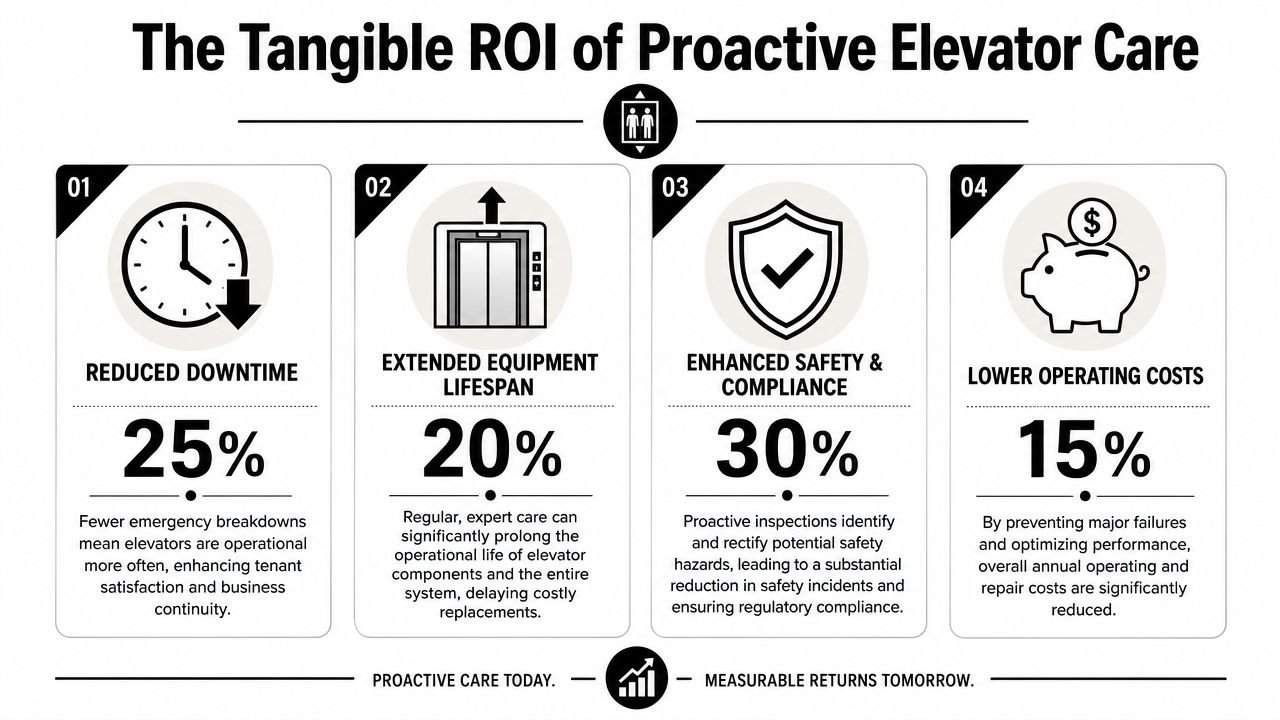
A building owner usually feels the cost of weak elevator service long before the accounting team totals it up. One car goes down during a busy morning. Staff start fielding complaints. Deliveries back up. A tenant with mobility concerns has a problem right now, not after the next service meeting. That is where return on investment becomes real.
Reliability saves money before the invoice arrives
The clearest payoff is fewer interruptions.
A well-run program cuts callbacks, reduces emergency dispatches, and gives worn components a chance to be replaced during planned service instead of after a shutdown. That difference matters in Michigan buildings with salt, moisture, temperature swings, and heavy seasonal traffic. Door equipment, contacts, rollers, and other wear items do not fail on a neat accounting schedule. They fail when the building is trying to operate.
The labor cost of a scheduled visit is usually the cheap part. The expensive part is the chain reaction that follows a preventable outage. Property staff lose time. Tenants lose confidence. One disabled car often puts extra wear on the remaining unit. Owners who want a realistic baseline for budgeting should compare their current approach against the typical cost of elevator maintenance for commercial buildings.
A short video can also help frame the issue from an operations standpoint.
Compliance protects more than the elevator
In Michigan, the return is not limited to repair savings. It also shows up in inspection readiness, documentation, and reduced exposure when something goes wrong.
Owners are responsible for equipment that runs safely and stands up to inspection. That means annual tests, maintenance records, code corrections, and service that addresses actual wear instead of just clearing the current trouble call. A contract that looks cheap on paper can get expensive fast if it leaves recurring deficiencies, missed testing items, or poor documentation for the state and the inspector.
I have seen buildings pass for a while with bare-minimum service, then hit a stretch where nuisance shutdowns, door faults, and inspection write-ups start showing up together. At that point, the owner is paying twice. Once for reactive repairs and again for the catch-up work that should have been handled earlier.
Preventative replacement matters here. Belts, rollers, contacts, seals, batteries, and other consumables do not care whether the monthly checklist was marked complete. If they are near end of life, they need to be scheduled and replaced before they create a code issue or a service interruption.
Better service supports tenant retention
Tenants rarely praise an elevator that works every day. They do remember the one that traps people, runs rough, or sits out of service with no clear answer.
Reliable vertical transportation changes how a property feels. Offices look better managed. Medical buildings run with less friction. Senior housing and public-use facilities reduce day-to-day anxiety for residents, visitors, and staff. For many occupants, elevator performance is part of the building’s credibility.
That is also why service verification has real financial value. If the manager cannot confirm the mechanic showed up, what was done, and which parts are approaching replacement, there is no clean way to judge whether the contract is preventing failures or just delaying them. Policies such as No Show, No Pay speak directly to that problem. They tie payment to verified service, which gives owners better oversight and usually leads to better long-term decisions.
The strongest ROI comes from a program that does three things consistently. It keeps the cars running, replaces consumables before they turn into shutdowns, and gives the owner proof that the work happened.
Implementing a Preventative Maintenance Program A Roadmap
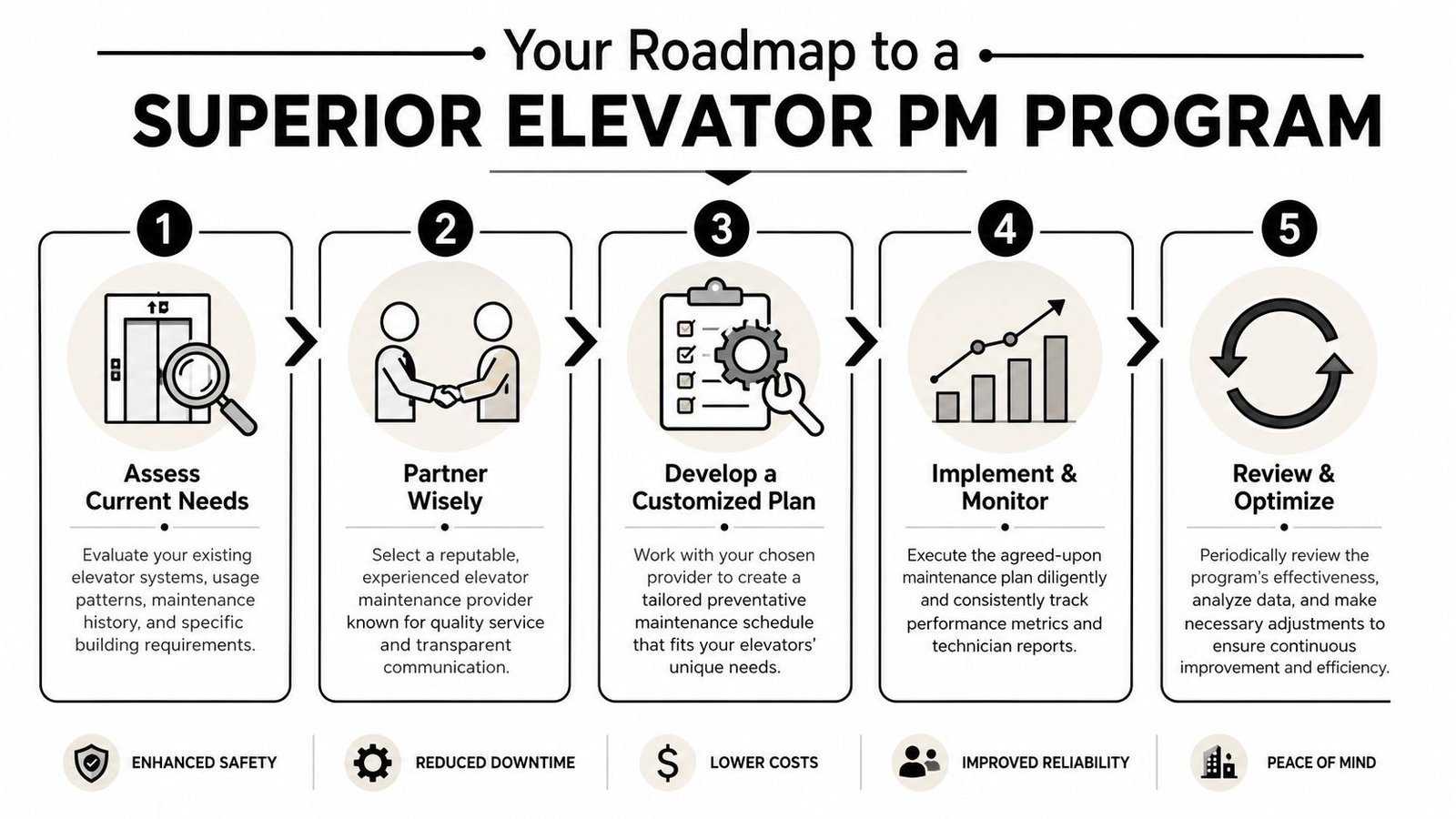
A solid program doesn’t start with a sales quote. It starts with an honest review of what your equipment is, how it’s being used, and where the service history keeps repeating itself.
Start with the actual condition of the equipment
Don’t rely on the contract summary alone. Look at each unit by age, type, traffic pattern, prior shutdowns, and parts history. A hydraulic passenger elevator in a municipal building doesn’t need the same plan as a freight unit in an industrial facility or a passenger car in a medical office.
Review these basics first:
- Usage pattern: Identify when the cars are busiest, whether traffic is peaking at open and close, and whether the building has freight, medical, school, or public-use demands.
- Repeated issues: Look for recurring door faults, leveling complaints, nuisance shutdowns, emergency phone issues, or code-related deficiencies.
- System type: Hydraulic and traction units fail differently and need different attention.
- Environment: Salt, moisture, dust, and debris matter in Michigan buildings, especially near loading areas, garages, older entrances, and industrial spaces.
Once you know how the equipment is behaving, the maintenance schedule can be built around risk instead of guesswork.
Match the contract to the work required
Many building owners lose control when they compare proposals by monthly price but never compare service depth.
For hydraulic equipment, compliant maintenance specifications call for at least 1.5 journeyman mechanic hours per month per elevator. If a contractor is pricing the work like a quick stop with a clipboard, ask how that requirement is being met. The same specification includes monthly vacuuming of the shaftway and cleaning guide rails with a nonflammable solvent. Those are dirty, time-consuming tasks. They don’t happen by accident.
A good agreement should clearly define:
- Visit frequency: Not just monthly in theory, but the actual expected service cadence.
- Included labor: What routine adjustments, clean-downs, inspections, and minor replacements are covered.
- Testing responsibilities: Who handles annual safety tests, coordination, and documentation.
- Service records: What the technician records after each visit and what the owner gets to review.
If you’re evaluating terms side by side, compare them against a detailed lift maintenance contract checklist so you can see what’s included.
Choose partners that don’t lock you in
A maintenance provider should make your building easier to service, not harder to exit. Proprietary systems can limit who can troubleshoot, source parts, or perform future modernization work. That reduces your bargaining power as an owner.
Non-proprietary equipment and controls give you options. If service quality slips, you can move the account. If modernization becomes necessary later, you’re not forced into one vendor’s ecosystem. In the long run, that flexibility matters as much as the monthly PM rate.
Owner check: Ask a simple question before signing. Can any qualified elevator contractor service this system, or only the original installer and its network?
Track proof, not promises
A maintenance program only works if the owner can verify it. Service logs should show what the mechanic did, what condition the equipment was in, and what should happen next. Vague notes such as “checked unit” or “operating properly” don’t tell you much.
Use practical performance indicators:
- Callback patterns by car
- Repeat trouble on the same component
- Inspection deficiencies
- How often scheduled work gets rescheduled
- Whether cleaning and housekeeping conditions improve
A clean machine room, car top, and pit tell you more than a generic invoice comment. If the environment still looks untouched, ask harder questions. Verification is part of the program, not an optional extra.
From Preventative to Predictive The Next Level of Reliability
Scheduled PM is the backbone. Predictive maintenance is the next layer.
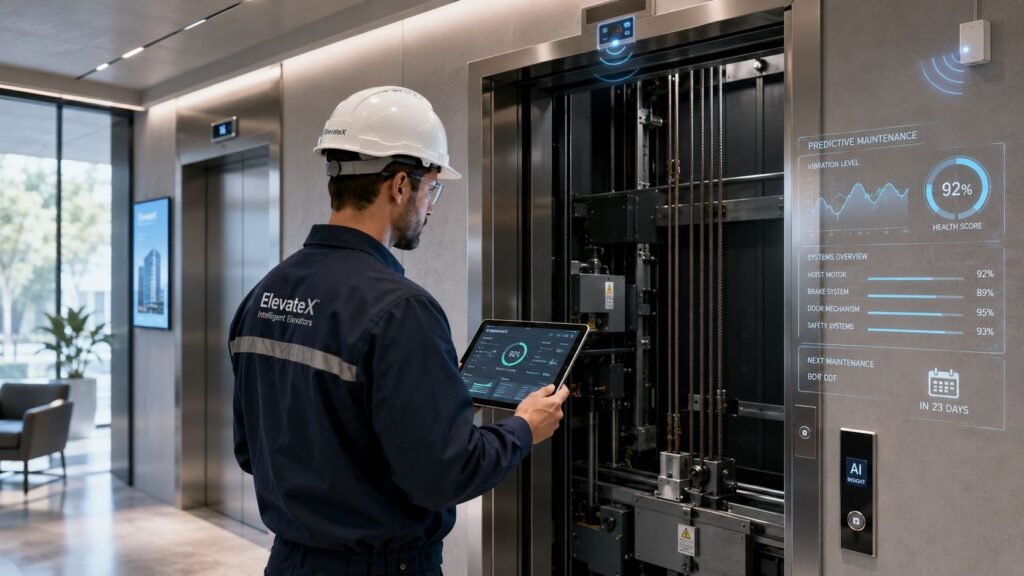
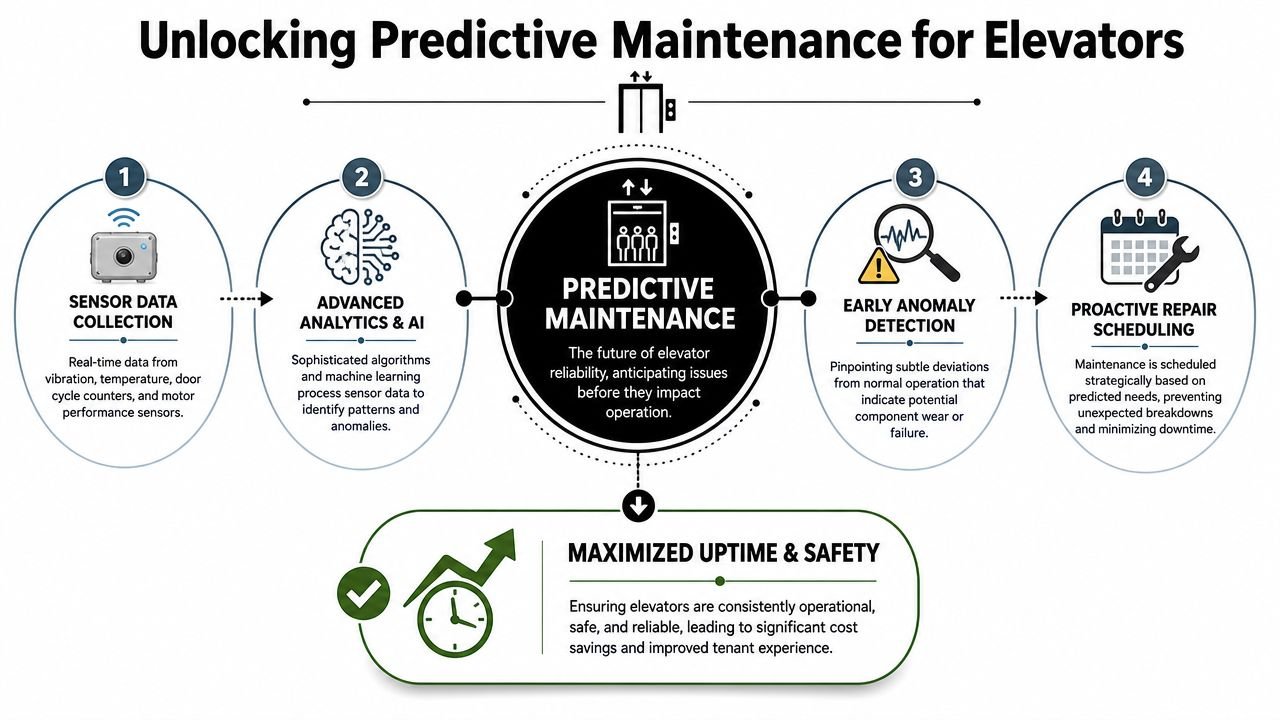
The idea is straightforward. Instead of waiting for a calendar date or an obvious failure, the elevator’s operating condition starts guiding service decisions. Sensors and monitoring tools track how key components behave. When that behavior changes, the system flags a developing problem before it becomes a shutdown.
What predictive maintenance looks like on real equipment
On an elevator, the most common trouble spots are also some of the most measurable. Door systems can be tracked by cycle patterns and performance changes. Motors and machines can be monitored for heat and vibration changes. Braking performance, ride quality, and leveling behavior can all show drift before riders start filing complaints.
That doesn’t mean every building needs a complicated tech stack. It means the service approach should move beyond fixed-interval maintenance when the equipment or traffic level justifies it.
Here’s the basic flow:
| Step | What happens |
|---|---|
| Data collection | Sensors or monitoring tools capture operating behavior from critical components |
| Analysis | The contractor reviews trends, anomalies, or patterns that don't fit normal operation |
| Early intervention | A part is adjusted, cleaned, repaired, or scheduled for replacement before failure |
| Planned repair timing | Work is done during lower-impact hours instead of in response to an outage |
Why predictive tools matter most in busy buildings
In a low-use building, traditional PM may be enough for a long time. In a medical office, senior facility, campus, or multi-tenant office building, the margin for surprise downtime is much smaller. The elevator gets used too often and by too many people to leave reliability to a calendar alone.
Predictive methods help answer practical questions:
- Is the door operator getting weaker before it starts faulting out?
- Is motor behavior changing under load?
- Is one car performing differently than the others?
- Should a replacement be planned now instead of during the next shutdown?
That’s also why some components shouldn’t be viewed as “still good until they fail.” A cable may still move the car while already showing the kind of wear that should trigger a planned replacement decision. Work like elevator cable replacement service is most effective when it’s scheduled around condition and safety, not forced by a breakdown.
Predictive doesn’t replace fundamentals
The mistake some owners make is assuming technology can substitute for hands-on maintenance. It can’t.
Sensors don’t vacuum a shaftway. Data doesn’t clean guide rails. Analytics won’t replace code-required tests, proper lubrication, brake inspection, housekeeping, or worn consumable replacement. Predictive maintenance works best when the basics are already being done right.
The smartest monitoring setup in the world won’t rescue a weak maintenance program.
For Michigan owners, the best approach is usually layered. Start with solid preventative elevator maintenance, add verification, then use predictive tools where building traffic and operational risk justify the extra visibility.
Common Maintenance Pitfalls and How to Avoid Them
A building owner usually sees the pattern only after the costs start stacking up. One car is down again. Tenants are complaining. The service log says the elevator was maintained, but the same door fault keeps coming back and the pit looks like nobody touched it.
That pattern usually starts with one bad assumption. A lower monthly contract price does not mean lower operating cost. It often means fewer real maintenance hours, weak documentation, and worn parts left in service until they force a shutdown. In Michigan, that gets expensive fast, especially in older buildings where weather, moisture, salt tracked in from winter conditions, and deferred repairs all speed up wear.
Another common mistake is treating inspection, maintenance, and replacement as if they are the same thing. They are not. A mechanic can inspect a roller, contact, belt, or door component, note that it is worn, and leave it in place. If no one approves replacement until after a failure, the building is not on a preventative program. It is running to breakdown with paperwork.
That gap between preventative maintenance and preventative replacement is where many owners lose money. Consumables and routine wear items have a service life. Waiting for them to fail rarely saves anything once you count tenant complaints, entrapments, after-hours calls, and the premium cost of emergency work.
The transparency problem is real
Building managers know when service feels thin. They may not have enough proof to challenge the invoice.
According to a 2025 report from V/O Elevator on service transparency in maintenance, 62% of building managers distrust maintenance contracts due to a lack of service transparency, and the same report found that unverified or incomplete maintenance is associated with 35% higher emergency repair costs. You can review that report here: V/O Elevator on proactive maintenance and service transparency.
That lines up with what we see in the field. The ticket says service was completed. The machine room has dust and debris in the corners. The car top is dirty. No meaningful notes explain what was adjusted, tested, cleaned, or recommended for replacement. Then the same callback shows up again two weeks later.
At that point, the problem is bigger than one bad component. The owner has no reliable way to verify whether the work billed was the work performed.
What to do instead
Owners avoid these problems by tightening the contract and making service visible.
- Reject vague scope language: The agreement should spell out visit frequency, cleaning tasks, lubrication points, testing duties, recordkeeping, and who is responsible for identifying worn parts before failure.
- Ask about preventative replacement: Get a clear answer on which wear items are replaced on condition and which are only observed until they fail.
- Keep your options open: Avoid proprietary arrangements that make it hard to change providers, source parts, or plan modernization work competitively.
- Require service verification: Technician notes should reflect actual conditions onsite, not generic closeout language. Housekeeping in pits, machine rooms, and on car tops should be easy for your staff to confirm.
- Tie payment to proof: A “No Show, No Pay” policy solves a problem building managers have dealt with for years. If the visit cannot be verified, it should not be billed.
For Michigan owners, that approach does more than clean up paperwork. It reduces repeat callbacks, supports code compliance, helps document due care, and lowers the odds that a small wear issue turns into a shutdown at the worst possible time.
If you want a maintenance partner that treats reliability, transparency, and non-proprietary service as standard practice, Crane Elevator Company serves Lower Michigan with preventative maintenance, repairs, testing, modernization, and straightforward service verification. For owners who are tired of vague logs and recurring callbacks, Crane’s team offers a practical second opinion on what your elevators need.