A tenant calls at 7:15 on a Monday morning. The elevator stopped between floors, the doors won't respond, and a delivery crew is waiting at the loading entrance. Within minutes, the facility manager is handling more than a service call. Accessibility is affected, staff routes change, tenants want answers, and an overdue inspection or unresolved violation may turn a mechanical problem into a compliance problem.
That's the operating reality behind Tecumseh Elevator Services. Reliable elevator work isn't limited to replacing a failed part after a breakdown. It requires an accurate asset register, scheduled maintenance, documented testing, suitable parts, and a contractor who can support the equipment when conditions become urgent.
The Reality of Elevator Downtime and Compliance
A grounded elevator can interrupt an entire building even when every other system is working. A healthcare facility may need to reroute patients and equipment. A school may have to reconsider accessible movement between floors. A church, warehouse, or municipal building may lose the only practical route for people or materials. The outage itself is visible, but the administrative consequences often take longer to resolve.
A facility manager dealing with an unexpected shutdown should separate the immediate safety response from the commercial response. Keep passengers clear of the equipment, preserve any alarm or emergency-phone information, record the time and symptoms, and notify the service provider. Don't allow staff to bypass doors, reset safety devices repeatedly, or place the unit back in service without a qualified assessment.
Practical rule: Treat every recurring fault as an asset-management signal, not as an invitation to keep resetting the same component.
Why deferred work creates larger problems
A worn door operator may first appear as a nuisance. The car takes longer to close, users hold the doors, and staff begin reporting intermittent faults. If the condition continues, the operator, door restrictor, locks, rollers, and controller inputs may all become part of the diagnostic chain. A technician who receives only “the elevator is stuck” has less useful information than one who receives a dated pattern of door faults, leveling errors, and callback history.
Compliance adds another layer. Oklahoma records for Tecumseh show elevator assets tracked with fields including serial number, hoistway location, expiration date, last inspection date, and address in state inspection programs. That asset-level structure is a useful operational model for any multi-site manager, because it connects each device to its service history and inspection status rather than treating “the building elevator” as one undifferentiated item. Oklahoma's elevator inspection records illustrate the kind of register managers should maintain.
Crane Elevator Company provides a regional option for preventive maintenance, repairs, testing, inspections, and modernization across Michigan and Ohio. The practical question isn't whether a contractor promises emergency response. It's whether the contractor can keep the asset safe, documented, serviceable, and available between emergencies.
Regional Service Coverage Across Michigan and Ohio
Regional coverage matters because elevator portfolios rarely sit in one convenient cluster. A property group may have a commercial building in Detroit, an educational facility near Lansing, a medical office in Ann Arbor, and an industrial site around Grand Rapids. Those assets may use different controllers, drive machines, door equipment, hydraulic systems, and inspection schedules.
Crane Elevator Company states that it serves Detroit, Lansing, Ann Arbor, and Grand Rapids, along with surrounding communities throughout Southern Michigan. Its listed Ohio coverage includes Toledo, Bowling Green, Findlay, Fremont, Defiance, and Perrysburg, with service extending to communities between the larger cities. The company's coverage statement supports a regional contractor model rather than a single-city operation. Review Crane Elevator's regional service coverage.
How to manage a dispersed portfolio
Start with one master register. Give every elevator, wheelchair lift, residential unit, material lift, and dumbwaiter its own record, even when several devices share an address. Record the manufacturer, model, serial, location, equipment type, controller, drive, door operator, inspection status, known deficiencies, and service contact.
Then divide response planning into practical zones:
- Metro assets: Detroit, Ann Arbor, Lansing, and Grand Rapids may require tight scheduling across busy facilities and multiple simultaneous service needs.
- Regional assets: Smaller communities need the same technical support, but travel planning and parts staging become more important.
- Ohio locations: Toledo, Bowling Green, Findlay, Fremont, Defiance, and Perrysburg should be managed with their applicable Ohio inspection and documentation requirements, not just copied from a Michigan schedule.
For managers with Ohio properties, the Ohio elevator services team should be assessed against the actual equipment list, not a generic service description. Ask how the contractor handles after-hours calls, recurring visits, inspection preparation, parts availability, and communication with building staff.
A single regional contractor can simplify reporting across locations, but consolidation has a trade-off. One provider may improve consistency, while a portfolio still needs documented performance requirements, escalation contacts, response expectations, and an exit plan if service quality declines.
Core Elevator Components and Part Functions
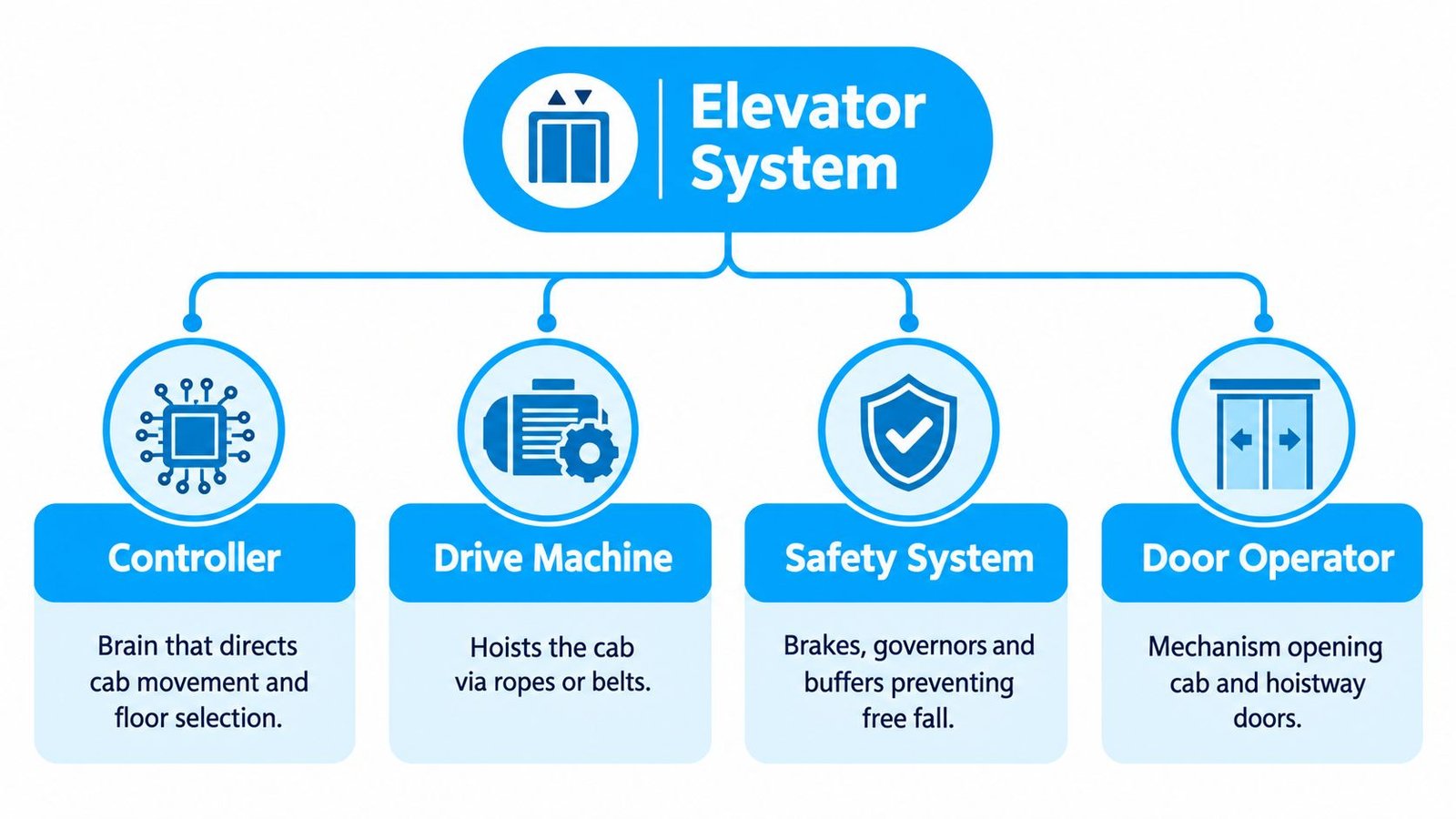
Facility managers don't need to become elevator mechanics, but they do need to recognize what a proposed repair affects. An elevator is a coordinated system. A controller can report a door fault when the underlying problem is mechanical, and a motor issue may be caused by drive, brake, sheave, bearing, or alignment conditions rather than the motor alone.
The main mechanical systems
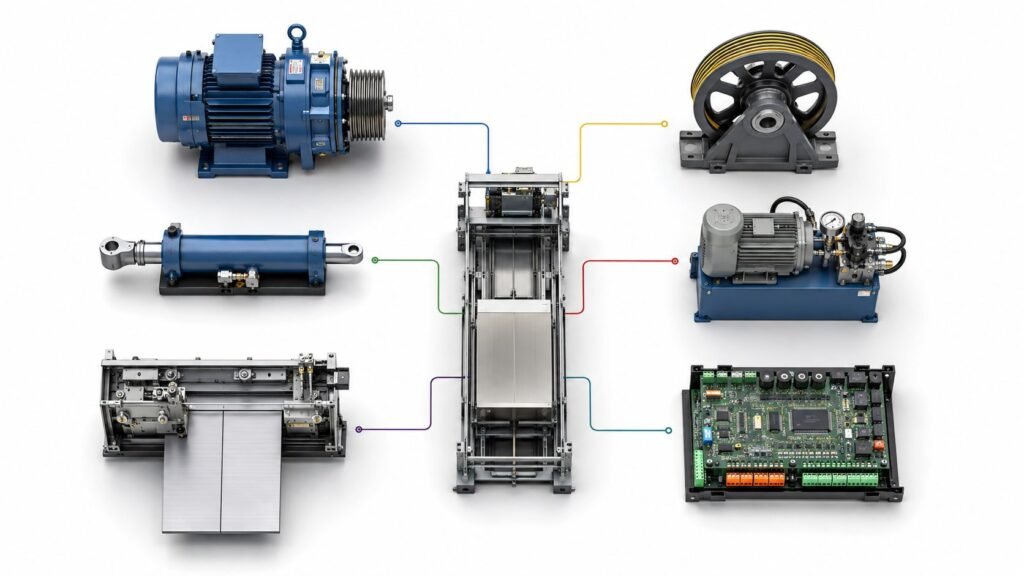
Hoist motor and drive machine. In a traction elevator, the motor turns the drive machine, which moves the sheave and raises or lowers the car through ropes or belts. Heat, unusual vibration, bearing noise, brake wear, and inconsistent stopping can indicate trouble in the drive train. A motor replacement without checking the brake, sheave, bearings, and controller can leave the original failure pattern in place.
Sheave, ropes, and suspension components. The sheave transfers motion to the ropes or belts. Grooving, wear, tracking problems, or rope condition can affect ride quality and traction. Technicians need to evaluate the complete suspension arrangement, not just the visible rope surface.
Hydraulic jack and power unit. Hydraulic elevators use a pump, tank, valves, piping, and jack to move the car. Slow leveling, oil leakage, drifting, weak acceleration, or a pump that runs without producing expected movement can point to packing, valve, pump, tank, or jack conditions. A clean-up alone doesn't correct the source of hydraulic leakage.
Door operator and locks. Doors create a large share of everyday user interaction. The operator moves the car door, while interlocks and monitoring circuits confirm that doors are closed and secured before movement. Dragging panels, repeated reopening, failed nudging, poor alignment, or intermittent lock faults deserve documented diagnosis.
The electrical and safety controls
Controller and logic boards. The controller coordinates calls, direction, leveling, door operation, inspection mode, and safety inputs. A fault code is evidence, not a complete diagnosis. Technicians should connect the code to test results, wiring condition, input and output behavior, and the history of repeat faults.
Safety system. Brakes, governors, safeties, buffers, door locks, limit switches, and related circuits prevent unsafe movement or stop the car under abnormal conditions. Never defeat or bridge a safety circuit to return an elevator to service.
A useful service proposal identifies the failed function, the tested cause, the recommended part, and the risk of leaving the condition unresolved. It should also distinguish a repair that restores operation from modernization that improves long-term serviceability.
Navigating Proprietary Versus Non-Proprietary Parts
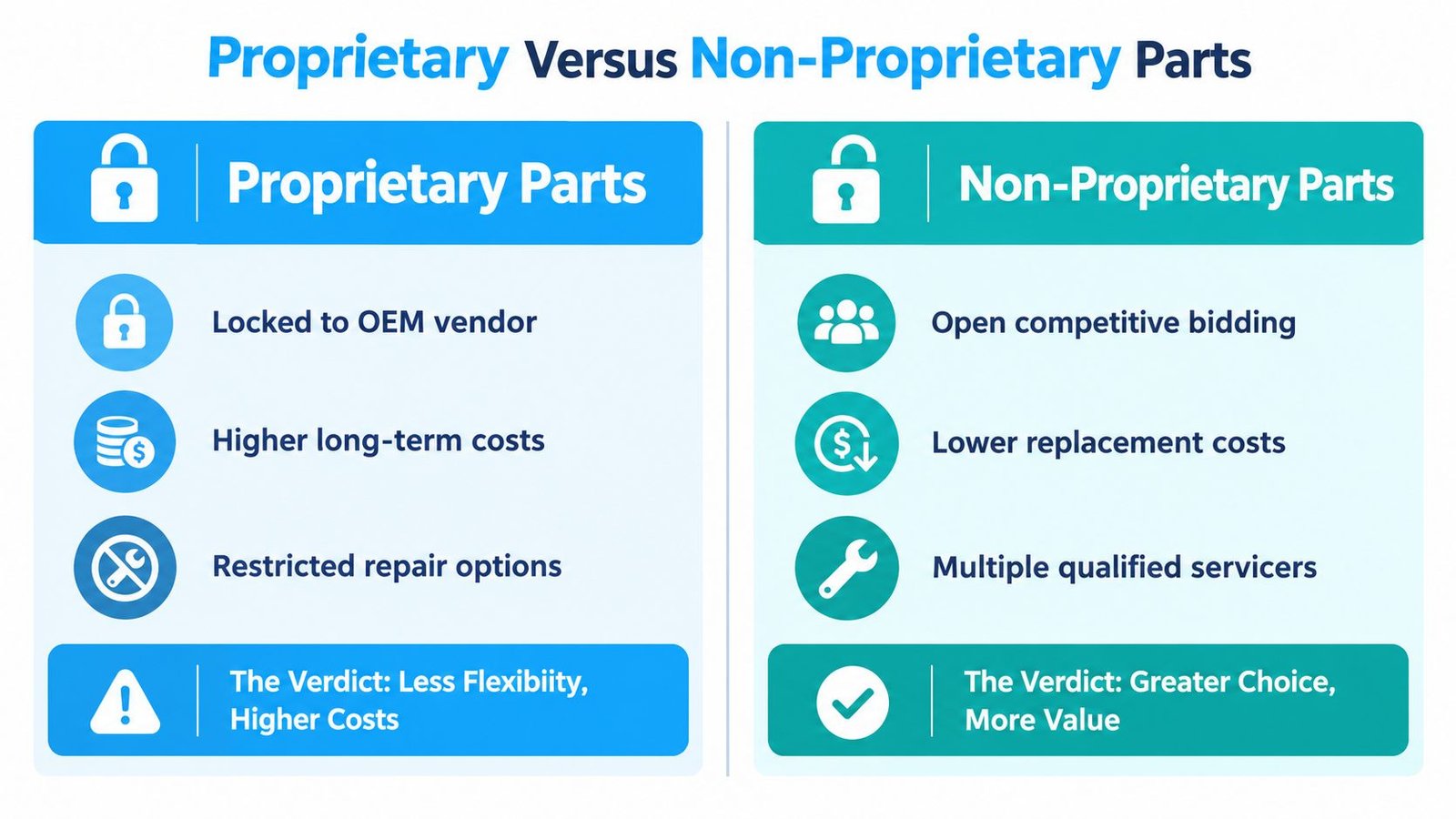
The parts decision affects who can work on the elevator long after the original installation. A proprietary system may tie access, diagnostic tools, replacement boards, or software support to one source. That can make a familiar system convenient at first, but it can narrow future repair options and complicate competitive procurement.
A non-proprietary approach aims to keep the equipment serviceable by multiple qualified providers. It doesn't mean every part fits every elevator, or that a manager should select the cheapest substitute without engineering review. It means the owner evaluates compatibility, code requirements, documentation, and future access instead of accepting unnecessary vendor lock-in.
The trade-off owners should examine
| Decision factor | Proprietary model | Non-proprietary model |
|---|---|---|
| Service access | Often restricted to an OEM-linked channel | Multiple qualified servicers may be able to work on the system |
| Parts sourcing | May depend on a specific source | Can support competitive sourcing when technically suitable |
| Long-term control | Owner may rely heavily on one provider | Owner retains more flexibility in procurement |
| Modernization planning | Replacement path may follow the original platform | Design can emphasize open serviceability |
| Technical responsibility | Compatibility may be clearer within one ecosystem | Specifications and integration need careful review |
The wrong comparison is “expensive part versus cheap part.” The better comparison is total operating control. Ask whether the board, drive, door operator, or controller can be supported by qualified technicians, whether programming information is available, whether replacement parts can be sourced without an emergency premium, and whether the modernization leaves usable documentation behind.
Crane Elevator Company offers non-proprietary modernization and service for different makes and models, including older freight equipment, passenger units, residential elevators, wheelchair lifts, material lifts, and dumbwaiters. That makes a non-proprietary discussion relevant for mixed-use owners, but every proposal still needs a device-specific review. See Crane Elevator's non-proprietary elevator approach.
A non-proprietary design can reduce dependence on one channel, but it won't eliminate the need for competent engineering, proper testing, and code-compliant installation. Owners should require a parts list, compatibility statement, wiring and logic documentation, warranty terms, and a clear explanation of who owns the resulting records.
The following video offers another way to frame the serviceability issue before a modernization decision is made.
State-Mandated Maintenance and Inspection Frequencies
Michigan and Ohio impose different baseline obligations, and a portfolio that crosses the state line needs separate compliance calendars. A service contract should identify the equipment type, the required visit or inspection interval, the records retained, and the person responsible for confirming completion.
Michigan requires a power elevator, except certain private-residence devices, to receive maintenance at least once every 90 days by a licensed elevator journeyperson. Dumbwaiters and some smaller or special devices have a 180-day maintenance interval. Michigan also requires written records covering maintenance, repairs, replacements, inspections, callbacks, and testing, kept in the machine room or on-site when no machine room exists. Read the Michigan maintenance rule.
| Jurisdiction | Equipment type | Required frequency |
|---|---|---|
| Michigan | Power elevator, subject to listed exceptions | At least once every 90 days |
| Michigan | Dumbwaiters and certain smaller or special devices | At least once every 180 days |
| Ohio | Passenger elevators, escalators, moving walks, and freight elevators, including gravity elevators | Twice every 12 months |
| Ohio | Power dumbwaiters, hoists, and other non-person-carrying lifting or lowering apparatus | At least once every 12 months |
Ohio law also permits certain passenger elevators with a capacity of 750 pounds or less to follow an annual inspection schedule by board rule, and private-residence elevators are excluded from these requirements. Review Ohio's elevator requirements.
Turn the rules into an audit
Pull the current inspection certificate, the last service report, the open violation list, and the contract visit history for each device. Compare the dates rather than assuming that a monthly invoice proves the required work occurred. A technician's report should state what was inspected, what was adjusted or replaced, what remains open, and whether the elevator was left in service.
For testing and inspection preparation, use a documented workflow that assigns owners to certificates, maintenance records, access arrangements, deficiency correction, and reinspection. Review elevator testing services as part of that process, but keep responsibility for the compliance calendar inside the facility organization.
Compliance Triggers for Diverse Building Types
A church, hospital, school, warehouse, and apartment building may each operate an elevator, but the consequences of failure differ. The equipment may also differ. Public elevator registries show a mix of passenger elevators, LU/LA units, and residential lifts in Tecumseh-area and nearby markets, so a generic “elevator service” plan can miss important distinctions.
A church may have low traffic during the week and intense use during events. That pattern can hide door wear and create a concentrated accessibility problem when the building is full. An educational building may need reliable access for students, staff, and equipment, while a healthcare facility may need stronger controls around emergency response, infection-sensitive areas, and transfer routes.
Match the plan to the occupancy
- Churches and community buildings: Track event schedules, accessibility routes, emergency contacts, and inspection status. A quiet operating period doesn't replace required maintenance.
- Schools and educational facilities: Coordinate service access with the academic calendar, protect students from work zones, and maintain a clear alternate route when an elevator is unavailable.
- Healthcare properties: Define escalation procedures, identify critical destinations, and require technicians to communicate clearly with facility engineering and clinical operations.
- Warehouses and industrial sites: Separate passenger, freight, and material-handling equipment in the register. Review loading conditions, door impact, controls, and the consequences of a lift being unavailable.
- Residential and mixed-use buildings: Identify whether the device is a passenger elevator, LU/LA unit, residential elevator, or wheelchair lift. Resident communication and accessibility planning should be part of the response procedure.
Oklahoma enforcement documents show that Tecumseh-area properties have included churches and educational buildings in overdue-inspection listings, with inspection status, expiration dates, and red-tag or inactive flags tracked by regulators. The operational lesson is direct. An overdue inspection should trigger immediate review of the device, service records, certificate status, and occupant communication, not a quiet filing exercise. Examine the Oklahoma past-due inspection records.
Modernization triggers
Modernization becomes harder to postpone when parts are repeatedly unavailable, the controller produces recurring faults, the door system can't maintain reliable operation, or the equipment lacks usable documentation. A good plan considers inspection windows, tenant impact, temporary accessibility measures, shutdown duration, parts lead time, and whether the proposed system remains serviceable by qualified providers.
The cheapest short-term repair may not be the lowest-risk lifecycle decision. Managers should ask for a repair-versus-modernization comparison that separates immediate restoration from the conditions likely to generate another outage.
Vetting Contractors and Mitigating Procurement Risks
A polished proposal doesn't prove that a contractor is licensed, insured, responsive, or equipped to finish the work. Facility managers should treat contractor vetting as a safety and continuity control, especially when the project involves a healthcare, industrial, education, or municipal building.
Recent local coverage from Tecumseh, Michigan, described a homeowner's allegation that a contractor misrepresented licensing and caused damage after collecting more than $40,000 upfront. The report isn't evidence about every elevator contractor, but it highlights why buyers should verify credentials and payment terms before work begins. Review the local contractor-license dispute coverage.
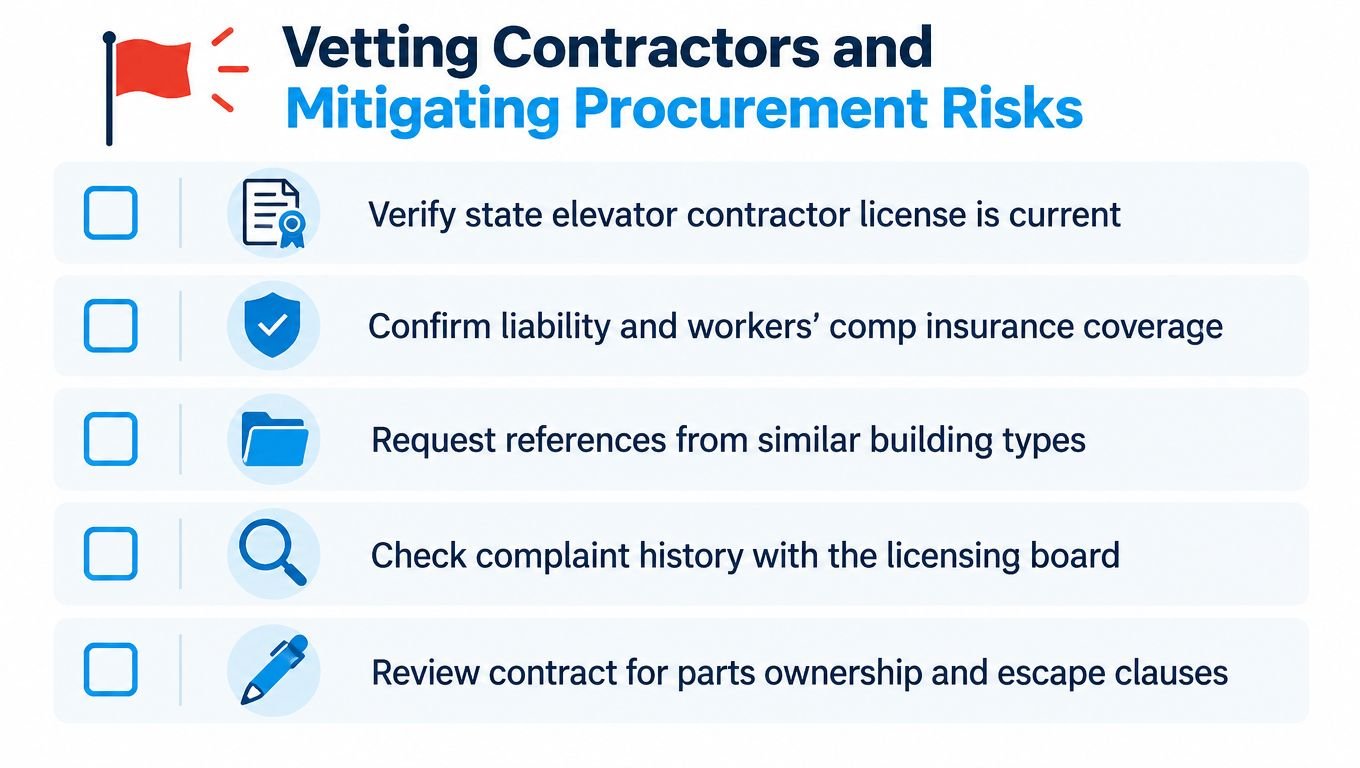
Documents to request before signing
- Verify the state elevator contractor license. Confirm that the license is current and matches the legal entity named in the proposal. Ask who will perform maintenance and whether the assigned personnel hold the required credentials.
- Confirm insurance and bonding. Request current liability and workers' compensation certificates. Check policy dates, covered entities, and whether the limits fit the building's procurement requirements.
- Request relevant references. Choose references from similar occupancies, such as a school for a school project or an industrial site for a freight application. Ask about callbacks, reporting, emergency communication, and unresolved work.
- Check complaint and enforcement history. Search the applicable licensing authority and ask the contractor to explain any relevant complaint, disciplinary, or unresolved compliance matter.
- Review the contract mechanics. Define scope, exclusions, parts ownership, documentation, response procedures, cancellation rights, warranty coverage, payment milestones, and the conditions for emergency work.
Procurement safeguard: Don't pay for an undefined future result. Tie payments to identifiable deliverables, documented progress, testing, and accepted closeout records.
Large upfront demands deserve especially careful review. Some projects require deposits for equipment or custom fabrication, but the contract should identify the item, delivery condition, ownership, refund treatment, and protections if the contractor stops responding. A credible service relationship also needs an escalation path that reaches someone with authority to resolve missed visits and open deficiencies.
Building a Robust Maintenance Control Program
Michigan's elevator division requires a Maintenance Control Program, or MCP, for all elevating devices under ASME A17.1-2010 Section 8.6.1.2.1. The program must be available at inspection, and Michigan states that failure to have an MCP available results in a violation. Review Michigan's MCP guidance.
An MCP should live with the asset, not in a technician's memory or an inaccessible email thread. Build one record for each device and keep the current version available to the people responsible for inspections, maintenance coordination, and emergency response.
What the record should contain
- Equipment identity: Manufacturer, model, serial, address, hoistway location, equipment type, controller, drive, and door equipment.
- Maintenance procedures: Required tasks, safety precautions, inspection points, lubrication requirements, adjustment limits, and manufacturer or engineering references.
- Service history: Dates and descriptions of maintenance, repairs, replacements, testing, callbacks, and inspection activity.
- Open conditions: Violations, temporary measures, parts on order, responsible parties, target completion, and verification of closure.
- Emergency information: Disconnect locations, machine-room access, emergency contacts, fire service information, generator relationship, and passenger-release procedures managed by qualified personnel.
The strongest MCPs connect the written procedure to actual field evidence. A service report should identify the device, describe the work completed, list deficiencies, and state whether further action is required. Managers should review the register before inspection, not discover missing records when the inspector arrives.
Essential Elevator Terminology and Definitions
A shared vocabulary helps facility managers challenge vague proposals and report symptoms accurately.
- Hoistway: The vertical shaft containing the elevator car, counterweight where applicable, rails, doors, and related equipment.
- Door lock monitoring: A control function that checks whether the hoistway and car doors are properly closed and locked before movement.
- Controller: The electrical system that processes calls, safety inputs, door signals, and movement commands.
- Drive machine: The traction machinery that moves the car through a sheave, ropes, or belts.
- Hydraulic power unit: The pump, tank, valves, and motor assembly that supplies hydraulic movement.
- LU/LA: A limited-use, limited-application elevator designed for specific low-rise applications, with requirements different from a standard passenger elevator.
- Non-proprietary controller: A controller designed to support service and replacement options from qualified providers rather than restricting the owner to one source.
- Maintenance Control Program: The documented procedures and records used to control maintenance, testing, and inspection readiness for an elevating device.
When a technician writes “door lock fault,” ask whether the cause is alignment, wiring, the lock itself, monitoring logic, or a related mechanical condition. Precise language improves the work order and reduces needless part swapping.
Quick-Reference Troubleshooting and Action Guide
The first response to an elevator problem should protect people and preserve useful information. Don't repeatedly reset the controller, open equipment cabinets, or attempt a passenger release unless the person performing the action is trained and authorized. Record the floor, direction, door position, display message, unusual sound, and whether the issue is repeatable.
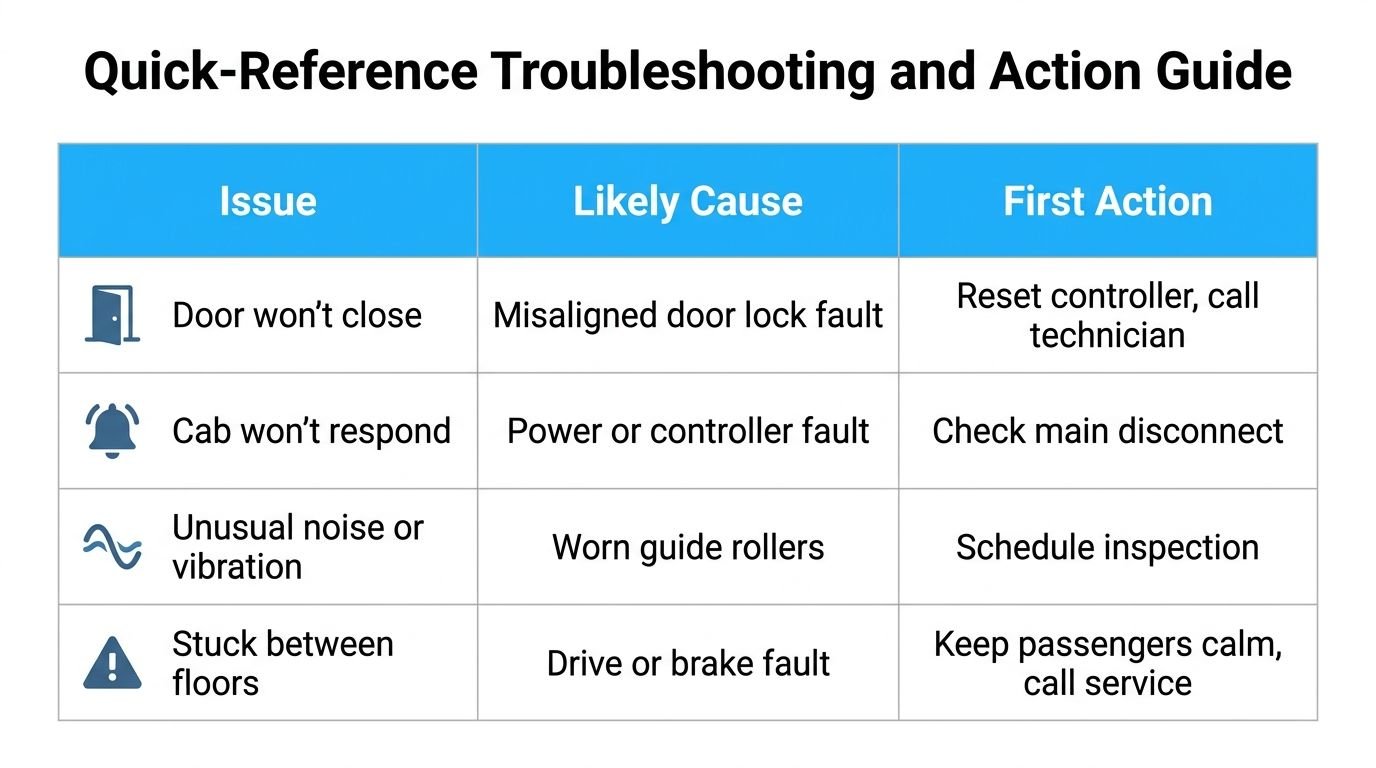
| Issue | Likely cause | First action |
|---|---|---|
| Door won't close | Misaligned door lock fault | Keep people clear, note the display or door behavior, and call a qualified technician |
| Cab won't respond | Power or controller fault | Check the main disconnect only if authorized, then report the condition |
| Unusual noise or vibration | Worn guide rollers, drive, brake, or related equipment | Remove the unit from normal use if safety or ride quality is affected and schedule inspection |
| Elevator stops between floors | Drive or brake fault, safety circuit interruption, or control fault | Keep passengers calm, use the emergency communication system, and call service |
| Elevator levels poorly | Sensor, valve, encoder, brake, or controller issue | Restrict use if the floor difference creates a trip hazard and document the landing |
| Repeated callbacks | Unresolved root cause or interacting component faults | Send the complete history to the contractor and request a root-cause review |
What to include in the service call
Give the dispatcher the building address, elevator identification, occupancy, passenger status, last known position, and any active alarm or error message. Tell the technician whether the problem followed maintenance, a power event, water exposure, unusual loading, or a prior repair.
After restoration, request a written report that distinguishes the immediate correction from recommended follow-up. A reset may return the elevator to service, but it doesn't explain why the fault occurred. The manager's job is to make sure the event becomes part of the asset history and that recurring symptoms receive a deeper response.
Crane Elevator Company provides preventive maintenance, repairs, testing, inspections, modernization, and emergency service for elevators and other vertical-transportation equipment across Michigan and Ohio. Visit Crane Elevator Company to discuss a Tecumseh-area asset register, compliance review, non-proprietary service options, or a second opinion before the next outage.