
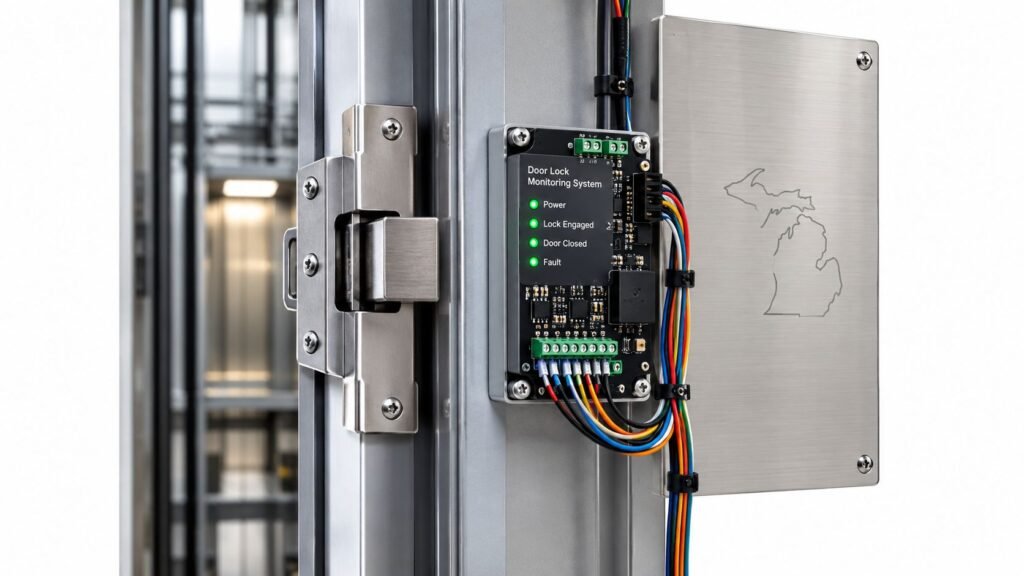
A code notice arrives before the morning inspection, and the wording is not clear enough to tell you whether the elevator needs a new controller, a revised door circuit, or a file containing manufacturer documentation. Your first questions are practical: Can the car stay in service? Which units need hardware? How should the work fit into the maintenance budget?
Door Lock Monitoring, or DLM, is both a safety function and a scheduling issue. For Michigan facility managers, the important decision is not just whether the elevator has DLM. It's whether the existing controller can demonstrate the required monitoring function, whether the authority having jurisdiction accepts that evidence, and whether any corrective work can be completed before the January 1, 2028 Michigan compliance deadline identified in Crane Elevator's Michigan elevator code deadline guide.
Why Door Lock Monitoring Is on Every Michigan Facility Manager's Desk
A notice referencing ASME A17.3 Section 3.10.12 can create confusion because “door lock monitoring” sounds like a replacement part. In practice, the requirement may involve controller programming, relay logic, added monitoring hardware, revised wiring, door-contact work, or documentation confirming that the equipment already performs the required function.
The first step is to identify the elevator's controller type and modernization history. Don't approve a blanket controller replacement until a qualified elevator professional has reviewed the wiring diagrams, door interlock circuit, controller inputs, and available manufacturer documentation.
What the notice means operationally
Michigan's existing-elevator requirements can affect older equipment even when the elevator has operated safely for many years. The state's administrative framework points owners and contractors toward the applicable safety requirements for existing installations, while the enforcement outcome depends on the inspection process and the authority having jurisdiction.
That makes DLM a compliance-timing and budgeting problem, not automatically an emergency shutdown. A unit may need immediate correction if an inspector identifies an unsafe condition, but a code notice about future compliance should first lead to an equipment evaluation and written scope.
The practical questions are:
- Controller capability: Can the controller monitor the relevant door lock and contact circuits?
- Physical condition: Are the landing door interlocks, contacts, wiring, and terminals operating correctly?
- Evidence: Does the manufacturer provide documentation confirming the monitoring function?
- Inspection timing: When is the next annual inspection, acceptance test, or modernization milestone?
- Portfolio sequencing: Can several elevators be assessed together and corrected in phases?
Practical rule: Treat the next inspection cycle as a planning anchor. Don't treat every DLM letter as proof that a complete controller replacement is necessary.
This article focuses on the controller behavior, Michigan's existing-elevator compliance timing, hardware versus documentation decisions, inspection preparation, and regional scheduling. It doesn't cover Phase 1 fire service recall changes, hydraulic jack replacement, or requirements outside Michigan.
What Door Lock Monitoring Actually Does on an Elevator
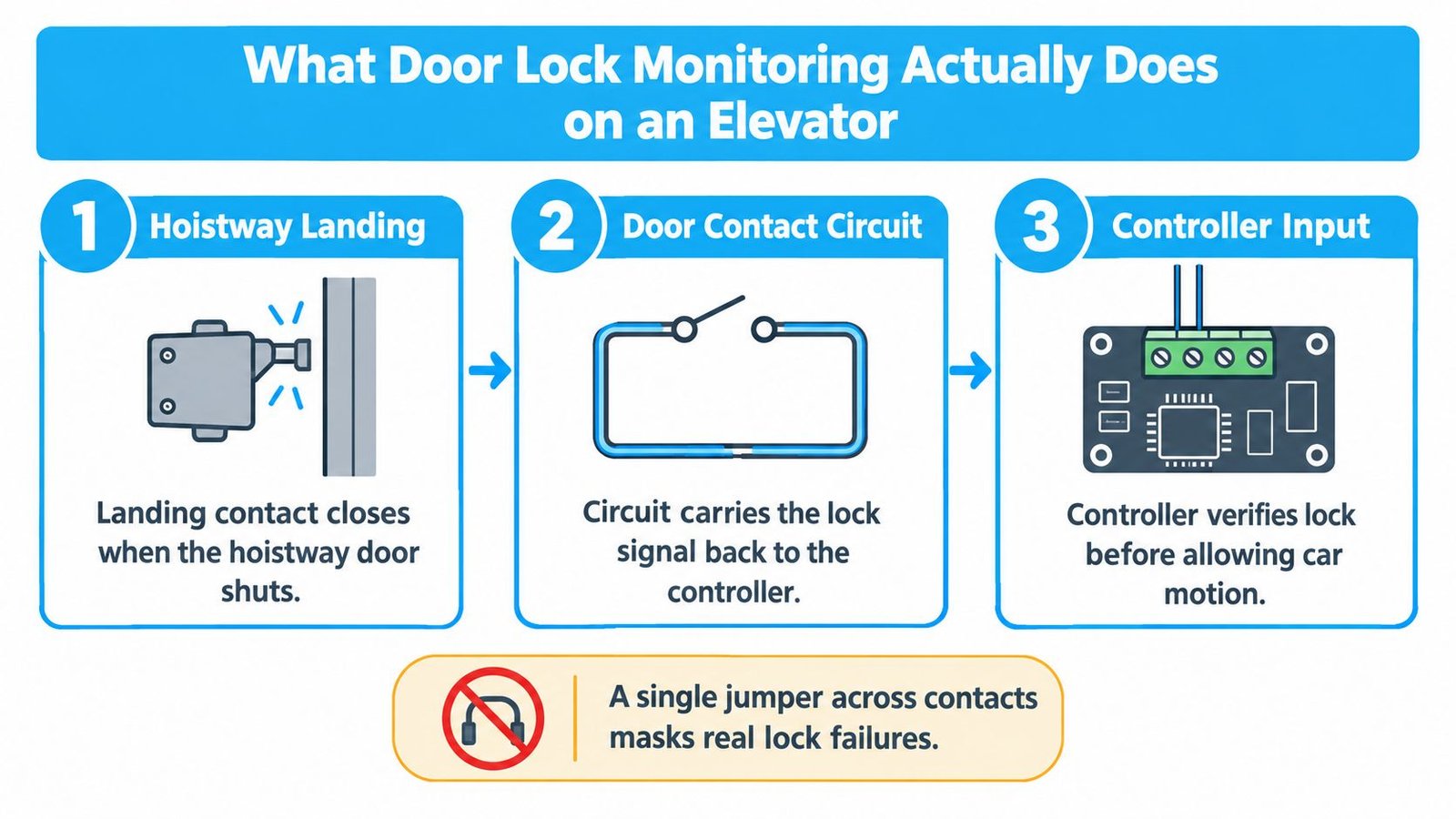
Door Lock Monitoring is a controller function. It verifies the condition of the door-lock circuit before the elevator is allowed to move under automatic operation. The function depends on the relationship between each hoistway landing door contact, the wiring circuit, and the controller input.
At a landing, the door interlock or contact closes only when the hoistway door reaches the proper closed and locked condition. That signal travels through the door-contact circuit to the controller. The controller then checks whether the expected lock condition exists before it permits normal car movement.
Why jumpers create a serious problem
Older relay logic can be vulnerable to a simple bypass. A jumper across a door contact may make the controller “see” a closed circuit even though a landing door is not properly secured. The elevator then receives an electrical signal that doesn't match the mechanical condition of the door.
DLM is intended to detect that mismatch. The controller must monitor the relevant contacts rather than accepting a permanently closed or improperly bypassed circuit as proof that every door is locked.
A garage-door analogy helps define the boundary. If someone bypassed the safety contact on a garage door, the opener might receive a false signal that the door is safe. Elevator DLM addresses a comparable contact-circuit problem, but it doesn't replace every other door safety device.
What DLM does not replace
DLM isn't a door restrictor, a gate switch, a hoistway access system, or a complete door operator modernization. It also doesn't make every possible door-open operating condition disappear in every operating mode. The contractor must evaluate the applicable circuit, operating mode, and code requirements rather than describe DLM as a universal door upgrade.
For facility managers, the most useful distinction is simple:
- The door hardware creates the lock signal.
- The circuit carries the signal.
- The controller verifies the signal.
- The inspection confirms that the system responds correctly to faults.
Routine door condition and adjustment work remains important. A commercial elevator door maintenance program can identify worn rollers, misalignment, damaged contacts, and inconsistent closing before those issues become DLM test failures.
ASME A17.3 and the Michigan Code Behind the 2028 Deadline
ASME added formal door lock monitoring requirements to ASME A17.1 in 1996. DLM later became part of the existing-elevator code through ASME A17.3 in 2015 for electric traction elevators and in 2017 for hydraulic elevators, according to Elevator World's summary of door lock monitoring adoption.
In plain English, the existing-elevator rule requires the controller to monitor each hoistway door interlock or contact so the car cannot move away from a landing unless the applicable doors are closed and locked. The rule addresses the gap between an electrical indication and the actual mechanical condition of the door.
How the Michigan deadline changes the decision
Michigan facility managers should treat January 1, 2028 as the currently identified planning trigger for existing in-service elevators, not as a reason to order the same work on every unit. The right scope still depends on the controller, the door circuit, the elevator's documentation, and the position taken by the authority having jurisdiction.
The Michigan administrative rules for existing installations connect enforcement to adopted elevator safety standards. A substantial alteration or modernization can also bring additional code review, so owners planning controller, door, or major operating-system work should ask whether the project will be handled as a standalone repair or as part of a broader alteration. For a practical overview of how that deadline is being discussed in the field, see Michigan's elevator code deadline guidance.
Annual testing still matters. Industry maintenance guidance describes commercial elevator programs as including inspections, lubrication, component testing, compliance certifications, and modernization planning. It also identifies annual Category 1 testing for hydraulic elevators and Category 5 testing for traction elevators, with the applicable requirements confirmed by the jurisdiction and inspector. These testing intervals are summarized in this commercial elevator maintenance guide.
DLM compliance triggers by Michigan rule
| Reference | Scope | Applies To | Trigger Date |
|---|---|---|---|
| ASME A17.3 Section 3.10.12 | Monitoring of applicable hoistway door lock and contact circuits | Existing elevator installations covered by the adopted code | Michigan's currently identified January 1, 2028 target compliance date, subject to confirmation by the authority having jurisdiction |
| Michigan administrative rules for existing installations | State adoption and enforcement framework | Elevators regulated by Michigan authorities | The effective date and inspection direction stated by the authority having jurisdiction |
| Substantial alteration review | Additional code review when modernization changes covered systems | Elevators undergoing qualifying modernization or alteration | Project-specific, based on permit and scope review |
An inspector may identify a DLM deficiency during an annual inspection, while a modernization project can create a separate acceptance and return-to-service review. The building owner should confirm the exact enforcement path with the licensed contractor and the Michigan authority responsible for the elevator.
Which Elevators Need Hardware and Which Need Documentation
The controller's age is a clue, not a verdict. Minnesota's elevator guidance makes the point directly: elevators installed before 2007 must be evaluated individually for compliance, and owners may receive up to 5 years to complete corrections after notice, depending on the circumstances described by the state. That guidance is available through the Minnesota door lock monitoring FAQ.
A documentation-only route can work when the manufacturer confirms that the controller already performs the required monitoring function and the equipment passes inspection. A hardware route becomes more likely when the controller lacks suitable inputs, the relay logic cannot recognize the required fault conditions, or the door circuit has been modified in a way the available documentation doesn't support.
The evidence that separates the two routes
Ask for a written evaluation rather than a verbal assurance. The file should identify the controller, describe the monitoring method, state which door circuits are supervised, and explain how the controller responds when a contact is opened, shorted, or bypassed.
The owner should also confirm whether the Michigan authority accepts manufacturer documentation as sufficient evidence. Some jurisdictions require a licensed elevator contractor's field confirmation, and an inspector may still require functional testing even when the paperwork appears complete.
| Controller Era | Compliance Path | Evidence Required | Typical Cost Driver |
|---|---|---|---|
| Pre-2007 equipment | Individual evaluation, followed by documentation or hardware correction | Manufacturer records, wiring diagrams, and licensed contractor confirmation | Relay changes, added monitoring equipment, obsolete parts, and access time |
| Later microprocessor equipment | Firmware, programming, contact changes, or documentation may be sufficient | Controller model information, current software details, and functional test results | Licensing, programming, compatible components, and verification testing |
| Any controller with altered door circuits | Circuit correction and documented retest may be required | As-built wiring review and inspection records | Troubleshooting, correcting undocumented modifications, and repeat testing |
The costly mistake is choosing the remedy before establishing the evidence. A board replacement may be unnecessary if the controller already contains the required logic. Documentation alone won't solve a controller that can't detect a defeated lock circuit.
A proper survey protects the owner in both directions. It prevents unnecessary modernization on a compliant unit, while also preventing a paperwork-only decision on equipment that requires a genuine monitoring upgrade.
How DLM Fits into Inspections, Category Tests, and Violations
An inspection day often reveals the difference between a controller that has a DLM label and one that performs the required function. The qualified elevator inspector reviews the equipment, observes the door circuits, and tests how the controller reacts when the expected lock signal is interrupted.
The inspector may check a representative landing, review the circuit behavior, and verify that the controller doesn't permit normal movement when the monitored lock condition is defeated. The exact procedure and documentation depend on the adopted code, the equipment, and the authority having jurisdiction.
What the inspector is looking for
A facility manager should expect questions about:
- Door-contact response: Does the signal drop out when the landing door is no longer properly locked?
- Circuit integrity: Can a short, open circuit, or jumper defeat the monitoring function?
- Controller recognition: Does the controller register the abnormal condition instead of treating it as a valid lock?
- Equipment records: Do the wiring diagrams and manufacturer documents match the installed equipment?
- Post-work testing: Has the contractor tested the system after a repair, modernization, or programming change?
A door lock monitoring issue can become part of the inspection record and may require correction before the operating certificate is renewed. Significant modernization or repairs commonly require re-inspection before the elevator returns to service, as explained in this qualified elevator inspector FAQ.
Category testing and return to service
Hydraulic and traction equipment don't follow identical testing schedules. Annual Category 1 work is associated with hydraulic elevator testing, while traction elevators have the separate Category 5 testing cycle described by the applicable maintenance and inspection program. A door-system or controller modernization can also trigger acceptance testing outside the normal annual rhythm.
Owners should keep the DLM report, controller documentation, wiring updates, test results, and correction records together. If the inspector finds a failed contact, an undocumented jumper, or a controller that doesn't recognize a fault, the contractor needs enough information to correct the actual cause rather than reset the fault and return the car to service without proof.
Crane's Category 1 and Category 5 elevator testing service can be coordinated with a DLM evaluation so the inspection plan reflects the equipment's actual condition and upcoming work.
How Michigan Cities and Surrounding Towns Are Handling DLM Work
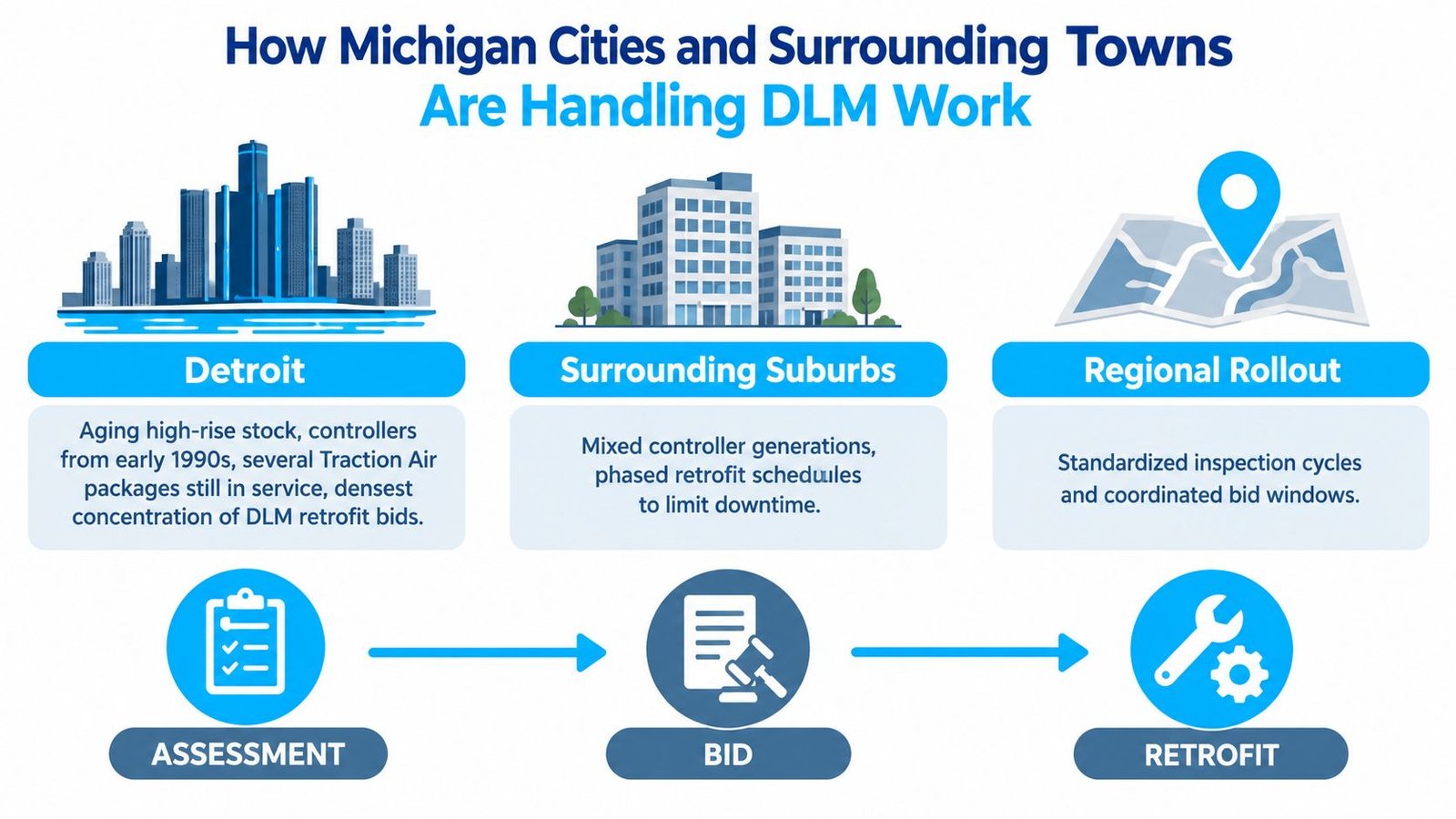
A statewide DLM program looks different in a downtown high-rise than it does in a school, hospital, distribution building, or municipal facility. Detroit, Grand Rapids, Ann Arbor, and Lansing are among Michigan's largest cities, with populations listed at approximately 645,705, 200,117, 122,925, and 114,336, respectively, in the Michigan city population dataset. Those markets also connect to surrounding communities where owners face different building ages, elevator types, inspection calendars, and authorities having jurisdiction.
Detroit's older commercial and residential inventory can produce complex retrofit scopes, particularly where legacy relay equipment, incomplete drawings, and multiple elevators share a machine room. Lansing's government, office, education, and healthcare properties may have a mixed portfolio in which one elevator needs hardware while another clears the review through existing documentation.
Ann Arbor adds a scheduling challenge. Hospitals, laboratories, and research facilities often have narrow maintenance windows and strict operational controls, so a controller or door-circuit intervention may need to occur overnight or during a planned shutdown. Grand Rapids includes medical, educational, commercial, and industrial properties that frequently coordinate elevator work with broader construction and facilities calendars.
Surrounding communities affect the schedule
Service planning shouldn't stop at the city limit. Michigan elevator service directories list broad clusters around Grand Rapids and Lansing, including Ada, Belmont, Byron Center, Caledonia, Cedar Springs, Comstock Park, Dutton, East Grand Rapids, Grandville, Kent City, Kentwood, Rockford, and Sparta, among other communities, as shown in the Michigan elevator service directory.
That regional spread matters when a facility manager is sequencing several buildings. A portfolio may include a municipal unit in Lansing, a healthcare elevator in Ann Arbor, a warehouse near Kentwood, and a mid-rise office in East Grand Rapids. Each location may require a separate review, bid, permit conversation, and inspection appointment.
Crane Elevator Company serves Detroit, Lansing, Ann Arbor, Grand Rapids, and surrounding Michigan areas with preventative maintenance, repairs, code-required inspections, safety testing, modernization, door lock monitoring upgrades, and service for passenger elevators, freight elevators, residential elevators, wheelchair lifts, material lifts, and dumbwaiters. That broad service range lets an owner evaluate DLM alongside the rest of the elevator's condition instead of treating the door circuit as an isolated purchase.
Planning a DLM Retrofit Without Long Downtime or Surprise Costs
The best retrofit plan starts with evidence, not equipment. Put every elevator into one of three working groups: documentation candidate, targeted hardware correction, or broader modernization candidate. Then compare that classification with the next inspection, planned shutdown, Category 5 test, or building renovation.
Four decisions keep the project controlled
Anchor the deadline. Use January 1, 2028 as the completion target identified for Michigan's existing in-service units, but confirm the enforcement schedule and inspection expectations for each property.
Review documentation first. Gather controller model numbers, installation and modernization records, wiring diagrams, manufacturer letters, prior inspection reports, and evidence of earlier door-circuit changes.
Define the smallest compliant scope. A newer controller may need a firmware or programming change. A legacy relay controller may require monitoring hardware, relay work, circuit correction, or a larger modernization. The field evaluation should explain why.
Coordinate verification. Schedule functional testing after installation and align the work with an existing inspection or modernization window where possible. A second shutdown is often avoidable when testing is planned before the equipment is returned to normal service.
The cost drivers vary by equipment. Older controllers may require relay replacement, added monitoring components, or troubleshooting of undocumented wiring. Newer microprocessor systems may involve compatible firmware, licensing, programming, or a controller-specific contact arrangement. Door-zone sensors and related circuit verification can also expand the work when the inspector requires proof that the system recognizes the relevant operating condition.
Budget by elevator condition, not by building count. Two units in the same building can have different controllers, different door circuits, and different compliance paths.
Phasing can reduce disruption, but it shouldn't push every correction into the final inspection window. Start with the elevators that have the weakest documentation, the most difficult parts availability, or the greatest operational importance. Complete the assessment early, reserve compatible materials, and schedule the final test before the Michigan deadline rather than waiting for a violation to force the work.
Crane Elevator Company can evaluate Michigan elevators for Door Lock Monitoring, determine whether documentation or hardware work is appropriate, and coordinate repairs, inspections, testing, and modernization across Detroit, Lansing, Ann Arbor, Grand Rapids, and surrounding communities. Visit Crane Elevator Company to request an evaluation and plan DLM work around your building's inspection calendar.