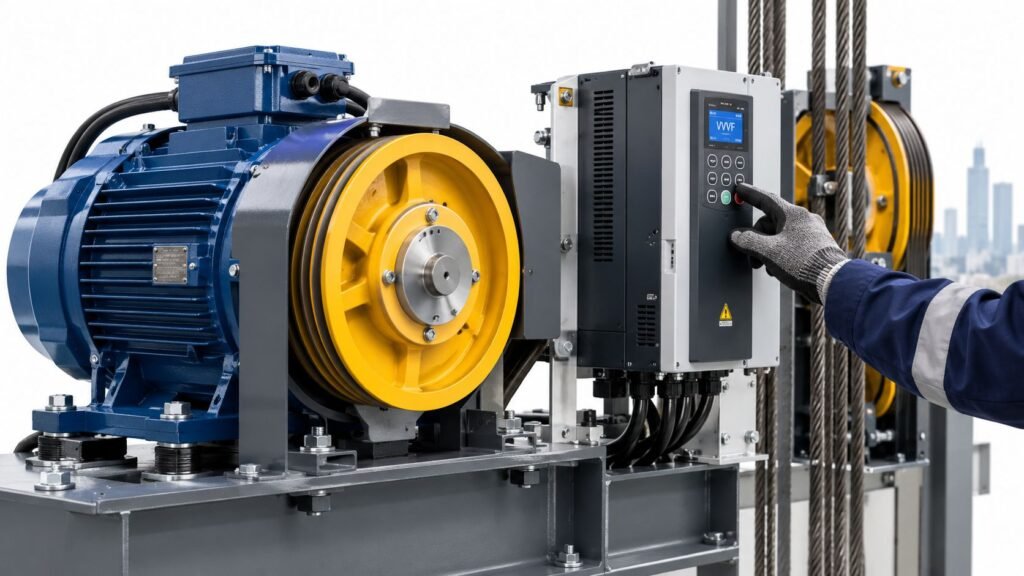
You usually don’t think about an elevator motor until the car starts sounding tired. Then it shows up in the morning rush, a little slower between floors, a little rougher on start, and a little more temperamental when the building’s hot and busy. In Michigan, that’s rarely just a nuisance. It’s often the point where elevator motor replacement becomes a budgeting, code, and uptime decision at the same time.
A property manager in Detroit, a facilities director in Lansing, or an owner in a smaller town like Howell or Niles can all end up in the same spot. The call starts as “the elevator feels off,” then turns into a technician visit, then a conversation about age, compatibility, parts, and whether the motor is still worth saving. That’s where the work starts.
When an Elevator Motor Becomes a Building Problem
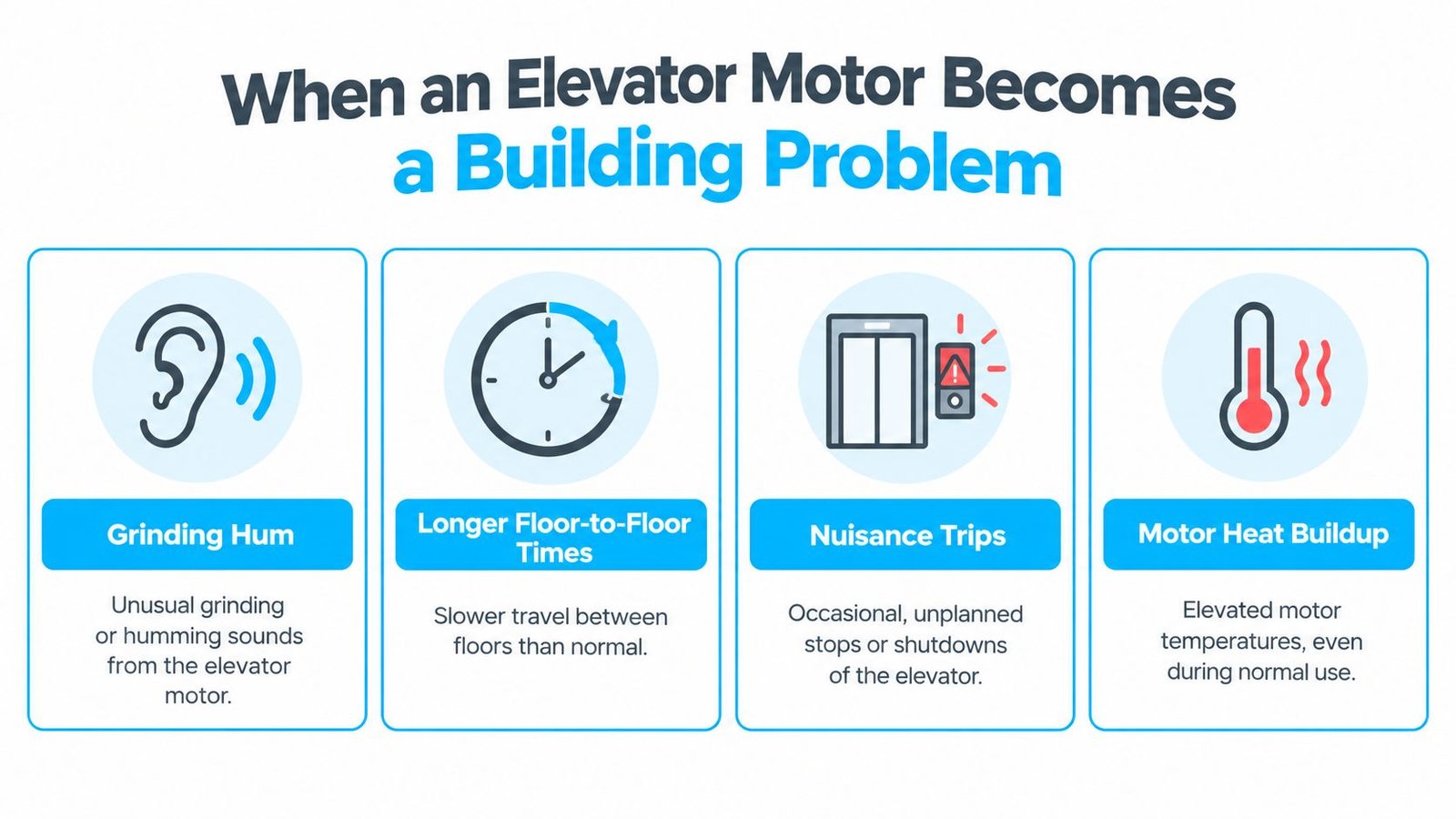
The first sign usually isn’t a dramatic failure. It’s the hum that turns into a grind, the longer trip between floors, the occasional nuisance trip when the machine room warms up, or the way the car seems to labor more under load than it used to. On hydraulic units, you might smell oil before you see anything obvious. On traction equipment, the vibration often shows up before the motor gives out completely.
The pattern that separates wear from a bigger problem
A lot of owners hope the issue is a door, a brake, or a controller nuisance because those feel easier to fix. Sometimes they are. But a motor issue tends to leave a pattern behind, and the pattern usually gets worse under load, not better.
Practical rule: if the car is increasingly inconsistent across the day, the motor is moving from “watch it” to “plan for it.”
That’s the moment I stop treating it like a routine service call and start treating it like capital planning. Older elevators cross that line for a few reasons at once, not just age. Parts get harder to source, shutdowns become more frequent, controller compatibility gets touchy, and Michigan owners still have maintenance and inspection obligations to keep up with.
OTIS notes that more than 7 million of the world’s 21 million elevators are over 20 years old, and that this is the age when building managers typically begin considering modernization, with the number needing modernization expected to more than double to 15 million in the next decade, which is why motor replacement has become a recurring life-cycle issue rather than a rare emergency OTIS benchmark. For owners, that doesn’t mean every old motor gets replaced. It means age is one factor, not the only one, and the decision comes down to whether the machine is still worth repairing, rewinding, or upgrading into a newer system.
How an Elevator Motor Actually Moves the Car
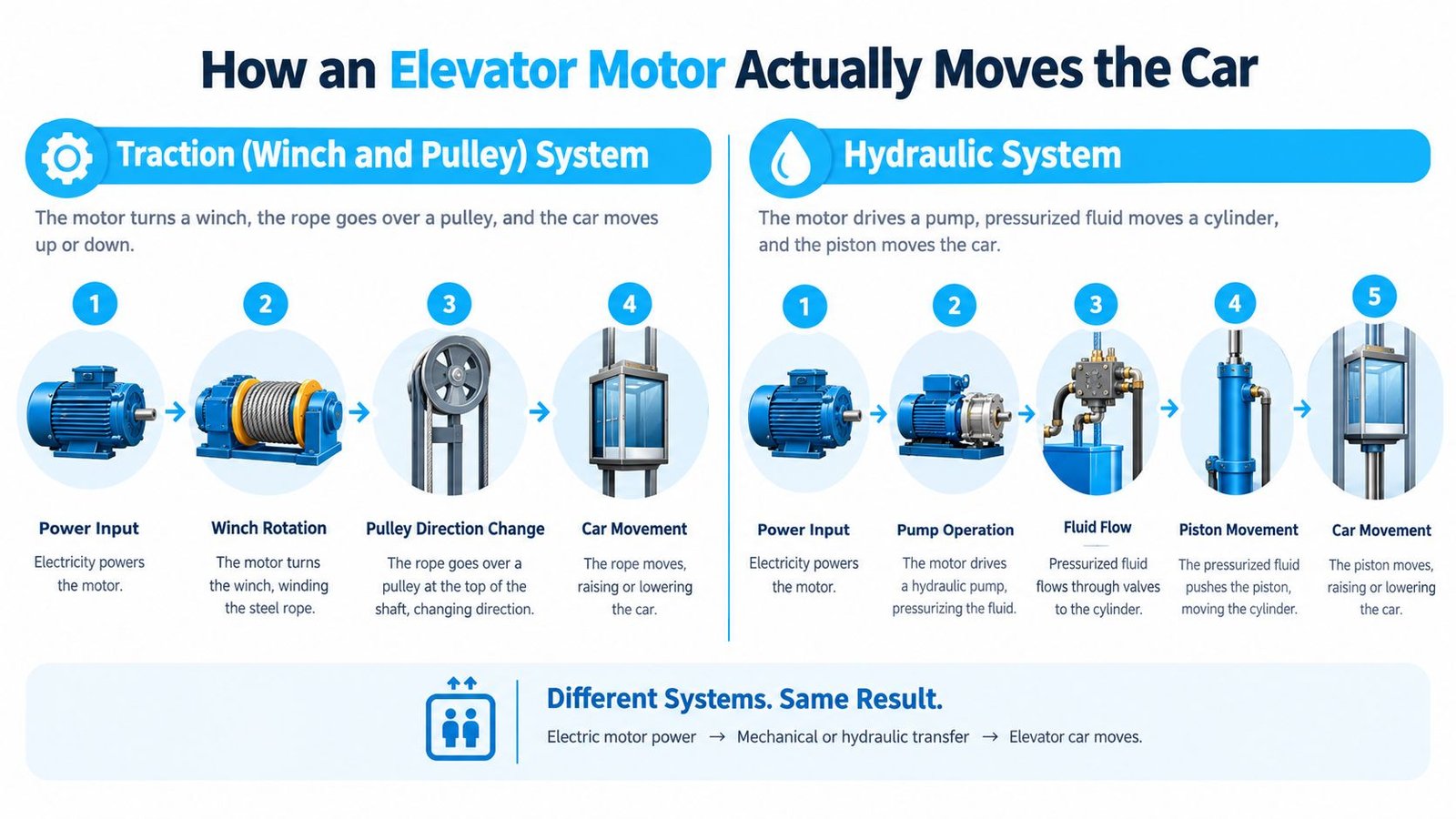
A traction elevator motor is basically the thing that turns the machine that turns the ropes. The motor spins the sheave, the ropes move, and the car travels because the counterweight is doing the other half of the work. In a hydraulic elevator, the motor runs a pump that pushes fluid and raises the car through pressure instead of rope pull.
Traction gear and hydraulic power in plain terms
Think of a traction machine like a winch with very precise control. The motor doesn’t just “run,” it has to start, slow down, stop, and hold the car exactly where the landing is supposed to be. That’s why the brake, drive, and feedback device matter as much as the motor itself.
Hydraulic systems are simpler to picture. The motor powers a pump, the pump builds pressure, and the pressure lifts the car. If the motor is weak, overheated, or mismatched, the whole lift feels sluggish or unreliable. That’s why the motor isn’t just another part, it’s the part that makes the rest of the system usable.
A replacement motor that doesn’t match the machine’s speed and control needs is just an expensive way to create a new problem.
The controller is the brain that tells the motor how fast to turn, when to stop, and how to behave during acceleration and leveling. That’s why motor work and controller work are so often tied together. For more on how those control systems fit into the rest of the installation, see elevator controls and modernization interfaces.
DC, AC, and Permanent Magnet Motors Compared
In Michigan buildings, you’ll still run into three broad motor families. Older DC motors show up in legacy traction systems, especially where brushes, armatures, and older controllers are part of the original design. AC induction motors are the workhorse replacement option in many retrofit jobs. Permanent magnet synchronous motors are common in newer, tighter, higher-efficiency traction packages.
The best choice depends on the machine, the drive, and the building’s service expectations. A 1960s DC setup with a relay-based controller is a very different candidate than a newer traction machine that was built for VVVF control from the start.
| Motor Type | Common Application | Maintenance | Efficiency | Ride Quality |
|---|---|---|---|---|
| DC motor | Older traction elevators and legacy modernization work | Higher, because of brushes and aging components | Lower than modern options | Can be acceptable when well maintained, but varies with controller condition |
| AC induction | Retrofit traction and hydraulic modernization | Lower than older DC systems | Better than many legacy systems | Strong when paired with the right drive |
| Permanent magnet | Modern traction and machine-room-less systems | Lower routine burden | High | Smooth and precise when installed and tuned correctly |
Why the industry keeps moving away from legacy DC
Old DC systems can still be repaired, but they’re often a maintenance story, not a long-term efficiency story. Replacement parts may be available, but the system around the motor is usually the problem. If the drive, feedback, and controller are all aging together, the job stops being about one motor.
Modern retrofit packages commonly pair a new AC motor with a custom coupling and an integrated velocity encoder so the drive can regulate speed and braking more precisely than older fixed-speed or DC systems, and that’s what usually improves how the elevator feels in the cab TKE retrofit guidance. For many owners, that’s the practical reason to replace instead of rewind. The new motor isn’t just newer, it works with a modern control system that can utilize it well.
Repair, Rewind, or Full Motor Replacement
The right answer usually comes down to condition, downtime, parts access, and long-term cost, not just age. If a bearing is noisy, a lead connection is loose, or a brush issue is isolated, a repair can make sense. If the windings are tired or insulation has broken down, rewinding may buy time. If the motor is part of a wider control or compatibility problem, replacement is the cleaner move.
Four questions that decide the job
A field mechanic usually looks at four things before recommending anything:
- Motor condition: Insulation, bearing noise, rotor or brush damage, and the condition of the shaft all matter.
- Downtime tolerance: A school, hospital, or high-traffic office building may not have the same outage window as a low-use residential property.
- Parts availability: If parts are still on the shelf, repair stays on the table longer.
- Five- to ten-year cost: The cheapest fix today isn’t always the cheapest machine over the next several years.
Rule of thumb: if the motor is healthy enough to repair but the rest of the system is obsolete, the motor isn’t the whole problem anymore.
Rewinding can absolutely return a motor to service, especially on older DC and AC equipment. What it usually doesn’t do is improve efficiency, reduce controller complexity, or solve compatibility problems with newer drive equipment. Full replacement starts to win when the machine is repeatedly down, the core iron is damaged, or the modernization plan already includes a drive and controller change around it.
| Factor | Spot Repair | Shop Rewind | Full Replacement |
|---|---|---|---|
| Motor condition | Best for isolated issues | Works when windings are the issue | Best when the machine is broadly worn or obsolete |
| Downtime | Shortest | Moderate | Often longer, but more complete |
| Parts availability | Needs the right parts now | Needs winding and rebuild capability | Needs a matched new machine and drive setup |
| Long-term outcome | May be temporary | Restores function, not usually efficiency | Gives the cleanest path for modernization |
If you need an actual field review of a motor issue in Michigan, elevator motor repair guidance is a reasonable place to start looking at the repair path before you commit to a full swap.
What a Real Motor Replacement Project Looks Like
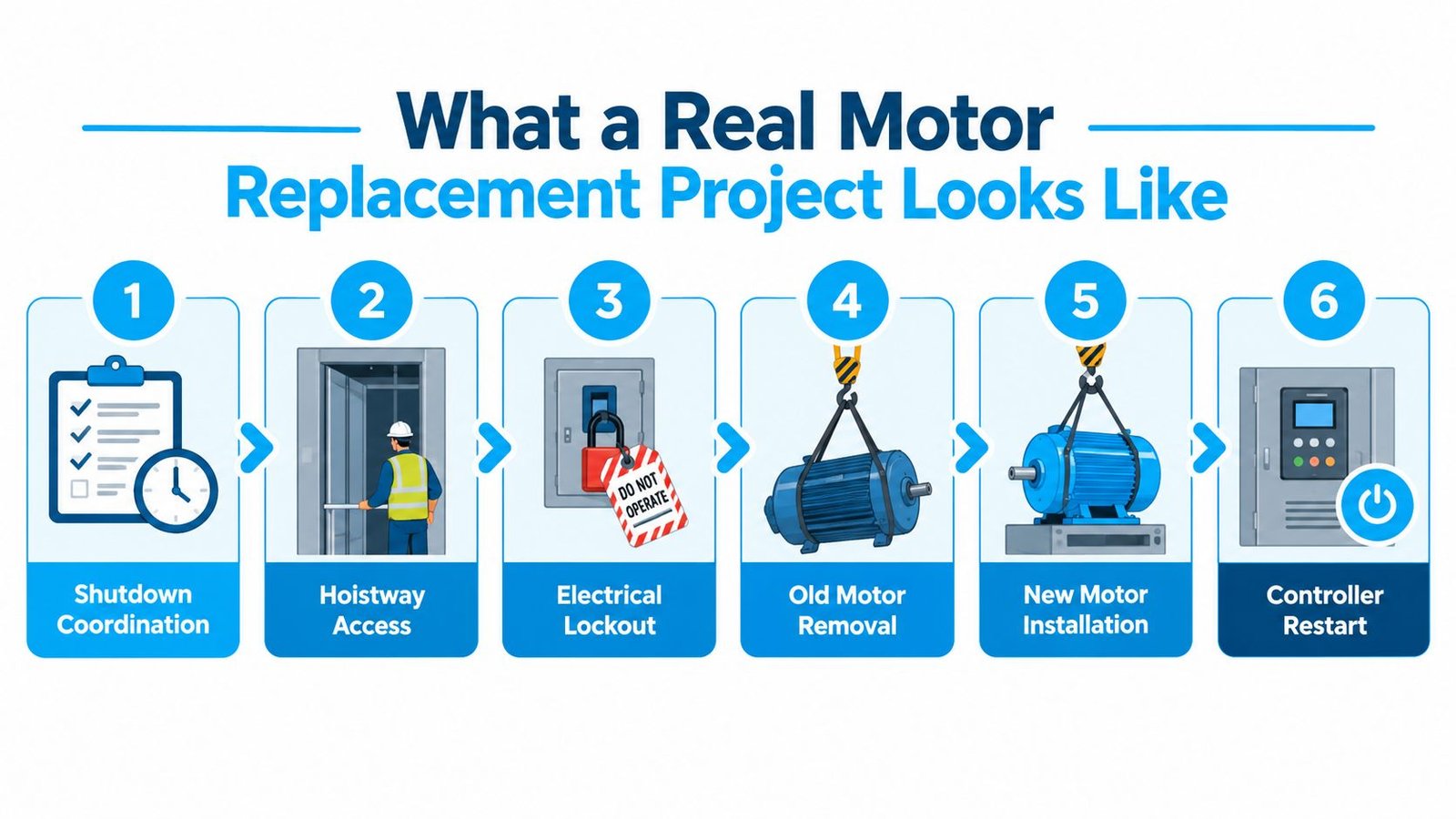
A real traction motor replacement starts before anyone touches a wrench. The crew coordinates shutdown, locks out power at the line disconnect, checks hoistway access, and makes sure the machine room is ready for rigging. If the elevator is still running part of the building, that planning matters more than the motor itself.
The sequence that keeps the job controlled
The old motor usually comes out after the crew breaks the bedplate or sheave connection and stages the replacement on the machine room floor. A chain hoist or similar rigging setup lifts the old machine out and brings the new one in. Then comes alignment, which is where a lot of sloppy work gets exposed. If the sheave-to-rope relationship is wrong, the car may still move, but it won’t move well.
Encoder mounting and drive commissioning come next. The drive has to be told how the motor behaves, how the speed matches the contract speed, and how the braking and stopping profile should work. If the replacement package includes a different machine or control strategy, that commissioning step is where the project either becomes clean or becomes noisy.
Typical like-for-like traction swaps often take one to three working days, while changes to the bedplate, drive, or rope set can push that longer. That’s one reason owners should ask about the complete scope, not just the motor line item.
A proper closeout should include acceptance testing, a punch list, and the paperwork the building manager needs for records. In Michigan, that paperwork matters because maintenance and replacement records aren’t optional housekeeping, they’re part of the compliance trail.
Modernization, Code, and Energy Tradeoffs
Motor replacement by itself is sometimes the right move, but it often leaves money on the table if the controller is old or the drive is mismatched. The best results usually come when a new AC or permanent magnet motor is paired with a modern solid-state controller and a VVVF drive. That combination is what gives the motor its real control, ride quality, and efficiency.
Why isolation can be the expensive way to save money
A standalone motor swap can get an elevator back in service fast. It doesn’t always get the building into a better place for the next five or ten years. If the controller still can’t talk cleanly to the machine, or if the braking and feedback logic are dated, you’ve bought relief without solving the system problem.
One industry modernization article says a standard geared AC motor operating under fixed test conditions uses about 13,000 kWh annually, while a fully refurbished and modernized DC motor under the same conditions uses about 6,000 kWh, a reduction of more than 50%, and it also notes that modernizing to a more efficient motor and control setup can yield about 40% energy savings in some cases FacilitiesNet modernization article. That same source also reports 25% savings over DC silicon-controlled-rectifier drives, 45% over motor-generator sets, and 42% versus non-regenerative AC drives. Those are exactly the kind of numbers that make owners take modernization seriously instead of treating the motor as a one-off repair.
If the building is already planning controller work, a motor-only quote deserves a second look.
Michigan owners also need to think about code timing and lifecycle timing together, because the project isn’t just mechanical anymore. Maintenance contracts, emergency communications, fire service upgrades, and brake requirements all get pulled into the same conversation when the equipment is old enough to need deeper work. A motor swap can be a useful first step, but it often resets the question of what else is nearing the end of its useful life.
Michigan Service Coverage and What Owners Should Expect
A motor replacement can look straightforward until the contractor opens an older proprietary system. The replacement may fit the machine mechanically, yet still require firmware access, encoder calibration, and drive parameters that the original manufacturer does not openly provide. Compatibility therefore involves the motor, drive, controller, feedback system, and commissioning process.
An independent contractor should be able to source motors and drives through OEM channels or reputable aftermarket suppliers, then document the setup used for the installation. Stocking common AC induction and permanent magnet machines helps reduce delays, but parts availability does not replace technical judgment. The contractor also needs to identify when a motor project has become a controller or modernization project, rather than selling a motor-only fix that leaves the larger fault unresolved.
Crane Elevator serves Detroit, Lansing, Ann Arbor, Grand Rapids, and surrounding Michigan communities, including smaller towns where equipment may be older and the service window tighter. Owners can review the company’s Michigan elevator service coverage before requesting a site visit. A contractor covering this range needs a practical plan for travel, parts, callbacks, and the testing required before equipment returns to service.
Michigan’s rules make inspection and maintenance part of that service decision. Most passenger and freight elevators must be inspected at least once every 12 months. Power elevators must be maintained at least once every 90 days by a licensed elevator journeyperson, and written records covering maintenance, repairs, replacements, inspections, callbacks, and testing must remain on site Michigan Elevator Code rule. The Michigan Elevator Section enforces the code through inspections, annual safety work, and accident investigations. Detroit’s elevator ordinance addresses elevators, escalators, dumbwaiters, moving walks, platform lifts, and stairway chairlifts across their service life.
For owners in Battle Creek, Alpena, Monroe, or Big Rapids, ask whether the contractor can document the work, verify controller compatibility, and complete fire service and Phase II recall testing. Confirm warranty terms for a rewound motor versus a new one before signing the scope. Those answers separate a temporary patch from a replacement plan that fits the building’s equipment and code obligations.
Crane Elevator Company handles motor repair, replacement, inspections, modernization, and related code work for Michigan buildings. Visit Crane Elevator Company to request an assessment of the machine, drive, and controller before a recurring callback becomes a larger shutdown.