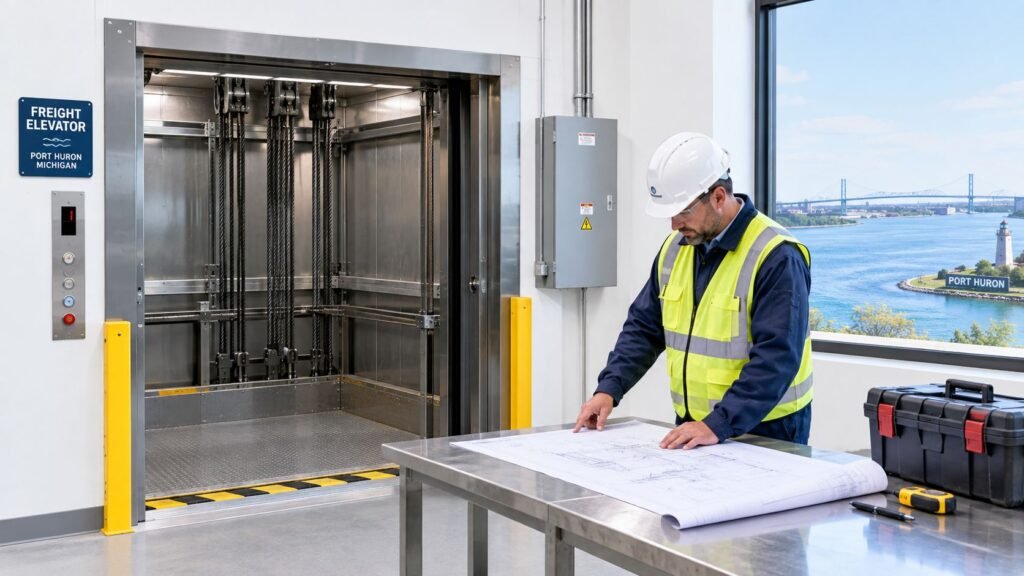
A facility manager in Port Huron rarely starts thinking about elevator strategy on a quiet day. More often, the issue arrives as a repair quote, a failed inspection item, a freight car that won’t serve the next shift, or a tenant asking why the passenger elevator is still out of service. The pressure is immediate, but the expensive decision usually began years earlier with incomplete service records, obsolete controls, or a contract that left the owner without useful documentation.
Port Huron has long depended on vertical and bulk-transport infrastructure. Grain elevators were documented in the city as early as circa 1877, and the rebuilt Botsford Elevator reportedly held 125,000 bushels, a scale that reflects the area’s longstanding connection to industrial and maritime trade. Port Huron railroad and grain-elevator history offers useful context, but today’s owners need a more practical question: should they repair, modernize, replace, or renegotiate the way the elevator is serviced?
Why Port Huron Elevator Service Decisions Start Before the Phone Call
Start with the equipment history, not the contractor directory. Before requesting Port Huron elevator service, pull the last three years of service reports, callback notes, inspection certificates, violation notices, and parts invoices. Those records show whether the current problem is isolated or whether the same door operator, controller, leveling system, or hydraulic component keeps returning to the invoice.
Build the decision file
Use a short pre-call checklist:
- Identify the controller. Record the manufacturer, model, generation, and whether the controls are relay-based, microprocessor-based, or otherwise obsolete. A contractor can’t give a credible modernization opinion without knowing what controls the elevator uses.
- Review repair concentration. Separate recurring repairs from routine maintenance. A single failed switch isn’t the same decision as repeated door faults, unavailable boards, and rising emergency callbacks.
- Confirm inspection status. Find the latest Michigan inspection date and every open correction. An elevator that operates today may still be unable to pass its next inspection.
- Check parts access. Ask whether replacement boards, drives, door components, and diagnostic tools are available from more than one source. If the answer depends on a vendor password or a single supply channel, that limitation belongs in the project decision.
- Define the business impact. A freight elevator serving a warehouse, a passenger unit serving a clinic, and a lift serving a private residence don’t carry the same downtime cost.
A practical modernization rule is to begin a full review when annual repair spending reaches roughly 30% to 40% of modernization cost, rather than waiting for repairs to consume half the project value. The controller-first modernization guidance also identifies obsolete relay-logic controllers as a major source of service callbacks. Use that rule as a trigger for investigation, not as an automatic order to replace the entire elevator.
Practical rule: The owner who controls the service history controls the first conversation. Don’t let the first contractor who answers the phone define the scope.
The Blue Water Bridge provides a local reminder that elevator operation in a transportation corridor requires formal service discipline. A Michigan contract covering two Dover hydraulic passenger elevators specified monthly inspections, 12 times per year, with each unit billed at $420 per quarter and a total five-year value of $37,980. The state contract record isn’t a quote for your building, but it demonstrates why inspection frequency, documentation, and service responsibility should be written clearly.
Matching the Right Elevator Type to Your Port Huron Building
The correct elevator is determined by the work it performs, not by the lowest equipment price. A Port Huron warehouse moving pallets needs a different car, door arrangement, loading strategy, and control sequence from a downtown office, medical building, school, or residential property.
Match the device to the load
A freight installation should be specified around the actual material-handling pattern. Tell the designer whether users will move pallet jacks, carts, machinery, drums, or long material. Cab depth, clear door width, door operation, sill design, travel, pit conditions, and overhead clearance all affect the building work around the elevator.
A passenger elevator serving offices or medical tenants should be evaluated around traffic flow, accessibility, ride quality, door timing, emergency communication, and finish durability. A unit near McMorran Place may need a very different interior and operating schedule from one serving a quiet suburban office.
A wheelchair lift or platform lift can solve a carefully defined accessibility problem, but it isn’t a substitute for a passenger or freight elevator. Its permitted application, platform size, travel, and operating conditions must match the building’s use. A dumbwaiter handles goods, not people. A material lift may fit a controlled service route but may not satisfy the expectations of a public passenger installation.
| Device Class | Capacity Range | Typical Use | Code Reference |
|---|---|---|---|
| Passenger elevator | Specify from occupancy and traffic study | Offices, clinics, apartments, public buildings | Applicable Michigan elevator rules and adopted safety standards |
| Freight elevator | Specify from pallet, cart, and equipment loads | Warehouses, industrial tenants, service areas | Applicable freight-elevator requirements and approved design |
| Heavy-duty industrial freight | Specify from production loads and duty cycle | Manufacturing, fabrication, and riverfront industrial facilities | Project-specific code review and equipment classification |
| Wheelchair or platform lift | Limited by platform, travel, and application | Accessibility between limited levels | ASME A18.1 application requirements |
| Dumbwaiter or material lift | Limited to the intended goods-handling use | Food service, records, supplies, and light materials | Device-specific Michigan requirements |
The building cost often follows the elevator dimensions. A deeper cab may require a deeper pit. A different door arrangement may affect shaft width, landing structure, machine-room planning, and fire separation. Get those dimensions right before requesting a fixed quote.
For a warehouse on Twenty-Fourth Avenue, describe the heaviest palletized load and the turning radius of the handling equipment. For a manufacturing site along the Black River, document production loads and duty cycles. For a downtown office or healthcare building, document peak passenger demand and accessibility requirements. A good survey converts those facts into a device specification instead of forcing an existing building to accept an ill-fitting package.
Michigan Codes, Inspections, and the Compliance Calendar
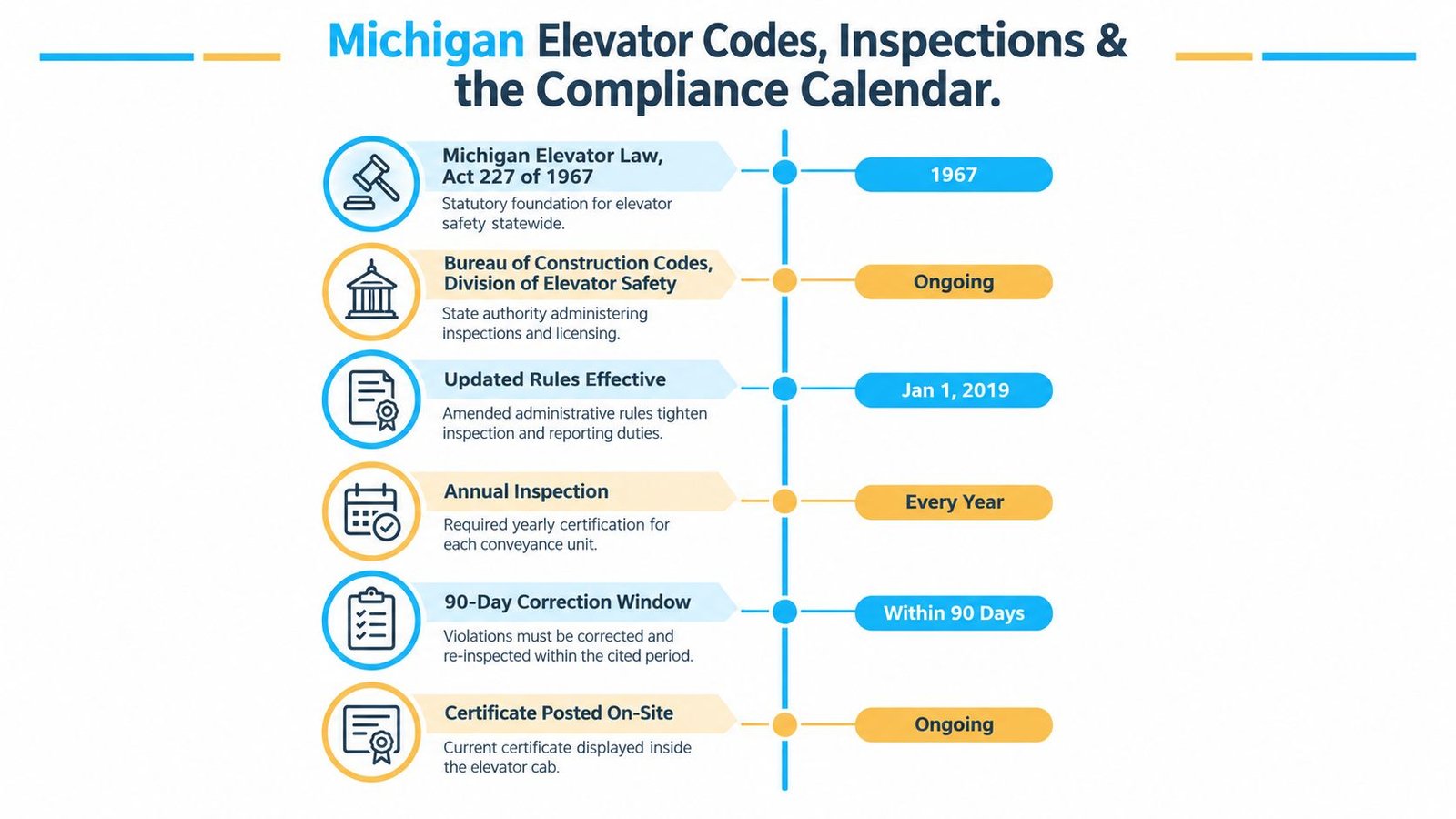
A Port Huron facility manager can have a clean-looking elevator and still face a compliance problem if the inspection date, test record, or correction file is missing. Michigan compliance depends on the device, its use, and the work being performed. Maintenance, inspections, testing, permits, accident reporting, and violation correction each require their own record. The Michigan Elevator Section administers inspections of installations and alterations, annual safety inspections, permits, and investigations of accidents and violations.
Build the calendar by conveyance, not by property. Most passenger, freight, limited-use, and special-purpose elevators require inspection at least every 12 months. Dumbwaiters, stairway chairlifts, and platform lifts can follow a 24-month cycle. Temporary construction hoists have tighter requirements, including 90-day inspections and 30-day maintenance obligations. Check Michigan’s current elevator-code document against the specific device and rule before scheduling work.
Build records around the device
For every conveyance, assign a responsible person and track:
- Inspection due date: A building with a passenger elevator, freight elevator, and platform lift may have separate renewal dates.
- Test schedule: Record safety tests, fire-service functions, emergency communication checks, and other periodic testing that applies.
- Correction status: Keep photographs, technician notes, invoices, violation notices, and reinspection information together.
- Certificate control: Confirm that required documentation is posted or retained, and tell management staff where the records are stored.
Paperwork failures can create the same operational trouble as mechanical failures. One audit recorded 8,807 missed annual elevator inspections in a single year, equal to 13% of required inspections, while another sampled review found only 33.9% of buildings due for annual inspection had been inspected, according to the field-service scheduling review. That review also identifies documentation gaps, door interlocks, pit debris or water, fire-service functions, and safety devices as recurring failure points.
Compliance is an operating process, not a sticker on the wall. Assign an owner, a due date, and a closeout record for every inspection item.
Before altering an older unit, have the contractor confirm the current code obligations. A repair, controller replacement, or modernization may trigger requirements that did not apply to the original installation. Put permit responsibility, testing scope, inspection planning, and violation closeout into the proposal. Use Crane Elevator’s elevator code requirements as a discussion prompt, then confirm the rules for the specific device and jurisdiction.
Non-Proprietary Service Contracts vs Locked-In Providers
A non-proprietary elevator is not an elevator with a different logo on the controller. In practical terms, the owner should receive equipment that qualified technicians can diagnose with accessible documentation, available parts, and defined software or firmware rights. Ask whether the controller is open to service by a licensed Michigan elevator contractor, whether schematics are included, and whether diagnostic access remains available after handover.
A locked-in arrangement can appear convenient because one provider supplies the controller, door operator, monitoring, repairs, and parts. The trade-off is reduced negotiating power. If the owner can’t obtain diagnostic information, source compatible parts, or transfer service without a penalty, the contract may be inexpensive only at the beginning.
| Decision Area | Non-Proprietary Approach | Proprietary Approach |
|---|---|---|
| Parts access | Multiple qualified supply options may remain available | The original equipment channel may control supply |
| Diagnostics | Owner receives defined access and documentation | Access may depend on vendor credentials or licensing |
| Service transfer | Another qualified provider can evaluate the equipment | Transfer may require approval, fees, or retraining |
| Contract leverage | Owner can compare maintenance and repair proposals | The original provider retains more control after installation |
| Long-term planning | Modernization scopes can be phased around available components | Equipment may need replacement within one supplier ecosystem |
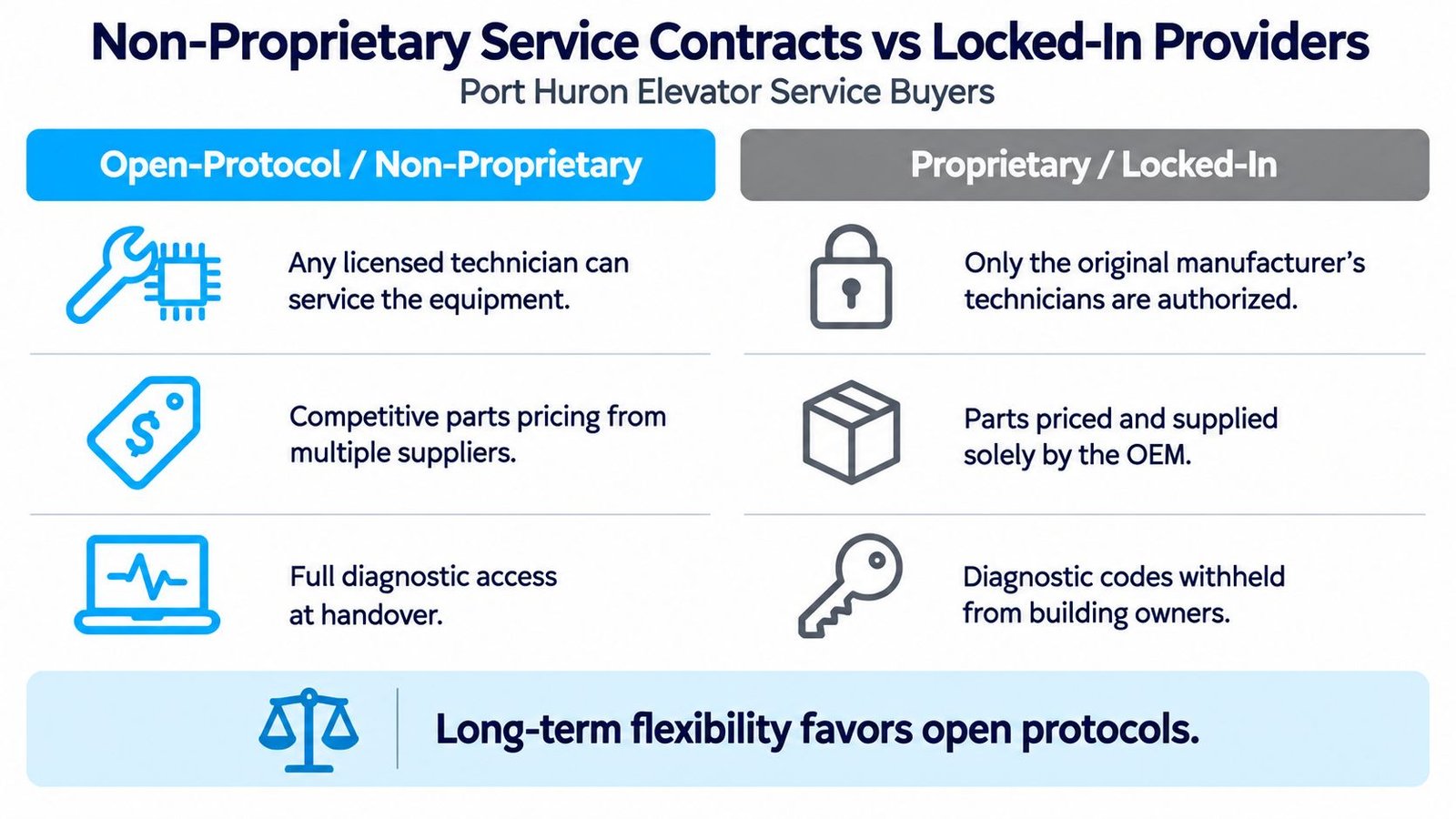
Read the contract clauses that govern schematics, software, firmware, remote monitoring, passwords, parts markups, callback rates, and termination. Those clauses matter more than a vague promise of responsive service. A warehouse on Griswold Street, a clinic near McMorran Place, and a mixed-use property in St. Clair County may all need different response terms, but none should surrender basic ownership information.
The non-proprietary elevator service guidance is useful when comparing what the contractor will hand over. Require the answer in writing. “We can service it” isn’t enough unless the proposal explains how, with what tools, and under whose control.
Modernization Timing and the Controller-First Approach
A failed door operator can tempt an owner into replacing one visible component at a time. That approach often leaves an obsolete controller coordinating old logic, safety inputs, door equipment, drives, and fixtures. Start with the control platform. It governs starting, stopping, leveling, fault reporting, and compatibility with newer equipment.
Set the controller scope before choosing finishes
Review the original drawings, machine-room clearances, pit, overhead, machine, motor, door equipment, safeties, fixtures, and wiring. Confirm that the proposed equipment fits the existing geometry. Check whether the work will require permits, testing, or inspection changes before the shutdown begins.
Use this order when building the scope:
- Controller and drive: Replace obsolete logic and establish the new operating sequence.
- Door operator and safety interfaces: Correct recurring door faults after the control platform is defined.
- Fixtures and communication: Replace landing stations, car operating panels, emergency phones, and related interfaces where condition or code requires it.
- Mechanical assemblies: Keep sound equipment, while planning motor, machine, sheave, hydraulic, jack, or cable work where condition and compatibility demand it.
- Cab interior: Handle finishes separately unless damage or accessibility requirements justify earlier work.
Specify non-proprietary parts and service access in the proposal. Ask which components another qualified contractor can source, test, and maintain. A controller upgrade that leaves the owner dependent on restricted software, passwords, or unavailable parts has only moved the problem.
The controller-panel modernization resource helps frame the controller as the project’s scheduling priority instead of treating every component as equally urgent. A full project may require a 12 to 18 week shutdown window when the scope and schedule call for it. Treat that as a planning figure, not a promise for every elevator.
Don’t approve a full replacement because one part failed. Don’t approve a patch because the controller has become the recurring failure point.
Build a device-specific compliance calendar before removing the existing controls. Coordinate permit submissions, equipment release, shutdown planning, contractor labor, testing, and final inspection. For a St. Clair County facility, reopening requires more than installation completion. The elevator must be safe, documented, tested, and accepted for service.
From Quote to Handover in Port Huron and Across Michigan
A light-industrial building near the Black River needs a freight elevator for palletized goods. The owner knows the intended equipment, travel, stops, and loading pattern. That information starts the project, but it does not justify a phone estimate. Require a site survey before anyone sets a price or promises a schedule.
The first visit should verify the shaft, pit, overhead, machine-room condition, electrical service, rigging access, landing conditions, and actual load requirements. The contractor should record existing equipment and assign each task to the correct scope: demolition, structural preparation, electrical service, controls, installation, testing, permits, or inspection. Gaps at this stage become change orders and shutdown delays later.
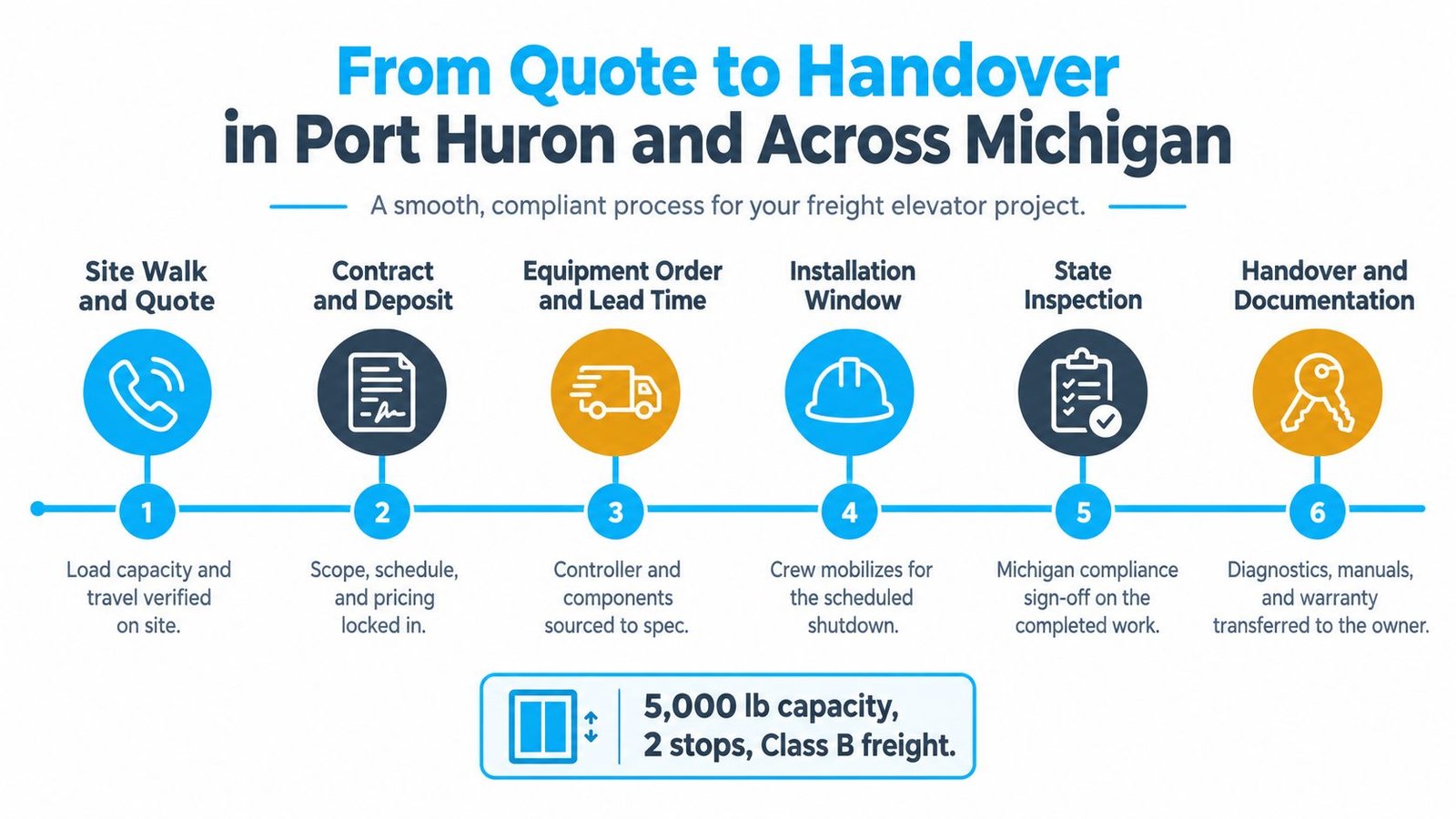
Your proposal should answer these questions in plain language. Demolition and disposal: What comes out, and who disposes of it? Rigging and delivery: How will equipment enter the building, and what access must the owner provide? Electrical work: Are disconnects, feeders, grounding, lighting, and machine-room work included? Permits and inspections: Who submits plans, schedules testing, and pays state or local fees? Installation and startup: What does the shutdown schedule cover? Documentation and warranty: When does coverage begin, and which records arrive at handover?
Financing may involve contractor financing, manufacturer programs, or capital-lease structures, subject to credit approval and project terms. Request the total obligation, exclusions, early-payoff terms, and the party responsible for costs if inspection delays extend the shutdown.
Identify the authority having jurisdiction early, especially for specialized buildings. A fire-service access elevator in a larger building may require additional plan review. Schedule acceptance testing with the Michigan elevator inspector before the installation crew leaves.
The car moving does not complete handover. Require as-built drawings, controller schematics, maintenance manuals, test records, diagnostic information, warranty start dates, and an installed-component list. Those records support the next repair decision and keep the owner able to compare qualified service providers.
Smart Questions to Ask Before You Sign
A maintenance or modernization contract should function as an operating agreement for the building. Before signing, ask who owns the controller documentation, whether firmware and diagnostic access transfer to the owner, and whether the contractor will provide complete as-built drawings after acceptance. If the answer depends on a manufacturer’s permission, the building may face avoidable service restrictions later.
Price the work beyond the first service call. Get mechanic-hour rates, emergency response terms, travel charges, parts markups, testing fees, and correction responsibilities in writing. Ask whether the same field team handles route repairs and emergency calls. Familiar technicians can save time because they already know the equipment history, prior repairs, and recurring faults.
| Question Topic | What to Ask | Acceptable Answer | Red Flag |
|---|---|---|---|
| Controller access | Will the owner receive schematics, passwords, and diagnostic rights? | Rights and deliverables are listed in the contract | “The manufacturer keeps that information” |
| Parts sourcing | Can the contractor disclose the source and markup for major parts? | Pricing and sourcing rules are documented | No explanation until an emergency occurs |
| Inspection work | Who schedules inspections and handles corrections? | One named party owns the calendar and closeout | Owner must coordinate every step without support |
| Callback service | What response applies to routine and emergency calls? | Separate response terms with clear exclusions | “As soon as possible” with no operating definition |
| Warranty and maintenance | How do warranty repairs interact with the maintenance agreement? | Responsibility and exclusions are stated | Warranty work can be denied because of routine service |
| Termination | Can the owner terminate for non-performance? | Cure periods and termination rights are clear | Long lock-in with no performance remedy |
Short answers to common Port Huron questions
When should the owner trigger a controller-first review? Start when recurring repairs point to obsolete controls, unavailable parts, or repeated callbacks. Compare repair spending with modernization cost, then ask for a controller-first scope that preserves usable equipment and specifies non-proprietary replacement parts where they fit.
Can an owner finance modernization? Ask about contractor financing, manufacturer financing, and capital-lease structures. Compare the total repayment obligation with the cost of keeping a failing elevator in service. The proposal should state exclusions, early-payoff terms, credit requirements, and who carries costs if inspection delays extend the shutdown.
What does ASME A17.3 mean for an older elevator? Existing equipment may be evaluated under the code and rules adopted for existing installations. Require the contractor to identify the provisions that apply to the equipment, planned alteration, and jurisdiction. A general code reference does not establish that the proposed work is approved.
What does conveyance status mean? Temporary construction hoists can have different inspection and maintenance requirements from permanent passenger and freight elevators. Confirm the device category before entering dates in the compliance calendar. The calendar should name the responsible party, required test, due date, correction deadline, and records needed for closeout.
Crane Elevator Company is a family-owned and operated provider offering preventive maintenance, state testing and inspections, repairs, and modernization for vertical transportation equipment. It serves Detroit, Lansing, Ann Arbor, Grand Rapids, Toledo, Perrysburg, Flint, Kalamazoo, Port Huron, and surrounding Michigan and Ohio communities. Its service scope includes passenger and freight elevators, residential elevators, wheelchair and material lifts, and dumbwaiters. Visit Crane Elevator Company to request a Port Huron evaluation, compare a repair decision with a controller-first modernization scope, and discuss a service plan built around documentation, compliance, and non-proprietary equipment.
Crane Elevator Company can review service history, inspect the equipment, perform required testing, and quote repairs or non-proprietary modernization for all makes and models. A second opinion should produce a written equipment condition, parts strategy, compliance calendar, and handover list, not just another repair price. Contact Crane Elevator Company to start a Port Huron elevator service conversation.