
A tenant reports that the elevator door opened, but the car wasn't level with the floor. Another elevator may stop running every few days because a controller shows a door fault. In both situations, the visible symptom can look similar, yet the underlying risk may be very different. A door that appears closed isn't necessarily a door that's mechanically locked.
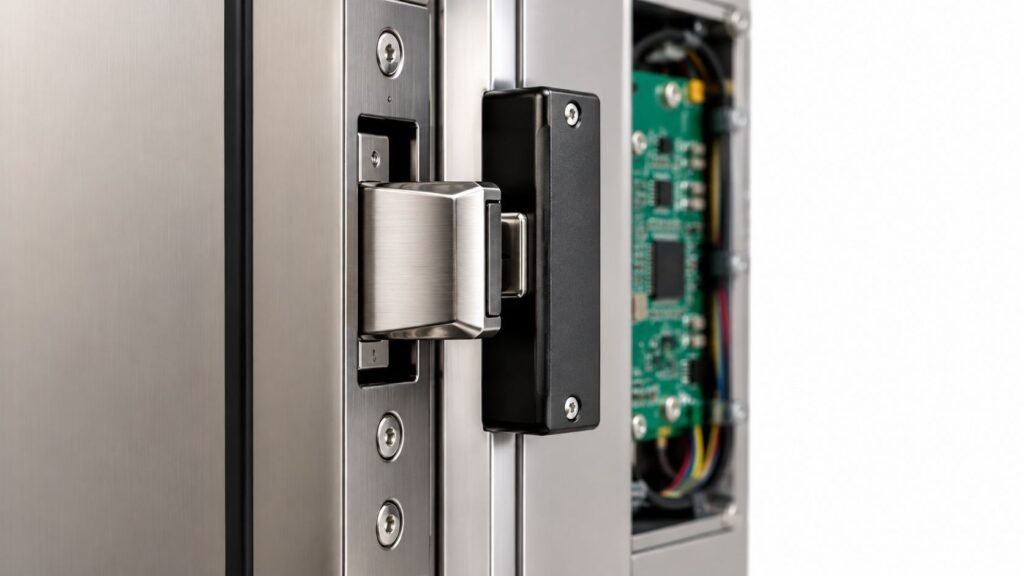
An elevator door lock, also called a hoistway interlock, is a life-safety device. It has to coordinate physical door retention with electrical permission for the elevator to move. That distinction matters in every building, especially older passenger and freight elevators where worn hardware, replacement controls, and repeated resets can hide a loss of safety margin.
Why Elevator Door Locks Are a Life-Safety Issue
A worker steps toward a landing entrance expecting the car to be there. The door opens, but the car has moved away from the floor. If the interlock has failed, been misadjusted, or been bypassed, the person may see an apparently normal entrance where an open hoistway does exist.
That is why an elevator door lock isn't merely a nuisance switch. It is intended to prevent a landing door from opening unless the car is present and to prevent car movement when a landing door is open. The mechanical lock secures the landing door, while the electrical circuit prevents the driving machine from operating until the required conditions are satisfied.
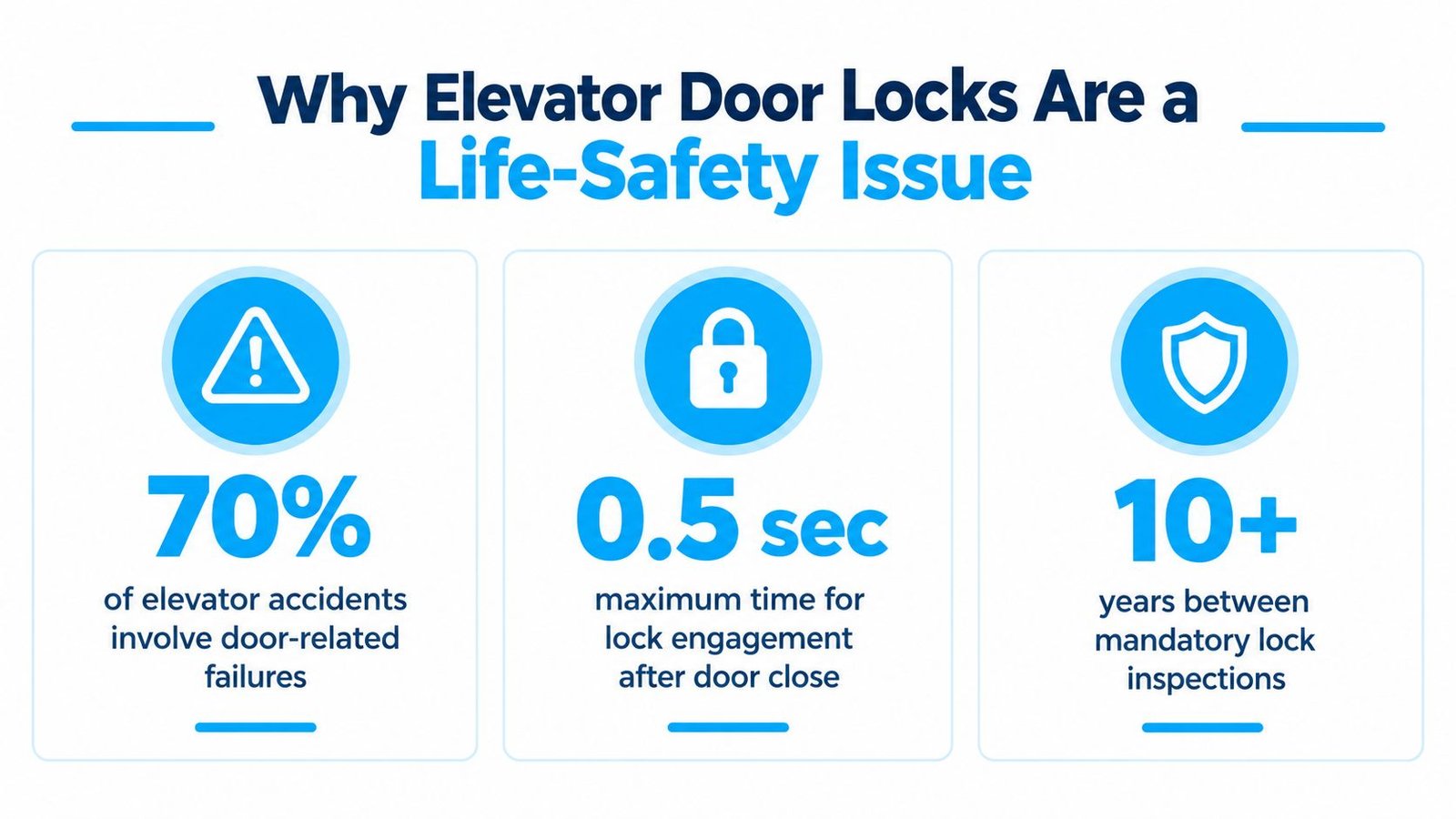
Historical injury data shows the consequences when those protections fail. A CPWR analysis of Bureau of Labor Statistics data identified 263 elevator-related worker deaths in or near elevator shafts from 1992 through 2009, averaging approximately 15 deaths per year. Among working passengers, the analysis identified 89 elevator-related deaths during the same period, averaging about 5 per year. Three-fifths of those passenger deaths involved falls, and 30 fatalities occurred when an elevator door opened even though the car had left the floor, with the hoistway interlock or door closer failing mechanically or electrically. The same analysis found that 56% of worker deaths in or near elevator shafts resulted from falls.
Those figures don't mean every incident was caused by a defective lock. They demonstrate how severe the consequences can be when access-control functions fail, are defeated, or aren't properly maintained.
What owners should take from the risk
A recurring door fault deserves a safety investigation, not an automatic reset. Qualified elevator personnel should inspect, test, adjust, and document the components that establish both mechanical engagement and electrical continuity.
Practical warning signs include:
- Unexpected door opening: Remove the elevator from service and call qualified personnel immediately.
- Repeated door-lock faults: Treat recurring shutdowns as evidence of a possible underlying mechanical or electrical problem.
- Unexplained resets: A reset may restore operation temporarily without correcting worn, contaminated, or misaligned hardware.
- Evidence of bypassing: Jumpers or defeated interlocks can eliminate the very protection the system is designed to provide.
Practical rule: If the door behaves unsafely, don't keep cycling the elevator to see whether the problem clears. Secure the equipment and arrange a qualified diagnosis.
For a building owner, door-lock maintenance protects more than uptime. It protects tenants, visitors, workers, and the building's ability to satisfy inspection and safety obligations.
The History of Elevator Door Lock Regulation
The first national elevator safety codes were much smaller than the standards technicians work with today. The American Society of Mechanical Engineers' history of the elevator code records that ASME issued the first A17 Safety Code for Elevators in 1921. That document was only 25 pages, yet it already included provisions for switches, door-locking mechanisms, and speed control.
The importance of that milestone wasn't the size of the document. It was the move toward consistent safety requirements for an industry that had previously operated with comparatively limited uniform regulation. Door locking became part of a larger system involving control circuits, mechanical construction, inspection, and operating safety.
The modern framework is substantially more developed. ASME A17.1/CSA B44 is a binational safety code jointly developed by ASME and the Canadian Standards Association, and it contains more than 350 pages. It addresses equipment and control technologies that didn't exist when the original code was written, including relay-based systems and solid-state computerized components.
Why legacy equipment deserves closer review
The code's evolution creates a practical issue for owners of older equipment. A lock manufactured for a legacy controller may still be physically present, but its condition, timing, contact arrangement, and compatibility with newer controls all matter. Replacing one part without verifying the complete safety sequence can create a new problem instead of solving the old one.
A major milestone came in 2007, when ASME and CSA published the first performance-based elevator safety code, A17.7/CSA B44.7. This shift reflects the way elevator technology keeps changing. Safety isn't tied only to a particular historical design. It also depends on whether the installed system achieves the required protective performance.
For an older freight elevator in Detroit, a passenger unit in Lansing, or a mixed-age portfolio in Ann Arbor or Grand Rapids, the right question isn't just, “Can this lock be replaced?” The better questions are:
- Does the replacement match the approved equipment and adopted requirements?
- Does the locking member engage correctly before the electrical circuit permits movement?
- Will the existing controller, door equipment, and release-zone functions work together?
- Does the proposed modernization address the failure mechanism or only the immediate symptom?
A door lock is therefore not an isolated hardware item. It's one component in an evolving safety system that includes installation, inspection, maintenance, control logic, and modernization.
How the Interlock Mechanism Actually Works
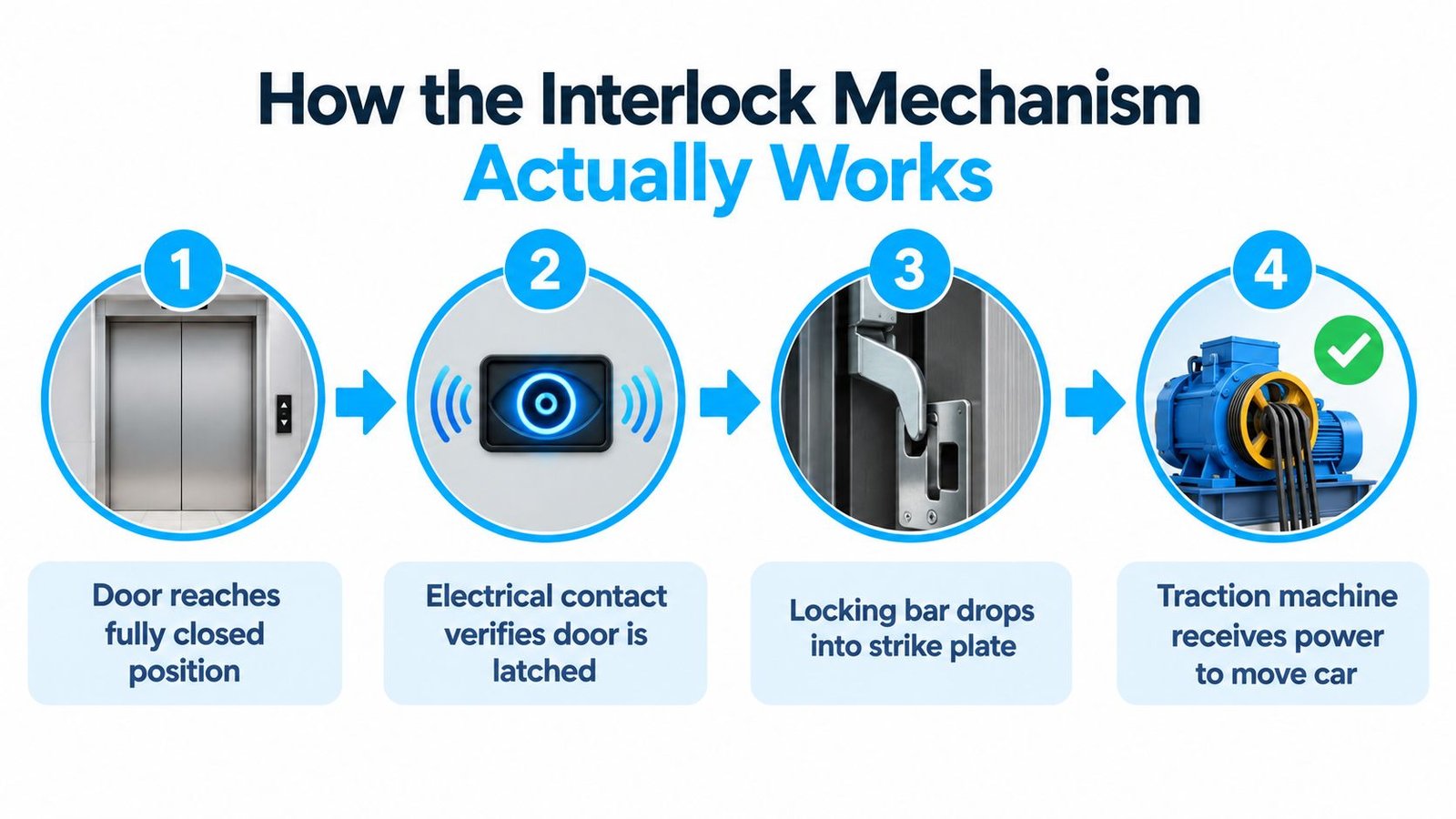
A properly functioning hoistway-door interlock performs two linked jobs. First, it mechanically retains the landing door in the locked position. Second, it electrically prevents the driving machine from operating until the landing door is closed and locked.
Those jobs must agree. An electrical contact that says “closed” can't substitute for physical engagement, and physical engagement can't safely authorize movement if the electrical circuit remains falsely closed.
The mechanical side
The locking member has to enter and retain the landing-door locking area. The mechanism must remain locked through an approved holding method, such as gravity, a restrained compression spring, or the opening member. California's requirements provide a clear example of the principle. They state that interlock contacts must be positively opened by the locking member, or by a mechanically connected member.
That requirement guards against a dangerous false signal. A welded contact, a misadjusted contact, or a contact that closes before the lock has engaged shouldn't be able to authorize elevator movement by itself.
A retiring cam also needs sufficient operating margin. California requirements state that the cam must generate at least twice the average force required to operate the interlock and travel at least 13 mm, or 1/2 inch, farther than the average required operating movement. The purpose is practical. Extra force and travel help overcome friction, contamination, spring variation, and alignment drift as components wear. These requirements are documented in the California interlock regulation.
What a technician actually verifies
A useful inspection doesn't stop at a controller diagnostic light. The technician should separately confirm:
- Door alignment: Panels, hangers, rollers, sills, and related hardware allow the door to reach its intended position.
- Lock engagement: The locking member reaches the designed position and holds the landing door securely.
- Contact sequencing: The electrical contacts change state as the mechanical lock operates, not before it.
- Cam operation: The retiring cam has adequate force, travel, and alignment throughout the operating cycle.
- End-position behavior: The mechanism isn't binding, bouncing, or stopping short because of debris or wear.
For related switching and safety-circuit context, owners can review elevator mechanical limit switch information, but any diagnosis or adjustment on an elevator safety circuit should be handled by qualified personnel.
The practical trade-off is straightforward. Cleaning and adjustment can correct contamination or minor alignment issues. Replacement or modernization is more appropriate when the lock, retainer, spring, cam, contacts, or associated controls have lost their designed margin. The correct repair addresses the reason the lock failed, not merely the fact that the elevator stopped.
Sensing Closure Versus Mechanical Locking
A door can look closed and still fail the more important test. Visual closure tells an occupant that the panels meet. It doesn't prove that the hoistway door's locking member has fully engaged or that the electrical circuit has changed state in the correct sequence.
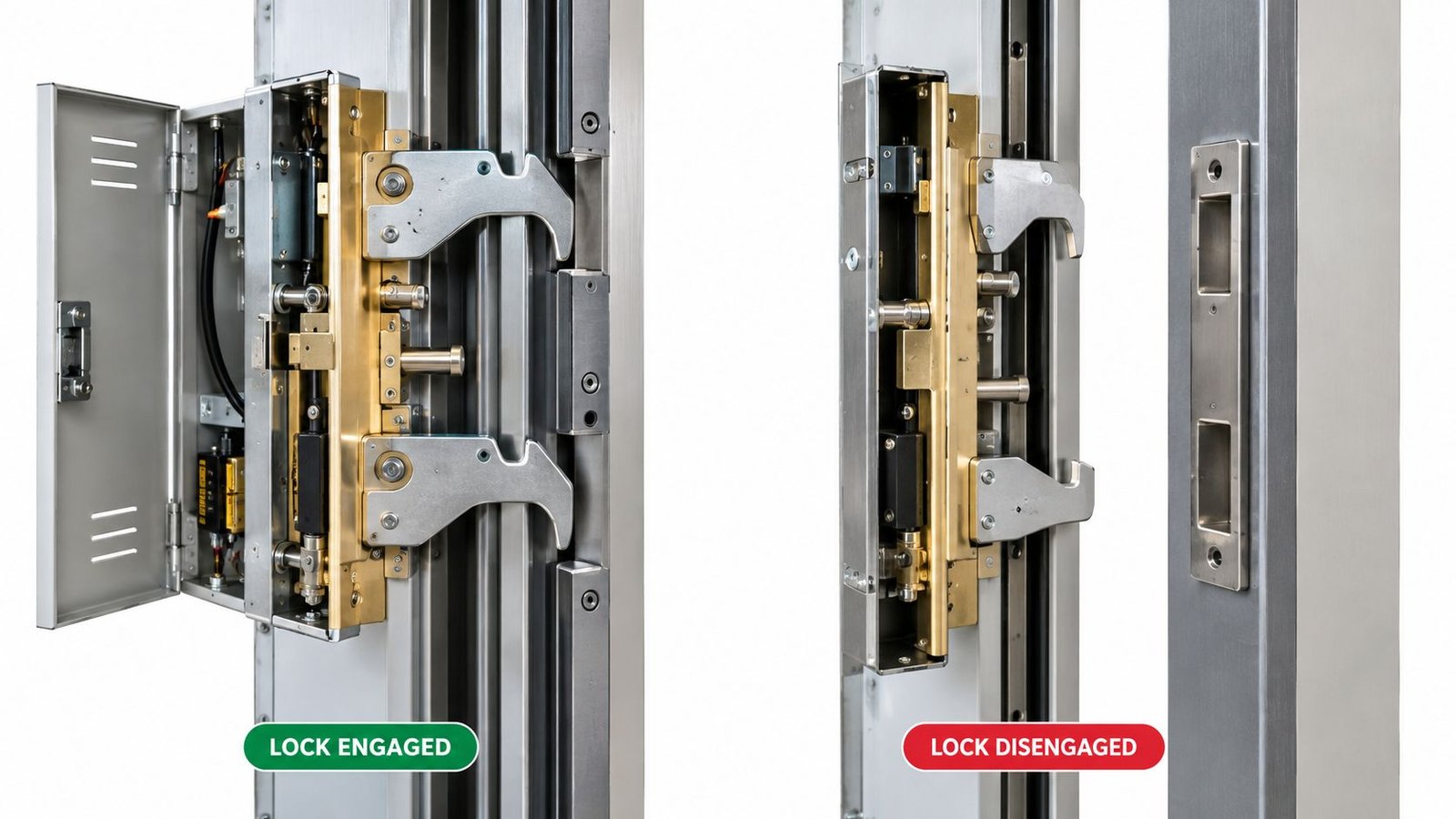
The North American safety-code definition requires two interdependent functions. The system must prevent normal elevator operation unless the hoistway door is locked, and it must prevent the landing door from opening unless the car is within the permitted landing zone. The code also specifies that the locking member must engage at least 7 mm, or 0.28 inch, before the interlock contacts close and before the driving machine can operate, as described in this published safety-code text.
That sequence creates a critical distinction:
| Condition | What it tells you | Why it isn't enough by itself |
|---|---|---|
| Door appears closed | The panels have reached an apparently closed position | The locking member may not be fully engaged |
| Electrical contact changes state | The circuit is sensing a permitted condition | A damaged, welded, bypassed, or misadjusted contact can give a false signal |
| Mechanical lock engages | The landing door is physically retained | The electrical circuit must still correctly prevent movement when the lock isn't engaged |
Common causes of false closure include misaligned panels, worn rollers, sill debris, weak springs, damaged retainers, poor cam timing, and improperly adjusted contacts. Older freight elevators in Flint, Kalamazoo, and Saginaw can be especially challenging when legacy door equipment interacts with newer controllers.
A door sensor reference can help owners understand the sensing side of the system, but sensing isn't the same as locking. The qualified technician needs to test the physical and electrical conditions independently.
The following visual demonstration can help explain why the two conditions must work together:
Repeated door-lock faults should be treated as a possible loss of safety margin. Resetting the controller may restore service for a short time, but it doesn't correct a worn lock, weak spring, contaminated sill, damaged retainer, or timing problem. Owners should request documentation showing what was tested, what was adjusted or replaced, and how the final mechanical engagement and electrical sequencing were verified.
Michigan Code Requirements and Inspection Rules
A door may look closed while the elevator remains out of compliance. Michigan requires every hoistway door to have an approved interlock so the elevator cannot run unless the landing door is secured. The governing requirements appear in the Michigan Elevator Code.
The rules also set measurable entrance conditions. For horizontally sliding doors or gates, the clear opening must generally be no more than 2 inches, or 51 mm. Where a car-door interlock is installed, the specified opening is 0.375 inch, or 10 mm. These measurements help inspectors identify conditions that a quick visual check can miss.
Michigan's requirements also address the verification sequence. Door lock monitoring must confirm that the interlock has reached the required condition before the controller permits operation. Owners can review the elevator DLM door lock monitoring overview for more detail on that monitoring function. Electrical sensing supports the safety circuit, while the mechanical lock must physically retain the landing door. Testing one does not prove the other.
Who enforces elevator safety in Michigan
The Michigan Elevator Section administers and enforces the Michigan Elevator Code. Its work includes inspecting installations and alterations, conducting annual safety inspections, investigating accidents and code violations, and confirming that required permits have been issued. Keep inspection findings, corrective work, test results, and permit records together so they can be reviewed without delay.
Detroit has its own Elevator Inspection Team within the buildings and safety department. The team inspects and licenses elevator journeypersons and contractors, examines elevators, escalators, dumbwaiters, and wheelchair devices, investigates complaints, reports elevator accidents, and handles elevator-code questions. In Detroit, an undocumented reset or partial repair is difficult to defend when an inspector asks how the lock was corrected and tested.
A useful response to an inspection finding is a written correction plan. Identify the failed condition, state whether the remedy requires adjustment, cleaning, replacement, monitoring, or modernization, and document the functional test completed afterward. Michigan enforcement timelines make prompt, traceable corrective work more practical than repeatedly returning an elevator to service without resolving the underlying fault.
Crane Elevator Company provides door-lock inspection, troubleshooting, repair, replacement, and related elevator services in Detroit, Lansing, Ann Arbor, Grand Rapids, and nearby communities. Its Michigan service area also includes Flint, Kalamazoo, Livonia, Novi, Dearborn, Saginaw, and Holland.
Choosing a Maintenance and Modernization Partner
Door-lock work requires a contractor who can evaluate both sides of the safety function. A replacement contact may not solve a mechanical engagement problem, and a new lock assembly may not work correctly with an outdated controller or altered door equipment. The strongest maintenance programs document the condition of the hardware, the reason for failure, and the final test results.
For owners comparing providers, look for practical capabilities:
- Mechanical and electrical diagnosis: The contractor should verify physical locking, contact sequencing, cam operation, alignment, and clearances.
- Code-required inspections and testing: The provider should understand the adopted Michigan requirements and help correct documented violations.
- Modernization flexibility: Non-proprietary solutions can be useful when an older system needs updated controls or door equipment without unnecessarily restricting future service options.
- Equipment coverage: The service scope should match the property portfolio, including passenger elevators, freight elevators, residential elevators, wheelchair lifts, material lifts, and dumbwaiters.
- Maintenance documentation: Reports should identify recurring faults and distinguish a temporary reset from a completed repair.
Crane Elevator Company is a family-owned elevator contractor serving Michigan and Ohio with over 25 years of hands-on experience. The company provides preventive maintenance, repairs, code-required inspections, testing, violation correction, and full non-proprietary modernizations for all makes and models. Its Michigan service coverage includes Detroit, Lansing, Ann Arbor, Grand Rapids, Flint, Kalamazoo, and nearby communities.
For a building with repeated door-lock shutdowns, the decision shouldn't be based only on the price of the next replacement part. Ask whether the proposed work restores the required mechanical margin, confirms the electrical sequence, and gives the owner a clear record for future maintenance and inspection.
Visit Crane Elevator Company to arrange elevator door-lock diagnostics, preventive maintenance, repair, inspection support, or non-proprietary modernization in Detroit, Lansing, Ann Arbor, Grand Rapids, and surrounding Michigan communities. Ask for a documented evaluation of both mechanical locking and electrical sensing so your elevator receives a corrective solution rather than another temporary reset.