
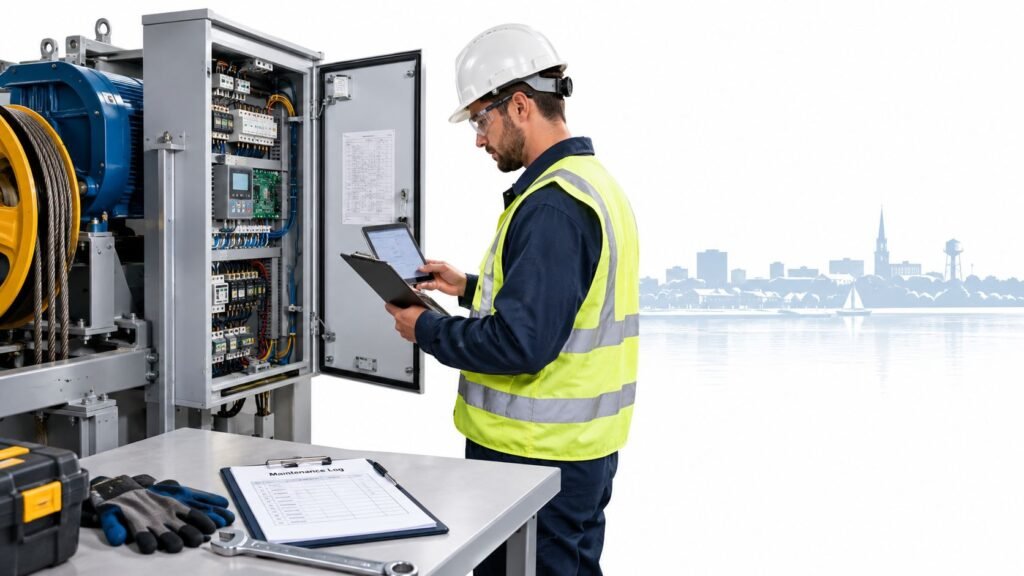
A defensible elevator maintenance log is more than a checkmark. It needs traceable field data recorded every 90 days by a licensed elevator journeyperson, especially when Michigan's inspection backlog has left 78.4% of required routine inspections incomplete.
The situation is familiar: a facility manager opens a binder after a callback, finds a few initials, a service sticker, and no clear record of what the technician tested or what still needs correction. The elevator may be operating, but the documentation doesn't show whether the doors, safeties, emergency communication, fire service, and recurring faults were addressed. For elevator maintenance in Traverse City, the log isn't clerical overhead. It is the working history of the equipment and the evidence that your team is managing it deliberately.
The Local Elevator Landscape in Traverse City
A facility manager overseeing Traverse City properties may be responsible for equipment with very different operating histories. A parking structure elevator sees a different duty pattern from a small building lift, and a modernized controller doesn't erase the maintenance history of the car, doors, hoistway, or safety equipment around it.
Traverse City's municipal inventory shows why a generic logbook breaks down. A city procurement document identified five passenger elevators across three locations: two 2,500-pound Otis elevators serving four floors at the Larry C. Hardy Parking Structure, two 3,500-pound Schindler elevators serving four floors at the Old Town Parking Structure, and one 2,000-pound KONE elevator serving two floors at the Carnegie Building. The same document noted that the Hardy elevators received modernization upgrades completed in July 2025, with licensed elevator-journeyperson service and examinations required at least every 90 days under the stated requirements. Traverse City municipal elevator information
That mix matters when you build a record. The equipment nameplate, rated load, drive system, controller type, safety devices, emergency communication, fire-service functions, and applicable test dates should appear in the record for each unit, not only in a folder for the property. A technician should be able to open the unit history and understand which parts were modernized, which components remain original, and which deficiencies have returned.
Historic buildings need current records
Traverse City's elevator story also reaches back to the Hannah and Lay Mercantile Building, constructed in 1883 and identified by a Michigan Historical Marker as the city's first building with elevators. That history is more than a point of local interest. Historic buildings can contain legacy equipment, constrained machine-room layouts, unusual access conditions, and components that require careful planning before replacement or modernization.
A sound log records those realities. It should identify restrictions on access, unusual operating conditions, discontinued components, previous alterations, and decisions to repair, replace, or modernize. A modernized unit may need a new maintenance approach, but it still needs a connected history that shows what changed and when.
Practical rule: Build one complete record per elevator, even when several units share a building, ownership group, or service contract.
The useful question isn't only whether an elevator was serviced. It is whether the next technician, inspector, or facility manager can determine exactly which unit was examined, what was found, what was corrected, and what remains open.
Why Compliance and Documentation Matter More Than Ever
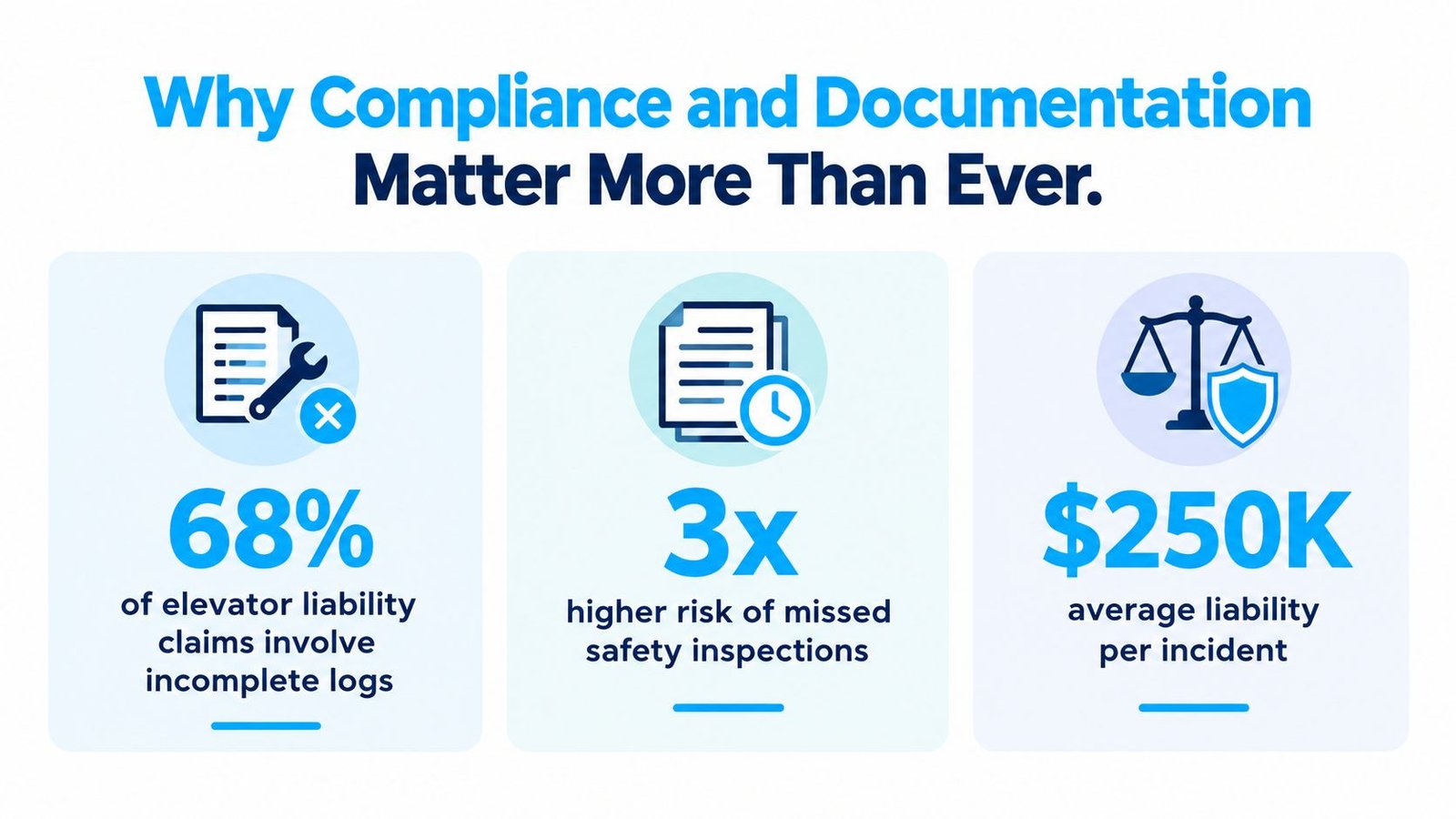
Michigan's inspection history shows how quickly a calendar problem can become an operational and compliance problem. A Michigan Auditor General review examined records for 40 elevating devices requiring 74 routine inspections between October 1, 2018, and May 31, 2020. The review found that 58 of the 74 required routine inspections, or 78.4%, had not been conducted. By May 31, 2020, 29 of the 40 devices, or 72.5%, had an overdue routine inspection, with overdue periods ranging from 26 to 2,140 days. Michigan Auditor General review of elevator inspections
Those findings don't prove that every overdue elevator is unsafe, but they do show the danger of relying on informal reminders and fragmented records. When a facility can't demonstrate what was scheduled, what was performed, which deficiencies remained open, and who completed the work, managers lose control of the compliance process. Missed examinations can also create avoidable downtime when a defect is discovered late and the team has no reliable service history to guide the response.
Know which interval applies
Michigan rules don't assign every elevating device the same inspection schedule. Passenger and freight elevators generally require inspection at least annually, while dumbwaiters, stairway chairlifts, platform lifts, and certain one-person elevators generally require inspection at least every 24 months. Temporary personnel hoists require inspection at least every 90 days, and Michigan rules also require maintenance inspections and tests of elevator car and counterweight safeties and governors at intervals of no more than 12 months. Michigan elevator code and inspection intervals
The record should state the equipment type and the applicable interval. A calendar that labels every device “annual inspection” can be wrong for both a temporary hoist and a unit with separate safety-test requirements. Facility teams should also verify who performed the work. Michigan law requires installation, alteration, maintenance, repair, servicing, inspection, adjustment, and testing to be performed by a licensed elevator journeyperson, and access to a hoistway or machine room for this work is restricted to licensed or properly supervised personnel. Michigan elevator permit and licensing information
A useful compliance record ties the certificate, test report, deficiency notice, corrective-work order, and follow-up result to the same unit. Facility managers can also use Michigan elevator code requirements as a practical reference point when organizing questions for their service provider.
Building a Defensible Elevator Maintenance Log
Start with the asset, not the appointment book. Before the first recurring visit, create a unit-specific inventory that identifies the elevator type, rated load and speed, drive system, controller, safety devices, fire-service functions, emergency communication equipment, and required state test dates. For a Traverse City elevator, the preventive-maintenance workflow should include examination by a licensed elevator journeyperson at least every 90 days. Traverse City elevator service specification
A useful record should make the technician's work visible without turning the log into a novel. Capture the service date, unit identification, operating condition, measurements, deficiencies, repairs, parts used, technician, and next action. “Serviced” is not a useful finding by itself. “Landing door restrictor adjusted, closing force checked, operation verified, monitor for repeat fault” gives the next person something they can act on.
Use fields that support decisions
The inventory and service record should answer five practical questions:
- What equipment was examined? Record the unit number, location, manufacturer, rated load, drive arrangement, and major modernization history.
- What condition did the technician observe? Identify the component and describe wear, contamination, misalignment, damage, abnormal noise, fault history, or measured result.
- What risk did the condition create? Distinguish a housekeeping correction from a condition affecting door operation, leveling, emergency communication, fire service, or safety performance.
- What action was taken? Record the adjustment, cleaning, repair, replacement, temporary control, or recommendation.
- What happens next? Assign responsibility, record the date, and flag whether a follow-up test, quotation, inspection, or shutdown is required.
That structure creates traceability. The accepted benchmark is that every defect identifies the component, observed condition, risk, corrective action, responsible technician, date, and follow-up test requirement when applicable.
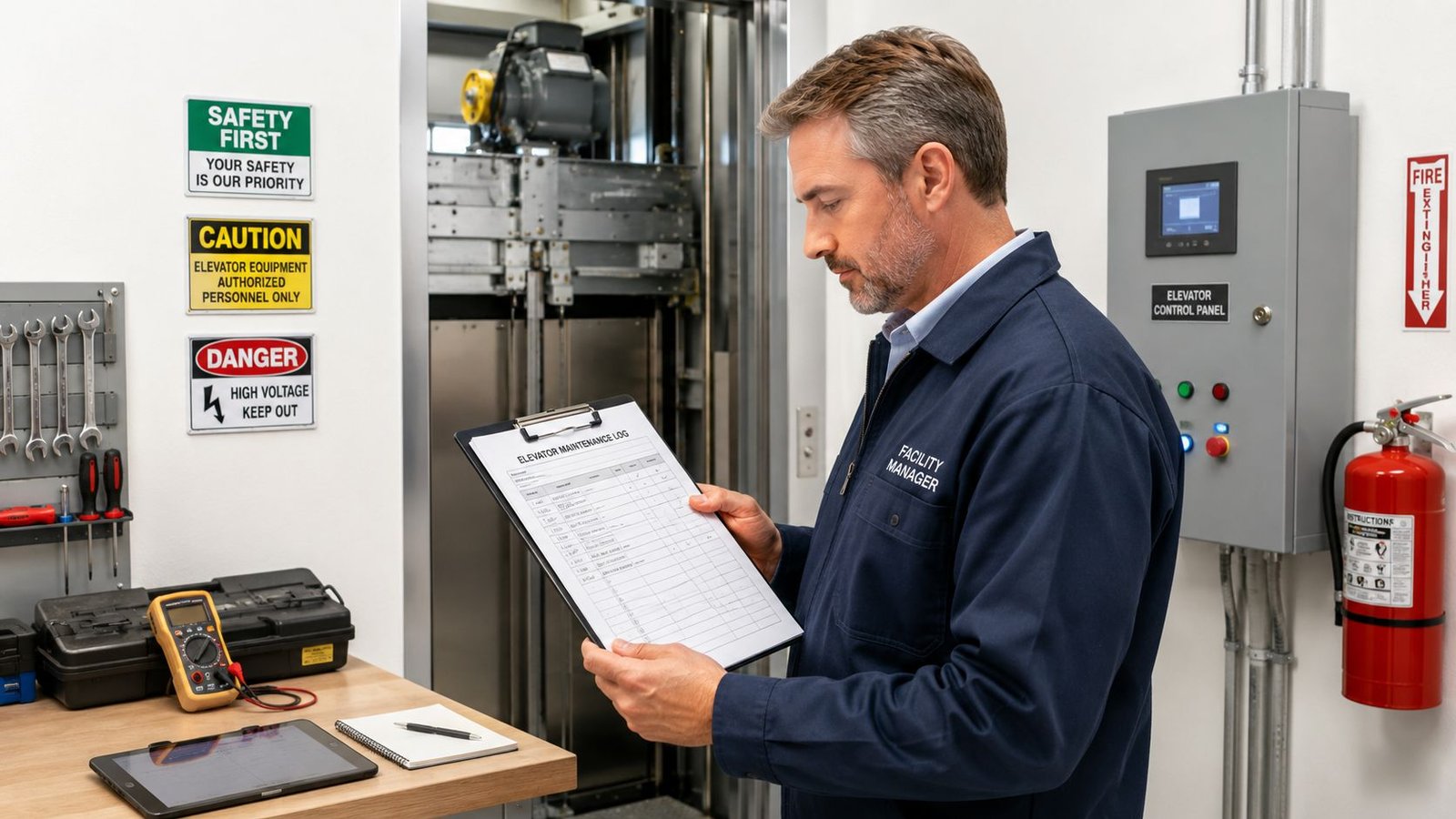
During the visit, the technician should review open deficiencies and the prior history, then examine the machine or control room, hoistway, car top, pit, doors, safeties, buffers, leveling, and emergency systems. The technician should record measured results and test evidence rather than just initialing a checklist.
Trend recurring faults
A door fault that returns after every adjustment isn't a successful maintenance outcome. It may point to alignment, wiring, controller behavior, mechanical wear, or contamination that needs root-cause work. Leveling errors deserve the same treatment. A log that records the same symptom repeatedly without documenting an investigation shows activity, not control.
Avoid the common mistake of treating a quarterly visit as a visual-only walk-through. The value of a scheduled examination comes from reviewing the history, inspecting the right equipment, recording evidence, and closing the loop on deficiencies. A provider working across different equipment types can also use elevator maintenance services to coordinate documentation practices across properties, provided each unit still receives its own technically accurate record.
Digital Tools Versus Paper Records
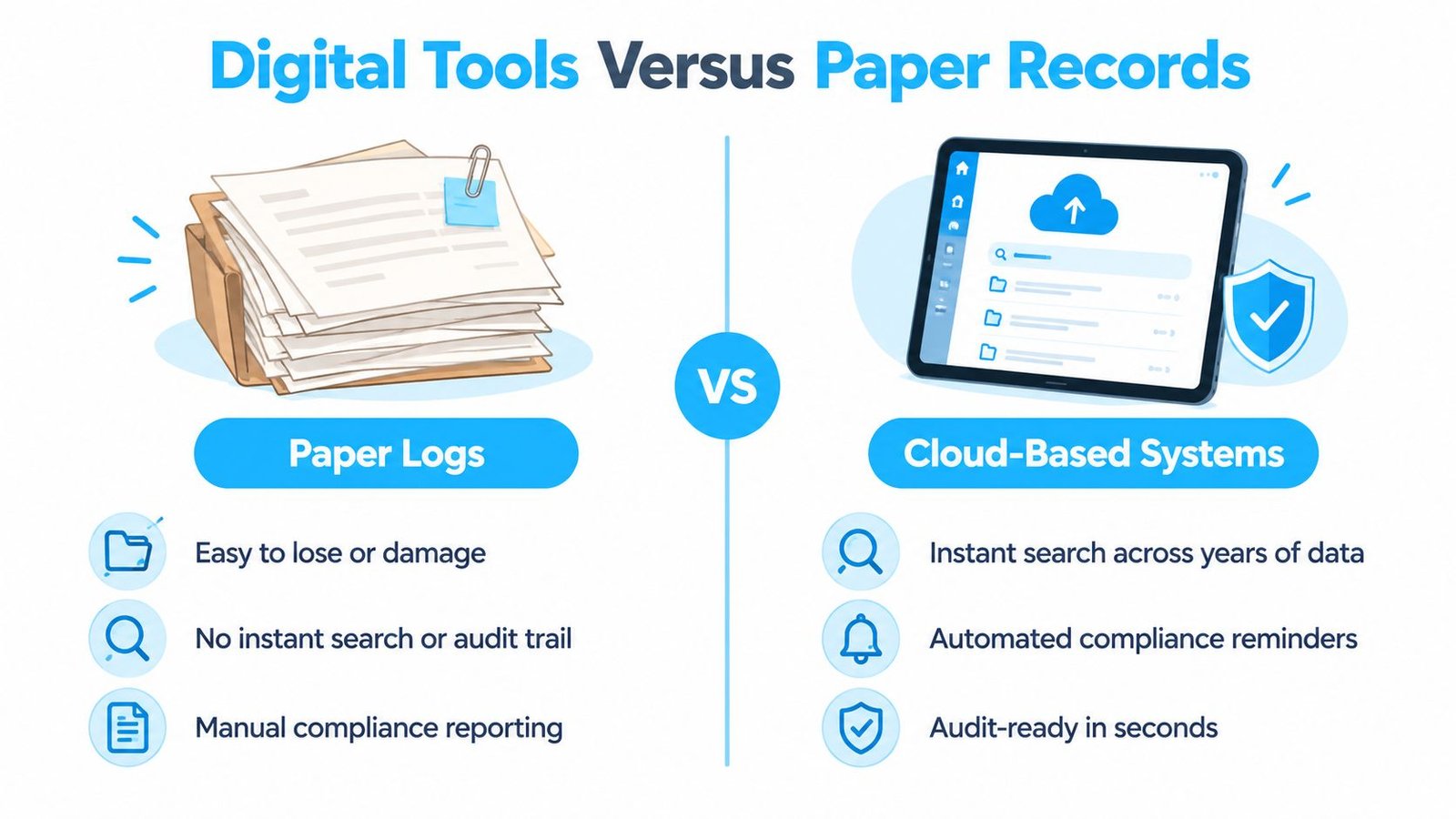
Paper and digital records can both support a defensible maintenance program. Neither format can rescue incomplete field data. A cloud platform with empty fields is no better than a neat binder with missing test reports.
Paper works well when a small facility has a disciplined custodian, stable access to the binder, and a clear filing routine. It doesn't depend on a device, battery, login, or network connection. The weaknesses appear during handoffs and audits. Pages can be misplaced, handwriting can be difficult to interpret, and a manager may spend too long searching for a prior deficiency or certificate.
Digital records make searching and scheduling easier. A facility team can filter by unit, deficiency, technician, test type, or open action, then attach reports and photographs to the relevant asset. Automated reminders can help prevent missed recurring examinations, while a dashboard can reveal repeat door faults or overdue corrective work across several buildings.
Choose the system that preserves the chain
The right choice depends on how well the system connects evidence:
| Record requirement | Paper approach | Digital approach |
|---|---|---|
| Service history | Use a dedicated tab for each unit and write the unit number on every page. | Use one asset profile per elevator with controlled unit identification. |
| Open deficiencies | Maintain a dated corrective-action sheet behind the service log. | Link each deficiency to an owner, due date, work order, and closeout record. |
| Testing evidence | File certificates and reports in sequence behind the correct unit divider. | Attach certificates and reports directly to the relevant test or deficiency. |
| Audit retrieval | Use an index and consistent file naming. | Use search, filters, and an exportable history. |
The failure isn't choosing paper. The failure is letting certificates, test reports, and corrective-work orders live in separate, unlinked files. If records move from paper to digital, mark the transition date and preserve the historical sequence. Scan or transcribe carefully, retain the original source where appropriate, and don't create an unexplained gap between the last paper entry and the first digital entry.
A practical test is simple: ask someone who didn't perform the last service visit to find the current certificate, open deficiencies, and most recent test result. If that person can't do it quickly and confidently, the record system needs work regardless of its format.
Standardizing Safety and Emergency Function Tests
Routine maintenance and safety testing belong in the same lifecycle program, but they shouldn't be collapsed into one generic checkbox. A maintenance visit may identify wear or adjustment needs. A formal safety or emergency test has its own scope, evidence, qualified personnel, and sign-off.
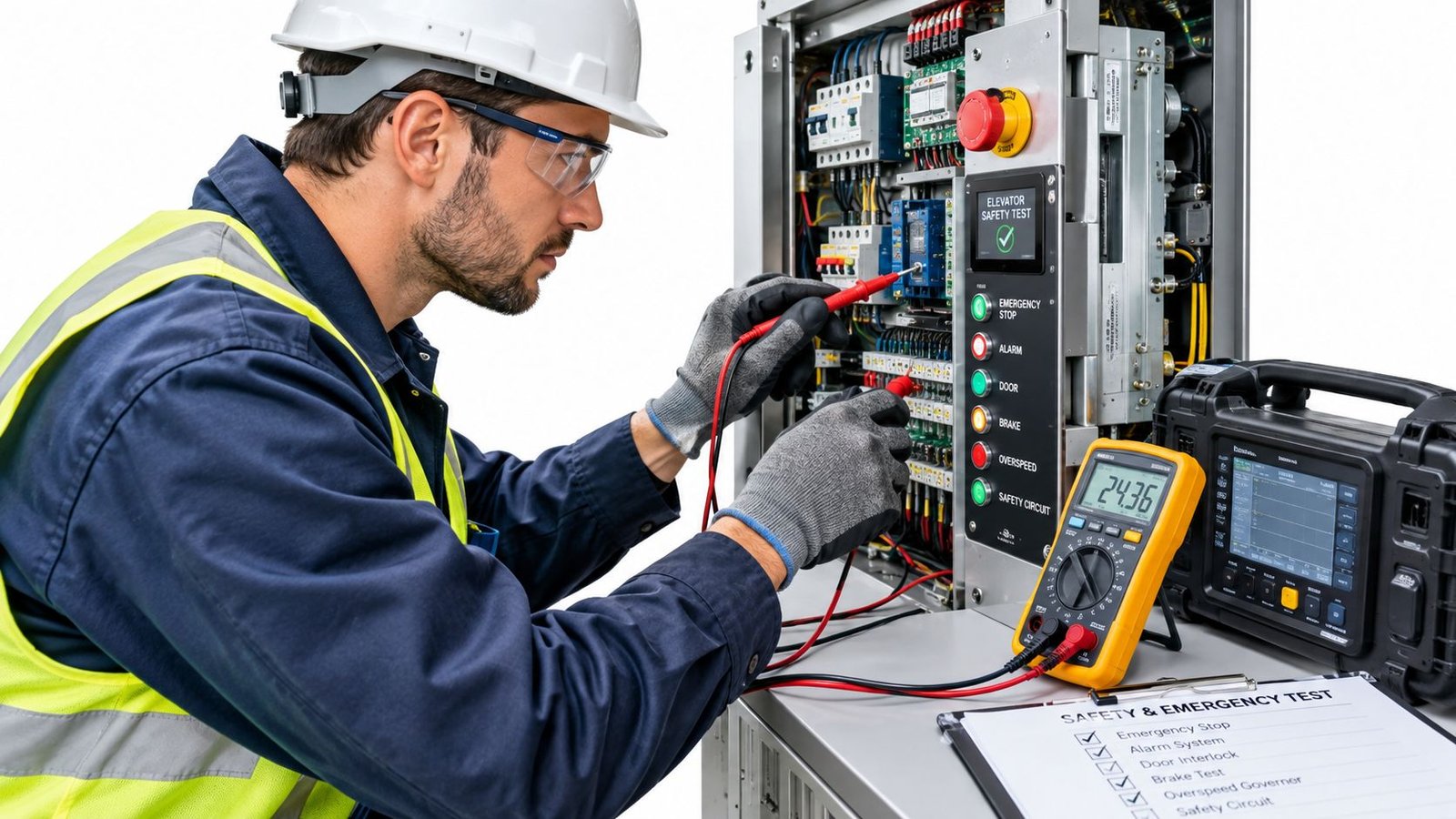
Begin with the maintenance-control documentation and the manufacturer's or code-required interval for each device. Before work, isolate the unit under an approved lockout/tagout procedure. The technician can then inspect and function-test door interlocks, car and landing doors, stopping and leveling, the overspeed governor, safeties, buffers, emergency stop, alarm, two-way communication, and fire-service Phase I recall and Phase II in-car operation.
Separate the work packages
The log should distinguish at least these activities:
- Routine examination: Record the condition of operating components, rooms, hoistway areas, doors, leveling, lubrication, contamination, wear, and open deficiencies.
- Safety testing: Document the test type, date, equipment involved, measured result, deficiency, corrective action, and required witness or sign-off.
- Emergency communication: Record the alarm and two-way communication test separately, including the result and any call-center or receiving-party verification required by the facility's procedure.
- Fire service: Record Phase I recall and Phase II operation as distinct functions, not as a single “fire service checked” entry.
- Load testing: Schedule and document load and safety tests according to the adopted code, with the required qualified personnel and witness.
The U.S. Bureau of Reclamation describes periodic testing by qualified elevator personnel, witnessed by a QEI, followed by a written report identifying test dates, test types, results, deficiencies, and corrective action. Federal elevator testing documentation guidance
An annual inspection isn't automatically the same event as a full-load or safety test. Give each event its own date, scope, evidence, and approval. For firefighter-service elevators, federal VA specifications call for monthly Phase I emergency recall and at least one-floor Phase II operation. The facility's adopted requirements and equipment documentation should control the final schedule, but the log must make each required activity visible.
Use the record to find root causes
Track callback frequency, door faults, leveling errors, and repeat violations by unit. A reset may return an elevator to service, but it doesn't explain why the fault occurred or whether it will return. If the same fault appears after adjustment, the technician should document the investigation and recommend root-cause repair involving alignment, wiring, the controller, or mechanical wear where appropriate.
The log should show whether the team solved the failure or only cleared the symptom.
A facility manager can use elevator testing services to coordinate formal tests, emergency functions, and corrective work, but the resulting reports still need to be filed against the correct unit and connected to the maintenance history.
Understanding the Hidden Risks of Dormant Equipment
Taking an elevator out of service doesn't necessarily remove the owner's compliance responsibilities. Seasonal closures, historic renovations, capital projects, and vacancies can leave a car idle for months, while the owner assumes that no passengers means no maintenance or permitting issue. That assumption can create a larger reactivation problem.
Michigan guidance states that permits are required when an elevator is made dormant. It also states that a dormant elevator must be brought into compliance with the current code and rules, rather than only the code in effect when the elevator was installed. Michigan guidance on dormant elevators
Plan the shutdown before it happens
The first practical task is to distinguish a temporarily unavailable elevator from one formally placed into dormant status. Don't rely on a sign on the landing door to establish that distinction. Confirm the status with the licensed contractor and the applicable authority, then retain the permit, approved plans, shutdown records, equipment inventory, and last test documentation together.
Before shutdown, document:
- Current condition: Record existing deficiencies, open violations, unusual noises, door behavior, leveling issues, and emergency-system status.
- Equipment history: Assemble modernization documents, wiring information, controller details, prior test reports, and parts information.
- Site controls: Record how the machine room, pit, hoistway, car, and landing areas will be secured and accessed.
- Reactivation plan: Identify the inspections, testing, repairs, approvals, and operational checks required before passengers use the elevator again.
The trade-off is easy to miss. Deferring work may seem to preserve budget flexibility, but dormancy can expose the unit to current-code requirements when the owner seeks reactivation. The resulting scope may be broader than the work needed to keep a continuously maintained unit in service.
A dormant elevator also shouldn't become invisible in the facility's asset register. Keep its calendar active, mark its status clearly, and assign an owner for the next compliance decision. A reliable record prevents the project team from treating an old elevator as an abandoned asset and discovering its obligations only when construction is complete.
Partnering for Reliable Elevator Lifecycle Management
A maintenance log is only as reliable as the field work behind it. Facility managers need a contractor who can examine different equipment types, document deficiencies clearly, perform required testing, and explain when a repair, modernization, or replacement is the practical choice.
Crane Elevator Company serves Detroit, Lansing, Ann Arbor, Grand Rapids, Traverse City, Flint, Kalamazoo, Holland, Muskegon, Mount Pleasant, Bay City, Saginaw, and surrounding Michigan communities, with service extending through Michigan and Ohio. Its stated service model covers every major elevator-service category, including proactive preventive maintenance, emergency repairs, code-required inspections, testing, modernization, new installations, and work on passenger elevators, freight elevators, residential elevators, wheelchair lifts, material lifts, and dumbwaiters.
Match the provider to the record
For a facility manager, the useful questions are operational:
- Can the provider work across equipment types? A portfolio may include legacy freight cars, modernized passenger units, hydraulic systems, residential elevators, and accessibility lifts.
- Can the provider support emergencies? Responsive field operations matter when an elevator affects healthcare access, industrial movement, municipal operations, or resident mobility.
- Will the work be documented clearly? The service record should identify the unit, observed condition, corrective action, technician, date, and follow-up requirement.
- Can the provider handle non-proprietary work? A non-proprietary modernization approach can give owners more flexibility when selecting qualified future service providers.
- Can planned work be priced transparently? Competitive quotes, second opinions, and financing options can help owners compare repair and modernization paths without separating the technical review from the budget decision.
The company's maintenance program includes scheduled service, cleaning, adjustments, wear tracking, machine-room, pit, and car-top clean-downs, along with work such as door-lock monitoring, hydraulic packing, jack and cable replacement, motor and machine replacement, emergency phones, fire service, generator testing, safety tests, and violation corrections. A No Show, No Pay policy and 24/7/365 field operations are also part of its stated service offering.
The right partnership doesn't replace the facility manager's responsibility for records. It makes that responsibility manageable. The manager still needs one asset history per unit, an active compliance calendar, linked certificates and work orders, and a clear process for reviewing repeat faults. The contractor should supply accurate field evidence and explain unresolved risks before they become a shutdown or a rushed capital project.
For elevator maintenance in Traverse City, that combination is what works: equipment-specific logs, scheduled licensed examinations, distinct safety-test records, deliberate dormant-equipment planning, and a service partner capable of handling every type of elevator service your portfolio contains.
Crane Elevator Company provides preventive maintenance, emergency repairs, inspections, testing, modernization, and service for passenger elevators, freight elevators, residential units, wheelchair lifts, material lifts, and dumbwaiters across Traverse City and surrounding Michigan communities. Visit Crane Elevator Company to request service, a second opinion, or a quote built around the equipment history and documentation your facility needs.