
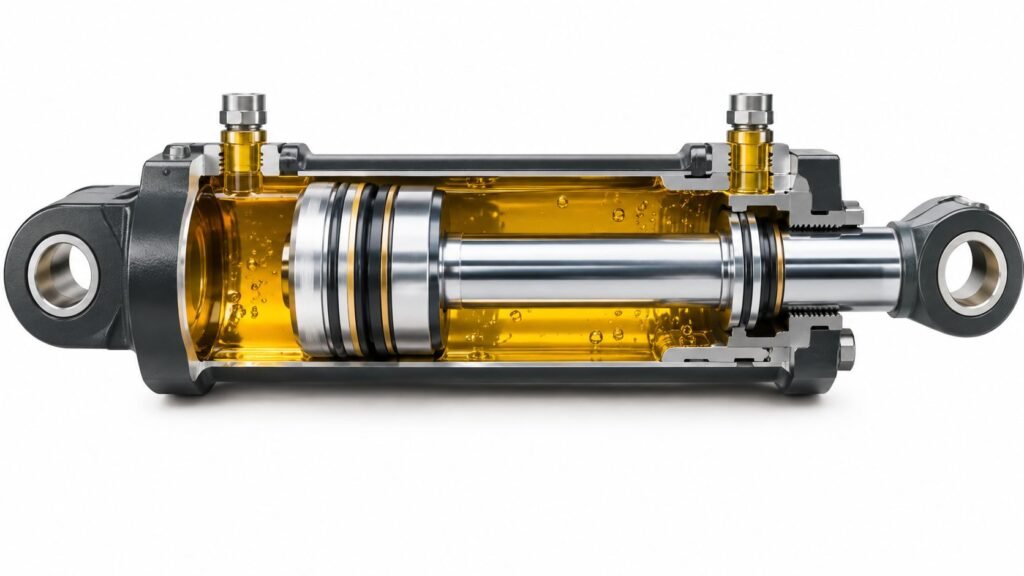
A hydraulic elevator can run without sound for years, then give an owner a warning that seems minor: a milky mark near the tank, a slow-leveling car, or a thin film around the cylinder packing. Tenants notice the ride first. The building team usually notices the fluid only after the equipment has already begun telling them something is wrong.
Elevator hydraulic fluid isn't a one-time fill that can be ignored until a leak empties the reservoir. It carries pressure, lubricates the pump and valves, transfers heat, protects metal surfaces, and can move beyond the machine room through leaks, mist, or vapor. The right maintenance decision depends on fluid grade, temperature, contamination, seal condition, equipment approval, and the possible environmental pathway.
For owners and facility managers in Detroit, Lansing, Ann Arbor, Grand Rapids, Flint, Kalamazoo, Jackson, Saginaw, Battle Creek, and surrounding Michigan and Ohio communities, the practical questions are straightforward. What fluid belongs in the system? How does water get into it? When is testing better than replacement? When should a technician top off, filter, flush, or drain the reservoir? What should staff do when oil reaches the pit, a drain, or soil? And how does fluid care fit into inspections, emergency repairs, and long-term modernization?
Why Elevator Hydraulic Fluid Should Be on Every Owner's Radar
At a Michigan hospital, the elevator may make hundreds of quiet trips while staff move patients, supplies, and equipment. In an office building, it may cycle through the day without anyone looking into the machine room. At a school or municipal building, the same system can appear dependable right up until the car begins leveling poorly or the pump starts working harder than it should.
The fluid inside the reservoir is aging during every cycle. It absorbs moisture through breathers, seals, fill openings, and other points that aren't perfectly sealed. Dirt enters with maintenance activity, air can become entrained in the oil, and heat accelerates oxidation. The result may be a change in color or viscosity long before the elevator stops.
Practical rule: A fluid-level check tells you how much oil is present. It doesn't tell you whether that oil can still protect the hydraulic circuit.
Fluid condition is one of the most overlooked predictors of hydraulic-elevator reliability because the oil connects nearly every major operating function. It affects pump filling, valve response, leakage, lubrication-film thickness, motor loading, and the behavior of seals and cylinders. An industry technical article estimates that nearly 80% of hydraulic-equipment failures are associated with the hydraulic fluid, although that figure is an industry estimate and not a universal elevator-failure statistic. The same article reports that water levels as low as 250 parts per million in vegetable-based oils and 500 parts per million in mineral oils can trigger oxidation-related problems (technical guidance on hydraulic elevator fluids and water contamination).
The indoor environment also deserves attention. A toxicological profile from the U.S. Agency for Toxic Substances and Disease Registry reports that mineral-oil hydraulic fluids may be released during hydraulic-elevator operation through volatilization, mists, or aerosols from reservoirs and piston mechanisms. In a cited study, building-air paraffin concentrations associated with hydraulic-elevator operation measured approximately 0.0088–0.262 mg/m³ (ATSDR toxicological profile for hydraulic-fluid exposure information). Those figures apply to mineral-oil hydraulic fluids generally, not to every elevator or brand, so they should guide risk management rather than serve as a prediction for a particular building.
The owner's job isn't to guess at the oil's condition. It's to maintain a record, investigate changes, control contamination, and require a service provider to explain why a recommendation is necessary. That approach protects uptime, indoor conditions, equipment, and the building's environmental position at the same time.
How a Hydraulic Elevator Actually Works
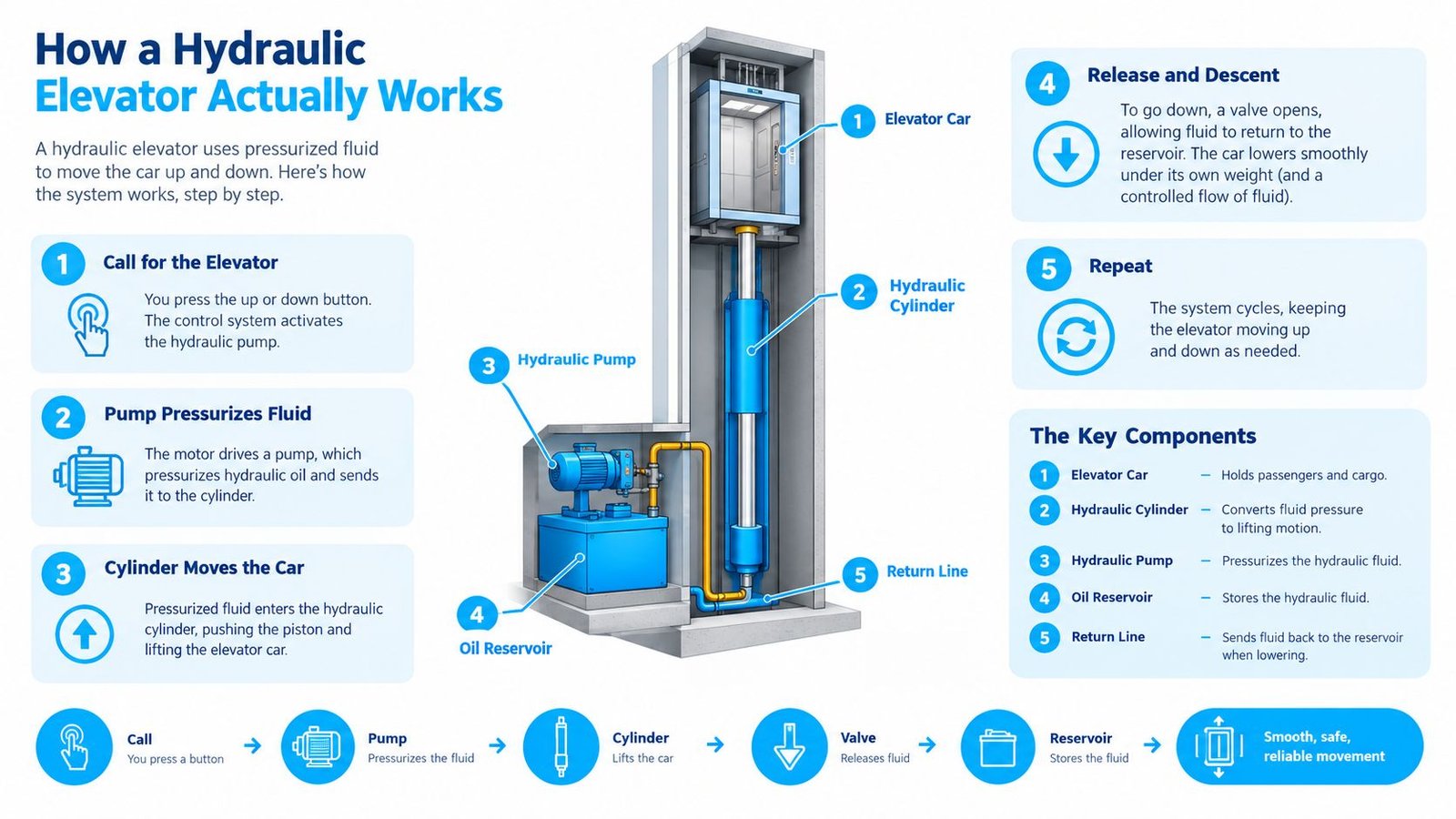
Start with the simplest model. A hydraulic elevator uses a pump to push fluid into a cylinder, where pressure acts on a piston connected to the elevator car. To lower the car, the control valve meters fluid back toward the reservoir. It's similar to a giant syringe supporting a car, except the system uses precision valves, pressure controls, seals, and safety devices to make movement controlled and repeatable.
The components that matter
The reservoir holds the oil. The power unit, often with a submersed pump and motor, draws fluid from that tank and sends it through the valve assembly. The valve stack controls acceleration, leveling, descent, pressure relief, and related operating behavior. If the valve receives dirty oil, its small passages and moving components can respond poorly even when the tank still looks adequately filled.
From the valve, fluid travels through piping or hose to the cylinder. Depending on the installation, the cylinder may be above ground or installed below ground, and it may use steel or PVC protection around the hydraulic components. The piston rises as pressure builds. At the top of the cylinder, packing seals the moving rod and limits oil loss while allowing the rod to travel.
A breather lets the reservoir exchange air as the oil level changes. That opening is useful, but it also creates a route for moisture and airborne dirt. Fill equipment, open covers, damaged seals, and careless handling create additional contamination opportunities.
Why viscosity changes the ride
Hydraulic fluid must move through the pump, valve, piping, and cylinder at the right resistance. Fluid that becomes too thick during a cold start can increase pressure drop, slow pump filling, and raise cavitation risk. Fluid that becomes too thin at operating temperature can reduce lubrication-film thickness, increase internal leakage, and weaken volumetric efficiency.
Normal operating-temperature guidance places many hydraulic systems around 30–60°C, or 86–140°F, with excessive heat accelerating oxidation and shortening fluid and component life (hydraulic-elevator preventive-maintenance specifications).
A technician inspecting a hydraulic freight elevator looks beyond the reservoir. The pit, cylinder, packing, hoses, fittings, tank, valve, motor, and machine-room temperature all help explain where a fluid problem started and why it may be affecting the ride.
The maintenance specification cited above calls for laboratory testing of viscosity, color, contamination, foaming, and other manufacturer-defined properties. It also calls for replacement when the fluid fails specification or condensation introduces water contamination. That makes the lab result more useful than a casual glance at the oil.
The Main Fluid Types Used in Elevators and What Each One Costs You
The correct fluid isn't just the product already sitting on a service truck. A technician must verify the elevator manufacturer's requirements, viscosity grade, additive chemistry, temperature range, seal materials, component approvals, and warranty conditions.
Public-sector specifications identify ISO VG 32, at approximately 150 SSU at 100°F, for some hydraulic-elevator systems. Other programs specify a multi-viscosity ISO VG 46, Group II base-oil fluid for service conditions from approximately −10°F to +100°F (public-sector hydraulic elevator hoisting specifications). These examples show why ISO grade alone doesn't settle the decision.
Common elevator hydraulic fluid families at a glance
| Fluid family | Typical ISO VG | Temperature range | Seal compatibility | Best-fit use case |
|---|---|---|---|---|
| Conventional mineral oil | VG 32 or VG 46, subject to approval | System-specific | Established seals and components, only after verification | Existing systems with compatible equipment and controlled spill risk |
| Vegetable-based or high-biodegradability fluid | Manufacturer-specified grade | System-specific, with special moisture control | Must be confirmed with packing, seals, pumps, and valves | Sites with environmental procurement goals and approved equipment |
| Fire-resistant fluid, including HFDU, water-glycol, or synthetic ester | Formulation-specific | Formulation and equipment dependent | Requires written compatibility approval | Applications where fire resistance is a defined engineering requirement |
| Specialty synthetic | Product-specific | Product and system dependent | Requires component and seal review | Equipment with documented need for specialized performance |
Conventional mineral oil is familiar, widely supported, and often straightforward to service. Its disadvantages include spill persistence, possible indoor-air exposure from operation or leakage, and the need for strict housekeeping and containment. It isn't automatically the wrong choice, but it must match the equipment and building risk profile.
Vegetable-based fluids can improve the environmental profile, but they demand disciplined contamination control. The lower water threshold reported for vegetable-based oil means a plant-derived product isn't a license to neglect sampling. Moisture, oxidation, seal behavior, storage, and disposal still matter.
Fire-resistant fluids can be useful where fire risk drives the specification, but they aren't a universal code upgrade. Water-glycol and synthetic-ester formulations behave differently from mineral oil, and the pump, valve, packing, hose, and cylinder materials must tolerate the chosen chemistry.
Specialty synthetics may offer useful temperature or oxidation characteristics, but the label doesn't override the elevator manufacturer's approval. If a contractor changes fluid families, residual oil can alter viscosity, additive performance, seal behavior, and fire-resistance characteristics. A complete drain and system cleanout is normally the responsible approach.
Contamination, Degradation, and What a Good Fluid Test Actually Tells You
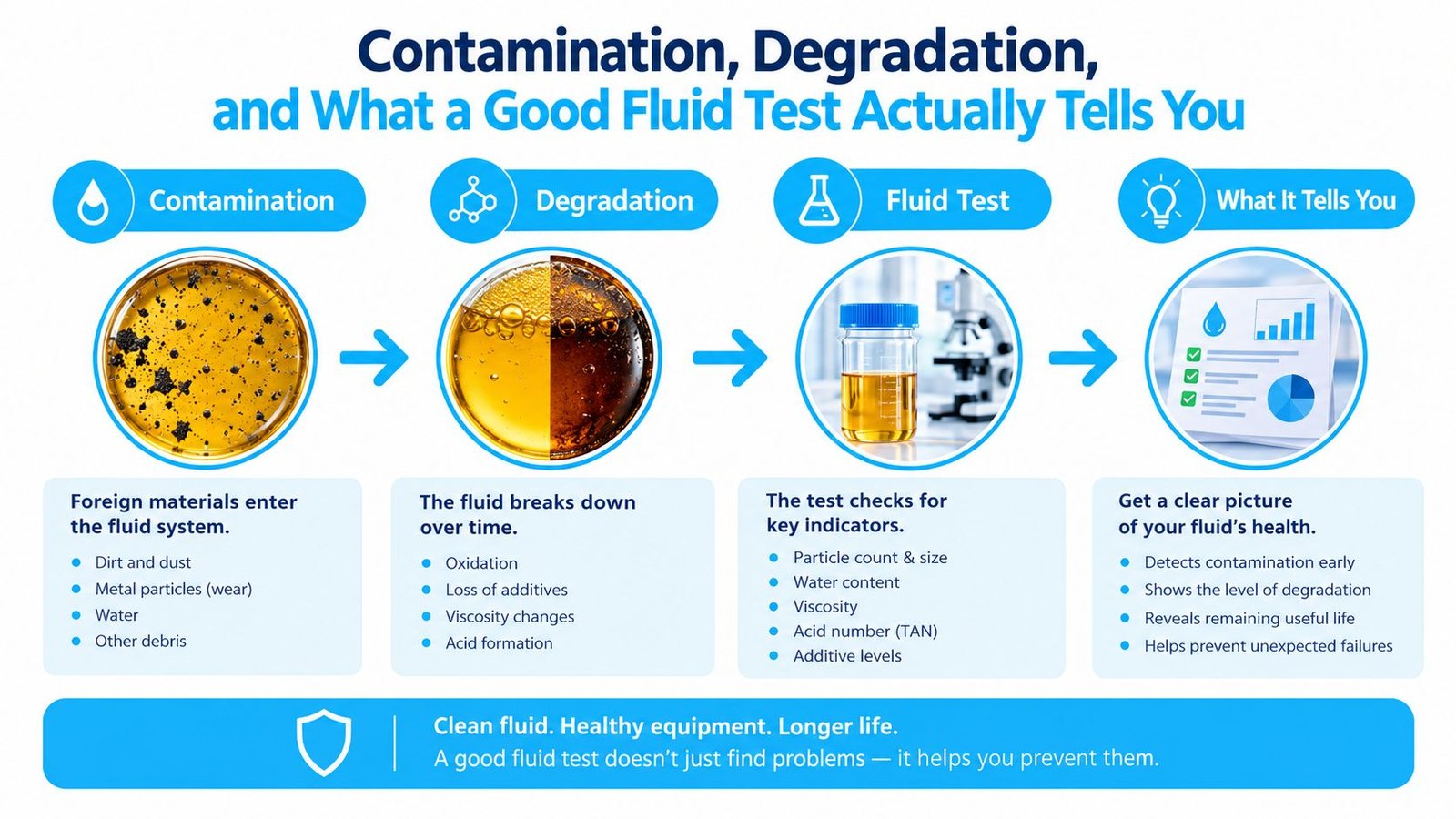
A hydraulic elevator can keep running while its oil is already damaging valves, pumps, seals, and the cylinder. Fluid condition changes when water, particles, air, heat, or oxidation products alter the oil's viscosity and protective properties. Owners in Michigan and Ohio also need to connect the mechanical evidence to environmental response. Oil inside the equipment is a maintenance problem. Oil that escapes onto soil, into a drain, or beyond the equipment area may create a reportable-release question, so document the location, amount, path, and cleanup response before assuming it is only a leak.
Water is the first contaminant to investigate. Moisture can enter through a breather, condensation, damaged packing, an open fill port, or a leak in the maintenance room. It reduces lubrication, promotes corrosion, accelerates oxidation, and can make valves, pumps, seals, and cylinders unreliable. Clear oil can still contain harmful moisture. Reported thresholds are as low as 250 parts per million in vegetable-based hydraulic oils and 500 parts per million in mineral oils (industry article on hydraulic-fluid contamination).
What the sampler should look for
Take the sample from the reservoir with clean equipment and a documented method. A dirty dipstick, container bottom, or recently disturbed area can produce a result that sends the repair in the wrong direction. Record the machine condition, operating temperature, recent service, and any visible leak before sampling.
Ask the laboratory or service provider to explain:
- Viscosity: Whether the oil has thickened, thinned, or moved away from the specified grade.
- Particle contamination: Dirt and wear debris that can restrict valves and accelerate component damage.
- Water content: Karl Fischer testing can find moisture that visual inspection misses.
- Acid number: Evidence of oxidation and chemical degradation.
- Elemental wear metals: Clues pointing to pump, valve, cylinder, or other component wear.
- Foaming or air-related observations: Signs of aeration, reservoir problems, or fluid disturbance.
- Additive condition: Depletion or chemistry changes that reduce protection.
Milky oil suggests water contamination. Dark oil may reflect oxidation, heat, dirt, or several conditions at once. Appearance alone does not justify a complete replacement. Compare the laboratory trend with operating temperature, elevator behavior, and the contamination source.
Read the recommendation line carefully: “Replace” is useful only when the report identifies the failed property and the corrective action that will keep the replacement fluid from failing again.
The New York OGS preventive-maintenance specification for hydraulic elevators notes that oxidation produces acidic by-products, varnish, and sludge. It also gives a rule of thumb that oxidation approximately doubles for each 10°C increase in temperature (hydraulic-fluid condition guidance from Eaton). Log temperature, keep the breather clean, inspect recurring filter or seal contamination, and evaluate an elevator oil cooler when heat remains persistent. Those records support both maintenance decisions and the environmental file if a leak occurs.
When to Top Off, Flush, or Replace the Fluid Entirely
A low reservoir level is not a fluid-condition diagnosis. Topping off with the approved grade may restore operating level, but it can also hide a packing leak, hose seepage, underground cylinder problem, or recurring loss at the tank.
Top off only after finding the reason
A top-off makes sense when the existing fluid is confirmed compatible, the level is below the manufacturer's operating range, and the service team has investigated why the level changed. The technician should record the product, grade, quantity, date, and source of the loss. Adding oil without repairing the leak turns maintenance into an untracked consumption program.
Sampling should reflect use and risk. A lower-cycle building may use a periodic condition-monitoring plan, while a hospital, industrial site, or heavily used passenger system may need more frequent review. The important point is to establish a baseline and compare future viscosity, water, particle, and temperature results against it.
Filter or flush when the oil is recoverable
Filtration can remove particulate contamination and some free water when the fluid chemistry remains acceptable. It works best when the team also cleans the reservoir, replaces contaminated filters, services the breather, and identifies the contamination source. Filtering dirty oil while leaving a damaged seal or open breather in place only delays the next failure.
A partial flush may suit a system with localized contamination or a documented maintenance issue. It isn't the correct answer when the fluid has incompatible chemistry, severe oxidation, persistent water, or heavy sludge.
Drain and clean when the fluid family changes
A full drain and system cleanout is the safer path when changing from mineral oil to a vegetable-based product, a fire-resistant formulation, or another incompatible family. Residual oil can change additive performance, viscosity, seal behavior, and fire-resistance characteristics.
The decision should come from the lab result and equipment documentation, not a blanket calendar rule. A credible proposal should identify the fluid, amount, labor, filtration or cleaning work, disposal method, leak repairs, and recommissioning checks. Be cautious with any recommendation that treats replacement as the answer without explaining the contamination source or failed property.
Biobased, Food-Grade, and Fire-Resistant Fluids Without the Marketing
“Biodegradable” describes an environmental characteristic, not universal building safety. A plant-derived fluid can still contaminate a pit, drain, soil, or water pathway, and it can still damage an elevator if the pump, seals, packing, valves, or cylinder materials aren't compatible.
The U.S. federal green-construction specification recommends at least 44% biobased content for stationary-equipment hydraulic fluids. It also calls for biodegradability testing under ASTM D6006, persistence evaluation under ASTM D6046, and limits on soil and water ecotoxicity (federal green-construction hydraulic-fluid specification). Those criteria are more meaningful than a front-label claim because they examine what happens after a release and how long the material remains in the environment.

Three labels that need scrutiny
Biobased may support an environmental procurement goal, but it doesn't eliminate water sensitivity, oxidation, or compatibility testing. The lower reported moisture threshold for vegetable-based oil makes breather maintenance, clean storage, and regular sampling particularly important.
Food-grade or kosher labeling addresses a product's intended formulation or contamination-control context. It doesn't establish that the fluid belongs in a passenger elevator. The elevator manufacturer and hydraulic-component suppliers still need to approve the product and its seals.
Fire-resistant describes a performance objective, not automatic code compliance. HFDU, water-glycol, and synthetic-ester fluids can require different seals, hoses, pumps, coatings, or maintenance procedures. A building owner should obtain written confirmation before treating a fluid conversion as an upgrade.
Procurement test: Ask for the technical data sheet, safety data sheet, compatibility statement, temperature range, test documentation, and written elevator approval before authorizing a fluid change.
Environmental selection also includes spill controls. Protected drains, clean machine rooms, documented oil quantities, leak detection, prompt packing and hose repairs, and a disposal plan may reduce risk more effectively than choosing a product based only on its marketing category. The best fluid is the one that meets the environmental objective and works reliably in the exact hydraulic circuit.
How to Respond When a Hydraulic Elevator Leaks
A leak response starts with safety, not a mop. Keep passengers and unauthorized staff away from the elevator, and don't enter a pit or machine space unless the responsible elevator professional has made access safe. If isolation can be performed safely under the building's procedures, take the unit out of service and prevent unintended operation.
The first-response checklist
- Protect people. Secure the car, pit, machine room, and affected walking surfaces. Treat oil as a slip hazard and assume electrical equipment may be affected.
- Isolate the source. Stop the elevator if it can be done safely. Don't loosen fittings, open valves, or attempt a pressure repair without qualified elevator personnel.
- Block migration. Use appropriate absorbent and containment materials to keep oil away from floor drains, ejector pumps, sanitary sewers, storm sewers, soil, and surface water. Never pour recovered oil into a drain.
- Document the scene. Photograph the leak, estimate the quantity, identify the source if known, and record whether the oil is mixed with water or has reached a drain or other pathway.
- Preserve records. Keep fluid labels, purchase records, laboratory reports, maintenance logs, inspection documents, and information about the elevator's last service.
- Escalate correctly. Notify the building's safety or environmental contact, the elevator contractor, and qualified environmental guidance when the release may have moved beyond the equipment.
Connecticut's current environmental regulations specifically identify hydraulic oil in elevators or vehicle lifts among releases that may require reporting when the oil's PCB content is unknown. The state framework also covers qualifying discharges, spillages, uncontrolled losses, seepages, or filtrations (Connecticut environmental release regulations). Michigan and Ohio owners must check the rules and agency requirements that apply to their location rather than copying another state's threshold.
A contained pit isn't automatically the end of the analysis. The team still needs to assess quantity, sheen, drainage connections, soil or water contact, fluid identity, and possible PCB status where relevant.
A qualified technician can identify whether the source is a hose, fitting, valve, packing, cylinder, tank, or power unit. Packing wear deserves prompt attention, and an elevator hydraulic packing seal inspection can help determine whether the leak is an external maintenance issue or evidence of a deeper cylinder problem. Cleanup is a separate decision from repair. Don't restart the elevator or dispose of contaminated materials until the responsible technical and environmental contacts agree on the next step.
Maintenance Practices and the Michigan Inspection Cycle That Hold It All Together
A fluid program works when daily observations support formal inspection records. Michigan's regulated schedule generally requires passenger and freight elevators, material lifts, wheelchair-accessible lifting devices, escalators, and other listed elevating devices to receive state inspection at least once every 12 months. Dumbwaiters, stairway chairlifts, platform lifts, and certain one-person elevators generally require inspection at least once every 24 months (Michigan elevator inspection rules).
Personnel hoists require inspection at least every 30 days under the state schedule. Construction-use elevators and hoists can require maintenance every 30 calendar days by a licensed elevator journeyperson and inspection every 90 days (Michigan elevator code and construction-use schedules).
Keep fluid condition in the same record as inspection work. Track the grade and additive family, reservoir temperature, visible changes, sampling dates, packing condition, hose and fitting wear, valve operation, cylinder leaks, and the cleanliness of breathers, fill tools, pits, and machine rooms. Each entry should identify the leak, repair, inspection result, disposal decision, and any environmental reporting review.
Owner checklist:
- Record fluid grade and additive family.
- Log reservoir temperature and visible changes.
- Sample when condition is uncertain.
- Inspect packing, hoses, fittings, valves, and cylinders.
- Keep breathers, fill tools, pits, and machine rooms clean.
- Document every leak, repair, inspection, and disposal decision.
- Confirm reporting obligations before cleanup or restart.
A technician should review the records with the owner before the next inspection cycle. Crane Elevator Company can coordinate inspections, test fluid, investigate leaks, correct violations, and plan repairs or modernization for elevator equipment in Michigan and Ohio.
Crane Elevator Company can inspect hydraulic fluid condition, test for contamination, investigate packing and cylinder leaks, coordinate required inspections, and support repairs or modernization for elevator equipment. Visit Crane Elevator Company to request service, a second opinion, or a practical maintenance plan for your building.