
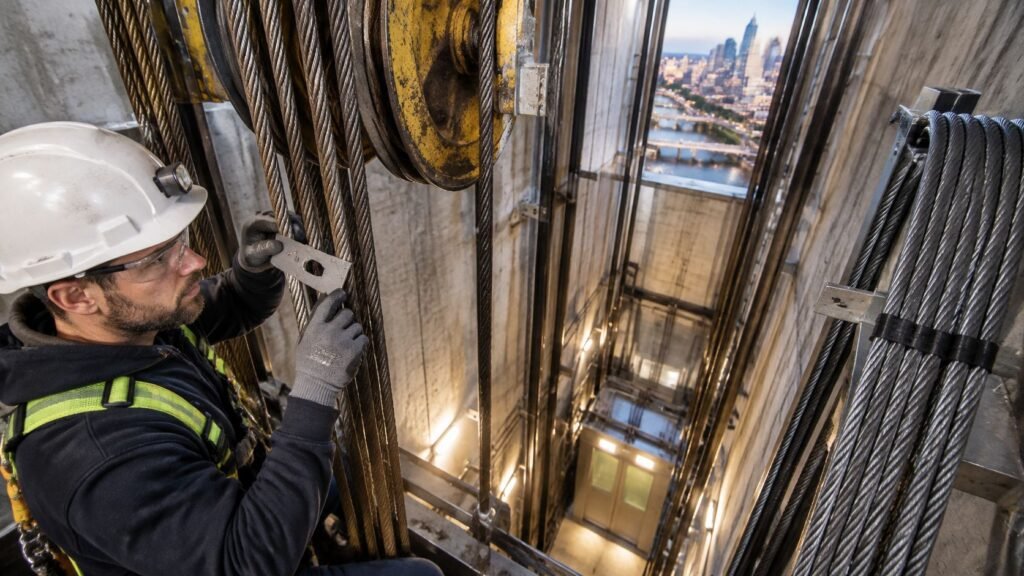
You've got an inspection finding, a replacement quote, and a shutdown nobody wants. From the car top, the ropes may look serviceable. Then the technician finds a flattened section near a termination, and you need to know whether you're authorizing necessary safety work or an incomplete repair.
For elevator cable replacement in Grand Rapids, the useful questions are specific: What condition requires removal? Does the entire suspension set need replacement? What damaged the rope? And what must happen before the elevator can reopen? A sound proposal answers those questions before you sign.
Cable Wear Signs That Mean Replace, Not Wait
A rope can look sound along the accessible run and still have serious damage at a termination or sheave. Judge it by the worst section, not by the cleanest visible stretch. Condition, not age, determines whether it stays in service.
Rope removal criteria
For elevator ropes, the applicable discard limits come from the elevator's governing code, the rope manufacturer, and the equipment's design requirements. The construction standard in Michigan's construction wire-rope safety standard applies to covered construction hoisting work. Its broken-wire and diameter figures are not elevator-rope discard limits.
| Condition | What to check | Action |
|---|---|---|
| Broken wires | Count and location against the elevator's applicable code and rope-manufacturer discard limits | If the limit is met, remove the affected rope and assess the matched suspension set for replacement |
| Diameter loss | Measure against the elevator's specified discard limit; do not apply a construction-rope percentage as an elevator threshold | If the specified limit is met, remove the rope and document the measurement |
| Heat damage | Look for evidence of heat exposure | Remove the rope |
| Serious distortion | Check for kinking, crushing, birdcaging, or flattening | Remove the rope |
| Corrosion or rouge | Record depth, location, and related deterioration | Have the qualified examiner determine disposition against the applicable elevator requirements |
| Rope idle for time | Check whether the rope has been idle for more than one month under the cited construction guidance | Inspect before returning it to service |
OSHA's wire-rope criteria establish the greater-than-5% trigger for covered hoisting applications. That trigger does not set the discard threshold for an elevator rope. Ask the technician to record the elevator-specific limit used, the rope measurements or wire count, and the resulting disposition.
Can only the damaged rope be replaced?
When a rope in a matched suspension set reaches its applicable discard limit, replacing the complete set is generally needed to maintain even load sharing. A single-rope replacement should have manufacturer or engineering approval, not rely on an improvised substitution.
Practical rule: Ask what measured condition requires removal, and what equipment condition caused it.
The replacement decision addresses the rope. The repair must also address why it wore. Check sheave grooves, lubrication, alignment, and rope tension before ordering materials. An assessment of elevator sheaves and bushings can help identify wear or fit problems that may damage the new set. Replacing rope without correcting the cause risks repeating the same failure.
Michigan Inspection and Permit Rules for Grand Rapids Elevators
A cable replacement can lead to questions about permits, testing, and state inspection. The answer depends on the elevator and the actual work scope. Confirm the applicable requirements with the licensed contractor before setting a shutdown date.
Michigan inspection and test intervals
| Equipment or task | Interval to verify | Owner record |
|---|---|---|
| Passenger, freight, inclined, limited-use elevators, material lifts, and similar devices | General inspection at least every 12 months. Verify the applicable code provision. | Inspection report and any correction orders |
| Dumbwaiters, platform lifts, and certain smaller devices | Inspection at least every 24 months. Verify the applicable code provision. | Inspection report |
| Car and counterweight safeties and governors | Maintenance inspections and tests at intervals no longer than 12 months. Verify the applicable code provision. | Certified test results |
| Drum-type machine with 1-to-1 roping, machine below or beside the hoistway | Reshackle ropes at car ends at intervals no longer than 24 months. Verify the applicable code provision. | Reshackling date and rope specifications |
| New, altered, or relocated elevator | Inspection and testing before service. Confirm the requirement for the project. | Applicable state inspection and acceptance documentation |
The intervals and related provisions should be checked against Michigan's elevator-code materials. Ask the contractor to identify the code section that applies to each interval in the proposal or inspection records. Construction-rope guidance has a different scope; its daily inspection provision is not a blanket requirement for passenger elevators.
Establish permit responsibility before shutdown
Permit and inspection requirements depend on whether the cable work qualifies as an alteration and whether related equipment changes are included. Have the licensed contractor make that determination for the specific job, including any changes to safety components.
Ask who will confirm permit requirements and coordinate any state inspection before the elevator returns to service. The Michigan Elevator Section's role and applicable procedures should be verified in the state's code materials and with the relevant state office, rather than assumed from a contractor's general promise to “handle compliance.”
Review the proposed scope against Michigan elevator code requirements, then get clear answers in writing:
- Permit responsibility: Who determines whether a permit is required, and who obtains it if needed?
- Inspection scheduling: Who requests the state inspection and coordinates access and attendance?
- Completion records: Which inspection reports, certified test results, and acceptance documents will the owner receive?
Keep the replacement decision tied to the elevator's condition and maintenance history. The removal criteria determine which ropes come out; the inspection should also identify whether sheaves, lubrication, alignment, or tension need correction. Otherwise, the new rope may face the same damaging conditions.
How to Replace Elevator Cables Step by Step
The process starts with a qualified-person examination, not an age-based order for replacement rope. For an owner, the purpose of understanding the sequence is to evaluate the scope, not to direct or perform hazardous elevator work.
This visual outlines the professional workflow; the contractor's equipment-specific procedure and required safety controls must govern the actual job.
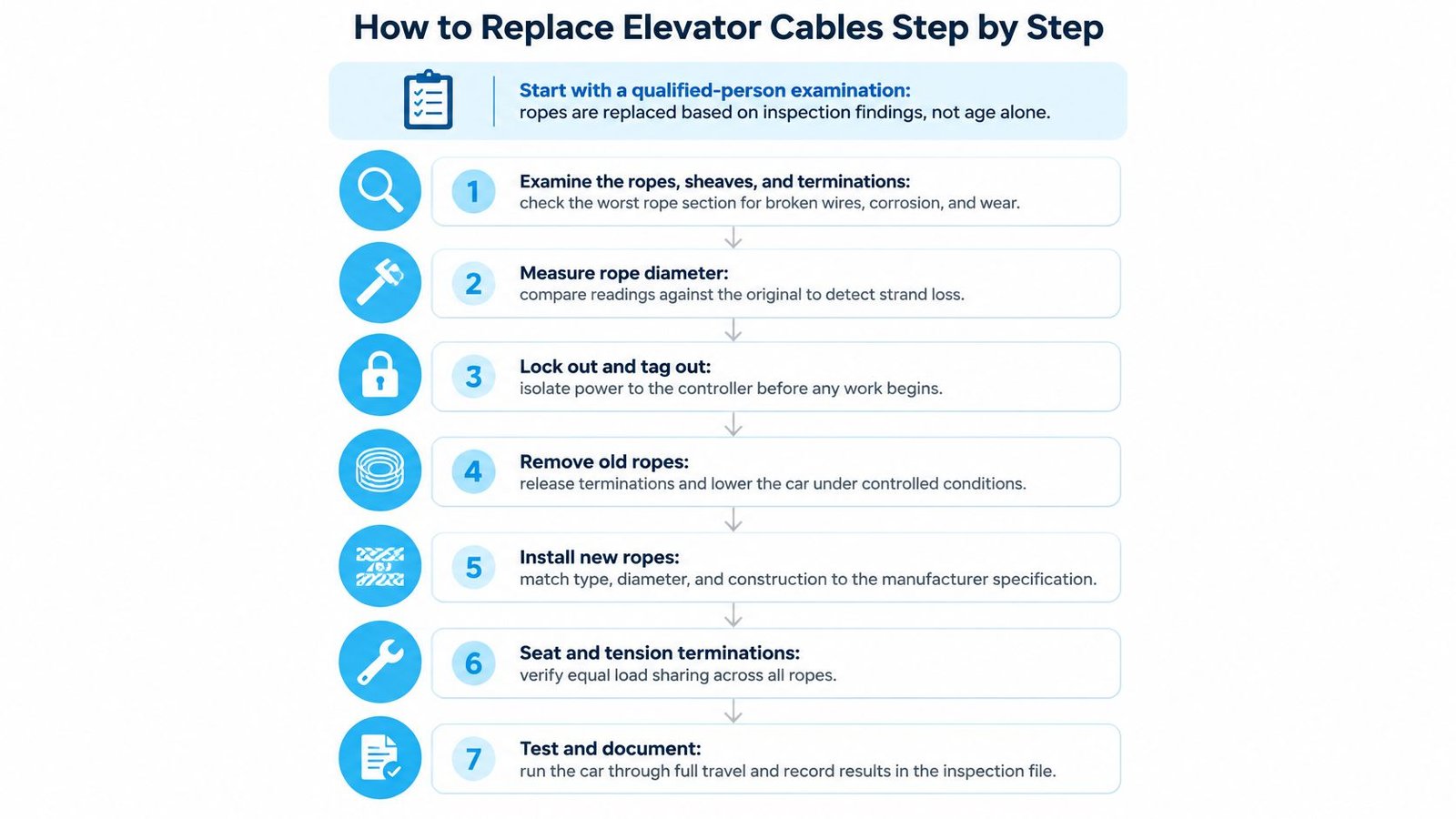
From examination to installation
Examine the complete suspension arrangement. The technician checks ropes, sheaves, and terminations and identifies the worst rope section. Looking only at a convenient length can miss localized damage near an anchorage or elsewhere along the travel.
Record rope construction, nominal diameter, lay length, strand and core type, lubrication, and equalizer condition. The common mistake is ordering by apparent diameter alone without confirming the equipment's required specification.
Measure at multiple locations with a calibrated rope gauge. Record the readings and their locations so the replacement decision can be checked. A measurement at a clean, lightly worn section doesn't describe the entire rope.
Confirm the replacement-set requirements against the manufacturer's instructions and ASME A17.6. Don't assume that matching the appearance of the remaining ropes establishes compatible performance.
Finalize scope and applicable permits before controlled removal. Qualified personnel establish barricades, isolation, lockout procedures, and the equipment-specific work method. A shutdown notice isn't a substitute for securing the equipment and work area.
Install the specified matched set and address sheave grooves identified during examination. Re-grooving or replacement should follow the applicable technical assessment, rather than accepting a damaged groove because the new rope fits into it.
Verify rope length, balance tension, and secure terminations. Record the checks instead of relying on a visual impression that the ropes hang evenly. The installation isn't complete just because every rope is in place.
Conduct low-speed and full-travel observations before the required testing and release process. Any abnormal tracking or movement needs resolution, not an assumption that it will settle after reopening.
A clean visual inspection alone is insufficient. Diameter loss, valley wire breaks, rouge, and incompatible sheave grooves can remain consequential even when the accessible rope surface looks acceptable.
The accompanying video provides additional visual context, but it doesn't replace an approved work procedure.
Get a project-specific timeline
Ask for examination and measurement at the initial assessment, followed by confirmation of manufacturer lead time. The contractor should then identify the installation shutdown window and inspection scheduling separately.
There's no defensible universal shutdown duration without knowing the equipment, access, related repairs, and approval requirements. Request each duration in writing, including what could extend it and when the contractor will notify you of a change.
Planning Downtime and Testing Before Reopening
A quick installation doesn't guarantee a quick reopening. If testing, documentation, or inspection coordination remains unfinished, the elevator may still be unavailable after the ropes are installed.
Michigan's maintenance inspection and testing rule connects maintenance work with required safety verification and certified results. Plan the release process before shutdown, not after the technician finishes the mechanical work.
Before the shutdown
- Notify occupants in writing. State the expected outage window, affected elevator, access restrictions, and contact for updates. Distinguish the installation target from the anticipated return-to-service date.
- Plan temporary accessibility. Healthcare, school, municipal, and residential managers should identify who cannot use stairs and arrange appropriate alternatives. Don't leave patients, students, residents, or staff to discover the access problem on arrival.
- Confirm work-area controls. Have the contractor identify responsibility for barricades, isolation, and coordination with building personnel. Building staff shouldn't remove barriers because the work area appears unattended.
- Reserve the verification work. Include rope-end and anchorage checks, testing personnel, and applicable inspection coordination in the schedule. These aren't optional tasks to fit around another appointment.
- Agree on the handover packet. Specify the contractor's completion statement, rope information, test results, inspection documentation, and any remaining correction items.
Before occupants return
The release checklist should address the installation and the elevator's operation as a system:
- Suspension verification: Confirm documented tension equalization and termination checks.
- Safety performance: Complete applicable brake, governor, and safety-device verification.
- Passenger operation: Check leveling, door-zone performance, and door operation.
- Emergency functions: Verify emergency communication and applicable emergency-operation functions.
- Approval status: Complete the coordinated state inspection when required and resolve conditions that prevent release.
A contractor's completion statement confirms its work status. It isn't interchangeable with the required inspection and test record. Keep both, and make sure the documents identify the equipment and work performed.
If the outage extends, have the contractor assess whether the idle-rope inspection requirement described earlier applies. Don't assume that inactivity eliminates the need for examination before movement.
The building's reopening announcement should follow verified release, not the moment the replacement ropes are installed.
Write an owner-protection requirement into the contract: no return to normal operation until the required inspection and test documentation is in the owner's hands. Have the contractor confirm how that handover will work before approving the shutdown.
Cable Replacement Costs and Financing Options
Planned work gives you time to compare scope, arrange access, and avoid making every decision during an outage. It doesn't guarantee a lower total price, but it gives you more control over scheduling and purchasing.
A credible Grand Rapids quote needs equipment-specific findings. Without rope specifications, access conditions, and the related sheave assessment, a published dollar figure would be guesswork.
Cable replacement cost drivers
| Cost driver | What raises the price | Quote request |
|---|---|---|
| Number of ropes | Replacement of the complete matched suspension set | Price per rope and total set price |
| Rope diameter and material | Equipment-specific elevator wire cable requirements | Rope specification, quantity, and unit price |
| Sheave and groove work | Re-grooving or replacing worn sheaves | Separate repair or replacement line item |
| Hoistway and machine room access | Difficult pit, overhead, or equipment access | Access labor and required arrangements |
| Permit and state inspection | Applicable fees and inspection coordination | Fees, scheduling responsibility, and included attendance |
| Downtime and temporary access | After-hours work and alternate access arrangements | Shutdown assumptions and temporary access costs |
| Planned versus emergency | Emergency mobilization and expedited materials | Planned lead time and any expedited-work premium |
Read the quote across the rows, not just at the total. A lower proposal may exclude sheave correction, inspection attendance, or access labor that another contractor has included.
Ask for related machine and sheave work separately. That lets you distinguish work necessary for the replacement from optional improvements. If a condition makes the proposed installation unacceptable, the contractor should explain that dependency rather than presenting it as an optional upgrade.
Financing without hiding the scope
Commercial elevator financing and modernization financing can spread an approved capital expense across a payment schedule. They're worth discussing when cable replacement accompanies broader modernization or when the building cannot absorb the project in its current capital budget.
Evaluate financing after the technical scope is clear. Ask for the financed amount, payment schedule, interest and fees, eligibility conditions, and any early-payment provisions in writing.
Budget check: Compare the cash project price with the total financing obligation, not just the recurring payment.
Don't use a manageable payment to justify an unexamined scope. First establish what must be replaced, what must be corrected, and what can reasonably remain in service. Then compare payment options for that defined project.
Book the Examination and Vet the Contractor
Before requesting a cable examination, gather the latest inspection report, rope specifications and installation date, reshackling records, maintenance history, running-rope logs if kept, and recent test certifications. Send the records ahead of the visit. The technician can compare current rope and sheave conditions with earlier findings, and note changes that may affect the replacement scope.
Michigan's Act 227 of 1967 established regulation covering elevator construction, maintenance, repair, operation, and contractor licensing. Keep cable work with the elevator's maintenance and safety records. A purchasing file alone does not show what condition prompted replacement or whether related defects were corrected.
Contractor verification checklist
| Verify | What good looks like | Red flag |
|---|---|---|
| State licensing | Current Michigan elevator contractor license, with its number on the quote | Cannot provide a license number |
| Examination before quote | Written rope and sheave findings, including measurements | Final replacement price without an examination |
| Non-proprietary capability | Documented equipment capability and parts-sourcing plan | Unexplained dependence on an exclusive parts source |
| Permit handling | Written responsibility and applicable inspection plan | Owner asked to bypass required permitting |
| Records | Maintenance history reviewed and a sample completion packet available | No documentation process |
| Insurance | Current liability and workers' compensation certificates | Certificates refused or expired |
| Response | Defined field-response arrangements and a named contact | Availability does not meet building needs |
| Quote | Itemized scope, with sheave and access work listed separately | Lump sum without meaningful detail |
Compare proposals against the same examination findings. A fast response cannot make up for missing measurements or an unclear permit plan.
Ask how the contractor will check the cause of wear, including sheave condition, lubrication, alignment, and rope tension. The removal criteria determine which ropes come out; the cause check determines what else needs correction. If those conditions remain unaddressed, new rope may wear prematurely too.
For non-proprietary service, ask what parts, settings, and records another qualified contractor would need to maintain the equipment. A general promise is not enough. The answer should reflect the actual elevator and available parts.
Resolve scope disagreements before signing
Compare the written examination with the applicable removal criteria and inspection schedule. If a proposal recommends replacement but does not identify the observed condition, ask for the finding and supporting measurements before approval.
A second opinion can help while the scope is still open. Ask the reviewing contractor to address both possibilities: replacement that is not supported by the condition, and related work omitted from the initial proposal.
A reliable elevator company may provide inspections, cable and sheave work, and testing documentation. Ask for the company's current written terms, and confirm which capabilities and records apply to your equipment and proposed job. Request a written scope rather than relying on a general service description.
After the work, keep the rope specification, installation record, measurements, and repair details with the maintenance file. Set a preventive-maintenance plan that records cleaning, examinations, and testing.
Do not authorize materials or an outage from a quote that lacks examination findings and a clear compliance plan. Have the contractor resolve those gaps before signing.
Bring the latest inspection report and cable proposal to Crane Elevator Company for an examination or second opinion. Request written rope findings, a separate sheave assessment, an itemized scope, and a permit-and-testing plan before scheduling the Grand Rapids shutdown.