
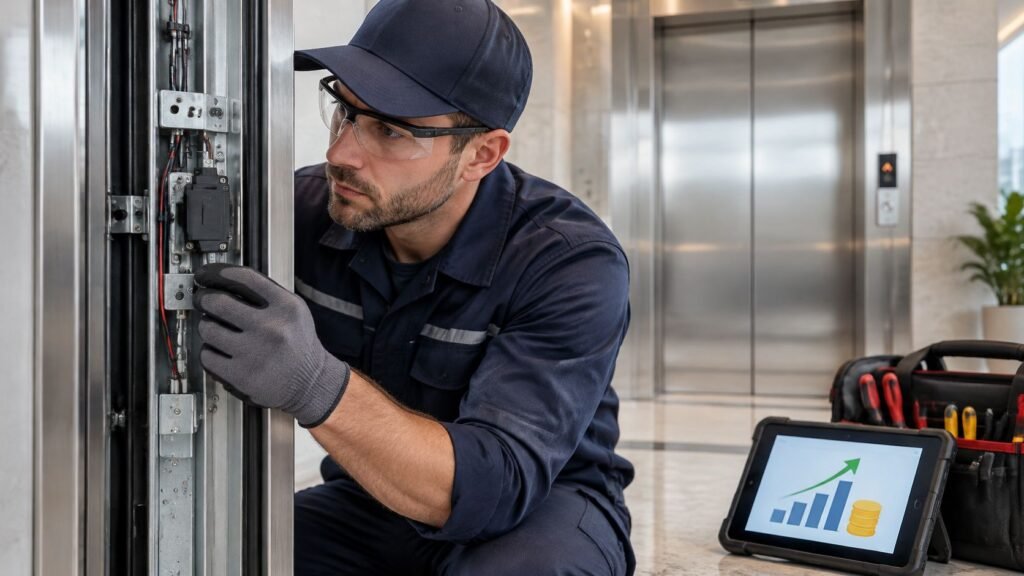
8A monitoring-only installation on an older traction elevator is typically planned at $15,000 to $25,000, while a complete modernization is typically planned at $85,000 to $350,000. Both are per-elevator planning figures, not fixed bids.
Most owners price the monitoring module and stop there. What if the quote that looks cheapest leaves the rollers, the controller inputs, and the acceptance test unpaid, so the job fails and comes back as a second project?
That gap is the budget question behind elevator door lock monitoring installation and cost. Hardware is one line. Passing inspection is the rest of the invoice.
Installation Cost Ranges at a Glance
| Benchmark | Typical range | Basis and scope |
|---|---|---|
| Illinois regulatory estimate, compliant upgrade | $10,000 to $25,000 per elevator | State regulatory analysis of proposed ASME requirements |
| Industry education presentation | $14,000 to $22,000 per elevator | Door-lock monitoring line item in an industry presentation |
| Savannah city procurement, nine elevators | About $7,636 per elevator | Up to $68,720 for hardware and software, before site conditions |
| Florida 2025 price guide, single elevator | $2,000 to $8,000 total | Installation and wiring alone estimated at $800 to $4,000 |
| Michigan price for your elevator | Set only after an on-site assessment and a written quote | Site assessment and written quote |
The Illinois regulatory analysis estimated a compliant door-monitoring upgrade at $10,000 to $25,000 per elevator, with the same discussion placing an older traction elevator at $15,000 to $25,000 against $175,000 to $350,000 for a complete modernization. Those are planning ranges for a proposed code path, not a bid for your controller.
An industry education presentation lists door-lock monitoring at $14,000 to $22,000 per elevator as its own line, separate from other modernization work. Use that row when a vendor buries monitoring inside a lump sum.
Procurement and regional rows
Savannah’s council record authorized up to $68,720 for hardware and software on nine city-owned elevators, about $7,636 per elevator before site conditions, taxes, or change orders, as shown in the November 2024 city council agenda. That is a procurement ceiling, not a market price.
A 2025 Florida price guide lists installation and wiring at $800 to $4,000, with a total single-elevator project of about $2,000 to $8,000. The spread against the other rows shows how far regional and scope assumptions can move the number. It doesn’t set a Michigan price.
Take three numbers into a budget meeting.
- Per-elevator band from the sourced rows: about $2,000 to $25,000, depending on which scope you are buying.
- Controller age and wiring: the total moves with those conditions, so a flat building price hides the unit that will fail testing.
- On-site time: no Michigan figure is real until someone opens the controller, counts landings, and writes the scope.
Function, Requirement and Timing
A seatbelt works the same way. The car shouldn’t move until the belt is latched. Door-lock monitoring applies that logic to the landing door and the car door. The controller looks for an open, unsecured, or faulty door circuit and blocks normal movement. Inspection operation and emergency modes stay available.
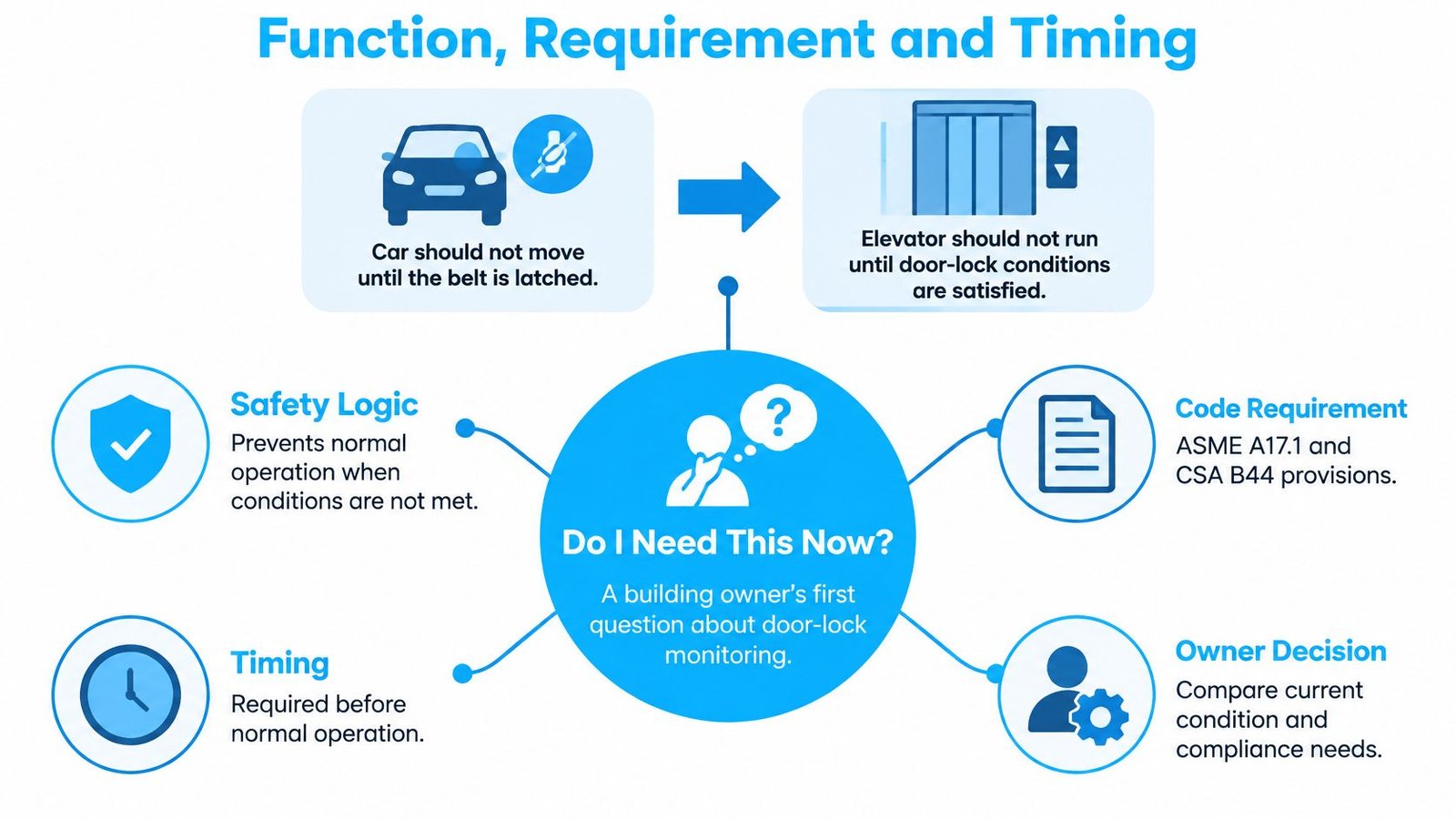
Do you need it this year, or only when someone alters the elevator? The honest answer is jurisdiction, equipment, and whether the work counts as an alteration. A generic national article that says every existing car must be retrofitted tomorrow is wrong for plenty of buildings.
Historical U.S. National Bureau of Standards research found that 73.8% of fatal elevator accidents examined might have been prevented by well-designed interlocks. Door interlock failures have caused serious elevator injuries and deaths over the years, which is why I treat monitoring as life safety, not a convenience board.
When the rule actually bites
Illinois draws a clean line. The state elevator FAQ says the 2019 ASME A17.1 requirement applies to new and altered elevators, while existing elevators without monitoring aren’t currently required to have it. Proposed newer rules would add a retrofit deadline for automatic passenger and freight elevators with power-operated, mechanically coupled doors. An inspection notice, a modernization permit, or a rule change can create a different duty than a blog post assumed.
Michigan owners shouldn’t copy Illinois dates onto a Lansing hospital or a Detroit school. Ask the state authority or the inspector for a written determination, and note whether the doors are mechanically coupled. Our door lock monitoring work starts from that written call, not from a national deadline.
Budget by scenario: install now, install when you alter the car, or document a monitored deferral. Don’t promise one universal date.
That written call also sets the money question. A monitoring add-on on doors with tired rollers and an aging controller is a different job than a clean retrofit, and the quote should say which one you’re buying.
Door Parts That Shape the Monitoring Scope
Price follows the parts a technician touches, starting at the landing and ending in the controller.
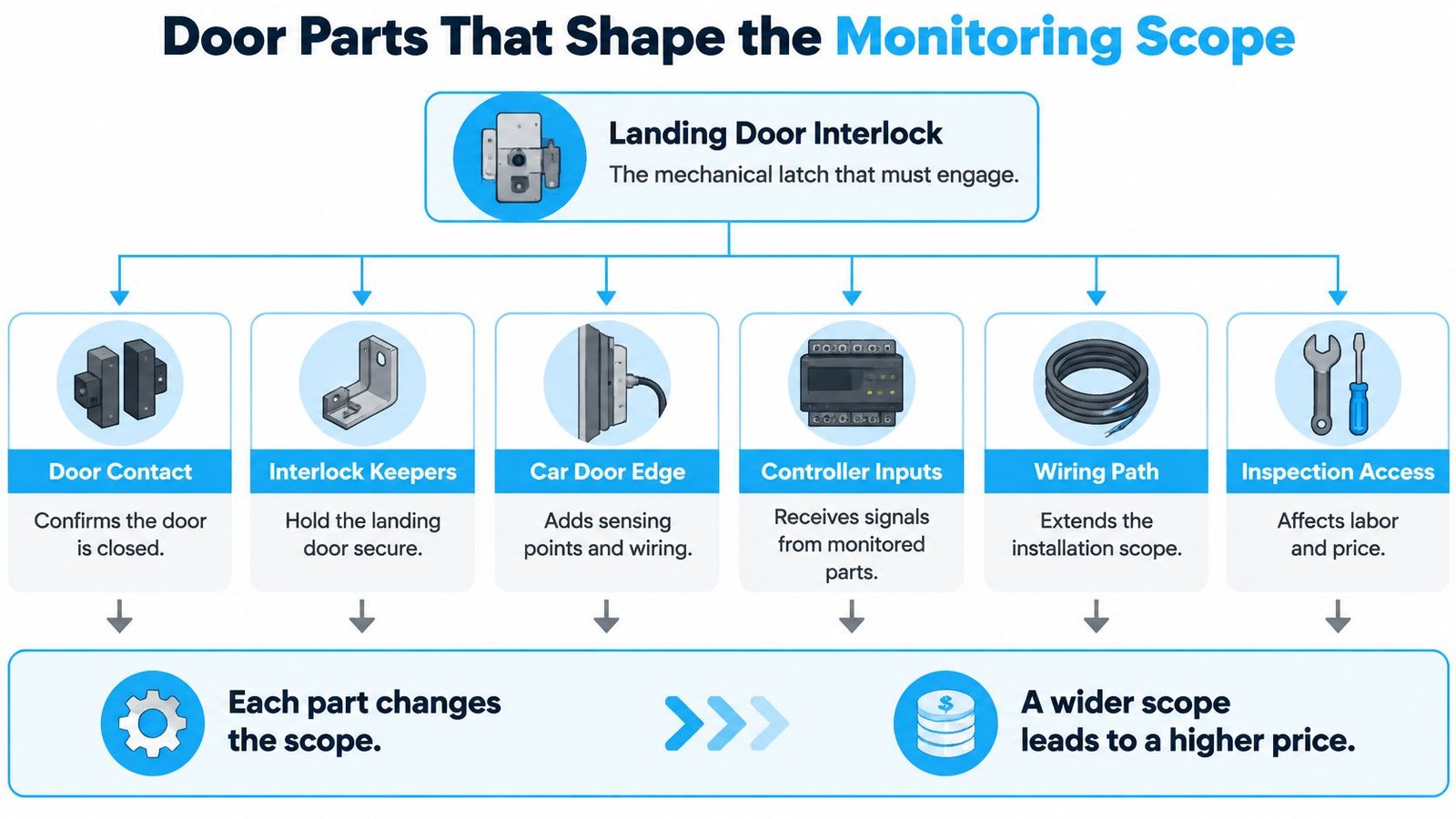
Michigan’s elevator code requires each hoistway door to have an approved interlock, a mechanism that prevents operation unless the landing door is secured, as set out in the Michigan elevator code. The locking member has to engage before the circuit may report the door as locked. A relay strapped across a latch that does not fully throw bypasses the protection the circuit is supposed to prove.
From the contact back to the controller
The car-door contact closes only when that panel is shut, and the wiring has to carry a true signal rather than a short, a jumper, or a corroded splice in the header. Controller logic then inhibits normal motion when a contact opens, shorts, or is jumped. Spare inputs are the fork in the road: an older relay or early microprocessor controller with no spare safety input turns a monitoring job into a controller job.
On power-operated doors, one door operator drives the car panel and, through a clutch, the landing panel. Roller guides and door hangers keep both panels on the track. Worn rollers are the fault most often missed. The door drifts, the contact no longer closes cleanly, and the fault looks electrical. Relays get replaced while the panel still rubs the sill.
That is the budget split a low quote can hide. Monitoring hardware is one line; rollers, hangers, operator adjustment, controller inputs, and testing are the lines that decide whether the door can prove locked. Walk the entrance before you accept a hardware-only price. Our door maintenance checks use the same list.
- Sill contact: the panel rubs, chatters, or leaves a bright wear line.
- Panel gaps: the meeting gap is wide at the top and tight at the bottom, or the reverse.
- Close time: the door creeps, stalls, or needs a push to latch.
- Nuisance faults: the car shuts down on door faults, then runs after someone slams the panel.
A monitoring relay will not square a worn hanger. If the checklist shows wear, budget rollers and hangers in the same shutdown, and keep inspection, diagnosis, wiring or controller work, replacement parts, and violation correction as separate items. The cheapest proposal can be a second project if it prices only the relay and leaves a rubbing panel, a weak clutch, or a controller with no spare input for later. Crane Elevator Company lists door-lock monitoring upgrades with its safety and compliance work and modernizes hydraulic and traction equipment, so door hardware and controller scope can be priced in one visit.
How to Install and Test Door-Lock Monitoring
Under ASME A17.1/CSA B44, the controller must prevent normal driving-machine operation when the required door-lock or closed-position conditions aren’t satisfied. The door-locking devices guidance sets the mechanical bar: the locking member needs at least 7 mm (0.28 in.) of engagement before the detection circuit may call the door locked and before the machine may run, except for specifically permitted access, leveling, or zoning. A falsely closed circuit defeats the protection. Some jurisdictions tie the monitoring requirement to new and altered elevators, and some cities extend it to existing automatic passenger and freight cars. Your inspector’s adopted edition still governs.
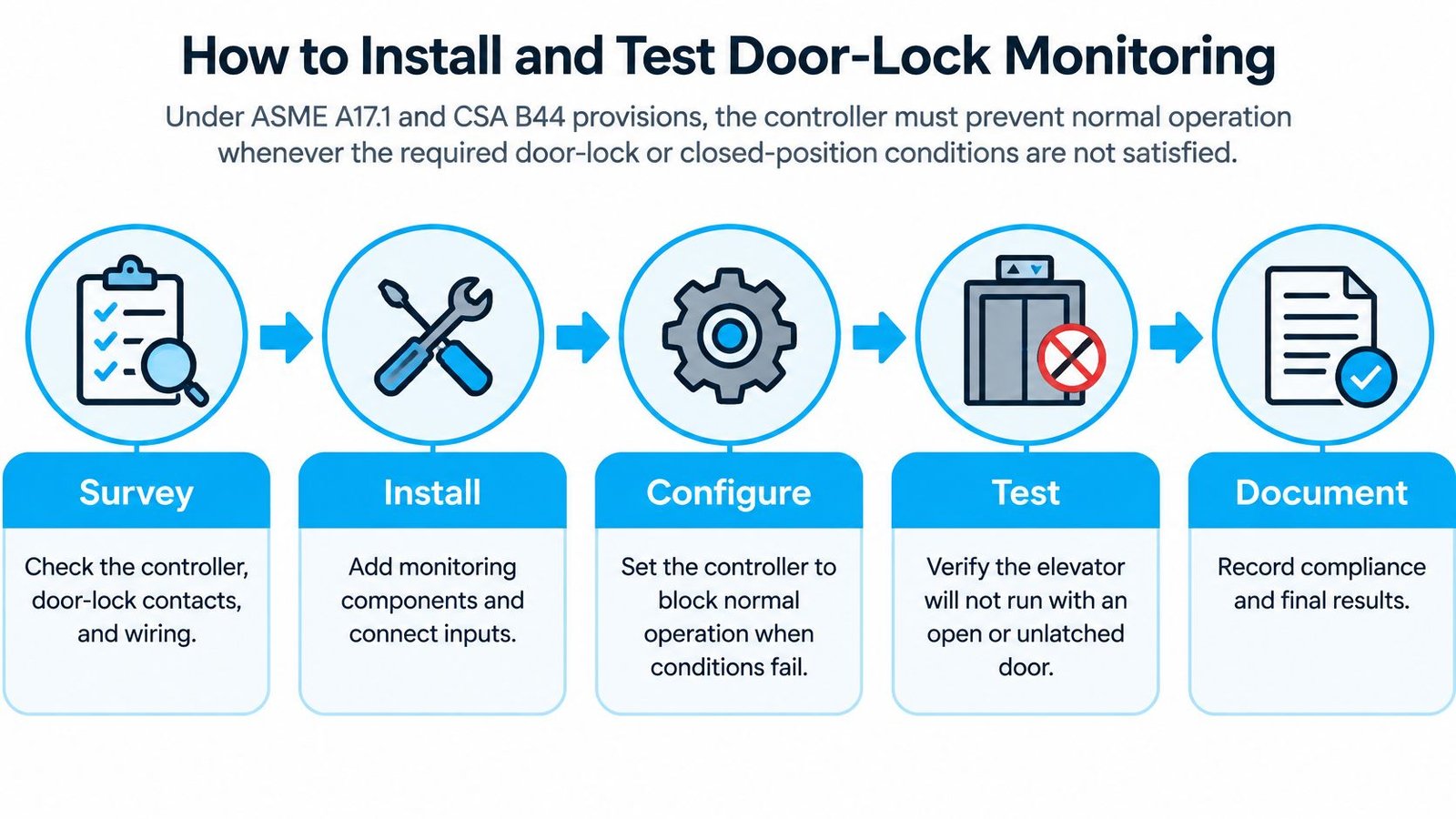
Door Lock Monitoring installation and upgrades are a defined scope that reaches past the door operator itself. I would not start wiring until the survey and the permit language match.
Seven steps and the usual miss
- Survey every landing and the car. Record controller type, spare inputs, and each interlock. Pricing from the elevator’s age alone misses a fried contact on floor 3 and a full spare rail on floor 1.
- Lock the permit scope and the code edition with the inspector before any new wire. An alteration can pull the monitoring requirement in. Starting because the parts arrived is how a passed rough-in becomes a failed final.
- Prove mechanical engagement to at least 7 mm (0.28 in.). Watch the latch throw, then watch the contact. Wiring a relay over a worn latch lets the car run with a door that isn’t locked.
- Land the contacts, the wiring, and the controller logic together. An open or misaligned contact has to inhibit normal motion. Permitted access, leveling, and zoning stay only where that code edition allows them. This step runs longer because logic and mechanics have to agree. A neat wiring photo with the wrong bypass still fails.
- Test every landing interlock and every car-door circuit on its own. Include fire service and emergency operation, and confirm no single fault allows normal movement. Testing the lobby and calling the rest “the same” is the miss that shows up when the inspector picks floor 4.
- Write each result against its landing, then book the authority-having-jurisdiction inspection. Incomplete records make a good install look unfinished. The passed job is the one where every landing stops the car when its door opens, and the paperwork names that landing.
- Confirm warranty and the maintenance interval before the car returns to automatic. A monitor that nobody retests after the first door adjustment drifts back to a jumper culture.
Crane Elevator Company performs no-load and full-load tests on time and guarantees that customers save money on testing. The company also manages violation resolution and the mandated CAT 1, CAT 3, and CAT 5 safety inspections, so the monitoring test stays tied to the category testing the state already expects.
What Drives the Quote and How to Compare Bids
Say a five-stop traction passenger elevator has an aging controller and worn landing interlocks. Bid A is a monitoring-only overlay: relays, a couple of contacts, a short shutdown. Bid B replaces the bad interlocks, integrates the controller, and plans the downtime. Bid A wins the spreadsheet. Then the controller can’t accept the logic, or the worn latches fail the engagement check, and a second project shows up within a few years. The cheap quote wasn’t cheap. It was a deposit on the complete job.
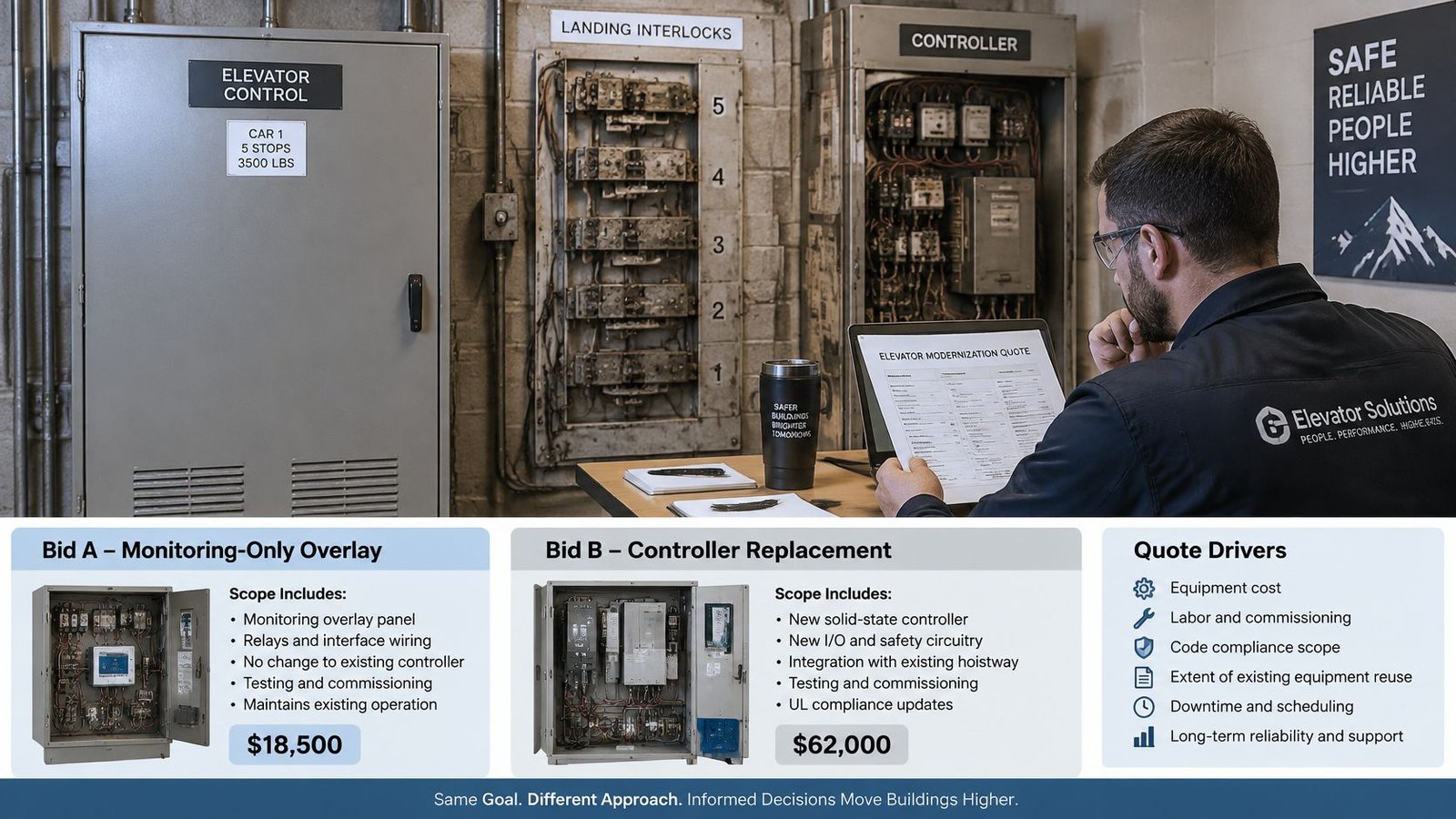
What a fair quote itemizes
Split the price so you can see the pass-fail work, not just the module.
- Diagnostic and code review: controller photos, landing count, and the edition the inspector will use.
- Monitoring hardware: relays or safety inputs, not a mystery “kit.”
- Contacts and wiring: car gate, each hoistway interlock, and the traveling cable if it’s full.
- Controller programming: only if spare, safety-rated inputs exist.
- Labor and travel: nights and weekends called out, not folded in.
- Access and shutdown: how long each car is out, and which car stays in service.
Exclusions that turn a low number into a second invoice are worn interlock replacement, a controller upgrade because there is no spare input, roller or hanger correction, and retesting after a failed inspection. Hold any bid far under the published per-elevator bands to that list. Those public figures are regulatory, educational, or regional, not a universal street price, but a bid that can’t name its exclusions isn’t a bargain.
Ask four questions on every bid: Is this an overlay or a modernization? What is excluded? What does the warranty cover? How much downtime should I expect?
Compare per elevator and per monitored landing, not as one building total. A six-car group with two swing-door landings isn’t six copies of the cheapest car.
We give a free, no-obligation quote on compliance and violation work, and we will beat a competing proposed price under a guaranteed price match. Elevator financing, including modernization and commercial elevator financing, is available when the right fix is the controller rather than another overlay. I’d rather finance the job that passes than discount the one that comes back.
Michigan Inspection Intervals and Recurring Budget
Monitoring hardware is a one-time invoice. Michigan’s inspection calendar is the recurring part of the spend, and it runs by device type, so a building with mixed equipment carries more than one budget rhythm.
| Equipment | Minimum inspection interval | Budget effect |
|---|---|---|
| Passenger and freight elevators, material lifts, barrier-free lifting devices, escalators, moving walks | At least every 12 months | Annual line item |
| Dumbwaiters, stairway chairlifts, one-person elevators, platform lifts, power sidewalk elevators | At least every 24 months | Every two years |
| Personnel hoists | At least every 30 days | Monthly schedule |
The Michigan elevator licensing rules require passenger and freight elevators, material lifts, barrier-free lifting devices, escalators, moving walks, and other listed devices to be inspected at least once every 12 months. Dumbwaiters, stairway chairlifts, one-person elevators, platform lifts, and power sidewalk elevators need inspection at least once every 24 months. Personnel hoists must be inspected at least every 30 days. Owners schedule the qualified inspection, correct violations, and keep the equipment operable.
A three-year stack
A single annual guess misprices a mixed building. Price each device off its row.
- Annual cars: count each passenger and freight elevator once a year for three years. That’s three inspections per car before any repair. Barrier-free lifting devices ride this same line, which is where a wheelchair lift classified under that category lands.
- Biennial devices: dumbwaiters, stairway chairlifts, one-person elevators, platform lifts, and power sidewalk elevators each land twice in the same three years. Confirm the classification before you count. A wheelchair lift on the barrier-free row and a platform lift in the same building carry different intervals.
- Personnel hoists: 12 checks a year, 36 in the window. Keep that off the passenger line.
- Correction contingency: any violation has to be fixed for the device to stay in service. Carry a repair allowance for the door work a monitoring inspection turns up, so a flagged car returns to service on a scheduled visit.
The monitoring hardware sits in year one. The roller, controller, and correction work shows up on this calendar, which is why the install quote and the inspection budget belong on the same page.
Book the monitoring acceptance test on the same visit as the required state inspection. One shutdown covers both.
We provide state testing and inspections, violation corrections, preventive maintenance, repairs, and modernization across these device types. Booking state-mandated elevator testing on the visit you already owe keeps a door-lock upgrade tied to an interval you already fund.
Request a Door-Lock Monitoring Review for Michigan Elevators
Crane Elevator Company is family-owned, with over 25 years in the trade, and serves communities across Michigan and Ohio, including Detroit, Ann Arbor, Lansing, Flint, Kalamazoo, and Birmingham, plus surrounding communities. A hospital passenger car and a freight elevator on a loading dock take the same scope language, because a monitored door circuit works the same way on both.
One crew can carry the related work so the monitoring relay doesn’t sit alone on a car that still has a worn latch. The scope can cover door-lock monitoring upgrades and emergency phone installation and upgrades, preventive maintenance, state testing and inspections, violation resolution, major and minor repairs, non-proprietary hydraulic and traction modernization, and emergency response. Equipment runs from passenger and freight elevators to residential elevators, wheelchair and material lifts, and dumbwaiters.
Why the combined visit holds up
The hardware-only line is where a low quote gets cheap. It prices the monitoring device and nothing else, so the dragging roller, the dirty contact, the controller wiring, and the acceptance test that decides whether the job passes are still waiting on a second invoice. An isolated install also leaves the dead emergency phone and the open violation for another shutdown. Combining them means the door, the controller, and the paperwork get judged together, and the cheapest quote stops looking like a finished job.
Maintenance follows a No Show, No Pay policy, and the visit is guaranteed to be done right every time. That matters when the monitoring test has to land on the state’s interval rather than a missed appointment.
Send this, and ask for the written scope the same week.
- The elevator list: each car or lift, with stops and door type.
- Controller age: nameplate year, or a photo if the plate is gone.
- The last inspection report: open violations included.
- The scope you want named: code edition, number of monitored circuits, included parts, test steps, and exclusions.
That package is enough to separate an overlay from a modernization before anyone sells you the cheaper one. If the answer comes back as one line and one number, treat that bid as the first of two projects.
We install and test door-lock monitoring, correct the door and controller faults that make a low quote fail later, and tie the work to Michigan’s inspection intervals. If you manage a passenger car, a freight elevator, or a wheelchair lift, start with a written scope instead of a hardware-only price. Visit Crane Elevator Company and send your elevator list, controller ages, and last inspection report.