
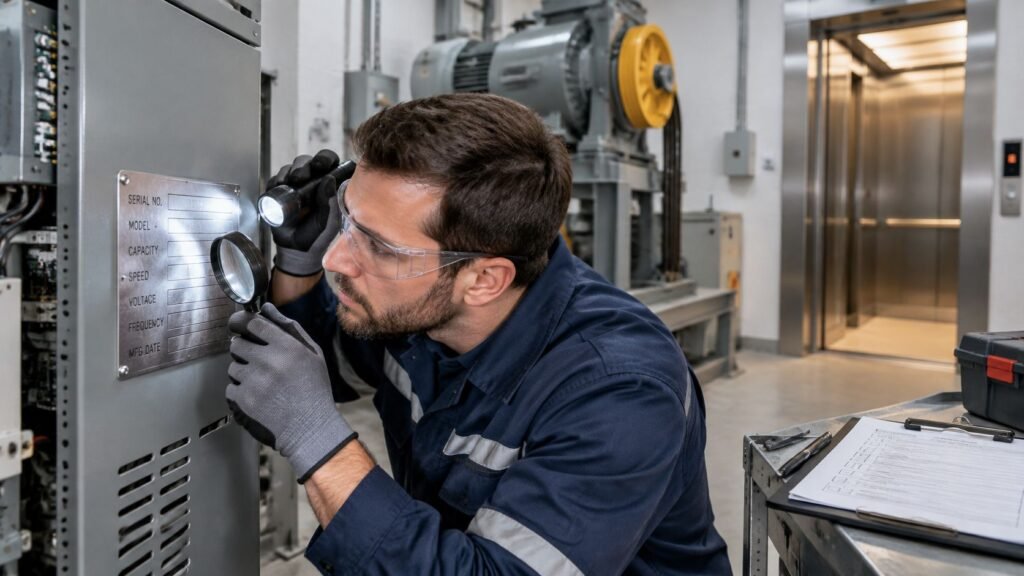
Your elevator inspection is approaching, and you've pulled the service folder from the office cabinet. The last repair invoice lists a replacement controller, but the identification plate still carries the original manufacturer's name. Before you order another part or assume the paperwork is complete, someone needs to establish which record describes the equipment that's installed.
An elevator repair company should start that reconciliation with the data plate, not treat it as a label to replace at the end of a job. For a building owner, the useful question is simple: can you connect this physical elevator to its permits, maintenance history, tests, and alteration records without guessing?
Required Fields on an Elevator Data Plate
Say an inspector arrives and starts by reading the plate. The information identifies the equipment and provides a starting point for comparing its physical condition with the owner's records. A discrepancy at this stage can change what the inspector needs to investigate.
A data plate is a durable identification label containing technical information about the elevator or a particular assembly. Don't confuse it with the inspection certificate, the passenger capacity sign, or a component nameplate. An elevator may have several plates, and no single component label necessarily contains the complete installation record.
Read the identifying information first
Start with the manufacturer and model. These identify the maker and equipment design, but check whether the label describes the whole installation, the controller, or the driving machine. The controller is the equipment that directs elevator operation; the drive regulates the motor's movement.
Next, read the serial number, the identifier assigned to that unit or component. Record its label location along with the number so a controller serial doesn't accidentally become the elevator's installation identifier.
Then examine rated load, the permitted car load in pounds or kilograms, and rated speed, the designed operating speed, commonly expressed in feet per minute. The governor is a speed-monitoring safety device, not another name for the drive.
Finally, identify the installation or alteration year and any code designation. The year helps establish the applicable requirements, but it doesn't determine them alone. The adopted code, alteration scope, and jurisdiction's requirements also matter.
Data plate fields and what each one records
| Field | What It Records | Why Inspectors Check It |
|---|---|---|
| Manufacturer and model | Maker, model and controller type | Identifies which code provisions and service parts apply |
| Serial number | Unique unit identifier | Matches the plate to permits, service history and recall notices |
| Rated load | Maximum car load in pounds or kilograms | Must match the load label inside the car |
| Rated speed | Designed car speed in feet per minute | Checked against drive and governor settings |
| Year installed or altered | Date of installation or last alteration | Helps determine which code edition governs the unit |
| Code edition or classification | Standard the unit was built and inspected under | Sets the scope of tests and inspections |
Separate a missing field from missing equipment information
Use these fields as a reconciliation checklist, not proof that every elevator must display an identical plate layout. The applicable elevator code requirements establish what identification and marking the particular installation needs.
A blank or unreadable field is a documentation gap. Preserve what's legible, record where the plate sits, and obtain the missing information from an authoritative equipment or permit record rather than filling it in from memory.
Where to Find the Plate on Each Elevator Type
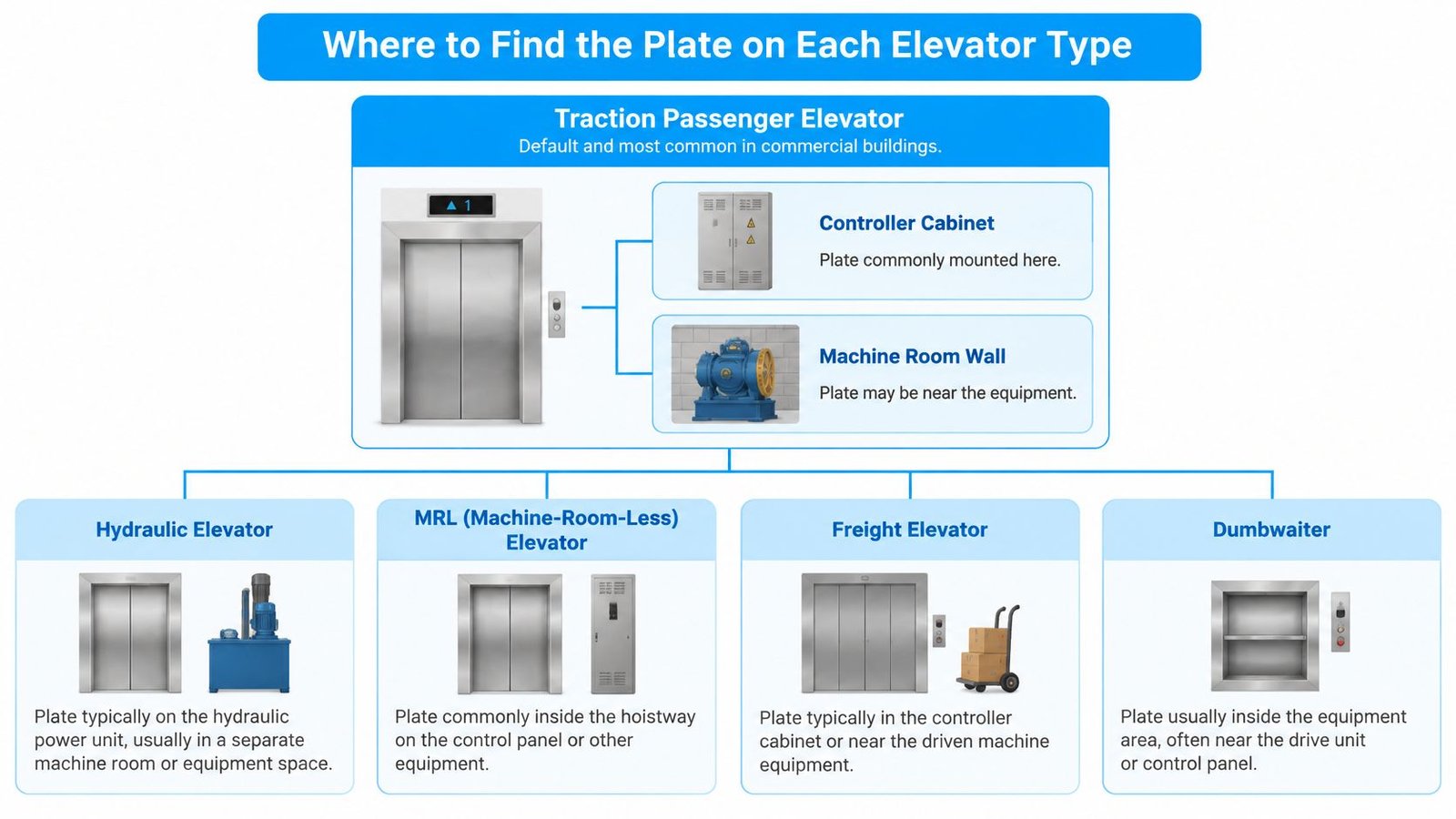
Start with a traction passenger elevator, which moves the car through a machine acting on suspension ropes or belts. For a conventional machine-room installation, the controller cabinet and machine-room wall near the entrance are useful first locations. The car operating panel, the passenger button panel, is another place to check for identification.
These are search locations, not permission for an owner to enter restricted spaces. Have the elevator technician inspect locked equipment areas, open enclosures, and inaccessible surfaces.
Match the search to the equipment
A hydraulic elevator uses pressurized fluid and a jack to move the car. Its power unit includes the pump, motor, valves, and fluid tank. Check identification at the power unit and controller, but distinguish the tank or motor nameplate from the installation's code information.
A machine-room-less elevator, often abbreviated MRL, doesn't have a conventional machine room. Its designated control space or access cabinet becomes the technician's starting point. Don't assume a missing machine room means the elevator lacks identification.
Home elevators and platform lifts have different arrangements again. A platform lift carries a user on a lifting platform rather than in a conventional enclosed elevator car. Identification may be close to the platform, controller, or landing controls.
Typical plate locations by elevator type
| Elevator Type | Usual Plate Location | Where to Check First |
|---|---|---|
| Traction passenger | Controller cabinet or machine room wall near the door | Machine room, then car operating panel |
| Hydraulic passenger | Power unit or controller in the machine room | Power unit tank area, then car panel |
| Residential home elevator | Car operating panel or controller enclosure | Inside car near controls, then hoistway door frame |
| Wheelchair or platform lift | Lift base or controller near the platform | Platform underside, then call station |
| Dumbwaiter or material lift | Car frame or entry landing | Landing frame at each floor served |
Record the search, not just the result
For a dumbwaiter, a small conveyance for goods rather than passengers, identification may be associated with the car frame or a landing entrance. Material-lift identification likewise needs to be matched to the actual device, not merely a nearby electrical enclosure.
Our residential division maintains and repairs home elevators and wheelchair lifts using the same record-first approach. The search proceeds through the equipment space, car or platform, and landings as applicable.
Access rule: Owners can photograph accessible labels. A technician should handle any search requiring enclosure access, hoistway access, or work beneath a platform.
If the plate still can't be located, enter plate not located in the equipment history and list the places checked. That gives the next technician a useful starting point without claiming the equipment never had a plate.
What a Mismatched Plate Value Signals
A number on the plate that does not match the file starts an equipment record check. The plate is the starting point, so the mismatch gets traced back through permits, alteration records, and service history before an inspector flags it.
Manufacturer and model. The installation file may name the original controller, while the cabinet now holds a different control system. That pattern often points to a controller modernization with supporting documents filed separately. The original parts list does not apply automatically to the replacement controls, and each document needs to be matched to the equipment installed.
Serial number. A different serial on a door operator does not change the identity of the elevator by itself. The door operator is the mechanism that opens and closes the car doors, and it can carry its own serial number apart from the car or controller. First identify which component each number belongs to. Then look for that component's replacement record.
Rated load. When the technical record and the car sign disagree, causes include a replacement sign, a transcription error, or an undocumented alteration. Do not settle it by picking the larger value. A qualified technician establishes the authorized capacity from the equipment configuration and the approved records. The sign follows that finding.
Rated speed. Compare the recorded speed with the authorized operating configuration and the test documentation. A car running faster than its approved rating is a safety problem, not a paperwork problem. Drive settings and governor data require qualified technical review. Owners should not adjust them.
Read the year against the adopted code
An older installation year does not automatically mean noncompliance. A recent controller label does not prove every part of the elevator is new. The plate year tells you which code cycle likely applied at installation or alteration, and nothing more.
The Michigan code-books page identifies an elevator code effective June 27, 2023, incorporating the 2016 ASME A17.1 Safety Code for Elevators and Escalators and the 2017 ASME A18.1 Safety Standard for Platform Lifts and Stairway Chairlifts.
The authority having jurisdiction is the agency responsible for enforcing the applicable requirements. It determines how the adopted edition and amendments apply to a specific installation or alteration. Crane Elevator Company applies this statewide framework to non-proprietary repair and modernization for building owners across Michigan and Ohio, including Detroit, Toledo, Ann Arbor, Lansing, Perrysburg, Flint, Kalamazoo, and surrounding communities. Non-proprietary controls are control systems that another qualified service provider can maintain. They still require a documented alteration record.
A conflicting value should remain an open discrepancy until the equipment, permit history, and technical documentation support the same conclusion.
How Inspectors Use the Plate During an Inspection
The plate supplies an identification reference for the inspection. It doesn't prove that maintenance occurred, that a test passed, or that an open violation was corrected.
An owner can prepare by arranging the records so the inspector can follow the connection from the installed equipment to the documented work. The actual inspection procedure and required tests remain subject to the applicable jurisdiction and equipment type.
Follow the identification and verification sequence
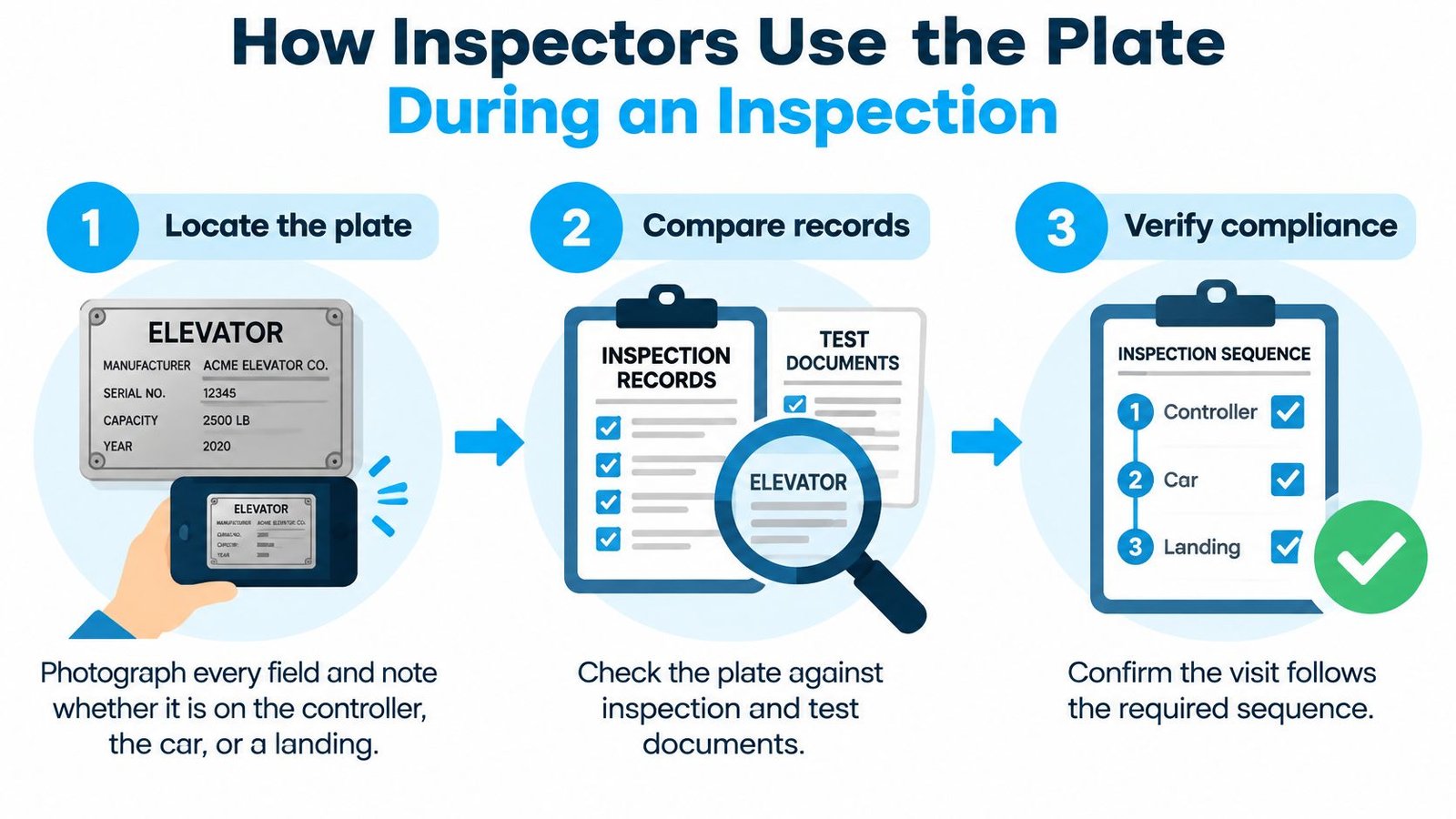
Locate and document the plate. Record its position and photograph each legible field. Include an overall photograph showing whether it belongs to the controller, car, machine, or landing so an isolated close-up doesn't lose its context.
Compare the equipment identity with the file. Check the manufacturer, relevant serial number, installation or alteration information, and code designation against permits and the permanent equipment history. Investigate conflicts before accepting the file as a description of the current installation.
Compare operating ratings with supporting records. Match the rated load to the car sign and authorized documentation. Review the rated speed against recorded testing and the equipment's approved configuration.
Review test status and corrective actions. Check the applicable safety and governor test records, including dates, results, deficiencies, and evidence that corrective work was completed. A scheduled appointment isn't proof that a test occurred.
Keep unsafe equipment out of use. Where a defect affects safety, the elevator must remain out of service pending appropriate correction and documented authorization to reopen. Owners shouldn't bypass devices or attempt a restart to keep traffic moving.
Keep the safety rule in its proper scope
OSHA's maritime-terminal elevator regulation prohibits use of elevators with safety-affecting defects and bypassing safety devices within that regulation's scope. It shouldn't be presented as the inspection schedule for every Michigan office, hospital, or residential building.
For an isolated unit, the technician should document the defect and isolation status and control access to restricted spaces. The owner's record should identify who can authorize reopening and what verification remains outstanding.
A matching plate makes identification easier, not inspection optional. A conflict can require further investigation, additional testing, or a correction notice, depending on what the inspector finds.
Assign someone in building management to maintain the schedule and retain the history. A service contract names a provider; it doesn't demonstrate that an individual inspection, repair, or filing has been completed.
Diagnosing Missing or Incorrect Plate Data
A plate may become unreadable beneath paint, through corrosion, or after equipment replacement. Don't scrape, solvent-clean, or remove it before the technician has assessed whether that could destroy remaining information.
Begin with photographs, the equipment identifier used by the jurisdiction, and the permit file. The technician should distinguish between a missing identification plate and missing documentation for an alteration.
Pair each symptom with evidence
Plate data symptoms, causes and fixes
| Symptom | Likely Cause | Fix |
|---|---|---|
| Plate missing or unreadable | Paint, corrosion or removal during modernization | Licensed journeyperson verifies values from equipment and permit records, then arranges the appropriate replacement plate |
| Serial number differs from records | Component replacement without updating history, or comparison of different component identifiers | Identify the component, update the equipment history and attach replacement-parts records |
| Rated load differs from car label | Undocumented alteration or replaced label | Establish authorized capacity, perform required verification testing, then correct the label and records |
| Year blank or wrong | Original plate lost and year entered from memory | Confirm the year from permit files or manufacturer records |
| Code classification outdated | Record not reviewed after an alteration or a change in applicable requirements | Schedule a code review and document the required scope with the inspector |
These are diagnostic possibilities, not automatic conclusions. For example, an updated code adoption doesn't necessarily require an older elevator to receive a new classification plate. The review must establish whether a requirement applies.
Keep technical work with the licensed person
The Michigan elevator permit guidance requires installation, alteration, maintenance, repair, servicing, inspection, adjustment, and testing to be performed by a licensed elevator journeyperson, with helpers under that journeyperson's immediate supervision. The framework also covers platform lifts, stairway chairlifts, belt manlifts, and related devices.
The owner's role is to assemble records and authorize the investigation. The journeyperson's role is to establish the equipment facts and carry out the technical correction within the applicable permitting and inspection process.
A straightforward identifier check may be resolved during a service visit. A capacity dispute or alteration review may require manufacturer documentation, engineering information, testing, and inspector coordination. Don't promise a return-to-service date before those dependencies are known.
Our work covers commercial, industrial, healthcare, education, municipal, and residential properties across Michigan. For an unresolved existing or ongoing problem, we provide a second opinion at no extra charge, including a visit and solution plan; compliance and violation work also qualifies for a free, no-obligation quote.
Documentation standard: The correction record should explain where the replacement value came from, who verified it, and which supporting document was retained.
Tying Plate Data to Maintenance and Violation Records
The work order should connect equipment identity to the work performed. It should name the conveyance type, meaning the kind of elevator or lift, and identify the applicable code edition, local amendments, relevant history, safety deficiencies, tests, replaced parts, and return-to-service authorization.
ASME's A17.1/CSA B44 safety-code overview places installation, operation, inspection, testing, maintenance, alteration, and repair within a shared safety framework. That distinction matters because a maintenance visit and an alteration aren't interchangeable entries in the equipment history.
Reconcile the permanent history
Copy the identification fields accurately. Preserve the original wording and units, and state which plate or assembly supplied each value. Attach the location photographs rather than relying on a typed transcription alone.
Match identifiers to permits and alterations. Connect a replacement controller or machine to its work order, parts documentation, permit where required, and acceptance records. Keep the superseded record as history instead of deleting it.
Compare completed tests with the applicable schedule. Record actual completion dates and results separately from planned appointments. Use the Michigan interval table to distinguish recurring work from event-triggered verification.
List open violations and closure evidence. Attach the correction work order and any required acceptance or filing confirmation. An invoice marked paid doesn't establish that the jurisdiction closed the violation.
Flag repeated component defects. Group callbacks by component and symptom. Repeated door faults, for example, warrant checking adjustment, compatibility, and replacement history rather than treating every callback as unrelated.
Use the history to ask better technical questions
A recurring defect doesn't prove the plate is wrong. It does justify checking whether the installed component agrees with the documented configuration and whether a previous repair addressed the underlying cause.
For properties arranging elevator maintenance in Traverse City, the same record structure can support both routine service and a later alteration review. Keep technical reports, owner observations, and regulatory notices distinguishable so nobody mistakes a tenant complaint for a completed inspection.
The strongest inspection file connects identification, condition, work, and verification. A plate-matched history gives the inspector traceable evidence, while preserving the unresolved items that still need attention.
Michigan Test Intervals That Depend on Your Plate Data
A data plate works like a name tag for test timing. Speed, capacity, drive type, and year tell which interval applies, so a wrong entry sends the schedule in the wrong direction. Read the plate first, then match each value to the testing rule that cites it.
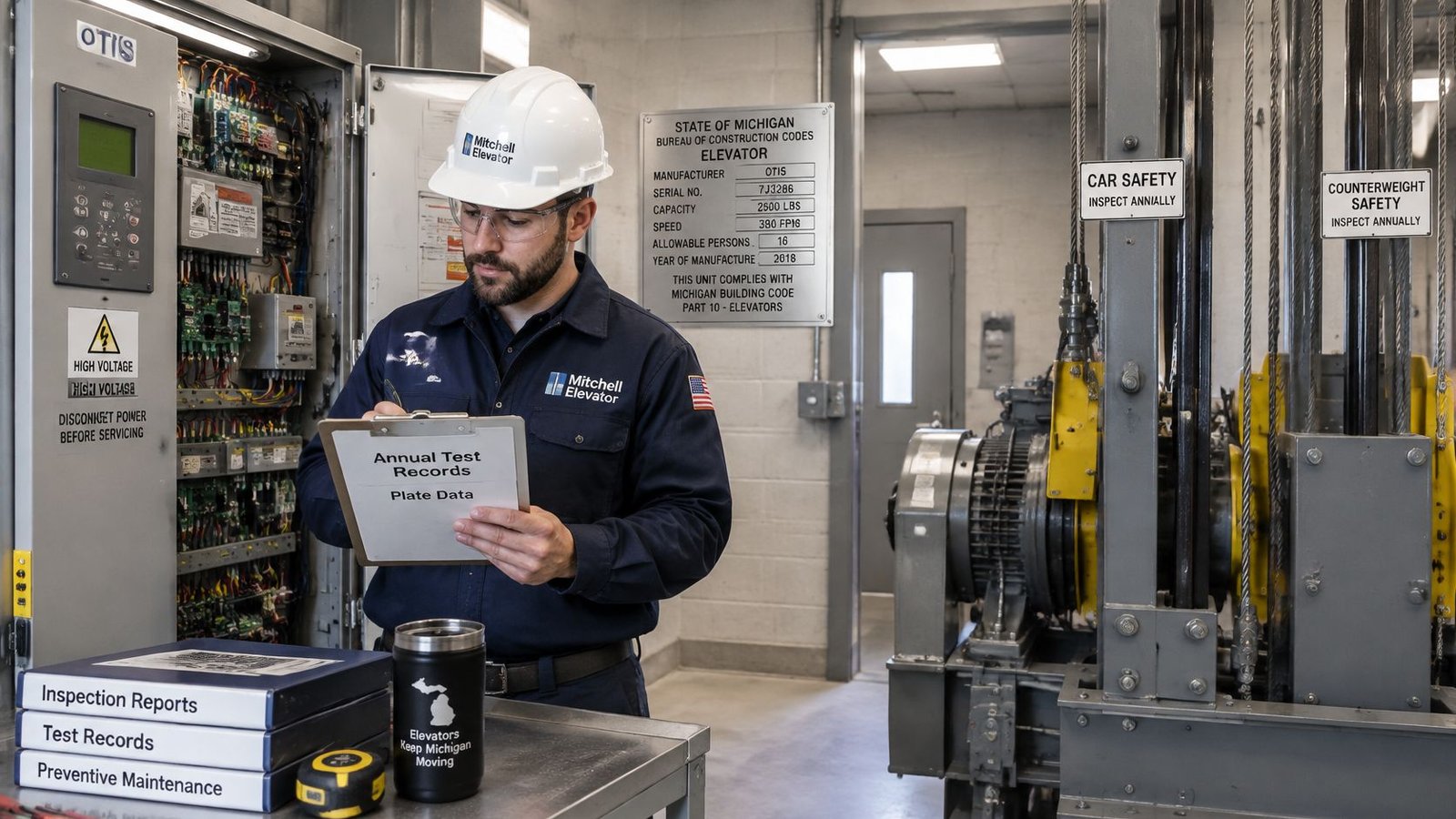
Michigan's elevator-licensing rulemaking document lists safety and governor inspections and tests at intervals of no more than 12 months. The same cited text calls for inspection and testing in a general inspector's presence before a new, altered, or relocated elevator enters service, except where a statutory exception applies.
Compare recurring and event-based requirements
Recurring work repeats on a calendar cycle. Event-based work starts after a defined change, such as an alteration, relocation, or temporary construction use. Confusion starts when a construction-use car is treated like a normal passenger car.
The separate Michigan elevator-code rulemaking document lists maintenance every 30 calendar days by a licensed elevator journeyperson and inspection every 90 calendar days by a state-employed general inspector for permanent elevators used temporarily during construction.
Michigan elevator test and maintenance intervals
| Requirement | Interval | Scope |
|---|---|---|
| Car and counterweight safeties and governors | No more than every 12 months | Inspection and test of each applicable unit in service |
| New, altered or relocated elevator | Before it is placed in service | Inspected by, and tested in the presence of, a general inspector, unless a statutory exception applies |
| Temporary construction elevator maintenance | Every 30 calendar days | Maintenance by a licensed elevator journeyperson |
| Temporary construction elevator inspection | Every 90 calendar days | Inspection by a state-employed general inspector |
Translate the schedule into assigned work
Safeties are devices intended to stop and hold the car or counterweight under specified emergency conditions. Testing them is separate from ordinary preventive maintenance or an emergency callback. Preventive Maintenance, State Testing and Inspections, Major and Minor Repairs, and Elevator Modernization each produce different records, so file the test form under testing and keep the maintenance log separate.
Owners who schedule elevator testing in Birmingham tie each due date back to plate values, including drive type and rated speed. Crane Elevator Company provides elevator services throughout Birmingham, Michigan. Field operations are open 24 hours a day, 7 days a week, 365 days a year. Emergency availability does not replace a scheduled inspection or authorize reopening equipment awaiting required approval.
Update the schedule the same day a plate correction is recorded. A clerical correction may leave due dates unchanged. Discovery of an undocumented alteration or construction-use condition may change the required next action.
Arranging the Plate Correction in Michigan
If the identification is legible and agrees with the authorized equipment record, retain the photographs and reconciliation notes with the elevator history. Assign an owner-side contact to keep that file available when technicians and inspectors visit.
If a field remains blank, conflicts with the installed equipment, or can't be located after an appropriate search, arrange a licensed investigation rather than choosing a plausible value. A missing label alone and a safety-affecting equipment defect are different findings; an unsafe car must stay out of use pending proper correction and authorization.
Define what the correction visit must produce
The visit should establish the conveyance type, verify the relevant controller and permit information, determine the proper plate correction, and document any required inspection or testing. The closing record should also identify unresolved items and the person responsible for completing them.
- Equipment evidence: Legible plate photographs and verified identification values.
- Correction evidence: The source document, work performed, and any replacement-plate details.
- Service status: Applicable test results, required approvals, and return-to-service authorization.
Crane Elevator Company is a family-owned and operated business with over 25 years of elevator-industry experience, serving all major Michigan cities and surrounding towns. Our correction service area includes Detroit, Ann Arbor, Lansing, Flint, Kalamazoo, Grand Rapids, Warren, Sterling Heights, Traverse City, Marquette, Monroe, Holland, Adrian, Pontiac, Royal Oak, Bay City, and Port Huron.
For service or questions, call 1-734-726-4247. Our office hours are 8am to 4:30pm, Monday to Friday.
The objective isn't a new label. It's one traceable equipment history that describes what's installed, what was corrected, and what authorization supports its operating status.
Crane Elevator Company provides licensed repair, testing coordination, and compliance work to resolve missing or conflicting elevator identification. Visit Crane Elevator Company to arrange a review, and have your plate photographs, latest inspection report, and alteration records ready so the visit can focus on the unresolved discrepancy.