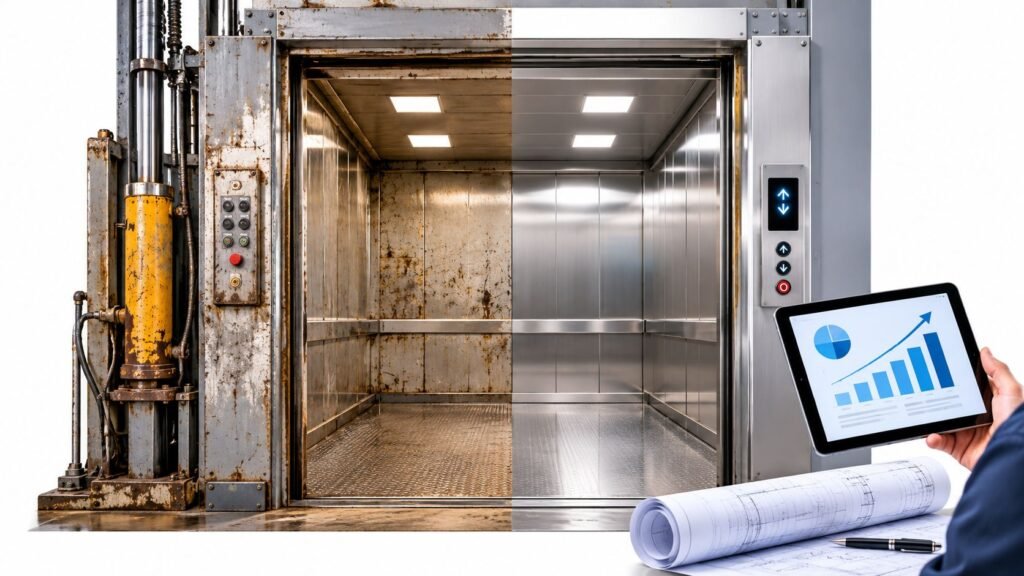
Partial freight modernization runs about $70,000 to $90,000 per car and full modernization runs about $120,000 to $400,000 per car, while repair and new-install prices stay site-specific until a survey prices the failed assembly or the building work. That's the planning frame. The harder question is which invoice ends the shutdowns.
You're likely reading this because a freight car stopped between floors, a biparting door won't close after another pallet hit, or an inspector wrote up the same controller fault for the second year in a row. Shipping is waiting, staff are carrying loads the long way, and you have three quotes that don't describe the same work. A freight elevator modernization service should sort that confusion before it sells you equipment. The cheapest first invoice can be a lifecycle trap when it replaces the part that failed today and leaves the part that will fail next month untouched.
Freight Elevator Cost Ranges for 2026
A stalled freight car usually puts three invoices in front of you, a targeted repair, a partial modernization, or a full modernization, and a fourth option, a new installation, only enters when the shaft itself can't do the job.
| Path | Typical scope | 2026 planning band per car | Fits when |
|---|---|---|---|
| Targeted repair | One failed assembly; shaft, rails, and structure stay | Site-specific after survey, priced by the failed assembly | Isolated failure, parts still available, clean inspection history |
| Partial modernization | Controller, door equipment, and fixtures | $70,000 to $90,000 | Obsolete controls but a sound machine, rails, and structure |
| Full modernization | Controls, doors, cab, machine or power unit, and safety devices | $120,000 to $400,000 | Repeat violations, scarce parts, or several worn systems |
| New freight installation | New car plus hoistway, pit, and overhead | Site-specific after survey, priced by hoistway, pit, and overhead work | No usable shaft, or a capacity change the building cannot support |
Published estimates in Convex's elevator modernization guide place full modernization at roughly $120,000 to $400,000 per car and partial upgrades at approximately $70,000 to $90,000. Those bands are planning brackets, not quotes. They don't tell you whether your hoistway, rails, machine, and structural supports can stay, and that single answer moves you between rows.
Why the repair and new-install cells stay open
A targeted repair has no honest flat band because the failed assembly sets the price. A door operator, a hydraulic valve, and a control board are different parts with different labor, lead times, and test requirements. Pricing one as if it were the others helps nobody.
A new installation stays open for the opposite reason. The car is the smaller part of that bill. Cutting a hoistway, digging or deepening a pit, building overhead structure, and feeding power to a new machine room are building costs, and a survey has to measure your building before anyone can price them.
The lowest first price is not the lowest lifecycle cost
Say your controller is obsolete and boards are scarce. A controls-only job looks efficient on paper. But if your freight doors have taken years of pallet impacts, your hydraulic jack is weeping at the packing, or your hoist machine brake is tired, you've bought a modern brain for a car that will still shut down on its doors, its jack, or its brake. You pay for mobilization, permits, and downtime twice.
The reverse mistake costs money too. Full replacement isn't automatically superior when the shaft, rails, and structure remain serviceable. Retaining sound structure is often the single largest saving in the whole project, because you're not paying to rebuild a hole in the building that already works.
Practical rule: Add last year's emergency repair invoices, inspection corrections, and lost dock or production time to any quote before you compare it. A cheap scope that keeps generating those three bills isn't cheap.
Before you read further, match your car to a row using three facts you already have. Check your duty cycle, meaning how many trips and how much loading abuse the car takes each day. Check the rated load on the data plate. Then pull your latest inspection report and count how many systems, not how many line items, the violations touch. One system points toward repair or partial work. Three systems point toward the full row.
What a Freight Modernization Actually Changes
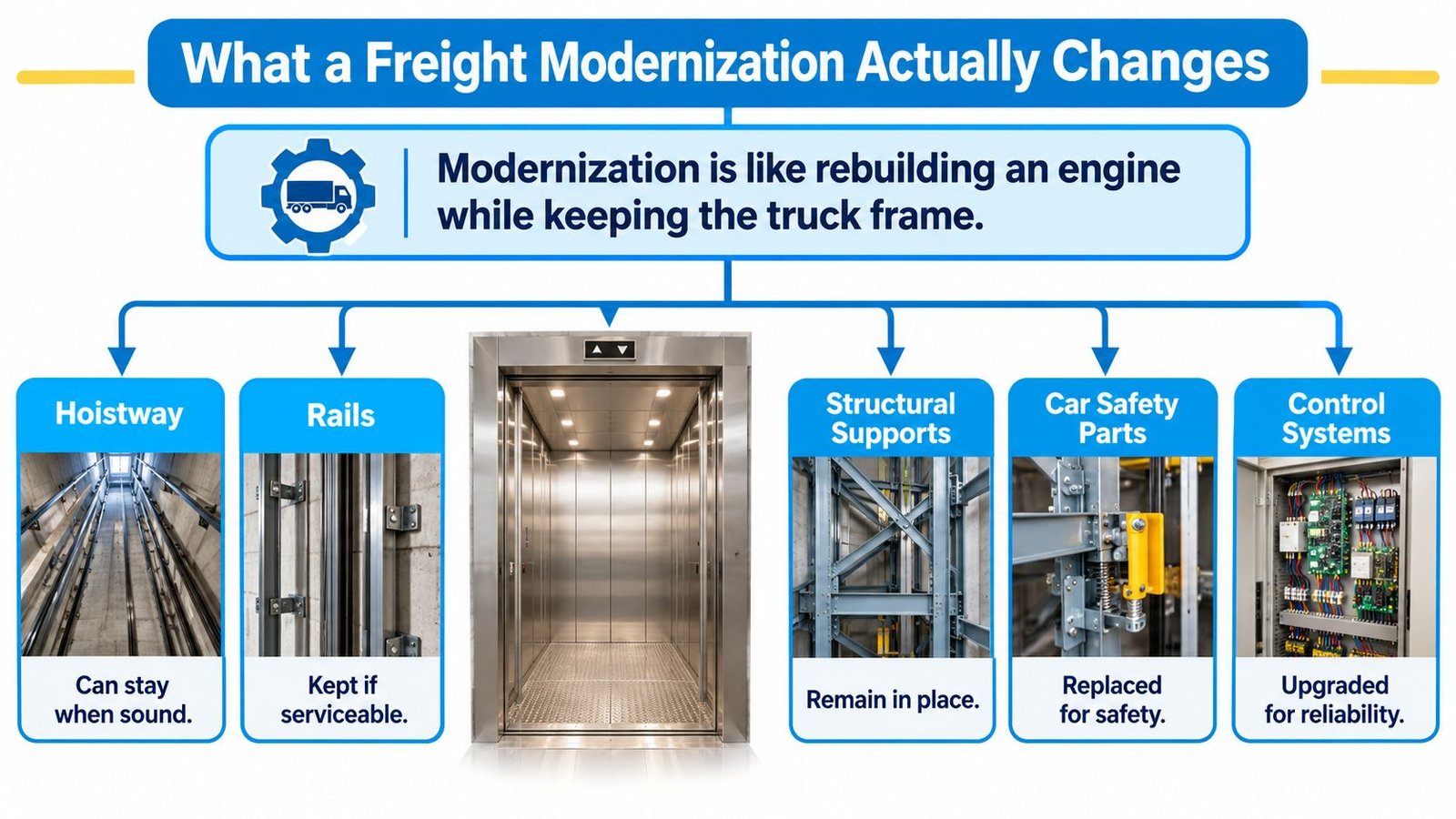
Think of modernization as rebuilding an engine while keeping the truck frame. The frame, in your building, is the hoistway, guide rails, and structural supports. When a survey finds them sound and properly aligned, they stay. The parts that make the car safe, controllable, and legal to run are what change.
The diagram below maps that split between what stays and what gets replaced.
What a proper survey walks through
A survey should move through the car in a fixed order so nothing gets assumed. It covers the car enclosure and platform, doors and interlocks at every landing, car safeties, the governor, buffers, suspension means such as ropes or the hydraulic jack, the machine or hydraulic power unit, and the emergency communication system. Each item gets a disposition, retain, repair, or replace, with a reason you can read.
This order matters because components interact. A new controller changes acceleration, deceleration, leveling accuracy, and door-zone behavior. Those changes expose weak braking, marginal rope traction, or a safety circuit that was sequenced for relay logic and now has to talk to solid-state controls. Checking brakes, traction, and safety-circuit sequence is part of the job, not an extra.
Our modernization work covers full non-proprietary upgrades on hydraulic and traction elevators, including cab interior updates, door equipment upgrades, and fixture replacements. All of our modernizations use non-proprietary control systems, which means any qualified service provider can maintain the car afterward instead of only one manufacturer.
In Michigan this is an alteration, not a parts swap
Michigan treats this work as a regulated alteration. The Michigan elevator permit information states that permits are required before an elevator is installed or altered, detailed plans and specifications must be submitted in triplicate with each installation permit application, and the work must be performed by a licensed elevator journeyperson under a code incorporating ASME A17.1 and Michigan Elevator Safety Board rules.
That sequence protects you if you use it. Ask for a component matrix before you sign anything. It should name what stays, what's altered, which code provisions apply, and which acceptance tests the alteration triggers. If a proposal can't produce that matrix, it isn't a scope yet, it's a guess.
Cost Drivers That Move the Bid
Two freight cars can sit in the same planning band and produce bids far apart. The drivers below explain where your quote lands inside the band, and why a hydraulic car and a traction car with identical capacity still price differently.
| Driver | What raises the price | Hydraulic freight car | Traction or hoist freight car |
|---|---|---|---|
| Capacity and platform | Heavier car, stronger supports, larger doors | Larger jack and power unit | Larger machine, ropes, and sheave |
| Travel and openings | More rail, wiring, and landing doors | Longer jack or drilled hole | More rope and rail |
| Pit and overhead | Concrete, steel, or machine-room changes | Buffer and jack clearance | Overhead for the machine or sheave |
| Controls and doors | Interlocks, fire service, phone, and fixtures | Non-proprietary controller and valve interface | Non-proprietary controller, drive, and brake logic |
| Machine condition | Replacing the motive equipment versus retaining it | Packing, tank, valve, or jack | Motor, brake, sheave, or ropes |
Capacity, travel, and openings
Capacity comes first because it sizes everything downstream. A higher rated load means a heavier platform, stronger structural supports, and larger door openings to load through. On a hydraulic car that means a larger jack and power unit pushing more oil. On a traction car it means a larger hoist machine, bigger ropes, and a sheave grooved for them.
Travel and openings multiply hardware. Every added floor adds rail, traveling cable and hoistway wiring, and a complete landing door package with its own interlock. A two-stop dock elevator is a smaller job than a car serving five floors, even at the same capacity. Count your openings, including rear openings, before you compare your quote to a neighbor's.
Pit, overhead, and machine condition
Pit depth and overhead clearance are building costs wearing an elevator costume. If your pit is too shallow for required buffer and jack clearance, or your overhead can't fit a machine or sheave with proper clearances, you're buying concrete, steel, or machine-room changes. Those line items can exceed the equipment price, and they don't appear in any catalog.
Controls move the bid when door interlocks, fire service operation, and emergency communication are brought current along with the controller. Specifying non-proprietary equipment at this stage costs little extra and decides whether another qualified company can service the car later without proprietary tools or licenses.
Machine condition is the last split. Hydraulic work centers on packing, the jack, the tank, and the control valve. Traction work centers on the motor, brake, sheave, and ropes, which is why worn suspension ropes belong in the same conversation as freight elevator cable replacement rather than in a later surprise invoice. We modernize both traction and hydraulic systems, so the driver in your bid should be documented condition, not a contractor's brand preference.
Mark the two drivers that apply to your car before you open any bid. Bids become much easier to compare once you know which rows should be carrying the money.
Sample Projects Across Michigan Cities
A leaking jack can turn a low-cost controller swap into a second shutdown. The scenarios below show how equipment condition and building constraints change the scope, and why the cheapest first invoice may cost more over the elevator's service life.
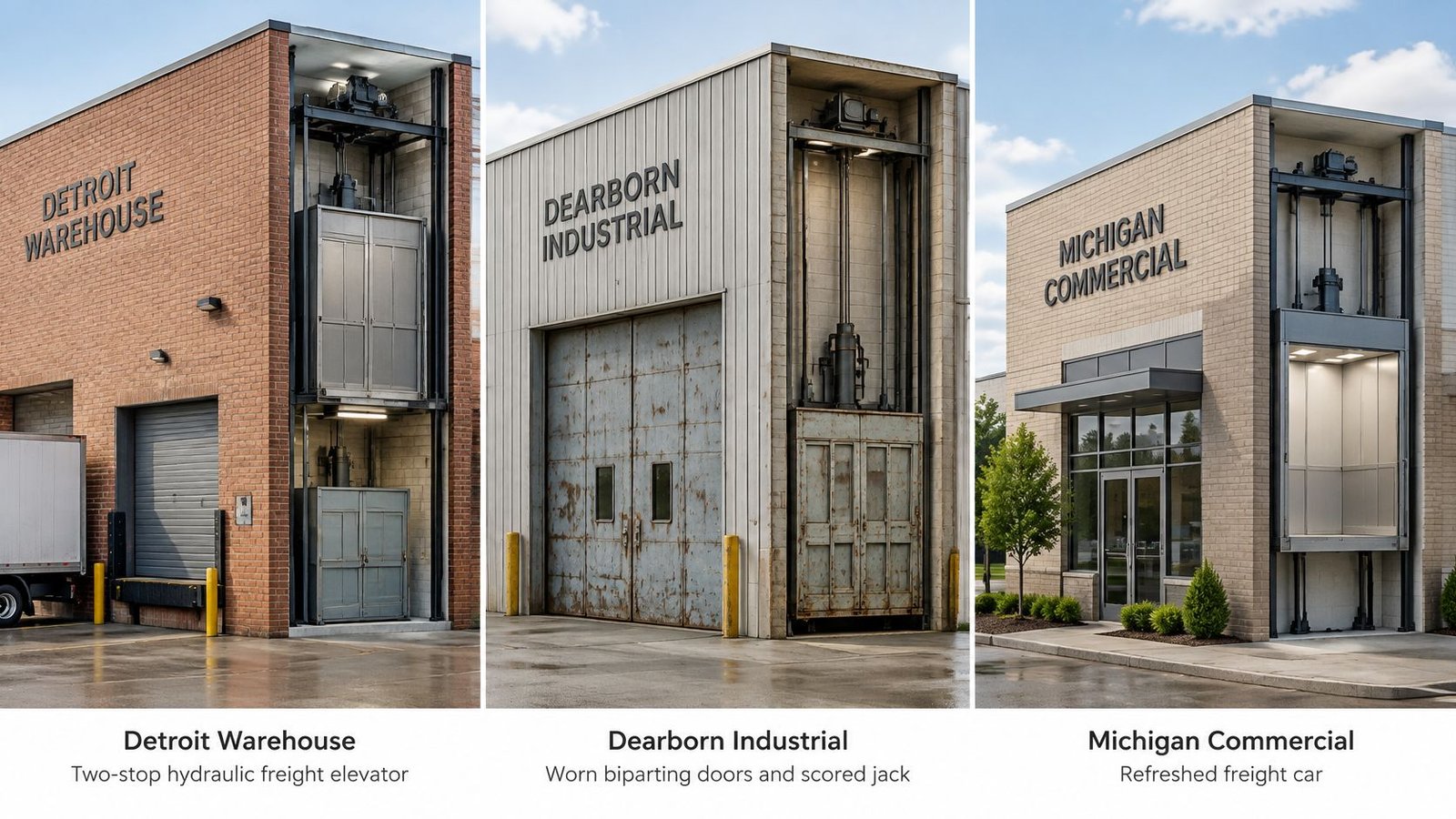
The image below shows how freight entrances differ between warehouse, industrial, and commercial buildings.
A warehouse freight car
Consider a two-stop hydraulic freight car with a jack leaking past its packing and biparting doors that have been straightened repeatedly after forklift contact. If the shaft and rails remain serviceable, a focused modernization may retain them while addressing the hydraulic equipment, doors, and controls. Replacing only the controller would leave the leak and damaged doors in place, risking another shutdown and another mobilization. The building can compare that staged scope with a full replacement before committing.
A hospital or campus service car
A service elevator may have a sound machine, clean ropes, and a straight hoistway, while its controller is obsolete and replacement boards are difficult to obtain. That condition can support a partial upgrade, provided the work also addresses needed door interlocks and emergency communication. Deferring known inspection items merely shifts the cost to a later repair or correction.
The short video below walks through how a modernization crew sequences work inside an occupied building.
A municipal or school freight car
A shallow pit can change the economics of an otherwise serviceable freight elevator. Correcting pit depth may require concrete work, water management, or clearance changes, so building modifications can outweigh the equipment portion of the bid. A new installation makes sense only if the survey shows the existing shaft cannot support the capacity and travel the building requires.
For either a partial upgrade or a larger project, the survey should identify the equipment to retain, the work required for safe operation, and any building changes. Crane Elevator Company serves Birmingham and communities across Michigan and Ohio around Detroit, Ann Arbor, Lansing, Flint, Kalamazoo, and Toledo. In Michigan, installations and alterations require permit coordination, and the Michigan Elevator Section conducts inspections and annual safety inspections.
Commercial and Modernization Financing
Knowing what a project costs doesn't settle how your building pays for it. A repair invoice usually lands as an operating expense. A modernization is a capital project, and paying for it in one year can empty a capital budget that also has a roof and a boiler in it.
The checklist below lays out the financing pieces worth discussing with a lender and your contractor together.
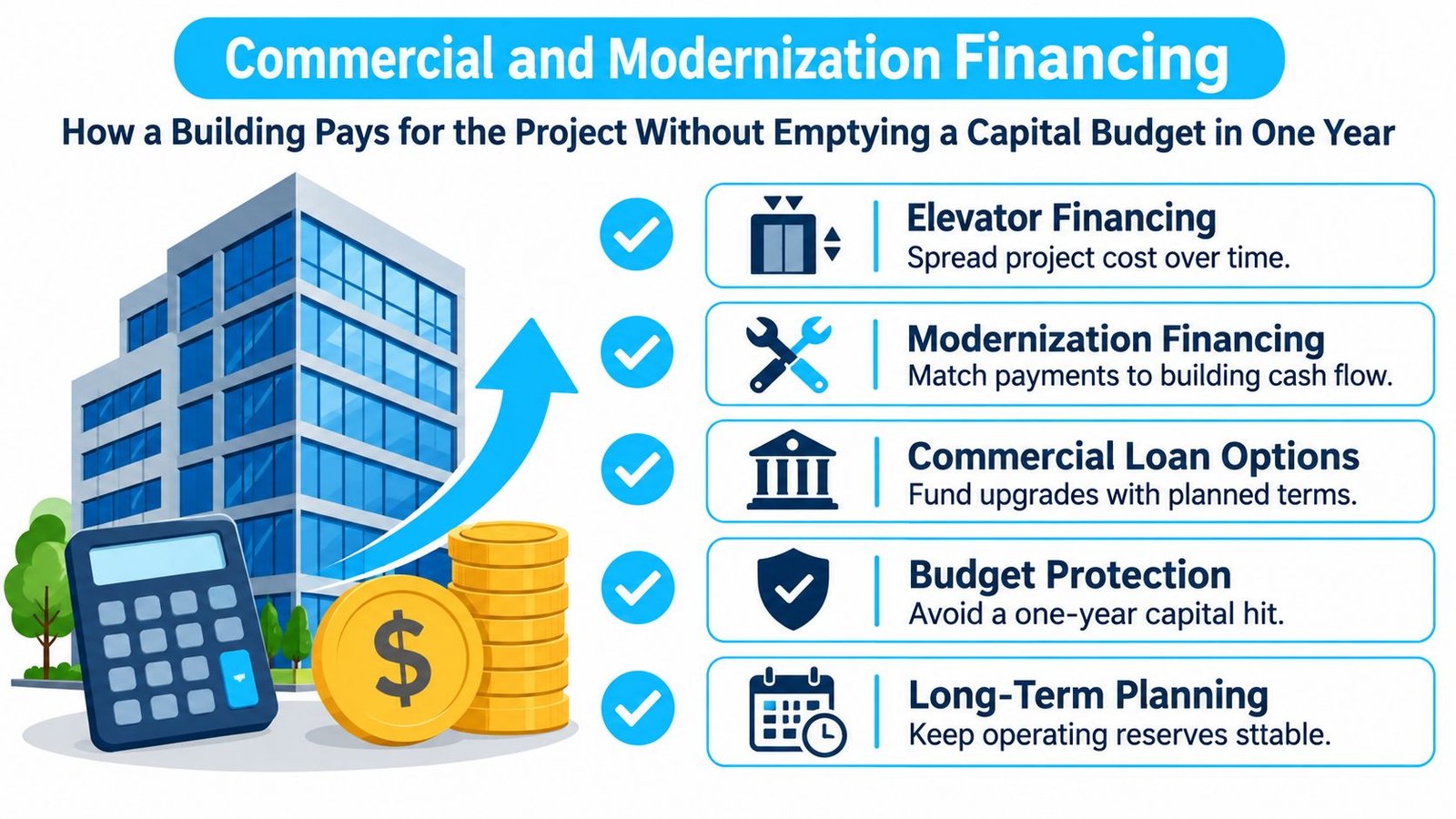
Three cash paths worth comparing
- Pay at substantial completion: You fund the full modernization from capital reserves when the car passes inspection. This suits buildings with a funded reserve study and no competing projects.
- Finance the equipment package: You spread the project cost over a fixed term through commercial elevator financing in Michigan, matching payments to building cash flow instead of taking a one-year hit.
- Stage the work, then finance the rest: You do a partial upgrade now and finance retained-machine work later. This only works when the deferred components are sound.
That last path deserves a warning. Financing a controls-only job that leaves a failing jack in place just adds interest to your next outage. Staging is a scheduling tool for healthy components, not a way to make worn components cheaper.
Crane Elevator Company offers elevator financing, including financing for elevator modernization and commercial elevators. Our consultation form lists Elevator Project Financing alongside Elevator Modernization, Elevator Maintenance, Elevator Repair, Elevator Testing, Residential Elevator, and Other, so you can start with the payment question if that's your blocker.
Questions to ask before you sign a term sheet
Ask what's financed, equipment only or labor and building work too. Ask whether permit and inspection fees sit inside the number. Ask how downtime is scheduled against your shipping or production calendar. Ask what happens financially if the alteration uncovers pit or overhead work after demolition. A lender and a contractor who answer those four questions in writing have scoped your project. Vague answers mean the number is soft.
Simple screen: If your annual emergency-repair spending plus lost dock time is approaching the monthly finance payment, modernization is already the more predictable bill. You're paying either way. One version comes with a schedule.
How to Cut Freight Elevator Lifecycle Cost
Lifecycle cost is mostly the outages you refuse to schedule. Emergency calls arrive at overtime rates, during your busiest hours, with parts expedited at freight premiums. Five concrete moves shift that spending into planned work where you control the timing.
The infographic below summarizes those five moves in the order we'd apply them.
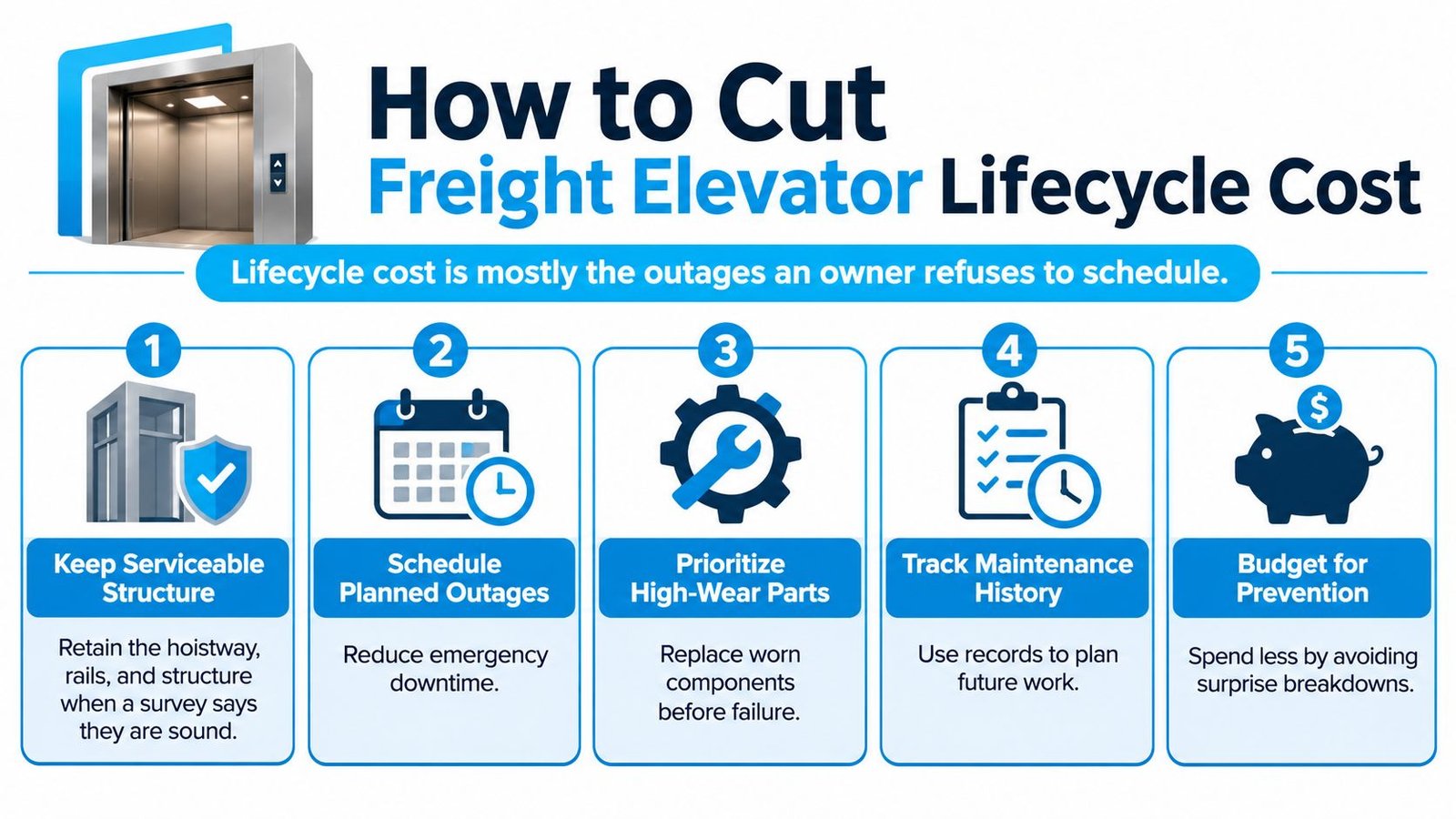
Five moves that lower the real bill
First, keep serviceable structure. Retain the hoistway, rails, and structural supports when a survey says they're sound. A new shaft is the most expensive path in this entire article, and avoiding it is the largest single saving available to most owners.
Second, demand documentation. Specify non-proprietary controls, parameter backups, and as-built wiring diagrams in the contract. The next technician, whoever employs them, should be able to troubleshoot your car without a proprietary callout or a license fee. That requirement costs almost nothing at signing and a great deal to retrofit later.
Third, prioritize what freight duty destroys first. Door equipment takes pallet and forklift impacts. Hydraulic packing wears and jacks leak. On traction cars, ropes and sheave grooves wear fastest under heavy or abrasive loads. Fund those components ahead of cosmetic cab work every time.
Fourth, measure savings claims instead of accepting them. Don't let anyone promise you a fixed energy or callback reduction. Freight duty cycles, hydraulic versus traction design, and loading patterns vary too much for a universal percentage. Ask what will be measured, over what period, and against which baseline.
Fifth, fund maintenance that takes place. Structured freight elevator preventative maintenance catches door wear, packing leaks, and rope condition while they're adjustments instead of replacements. We provide a proactive preventative maintenance program, work on all makes and models of elevators and lifts, and include full cleaning of machine rooms, pits, and car tops, because debris in a pit or on a car top hides exactly the wear you're paying us to find.
Modernization doesn't retire your inspection calendar. The Michigan elevator code rules place freight elevators among the devices inspected at least once every 12 months, with car and counterweight safeties and governors inspected and tested at intervals of no more than 12 months. Budget for that testing as a fixed annual cost, not a surprise.
Set a one-year checkpoint after any modernization. Callbacks, inspection violations, and door damage incidents should all be trending down. Our No Show, No Pay maintenance policy means a missed visit isn't billed, so the maintenance you're counting on in that checkpoint occurs.
Choose the Scope Before You Sign
Three quotes can look comparable while covering different work. Match each scope to the freight car's actual condition, not the condition you hope it has. A failed assembly with available parts may need a repair. Obsolete controls on a sound machine may justify a partial upgrade. Violations, leakage, door damage, or scarce parts across several systems can point to full modernization. New construction is a different decision, suited to a hoistway that cannot safely meet the required capacity or travel.
Why waiting has a Michigan deadline
Michigan's current elevator rules took effect June 27, 2023. The Michigan code books page states that new installation and alteration permits had to comply beginning June 29, 2023. Requirements under ASME A17.3 for existing equipment phase in on a tiered schedule that began January 1, 2025 and finishes January 1, 2028. After that, inspectors may issue violations following an annual inspection.
The schedule applies across Michigan, from Detroit, Grand Rapids, Lansing, Flint, Kalamazoo, Jackson, Ypsilanti, Wyoming, and Holland to smaller communities. Planning work lets you choose the scope and timing. Waiting for an inspection finding can narrow those choices and add another outage to the bill.
The one practical next step
Request a component-level assessment of one freight car, not a package price for the building. The recommendation should identify what stays and what changes, the permit path, required acceptance tests, and whether repair, staged modernization, or financing gives that car the lower lifecycle cost.
Crane Elevator Company offers a second opinion on an existing or ongoing elevator problem at no extra charge, including a visit and solution plan. Field operations are open 24 hours a day, 7 days a week, 365 days a year. Call 1-734-726-4247 to discuss the car causing the most dock delays. A documented scope turns three confusing quotes into a decision you can explain to your board, tenants, or budget team.
If repeat callbacks, inspection violations, or dock delays are driving the decision, compare repair, partial upgrade, and full modernization by what each replaces and what it leaves in service. Crane Elevator Company provides non-proprietary modernizations, preventative maintenance, and modernization financing for building owners across Michigan and Ohio. Visit Crane Elevator Company to request a free second opinion and a component-level plan for a hard-working freight elevator.