Two quotes for the same elevator, one at roughly three times the other, and both contractors are telling the truth. One is pricing a power unit, a controller and a crew for four days. The other is pricing a new traction machine, hoistway work, a permit package and weeks of disruption. Those aren’t competing bids. They’re answers to two different questions.
More than 7 million of the approximately 21 million elevators installed worldwide are over 20 years old, the point at which building managers commonly start evaluating modernization, according to Otis. That’s roughly a third of the global installed base sitting at a decision threshold, and hydraulic units make up a large share of it in low-rise commercial, institutional and residential buildings.
So the useful question isn’t which quote is lower. It’s which scope your building needs and which components are worth keeping. Get that wrong and the budget drifts for a year. I’d resolve the scope before asking hydraulic elevator modernization experts for a number, because a well-defined job prices itself and a vague one prices itself twice.
Hydraulic Modernization Scope Levels at a Glance
There isn’t one product called modernization with a spread of prices attached. There are five, and they solve different problems. Place your building in a row before you read any further.
| Scope level | Typical work | Main cost driver | Typical trigger |
|---|---|---|---|
| Targeted component repair | Jack packing, valve adjustment, hoses | Extent of leakage and parts access | Leaks, drift or failed pressure checks |
| Controller and safety upgrade | Controller, door lock monitoring, safety devices | Code gaps and interface work with fire and phone systems | Inspection violations or unsupported parts |
| Power unit and jack replacement | Tank or power unit, jack, cylinder, piping | Cylinder and piping condition, pump sizing | Failed condition survey or corrosion |
| Full non-proprietary modernization | Controls, cab interior, door equipment, fixtures | Scope breadth, permits, phasing | Age, reliability and code alignment |
| Full replacement as new installation | New equipment under an installation permit | Permit fees and full design work | Equipment that cannot be economically reused |
A row is a definition of what the building gets, not a band of prices. That’s why two quotes are only comparable when they sit in the same row. One that repacks a jack and one that replaces a power unit and a controller describe two different elevators, even when the address on both is yours.
Take a three-stop hydraulic passenger car in a Michigan office building that drifts an inch off the landing and leaves a sheen under the jack. If the cylinder holds pressure and the piping is sound, that’s row one: new packing, valve adjustment, hoses. Now take the same building with a corroded tank, a pump that’s been rebuilt twice and a controller with no door lock monitoring. That’s rows three and four stacked together, and the number grows for reasons that have nothing to do with a crew’s hourly rate.
The rule that saves the most money: find out what the cylinder and piping are doing before anyone prices the controls.
Row five is the honest exit. When the cylinder, tank and piping can’t be reused economically, or the hoistway can’t take the equipment you’d need, a new installation under an installation permit is the only scope that leaves you with a reliable car. Modernization doesn’t always require complete replacement, and it doesn’t always avoid it either.
Pick your row now. Write one sentence describing the problem in plain terms, then gather the records covered below so a contractor prices that row and not a wish list.
What Pushes a Hydraulic Upgrade Budget Up or Down
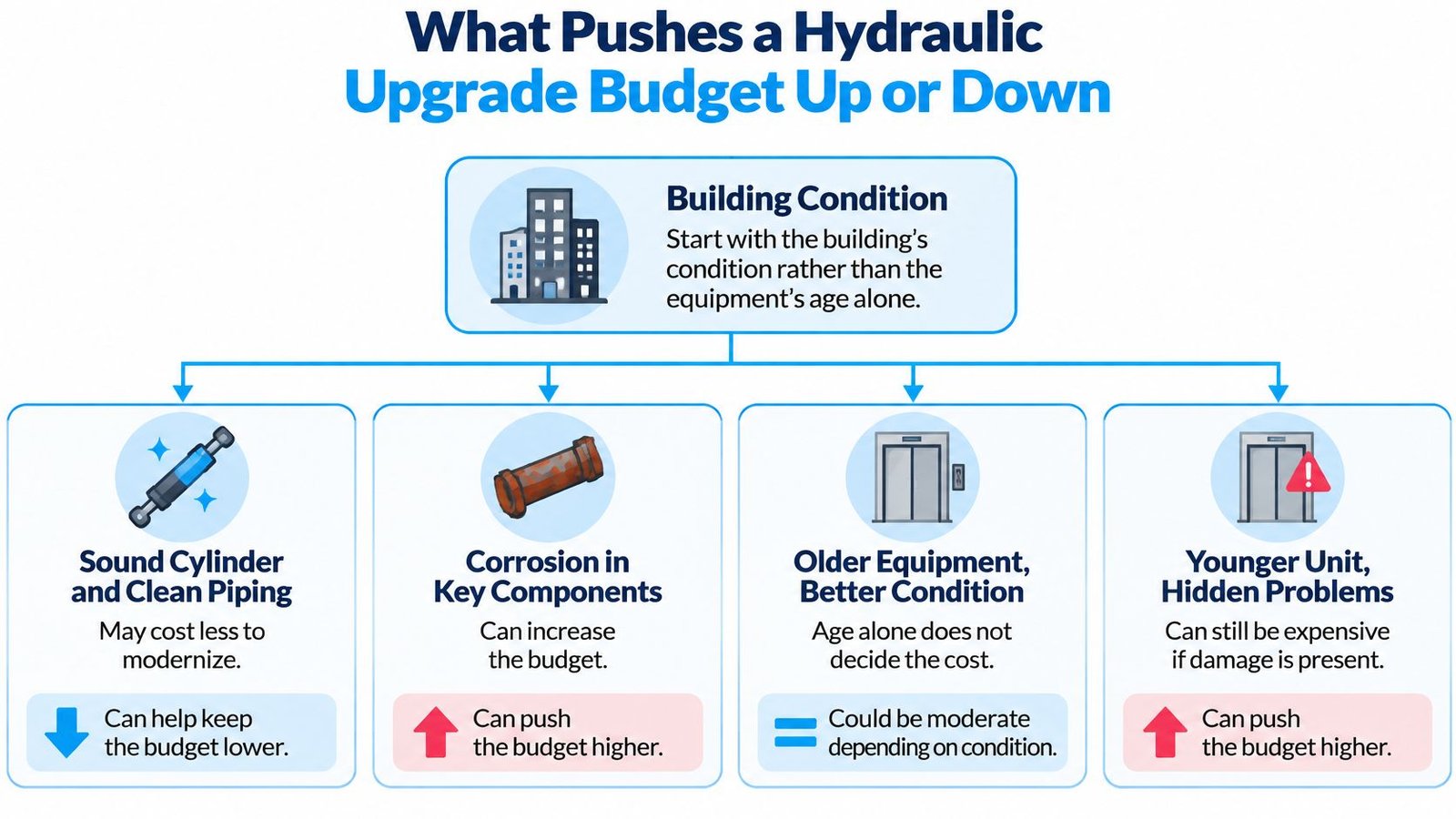
Start with condition, not with the date on the nameplate. A hydraulic unit from the late 1980s with a dry cylinder and clean piping is often cheaper to bring up to standard than a 2005 unit with corrosion in the tank and hoses weeping at every fitting. Age tells you when to look. Condition tells you what to buy.
The Drivers, In Order
Jack and cylinder condition. These two decide whether reuse is even on the table. A pitted or leaking cylinder pushes the project out of packing-and-valves territory and into jack, cylinder and piping work, which can move a scope up two rows in a single finding. Ask: what did the survey find at the jack, and was it recorded or estimated?
Traffic and standby behavior. Usage shapes which valves, pumps and motor controls are worth buying. A car that runs 50 trips a day spends most of its life sitting still, so idle draw and auxiliary loads matter more than motor horsepower. Ask: how many trips a day, and what does the system pull when nothing is moving?
Ask for the two numbers that decide the energy scope: trips per day and standby current. A contractor who can’t produce them is guessing.
Compliance scope. Open violations, failed tests and an expired certificate add work before a single new component is ordered, and the permit layer matters as much as the parts list. The Texas Department of Licensing and Regulation elevator FAQ confirms the pattern that holds across jurisdictions: alterations generally require approved plans, and owners remain responsible for recurring inspections and certificates of compliance long after the crew leaves. Budget for the paperwork, because an alteration scope that triggers plan review costs more in time and filing than the hardware it covers.
Interface work. Fire alarm, generator, emergency phones and electrical disconnects are where pump-only quotes fall apart. A modernization can pull in fire service requirements, emergency communication, machine-room lighting, car materials, access and testing documentation, and the exact obligations depend on the jurisdiction, equipment type, alteration scope and code edition in force. Ask: what’s in the price for the phone, the fire alarm interface and the generator test?
Why the Gap Shows Up Later
Say a freight elevator gets a quote covering the power unit, the pump and the tank. The emergency phone still runs on a conventional line that the building’s provider is retiring, and the testing documentation isn’t in the scope. Six weeks into the job, the phone work and the acceptance test become a change order, and the owner is now paying for two site mobilizations instead of one.
Maintenance history decides how many surprises a survey turns up. A unit with a documented preventive record, clean oil and no recurring callbacks usually brings fewer of them than a car that has been run to failure for a decade.
Ask every bidder to price required, risk-reducing and elective work in separate columns. Required is what the code and the inspection findings demand. Risk-reducing is what the survey says will fail next. Elective is the cab and the fixtures. Then compare bids on a like-for-like hydraulic elevator modernization cost breakdown rather than a single total, and approve or defer each column on its own. That column structure is what turns a budget from a price tag into a scope decision you can defend to a board.
How to Assess Your Hydraulic System Before Requesting Quotes
A hydraulic survey isn’t a walkaround. It’s a set of measurements that separates a valve problem from a cylinder problem, and that distinction decides whether you’re buying components or a jack. Run it with a licensed contractor before you ask anyone for a number.
The U.S. Bureau of Reclamation elevator guidance.pdf) splits hydraulic testing into Category 1, covering relief-valve setting, system pressure, cylinders and pressure piping, and Category 3, covering unexposed piston sections and pressure vessels, and the governing North American framework behind that work is ASME A17.1/CSA B44, which covers design, installation, operation, inspection, testing, maintenance, alteration and repair.
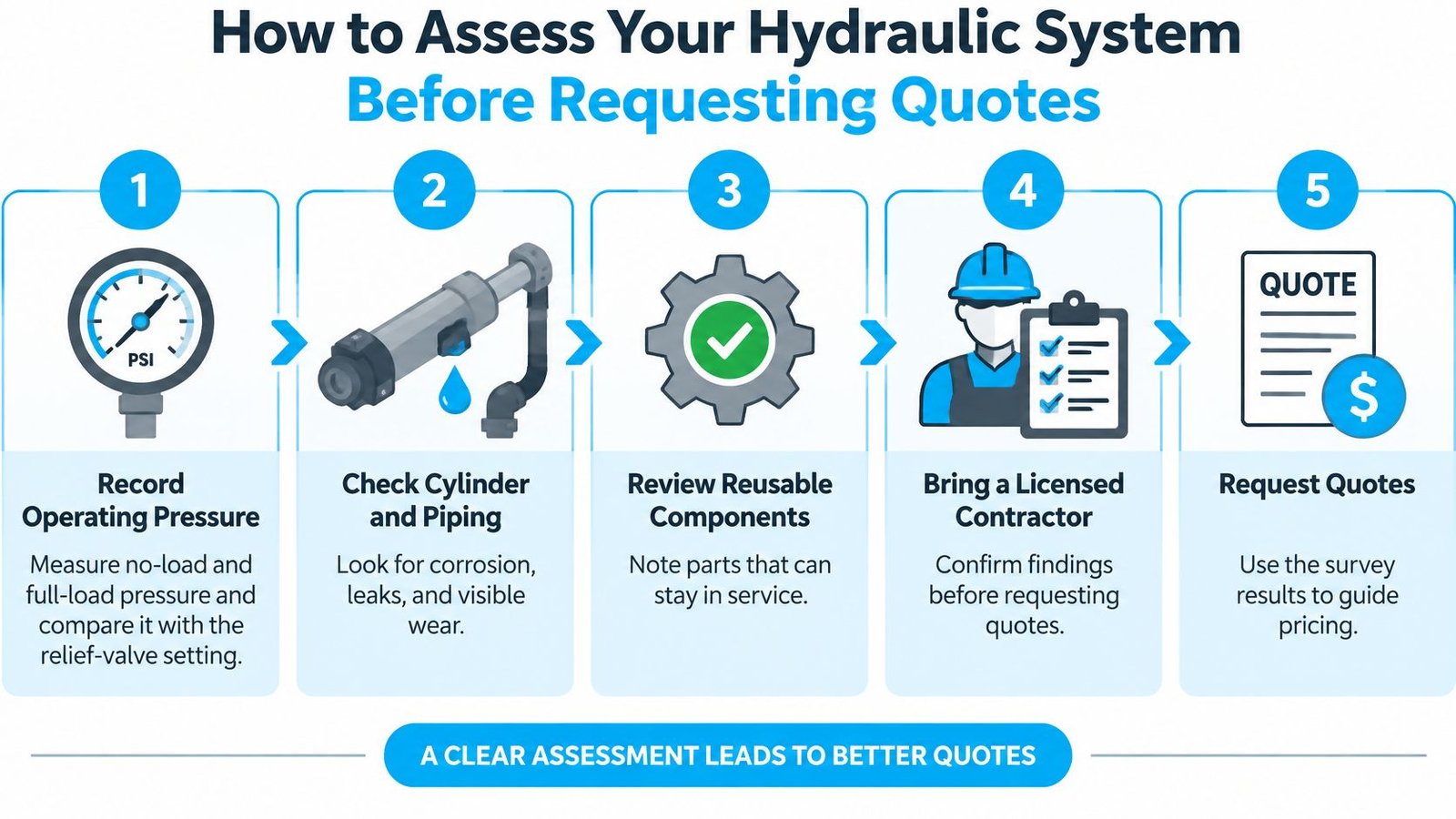
- Record operating pressure at no load and at full load. Compare both readings against the relief-valve setting. Pressure data is what separates lazy valve tuning from a weak pump or a leaking cylinder, and it’s the first figure a competent estimator asks for.
- Check relief-valve performance and the gauge together. A relief that lifts low and a gauge that reads high tell different stories. If the gauge hasn’t been calibrated recently, note that in the packet, because the whole scope rests on those readings.
- Inspect the cylinder and the piston, including sections you can’t see. Scoring, seepage and packing wear at the exposed section hint at what the unexposed section is doing. Where integrity is questionable, have the unit watched for leakage frequently until the work is complete.
- Examine the pressure piping, flexible hoses and tank. Corrosion at the tank, seepage at fittings and cracked hose jackets are reuse killers. Photograph each one with a reference point so the next contractor sees what you saw.
- Measure piston travel and bottom clearance. These fix the jack length and the pit depth, and they tell you whether a replacement cylinder fits the existing hole. Getting that wrong after the order is placed is the expensive version of this project.
- Log leveling and stopping variation, plus recurring callbacks. Three service calls for the same drift in a year is evidence. Write the dates down, because a pattern makes the case for a scope change better than an opinion does.
- Assemble the packet. Survey results, current code record, open violations, failed tests and the callback log belong in one document you can hand to every bidder. Industrial, healthcare, education and municipal owners usually need that packet for procurement anyway, and it’s what lets them compare bids on equal terms.
The survey answers one question: can the cylinder and piping be reused? If yes, price targeted component replacement. If no, the survey has just justified a broader scope with evidence instead of sales language. Either way, you’re buying a defined job rather than a unit rate and a hope.
Reading the Whole-Life Trade-Off
Does a hydraulic car have to become a traction car to count as efficient? Not always, and the numbers on low-use equipment are firmer than the marketing suggests.
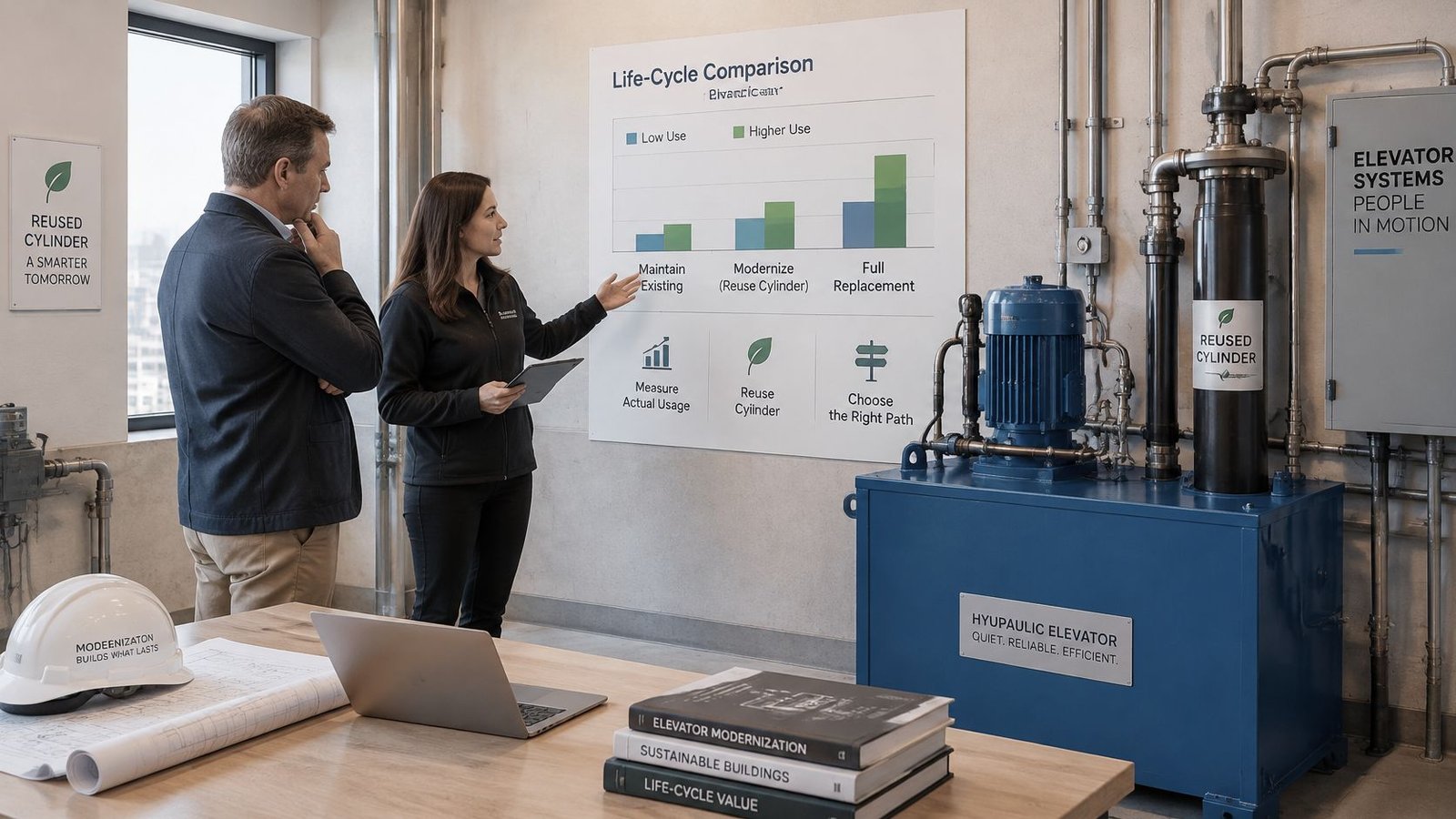
A life-cycle assessment of low-usage elevators averaging about 50 trips per day found hydraulic systems had a 7% lower total environmental impact than comparable traction systems, and replacing a hydraulic unit with traction produced a 43% higher impact in one comparison, per Elevator World’s hydraulic modernization analysis. At the other end of the range, an analysis covering an 80-year building life with modernization every 20 years found hydraulic systems could remain environmentally preferable even at approximately 300 starts per day.
That puts the key question somewhere more useful than hydraulic versus traction. It’s about measured usage, standby consumption, valve and motor technology, component reuse and embodied carbon. When reuse holds up, a non-proprietary modernization keeps the cylinder, tank and piping in service and leaves the controls serviceable by any qualified provider.
Where the Energy Actually Goes
Elevators account for about 2% to 5% of energy use in buildings covered by ASHRAE 90.1, and valve adjustment, sequential standby controls, improved cab lighting, ventilation and door-operation motors together could reduce energy use in typical hydraulic elevators by approximately 50%, according to the American Council for an Energy-Efficient Economy analysis. Regenerative drives are often uneconomical here because most hydraulic units run infrequently, so the load sits in standby and auxiliaries rather than in the motor.
None of that erases the trade-off. A conventional hydraulic unit may still use more energy during the ride phase than a traction machine, so a single efficiency claim isn’t a decision. You need a whole-life figure covering trips, standby draw, component life and embodied carbon.
The Measurements That Settle It
| Scenario | Reported result | Measure first |
|---|---|---|
| Low use, about 50 trips per day, reusable components | Hydraulic 7% lower in total environmental impact than comparable traction | Trips per day, standby draw, cylinder and piping condition |
| Replacing hydraulic with traction | 43% higher environmental impact in one comparison | Whether tank, cylinder and piping can be reused |
| High use, about 300 starts per day, 80-year building life with modernization every 20 years | Hydraulic could remain environmentally preferable | Valve and motor technology, variable-speed control options |
Measure trips per day and standby consumption before deciding, then bring both numbers into the survey. A low-rise office with a sound cylinder and undersized valves is the classic case where valve and controller upgrades beat replacement, because the embodied carbon of a new machine never gets paid back at that duty cycle.
Permits and Hidden Compliance Costs in Michigan
Michigan treats a lot of modernization work as a permit-triggering alteration, and the trigger is usually smaller than owners expect. A software update counts. So does swapping a phone line for VoIP.
| Work item | Michigan treatment | Budget item to add |
|---|---|---|
| Soft start installation | Can require an installation permit | Permit fee and inspection time |
| Main control board replacement | Can require a permit | Permit fee and inspection time |
| System software update | Can require a permit | Permit scope and documentation |
| Rope gripper or rupture valve replacement or modification | Can require a permit | Safety device testing and inspection |
| Emergency communication changed from conventional phone line to VoIP | Can require a permit | Coordination with the phone provider and inspection |
| Machine or pumping unit replaced together with controller and related equipment | May be treated as a new installation with fees | Installation permit and applicable fees |
The Rule of Thumb
If a repair changes a safety device or the emergency communication path, assume a permit and an inspection until the state or your contractor confirms otherwise. That covers rope grippers, rupture valves, door lock monitoring hardware and anything that touches fire service.
The Michigan Elevator Section’s modernization guidance lists those exact items, and it goes further: replacing a system’s machine or pumping unit, controller and related equipment together may be treated as a new installation, which brings an installation permit and applicable fees. That single sentence changes the category of a project that looked like a component swap.
The Cost Layers People Miss
Four of them, and none appears on an equipment quotation:
- Permit fees. Charged per permit, sometimes per device.
- Plan review time. Weeks you don’t get back, and a schedule that slides into a busy inspection season.
- Inspection scheduling. A finished car can’t be signed off until the state inspector arrives.
- Post-work testing. Safety device tests, fire service tests and documentation, all after the crew has left.
Walk the quote line by line and ask three questions of each permit-triggering item: which permit applies, what the fee is and who pulls it. A shrug here is a change order later. Our team works in both states and can walk an owner through which items on a scope are permit triggers, including emergency phone upgrades and controller work.
Buildings in Toledo and Perrysburg sit under Ohio’s rules, not Michigan’s, and this table doesn’t cross the state line. Confirm Ohio requirements with the state elevator authority before signing a scope that assumes Michigan treatment. Then check the whole package against elevator code requirements for your jurisdiction and code edition.
Ask for a scope that lists each permit trigger on its own line with its fee and review time. Compliance should be visible before the equipment order goes in, not discovered during the inspection.
Acceptance Targets That Protect Your Investment
Acceptance testing is the last deliverable of the contract, not a formality at the end of it. If you don’t write numbers into the specification, you’ll accept the car on how it feels on the day, and how it feels doesn’t survive an inspection.
| Check | Target | How to verify |
|---|---|---|
| Speed variation under all load conditions | Within 5% | Measure in both directions, empty and at rated load |
| Controlled acceleration and retardation | Not above 0.1G per ft/s² | Record during test runs |
| Maximum acceleration or retardation | Not above 0.2G | Record at peak under full load |
| Floor-level stopping accuracy | Within 3 mm (0.125 in.) above or below landing regardless of load | Measure at each landing, empty and loaded |
| Hydraulic component pressure rating | Factory-tested for 500 psi operating pressure | Confirm test certificates and the system gauge reading |
Those limits come from a published public-sector hydraulic modernization specification, which is exactly why they’re useful. They’re written as contract language, not as a preference.
The Test Order
Run it in this sequence, because each step depends on the one before. Verify contract speed in both directions. Measure leveling empty and again at rated load. Confirm pressure at the system gauge. Test automatic shutoff and the door interlocks, which must prevent car movement unless the doors are locked. Then file every result.
Add a documented Maintenance Control Program to the specification while you’re at it. A modernized car with no maintenance plan reverts to its old behavior on a predictable schedule.
Why Measurable Limits Pay for Themselves
Most callback complaints after a modernization trace to three causes: poor leveling, unstable valve tuning and incomplete safety integration. Each of those is preventable with a number in the contract and a measurement at acceptance. A car that stops within the tolerance at every landing, empty and loaded, doesn’t generate the “it’s drifting again” calls that eat a maintenance budget for years.
Where the Records Go
Keep acceptance results with the permit packet and the maintenance file, so future inspections and code reviews have one trail instead of three partial ones. When the next code edition lands, that file is what tells you which parts of the car were already brought up to standard and which weren’t.
Write the targets into the contract before the first day on site. Acceptance measured against numbers can be argued. Acceptance measured against impressions can only be renegotiated.
Get an Accurate Estimate From Crane Elevator Company
Before you call anyone, assemble the packet: the scope row your problem belongs to, the survey measurements, the code record, open violations, failed tests and your trips-per-day figure. Five documents turn a conversation into a quote. Without them, every number you hear is a placeholder for work the bidder has not priced yet.
Ask for Three Columns
Required, risk-reducing, elective. When each column carries its own price, you can approve or defer each one separately and you can see whether a bidder is padding the elective side or hiding compliance work inside the required one. It also makes phasing possible: a controller and door lock monitoring now, a power unit next fiscal year, cab finishes whenever the budget allows. Crane offers financing for modernization work, so a phased scope can run on a predictable payment instead of waiting for a single capital approval.
What We Do
Crane Elevator Company is a family-owned and operated business with more than 25 years of experience in the elevator industry. Every modernization uses non-proprietary control systems, so any qualified provider can service the equipment afterward instead of locking you to one vendor for the life of the car. Field operations run 24 hours a day, 7 days a week, 365 days a year.
The service list runs wider than modernization: preventive maintenance with full clean-downs of machine rooms, pits and car tops, state testing and inspections, major and minor repairs, door lock monitoring, jack, cable, tank and power unit, hydraulic packing, motor, sheave and machine replacements, emergency phones, fire service and generator testing, violation corrections, and residential elevators, wheelchair lifts and dumbwaiters.
The estimate itself costs nothing. A second opinion on an existing or ongoing elevator problem comes at no extra charge, including a visit and a solution plan, and compliance and violation work carries a free quote. If a competing proposal prices the same scope lower, we beat it.
Where We Work
Michigan’s inspection schedule isn’t the same for every device. Passenger and freight elevators, material lifts, barrier-free lifting devices and escalators generally must be inspected at least once every 12 months, while dumbwaiters, stairway chairlifts, one-person elevators and platform lifts generally run on a 24-month cycle, per Michigan’s elevator licensing rules. We structure maintenance around that device-specific schedule rather than treating every unit the same.
Our crews serve Detroit, Ann Arbor, Lansing, Flint, Kalamazoo, Birmingham and surrounding communities across Michigan, and we work in Toledo and Perrysburg in Ohio.
Request the survey and the second opinion, then set each quote beside the scope table. The row that matches your problem, the measurements that support it and the permits it triggers are what make two bids comparable in the first place.
A hydraulic elevator that’s drifting, leaking or failing inspection doesn’t need a guess, and it doesn’t need a full replacement by default. Crane Elevator Company provides non-proprietary hydraulic modernization across Michigan and Ohio, from jack packing and power unit replacement to controller upgrades and full cab work, backed by free second opinions and quotes on compliance and violation corrections. Visit Crane Elevator Company to schedule a survey and get a scope you can compare.