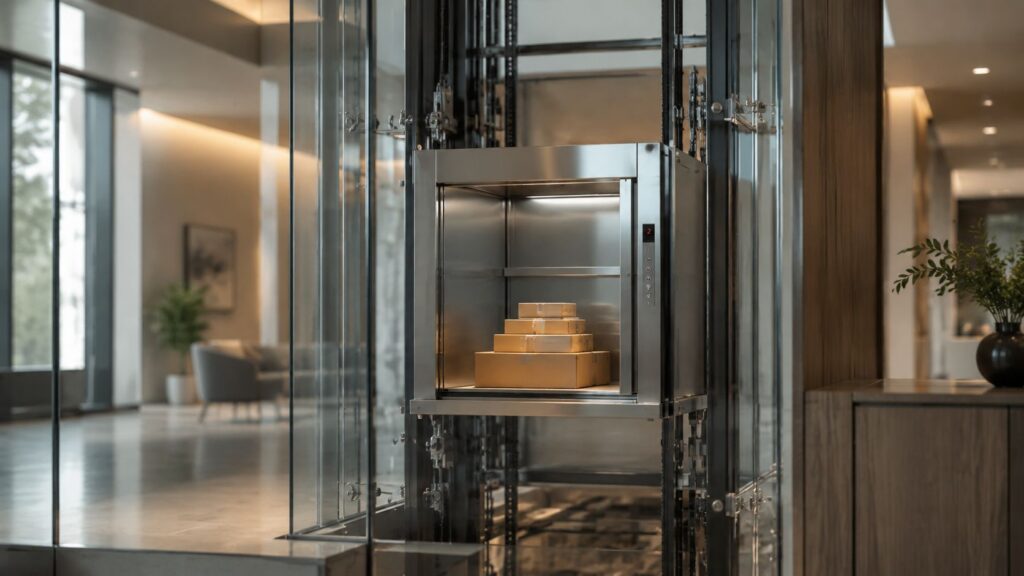
If you own a restaurant in Detroit, a clinic in Ann Arbor, a school in Lansing, or a mixed-use building in Kalamazoo, you've probably seen the same problem play out all day. Staff carry trays, laundry, records, supplies, or boxed inventory up and down stairs because the building was never set up to move materials efficiently. It slows people down, creates injury risk, and wastes labor on work that shouldn't require a person's back and knees.
That's where dumbwaiter lifts make sense. Not as a luxury feature, and not as a novelty, but as a practical tool for moving goods between levels in a controlled, repeatable way. In Southern Michigan, they're especially useful in older buildings where the operation has outgrown the original layout, but a full freight elevator isn't realistic.
The Smart Way to Move Materials in Your Building
A lot of owners start looking at dumbwaiter lifts after one annoying pattern becomes impossible to ignore. Kitchen staff are running sheet pans from prep to service. Office staff are carrying archive boxes to a basement. A small healthcare facility is moving linens and supplies by hand between floors. The work gets done, but it gets done the hard way.
That usually feels manageable until someone drops a load on a stair landing, ties up two employees for a routine supply run, or starts asking why the building still depends on manual carrying for daily operations. At that point, a dumbwaiter stops looking optional.
The larger market reflects that practical demand. The global dumbwaiter lift market is valued at approximately USD 18.8 billion in 2026 and is projected to exceed USD 24.7 billion by 2035, with growth tied to adoption in hotels, restaurants, and hospitals that want better operational productivity, according to Future Market Insights' dumbwaiter lift market outlook.
Where they make the biggest difference
In Southern Michigan, the buildings that benefit most usually fall into a few groups:
- Food service operations: Restaurants, banquet facilities, and cafeterias moving plated meals, dry goods, dishes, or bar stock.
- Healthcare and care settings: Clinics, senior facilities, and support buildings moving records, supplies, and laundry.
- Schools and municipal buildings: Staff handling files, maintenance materials, or food service loads between levels.
- Residential and mixed-use properties: Owners who need a reliable goods-only lift between floors without installing a passenger elevator.
Practical rule: If employees make the same loaded stair trip every day, the building likely has a material-handling problem, not a staffing problem.
In cities like Flint, Jackson, Battle Creek, Dearborn, Novi, and Toledo-area Michigan border communities, many of these projects happen in existing buildings. That matters, because retrofits live or die on planning. The best dumbwaiter installation is the one sized for actual use, laid out for service access, and designed around the building's code path before framing starts.
Understanding What a Dumbwaiter Lift Is
A dumbwaiter is a goods-only lift. That's the cleanest way to think about it. It does for materials what a passenger elevator does for people, but on a smaller scale and for a narrower purpose.
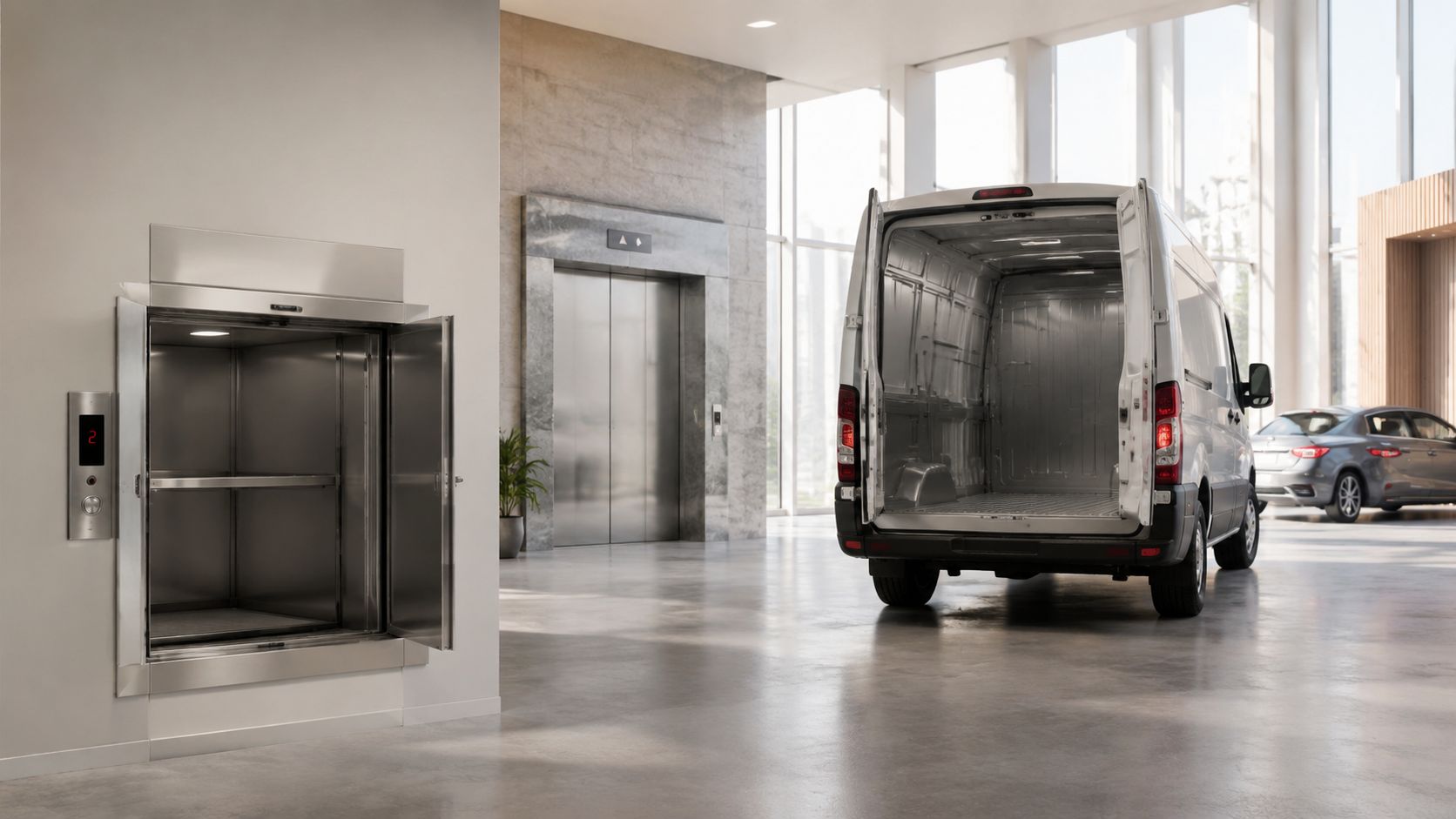
If a passenger elevator is a shuttle bus, a dumbwaiter is a work van. It's built to move packages, trays, supplies, dishes, tools, records, and light freight. It is not built for passengers.
How the equipment evolved
Dumbwaiters aren't new. The term dates back to 1749, and the modern mechanical version took shape when George W. Cannon patented a brake system in 1887. Electric motors were added in the 1920s, which changed the device from a simple hoist into the more reliable equipment owners recognize today, as outlined in Inclinator's history of dumbwaiters.
That history matters for one reason. Dumbwaiters have lasted because the use case is real. Buildings always need a safer, more efficient way to move materials vertically.
What they are and what they are not
Owners sometimes confuse dumbwaiter lifts with small freight elevators, residential elevators, or homemade hoist ideas. That usually leads to bad early decisions.
Here's the distinction that matters:
| Equipment | Primary use | Can carry people | Typical role |
|---|---|---|---|
| Dumbwaiter | Goods only | No | Food, files, supplies, laundry, tools |
| Passenger elevator | People | Yes | Public or private vertical access |
| Freight elevator | Heavy materials and carts | Sometimes with operator rules depending on application | Larger commercial and industrial transport |
| Wheelchair lift or accessibility lift | Mobility access | Yes | Accessibility and code access |
A dumbwaiter should solve a material flow problem. If you're trying to solve an accessibility problem, you need different equipment.
Why owners install them
The practical benefits are straightforward:
- Less manual carrying: Staff stop using stairs as the building's delivery route.
- Better workflow: Kitchens, clinics, and offices can move supplies without pulling people away from primary work.
- Lower strain exposure: You reduce repetitive lifting and carrying on stairs.
- Cleaner separation of tasks: Goods move in the shaft. People stay on the stairs or elevator.
That last point is important in busy operations. Good building systems keep people doing skilled work, not acting as a substitute for equipment.
Common Dumbwaiter Configurations and Capacities
Most owners ask the wrong question first. They ask, “How much weight can it carry?” The better question is, “What exactly are we loading into it, and how are we loading it?”
That's what determines whether the dumbwaiter works well or becomes awkward to use.
Typical size and load range
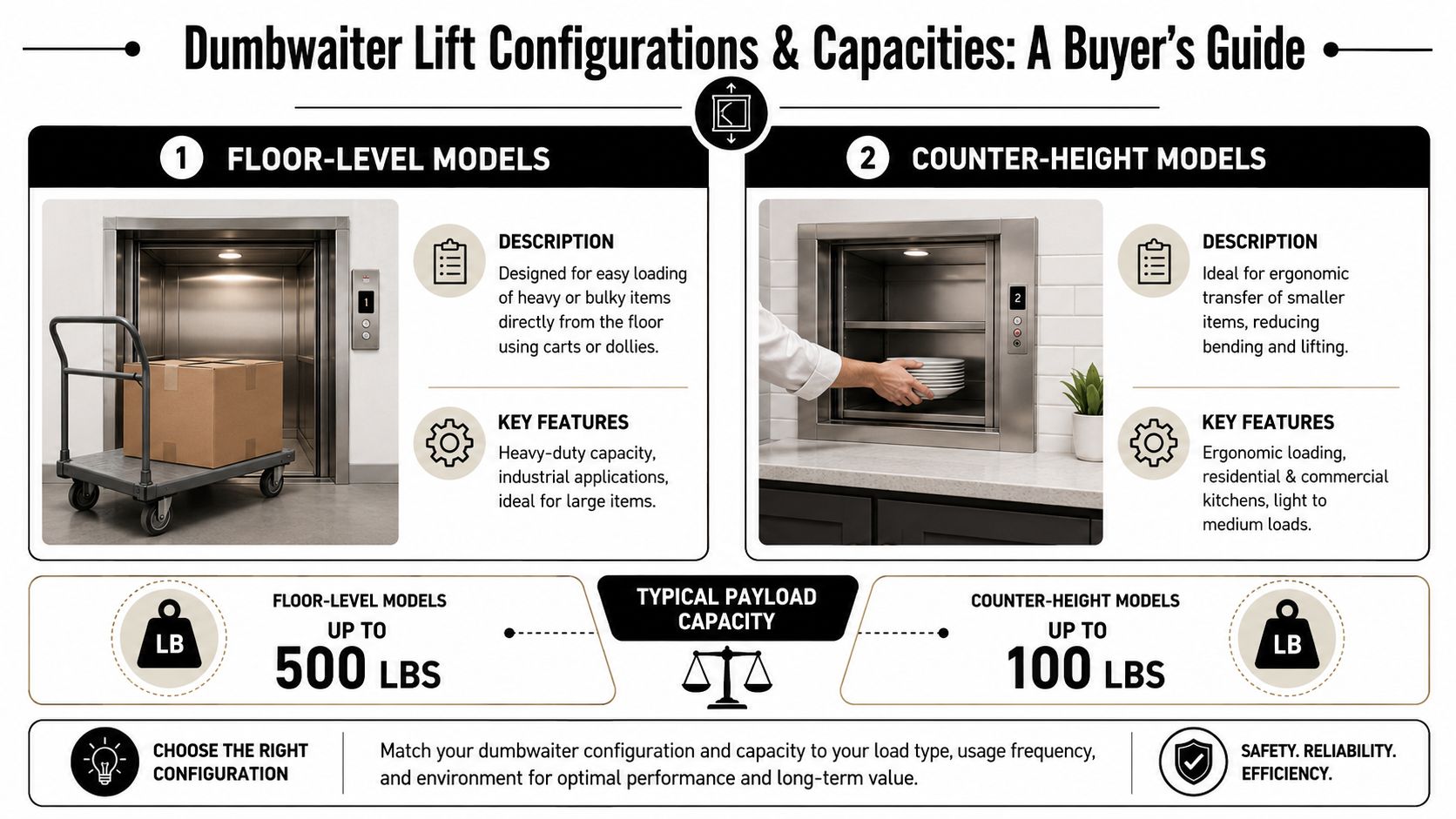
Commercial dumbwaiters are commonly rated in the 100 to 750 lb range, with standard car sizes often around 24 to 28 inches square in smaller models, according to Matot's dumbwaiter product specifications. Those dimensions tell you what the machine is for. Hand-loaded items, boxed goods, trays, and small cart transfer in the right application.
That also means what doesn't work. If you need to move palletized materials, large wheeled bins, or constant heavy freight, you're probably looking at the wrong class of equipment.
Two common loading styles
The most practical split is between floor-level and counter-height loading.
Floor-level units
These are the stronger choice when staff need to roll items in or load heavier, bulkier material with less lifting. They make sense in back-of-house commercial settings, storage areas, and service spaces where carts or dollies are part of the workflow.
Best fit:
- Restaurants with stock movement
- Institutional kitchens
- Maintenance departments
- Commercial back rooms
Counter-height units
These are often easier for hand-loading smaller items. They work well when staff are moving trays, office materials, medication packaging, files, or light kitchen goods and want the opening at a more ergonomic height.
Best fit:
- Office support spaces
- Clinics
- Residential kitchens
- Light commercial food service
Matching the lift to the job
A quick way to frame it:
| Building use | Usually works best | Common mistake |
|---|---|---|
| Restaurant service | Floor-level or larger counter-height, depending on trays vs stock | Choosing too small a cab for pan sizes or containers |
| Clinic or school office | Counter-height | Overbuilding for weight when the real need is clean loading access |
| Retail stock support | Floor-level | Ignoring door swing and landing clearance |
| Private residence | Counter-height in most cases | Treating it like a residential elevator |
One useful starting point for owners comparing vertical transport options is this overview of different types of lift systems. It helps clarify where dumbwaiters fit and where they don't.
If your staff has to turn every load sideways, stack it oddly, or make two trips for what should be one, the cab is undersized even if the rated load looks fine on paper.
Material and finish choices matter too
In Michigan kitchens and medical environments, finish isn't cosmetic. Stainless interiors hold up better where washdown, spills, food handling, or frequent cleaning are part of daily use. In office or residential settings, owners sometimes focus too much on trim and not enough on durability around the doors, sill, and latch hardware.
The parts people touch every day wear first. That's where good specification pays off.
Navigating Michigan Codes and Inspections
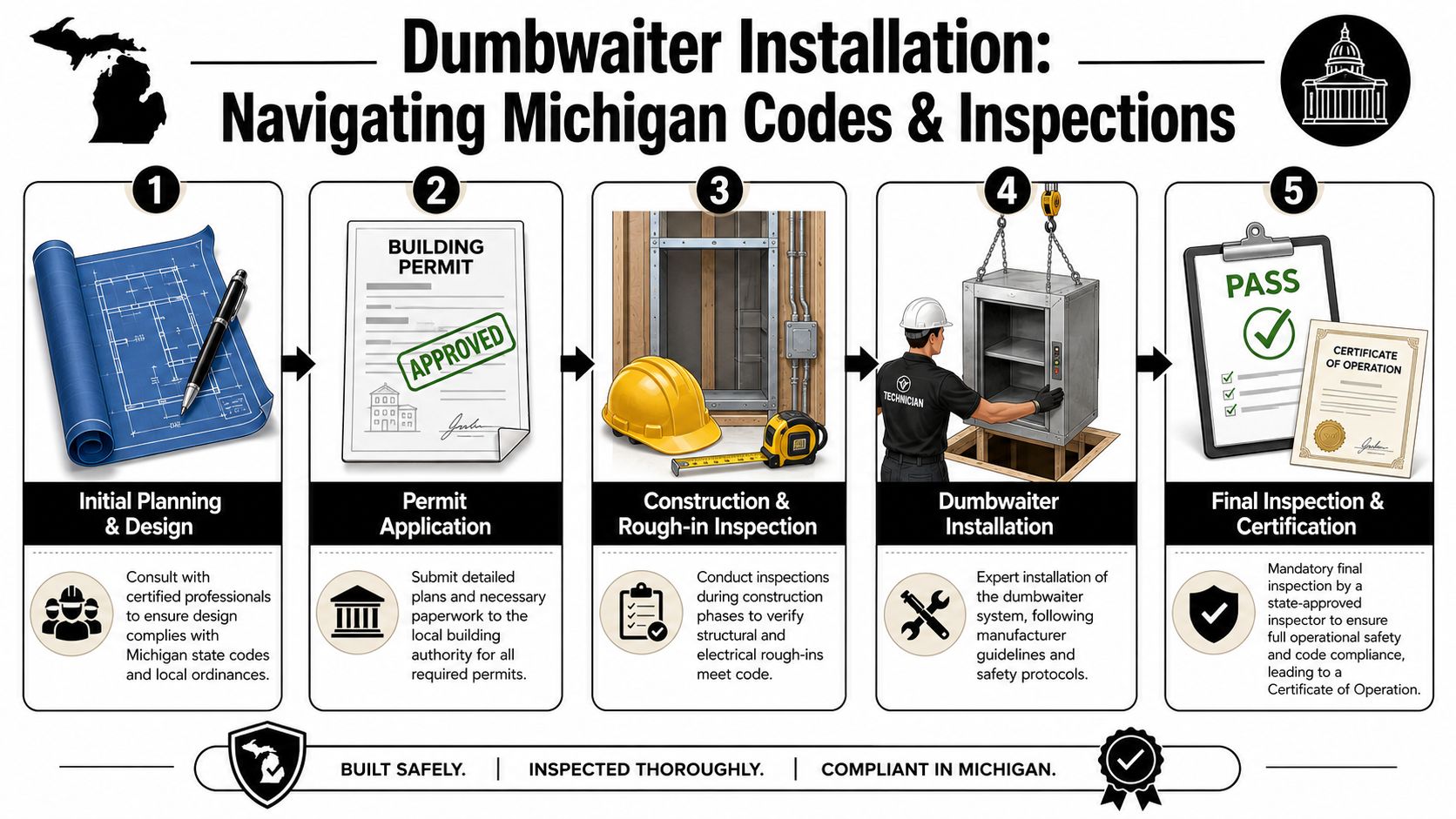
A lot of dumbwaiter jobs start with the wrong question. Owners ask which unit to buy before they confirm whether the building can legally and practically support one. In Southern Michigan, that order causes delays, redraws, and change orders.
A dumbwaiter installation lives or dies on the building side. Shaft size, door locations, fire separation, electrical coordination, access for service, and state inspection all have to line up before the unit goes into use.
What usually drives the design
In the field, the limiting factors are usually travel, stops, and machine arrangement. Those choices affect hoistway dimensions, landing construction, power requirements, and how service technicians will reach the equipment later.
That is why early layout work matters. A dumbwaiter that fits the handling need on paper can still be a bad fit if the machine space is inaccessible, the landing doors interfere with operations, or the shaft cannot be built to code in the existing structure.
Owners who want a baseline on the compliance side should review these Michigan elevator code requirements before finalizing layout or pricing. It saves time to sort out the code path before architectural and electrical drawings are locked in.
Where owners get burned
The recurring problems in retrofit work are usually predictable:
- Hoistway dimensions are too tight: Equipment clearances, rail space, or door assemblies do not fit the framed opening.
- Landings are poorly placed: Doors end up opening into work aisles, prep areas, storage conflicts, or circulation pinch points.
- Electrical scope gets pushed too late: Power, disconnects, and control coordination become last-minute change orders.
- Service access is ignored: A unit can pass installation and still be difficult or expensive to maintain.
- Code review starts after design decisions are made: By then, fixing the concept costs more than planning it correctly at the start.
I see this most often in older mixed-use and commercial buildings where everyone is focused on getting the shaft built. The harder question is whether the full installation can be permitted, inspected, and maintained without creating a long-term headache.
Early mistakes on a dumbwaiter job usually show up as permit delays, framing changes, door relocation, or failed inspection items. They rarely stay small.
Existing buildings need extra caution
Older properties in Detroit, Ypsilanti, Monroe, Adrian, and across Southern Michigan bring a familiar set of constraints. Floor framing may not support the planned shaft location. Mechanical and electrical rooms were not laid out with vertical transport in mind. Fire-rated construction details around openings can turn into the deciding issue.
Local review also slows down when drawings are vague. If the plans do not clearly show shaft construction, entrances, power, machine location, and code coordination, the permit process gets harder than it needs to be.
The compliance path is the core of the project
Manufacturers can provide equipment details, but they do not make the building compliant. The legal installation path depends on permit-ready drawings, licensed trades, correct field conditions, and a successful inspection process under Michigan rules.
That is the part owners need to budget for. A dumbwaiter may look simple compared to a passenger elevator, but it still sits inside a regulated system of construction, inspection, and ongoing responsibility. If the contractor cannot explain how the unit will be installed, inspected, and serviced after turnover, keep looking.
If you remember one thing, remember this: buying a dumbwaiter does not make your building compliant. Proper design, licensed installation, and passing inspection do.
Smart Maintenance and Modernization Strategies
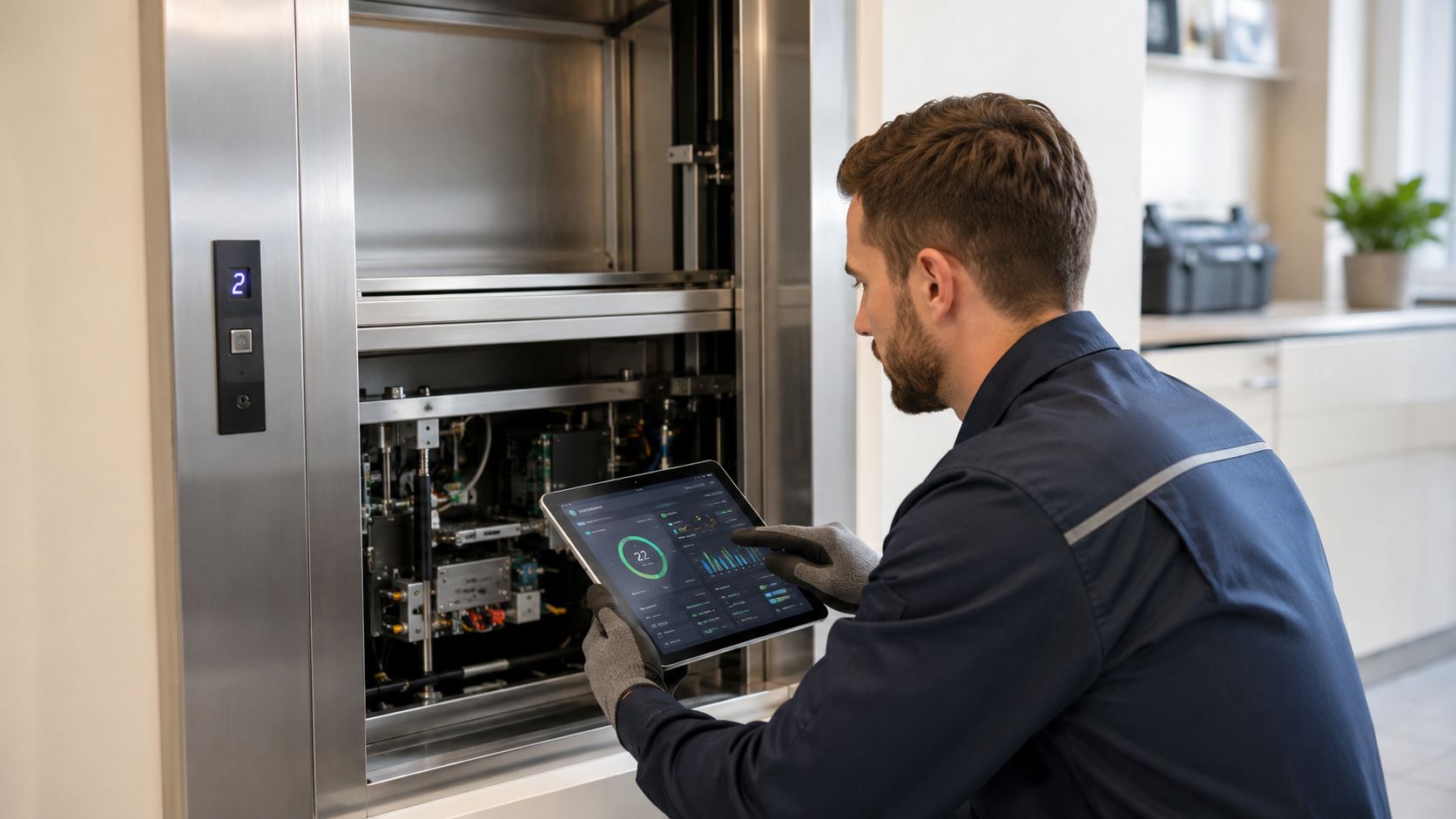
A dumbwaiter that gets used every day needs regular attention, even if it seems simple. Owners sometimes treat these units like they're maintenance-free because they're smaller than passenger elevators. That's a mistake. Small equipment can still create major downtime when doors, interlocks, controls, or drive components start acting up.
What preventative service actually protects
Preventative maintenance does more than keep the unit running. It helps catch the problems that turn into shutdowns.
Focus areas usually include:
- Door operation: Landing doors, latches, and interlocks take constant wear.
- Controls: Call stations, leveling response, and relay or controller issues show up gradually before failure.
- Guide and suspension components: Wear doesn't fix itself.
- Machine space condition: Dirt, moisture, and neglect shorten equipment life.
- Code-related items: Deferred corrections tend to become expensive corrections.
For owners, the business case is simple. Planned service is easier to schedule than emergency service, and it doesn't hit operations at the worst possible moment.
When modernization makes more sense than patching
There comes a point where repeated repairs stop being good stewardship. If parts are hard to source, controls are unreliable, or the unit no longer fits the building's workflow, modernization becomes the better move.
That doesn't always mean replacing the entire dumbwaiter. Sometimes the right answer is targeted work on controls, doors, operator components, wiring, or the drive package. Other times, older equipment has reached the point where a broader update is the only responsible option.
Owners exploring that path should look at a contractor that can handle elevator modernization with non-proprietary equipment and serviceable components. That matters because proprietary systems can tie you to one service channel later.
A quick visual on safe handling and service expectations helps put that into context:
Older dumbwaiters usually don't fail all at once. They become inconvenient first, unreliable second, and expensive third.
Why non-proprietary matters
A non-proprietary approach gives owners more options. If your service provider changes, your building shouldn't be trapped by inaccessible parts, locked-down diagnostics, or a system only one company wants to touch.
That's especially important for schools, municipalities, and commercial portfolios across Southern Michigan where budget control matters. The fewer artificial barriers tied to your equipment, the easier it is to maintain competitive service over the life of the unit.
Planning Your Budget and Selecting a Contractor
A lot of owners call asking for one number. They want to know what a dumbwaiter costs installed. In practice, the honest answer depends less on the catalog price and more on what the building will allow.
I see the same pattern across Southern Michigan. A new project with a planned shaft, clear electrical scope, and good access budgets very differently than a retrofit in an occupied building with tight structure, finished walls, and unknown conditions behind them. The lift may be similar. The labor, code coordination, and inspection risk are not.
What actually drives the budget
Equipment price is only part of the job. Final cost usually changes based on:
- Capacity and cab size: Standard sizes are easier to price and easier to fit. Custom dimensions can solve a layout problem, but they usually raise fabrication and installation cost.
- Number of stops: Each landing adds doors, interlocks, call stations, wiring, and more field coordination.
- Hoistway location: A straight vertical path saves money. Offsets, structural conflicts, and difficult access do not.
- Use and finish requirements: Restaurant, medical, and institutional applications often need more durable and easier-to-clean materials.
- Electrical and general construction scope: Service disconnects, rough openings, framing, fire-rated assemblies, and finish repair can move the number fast.
- Permit, test, and correction exposure: If the scope is loose on the front end, owners usually pay for it later in change orders and inspection-related fixes.
That last point gets missed a lot.
Contractor choice changes the real cost
A low bid is only useful if the contractor understood the building, the permit path, and the inspection standard before the quote was written. If they missed hoistway work, door requirements, electrical upgrades, or state coordination, the price was never real to begin with.
On dumbwaiter work, contractor selection and budgeting are tied together. Owners need a licensed contractor who can explain what is included, what is excluded, who is carrying the building-side work, and how the unit will get from submittal to final approval in Michigan. As noted earlier, contractor coordination and code planning have a direct effect on both schedule and cost.
There is also a long-term ownership issue. If the installer puts in proprietary equipment, the building can get stuck with limited service options later. That may not show up on day one, but it shows up during the first inconvenient shutdown or parts delay.
A practical vetting checklist
Ask direct questions and listen for direct answers.
- Who is pulling permits and coordinating inspection? If nobody owns that task clearly, the job is already at risk.
- What exactly is included in the proposal? Equipment, installation labor, delivery, wiring, hoistway doors, finish work, testing, and freight should be spelled out.
- What is excluded? Owners need to see the gaps before contract signing, not during demolition.
- Is the equipment non-proprietary? That affects future repair options, parts access, and who can service the unit.
- How were existing conditions verified? A contractor who has not properly looked at structure, access, and utilities is guessing.
- Who handles service after turnover? Installation is one phase. Ownership is the longer phase.
- What happens if the inspector calls for corrections? Good contractors answer that without hedging.
In older buildings around Detroit, Ann Arbor, Flint, Lansing, Jackson, Kalamazoo, and Portage, this matters even more. Retrofit work tends to expose framing conflicts, fire-separation issues, and access problems that never appeared on the original walk-through.
Financing only helps if the scope is clear
Financing can make sense for commercial owners who are pairing a dumbwaiter project with a kitchen upgrade, a service improvement, or a broader building update. It does not fix a poorly defined scope. It just spreads out the cost of bad planning.
The better approach is simple. Get the site conditions reviewed carefully, get the construction responsibilities defined in writing, and choose a contractor who can install equipment that another qualified company can still service years from now. That usually saves more money than chasing the lowest opening number.
Frequently Asked Questions from Michigan Owners
Can a dumbwaiter carry people
No. A dumbwaiter is a goods-only lift. If the need is passenger movement, accessibility, or mobility support, the solution is a passenger elevator or another code-appropriate lift.
Are dumbwaiters only for commercial buildings
No. They can work in residential settings too, especially in multi-level homes moving groceries, laundry, or household items. The planning and code path still matter, especially in retrofits.
Is an older building in Southern Michigan a bad candidate
Not automatically. Many older buildings are workable, but retrofits usually need more coordination around shaft location, entrances, electrical work, and fire-related construction details. Buildings in Detroit and other older urban areas often need more preconstruction review than newer suburban projects.
Should I choose proprietary or non-proprietary equipment
For most owners, non-proprietary is the safer long-term choice. It gives you more service options and reduces the chance that one manufacturer or one service company controls your future repair path.
How long does installation take
There isn't one honest universal answer. It depends on whether the shaft already exists, how many stops are involved, how quickly permits move, and what the building reveals once construction begins. Retrofit timelines are driven as much by the building as by the dumbwaiter.
What cities does Crane Elevator Company serve
Crane Elevator Company serves Lower Michigan communities including Detroit, Ann Arbor, Lansing, Flint, Kalamazoo, and surrounding areas. For owners with properties across Southern Michigan, that local coverage matters because permitting, inspection coordination, and service response all depend on regional experience.
If you need help with dumbwaiter lifts, inspections, modernization, or ongoing service in Southern Michigan, contact Crane Elevator Company. They work on non-proprietary vertical transportation systems across Lower Michigan and can help you evaluate whether a dumbwaiter is the right fit for your building, your code path, and your long-term maintenance plan.