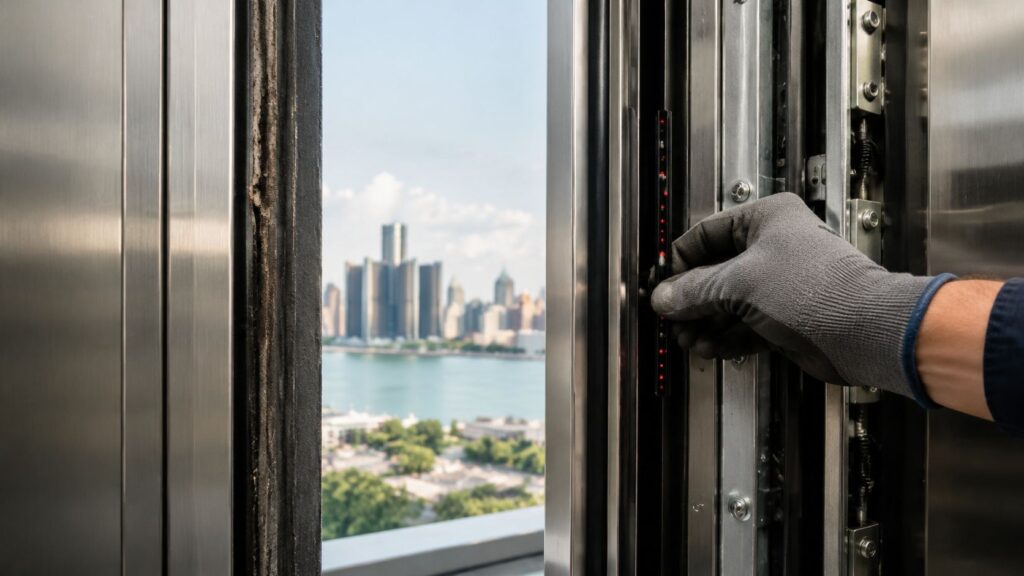
If you’re managing a building in Detroit, Ann Arbor, Lansing, Flint, Kalamazoo, or the towns between them, you probably know the pattern. The elevator runs fine for a while, then the door starts acting up. It bumps a cart. It reopens for no clear reason. Tenants complain that it hesitates, scrapes, or goes out of service at the worst time.
A lot of owners assume the operator is the problem. Sometimes it is. But on older equipment, the actual issue is often smaller and easier to overlook: the mechanical safety edge on the door.
That part used to be standard. Today, it’s one of the clearest signs an elevator door protection system is behind the times. Elevator safety edge replacement isn’t just a repair decision. It’s a risk decision, a compliance decision, and in many buildings, a smart capital planning decision.
The Hidden Cause of Your Elevator Door Problems
A property manager calls because the elevator keeps getting tagged out by staff. The complaint sounds familiar. The doors “hit people lightly,” or “bounce back randomly,” or “won’t stay closed.” The building engineer has already cleaned the sill, checked for obvious obstructions, and reset the unit more than once.
In older buildings, especially mixed-use and commercial properties across Southern Michigan, that symptom pattern often points back to an aging door protection setup. The mechanical edge may still technically work, but it only works after contact. That means the door has to touch a person, cart, wheelchair, or delivery load before it gets the signal to reopen.
That’s not a minor nuisance. According to the National Electronic Injury Surveillance System study on elevator door strikes, an estimated 23,659 elevator injuries among adults ages 20 to 64 were directly attributed to elevator door strikes, representing 42.5% of all elevator-related injuries in that group.
Why this gets missed
Owners usually focus on the callback, not the component. They hear “door problem” and approve another adjustment, another cleanup, another small repair. Meanwhile, the old edge keeps aging. Rubber hardens. Internal contacts wear. Wiring gets intermittent. The door system becomes unpredictable.
Practical rule: If an older elevator has recurring door complaints and still relies on a contact-type edge, the edge itself belongs on the short list of suspects.
What this means for Michigan properties
In office buildings, that translates to tenant frustration and avoidable downtime. In healthcare, education, and municipal settings, it creates a bigger exposure because traffic is constant and users may have limited mobility. In residential and small commercial properties, the liability issue gets even sharper because people assume the door protection is “safe enough” because it still moves.
The right question isn’t “Can we keep this old edge going one more year?” The better question is whether the building still has a component that no longer matches modern expectations for door safety, reliability, and serviceability.
What Are Elevator Safety Edges and Why They Fail
A mechanical safety edge is an older door protection device mounted on the leading edge of the car door. When the door hits a person, cart, or object, the edge compresses, trips a switch, and signals the operator to reopen. The key limitation is built into the design. Contact has to happen first.
That matters when an owner is deciding whether to keep repairing an old edge, replace it with the same type, or move to a light curtain. A contact edge can still function, but it does not provide the same level of detection as a non-contact system, and obsolete parts often turn a small door problem into an ongoing maintenance issue.
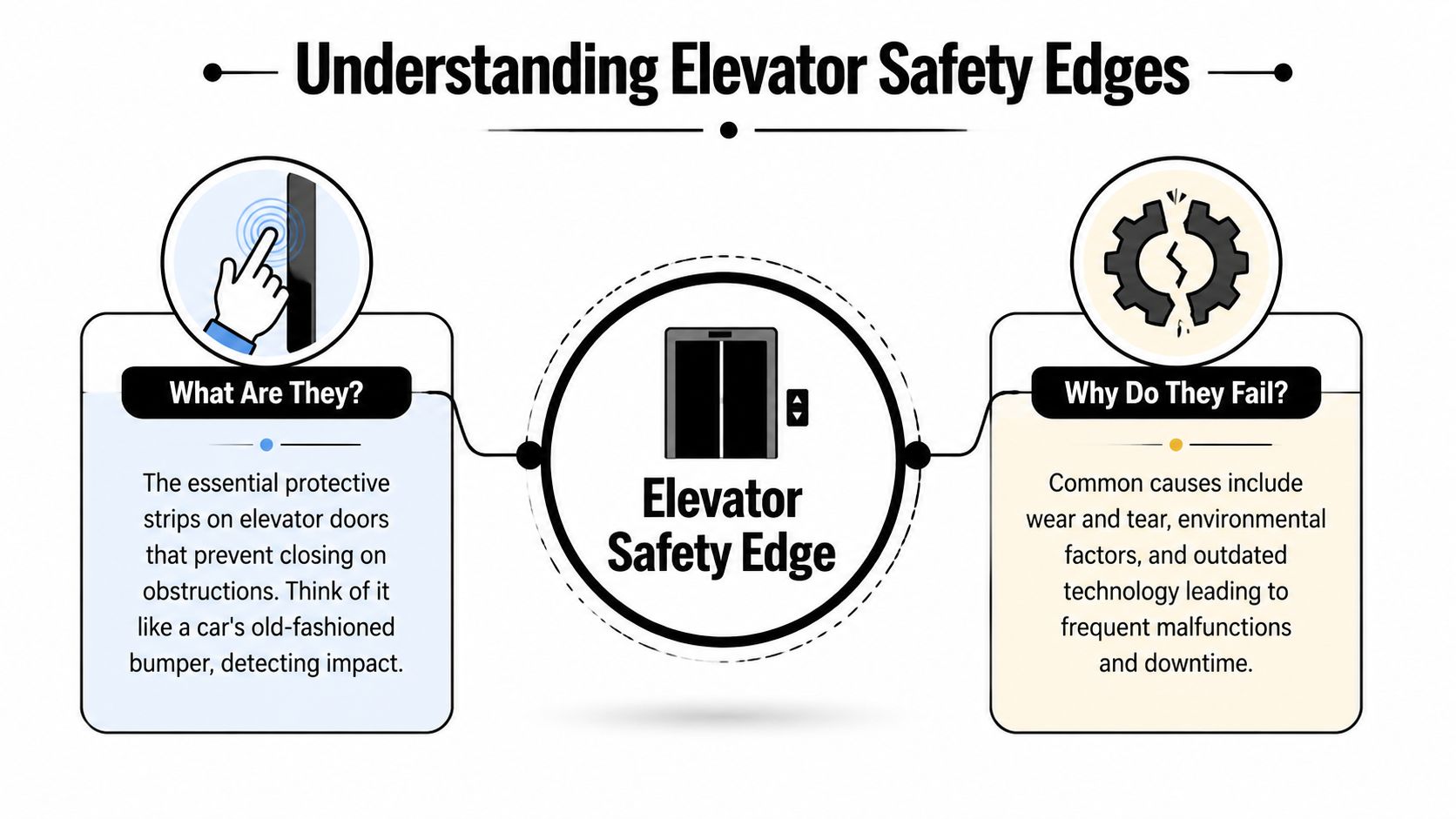
Why many older edges become a long-term liability
Mechanical edges fail in predictable ways because they are wear items exposed to constant abuse.
- Rubber hardens and cracks: Age, temperature swings, dirt, and repeated compression reduce sensitivity.
- Internal contacts wear out: The switch may still work some of the time, which creates the worst kind of fault. Intermittent and hard to pin down.
- Wiring breaks down: Door travel flexes the cable over and over until conductors or terminations start failing.
- Mounting shifts or loosens: Bent panels, loose retainers, and poor alignment keep the edge from reacting consistently.
- The design depends on impact: Even in good condition, the system responds after contact instead of screening the opening before contact.
In the field, that means nuisance reopenings, missed detections, repeat callbacks, and arguments over whether the problem is the operator, the controller, or the edge itself. A disciplined elevator door maintenance program can catch some of these issues early, but maintenance does not change the underlying limits of an aging contact edge.
Why owners often choose a different protection method during replacement
Modern infrared light curtains create a detection field across the opening, so the door can reverse before the panel touches the obstruction. That changes the conversation from simple replacement to risk reduction. If the old edge is damaged but the operator, controller interface, and door equipment are otherwise in decent shape, an upgrade may cost more upfront and still save money over time by cutting callbacks, reducing strike complaints, and improving parts availability.
A practical video overview helps show how these systems fit into a door protection package:
Beam coverage matters if you upgrade
Light curtains are not all built the same. Some provide a narrower detection pattern, while others create a denser field across more of the doorway, as shown in these documented elevator door edge configurations.
That difference affects real-world performance. In a busy Michigan office building, medical facility, school, or apartment property, better coverage usually means fewer missed detections near the closing edge and fewer complaints after installation. A cheap upgrade that leaves detection gaps can create a second round of problems, which defeats the point of replacing the old edge in the first place.
A door protection system should stop the closing cycle before contact whenever practical. That is the standard many owners expect now, and it is often the smarter benchmark when deciding whether an old safety edge is still worth repairing.
Telltale Signs Your Safety Edge Needs Replacement
Most property managers don’t need to diagnose the exact electrical failure. They do need to recognize the warning signs early enough to avoid an injury, shutdown, or repeat callback cycle.
Physical clues you can see
Start with the door edge itself during a normal walk-through.
- Cracked or brittle rubber: If the material looks dried out, split, or deformed, the edge is already past its prime.
- Loose mounting or peeling sections: A safety edge that isn’t secure won’t react consistently.
- Visible wiring damage: Frayed leads, pinched cable, or taped repairs are red flags.
Door behavior that signals trouble
A failing edge often shows up in operation before total failure.
- Doors close and make contact before reopening
- Doors reopen for no obvious reason
- The elevator intermittently goes out of service on door faults
- Closing cycles feel inconsistent from trip to trip
If the building keeps dealing with those patterns, it’s worth looking at a broader elevator door maintenance approach instead of approving isolated fixes one at a time.
Sounds that shouldn’t be ignored
Noise matters. The edge itself may not create the sound, but door behavior often does.
- scraping at the leading edge
- a dull slap when the panel meets a person or object
- repeated reopening clicks during one closing cycle
Those symptoms don’t always mean the safety edge is the only failing part. They do mean the door protection system needs professional attention.
If staff members are warning tenants to “watch the doors,” the equipment is already telling you the protection setup needs attention.
Comparing Replacement Options From Repair to Full Upgrade
A Michigan property manager usually sees this decision after the same elevator has already generated a few door complaints, a few callbacks, and one proposal that looks cheap until you read the exclusions. At that point, the question is not just what will get the door running today. The key question is which option limits repeat failures, tenant contact events, and future code pressure at a sensible cost.
Most jobs fall into three paths. Repair the existing mechanical edge. Replace it with a similar edge. Upgrade the opening with a light curtain.
When repair still makes sense
Repair is a reasonable choice when the failure is narrow and the rest of the assembly is still in good condition. A broken lead, a loose bracket, or a single damaged connection can justify a targeted repair if the edge is not brittle, the parts are still available, and the owner needs time before larger work is approved.
I treat repair as a short-horizon decision. If the rubber is aging, the edge has already been patched before, or service calls are becoming more frequent, a repair often buys a little time and not much more.
When a like-for-like replacement fits
A like-for-like replacement can be the right answer on older equipment that does not accept a simple retrofit, or in a building that plans to modernize the operator and controller later. It restores function without forcing a broader scope immediately.
There is a trade-off. You are still keeping a contact-based device at the landing entrance. The new part may solve the immediate reliability problem, but it does not change the underlying method of protection. In a lower-traffic building, that may be acceptable for a few more years. In a medical office, senior housing property, or busy apartment building, it is often a weak long-term choice.
Why light curtains usually win on long-term cost and risk
A light curtain changes the decision from replacement to improvement. Instead of waiting for the door to strike an object or person hard enough to compress a mechanical edge, the system detects presence across the opening before contact.
That matters in two ways. It reduces the chance of door contact complaints, and it usually reduces wear tied to repeated physical hits at the leading edge. Owners often focus on the higher initial price. The better comparison is lifecycle cost. If a light curtain cuts nuisance callbacks, reduces shutdowns, and lowers the odds of an injury claim, the higher upfront number often makes financial sense.
For buildings reviewing whether an upgrade aligns with current elevator code requirements in Michigan, this is usually the point where repair and replacement stop being purely maintenance decisions and start becoming risk decisions.
Crane Elevator Company and other qualified contractors may price this work either as a repair item or as part of a modernization scope. The label matters less than the details. Owners should look at compatibility with the operator, controller inputs, available parts, test procedures, and whether the installed solution will still be serviceable five years from now.
Safety Edge Options Compared
| Option | Upfront Cost | Safety Level | Long-Term Reliability |
|---|---|---|---|
| Repair existing mechanical edge | Lower | Lower, still contact-based | Variable, depends on age and condition |
| Replace with similar mechanical edge | Moderate | Better than a failed unit, but still contact-based | Moderate on legacy systems |
| Upgrade to infrared light curtain | Higher | Higher, non-contact detection field | Stronger long-term fit for modernization |
Decision filters that actually change the answer
Before approving work, look at the factors that drive total ownership cost, not just the first invoice:
- Remaining life of the current edge: If the material is already aging, repair is usually temporary.
- Parts availability: Obsolete components turn small failures into long outages.
- Building traffic and user profile: High-use buildings and vulnerable populations justify better door protection sooner.
- Modernization timing: If a larger upgrade is planned soon, choose a path that does not waste money now.
- Future serviceability: A cheaper fix is a poor value if only one niche part source can support it later.
The lowest proposal often becomes the most expensive option once repeat callbacks, tenant complaints, and another replacement decision hit the same budget cycle.
Navigating Codes Liability and Costs in Michigan
For Michigan owners, elevator safety edge replacement is rarely just a maintenance line item. It sits at the intersection of code compliance, operational risk, insurance exposure, and tenant relations.
Compliance is moving in one direction
Even when a legacy setup can still be kept running, code expectations and inspection culture continue to move toward safer, more reliable door protection. Owners who wait for a forced correction usually end up paying more because the work becomes reactive, the elevator stays down longer, and the schedule is now driven by a violation instead of planning.
If you're reviewing building obligations, this summary of elevator code requirements is a useful starting point for understanding how upgrades and corrective work are typically framed.
Liability isn't limited to obvious injuries
The business risk goes beyond a single door strike complaint. Repeated contact, nuisance shutdowns, and ignored service recommendations all create a paper trail. After an incident, people will ask whether the owner knew the door protection was obsolete or unreliable and chose not to address it.
That's especially important in buildings with seniors, patients, students, or mobility device users. In those settings, “minor” contact events don't stay minor for long.
Residential elevators need a different hazard review
In homes, small properties, and wheelchair lift applications, the most serious hazard may not be the safety edge at all. The U.S. Consumer Product Safety Commission warns about children becoming trapped in gaps between hoistway doors and car doors in home elevators and recommends qualified inspection, space guards, or electronic monitoring devices in unsafe conditions, as outlined in the CPSC home elevator and wheelchair lift safety guidance.
That matters because replacing the edge alone may leave the actual entrapment hazard untouched.
How owners should think about cost
The cleanest way to evaluate cost is by grouping it into three buckets:
- Direct project cost: Parts, labor, testing, and any related door adjustments.
- Downtime cost: Tenant disruption, staff time, accessibility issues, and lost productivity.
- Risk cost: Exposure created by keeping a contact-based system that no longer matches modern practice.
A repair can be the right answer when the goal is short-term continuity. A light curtain upgrade is usually the stronger answer when the goal is fewer door complaints, better protection, and a longer service horizon.
Choosing a Qualified Contractor in Southern Michigan
A safety edge replacement should never begin with “we'll swap the strip and see what happens.” That's not a diagnostic process. It's a guess.
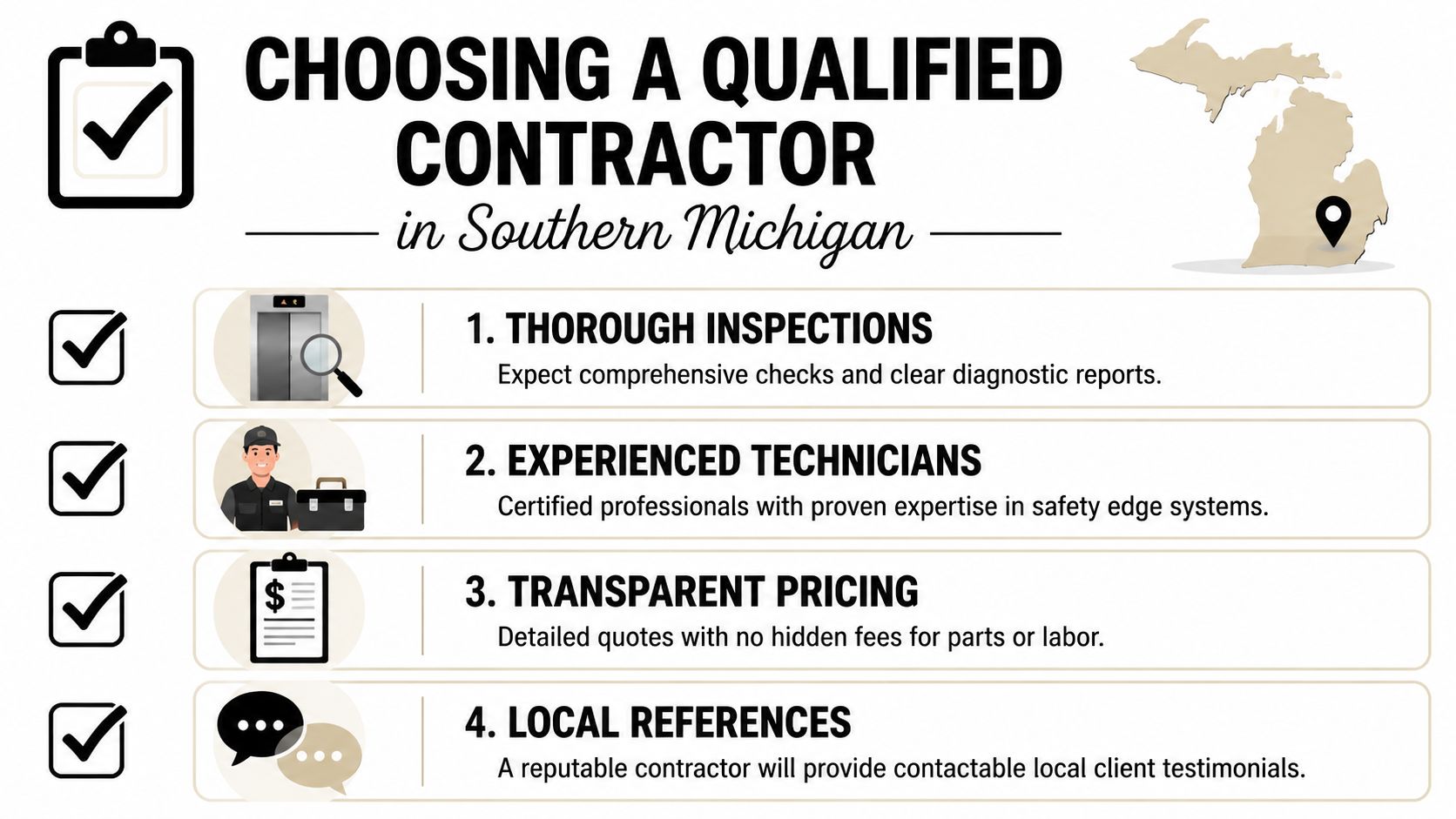
A qualified elevator contractor should inspect the full door protection chain. That includes the edge or detector, the operator behavior, the controller interface, mounting condition, wiring path, and the actual closing performance after installation.
What to demand before approving the work
Use a short checklist.
- A real site inspection: Not a phone diagnosis. The contractor should verify how the current protection works and whether the problem is isolated or systemic.
- Clear options in writing: You should see repair, replacement, and upgrade pathways when more than one is viable.
- Compatibility review: The proposal should address the operator and controller, not just the door edge itself.
- Testing after installation: Door protection has to be checked in operation, not just bolted on.
Warning signs during bidding
Some proposals tell you very little. That's a problem.
If the contractor can't explain whether the old edge is obsolete, whether parts are dependable, or whether a light curtain retrofit is compatible with the existing system, you're not getting enough information to make a sound decision. The same goes for vague pricing that leaves all door adjustments as “extra if needed.”
Ask one simple question: “If we approve this option, what problem are we solving for the next several years?” A good contractor will answer directly.
Why local experience matters
Michigan buildings add real-world variables. Older downtown properties in Detroit and Flint often have legacy equipment and tight hoistway conditions. Ann Arbor and Lansing properties may need to coordinate work around student, medical, or public-facing traffic. Industrial and municipal buildings in smaller towns often care most about uptime and serviceability.
That's why owners should look for a contractor with documented local experience, a process for inspections and testing, and a service philosophy built around non-proprietary equipment and long-term maintainability. If you're vetting providers, this overview of a reliable elevator company gives a useful benchmark for what a professional service model should include.
The standard should be simple
You want a contractor who can do four things well:
| What matters | What it looks like in practice |
|---|---|
| Diagnosis | Finds the root cause instead of swapping parts blindly |
| Compliance handling | Documents the work and aligns it with inspection expectations |
| Installation quality | Mounts, wires, and tests the system correctly |
| Serviceability | Leaves you with equipment other qualified providers can support |
That's the difference between fixing a symptom and improving the elevator.
Take the Next Step Toward a Safer Compliant Elevator
An old mechanical safety edge usually doesn't fail all at once. It declines in small ways. A little more contact. A little more inconsistency. Another service call. Another tenant complaint. Then one day the building owner is dealing with a shutdown, an injury report, or a replacement decision that should've been made earlier.
That's why elevator safety edge replacement should be treated as modernization planning, not just a repair ticket. If the existing edge is damaged but otherwise serviceable, a targeted repair may buy time. If the system is obsolete, parts are uncertain, or the building has steady traffic, replacing the old setup with a modern light curtain is often the smarter move.
For property owners across Southern Michigan, that decision affects more than the elevator. It affects accessibility, liability, tenant confidence, and how much money you keep spending on recurring door problems.
If your elevator doors are already sending warning signs, don't wait for a failed inspection or a serious incident to force the issue.
If you manage a property in Detroit, Ann Arbor, Lansing, Flint, Kalamazoo, or surrounding Lower Michigan communities, contact Crane Elevator Company for a no-obligation assessment of your elevator door protection system. A qualified review can help you decide whether a repair is still defensible, whether a like-for-like replacement makes sense, or whether a light curtain upgrade is the safer long-term fix.