
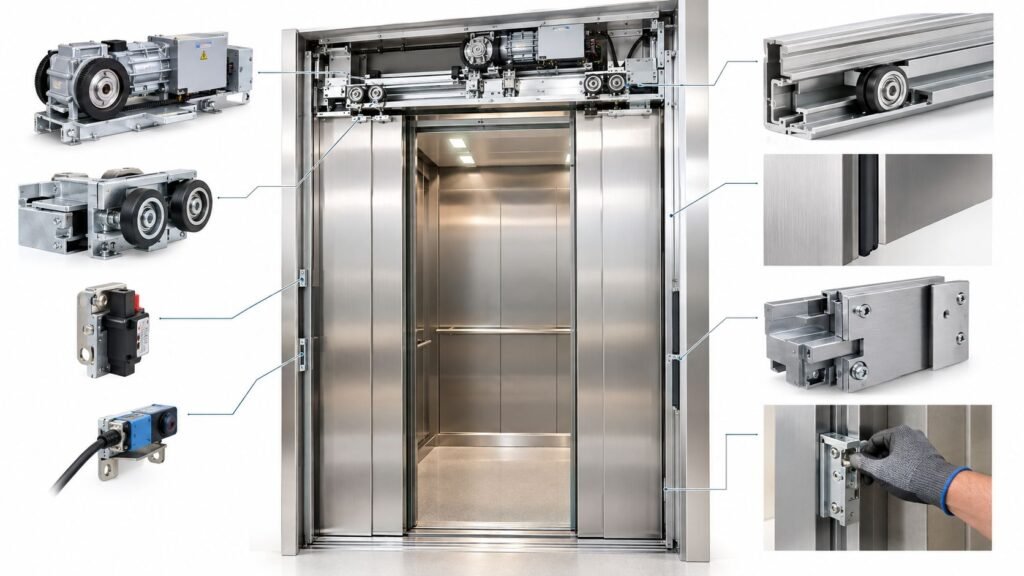
Elevator door problems rarely start with one dramatic failure. More often, a door begins to drift, scrape, reopen late, or make a new noise, and that small change points to wear in a connected system of panels, locks, sensors, rollers, operators, and safety circuits. That matters because elevator doors are among the most heavily used mechanical components in a building, with one industry source saying they open and close nearly 200,000 times per year and another saying door-related issues account for over 70% of elevator service calls National Elevator Industry summary. In practical terms, elevator door maintenance is the first place facility managers should look when reliability slips.
The task is simple, but it has to be disciplined. Identify the visible symptom, document what you see, and escalate any safety-related fault to a qualified elevator contractor. That applies across passenger, freight, residential, wheelchair, material-lift, and dumbwaiter applications, because the door system on each one still has the same basic job, protect the rider and keep the car available.
Crane Elevator Company is one Michigan and Ohio provider that fits that model. It serves Detroit, Lansing, Ann Arbor, Grand Rapids, Flint, Kalamazoo, Toledo, Perrysburg, and surrounding communities with maintenance, repairs, inspections, modernization, and other elevator services for all makes and models. In Michigan, that range matters because facilities in places like Detroit, Livonia, Ypsilanti, Midland, Bay City, and even smaller towns such as Manistee and St. Johns still need the same field-ready response when a door starts acting up.
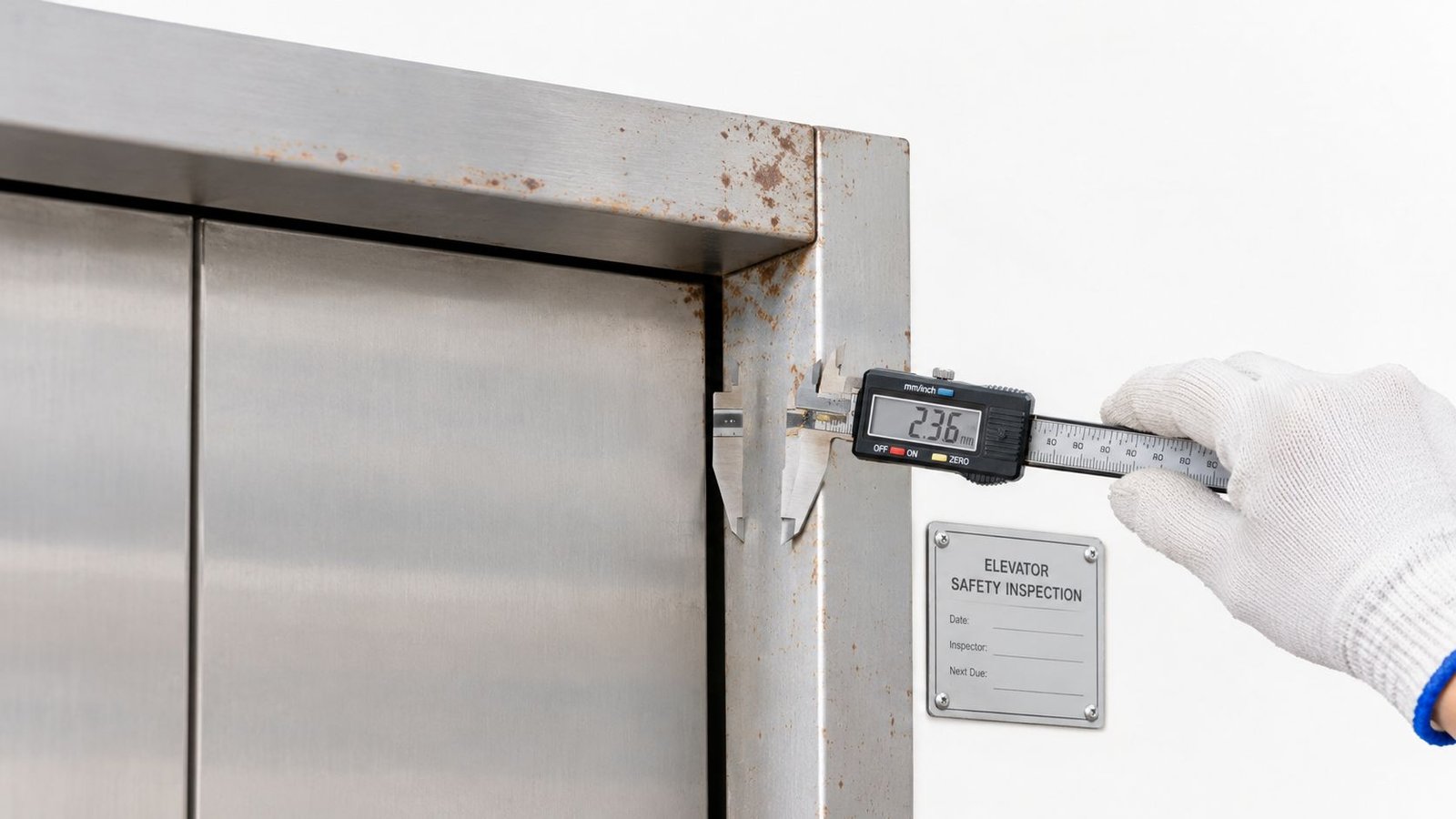
1. Door Panel and Frame Inspection
A bent panel or a twisted frame doesn't always stop the elevator right away. It usually shows up first as rubbing, uneven closing, or a car door that meets the landing door with just enough misalignment to create wear every time the cycle repeats. In a busy building, that kind of issue can hide behind normal traffic until someone finally notices scuff marks, gap changes, or corrosion around the edges.
High-traffic hospitals in Ann Arbor often expose rust on stainless steel panels before anyone sees a full operational failure. In Lansing schools, repeated use can pull a frame out of alignment, and in Flint manufacturing facilities, dent patterns can point to loading damage from carts or equipment. Those are the kinds of field clues that matter more than a cosmetic blemish.
Practical rule: If the panel no longer sits square in the opening, treat it as a mechanical issue first and an appearance issue second.
The best maintenance response is straightforward. Inspect both the car door and the landing door, photograph damage for the record, and check the seals where water intrusion might be starting. In high-use buildings, quarterly inspections make sense because they catch the slow failures before they turn into an expensive replacement.
A few actions are worth making routine:
- Document the condition: Photograph dents, rust, and frame shifts so the next visit has a baseline.
- Check for water paths: Look at seals and lower edges for moisture stains or swelling.
- Address corrosion early: Rust on a door panel rarely improves on its own, especially after winter salt and slush.
- Watch for repeat damage: If the same spot keeps getting hit, the underlying issue may be traffic flow or loading behavior.
For Michigan facilities, proactive service pays off. A panel that's still technically operating can still be the source of repeat callbacks, and those callbacks often cost more than a timely repair.
2. Door Operator and Drive System Maintenance
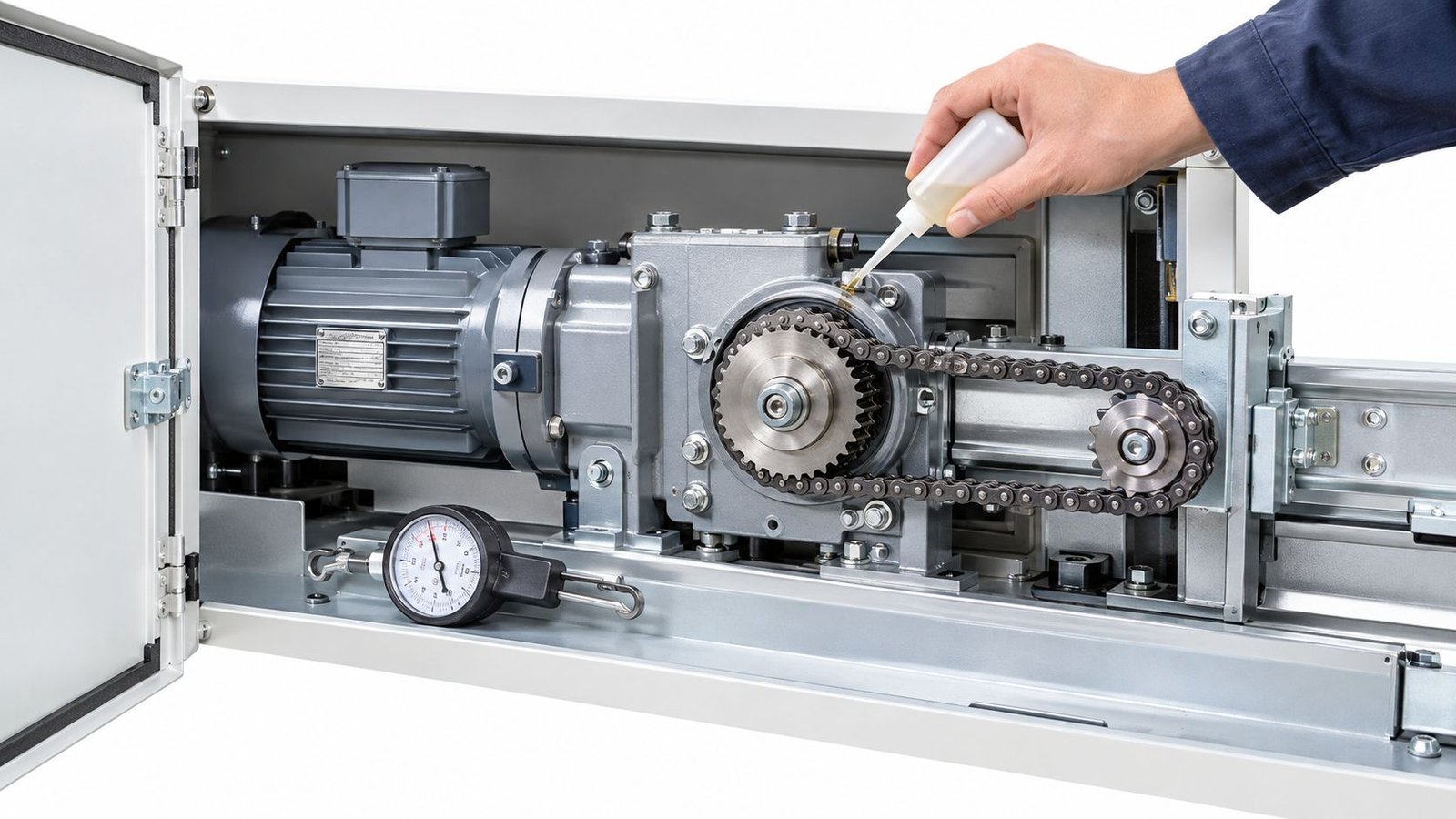
The operator is the part most riders never notice until it gets sloppy. When the motor, gears, and linkages are tuned correctly, the door moves at a predictable pace and stops cleanly. When they're not, the door jerks, stalls, drags, or starts changing speed from one cycle to the next.
Facilities in Toledo often call about door delay complaints that trace back to operator adjustment, not a bad door itself. Detroit office buildings can see repetitive morning slowdowns when traffic builds and a weak operator shows its age. Municipal buildings in Lansing also feel operator problems in a different way, because delayed or uneven doors create accessibility friction for visitors who already need a predictable entry experience.
The right maintenance approach respects manufacturer specifications. Lubrication has to match the equipment, and the technician should listen for grinding or squealing during normal operation instead of waiting for a failure. If a gear or chain is worn, replacement before complete breakdown is almost always the cleaner choice.
A useful maintenance sequence looks like this:
- Test door travel daily during routine checks: The operator should open and close without hesitation or surging.
- Match lubrication to the equipment: Wrong lubricant choices can create more drag, not less.
- Record speed changes: A slow door is often the first symptom of drive wear.
- Replace worn parts early: Gears and chains rarely fix themselves, and waiting usually creates a callback.
- Keep a written service trail: Adjustments matter because they show whether the problem is recurring or isolated.
For facilities with heavy traffic, operator work is a reliability decision, not a cosmetic one. A good technician can usually tell the difference between a small tuning issue and a drive system that's heading toward repeat outage patterns.
3. Door Lock and Safety Device Testing
A door that looks closed isn't enough. The lock and safety devices have to prove they're holding the system in a safe state before the car is allowed to move. That's why this part of the inspection should never be treated as a quick glance.
Door-related injuries remain a serious reason to stay strict here. A review of U.S. injury data cited by industry analysts found nearly 4,000 emergency-room visits annually tied to elevator doors closing on a body part or a walker being wedged in the doors, while another source reports elevators average about 0.4 entrapments per year, or roughly 1 in every 100,000 rides Elevator World on door protection updates. That's exactly why lock contacts, safety switches, and related circuitry need regular testing, not just visual attention.
Crane Elevator treats door lock monitoring as part of its preventive maintenance program, and that focus aligns with what the code expects. If you want a deeper look at that service category, the company's door lock monitoring page shows how it fits into ongoing safety work.
In practice, this means testing the lock every maintenance visit, cleaning the contacts, and checking for corrosion or loose wiring. Grand Rapids schools may uncover worn lock contacts during routine testing, while Ann Arbor residential buildings can avoid safety violations by catching intermittent failures before they become obvious. Kalamazoo industrial sites face a different trade-off, because a lock that fails only occasionally can still create downtime and uncertainty across the whole shift.
A lock that passes once but fails repeatedly is still a problem. Intermittent failures are often the ones that drive the most callbacks.
Keep the documentation tight. Record each test, note any abnormal readings, and replace safety devices at the manufacturer-recommended interval. In a real compliance file, that paper trail matters as much as the repair itself.
4. Door Hoist Cable and Pulley System Maintenance
Some door systems move with cables and pulleys, and those parts carry more hidden wear than you might expect. Frayed cable, uneven tension, or a pulley that no longer rotates smoothly can turn a normal door cycle into binding, noise, or sudden hesitation. The system may still function, but it won't be predictable.
In Flint and Lansing, that kind of wear shows up in facilities that see daily traffic and a lot of stop-and-start cycles. Office complexes in Detroit may first notice a door noise complaint, then discover that a pulley has drifted out of alignment. In Ann Arbor healthcare buildings, a cable problem can become a risk issue quickly if the door doesn't close the way the controls expect it to.
Routine inspection has to be hands-on. Look for fraying, corrosion, and tension drift, then compare both sides of the system so the door stays balanced. If a cable set is worn, replacing the whole set is usually the cleaner move because it helps preserve even operation.
The most useful habits are basic but easy to skip:
- Inspect cable condition on every preventive visit: Small frays tend to worsen under repeated use.
- Measure tension in high-use elevators: Unequal tension often shows up as rough movement before total failure.
- Use the right lubricant: Cable systems need products that fit the manufacturer's design.
- Watch for changing door behavior: A new vibration or noise usually means wear has advanced.
- Replace as a matched set: Mixing new and old cables can create uneven loading.
The larger lesson is simple. A cable and pulley door system doesn't fail all at once very often. It usually sends a series of small warnings, and the technician who catches those warnings early saves the building from bigger downtime later.
5. Door Sensor and Photoelectric Eye Maintenance
Door sensors do a job people only notice when they stop doing it. They watch for obstructions, prevent the doors from closing on a person or object, and keep the car from starting while someone is still entering or exiting. A dirty lens or a misaligned beam can create false readings, late reversals, or inconsistent closing behavior.
Recent predictive-maintenance work is making that oversight more visible. One research dataset collected door-related signals at 4 Hz, another at 9.1 Hz, and both used multivariate time-series recordings during high-traffic evening hours between 16:30 and 23:30 to capture door-cycle behavior and malfunction precursors IEOM Society proceedings. That kind of data supports a practical point, door health can be trended before a lockup happens.
Hospital emergency departments in Detroit are a good example of why the work matters. A sensor cleaning program can eliminate door closure incidents without changing the whole system. Retail environments in Grand Rapids also benefit because responsive doors improve the customer experience, while warehouse facilities in Lansing need reliable detection to prevent equipment damage from a false close.
Use the sensor the way it's meant to be used, as a monitored safety device, not just a lens to wipe off. If you're looking for a component-specific service reference, Crane Elevator's door sensor page matches this maintenance focus.
Monthly lens cleaning in dusty areas is a good baseline, but alignment checks matter just as much. If the sensor response changes, log it. If the unit starts behaving inconsistently across test cycles, replace it before the pattern becomes a service call.
6. Door Roller, Guide, and Track Maintenance
Rollers, guides, and tracks are the hidden path that makes the whole door feel smooth. When they're clean and aligned, the door slides like it should. When debris builds up or rollers wear flat, the door starts sticking, squeaking, or moving unevenly.
Schools in Ann Arbor often hear the first warning as noise. Commercial offices in Detroit notice sluggish response, and medical facilities in Flint may see delay complaints before anyone describes the underlying cause correctly. The fix usually isn't complicated, but it has to be consistent.
Maintenance here is mostly about friction control and alignment control. Clean the tracks, check the guides, and make sure the rollers aren't chewing into the rail surface. Crane Elevator's guide rail page is a useful point of reference for this kind of hardware relationship, because the rail and the door hardware have to work together for the system to stay reliable.
A practical inspection routine should include a few clear checks:
- Remove debris monthly in dirty environments: Dust, grit, and construction residue create uneven movement.
- Use manufacturer-recommended lubricant: Too little lubrication causes drag, too much attracts dirt.
- Check for binding during travel: A door that hesitates at the same point usually has a track or roller issue.
- Verify alignment at quarterly visits: Small shifts become repeated wear if nobody corrects them.
- Replace worn rollers before track damage spreads: A bad roller can scar the track and turn a modest repair into a bigger one.
A quiet door isn't just a comfort issue. It usually means the contact surfaces are doing their job, and that's the condition you want to preserve.
7. Door Buffer and Shock Absorber Inspection and Replacement
Buffers and shock absorbers are easy to ignore because they only show their value under impact. Their job is to cushion the door at the end of travel, reduce noise, and protect the mechanical components that would otherwise take the full hit. Once they lose effectiveness, the closing action gets harder and more abrupt.
That change matters in real buildings. High-rise offices in Detroit may start hearing a sharper closing sound before anyone notices a deeper mechanical issue. Residential buildings in Lansing can use buffer upkeep to improve closure comfort for elderly residents, and hotel facilities in Grand Rapids often feel the difference in noise complaints before guests ever see a maintenance ticket.
The inspection is partly visual and partly auditory. Look for leaks where buffer fluid should stay contained, and listen for a louder impact at the end of travel. Springs also need to be checked to make sure they still compress and recover the way they should.
Practical insight: If the door sounds harder at the end of travel, don't blame the panel first. Buffers and shock absorbers often explain the change.
The trade-off is simple. Replacing a buffer at the recommended interval costs less disruption than letting repeated impact loosen other parts of the system. Facilities that wait too long often end up chasing secondary wear in rollers, guides, and fasteners.
For Michigan properties that care about quiet operation and longer hardware life, this is one of the easiest preventive wins. It doesn't solve every door problem, but it removes a very common source of unnecessary wear.
8. Door Safety and Code Compliance Testing
Code compliance depends on proving that door safety devices operate correctly, not just confirming that they are installed. Test, document, and correct each device within the applicable local inspection framework. ASME A17.1/CSA B44 Section 8.6 has required maintenance for applicable components since the 2000 edition, as summarized by the NEII summary.
The inspection-ready catalog for this component includes door interlocks, restrictors, and reopening devices. Interlocks must prevent car movement when the landing doors are open. Restrictors help prevent unintended door opening outside the landing zone, while reopening devices must respond correctly when an obstruction is detected. A failed test can leave the elevator operating with a safety function unavailable, even if the doors appear to cycle normally.
Run each test under the conditions required by the applicable code and equipment design. Record the device tested, observed response, deficiency, corrective action, and retest result. Do not close a work order with “adjusted” as the only description. State what failed and how the technician verified the repair.
Michigan facilities should also keep inspection records easy to retrieve. Log interlock, restrictor, and reopening-device tests on Form X with the date, technician ID, and deficiency code, then file the form with the QEI inspection record for Michigan LARA review.
Schedule testing according to local requirements, retain results, and address violations promptly. Maintenance, repair, and documentation must describe the same safety condition.
8-Point Elevator Door Maintenance Comparison
| Service | Implementation complexity | Resource requirements | Expected outcomes | Ideal use cases | Key advantages |
|---|---|---|---|---|---|
| Door Panel and Frame Inspection | Low–Medium (visual & mechanical checks) | Calipers, cameras, basic hand tools, inspection time | Detect cracks, corrosion, misalignment; repair recommendations | High-traffic or aging buildings, cosmetic/structural checks | Early damage detection; extends panel life; improves safety |
| Door Operator and Drive System Maintenance | Medium–High (mechanical + electrical tuning) | Diagnostic equipment, lubricants, trained technician, spare parts | Smooth, consistent door motion; reduced failures & noise | Buildings with jerky/stalling doors, accessibility concerns | Restores reliable operation; extends motor/gear life; compliance |
| Door Lock and Safety Device Testing | Medium (electrical & safety verification) | Multimeter, test rigs, replacement locks, skilled tech | Verified lock function, correct safety interlocks, code compliance | Facilities with strict safety requirements, older systems | Prevents movement with open doors; reduces entrapment risk |
| Door Hoist Cable and Pulley System Maintenance | High (tensioning & possible replacement) | Tension gauges, hoisting tools, replacement cables, downtime | Prevents fraying/failure; smooth door travel; balanced operation | Cable-driven doors, industrial sites, noisy/binding systems | Reduces catastrophic failures; ensures smooth, safe operation |
| Door Sensor and Photoelectric Eye Maintenance | Low–Medium (cleaning & alignment) | Cleaning materials, alignment tools, sensitivity tester | Reliable obstruction detection; fewer false triggers | Dusty environments, hospitals, retail, high pedestrian areas | Protects passengers/equipment; improves responsiveness |
| Door Roller, Guide, and Track Maintenance | Medium (clean/align/replace components) | Lubricants, alignment tools, replacement rollers/tracks | Smooth, quiet door movement; reduced wear and binding | Buildings with sticking or squeaking doors, dusty sites | Prevents binding; extends component life; reduces noise |
| Door Buffer and Shock Absorber Inspection & Replacement | Medium (inspection + part replacement) | Replacement buffers/shocks, basic inspection tools, fluid handling | Softer closures; reduced impact and noise; protected components | High-rise offices, hotels, residential buildings prioritizing comfort | Protects mechanisms from impact; improves closure comfort |
| Door Safety and Code Compliance Testing | Medium–High (comprehensive testing & documentation) | Measurement equipment, certified technicians, reporting tools | Documented compliance; identified violations and remediation steps | Annual inspections, regulatory audits, ownership transitions | Ensures legal compliance; avoids fines; reduces liability |
Turn Door Findings Into a Maintenance Plan
A good maintenance program starts when the building team turns observations into work orders. Note the symptom, identify the affected component, record the inspection result, and assign a qualified elevator professional for adjustment, repair, testing, or replacement. That sequence sounds basic, but it prevents the most common failure in the field, treating the same symptom over and over without isolating the cause.
The eight components in elevator door maintenance work as one connected system. Door locks, sensors, operators, tracks, rollers, cables, panels, buffers, seals, and gibs influence each other, so a recurring problem usually deserves a broader assessment rather than another quick fix. A door that keeps sticking might point to track wear, but it might also trace back to a sensor issue, a lock contact problem, or a drive system that's not moving smoothly enough to stay in spec.
For Michigan and Ohio building owners, the practical move is to document what you see and then decide whether the issue belongs in preventive maintenance, emergency repair, code-required inspection, violation correction, or modernization planning. That's especially relevant in Detroit, Lansing, Ann Arbor, Grand Rapids, Flint, Kalamazoo, Traverse City, Battle Creek, Manistee, Toledo, Perrysburg, and surrounding communities where buildings range from older freight units to newer passenger cars and wheelchair lifts. Crane Elevator Company also offers 24/7/365 field response and free second opinions when a door issue needs a second look before a major repair is approved.
Use the inspection record to decide whether the problem is isolated or systemic. If the same door keeps returning with the same symptom, the building may be looking at worn hardware, failed sensing, or a modernization trigger rather than another temporary adjustment. That's the point where a qualified contractor can help you compare repair, replacement, and non-proprietary modernization options across the equipment you already have.
Crane Elevator Company handles preventive maintenance, repairs, code-required inspections, modernization, and door-related service for all makes and models across Michigan and Ohio. If your doors are sticking, drifting, or tripping callbacks, visit Crane Elevator Company to request service and get a practical maintenance plan that fits your building.