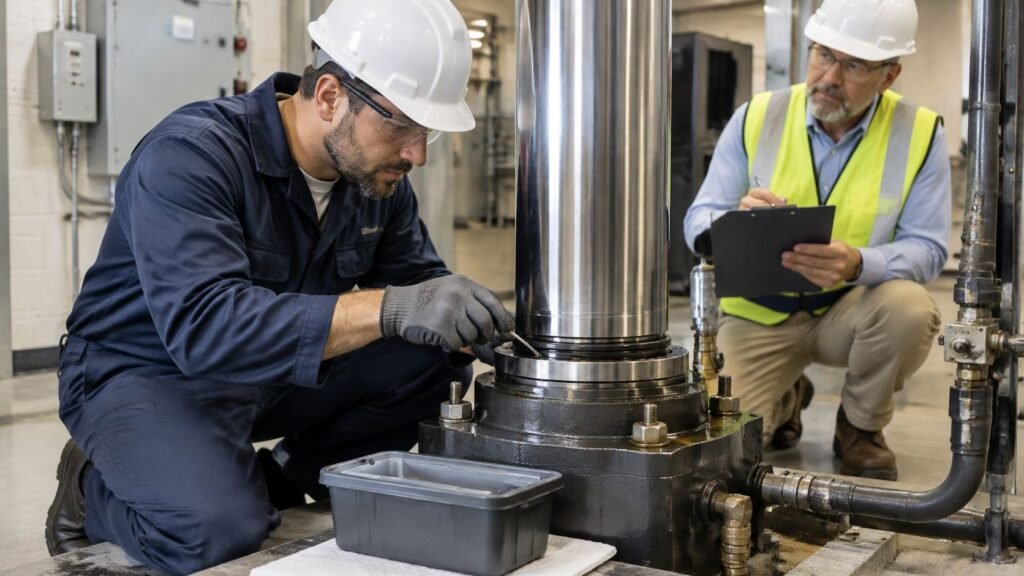
The common advice to replace the packing and see whether the leak stops leaves out the most important part of the job. Elevator packing replacement is a hydraulic pressure-integrity event, not just a seal change. Before approving a quote, a facility manager needs to know what caused the leakage, whether the surrounding equipment is serviceable, and how the contractor will verify and document the repair.
A dry cylinder head is a useful result. It isn't, by itself, proof that the entire hydraulic system has been checked or that the building's compliance obligations are complete.
Why Elevator Packing Replacement Is More Than a Seal Swap
Packing seals the opening where the plunger moves through the cylinder head. Whether a replacement holds depends on the sealing material, the plunger surface, the packing box, equipment fit, and installation. A parts-only quote leaves out the conditions that determine whether the repair will last.
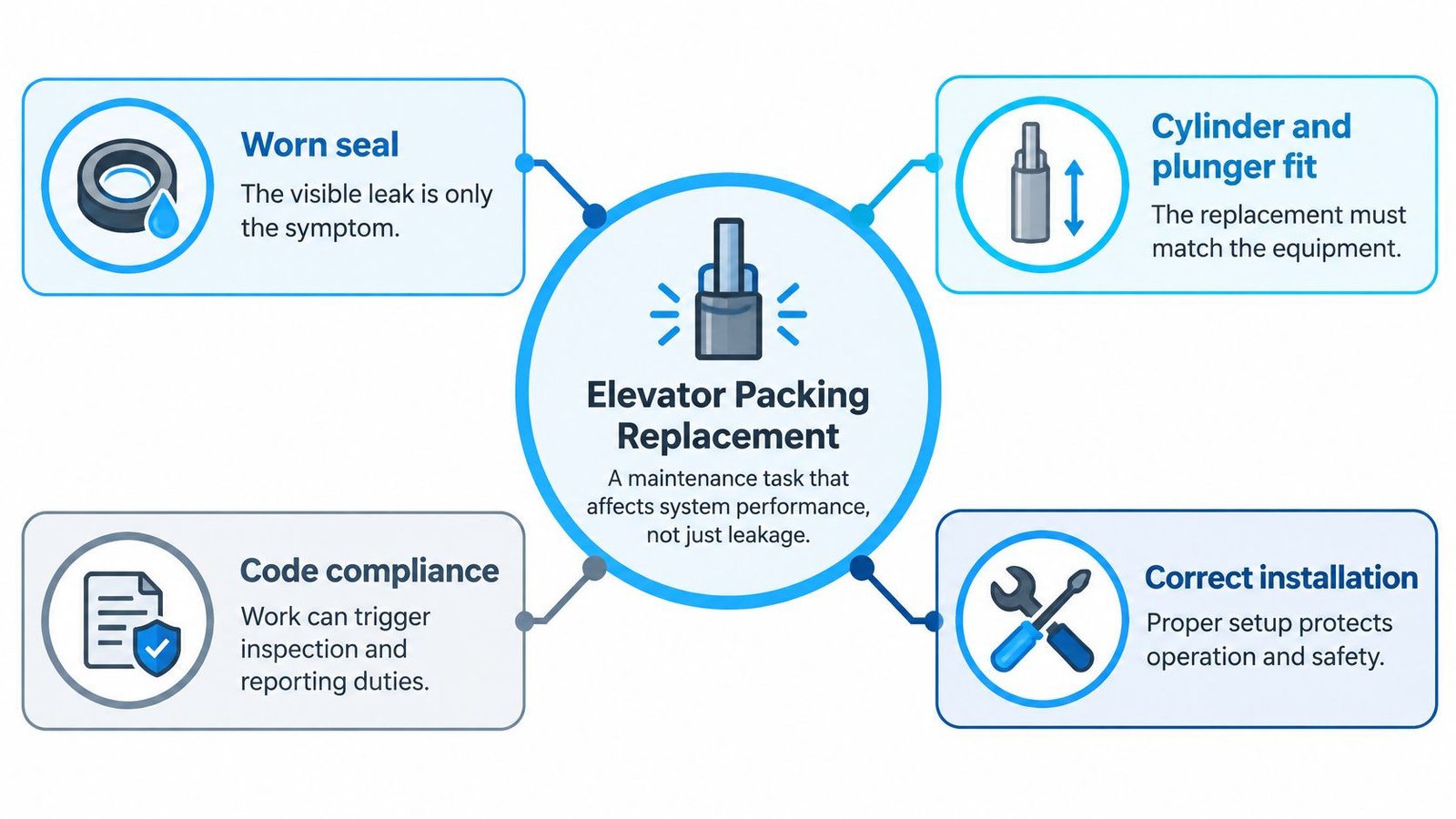
Ask the contractor to identify where the oil is escaping and whether another condition has damaged the packing. A scored or corroded plunger, a worn packing box, or poor alignment can compromise a new seal. The diagram shows how packing fits into the wider maintenance job.
The repair includes the hydraulic system
Missouri's memorandum on hydraulic elevator oil leakage describes the ASME A17.1/CSA B44 requirement to operate the entire hydraulic system at relief-valve pressure for at least 15 seconds after replacing cylinder packing, a cylinder seal, or a pressure-piping seal.
The memorandum also limits oil collected from each cylinder-head seal or packing gland to 19 liters, or 5 U.S. gallons, before removal. Collection requires a covered container that cannot overflow.
For the owner, completion means more than having new packing installed. The contractor's scope should account for the replacement, pressure verification, oil containment, and a written record of the work. Practical rule: approve a defined repair-and-verification scope, not an isolated parts change.
Compare scope before price
A packing-only quote may not include checks for plunger damage, corrosion, or alignment. If one of those conditions is causing the failure, replacing the packing alone may leave the source of the leak in place.
Ask each contractor to specify whether the price covers diagnosis, equipment inspection, oil containment, testing, and written results. That gives a facility manager or HOA board a clearer basis for comparing proposals: what each repair addresses, and what it leaves unresolved.
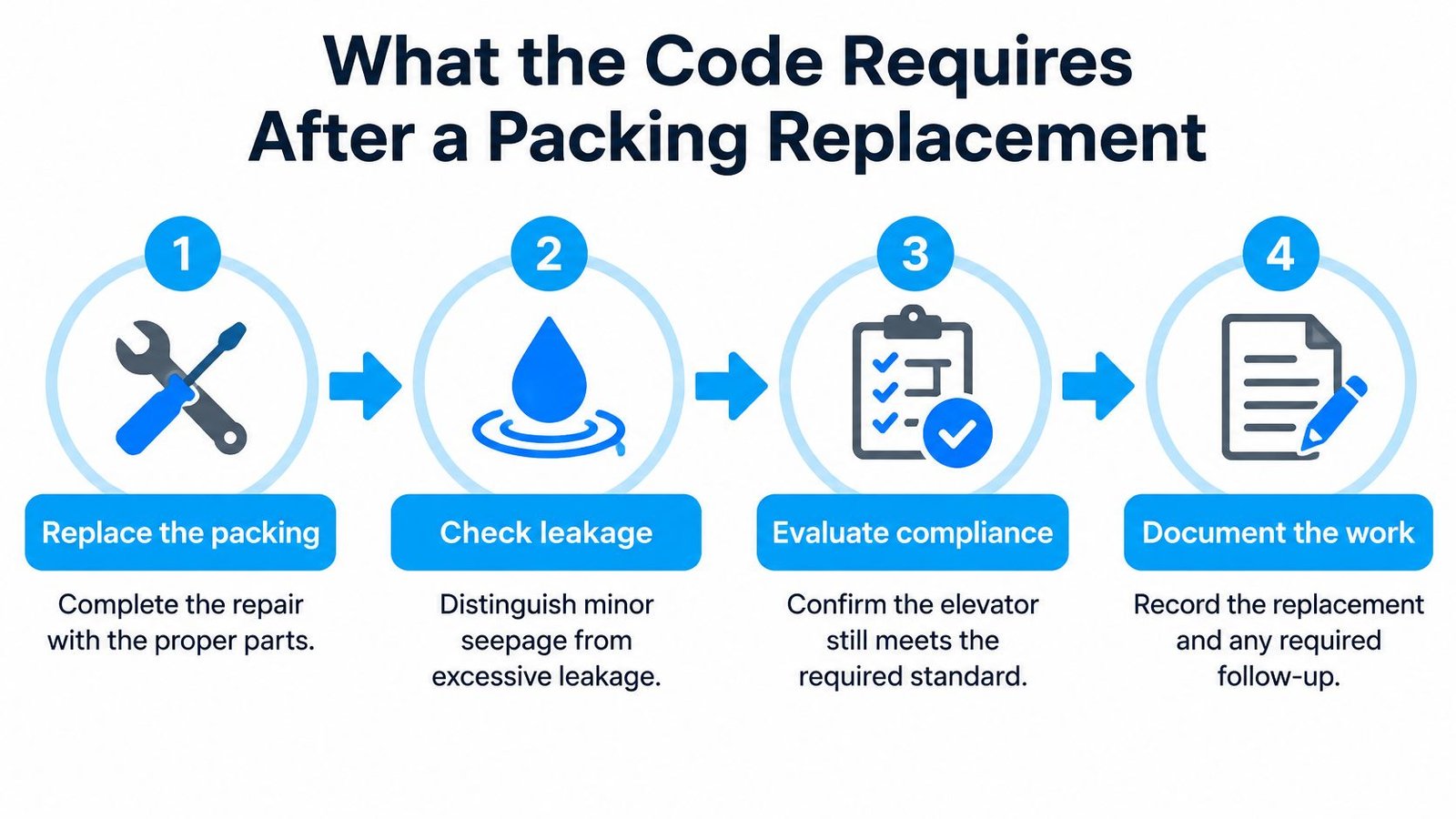
What the Code Requires After a Packing Replacement
A packing replacement is a pressure-integrity and documentation event, not just a seal change. Before assigning the leak to the packing, the contractor should review oil history and distinguish cylinder-head leakage from loss at a valve or pressure piping. Compare recorded fluid additions with recovered oil, then document what the evidence supports.
The work should connect repair, evaluation, and records.
Separate pressure verification from leakage investigation
Pressure verification after replacement and testing for concealed-system leakage answer different questions. A service ticket that says “tested” does not identify which check was performed. Ask for the test method and findings.
The Colorado hydraulic elevator oil log and test requirements call for records of fluid additions and oil emptied from leakage collection equipment when parts of the system are concealed. If oil loss remains unexplained, leakage testing is required. The reference specifies at least 15 minutes for unexposed cylinders and pressure piping. It also states that unexplained car-position change after the minimum test period indicates concealed leakage, and that the relief valve must bypass full pump output before pressure exceeds 150% of working pressure.
Turn observations into a decision
Appearance alone cannot establish whether leakage is minor or excessive. Assess the leak source, oil accumulation, usage history, and test results together. A collection pan captures oil, but does not show whether the loss is acceptable or account for total system consumption.
- Reconcile oil records: Compare fluid additions with oil recovered.
- Identify concealed areas: Record which cylinder or piping portions cannot be visually examined.
- Document findings: State whether packing leakage was confirmed or system loss remains unexplained.
- Confirm local scope: Check the applicable elevator code requirements for repair, testing, permits, and inspection.
For an older hydraulic elevator, a visible head leak may not explain all missing oil. Keep the test results and oil records together so the contractor can assess whether the confirmed leak accounts for the system's actual consumption.
Matching the Right Packing to the Cylinder and Plunger
A packing set that looks similar isn't necessarily suitable. The replacement must match the cylinder manufacturer, plunger diameter, head configuration, seal arrangement, wiper, and required O-rings or wear rings. The hydraulic packing technical guide also explains the importance of surface inspection, proper compression, and correct installation.
This comparison illustrates why identification comes before installation.
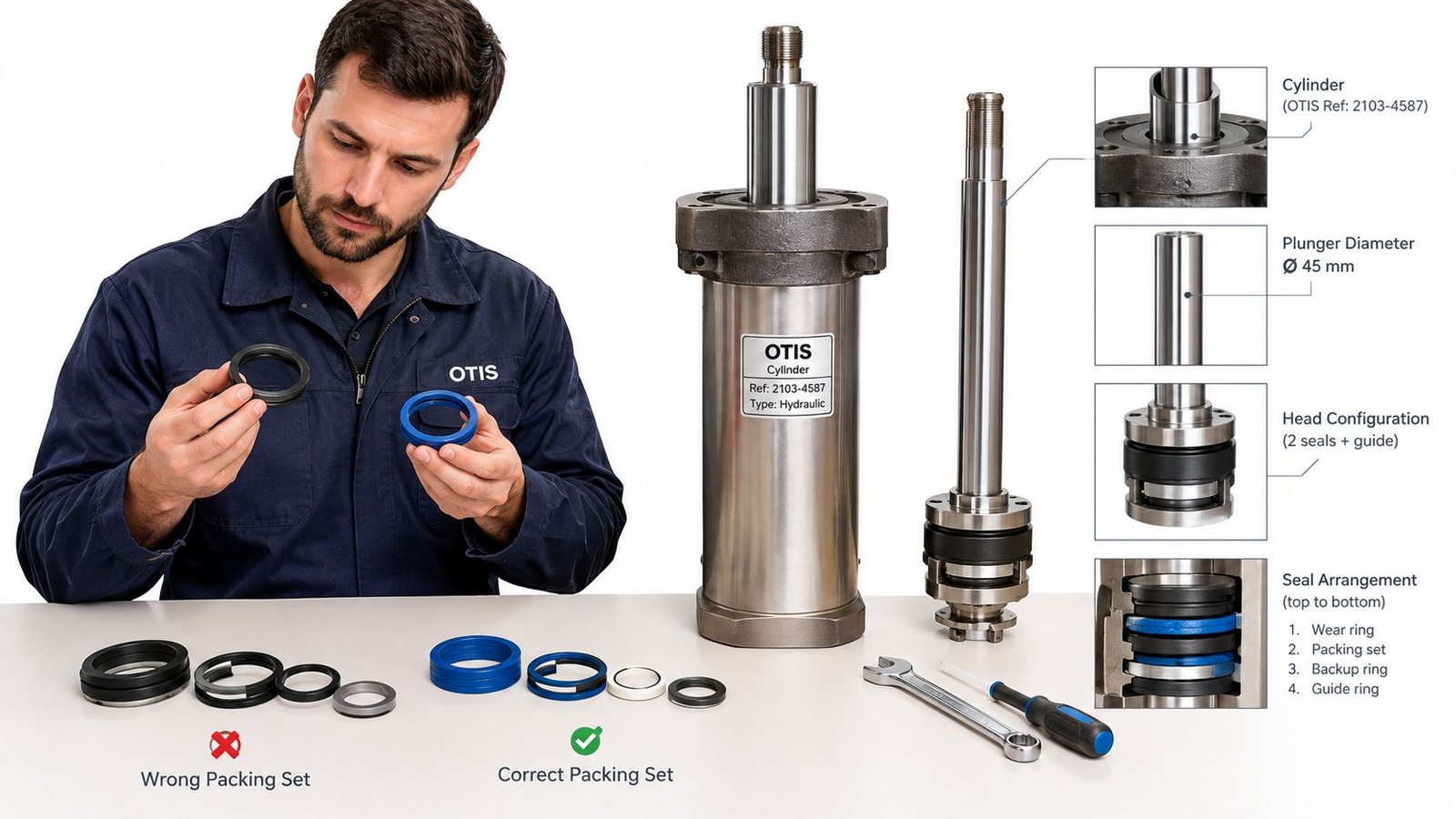
Inspect the surfaces that contact the seal
The mechanic should record the existing arrangement, measure the plunger and head, and inspect the chrome surface. Once opened, the packing box needs thorough cleaning and examination for burrs, grooves, and deep scoring.
Those defects matter because a damaged surface can cut the replacement seal or provide an oil bypass path. Installing new packing against an unresolved defect isn't a complete repair strategy.
| Component or condition | What the owner should ask |
|---|---|
| Packing identification | What measurements and equipment details establish the correct set? |
| Plunger surface | Were scoring, grooves, and chrome damage found? |
| Packing box | Was it cleaned and checked before installation? |
| Wiper and return arrangement | Were obstructions identified and corrected? |
More compression isn't a universal solution
Compression-style V-ring or chevron sets need controlled gland compression. Floating sets must not be compressed excessively. Tightening indiscriminately can increase friction, heat, and leakage rather than improve sealing.
The installation scope should also address seal orientation and the condition of associated components. Replacing the principal seal while overlooking a damaged wiper or obstructed oil return leaves avoidable uncertainty.
A replacement seal can't compensate for a damaged mating surface.
Deep plunger scoring deserves proper repair or engineering evaluation. Temporary fillers aren't a dependable substitute because hydraulic pressure can cause them to fail. Ask for the proposed surface remedy in writing before authorizing another repack, especially if the same location has damaged previous packing.
Licensing and Certification for the People Who Do the Work
A general maintenance agreement doesn't establish that the person assigned to hydraulic packing work holds the required elevator qualification. Verify the individual, not just the company name on the proposal.
Michigan's elevator permit information states that installation, alteration, maintenance, repair, servicing, inspecting, adjusting, and testing must be performed by a licensed elevator journeyperson. Packing replacement belongs within that regulated work, not ordinary building handyman maintenance.
Use the following checklist as a hiring aid, while distinguishing a company's authority from an individual mechanic's license.
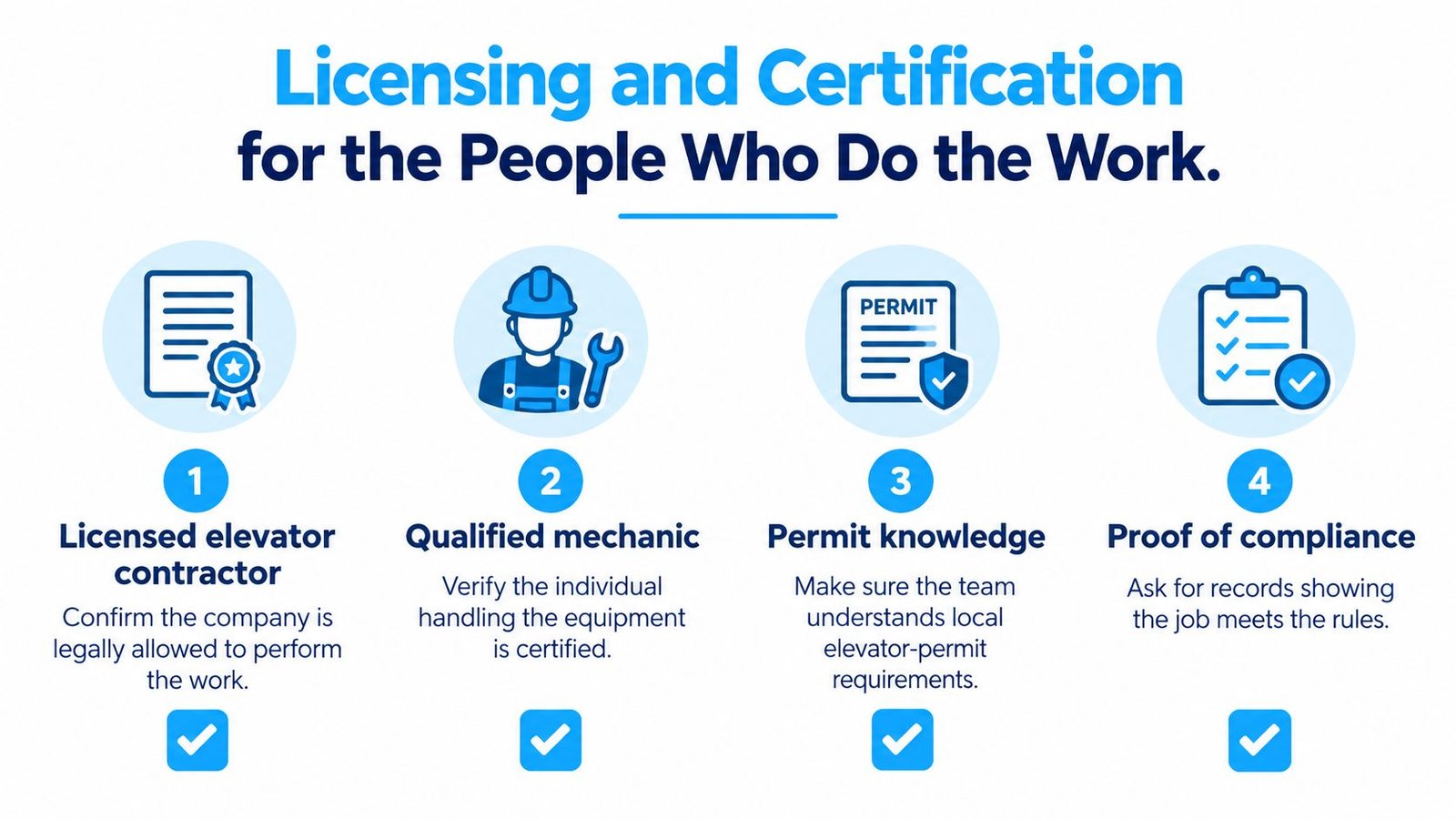
Verify credentials before scheduling
- Identify the assigned journeyperson: Request the person's name and license number, then confirm the credential with the relevant licensing authority.
- Check the company's authorization: Ask what contractor credentials apply to the proposed work.
- Request insurance documentation: Have your property-management or risk team review it rather than relying on a statement in the quote.
- Resolve permits: Ask whether the scope requires a permit, who will obtain it, and who coordinates any required inspection.
A certification, training certificate, or manufacturer course may demonstrate relevant education. It shouldn't be treated as interchangeable with the license required by the jurisdiction.
Ask about current technical competence
Code knowledge and equipment-specific competence both matter. Ask how the mechanic stays current through technical training or continuing education, without assuming that a particular course or renewal requirement applies everywhere.
For hydraulic work, useful questions concern packing identification, concealed-loss investigation, safe testing, and documentation. A contractor should be able to explain these in terms a facility manager can understand.
Michigan's licensing statement shouldn't be presented as Ohio law. For a building across the state line, confirm the applicable credentials and permit process with the Ohio authority having jurisdiction.
Whether the property is in Detroit, Lansing, Ann Arbor, Grand Rapids, or a smaller community, request a written assignment of responsibility. The owner should know who performs the work, who tests it, and who communicates with the inspector.
Michigan and Ohio Inspection Rules That Affect Packing Work
An inspection schedule and a repair-triggered test are separate obligations. Don't assume a recent routine inspection eliminates post-repair verification, or that completing a packing replacement automatically satisfies the next periodic inspection.
Michigan's Elevator Section administers and enforces the state elevator framework, including installation and alteration inspections, safety inspections, accident and violation investigations, and permit verification. That makes early coordination useful when a repair scope changes after equipment is opened.
Michigan and Ohio Elevator Inspection and Testing Requirements
| Requirement | Michigan | Ohio |
|---|---|---|
| Regular inspection intervals | Passenger, freight, limited-use/limited-application elevators, material lifts, barrier-free lifting devices, escalators, moving walks, and other listed devices require inspection at least every 12 months. Dumbwaiters, stairway chairlifts, one-person elevators, platform lifts, and power sidewalk elevators require inspection at least every 24 months. Personnel hoists require inspection at least every 30 days, under Michigan's inspection schedule. | Confirm the applicable inspection schedule with the responsible authority; don't import Michigan's equipment categories or intervals. |
| Periodic safety testing and reports | Establish the applicable testing and repair requirements for the specific installation. | Periodic safety tests follow adopted ASME A17.1 and A17.2 requirements, including at least one full-load safety test every five years; the completed inspection report must be available to the owner or operator on the inspection day, under Ohio's elevator inspection and testing rule. |
| Packing-work coordination | Confirm permit, inspection, and testing responsibilities before authorization. | Confirm repair-related obligations separately from periodic testing and retain the resulting reports. |
Coordinate without postponing corrective work
For properties in Flint, Kalamazoo, Jackson, Holland, Saginaw, and Monroe, start with the device classification. A building's passenger elevator and specialized lift may not share the same inspection schedule.
Owners in Toledo, Perrysburg, Findlay, Bowling Green, and Cleveland should likewise distinguish the repair record from the periodic safety-test record. Ask the contractor which existing documents remain applicable and which new records the work will generate.
Scheduling can reduce administrative duplication when a required inspection is approaching. It shouldn't become a reason to defer necessary leakage correction.
If the repair exposes a broader cylinder problem, revisit the permit and inspection plan before expanding the work. The original packing proposal may no longer describe the actual project.
Repacking Versus Jack or Cylinder Replacement
Repacking is reasonable when the evidence supports a packing problem. It becomes harder to justify when previous replacements haven't resolved leakage or when inspection identifies a defect the new seal cannot correct.
The decision should separate the immediate symptom from the condition of the hydraulic assembly. A visible head leak doesn't prove the concealed cylinder is sound, and a recurring packing leak doesn't automatically prove the cylinder requires replacement.
Choose the repair that addresses the cause
| Finding | Defensible direction |
|---|---|
| Packing is worn, mating surfaces are serviceable, and losses are explained | Repacking may address the identified defect. |
| Plunger damage is affecting the seal | Evaluate proper surface repair or an engineered remedy before repeating the same work. |
| Corrosion, alignment concerns, or unexplained loss remain unresolved | Expand diagnosis before committing to another packing-only repair. |
| Findings support a larger hydraulic assembly problem | Compare repair feasibility with jack or cylinder replacement. |
The ASME A17.1 code reference supports treating this as a performance and verification issue rather than a brand-specific seal procedure. Local permit and inspection requirements still need to be established for the actual project.
Budget perspective: A smaller invoice isn't better value if it leaves the reason for repeated failure unresolved.
Plan the operational consequences
At Crane Elevator, we provide every type of elevator service across Detroit, Lansing, Ann Arbor, Grand Rapids, and surrounding Michigan and Ohio communities. Our scope includes passenger and freight equipment, residential elevators, wheelchair and platform lifts, material lifts, dumbwaiters, repairs, maintenance, testing coordination, violation correction, and non-proprietary modernization for all makes and models.
A hydraulic elevator jack replacement evaluation should compare the findings against the narrower repacking option. Modernization belongs in that discussion when the project extends beyond the sealing assembly, not as an automatic substitute for a repairable packing problem.
For hospitals, schools, factories, and municipal buildings, require a project-specific shutdown plan. Address spill control, temporary accessibility, return-to-service responsibilities, and who pays to investigate follow-up leakage. Don't accept a universal downtime promise before the contractor understands the equipment and scope.
Verifying the Work and Documenting the Result
A completed invoice proves that work was billed. It doesn't establish what was tested, what passed, or whether unresolved findings remain.
The closeout package should let another qualified person understand the diagnosis and repair without reconstructing events from phone calls. Arrange elevator testing and documentation as part of the authorized scope, rather than trying to obtain missing records after the equipment returns to service.
Require an identifiable repair record
- Diagnosis and parts: Record the leakage source, equipment identification, installed packing configuration, and any additional defects found.
- Pressure verification: Identify the test performed, required pressure condition, duration, result, and person responsible.
- Oil containment: Record collection and removal activity and confirm that containment met the applicable requirements.
- Concealed-system records: Preserve fluid-addition and recovered-oil logs, along with any leakage-test findings.
- Regulatory closeout: Retain applicable permits, inspection reports, correction documentation, and return-to-service communications.
Monitoring after the repair is a separate practical check. Agree on follow-up observations over the following days and weeks, including who records renewed leakage and how the contractor will respond.
The collection limit described earlier is a removal threshold, not permission to keep operating indefinitely with defective packing. Don't allow a covered container to become the long-term repair plan.
Read the findings before filing the report
Review the inspection report for unresolved items, not just a satisfactory notation elsewhere on the page. If a correction order is issued, identify the exact deficiency, responsible party, required response, and evidence the authority expects.
Ask the contractor to distinguish completion of corrective work from formal acceptance or closure. Keep the confirmation with the original report so the owner can demonstrate what happened.
At handoff, ask direct questions: Was the required system pressure verification completed? Was collected oil managed correctly? Were concealed losses investigated where necessary? Are the results retained with the maintenance documentation?
If an answer is uncertain, list it as an open item. A defensible compliance record identifies unfinished work rather than implying that silence means acceptance.
Your Next Step for Compliant Packing Replacement
Before approving elevator packing replacement, gather the current quote, recent maintenance tickets, oil-use records, inspection report, and any earlier packing-replacement history. Ask the contractor to explain how those records support the proposed scope.
The key decision isn't whether new packing can be installed. It's whether the diagnosis supports repacking, whether the assigned person is properly qualified, and whether the proposal includes the required verification and closeout.
Make the quote review specific
Use the pressure-test duration, collection threshold, concealed-leakage test requirements, and state inspection schedules established above as your review points. Keep them distinct: routine inspection, post-repair pressure verification, and investigation of unexplained oil loss aren't interchangeable.
- Confirm the diagnosis: What evidence identifies the packing as the source?
- Confirm the personnel: Who is the licensed person assigned to the work?
- Confirm the jurisdictional process: Is a permit required, and who obtains it?
- Confirm completion criteria: What test results and records will the owner receive?
Owners in Detroit, Lansing, Ann Arbor, Grand Rapids, Flint, Kalamazoo, Jackson, Holland, Saginaw, Monroe, Toledo, Perrysburg, Findlay, Bowling Green, and Cleveland can request a free second opinion and a competitive quote.
Provide the existing proposal and records so the review can address missing scope, not just price. Require a clear explanation of who will obtain any required permit and document the post-replacement pressure verification.
Crane Elevator Company offers hydraulic packing replacement, jack evaluations, and broader maintenance and modernization support across Michigan and Ohio. Visit Crane Elevator Company to request a free second opinion or competitive quote, and ask for a scope that identifies the leakage cause, required testing, and closeout documentation.