
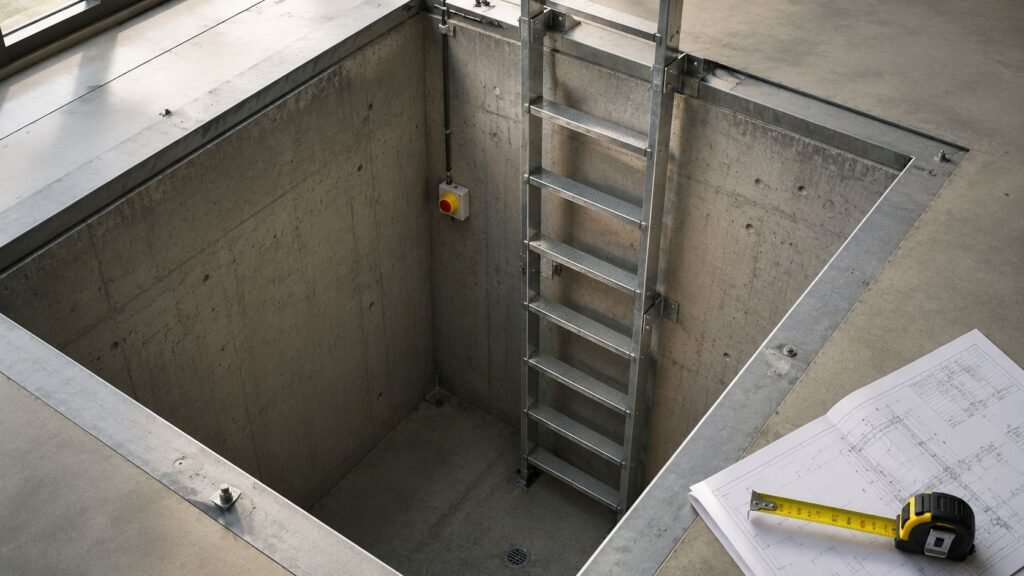
Your inspection notice is on the calendar. The controller has been stable, the doors are running well enough, and nobody on site is expecting trouble. Then the inspector opens the pit access, looks down, and the conversation changes fast.
That happens more often than building teams expect. The issue isn't always a major component. Sometimes it's the elevator pit ladder. It may be missing, too narrow, rusted through, mounted poorly, or lacking the newer safety device now tied to code compliance.
For facility managers in Southern Michigan, that's a frustrating kind of failure because it feels small until it isn't. A pit ladder problem can delay an inspection, block safe maintenance access, trigger a correction notice, and create liability questions no owner wants to answer after an incident. In older Detroit, Ann Arbor, Lansing, Flint, or Kalamazoo properties, the challenge is worse because pits and shaft layouts often weren't built with today's ladder expectations in mind.
The practical reality is simple. If a technician can't enter and leave the pit safely, work stops. If an inspector sees a non-compliant condition, your elevator can become a compliance problem even when the rest of the equipment seems serviceable.
The Overlooked Component That Can Shut Your Elevator Down
A lot of managers assume pit access is a minor detail. In practice, it's one of those items that tells an inspector or service mechanic whether the building has kept up with basic life-safety housekeeping.
The usual scenario goes like this. A building has an older passenger or freight elevator. It has been running for years. The pit ladder was installed decades ago, or maybe it was never installed because someone relied on informal access methods. During inspection, the pit gets examined more closely than it has in a long time. That's when the ladder becomes the reason the elevator gets flagged.
Why this catches owners off guard
The ladder sits out of sight, so it rarely gets attention until somebody has to use it. But the people who enter pits aren't casual occupants. They're mechanics, inspectors, and sometimes emergency personnel working in a confined space around buffers, wiring, and moving equipment.
If the ladder is damaged or non-compliant, nobody serious is going to treat that as a cosmetic issue.
Practical rule: If safe pit entry depends on improvisation, you already have a problem.
What surprises many owners is how quickly the consequences stack up:
- Inspection risk: A ladder defect can become a failed inspection item.
- Service delays: Mechanics may refuse pit entry until access is made safe.
- Liability exposure: If someone gets hurt entering or exiting the pit, the ladder condition becomes part of the investigation.
- Budget disruption: Emergency correction work almost always costs more than planned work.
What works and what doesn't
What works is boring. Documented pit access, a ladder that matches current expectations, and a building team that checks the pit area before inspection season.
What doesn't work is hoping an old condition gets overlooked, assuming an older building is automatically exempt, or waiting until the annual test to find out the ladder no longer passes muster. In Southern Michigan, where many properties mix older infrastructure with ongoing modernization, that wait-and-see approach is one of the most expensive ways to manage elevator compliance.
What Are Elevator Pit Ladders and Why They Matter
An elevator pit ladder is the permanent access point into one of the most hazardous spaces in the elevator system. It isn't a convenience item. It's the approved way for authorized personnel to enter and exit the pit safely.
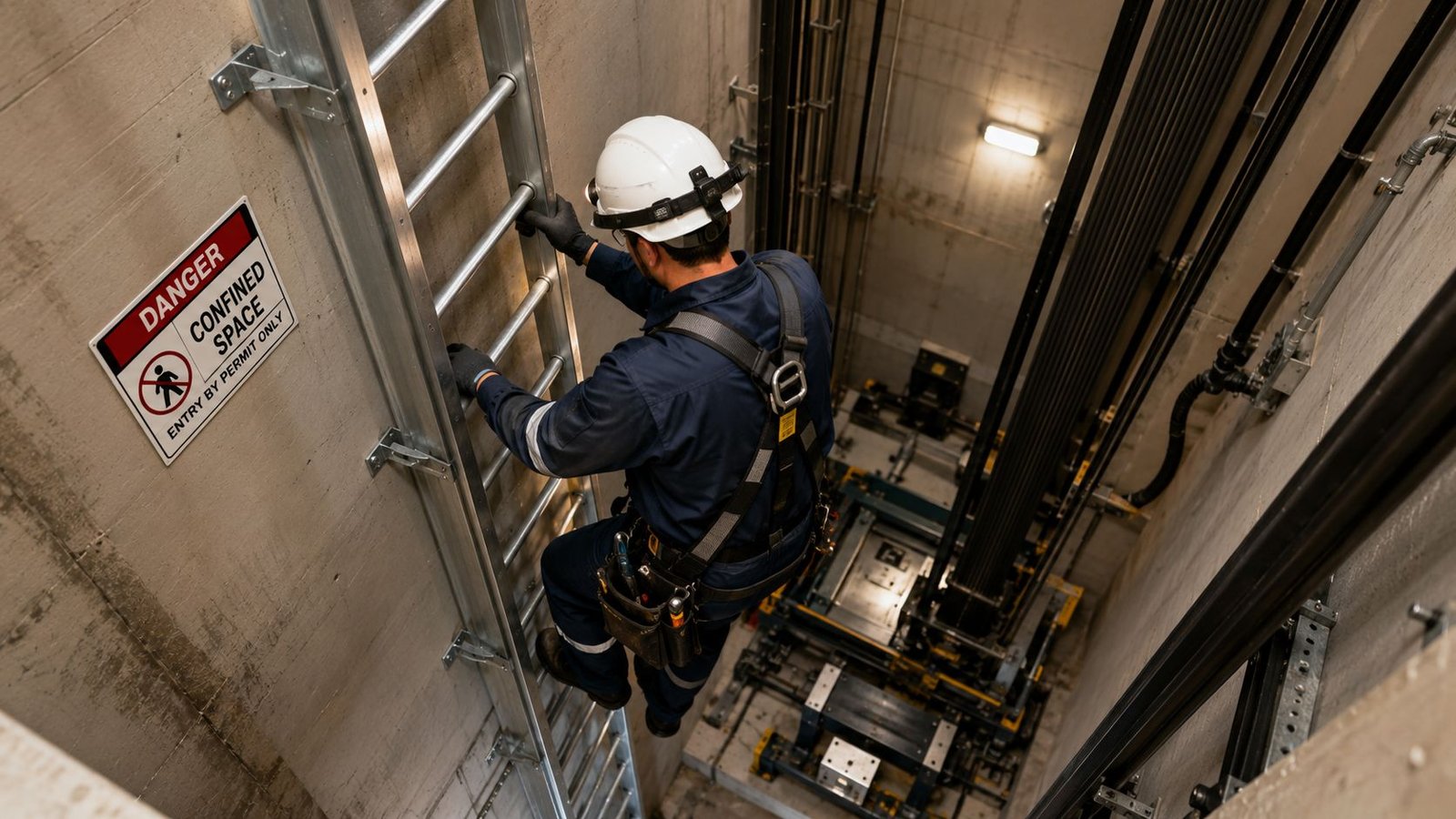
When a pit is deep enough, the ladder becomes the only sensible way to get in and out without climbing, jumping, or using temporary equipment. According to DC Elevator's summary of ASME A17.1/CSA B44 and OSHA confined space guidance, elevator pit ladders are mandated for pits exceeding 3 ft (914 mm) below the sill, with permanent access provided by a fixed ladder or stairway.
Why technicians care so much about pit access
A mechanic entering a pit isn't stepping into an empty utility closet. The pit may contain buffers, switches, oil, debris, water intrusion, and tight clearances. That makes access and exit part of the hazard, not separate from it.
Think of the ladder as the pit's emergency access ramp. If that route is missing or unreliable, every task in the pit becomes riskier.
Here's where the ladder matters day to day:
- Routine maintenance: Techs need safe access for inspection, cleaning, and adjustment work.
- Troubleshooting: When a shutdown or fault points to pit equipment, access can't depend on a workaround.
- Entrapment response: Emergency personnel need a safe route if the situation requires pit entry.
- Code inspections: Inspectors don't just check that a ladder exists. They care whether it's usable and compliant.
The real issue isn't the metal. It's the decision behind it.
A missing or bad ladder tells a service company something important about the building's maintenance habits. If pit access was neglected, there may be similar neglect elsewhere. That changes how contractors, inspectors, and insurers look at the site.
A pit ladder should never be the reason a trained person has to improvise around a live elevator system.
For owners and facility managers, the practical takeaway is straightforward. If the pit ladder is questionable, the pit is functionally questionable. And if the pit is functionally questionable, service decisions get more conservative fast.
Decoding Michigan's Elevator Pit Ladder Codes
A common retrofit problem in Southern Michigan looks like this: the annual inspection turns up a pit ladder issue in a 1960s or 1970s building, and what seemed like a small correction turns into a larger code and access discussion. That happens because pit ladders are tied to more than basic access. They affect inspection results, mechanic safety, and, in many older buildings, the scope of electrical and structural work needed to bring the elevator back into compliance.
The code points that usually drive the work
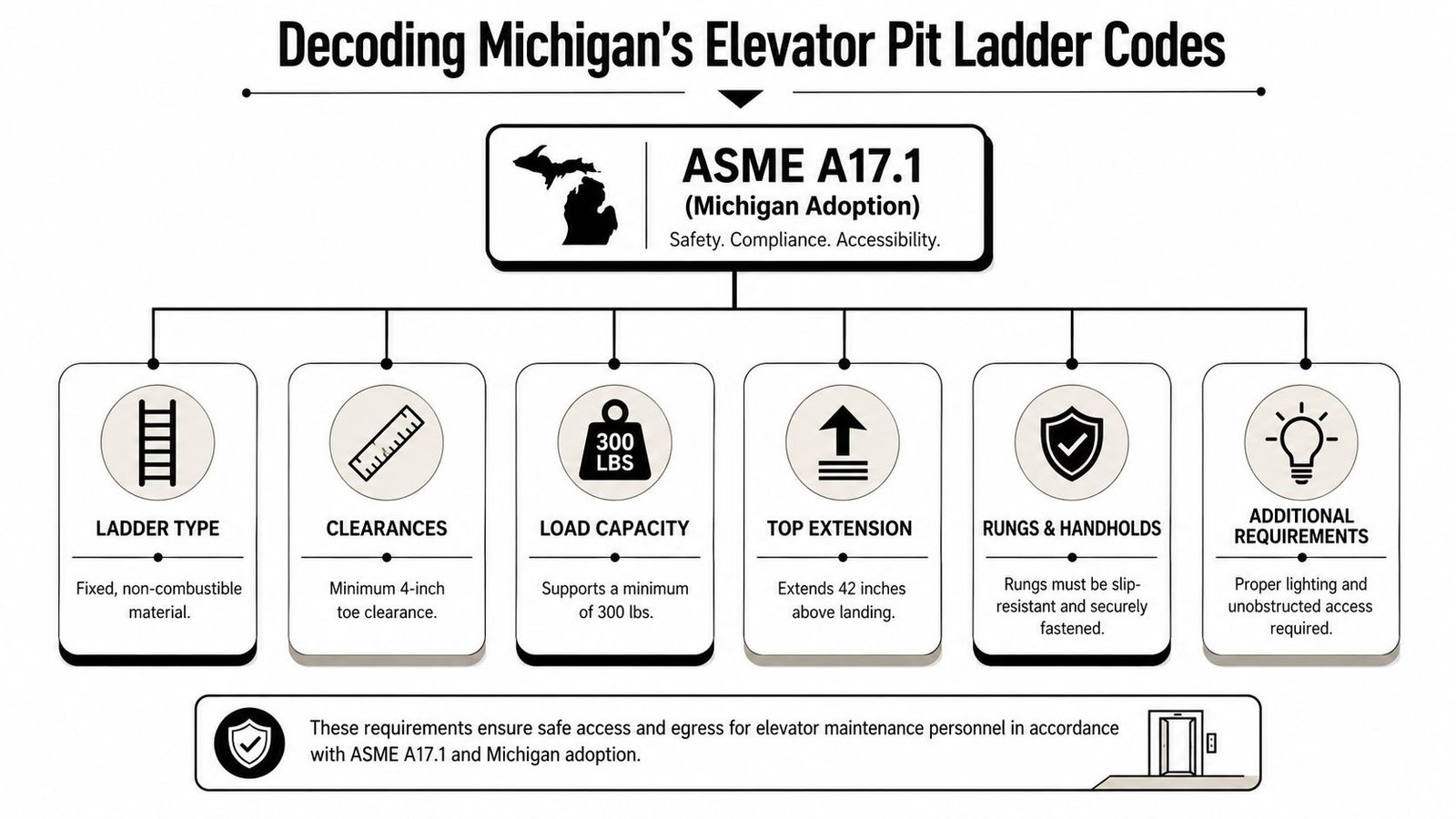
In Michigan, the practical starting point is the adopted elevator code standard and how it applies during inspection, alteration, and repair. For pit ladders, three items usually determine whether the existing condition can stay, needs modification, or needs full replacement.
First is pit depth. Once a pit is deep enough that safe entry and exit require a fixed means of access, inspectors expect to see a proper ladder installation. In older properties, this is one of the most common gaps because the original layout may predate current expectations or may have been altered over time.
Second is ladder geometry. The ASME A17.1-2022 / CSA B44:22 pit ladder change summary notes that non-retractable ladders must have 16-inch-wide rungs. That creates a real issue in retrofit work. A lot of older pit ladders were fabricated narrower, and a ladder that has served the building for years can still fail current inspection criteria.
Third is the ladder electrical device, often called the ladder safety switch in the field. The same ASME A17.1-2022 / CSA B44:22 pit ladder change summary explains that non-retractable ladders now require a device that stops the elevator when a person is on the ladder. That changes the job from a simple metal install to a coordination item involving the elevator controller, wiring, testing, and sign-off.
What that means for older Michigan buildings
Older buildings are where owners get surprised.
A newer pit often has enough wall area, cleaner clearances, and fewer conflicts for a compliant ladder and associated safety device. In an older hospital, school, apartment building, or municipal property in Southern Michigan, the pit may have water damage, patched concrete, obsolete equipment, tight buffer clearances, or wall conditions that make standard mounting difficult. The code requirement is the same. The path to meeting it is not.
That is why a ladder correction should be reviewed as a retrofit condition, not a handyman item.
| Issue | What you need to verify | Why it affects cost and compliance |
|---|---|---|
| Pit access requirement | Whether the pit depth and configuration require a permanent ladder | Determines whether the building can pass without added access equipment |
| Existing ladder dimensions | Whether rung width and overall layout match current code expectations | Older ladders often need replacement, not repair |
| Electrical safety device | Whether the ladder must be integrated with an elevator stop function | Adds wiring, testing, and possible controller coordination |
| Mounting surface and clearance | Whether the pit wall and surrounding equipment allow a compliant install | Common source of change orders in older buildings |
For a broader view of how these requirements fit into state and local enforcement, review these elevator code requirements in Michigan.
Where owners usually misjudge the risk
The first mistake is assuming the existing ladder is protected because it has been there for decades. Inspectors and service companies look at current applicable requirements, the condition of the equipment, and the scope of any alteration. Age alone does not protect a deficient installation.
The second mistake is budgeting for steel only. In many retrofits, the ladder itself is the cheap part. The added cost comes from field measurement, custom fabrication, anchor repairs, corrosion issues, electrical integration, and return trips for testing or reinspection.
That is why a pit ladder correction in an older Michigan building should be scoped early and priced accurately. If the building has an aging elevator, limited pit space, or known water intrusion, owners should expect more than a simple swap.
A Practical Pit Ladder Inspection and Maintenance Checklist
A pit ladder problem usually shows up at the worst time. Your elevator mechanic opens the pit for routine service, finds a loose ladder, heavy rust, or blocked access, and now a simple maintenance visit turns into a documented safety issue. In older Michigan buildings, that is a common compliance gap, especially where the ladder has been ignored for years because nobody enters the pit often.
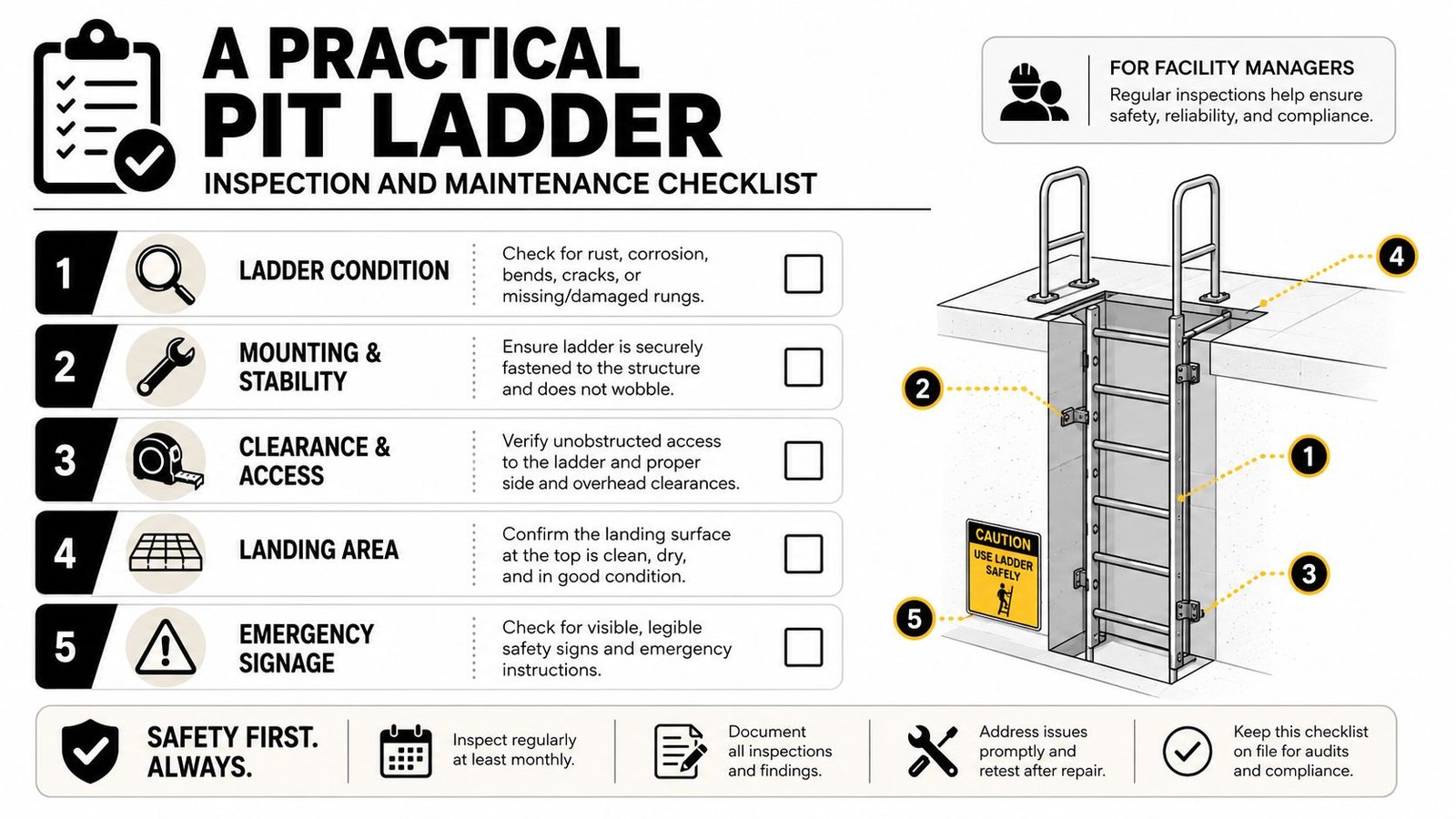
If your pit already falls into the category that requires ladder access, the practical question is simple. Is the ladder safe, usable, and still in condition to pass inspection without an argument? Facility staff do not need to make code calls in the field, but they should be able to spot conditions that create liability, delay service, or trigger a correction order.
What to look at during a visual check
Use this checklist during routine rounds or before a scheduled elevator inspection:
- Rungs: Check for bent rungs, rust loss, loose welds, worn slip resistance, or any damage that affects footing.
- Side rails and anchors: Look for movement, cracked mounting points, rust bleed around anchors, or signs the ladder is pulling away from the wall.
- Access path: Keep the entry to the ladder clear. Stored parts, janitorial supplies, and old pit debris are common violations in older buildings.
- Pit condition: Water, sludge, oil, and rust scale turn a usable ladder into a fall hazard fast.
- Top entry point: Confirm a mechanic can reach the first rung without twisting around piping, conduit, or other equipment.
- Unauthorized repairs: Field-added brackets, random bolts, patched steel, and unreviewed weld repairs usually create more problems than they solve.
For a facility-side record that helps your team document conditions before calling for service, use this pit inspection checklist for property teams.
What facility staff should not do
Do not climb into the pit to test the ladder unless you are trained, authorized, and following proper safety procedures. Do not send in-house maintenance staff to tighten hardware, patch anchors, or weld repairs onto ladder rails. In older pits, a small improvised fix can turn into a code issue, an injury claim, or both.
This short video gives useful visual context on safe elevator pit conditions and access concerns:
On-site reminder: A clean pit and a solid ladder do not guarantee compliance, but a dirty pit and a loose or corroded ladder will draw attention quickly.
One habit pays off every time. Take timestamped photos when your staff sees corrosion, standing water, loose anchors, or blocked access. That gives your contractor a clearer starting point, helps track deterioration over time, and supports the budget conversation if a retrofit in an older Michigan building turns out to need more than a minor repair.
Retrofit Solutions for Michigan's Older Buildings
Retrofitting elevator pit ladders in older Michigan buildings is where theory meets the wall. The shaft is tight, the pit was built for another era, and the existing structure may not cooperate with a clean replacement.
That matters because many commercial properties are dealing with this exact problem. According to Elevator World's discussion of code change impacts, over 25% of commercial buildings in major markets contain elevators installed before 2000, and many lack compliant access ladders. The practical gap isn't just the code itself. It's that many owners still don't have a clear retrofit path for newer requirements such as the 16-inch rung width.
Why older pits are harder than they look
A new building gives you room to plan access, mounting surfaces, clearances, and electrical routing. An older building gives you masonry that may not be ideal for new anchors, pit equipment that crowds the ladder zone, and dimensions that make standard products a poor fit.
The usual retrofit obstacles include:
- Tight geometry: The pit may not allow a standard non-retractable ladder without conflicts.
- Wall condition: Brick, block, aging concrete, or patched surfaces may need evaluation before mounting.
- Equipment interference: Buffers, piping, conduit, or hydraulic components can crowd the safe access line.
- Water problems: Corrosion and recurring moisture can damage both the ladder and the pit structure over time.
If your pit has chronic moisture or deterioration, addressing elevator pit waterproofing issues may need to happen before or alongside ladder work. Otherwise, you risk installing new hardware into an environment that will keep attacking it.
What usually works in real retrofit jobs
The best retrofit approach is rarely off-the-shelf. In older buildings, successful projects usually involve a site-specific solution built around actual field measurements, mounting conditions, and code interpretation.
Common workable paths include:
Custom-fabricated fixed ladders
These are often the right answer when the pit needs a compliant ladder but standard dimensions won't fit cleanly.Coordinated electrical upgrades
If the ladder requires a safety device, the mechanical and electrical work should be planned together, not as separate afterthoughts.Documented alternative solutions where constraints exist
Some pits present genuine structural or spatial limits. In those cases, the discussion shifts from “buy a ladder” to “document feasibility and get the right approval path.”
What doesn't work in historic and legacy buildings
The worst approach is forcing a standard product into a nonstandard pit and hoping the inspector accepts it. That often leads to rework, added fabrication, or a ladder that technically fits but still creates unsafe access.
In older buildings, code compliance is a design problem before it's a material problem.
That's why experienced field review matters so much. A contractor has to understand both the modern rule set and the quirks of older shafts. Without that combination, owners end up paying twice. Once for the wrong fix, then again for the correct one.
Budgeting for Pit Ladder Installation and Upgrades
Owners usually ask the same question first. What's this going to cost? The honest answer is that pit ladder work varies sharply depending on whether you're doing a straightforward installation or retrofitting an old pit with access and electrical complications.
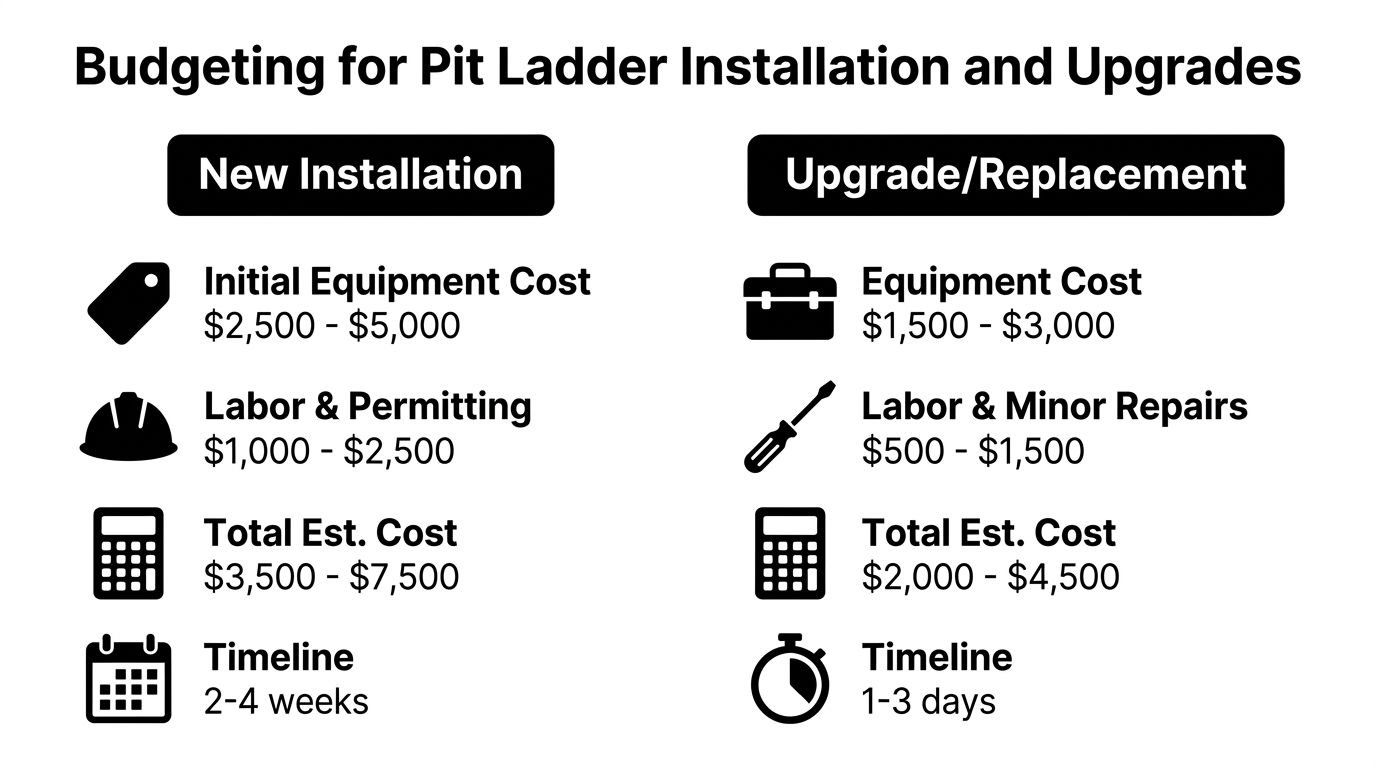
The infographic above shows budget ranges, but those figures should be treated carefully because every pit is different. What I'd focus on first is scope, not headline price.
What drives the budget up or down
The hardware itself is only part of the job. Right Way Elevator's technical summary of pit ladder design requirements notes that ladder specifications include uniform rung spacing between 10 and 14 inches, a minimum load of 250 pounds per rung, and a ladder electrical safety switch that halts elevator operation when personnel are detected. Once those elements come into play, pricing depends on more than steel and labor hours.
Key cost drivers include:
- Existing conditions: Clean concrete and clear access lower labor time. Corrosion, cracked walls, or cramped pits increase it.
- Fabrication needs: Standard ladder assemblies are simpler than custom retrofits.
- Electrical integration: Adding or modifying the safety device expands the trade scope.
- Permitting and inspection coordination: Administrative steps affect schedule and labor planning.
- Related corrections: Water intrusion, debris removal, lighting, or wall repair can turn a ladder job into a broader pit project.
How to budget without getting blindsided
A practical budgeting method is to separate the project into two buckets:
| Budget bucket | Typical contents |
|---|---|
| Core ladder scope | Ladder, mounting hardware, field installation, safety device work |
| Conditional repair scope | Wall repair, corrosion cleanup, waterproofing, electrical rerouting, access preparation |
That approach helps because owners can approve the baseline work while understanding what may be uncovered after the pit is opened and measured.
The biggest mistake is treating the cheapest quote as the safest quote. If a proposal doesn't clearly address code-related geometry, mounting condition, and safety switch integration, it may just be postponing the actual cost until after work begins.
Frequently Asked Questions About Elevator Pit Ladders
Can my technician just use a portable ladder
No. For pits that require permanent access, a portable ladder is not a substitute for a compliant pit ladder. From a liability standpoint, that's one of the weakest decisions a building can make because it asks a mechanic to work around a known access deficiency.
What happens if my building in Michigan fails an inspection because of the pit ladder
You should expect a correction process, and depending on the condition, the elevator may remain under heightened scrutiny until the issue is resolved. The practical fallout usually includes contractor scheduling, reinspection coordination, internal reporting to ownership, and pressure to move faster than you budgeted for.
My elevator is old. Am I automatically exempt from newer ladder expectations
Usually, that's not a safe assumption. Older equipment often creates legitimate retrofit challenges, but “old” and “exempt” aren't the same thing. If the ladder, pit layout, or access arrangement doesn't align with current requirements, the right path is a documented evaluation, not a guess.
Is the ladder itself usually the whole job
Sometimes, but not always. In many retrofits the ladder is only the visible part of the correction. The actual work may involve mounting surfaces, pit cleanup, water issues, electrical changes, or redesigning access around existing equipment.
What should I do before the next inspection cycle
Do a site walk, document the ladder condition, confirm the pit isn't being used for storage, and ask your elevator contractor for a specific pit access review instead of a general “look it over.” The more precise the request, the better the answer you'll get.
If you manage multiple buildings, standardize pit ladder reviews across the portfolio. One overlooked legacy condition tends to show up in more than one property.
Is this mainly a downtown high-rise issue
No. It shows up in industrial buildings, schools, healthcare facilities, municipal properties, apartment buildings, and smaller commercial sites. Any property with an elevator pit and aging infrastructure can run into the same access and compliance problem.
If you need a second opinion on pit ladder compliance, retrofit options, or a correction plan before inspection, Crane Elevator Company serves Lower Michigan with hands-on support for inspections, repairs, modernization, and violation corrections. They work on both older and newer systems and can help building owners understand what needs immediate action, what can be phased, and how to approach elevator pit ladder upgrades without guessing.