
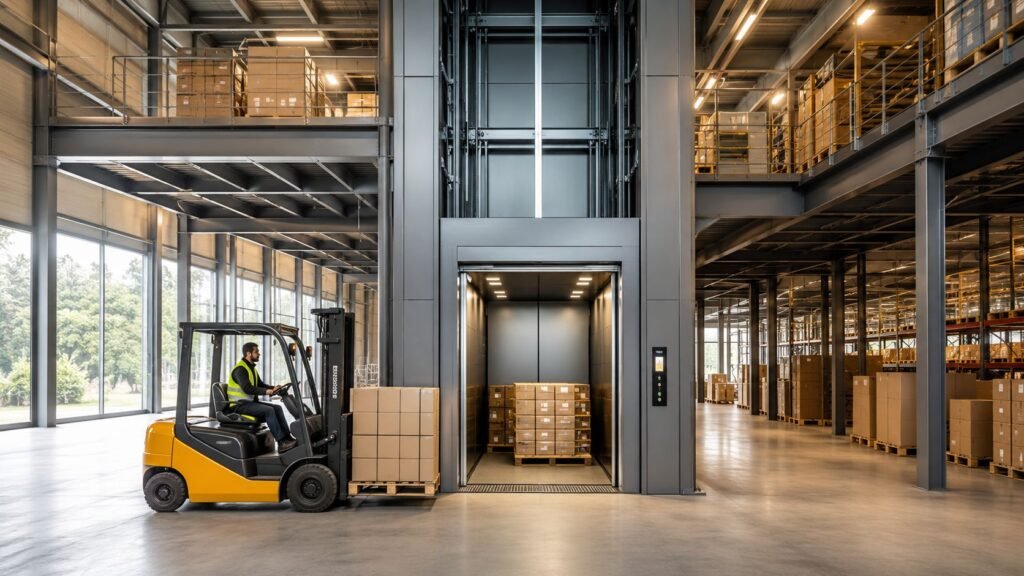
Your warehouse probably already runs a decent horizontal game. Pallets move. Pick paths are tight. Racking is organized. Then everything hits the same choke point when product has to move up or down.
That's where a warehouse elevator stops being a line item and starts becoming an operating decision.
Most facility managers first look at the purchase price. That's understandable, but it's rarely the part that hurts the most over time. The bigger costs usually show up later. Structural work nobody fully scoped. Lift speeds that don't match the flow of the building. Door layouts that fight forklift traffic. Maintenance plans that look fine on paper but leave dirt in pits, debris on car tops, and small faults turning into shutdowns.
A good warehouse elevator should support throughput, protect people, satisfy code, and stay serviceable for years. A bad one creates daily workarounds, expensive callbacks, and arguments between operations, maintenance, and accounting.
Moving Up The Role of the Modern Warehouse Elevator
A lot of warehouses run out of movement before they run out of space. Floor operations may be efficient, but once inventory has to move between levels, the building slows down. Teams start staging freight near the lift, waiting on a car, or breaking loads into smaller trips just to keep work moving.
That's a vertical logistics problem, not a staffing problem.
A warehouse elevator lets you use the building's full cubic volume instead of treating upper floors and mezzanines like inconvenient overflow. In a busy facility, that changes more than storage. It affects replenishment timing, labor flow, order accuracy, damage risk, and how confidently the operation can scale.
Why vertical movement matters more now
The pressure on multi-level facilities has increased as warehousing leans harder on speed, dense storage, and automation. The market reflects that shift. The global warehouse freight elevator market was valued at USD 3.81 billion in 2025 and is projected to grow to USD 6.44 billion by 2032, reflecting a CAGR of 6.0%, driven primarily by rising e-commerce demand and warehouse automation, according to warehouse freight elevator market projections from Research and Markets.
That growth doesn't happen because elevators are exciting. It happens because operators keep running into the same reality. A building with poor vertical transport can't fully benefit from better shelving, better software, or faster ground-floor processes.
Practical rule: If workers regularly queue loads at one landing, your warehouse elevator is already shaping labor cost and throughput, whether you're measuring it or not.
What a warehouse elevator really changes
In practice, the right lift does four things well:
- Moves the actual load you handle: Not an idealized pallet, but the awkward, overhanging, forklift-served, real-world load.
- Fits the traffic pattern: Forklifts, pallet jacks, carts, and operators need clear entry, exit, and staging.
- Keeps cycle time predictable: Operations can plan around consistent vertical transport. They can't plan around frequent bottlenecks.
- Supports safe, code-compliant use: The equipment has to work as a system, not just as a platform that goes up and down.
Facilities that treat the elevator as a strategic asset usually make better upstream choices. They think about doors early. They think about pit conditions before ordering equipment. They think about maintenance before turnover.
Facilities that don't usually end up paying twice. Once for installation, then again for the compromises.
Choosing Your Lift VRCs vs Freight Elevators
The first decision isn't brand, finish, or drive type. It's whether you need a Vertical Reciprocating Conveyor, usually called a VRC, or a freight elevator.
People mix these up all the time. That leads to bad budgets and worse assumptions during design.
The simplest way to separate them
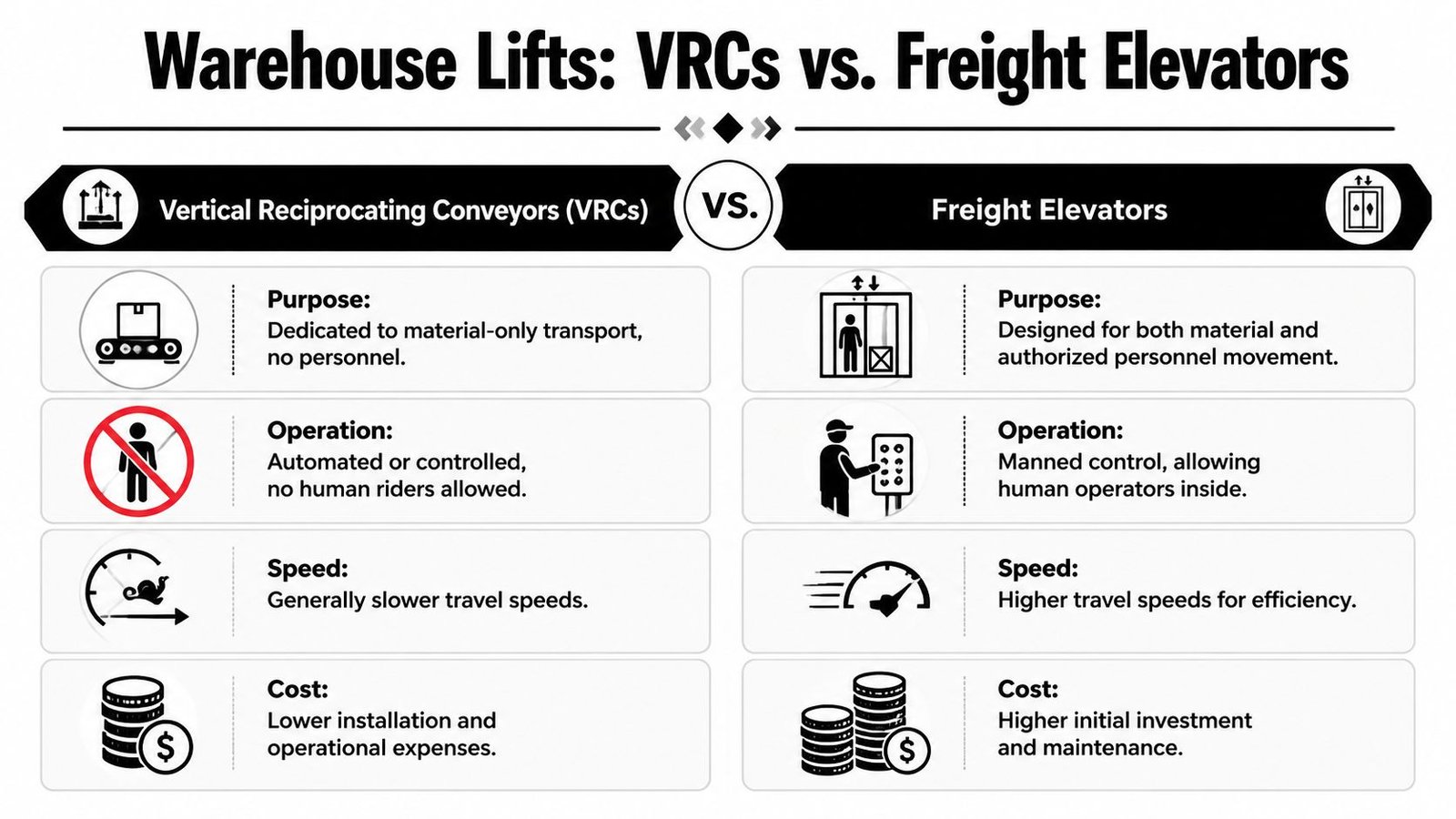
A VRC is material handling equipment. A freight elevator is an elevator.
That sounds obvious, but it matters because the use case, controls, guarding, code path, and long-term expectations all change from that one distinction. If your operation only needs to move goods between levels and no one rides with the load, a VRC may fit. If personnel need to accompany the load or operate from inside the car, you're in freight elevator territory.
Think of a VRC as a dedicated vertical transfer device for freight only. Think of a freight elevator as a heavy-duty transport car built for goods and authorized people.
Side by side trade-offs
| Type | Best fit | Main advantage | Main limitation |
|---|---|---|---|
| VRC | Pallets between fixed levels, no riders | Lower installation and operating complexity | No personnel riding |
| Freight elevator | Multi-level facilities with staffed load movement | Supports material and authorized personnel movement | Higher cost and more code obligations |
The lower entry cost of a VRC attracts a lot of buyers. Sometimes that's the right call. Sometimes it becomes a problem when operations gradually evolve and staff start expecting elevator-style use from equipment that wasn't selected for that purpose.
What works and what doesn't
A VRC works well when the movement is repetitive, controlled, and strictly freight-only. Mezzanine stock transfers are a common example. If loads are predictable and the process is guarded properly, it can be a practical answer.
A freight elevator works better when traffic is varied, loads are heavy, operators need car controls, or the building functions more like a multi-story distribution environment. In those cases, trying to save money upfront by forcing a VRC into an elevator role usually backfires.
Don't buy based on what the equipment can physically lift. Buy based on who needs to use it, how they'll use it, and what code framework applies after installation.
There's also a long-term service point that new facility managers often miss. Freight elevators usually integrate more naturally into buildings where uptime, inspections, and formal maintenance records matter. If you're comparing options for a staffed industrial application, it helps to review examples of industrial freight elevator configurations before locking in the wrong equipment class.
The cost mistake to avoid
The expensive mistake isn't choosing the more capable option. The expensive mistake is choosing the cheaper category, then redesigning operations around its limitations. Once that happens, savings disappear into labor friction, procedural workarounds, and retrofit discussions nobody wanted.
Siting and Structural Planning
The hardest part of many warehouse elevator projects isn't the elevator. It's the building.
If the site can't support the hoistway, pit, overhead, machine space, and traffic pattern, the equipment quote doesn't mean much. Consequently, projects often go sideways, especially in retrofits where people assume an elevator can be “fit in” later.
The three physical pieces that decide feasibility
A warehouse elevator needs three basic physical zones.
The hoistway is the vertical path the car travels in. It has to align with floor openings, landing doors, structural framing, and traffic flow. If the shaft location creates blind forklift turns or staging conflicts, operations will fight that layout every day.
The pit sits below the lowest landing. In new construction, planning for it is straightforward. In an existing building, pit depth, slab conditions, groundwater, and drainage can turn into the main project.
The machine room or machinery space depends on system design, but the point is the same. The drive and controller need proper placement, access, and environmental conditions. Squeezing machinery into leftover space often creates poor service access later.
What to check before you request final pricing
Before anyone gives you a serious number, confirm these conditions:
- Structural support: The building has to carry the live loads, rail loads, and related forces without wishful thinking.
- Overhead clearance: Low overhead can limit equipment options fast.
- Power availability: Service size and routing matter more than people expect.
- Traffic approach: Forklift entry, pallet jack turning, and door swing paths need room.
- Water risk: Pits and moisture don't mix well over time.
For managers planning a retrofit, reviewing common freight elevator dimension considerations helps frame the conversation with your architect, structural engineer, and contractor before the layout hardens.
The hidden cost is usually integration
Most surprise costs don't come from the car itself. They come from making the building accept it. Slab cutting, reinforcing openings, rerouting utilities, dealing with old foundations, and correcting bad access are what inflate budgets.
That's also why cheap early assumptions are dangerous. If your team only prices the equipment and ignores structural integration, the project will look affordable right up until reality arrives.
A short visual overview can help if you're evaluating a shaft location or retrofit concept:
Field note: A warehouse elevator should fit the building and the traffic pattern at the same time. If it only fits one of those, someone will pay for the mismatch later.
Navigating Code Compliance and Safety
Code compliance isn't paperwork. It's risk control.
A warehouse elevator handles heavy loads in close proximity to people, powered equipment, doors, interlocks, and structural openings. If any part of that chain is weak, the consequences show up fast. Property damage is bad enough. Injury exposure and legal exposure are worse.
Why code matters financially, not just legally
Facility teams sometimes treat code items as optional upgrades because they don't increase visible productivity. That's the wrong lens. Code-required features protect the operation from shutdowns, failed inspections, unsafe use, and hard-to-defend incidents.
Freight elevators have a strong safety record when they're maintained and operated correctly. In the U.S., where elevators make 18 billion passenger trips per year, the injury rate is only 0.00000015% per trip, according to elevator safety facts published by ElevatorInfo.org. That record exists because the industry relies on codes, inspections, testing, and disciplined maintenance. It doesn't happen by accident.
What inspectors and contractors focus on
A compliant warehouse elevator is more than a moving platform. Inspectors pay attention to the protective systems around the car and landing openings, and experienced contractors do the same.
Common focus areas include:
- Door interlocks and monitoring: Doors must secure properly and report status correctly.
- Emergency lighting and communication: People need safe visibility and a way to communicate during faults.
- Load handling behavior: Overloading, impact damage, and poor loading practices create recurring issues.
- Safety tests: Required testing verifies that protection systems perform when needed.
- Machine and control condition: Dirty, neglected equipment becomes unreliable equipment.
The operational side of safety
The safest warehouse elevator can still become a problem if the operation uses it badly. I've seen good equipment suffer because managers never defined loading rules, never marked clear approaches, or allowed impact damage to become normal.
Use policies that match the actual environment:
| Risk area | Good practice | Bad practice |
|---|---|---|
| Loading | Center loads as consistently as possible | Slam loads in from one side |
| Forklift traffic | Keep clear approach lanes and trained operators | Treat the landing like overflow staging |
| Damage control | Repair gates, sills, and doors early | Wait until doors stop functioning reliably |
| Inspection response | Correct violations promptly | Delay corrections until the next disruption |
Compliance is cheaper than explaining why a known defect stayed in service.
Ask better questions
When reviewing a warehouse elevator with a contractor or inspector, don't stop at “is it running?” Ask these instead:
- Are the safety devices working as intended, or just not failing yet?
- Have recurring door or leveling issues been traced to root cause?
- Does the maintenance history show proactive work or repeated patch repairs?
- Would you be comfortable defending this installation after an incident?
That last question cuts through a lot of sales talk.
Sizing and Selection Guidance
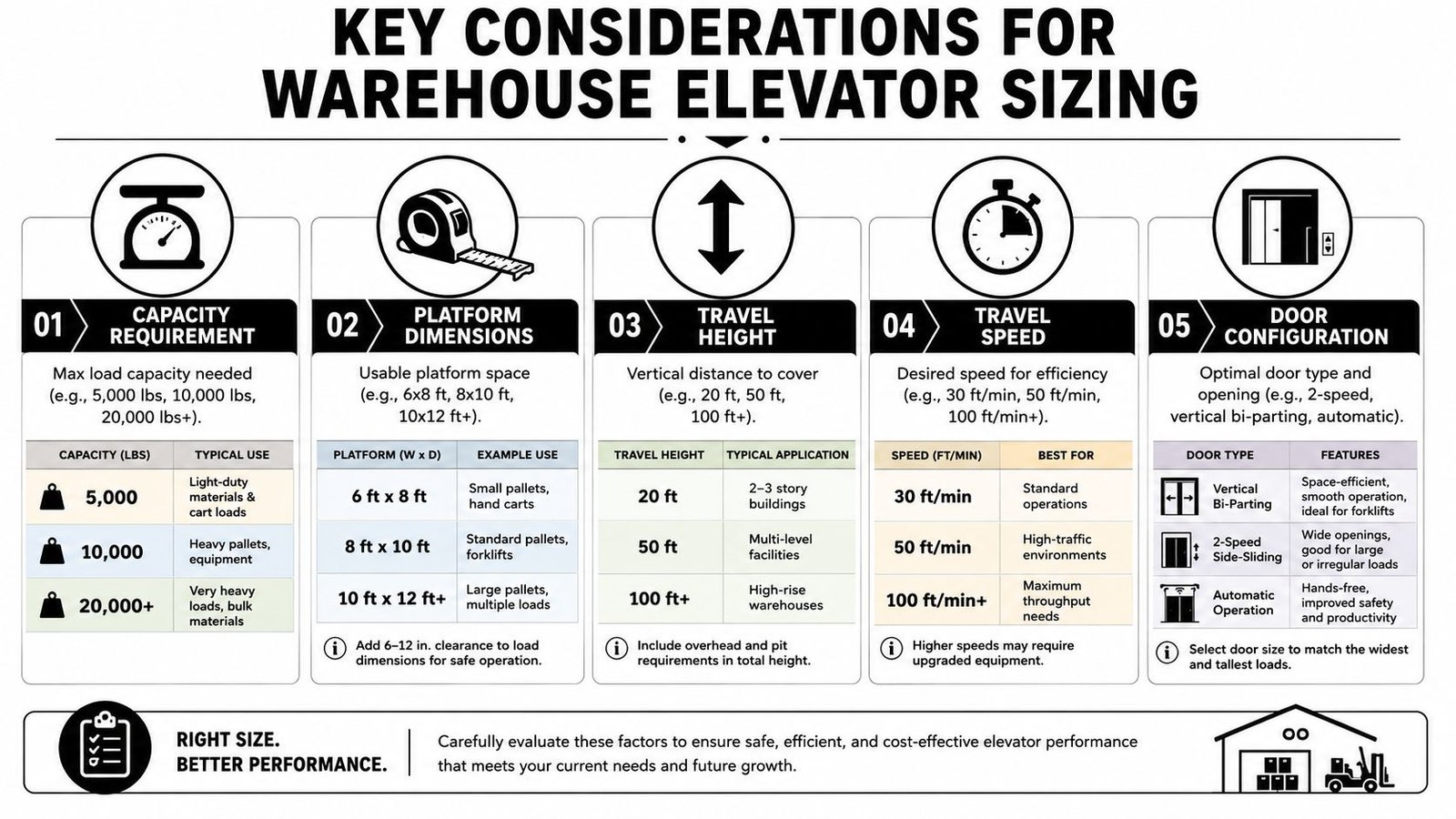
Most sizing mistakes happen because buyers plan around the average load. That's backwards. Size a warehouse elevator around the largest, heaviest, most awkward load you need to move, then test that choice against frequency and traffic flow.
If you size to the average and your operation regularly exceeds it, you'll force extra trips, manual workarounds, and avoidable wear from day one.
Start with the physical load
A freight car that accepts the weight but not the footprint is undersized. The same goes for a car that accepts the pallet but not the loaded forklift approach, overhang, or turning path.
The basic benchmark matters here. Industrial warehouse elevators require a minimum cabin height of 8 feet, width of 6 feet, and depth of 5 feet to accommodate palletized goods, with reinforced 14-gauge steel walls to withstand impacts, according to freight elevator planning guidance summarized in this dimensional reference.
That minimum is a starting point, not a recommendation for every application. If your loads are tall, irregular, or prone to impact, minimum dimensions can become maximum frustration.
Four questions that drive the right selection
Capacity
Write down the heaviest real load, not the estimated average. Include pallet, container, cart, attachment, and any handling equipment that enters the car.
A car that's too small on capacity creates repeat trips and loading restrictions. A car that's appropriately sized gives the operation breathing room.
Dimensions
Measure the load envelope thoroughly. Include overhang, operator clearance, and how the load enters and exits. Doors that look fine on a drawing can fail badly once a forklift needs to line up.
Speed
Speed should match workflow, not vanity. A slow car may be acceptable for occasional transfers. It becomes expensive if vertical movement is tied to active replenishment, order flow, or upstream automation.
Duty cycle
Some warehouse elevators move a few times per shift. Others work constantly. That difference affects component selection, heat, wear, maintenance planning, and how conservative you should be with sizing.
A practical selection sequence
Use this order when narrowing the field:
- Define the worst-case load
- Confirm usable car and door dimensions
- Map the loading method
- Check trip frequency
- Then choose speed and controls
Selection rule: Buy for the ugly load on the busiest day, not the clean pallet on the quiet day.
Don't forget future use
A warehouse elevator often gets repurposed over time. Inventory changes. Packaging changes. Departments move. If the system only works for the current snapshot of the operation, you may box yourself into an early upgrade.
The best selections leave room for operational drift without becoming oversized to the point of waste.
Installation Modernization and Lifetime Cost
The quoted equipment price is only one bucket of cost. For a warehouse elevator, total cost of ownership usually lives in three buckets: equipment, building modifications, and operating expense over time.
That's where new facility managers get blindsided. The purchase order may look reasonable, then site conditions, integration work, and recurring service realities change the whole financial picture.
Bucket one and bucket two rarely stay separate
On paper, equipment costs look clean. Then the building gets involved. Openings need work. Structural support needs verification. Power needs rerouting. Landings need protection. Doors need different handing because traffic doesn't approach the way the drawing assumed.
That's why a modernization can sometimes be the better financial decision. If the existing hoistway, entrances, and major structure are sound, replacing controls, door equipment, machines, or other core components can extend useful life without rebuilding the whole system.
But modernization only works when the original layout still fits the operation. If the old car is inherently undersized or the traffic approach is wrong, replacing parts won't solve the core problem.
The operational cost most buyers ignore
Speed mismatch is a classic hidden expense. If lift performance doesn't match how the warehouse moves product, labor absorbs the difference.
That isn't just a theory. A 2025 study of 100+ warehouse leaders showed that 40% of space optimization failures stem from uncalculated elevator lift constraints, such as when lift speeds are mismatched to vertical transport needs, increasing operational costs, according to warehouse automation planning findings from ISDDD.
The lesson is simple. A warehouse elevator isn't isolated equipment. It's part of the handling system. If it slows replenishment, disrupts pick flow, or creates queuing at landings, the warehouse pays for that every shift.
New installation versus modernization
| Path | Usually makes sense when | Main caution |
|---|---|---|
| New installation | Building needs a new vertical transport path or major capacity change | Integration costs can exceed early assumptions |
| Modernization | Core structure is usable and the layout still serves operations | New parts can't fix a bad original fit |
Plan budget around ownership, not arrival
A realistic budget should include:
- Equipment scope: Car, doors, controls, drive equipment, finishes suitable for industrial use
- Construction scope: Shaft work, pit work, electrical, structural reinforcement, fire-related building work where applicable
- Operating scope: Maintenance, repairs, testing, inspections, downtime exposure, and eventual component replacement
If you only compare vendor quotes on equipment line items, you're not comparing the actual project. You're comparing the smallest visible part of it.
Preventative Maintenance and Manager Checklist
A warehouse elevator doesn't stay reliable because it was expensive. It stays reliable because someone maintains it before failure becomes visible.
That distinction matters in industrial settings where dirt, impact, vibration, and frequent cycling wear equipment down faster than many office-building managers expect. Good maintenance protects uptime. Bad maintenance postpones problems until they become emergencies.
What real preventative maintenance looks like
A proper maintenance program does more than lubricate a few points and leave a tag behind. It should address the actual environment the elevator lives in.
For warehouse service, that means paying attention to contamination, impact damage, door performance, and machine condition. Pits collect debris. Car tops gather dust. Machine spaces get dirty. Those conditions don't just look bad. They interfere with switches, moving parts, cooling, and reliable operation.
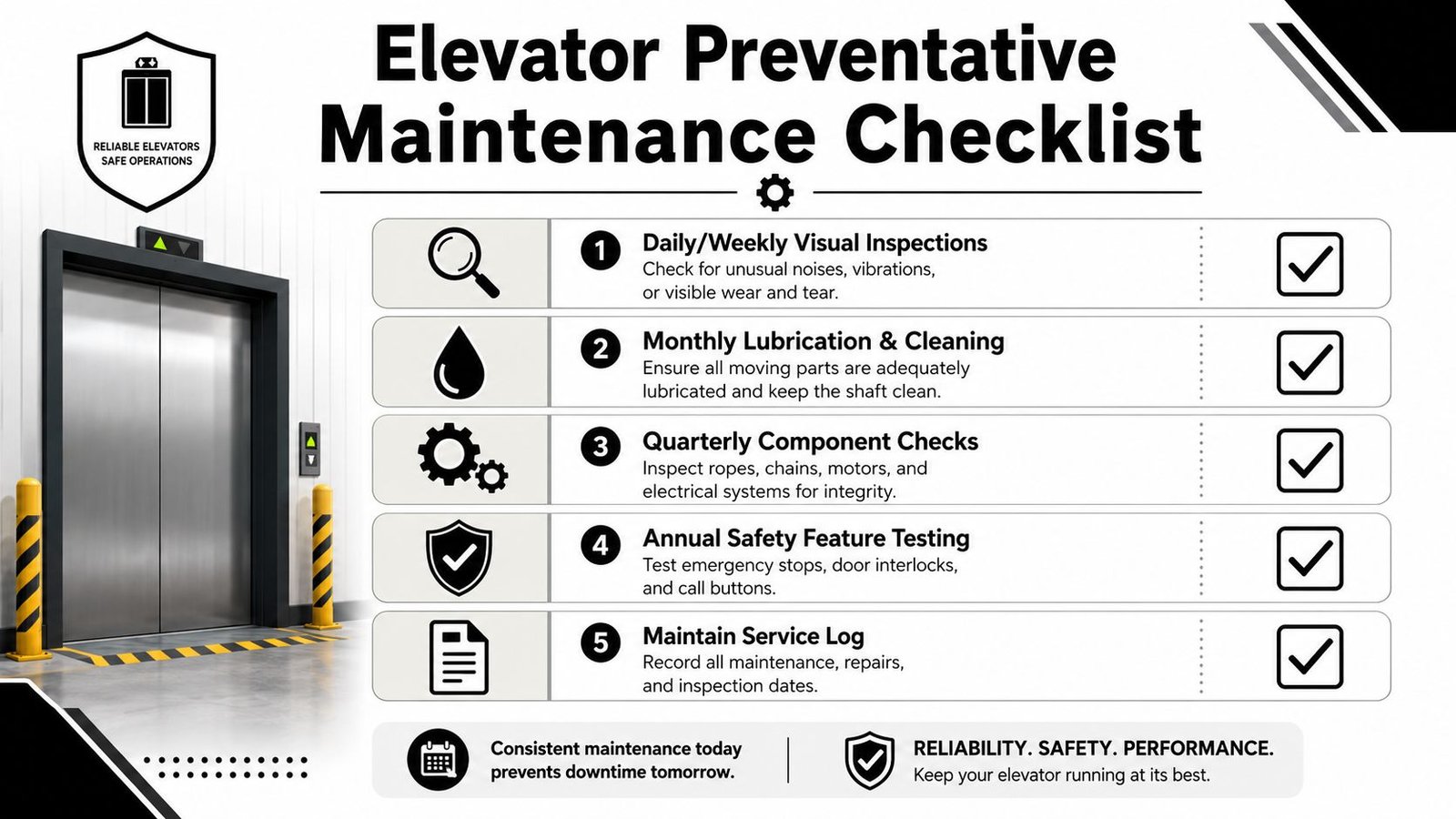
A solid service program should include clear visit accountability, documented findings, and thorough housekeeping in addition to mechanical checks. If you're reviewing service expectations, this overview of elevator preventative maintenance service shows the kind of scope facility managers should ask about.
The cheapest maintenance contract is often the one that produces the most expensive emergency call.
Match maintenance to actual use
Not every warehouse elevator sees the same punishment. Some carry occasional pallet transfers. Others function like a core production artery. Service frequency and inspection discipline should reflect that.
That's especially true when capacity rises. Warehouse elevators can scale significantly, with medium units measuring 8' x 10' handling 10,000 to 15,000 lbs and large units measuring 12' x 15' managing 20,000 to 30,000 lbs, enabling single-pass transport of heavy materials that would otherwise require multiple lifts, according to commercial freight elevator dimension guidance from Murphy Elevator. The heavier and more frequent the use, the less sense it makes to run maintenance like an afterthought.
Manager checklist for day-to-day oversight
You don't need to be a mechanic to manage a warehouse elevator well. You do need a repeatable review habit.
Daily or weekly checks
- Listen for change: New scraping, banging, or rough starts deserve attention.
- Watch the doors: Slow closing, bouncing, misalignment, or impact marks usually signal a developing issue.
- Look at landings: Damaged sills, bent guards, and cluttered approaches create repeat problems.
- Notice ride behavior: Jerky travel, poor leveling, or inconsistent stops are never “normal.”
Monthly review items
- Check housekeeping: Pit, machine space, and car top cleanliness matter more than many teams realize.
- Review service records: Make sure visits happened and findings were documented clearly.
- Track repeat calls: If the same failure keeps returning, push for root cause, not another temporary fix.
Questions to ask your service provider
- What recurring issue worries you most on this unit right now?
- Are you correcting causes or just restoring operation?
- What condition in the pit, machine area, or door equipment is shortening service life?
- What parts of this elevator show damage from loading practices?
- If this were your facility, what would you fix before it fails?
Signs your current plan isn't good enough
A weak maintenance program usually leaves clues:
- Frequent nuisance shutdowns
- Dirty equipment spaces
- Vague work tickets
- Repeated door issues
- Too much dependence on emergency calls
- No meaningful conversation about long-term component health
A warehouse elevator should be managed like infrastructure, not like a disposable convenience. When maintenance is disciplined, costs are more predictable, downtime is lower, and capital planning gets easier.
If you're evaluating a warehouse elevator project, dealing with recurring freight lift issues, or trying to lower lifetime costs on an existing unit, Crane Elevator Company can help with inspections, preventative maintenance, repairs, and non-proprietary modernization planning across Lower Michigan.