
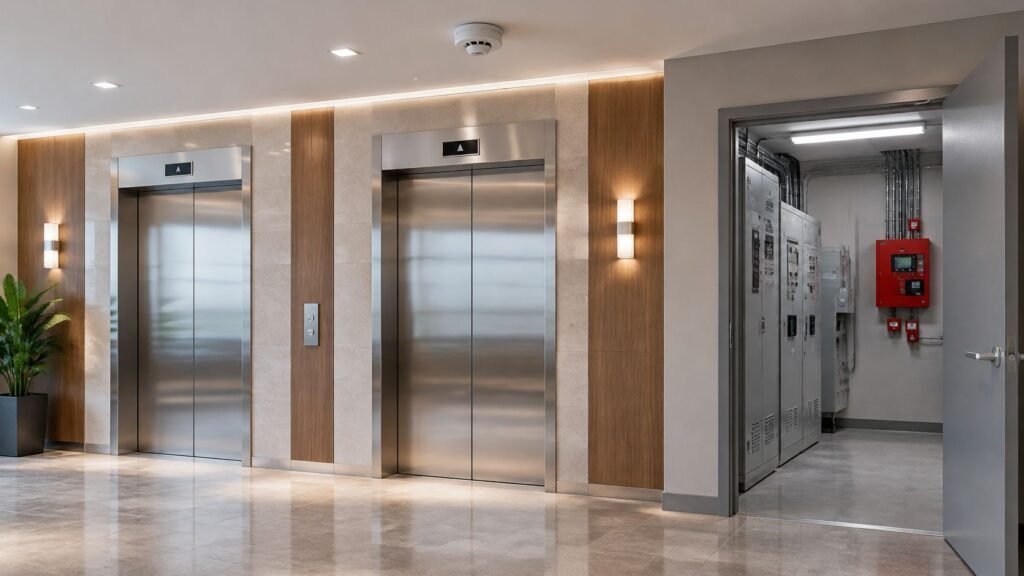
You're the facility manager who just got the inspection notice. The lobby ceiling has a smoke detector, the machine room has another, and nobody on staff can say which heads recall the elevator. Elevator smoke detector requirements aren't a single device somewhere in the corridor. They're a placement rule, a wiring path, and a test sequence that either returns the cars or fails the visit.
A detector can look installed and still sit too far from the doors, land on the wrong circuit, or reset itself before the controller finishes its response. Each rule below states the requirement first, then the consequence for the person who has to walk the building and sign the log.
Where Elevator Smoke Detectors Are Required
Phase I Emergency Recall needs initiating devices in each elevator lobby the elevator serves, in the machine room or control space, and at the top of the hoistway when sprinklers are installed there. Those devices start recall. They aren't stand-alone alarms. They have to sit inside the building fire-alarm system, or a dedicated elevator-recall control arrangement, and pass a signal to the elevator controller.
Colorado's state elevator guidance summarizes the ASME A17.1 pattern behind that layout. Lobby detectors must be within 21 feet of the centerline of each elevator served in the bank. The devices are installed to NFPA 72. The National Fire Protection Association ties the safety sequence to three functions: Phase I recall, Phase II firefighter in-car operation, and shunt trip, which is the power disconnect. A ceiling detector outside that 21-foot envelope, an unmonitored machine-room device, or a misprogrammed alarm can be present and still fail to recall the car. Sprinkler protection, hoistway design, local amendments, and the authority having jurisdiction change the final list, so confirm the adopted editions before you modernize.
Required locations at a glance
| Location | Required for Phase I recall | Placement rule |
|---|---|---|
| Elevator lobby, each served floor | Yes | Ceiling mounted within 21 ft (6.4 m) horizontally of the centerline of each elevator door |
| Elevator machine room or control space | Yes | Initiating device in the room, connected to the recall arrangement |
| Hoistway, top | Yes, when hoistway sprinklers are installed | Detector at the top of the hoistway; heat detector required in unsprinklered hoistways |
| Elevator pit | No, not required for Phase I recall | Pit detector may still be required by the fire official for another purpose |
Practical rule: Detector presence doesn't equal compliant recall. Location and the interface to the controller decide whether the test passes.
The pit row is the one many people mark wrong. A head down there can serve another life-safety job, and it still isn't an automatic Phase I device. Walk the building with this table. Mark every lobby, machine room, control space, and hoistway top as required, not required, or unknown. Unknown is an honest mark until the drawings and the adopted code edition are in hand.
How Phase I Recall Responds to a Fire Signal
Say a fire starts on the fourth floor of a seven-story office building. Smoke reaches the fourth-floor lobby, that detector trips, and the fire alarm panel sends the signal to the elevator controller. The cars leave normal service only if that path is wired and programmed as recall, not as a local alarm.
The handoff looks like this from the lobby to the designated landing.
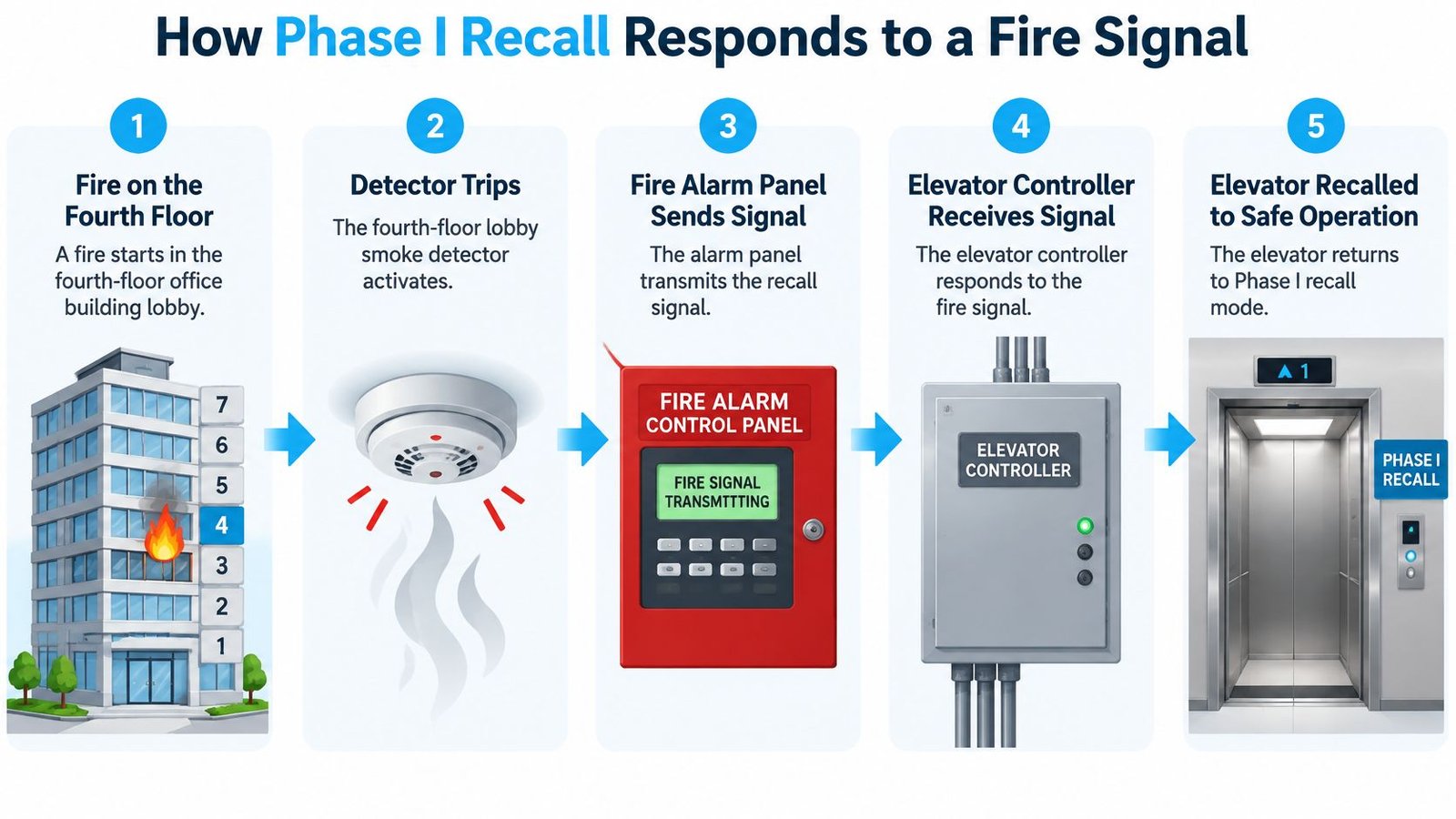
- The fourth-floor lobby detector activates and signals the fire alarm panel.
- The panel signals the elevator controller to start Phase I recall.
- Every car in the group returns to the designated landing and stops there.
- Doors open at the recall floor, and the cars are held out of normal service.
- Firefighters take control with Phase II in-car operation when they need the car.
- If hoistway sprinklers operate, a heat detector or a permitted waterflow arrangement can trigger shunt-trip power disconnection, and that disconnect has to follow recall.
Why power removal waits
Cutting power before the cars reach the designated landing can strand occupants or firefighters inside a car. Smoke detection should start recall first. The heat detector or waterflow input then removes power when hoistway sprinklers operate, after the cars are already parked.
Machine-room-less elevators follow the same order, but the devices are located in the control space and in any equipment area above the hoistway instead of a full machine room. What you will see on test day depends on which of those devices this building has. A group with no hoistway sprinklers shouldn't be expected to show a shunt trip.
Before the inspector arrives, trace the path on your own drawings: lobby device, panel, interface, controller input, designated landing. If you can't point to each handoff, the recall test isn't ready.
Firefighters take the car under Phase II only after recall has parked it. This clip shows that in-car operation once the car is already out of normal service.
The keyed switch and the in-car functions that follow a successful recall are laid out with the fire service elevator requirements.
Lobby Placement Measurements Inspectors Check
A facility manager finds the lobby detector on the corridor ceiling, 25 feet from the elevator doors. It still senses smoke. It still sits outside the 21-foot envelope, so it may not satisfy recall no matter how loud the alarm is.
Published NFPA 72 placement guidance requires a smoke detector in the elevator lobby on the ceiling within 21 ft (6.4 m) horizontally of the centerline of each elevator door that detector serves. Measure from the door centerline, not from the corridor wall or the call button. The detector has to see smoke on the approach path early enough for the controller to send the cars down before smoke compromises passengers or firefighters.
Measurements you can take with a tape
| Measurement | Requirement | Notes |
|---|---|---|
| Horizontal distance from elevator door centerline | Within 21 ft (6.4 m) | NFPA 72 Phase I lobby rule |
| Distance from sidewall | At least 4 in (100 mm) | Spot-type detectors |
| Sidewall mounting height | Top 4 to 12 in (100 to 300 mm) below ceiling | Spot-type detector mounted on a sidewall |
| Wall placement, lobby ceiling above 15 ft | Above and within 60 in (1.52 m) of top of hoistway door | Wisconsin guidance reflecting NFPA 72 |
| Relocated door, added partition or changed ceiling height | Re-measure all distances | Can invalidate a working recall installation |
Work the rows in order. First, the horizontal distance from each door centerline. Second, mounting: a spot-type detector stays at least 4 in (100 mm) off a sidewall, and a sidewall-mounted detector's top sits 4 to 12 in (100 to 300 mm) below the ceiling. Third, ceiling height. In lobbies higher than 15 ft, Wisconsin guidance reflecting NFPA 72 permits wall placement above and within 60 in (1.52 m) of the top of the hoistway door.
Moving an entrance, adding a partition, or dropping a new ceiling can wipe out distances that passed last year. Re-measure after any of those changes. The adopted code edition still controls the final numbers if your jurisdiction hasn't taken the same text.
You can check horizontal distance, sidewall clearance, and ceiling height with a tape. Zoning, relay programming, and whether the detector is listed for that space belong to the fire-alarm contractor. Don't sign off a renovation from the tape alone.
Pit Detectors and When Heat Detectors Can Replace Smoke
The common assumption is that every elevator needs a pit smoke detector. That assumption lists every elevator space as if it did the same job, and it treats the pit head as a recall device.
Tennessee's elevator acceptance requirements put recall detectors at each landing, in the machine or control room or space, and in the hoistway overhead. They specifically note that a smoke detector in the elevator pit is not required for Phase I recall. Colorado guidance adds the device-type nuance. Heat detectors may replace smoke detectors in pits and hoistways, and heat detectors must replace smoke detectors in unsprinklered hoistways.
A detector can serve four different jobs, and only one of them is recall:
- Elevator recall: The device starts Phase I and has to be on the recall circuit.
- Sprinkler monitoring: The device, or a waterflow arrangement, watches hoistway sprinklers and can lead to power removal after recall.
- Smoke-control equipment: The device may start fans or dampers and never talk to the elevator controller.
- General fire detection: The device alerts the building and may have nothing to do with car movement.
A pit detector can be required for one of those jobs by the fire official, the sprinkler layout, or the environment, and it still isn't a recall detector.
Nuisance alarms in a damp pit
Say a freight elevator in a Lansing warehouse has a damp pit. Dust and temperature swings trip the smoke detector every few weeks, and the owner wants the head removed so the alarms stop. Don't pull it because the alarms are annoying. Ask the authority having jurisdiction which device, and which control function, that specific pit requires. The replacement has to be listed for a dusty, damp, temperature-variable space. A smoke detector that isn't listed for that pit will keep failing for the wrong reason, and removing a device the fire official still wants will fail the inspection for a different one.
Testing Activation Logic and Keeping Records
Acceptance testing proves the whole chain, not the detector by itself. NFPA's explanation of firefighter elevator use says Phase I Emergency Recall can be initiated by detection in an elevator lobby, machine room, control room, or a nonsprinklered hoistway, with the fire alarm panel sending the signal to the elevator system. Maryland rules add two limits that change the test. Elevators react only to the first activated smoke-detector zone, and detector systems must not self-reset.
Lobby detectors generally start the primary recall path. Machine-room and hoistway devices may start another recall circuit. A designated recall lobby doesn't behave like the other lobbies, so that floor has to be tested on its own, not assumed from a typical floor.
The record should show the chain, not a single check mark next to "detector works."
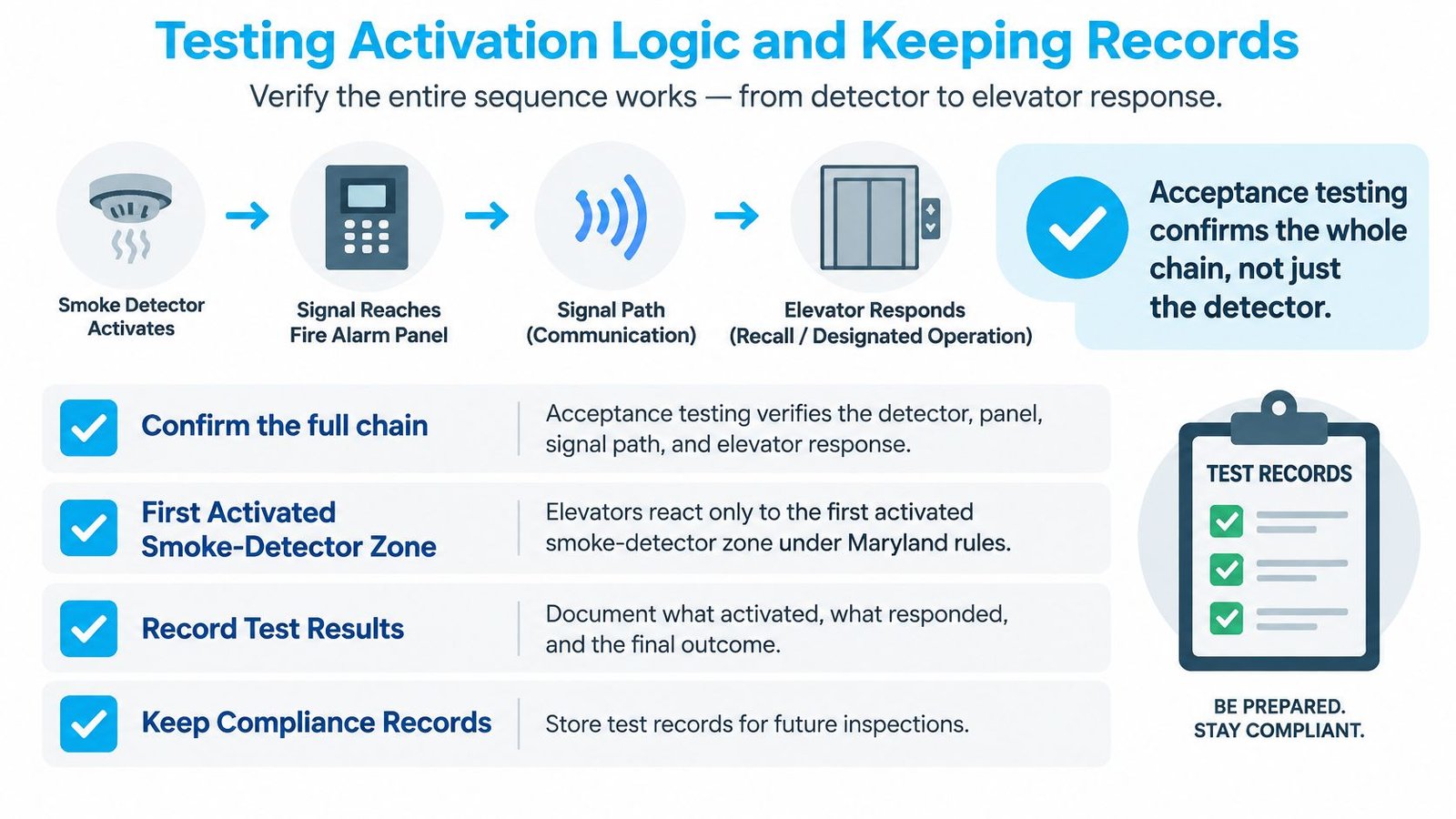
- Test each initiating zone separately, including every lobby, the machine room, and the hoistway device.
- Confirm the designated recall lobby behaves differently from the other lobbies.
- Verify the detector-to-controller sequence through to recall status and the firefighter indications.
- Confirm the controller ignores a second zone while the first zone is still active.
- Check that restoration after an alarm needs a manual reset, not a self-reset.
- Record the zone, device type, location, and result for each test.
Who signs the test record
The fire-alarm technician tests the detector, the panel, and the output. The elevator contractor tests recall and the controller response, including door behavior at the designated landing. Both sign the record. Elevator testing is categorized so it lines up with ASME A17.1 and CSA B44, which is why a fire-alarm printout alone doesn't close the elevator test.
That split is how elevator testing is organized, so the fire-alarm sheet and the elevator sheet describe the same activation.
If recalls are intermittent, check zone wiring and relays before you add heads. Extra detectors on the wrong zone produce failed tests and unwanted trips. They don't repair a bad interface. Some authorities want heat detectors in unconditioned or exterior spaces, so confirm the device type with the authority having jurisdiction before you rewrite the zone.
Michigan and Ohio Rules Side by Side
A recall test can fail even when detectors are present if their placement or wiring does not match the applicable rules. Michigan and Ohio share several requirements, but their guidance differs on how detectors connect to the fire-alarm system.
Michigan's fire-detection design guidance identifies elevator machine rooms, equipment areas above machine-room-less elevators, elevator lobbies, and the tops of sprinklered hoistways as detection locations. It also calls for these detectors to connect to the building fire-alarm control panel. Replacing a detector head alone does not address the required connection.
Ohio's elevator pre-inspection checklist calls for smoke detectors in enclosed elevator lobbies and machine rooms, control rooms, or control spaces. It also requires a hoistway initiating device when a sprinkler head is installed in the hoistway. Smoke is the expected initiating device; an alternative requires approval by the authority having jurisdiction under applicable fire-alarm and elevator requirements.
| Requirement | Michigan | Ohio |
|---|---|---|
| Elevator lobbies | Detection supports recall | Smoke detectors in enclosed elevator lobbies |
| Machine rooms | Detection required | Smoke detectors in machine rooms, control rooms, or control spaces |
| Equipment area above machine-room-less elevators | Detection required | Smoke detectors in control rooms or control spaces |
| Sprinklered hoistway | Detector at the top of a sprinklered hoistway | Hoistway device when a sprinkler head is installed in the hoistway |
| Activation device | Smoke detectors | Smoke, unless the authority having jurisdiction approves an alternative |
| Connection without building-wide fire alarm | Connection to the building fire-alarm control panel | Dedicated elevator recall control and supervisory panel in a visible monitoring area |
Where the wiring path splits
The main difference is the connection path. Michigan's guidance ties the detectors to the building fire-alarm control panel. Ohio allows a dedicated elevator recall control and supervisory panel when the building has no building-wide fire-alarm system. In either case, detector location, fire-alarm wiring, and the elevator controller must work together. Review the applicable elevator code requirements with the authority having jurisdiction before changing the system.
Crane Elevator Company serves Detroit, Toledo, Ann Arbor, Lansing, Perrysburg, Flint, Kalamazoo, and surrounding Michigan and Ohio communities. Its elevator services include maintenance, repairs, testing, and modernization for a range of elevator and lift types.
Ohio residential buildings over 75 feet
Ohio Revised Code Section 3781.104 applies to existing apartment and condominium buildings exceeding 75 feet that lacked a conforming automatic smoke-detection or sprinkler system. The statute requires an automatic smoke-detection system in those buildings. For non-dwelling areas, one specified spacing option places a detector on each floor, on the corridor or lobby side of every stairway and elevator door, and within 5 feet of the door.
Check the building's height and whether the statute applies. This requirement addresses the building's smoke-detection system; the elevator contractor's role concerns the recall interface and fire-service functions.
Confirm Your Elevator Detector Compliance Before Your Next Inspection
A recall test can fail even when the detectors appear to be in place. Inspectors also need to see that device locations, fire-alarm zones, and elevator response work together. Before inspection week, prepare these records and checks:
- Pull the drawings. Gather the elevator layout and fire-alarm riser, then match device IDs to floors.
- Record the dates and code editions. Note the installation or modernization date and the editions of ASME A17.1, NFPA 72, and the local building code adopted for the property.
- Check detector locations. Mark each lobby, machine room, equipment area, and sprinklered hoistway on the drawings. Compare the locations with the applicable placement measurements.
- Get the pit decision in writing. Ask the authority having jurisdiction to document its decision about a pit detector or heat-detector substitution before any device is removed or replaced.
- Schedule a joint test. Have the fire-alarm technician and elevator contractor test together. Request signed, zone-by-zone records showing the first zone, manual reset, and recall result.
Crane Elevator Company handles elevator-side recall interfaces, fire-service testing, inspections, repairs, and modernization. Crane serves Detroit, Lansing, Ann Arbor, and Birmingham, along with surrounding Michigan and Ohio communities. Its maintenance includes a No Show, No Pay policy, machine-room, pit, and car-top cleaning, and COP and PI bulb replacements. Fire-alarm installation and wiring remain with licensed fire-protection professionals; the elevator contractor coordinates with them at the controller.
For a recall test, the practical question is whether the correct fire-alarm signal makes the elevator perform the required response. Start with the drawings, then confirm the signal and car response together. Visit Crane Elevator Company to request a quote or a second opinion on the recall interface.