
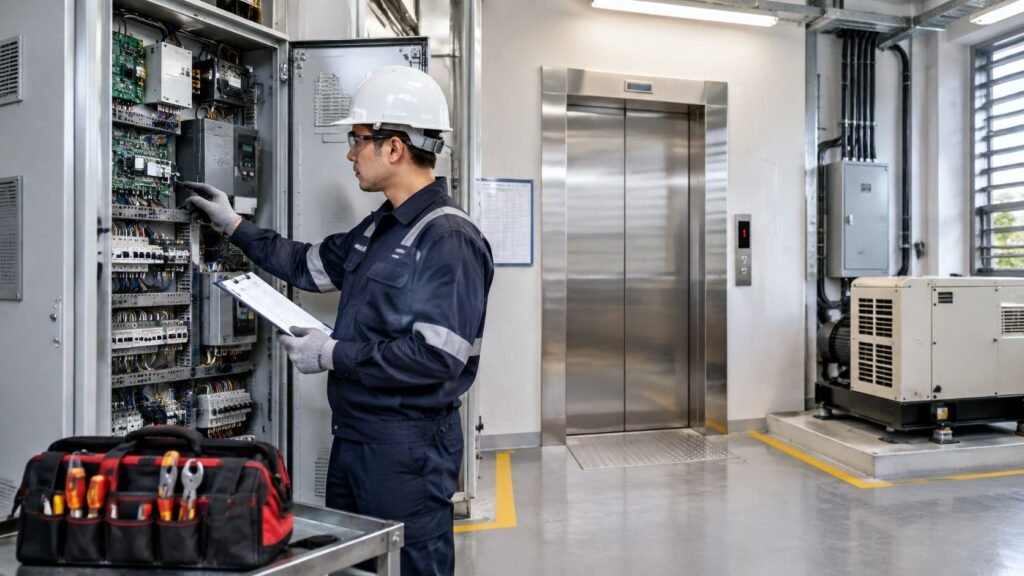
Falls to a lower level caused 53.5% of construction elevator fatalities in the historical analysis published by the Centers for Disease Control and Prevention. Elevator preventive maintenance is therefore more than an uptime service. It's a life-safety program for passengers, technicians, and anyone working around the hoistway.
A sound program connects routine visits, condition measurements, required tests, generator operation, and callback history. The calendar tells you when someone should arrive. The maintenance record tells you whether the elevator was examined, what changed, and whether it was safe to return to service.
Preventive Maintenance Frequencies by Equipment
For a passenger or freight elevator in daily service, use a monthly maintenance visit as the planning default, then adjust the scope to the equipment, manufacturer's instructions, environment, and maintenance-control program. That's a proposed operating cadence, not a claim that every elevator code mandates monthly service.
The stakes justify that distinction. A historical CDC elevator and escalator safety analysis estimated about 30 deaths and approximately 17,000 serious injuries annually from elevator- and escalator-related incidents. Its safeguards included adequate maintenance and inspection, qualified personnel, energy isolation, and fall protection.
A cadence the building engineer can post
Use the following table as a planning template, not authorization to extend a code-required interval. The contractor must reconcile each row with the adopted code edition, equipment instructions, and actual condition.
Elevator preventive maintenance frequencies
| Task | Passenger and freight | Hydraulic addition | Low-use lifts | Do not skip when |
|---|---|---|---|---|
| Clean machine room, pit, and car top | Every scheduled visit, typically monthly | Same, plus oil on the floor | Quarterly if duty is very low and the maintenance program permits | Water, rubbish, or grease is present |
| Doors, interlocks, force, clutch, and tracks | Monthly | Monthly | Each scheduled visit | Repeat door callbacks or entrapments |
| Controller logs, heat, contactors, batteries | Monthly | Monthly | Quarterly on low duty if permitted | Drive alarms or safety-chain resets |
| Leveling, brake, ropes or belts, vibration | Quarterly measurements, with abnormal conditions checked each visit | Oil level and leaks each visit | Belts or screws as equipped | Noise, shutdown, or releveling |
| Firefighter service and standby power | Annual operation test where applicable | Annual where applicable | Only if the feature exists | After generator or transfer-switch work |
| No-load safety, governor, and buffer tests | Annual where applicable | Annual applicable tests, plus relief and overspeed valves | Per the code for that device | After alteration or safety work |
| Full-load full-speed safety test | Every 5 years where required | Category test per adopted code | As that equipment's rules require | After safety-device replacement, as directed by code |
| Jurisdiction inspection | Michigan 12 months for most elevators, subject to current adopted rules | Same applicable cadence | Michigan 24 months for listed lower-use device categories | Before a new, altered, or relocated unit opens, subject to required acceptance procedures |
The test rows identify tasks to place on the calendar, not permission to test every device using the same procedure. A traction freight car, hydraulic passenger car, and platform lift don't share an interchangeable test method.
Separate maintenance from jurisdiction inspection
The Michigan elevator rule document lists inspection intervals of at least every 12 months for passenger, freight, inclined, limited-use/limited-application, special-purpose personnel, rooftop elevators, and material lifts, and at least every 24 months for dumbwaiters, stairway chairlifts, one-person elevators, platform lifts, and power sidewalk elevators. Because that document appears in Michigan's open-rule materials, confirm the currently effective requirements with the jurisdiction before treating it as the controlling schedule.
Low use can justify reducing some visual-service frequency when the governing program permits. It doesn't automatically extend safety-test deadlines or excuse deteriorated doors, leaking equipment, or unreliable communication.
Planning rule: Select the equipment row first, then increase attention for duty, contamination, age, and unresolved faults. Don't reduce required testing because a car rarely runs.
How to Run One Maintenance Visit
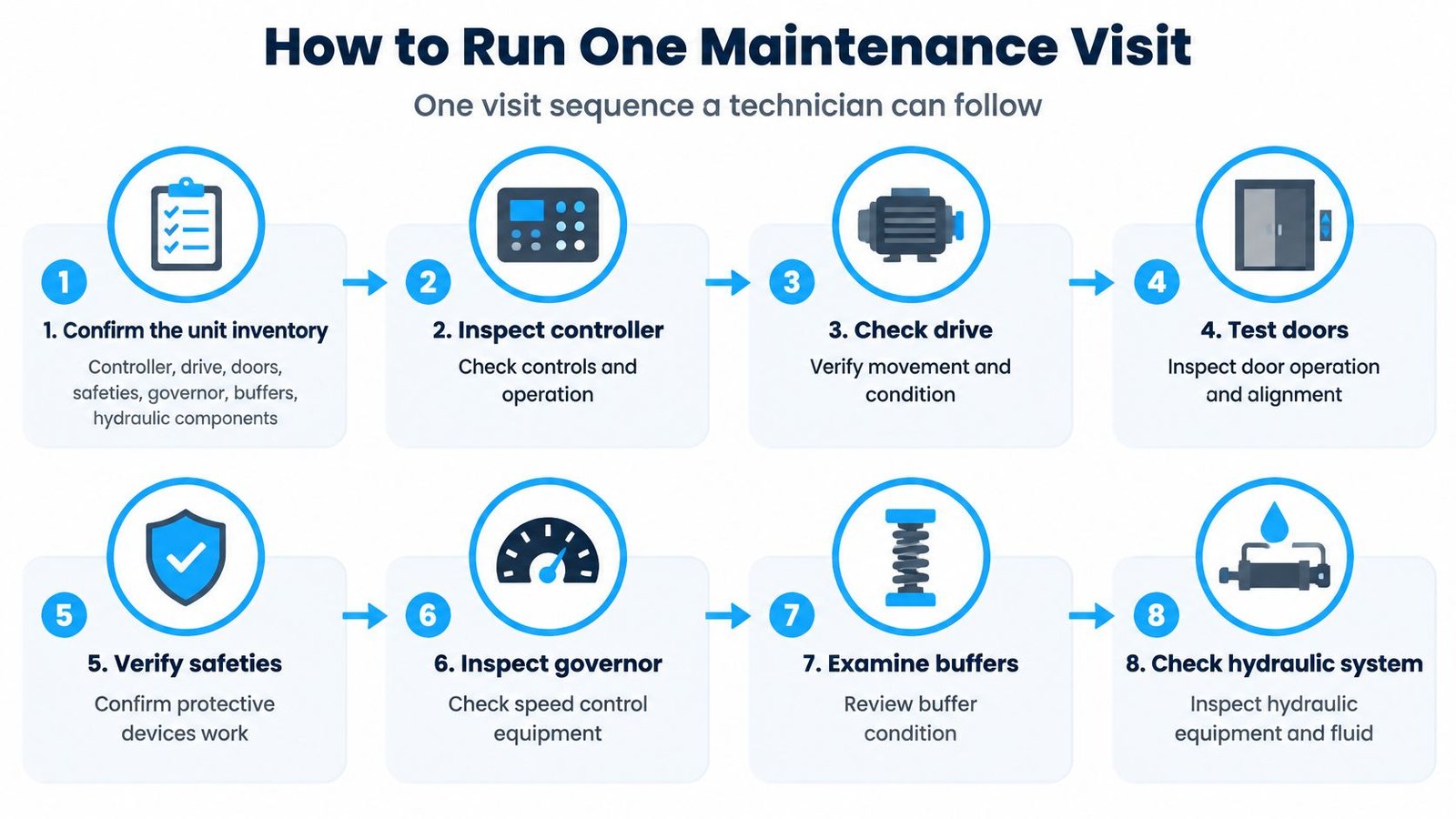
A maintenance visit is a sequence of checks and decisions, not a guarantee that an elevator is safe because a technician arrived. A hydraulic passenger car and a traction freight car need different procedures, but both require work matched to the equipment and a record of what was found. The federal elevator maintenance specification includes documented examinations, corrective work, annual applicable no-load and emergency-operation tests, and five-year full-load, full-speed testing where required, using applicable ASME procedures.
Use the sequence below to organize the visit. The equipment-specific maintenance-control program and written safety procedures determine how each task is performed.
Control the work before checking components
Confirm the unit inventory. Identify the controller, drive, doors, safeties, governor, buffers, hydraulic components, emergency phone, firefighter service, and standby-power equipment. Match the asset number to the maintenance record. Procedures for a different car may not apply.
Establish safe access and energy control. Follow the isolation, lockout/tagout, access, and fall-protection procedures for the task. Powered testing needs its own approved procedure; switching off a disconnect alone does not address every hazard.
Inspect and clean. Examine the machine room, pit, and car top. Remove rubbish and check for water or oil, recording the source of contamination rather than wiping away evidence.
Lubricate approved points. Follow the manufacturer's lubricant and application instructions. Excess lubricant can create problems, and friction surfaces must stay free of stray oil or grease.
Measure operating condition. As applicable, check door operation, leveling, brake response, rope or belt condition, hydraulic leakage, and abnormal vibration. Compare readings with equipment limits and previous results.
Test, document, and close the visit
Examine the door system. Check clutch and vane alignment, rollers, tracks, interlocks, reopening protection, and nudging operation. A successful door cycle does not verify the locking and protective devices.
Review the controller. Read fault history before clearing it. Inspect for heat, contamination, deteriorated contactors or relays, drive alarms, and battery problems. An undocumented reset erases useful diagnostic evidence.
Perform the functions due. Complete scheduled safety and emergency checks using the applicable procedure. A calendar visit does not make every test due, and different devices may have different test requirements.
Record findings and service status. Enter measurements, defects, corrective actions, outstanding work, and whether the car remains out of service. A signature alone does not show what was examined.
Verify the completed work. Correct unsafe conditions before release and prioritize other deficiencies. Where appropriate, verify operation with a representative load, then restore guards, access controls, and operating settings.
The ASME safety-code overview covers maintenance, inspection, testing, alteration, and repair within the elevator safety framework. Assign work according to the applicable jurisdictional requirements and the equipment's maintenance procedures.
Use the following video as a visual reference alongside written procedures.
What the Machine Room Log Must Show
A defensible machine-room log identifies the unit, explains what happened, and leaves the next technician with usable information. The owner should be able to distinguish completed maintenance, temporary restoration, and unresolved corrective work without interpreting vague shorthand.
Start with these fields:
- Visit identification: Date, unit identifier, technician, and the work performed.
- Operating history: Trouble calls, entrapments, shutdowns, and occupant complaints since the previous visit.
- Measured condition: Readings, units, applicable acceptance limits, and comparison with earlier results.
- Deficiencies: Component, location, observed condition, and immediate operating restriction.
- Corrective action: What was adjusted, cleaned, repaired, replaced, or tested.
- Disposition: Returned to service or held out of service, with the reason and responsible follow-up party.
Keep the equipment inventory with the maintenance-control record. It should identify the controller, drive, door equipment, protective devices, hydraulic equipment where fitted, emergency communication, firefighter service, and standby-power arrangement.
Record conditions, not just checkmarks
Ohio's elevator maintenance rule provides concrete conditions to document: clean hoistways and pits, no accumulated pit water, machine-room floors free of oil and grease, and no unnecessary storage in machine rooms or on car tops. It also addresses properly packed valves and cylinders and operational emergency communication, lighting, and door-closing and locking devices.
Write what the technician found and did. An entry such as “pit water present, source not established, owner notified, follow-up assigned” is more useful than a checked cleanliness box beside a wet pit.
For buildings covered by our Traverse City elevator maintenance information, the same record discipline applies regardless of whether the equipment serves residents, employees, or visitors. Keep the unit identification consistent across service tickets, inspection paperwork, and corrective-work records.
A reset restores operation. A repair addresses the cause. The log should never make those actions look identical.
Keep open work visible
If a technician clears a fault without establishing its cause, preserve the fault code, operating circumstances, observations, and next diagnostic action. Assign an owner and target date to the open item rather than letting it disappear into a closed service ticket.
Use separate statuses for awaiting diagnosis, awaiting authorization, awaiting parts, and completed with verification. Missing records can leave an owner unable to demonstrate what was done during an inspection review or insurance inquiry, even when a visit occurred.
When water or oil is found, photograph the affected area and file the image under the same date and unit as the log entry. Take a corresponding closeout photograph after correction so the record shows both the condition and its resolution.
How Generator Tests Join the Elevator Schedule
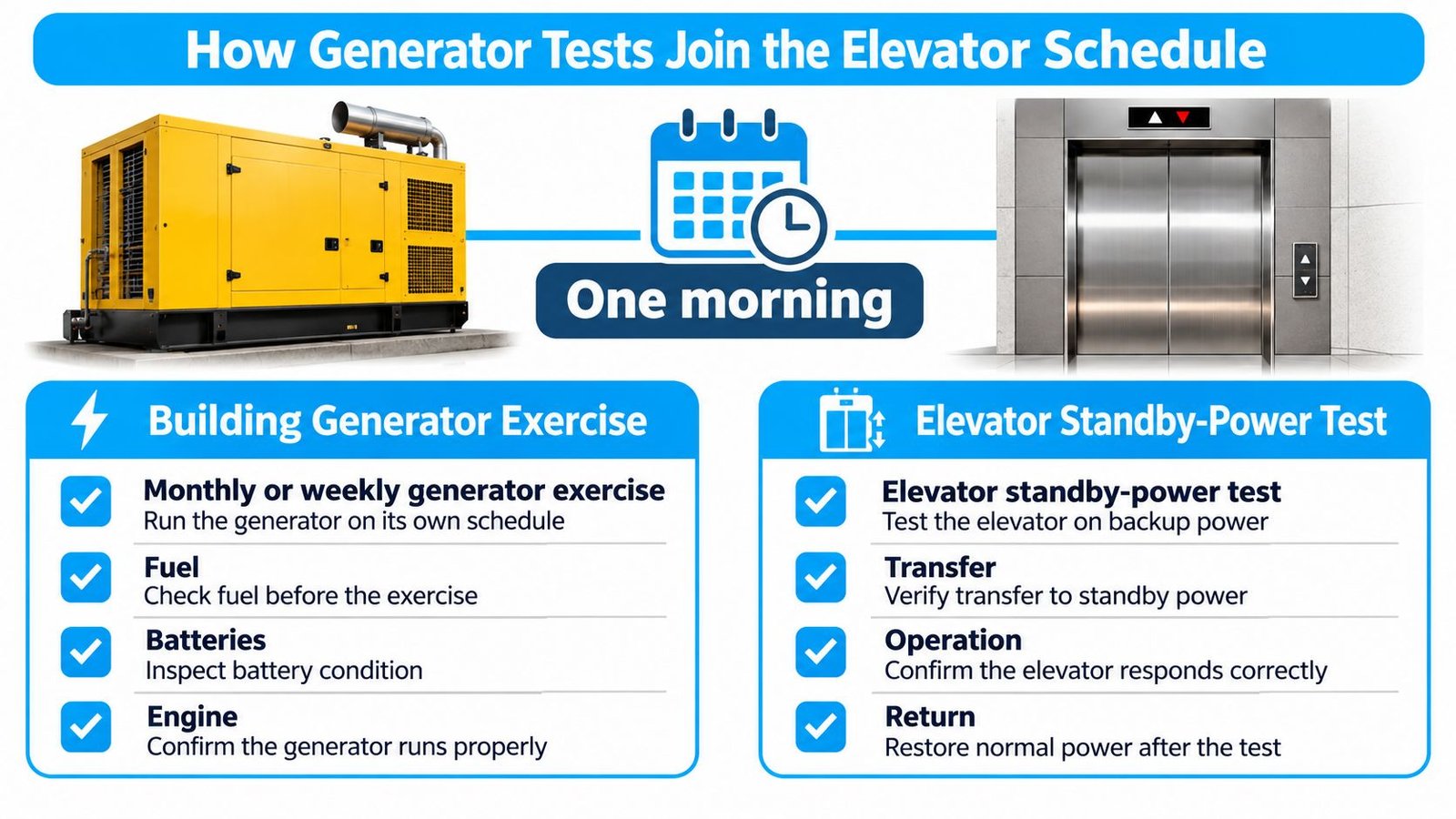
A generator that starts hasn't proved that the elevator accepts standby power. The building's generator exercise checks the generating equipment. The elevator standby-power test checks the elevator's response to transfer, selection, recall, operation, and restoration under its approved sequence.
Assign the responsibilities before scheduling the outage. The building engineer coordinates the generator, fuel, starting batteries, automatic transfer switch, and electrical support; the elevator technician controls the elevator procedures and evaluates the car's response.
The checklist illustrates how the separate responsibilities can share a coordinated test morning.
Coordinate the transfer, not just the appointment
Book the elevator test with a generator run. Use the building's established generator-exercise schedule, whether weekly, monthly, or another required cadence. Notify occupants, identify unavailable cars, and arrange accessible alternatives before taking equipment out of normal operation.
Verify supporting systems. The building team confirms transfer-switch readiness and the applicable electrical arrangements. The elevator technician checks emergency lighting and the phone or cellular dialer so communication isn't assumed to survive the transfer.
Follow the approved car-selection sequence. Move cars individually where the system requires sequential operation. Don't demand simultaneous operation from a generator and control arrangement designed to select only designated cars.
Observe the actual elevator response. Verify the required recall destination, door operation, selected-car operation, and in-car communication on standby power. Compare behavior with the documented sequence rather than assuming every installation should respond alike.
Record the transfer results. Identify which car ran, the elapsed transfer-to-recall time, fault codes, and any failed function. Verify the applicable firefighter-service functions through the approved test procedure, including required interaction with standby operation.
Restore and verify normal service. The building team restores normal supply under the coordinated procedure. The elevator technician confirms successful retransfer and rides each affected car before release.
Keep load testing separate. Don't combine the full-load safety test with generator operation as a shortcut. Maintain a separately approved test plan, supply arrangement, personnel assignment, and required witnessing.
File matching records. Store the generator run log and elevator test record under the same date, with cross-references to the affected units. Record unresolved transfer problems as corrective work, not a successful generator exercise.
Advance testing after a relevant change
Generator repairs, transfer-switch work, controller changes, or recurring outage-related failures should trigger a review of the test plan. A hospital, school, or municipal building that loses elevator operation during actual outages shouldn't wait for the next routine anniversary to investigate.
Use the elevator generator-testing requirements guide to prepare the coordination discussion. The critical deliverable is a documented operating sequence with clear responsibilities, observed results, and an assigned correction for anything that failed.
Extra Time for Doors and Controllers
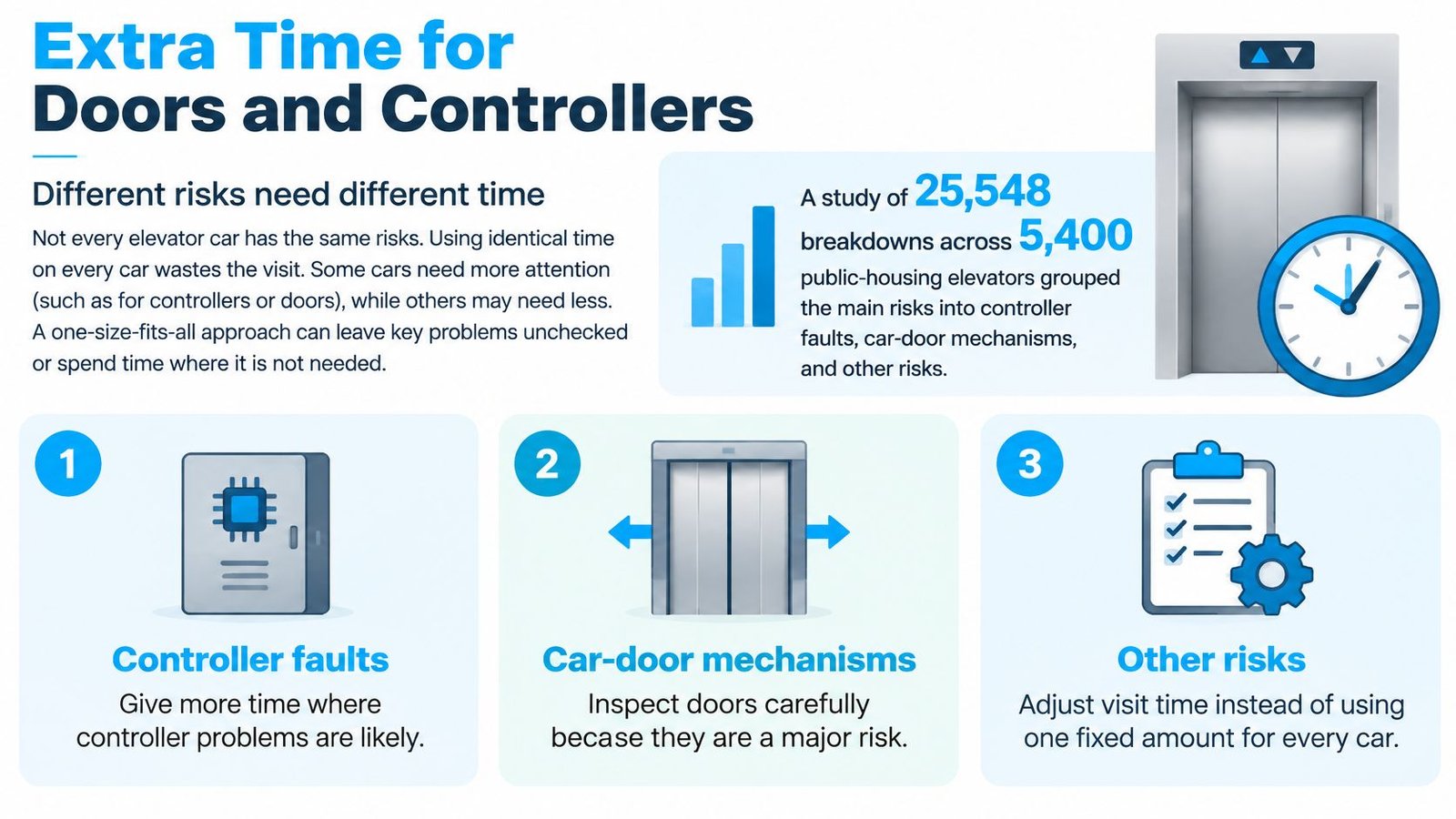
An analysis of 25,548 breakdowns involving 5,400 public-rental-housing elevators identified controller faults, car-door mechanisms, landing-door mechanisms, and other car-cage equipment as the principal breakdown-risk groups in the HKUST elevator performance thesis. The analysis also associated controller faults with the beginning of equipment wear-out.
That finding supports targeted attention, not a universal prediction for every building. Equal visit time on every unit can leave a repeatedly failing door system underexamined while a stable car receives work it doesn't yet need.
The graphic summarizes why component risk should influence the visit scope.
Let callback history direct diagnostic effort
Sort equipment by age, duty, environment, condition, and fault history. Then group callbacks and downtime by subsystem so the technician can see whether doors, controls, hydraulic equipment, or another assembly deserves focused investigation.
For example, a freight car exposed to loading debris and repeated landing-door complaints needs a different scope from a lightly used residential car with battery warnings. Neither should receive a reduced safety scope, but their diagnostic priorities shouldn't be identical.
- Door trends: Compare closing force, operating time, clutch and vane alignment, roller condition, tracks, interlocks, nudging, and leveling-related reopens. The elevator door maintenance guide provides a focused preparation reference.
- Controller evidence: Preserve fault logs and examine heat, contamination, relays, contactors, drive alarms, batteries, and intermittent safety-chain openings.
- Repeat symptoms: Require a root-cause entry when the same complaint returns. Identify the evidence still needed instead of treating another reset as a completed repair.
Measure outcomes without buying sensors first
Use repeat callbacks over a defined review window, mean time to restore service, entrapments, door-related shutdowns, overdue corrections, and first-time-fix rate. Keep the definitions consistent so a change in ticket coding doesn't look like an improvement in reliability.
Owners without continuous monitoring can start with trip counters, tenant complaints, inspection findings, and outage records. A railway-station maintenance scheduling study explored workload estimates from passenger flow, expert knowledge, and building-use patterns in a simulated case, supporting a cautious low-data approach rather than a promise of field-proven savings.
Decision boundary: An anomaly can justify a targeted visit. It cannot certify that a safety device passed its required test.
Any predictive alert needs a human-approved response: document and observe, schedule targeted diagnosis, remove the unit from service, or begin an immediate safety investigation. The technician should validate what the warning means before the owner treats it as a maintenance decision.
Build the 2026 Visit Calendar
Build the calendar around actual due dates, not the convenience of a quarter-end visit. An annual obligation that falls early in the year can't be moved later because the sample plan places that task in a different quarter.
Export each unit's inventory, installation details, maintenance instructions, last inspection, last applicable category test, and outstanding defects. Mark which cars have firefighter service, emergency communication, and standby-power operation so the calendar doesn't assign nonexistent features or omit installed ones.
Turn the inventory into dated work
- Anchor mandatory deadlines first. Enter the jurisdiction inspection and applicable safety-test due dates using the current adopted rules.
- Add recurring service. Place the proposed monthly visits and quarterly measurements around occupancy, production, and access restrictions.
- Reserve coordinated outage time. Put the standby-power operation test beside a suitable generator run, with electrical and elevator responsibilities assigned.
- Protect separate test appointments. Keep required full-load testing and acceptance work visible as distinct entries.
- Advance problem units. Move diagnostic work forward after repeat callbacks, relevant alterations, or deteriorating conditions.
2026 quarterly visit and record plan
This is an example calendar for equipment whose due dates permit this arrangement. Hydraulic checks shown in a quarter supplement, rather than replace, the applicable visit requirements.
| Quarter | Visits and tests | Records to file |
|---|---|---|
| Q1 | Three monthly visits; first quarterly trend review; annual test date booked | Logbook entries, trend sheet, test date set |
| Q2 | Three monthly visits; quarterly measurements; hydraulic relief and packing checks | Callback trend by subsystem, overdue list |
| Q3 | Three monthly visits; annual firefighter and standby-power test with generator run | Generator run log and elevator log filed under the same date |
| Q4 | Three monthly visits; annual no-load safety tests; jurisdiction inspection preparation | Test reports and inspection certificates on file |
At each quarterly review, reconcile the calendar against completed reports, not appointment confirmations. Carry unfinished work forward with an assigned person and date, and verify that a scheduled inspection produced the required documentation.
Ask Crane Elevator to Run the Program
A visit on the calendar is only one part of preventive maintenance. The program also needs a clear service scope, documented follow-up, and a way to connect generator testing with elevator operations.
Crane Elevator Company is a family-owned contractor with more than 25 years of hands-on experience serving Michigan and Ohio. Its services include preventive maintenance, state testing and inspections, major and minor repairs, and full non-proprietary modernization for all makes and models.
The company works on passenger, service, freight, and residential elevators, wheelchair and material lifts, and dumbwaiters. Its maintenance includes cleaning machine rooms, pits, and car tops, plus COP and PI bulb replacement. The No Show, No Pay Maintenance Policy means customers do not pay if Crane does not show up.
Put the scope in writing
Ask for a written program that identifies scheduled maintenance, required tests, recordkeeping, and responsibility for corrective work. Include the elevator list, last inspection dates, open violations, and whether a standby generator serves the elevators. That information helps align elevator checks with generator runs and flag repeat callbacks for follow-up.
Crane serves Detroit, Lansing, Ann Arbor, Flint, Kalamazoo, and Birmingham in Michigan, plus Toledo and Perrysburg in Ohio, along with surrounding communities. It offers a free second opinion on an existing or ongoing elevator problem, including a visit and solution plan, and a no-obligation quote for violation work. The company is available 24/7/365 for service needs.
Crane Elevator Company can provide maintenance, testing, repairs, and modernization support for a documented preventive maintenance program. Visit Crane Elevator Company with your equipment list and generator status, and ask for a written service cadence that identifies required tests, records, and corrective-work responsibilities.