
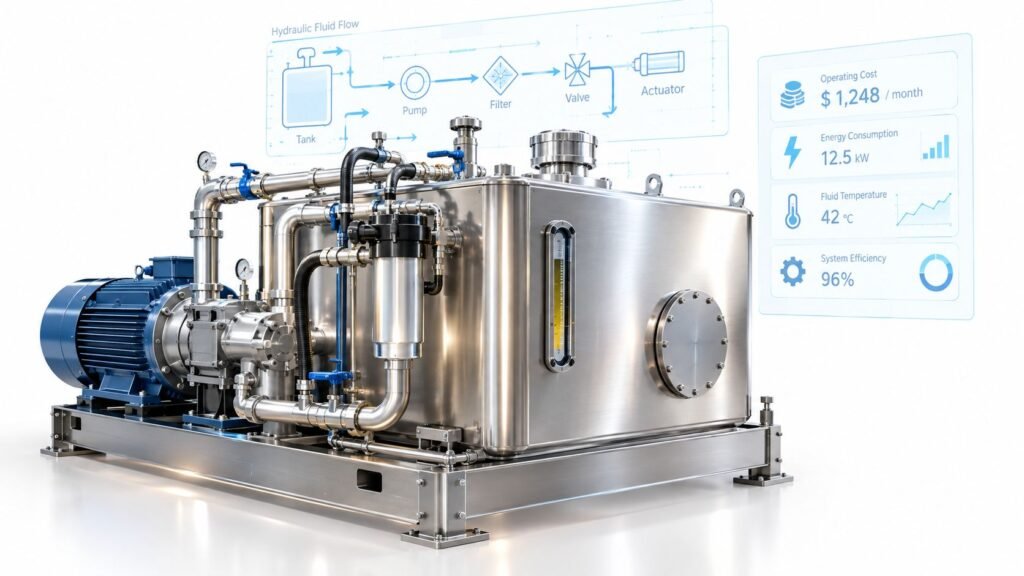
You're usually not shopping for a hydraulic elevator tank unit on a calm day. The call comes in because the elevator is slow to level, the machine room smells like hot oil, or someone spots fluid around the reservoir and starts asking whether this is a repair or a shutdown risk. At that point, most owners want one simple answer: what's this going to cost?
The trouble is that hydraulic elevator tank unit replacement rarely stays a simple parts question for long. A tank can look like a steel box with oil in it, but once you replace it, you may also trigger code review for venting, drainage, storage details, fluid-level marking, cleanup, testing, and recommissioning. That's why two buildings with what seems like the same elevator can end up with very different project scopes.
Older hydraulic systems have always carried this kind of decision pressure. Hydraulic elevators dominated from the late 1870s into the early 20th century, and Boston alone had 68 hydraulic elevators installed by 1901 to 1902 according to a historical hydraulic elevator timeline. Many of today's older units still reflect that design lineage. In New York, a later shift tells the other side of the story. By 1919, new service-pipe requests had fallen to zero, new installations were only two for the year, and elevators under water-department supervision had dropped to just above 510 from a high of 592 in 1904, which the record interprets as evidence that hydraulic units were being removed or converted in meaningful numbers, including a 14% decline in 15 years noted in this Smithsonian-linked historical record.
That history still matters because owners face the same basic question now. Keep patching an aging unit, replace the tank and power package, or step up to a broader modernization path. The right answer depends on condition, code exposure, environmental requirements, and how much downtime your building can tolerate.
Introduction to Hydraulic Elevator Tank Unit Replacement
A facility manager in a small medical office building notices the elevator has started stopping unevenly at the lobby. A week later, the service technician finds darkened oil, extra vibration at startup, and seepage around the tank area. Nobody in the building cares what the reservoir model number is. They care whether patients can use the elevator tomorrow, whether oil cleanup is coming next, and whether this job is going to stay contained or spread into a larger capital project.
That's the starting point for most tank unit conversations.
What owners are actually deciding
When people say “replace the tank unit,” they often mean the whole power unit package around the reservoir. That can include the tank, pump, motor, valve arrangement, piping connections, filtration or screening, and accessories needed to run the hydraulic elevator safely and consistently.
A replacement decision usually sits at the intersection of four concerns:
- Performance trouble: slow travel, rough stops, heat, noise, recurring leveling issues, or visible leaks
- Project cost: equipment, labor, oil handling, rigging, disposal, and restart work
- Code impact: whether the replacement is treated as an alteration rather than a maintenance swap
- Downtime risk: how long the elevator will be out of service and whether hidden issues appear once work starts
A leaking tank is rarely just a tank problem. It often tells you something about heat, contamination, aging seals, or a system that has outgrown its original setup.
Why this isn't a like-for-like swap
That's where many owners get caught off guard. You may expect a one-day mechanical exchange. Instead, the job may require review of venting, tank markings, drainage, pit conditions, environmental handling, and post-installation testing. If the machine room is tight or the old unit was undersized, a direct replacement may not even be the best fit.
This matters in every building type, from schools and municipal buildings to apartment properties and small commercial sites. It also matters across service areas in Michigan, where elevator needs range from busy urban properties in Detroit and Grand Rapids to lower-rise buildings in Lansing, Ann Arbor, East Lansing, Eaton Rapids, and surrounding towns.
The practical outcome
By the time you finish evaluating the job, you're not just pricing steel and oil. You're pricing certainty. You're deciding whether the next investment should buy a few more years of service calls or a cleaner operating path with fewer surprises.
How a Hydraulic Tank Unit Works and Why It Fails
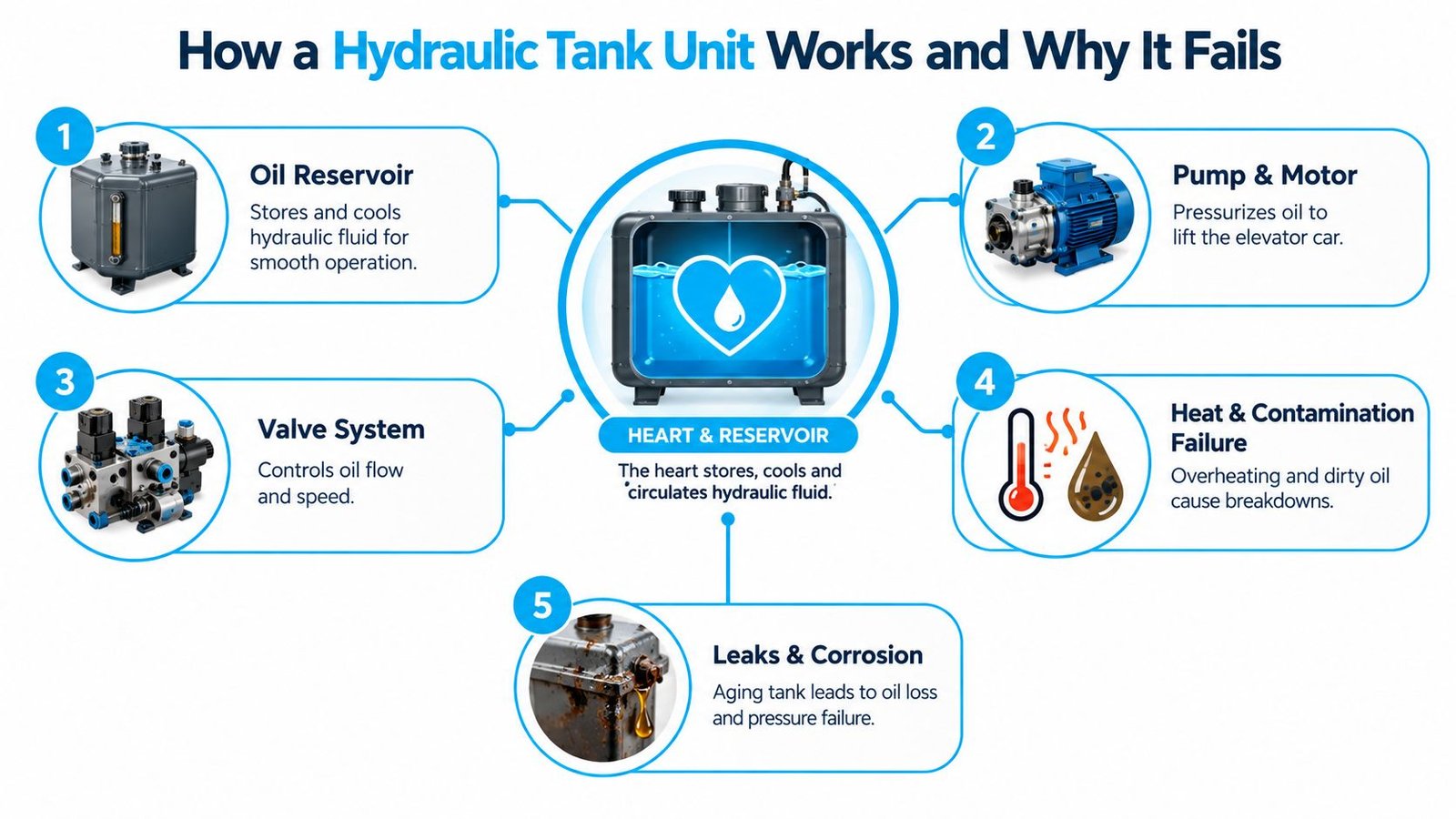
A hydraulic elevator tank unit works a lot like a heart paired with a reservoir. The reservoir stores and cools the oil. The pump and motor move that oil under pressure. The valve controls where the oil goes and how smoothly the elevator starts, runs, and stops. If one part gets out of balance, the whole ride changes.
The tank does more than hold oil
People often think the tank is passive. It isn't. A properly built replacement reservoir is typically welded steel, and practical specifications commonly call for a protected vent opening, a drain connection, suction-side filtration or screening, and reserve oil beyond what the lift itself needs, as outlined in the VA elevator specification for hydraulic systems.
That reserve matters because the tank needs room to:
- Store working oil: enough fluid to raise the car to the top landing
- Handle heat: more oil volume helps absorb and release heat
- Prevent suction problems: the pump needs a stable oil supply
- Control aeration: churned or foamy oil creates poor performance
Several practical specs call for tank capacity equal to the oil needed to raise the car to the top landing plus at least 10 gallons of reserve, and another rule of thumb sizes the tank at about 2.0 to 2.5 times pump output plus about 10% air cushion in the same VA hydraulic elevator guidance.
Why the system starts acting up
Most failures begin with a symptom owners can feel before they can name it. The elevator may run hotter, get noisier, level worse, or call for service more often.
Common failure paths include:
- Heat buildup: hot oil gets thinner and harder to control
- Aeration: air mixed into oil causes foaming, unstable flow, and noise
- Contamination: dirt, sludge, and worn material damage pump and valve components
- Seal wear: aging seals let oil leak internally or externally
- Corrosion and fatigue: old tanks and fittings don't improve with time
A unit that's too small for the building's traffic often runs hotter. A worn pump may add vibration. A badly vented or underfilled tank can churn oil. Those problems don't stay isolated for long.
For a deeper look at the full assembly, Crane's hydraulic elevator power unit overview is a useful visual reference for owners comparing tank-only concerns with full power-unit issues.
A short visual helps if you're trying to explain the system to a board or maintenance team:
One detail owners miss
One major code reference states that pressure-tank liquid level should be maintained at about two-thirds of tank capacity. That guidance matters because underfilled tanks can increase aeration and heat rise, while overfilled tanks reduce expansion space and can force fluid into the venting path, as discussed in the TSSA regulatory document on elevator alterations and tank requirements.
Practical rule: If the machine room shows heat, foam, vibration, and uneven leveling at the same time, don't treat them as separate annoyances. They usually point back to one stressed hydraulic circuit.
What Drives Purchase and Installation Costs
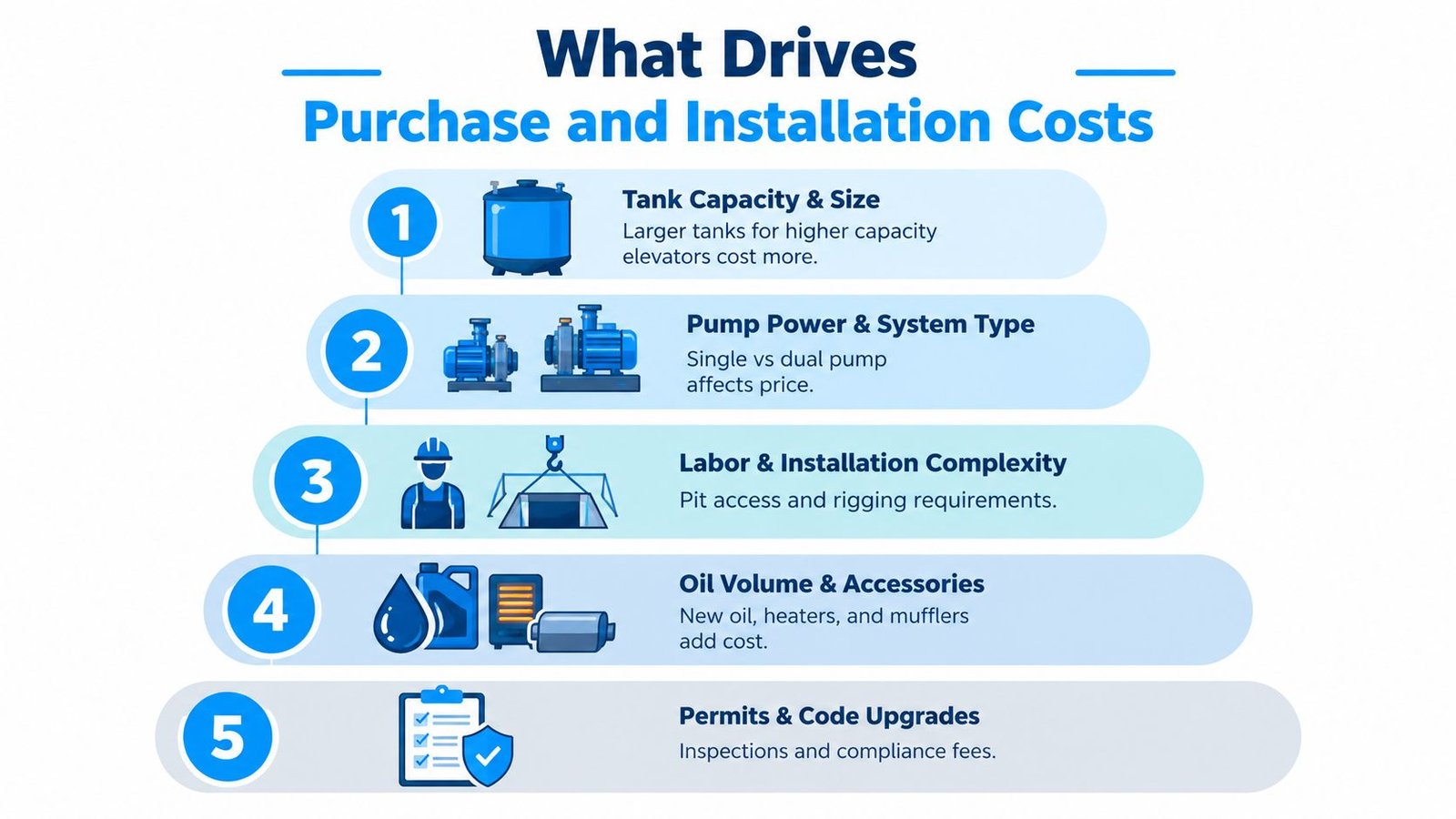
A tank unit replacement often starts with a simple expectation. Pull out the old reservoir, set in a new one, refill the oil, and turn the elevator back on. In practice, the price usually changes once the job is defined the way inspectors and mechanics see it. This is a system decision tied to code, containment, and return-to-service work, not just a steel tank on the floor.
Equipment size and oil volume
The first cost driver is sizing, but sizing is not only about whether the new tank fits in the machine room. It has to fit the hydraulic job the building asks it to do. A small apartment elevator with short travel places different demands on the oil reservoir than a busy medical office building that runs hard all day.
That matters because an exact copy of the old tank is not always the right answer. If the original unit was undersized, replacing it with the same capacity can preserve the same heat buildup, aeration, or service complaints. Owners sometimes hear “tank replacement” and assume they are buying a container. In reality, they may be buying a corrected operating setup.
Equipment costs often move with these choices:
- Tank capacity: more steel, more oil, and more space for fluid expansion
- Pump and motor matching: updated sizing may be needed if the building's traffic or usage has changed
- Valve package and accessories: gauges, mufflers, heaters, and coolers can expand the scope
- Filtration and screening: cleaner oil helps protect the pump and valve group
Removal and access can outweigh the tank price
Two buildings can buy the same replacement unit and end up with very different labor totals.
A clean, accessible machine room is the cheap version of this job. A cramped room with old piping, awkward doorways, stained floors, and no easy path for rigging is the expensive version. The tank may be the same in both places, but the hours are not.
Labor usually climbs when the crew has to handle:
- Tight machine room access
- Piping that does not align with current connection points
- Oil removal, storage, and disposal
- Rigging around occupied building operations
- Control rewiring, adjustment, and recommissioning
Building use also changes the schedule. In a school, senior living property, or medical building, downtime often has to be compressed into a narrower window. That can affect labor planning more than owners expect.
Code can expand the job scope
This is the cost category that changes early budgets the most. Once the work is classified as an alteration instead of routine maintenance, the replacement has to be reviewed as part of the full hydraulic arrangement. Owners then pay for more than equipment and labor. They may also pay for compliance work, documentation, testing, and machine-room corrections.
The practical effect is simple. The tank replacement can trigger questions about venting, markings, drainage, and other details that were ignored for years because the old unit was still sitting in place.
One widely used federal specification for hydraulic elevator power units shows how detailed those expectations can be, including requirements for tank construction, level indication, venting, and related fittings in new or replaced assemblies, as outlined in the VA elevator specification section for hydraulic equipment.
Environmental containment can change the true price
Hydraulic oil has to be controlled, not just stored. That point becomes expensive when a replacement project exposes an old machine room or pit condition that no longer passes review. The tank may be the reason the contractor came onsite, but spill handling and discharge protection can become part of the job.
A good building example is an older property with a pit sump that was never designed with oil contamination in mind. If the replacement raises questions about how an oil release would be contained or discharged, the owner may be pushed into added work outside the power unit itself. In some jurisdictions, rules on oil-bearing discharge and separator requirements make that issue explicit, as shown in the New York City administrative code on prohibited discharges and oil separation requirements.
That is why true replacement cost is often shaped by containment as much as by equipment.
Testing and return-to-service are part of the budget
The job is not finished when the new unit is bolted down and filled. The elevator has to be adjusted, checked for leaks, brought back to operating temperature, and tested under normal service conditions. In Michigan, owners should also view the project through the state's ongoing inspection and test cycle, because a replacement has to fit into the cadence that governs hydraulic equipment after installation. The State of Michigan elevator code page is a useful reference for current state requirements and adopted standards.
That affects downtime planning. It can also affect cost if extra visits, witness testing, or correction work are needed before the elevator returns to regular use.
A better way to compare quotes
A useful quote breaks the work into system pieces, not one lump sum. That makes it easier to see whether one proposal is cheaper because it is efficient, or cheaper because it leaves out code work, oil handling, or testing.
| Cost area | What to ask |
|---|---|
| Equipment | Is this tank-only, or a full power unit package? |
| Oil handling | Does the quote include removal, refill, cleanup, and disposal? |
| Code scope | Are venting, markings, drainage, or alteration requirements included? |
| Access labor | Is rigging or difficult machine room access priced in? |
| Restart work | Are testing, adjustment, and return-to-service steps included? |
That comparison gives owners a clearer picture of true cost. It also helps explain why the lowest number on paper can produce the longest downtime once code, containment, and testing enter the conversation.
Repair vs Replacement vs Modernization Economics
A building owner usually reaches this section of the decision after a familiar pattern. The elevator is put back in service, then the same complaint returns a few weeks or months later. Oil runs hot again. The ride gets noisy again. Leveling drifts again. At that point, the question is no longer whether a technician can fix one bad part. The question is whether the building is spending money on a failing system shape.
That matters more with a hydraulic tank unit than many owners expect. Replacing a tank unit is not just a parts swap. It can pull in containment, altered equipment sizing, restart testing, and project scheduling around state oversight. In other words, the economics change because the job can trigger system decisions, not just repair labor.
When repair still makes sense
Repair is still the right answer when the problem has a clear boundary.
If a coupling failed, a contactor dropped out, or one valve issue can be corrected while the tank, pump, motor, and oil condition are otherwise steady, a targeted repair may buy useful time at a sensible cost. A small apartment building with light use often fits this category better than a busy medical office or municipal building, because the cost of an unexpected shutdown is lower.
Repair usually makes sense when:
- The symptom appeared recently
- One failed component explains the problem
- Replacement parts are still practical to get
- The rest of the power unit is not showing age in several places at once
A good repair decision depends on honesty about condition. If the tank is corroded, the oil is repeatedly overheating, and the motor and pump are both showing wear, a low repair bill can act like patching one rotten board in a wet floor.
When replacement starts winning
Replacement starts to make financial sense when the power unit is wearing out as a group. That is common in older hydraulic systems. One component gets repaired, but the next weak point is already close behind.
Owners often see this in a sequence. First comes a noise complaint. Then heat. Then erratic leveling or slow performance. Then another call because the previous fix did not fully solve the ride issue. Each visit may be defensible on its own, but the total starts looking like installment payments on a replacement that has not happened yet.
This is also the point where code and environmental scope can change the math. If the existing arrangement no longer makes sense for current containment expectations, access limitations, or restart requirements, the project cost is shaped by those added obligations. A tank unit replacement can still be the best choice, but it should be priced and judged as a system event.
Replacement versus modernization
Tank unit replacement sits between a repair and a larger capital project. It is often the practical middle path when the controller, jack, and other major parts still support continued service, but the power unit has become the weak link.
Modernization becomes more attractive when the power unit problem is only one piece of a larger aging picture. If the building is already dealing with control obsolescence, poor ride quality, recurring shutdowns, or hard-to-find parts across multiple systems, owners should compare the tank unit quote with a broader hydraulic elevator modernization approach. A larger project can cost more up front and still produce a better long-term result if it removes several failure points at once.
A simple way to frame it is this. Repair tries to correct one problem. Replacement resets the hydraulic heart of the system. Modernization resets the future service plan of the elevator.
Repair vs Tank Unit Replacement vs Modernization Decision Matrix
| Option | Best When | Upfront Cost | Downtime and Compliance Impact |
|---|---|---|---|
| Repair | One fault is isolated and the rest of the unit is stable | Lower | Usually shorter downtime, but repeated service calls can continue and older compliance concerns may still remain |
| Tank Unit Replacement | Tank, pump, motor, or valve condition is declining together, but the rest of the elevator still supports continued investment | Moderate | Planned shutdown, recommissioning, and possible alteration-related code scope can enter the job |
| Modernization | Multiple systems are aging, support is getting harder, or the building wants a longer service horizon with fewer repeat failures | Higher | Broader project coordination, but often a cleaner path for long-term reliability, compliance, and maintenance planning |
Repeated repairs have a hidden price. Tenants lose confidence. Staff spend time managing outages. Emergency calls tend to happen at the worst time, not the most convenient one.
A simple decision filter
When boards and property managers feel stuck, four questions usually bring the decision back into focus:
- Are we fixing the same symptom again, or watching it change form? Either pattern can point to a larger power unit problem.
- Is the unit aging as a package? A worn tank, tired pump, and hot-running motor rarely become dependable because one piece was changed.
- Will this project trigger code-related work anyway? If the answer is yes, compare the full replacement scope against a modernization path before approving the smaller job.
- What does downtime cost this building in real terms? A senior housing property, courthouse, or medical building usually pays a higher price for uncertainty than a lightly used warehouse office.
That last question is the one owners skip most often. The invoice shows the repair cost. It does not show resident complaints, staff time, delayed access, or the pressure of trying to schedule another outage under Michigan's inspection and testing rhythm.
Good decisions in this part of the process come from treating the tank unit as part of the building's operating risk, not just its equipment list.
Operating Costs Maintenance and Code Compliance After Replacement
A building replaces a hydraulic tank unit on Friday, then expects Monday to feel like the end of the problem. In practice, Monday is the start of a different phase. The equipment may be new, but the building now has to live with the operating habits, testing schedule, and containment rules that come with that replacement.
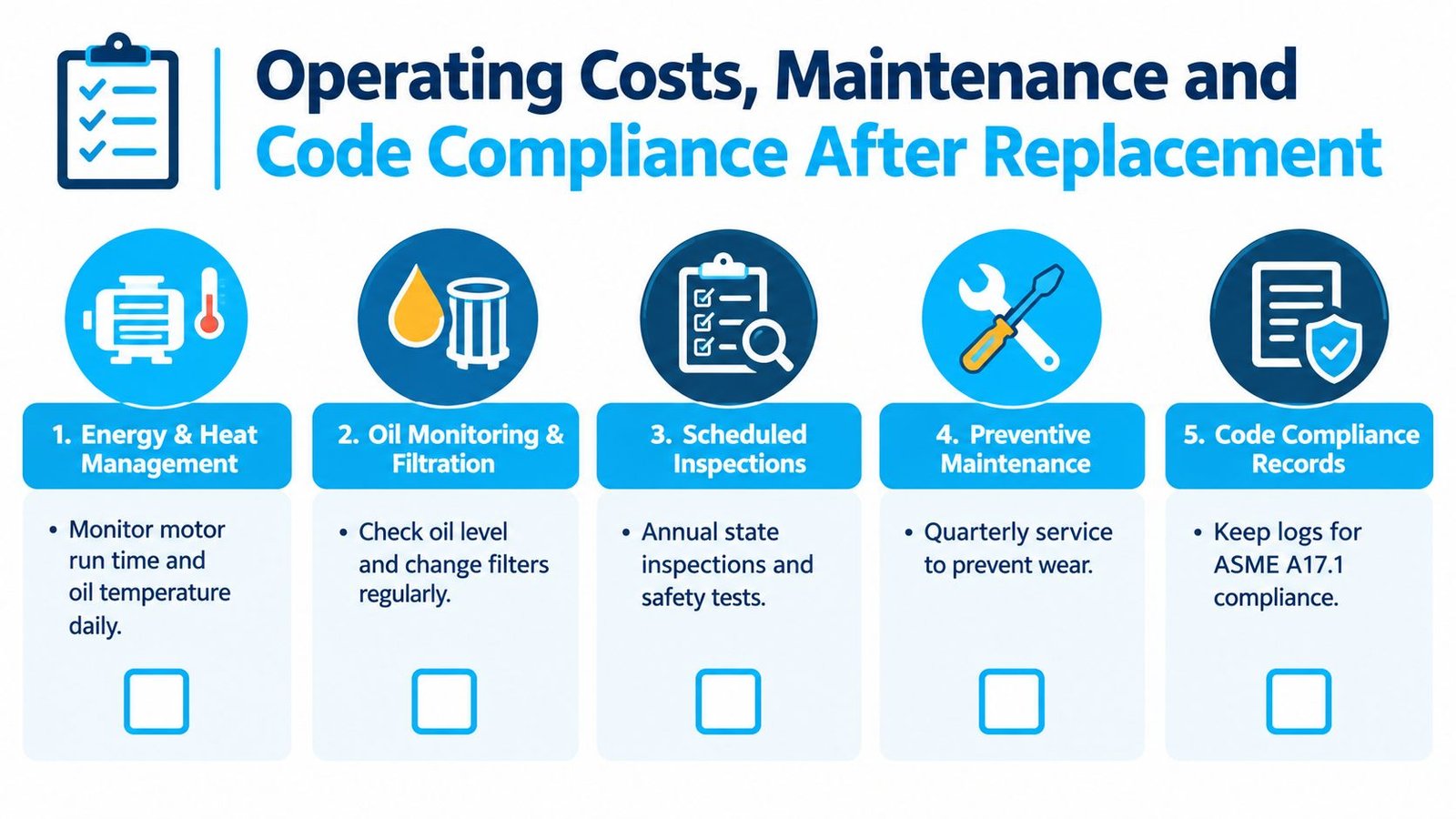
A hydraulic power unit works a lot like a heart, a fluid reservoir, and a cooling tank in one package. If the replacement was sized well and installed with the whole system in mind, day-to-day costs usually stay predictable. If the tank was treated as a simple metal container swap, the building can inherit new problems that show up as heat, noisy operation, contaminated oil, or repeat service calls.
Operating cost starts with heat and oil condition
Heat is one of the first things a manager notices after replacement, even if no one measures it with an instrument at first. The machine room feels warmer. The elevator may level a little differently in the afternoon than it does in the morning. Oil ages faster under those conditions, seals harden sooner, and technicians spend more time making small corrections.
Tank sizing affects all of that. A reservoir needs room for the oil to settle, release air, and shed heat between trips. If that space is too tight, the unit can still run, but it often runs harder than it should. That raises ownership cost in a quiet way through more frequent oil attention, more valve adjustment, and more troubleshooting time.
The same goes for oil cleanliness.
Dirty oil does not always announce itself with a shutdown. It often shows up first as rough starts, valve trouble, or a car that no longer feels as steady as it did right after the project was finished.
Maintenance after replacement should stay simple and consistent
Good post-replacement maintenance is not fancy. It is disciplined. The goal is to catch drift early, before a small symptom becomes another outage.
A useful routine usually includes:
- Checking oil level and oil condition. Low oil can pull air into the system. Dark, burnt, or foamy oil points to heat or contamination problems.
- Inspecting filters, screens, and strainers. Fine debris can score pumps and interfere with valve performance long before the elevator stops.
- Watching machine room temperature and cleanliness. A clean room makes new leaks easier to spot and helps separate old residue from an active problem.
- Tracking ride changes. Slower runs, harder starts, chatter, and leveling drift are early warning signs, not quirks to ignore.
- Reviewing records after each visit. A pattern matters more than any single service note.
That last point gets missed often. A stack of work tickets is not the same thing as a usable history. Owners make better decisions when the log says what changed, how often it changed, and under what conditions it showed up.
Code compliance after replacement is part of ownership cost
A new tank unit does not sit outside the code framework. Replacement can place more attention on the rest of the hydraulic system, especially where testing, recordkeeping, and oil containment are concerned.
In Detroit, post-replacement planning should account for the city's required maintenance and test rhythm. The local ordinance calls for periodic servicing and testing, including quarterly servicing for many covered elevators, a 30-day test related to monitoring hydraulic cylinders for corrosion and underground conditions, and testing of hydraulic cylinders and relief valves at acceptance and at least once every 30 months, according to the Detroit elevator inspection and testing ordinance.
That cadence affects more than paperwork. It shapes labor planning, shutdown timing, and how quickly a small hydraulic issue turns into a compliance issue if records are incomplete or follow-up work gets delayed.
Containment can change the real cost after the install
Owners sometimes budget for the tank unit and the installation, then learn later that the room or pit still needs attention. That is why replacement should be viewed as a system decision. Oil has to be managed not only inside the reservoir, but also in the places it could go if a leak develops or maintenance work goes wrong.
Older buildings are the usual trouble spot. A machine room may have poor housekeeping conditions, an aging floor surface, or a sump arrangement that was never designed around current expectations for oil-bearing discharge. The U.S. Environmental Protection Agency guidance on used oil management gives the broader framework for storage, handling, and release prevention that owners should keep in mind when hydraulic oil is part of the equipment picture.
That does not mean every replacement triggers major environmental construction. It does mean the replacement should prompt a hard look at containment, disposal practices, and whether the building is set up to handle a leak without creating a second problem.
What success looks like after the project
A stable hydraulic unit usually feels uneventful, and that is exactly the goal.
Look for:
- Steady leveling floor to floor
- Predictable starts and stops
- No rising machine-room heat trend
- No recurring foam, chatter, or vibration
- Service records that clearly document maintenance and required tests
If those signs are present, the replacement is doing what it should. It is not just running. It is fitting the building's code duties, maintenance rhythm, and operating budget the way a properly planned hydraulic system should.
Planning Your Project in Michigan and Ohio with Crane Elevator
A good hydraulic elevator tank unit project starts before the first wrench turns. The work begins with scoping. You need to know whether you're replacing a reservoir, replacing a full power unit, solving a heat problem, correcting a leak path, or walking into a code-triggered alteration that reaches beyond the machine room.
Regional coverage matters when downtime matters
For owners in Michigan, local reach changes response time and project planning. The state's largest population centers in this source set include Detroit at 645,705, Grand Rapids at 200,117, Ann Arbor at 122,925, and Lansing at 114,336, based on Michigan city population listings. The surrounding metros are much larger, with the Detroit-Warren-Dearborn metro at 4,351,387, Grand Rapids-Wyoming-Kentwood at 1,172,771, Lansing-East Lansing at 471,165, and Ann Arbor at 368,553, according to Michigan metro-area listings.
That's why service coverage can't stop at city limits. Buildings in East Lansing, Eaton Rapids, and other nearby communities still need practical access to maintenance, repairs, inspections, modernization, and emergency response. A neutral Michigan places list also identifies towns such as East Lansing and Eaton Rapids, which reflects the kind of surrounding-area service footprint many elevator owners depend on.

What to line up before quoting
Before you ask for final numbers, gather the details that shape scope:
- Current symptoms: leaks, noise, heat, slow travel, rough leveling
- Building constraints: access, occupancy, shutdown windows, sensitive tenants
- Known code issues: open violations, test scheduling, drainage concerns
- Service history: repeated repairs often reveal whether replacement is overdue
In this region, owners also tend to need more than one type of work from the same provider. That can include preventative maintenance, repairs, code-required inspections, tank and power unit replacement, jack work, controller updates, full modernization, residential elevator service, wheelchair lifts, material lifts, dumbwaiters, and support for older non-proprietary equipment.
One practical local option
For buildings in Michigan and Ohio, Crane Elevator's Michigan elevator service area outlines coverage built around Detroit, Lansing, Ann Arbor, Grand Rapids, and surrounding communities. The company also handles every type of elevator service across commercial, municipal, residential, and specialty vertical transportation equipment, which matters when a tank replacement turns out to touch more than one system decision.
Financing and scheduling matter more than owners expect
A well-planned project doesn't just solve the mechanical issue. It also reduces operational disruption. Financing can make that easier when the building wants to fix the problem now rather than stretch repairs over multiple shutdowns. A site review, a second opinion, and a detailed quote that separates mechanical replacement from code-related add-ons usually prevent the worst surprise in this kind of job, which is discovering mid-project that the “simple swap” was never simple.
For Michigan and Ohio owners, the smartest plan is usually the one that ties together scope, compliance, downtime strategy, and future service support before the old unit fails completely.
Making a Confident Replacement Decision
A hydraulic elevator tank unit is the system's working reservoir. If it's too worn, too hot, too contaminated, or no longer sized for the building, the rest of the elevator starts telling on it. You see that in leveling drift, vibration, leaks, slow travel, service callbacks, and machine-room heat that keeps returning.
The biggest mistake owners make is treating replacement like a parts purchase. It's a system decision. The tank has to be sized correctly. The venting and oil level details have to be right. The disposal and containment side has to be addressed. The building also has to understand whether the work will be treated as an alteration and what that means for schedule and budget.
A short checklist helps before you sign a proposal:
- Does the quote clearly separate tank-only work from full power-unit replacement?
- Has the contractor addressed oil handling, disposal, and cleanup?
- Are code-triggered items such as venting, markings, or drainage included or excluded in writing?
- Has someone reviewed whether pit or sump conditions create environmental scope?
- Is the building choosing between repair, replacement, and modernization with the long term in mind, not just the next breakdown?
If the answers are clear, the decision usually gets easier. If they're vague, the quote probably is too.
The best replacement projects feel uneventful once they're done. The elevator runs predictably. The machine room stays cleaner. The service log calms down. That's the result owners should be buying.
If your hydraulic elevator is showing heat, leaks, rough leveling, or repeat power-unit trouble, Crane can help you sort out whether you need repair, tank unit replacement, or a broader modernization path. Crane Elevator Company provides maintenance, inspections, repairs, and non-proprietary upgrades across Michigan and Ohio, and you can learn more or request a review at Crane Elevator Company.