
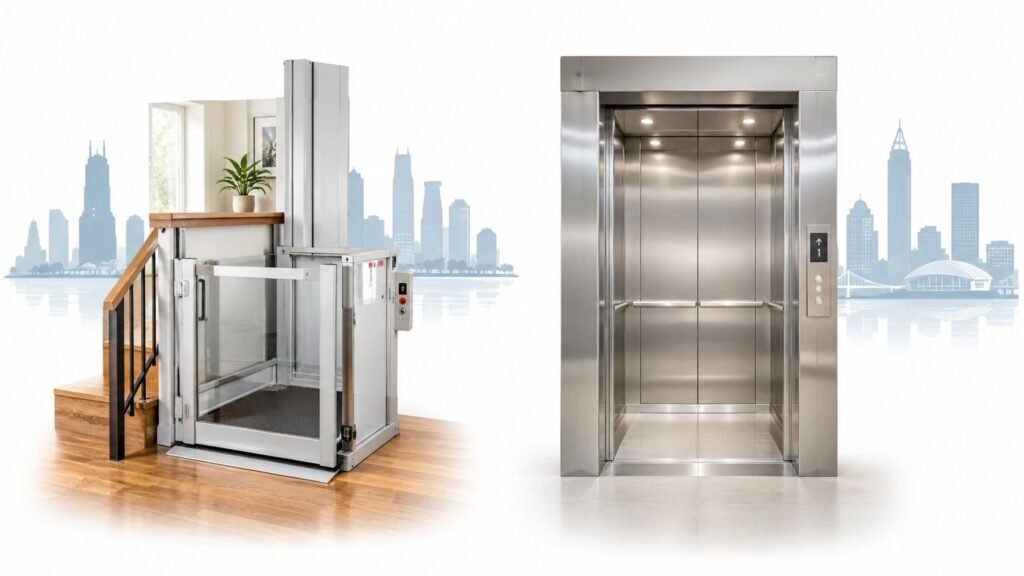
A property manager in Lansing searches for "commercial lift installation," copies the phrase into a renovation specification, and assumes the contractor will understand the requirement. The first proposal comes back for a platform lift. The building requires a passenger elevator, the accessible route remains unresolved, and the permit package must be revised.
That mistake isn't caused by carelessness. Lift and elevator usually mean the same vertical-transport machine in ordinary language. North American specifications normally use “elevator,” while British and much Commonwealth English generally use “lift.” Canada is a notable exception, where “elevator” is also common. The difference is geographic language, not a different operating principle or capacity category, as summarized in this overview of elevator terminology.
In Michigan and Ohio, the useful question isn't “Which word is correct?” It's Which device, under which code, serves which building use? A passenger elevator, freight elevator, LULA elevator, wheelchair lift, vertical platform lift, material lift, dumbwaiter, and private-residence elevator may all be casually called a lift. They don't have the same legal classification, loading expectations, accessibility function, or maintenance requirements.
Why the Question Matters More Than the Vocabulary
The label becomes expensive when it controls the specification. An owner who requests a “lift” without identifying the equipment class may receive a device that moves vertically but doesn't provide the required accessible route, accommodate the intended load, or satisfy the authority having jurisdiction. The resulting problem can appear as a permit correction, an inspection failure, a blocked route, or an installation that occupants can't use independently.
The first step is to describe the job without using either word:
- Identify the users. Tenants, patients, students, residents, workers, wheelchair users, visitors, or materials may need different equipment.
- Describe the route. State the floors, entrances, landings, travel path, and whether users must remain in a wheelchair.
- Define the load. A passenger car, pallet, vehicle, maintenance cart, wheelchair, or meal tray creates a different duty cycle.
- Name the jurisdiction. Michigan and Ohio authorities enforce adopted code editions and permit requirements. The contract should identify those editions instead of relying on a casual product name.
- Set the service expectation. A low-rise residence and a busy medical clinic shouldn't be evaluated with the same traffic assumptions.
Practical rule: Put the equipment classification, rated load, travel, door arrangement, applicable code, and intended users in the request for proposal. Use “lift” or “elevator” only as a secondary description.
That approach matters to a facility manager in Detroit, a school district in Perrysburg, an HOA in Ann Arbor, and a homeowner in Toledo for the same reason. The word starts the conversation, but code and use case finish it. This guide treats passenger, freight, residential, accessibility, and material equipment as separate decisions, even when a salesperson or drawing uses “lift” as shorthand.
Where the Two Words Come From
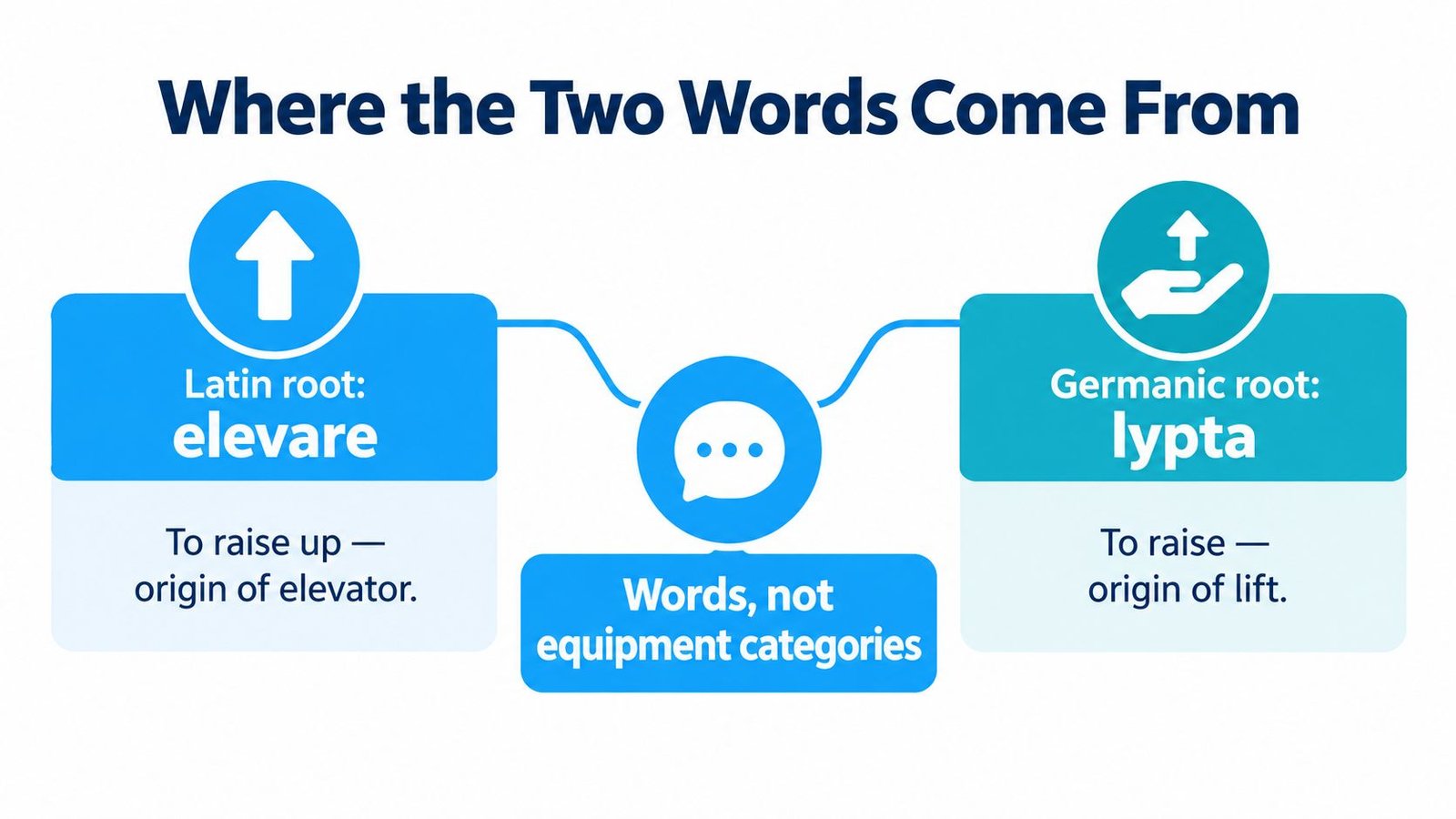
The words themselves explain the confusion. Elevator comes from the Latin elevare, meaning “to raise.” Lift is associated with the older Germanic and Norse verb lypta, also meaning “to raise.” Neither root identifies a passenger car, a freight car, a wheelchair platform, or a residential unit. They describe the action.
The technology is much older than modern building terminology. Roman architect Vitruvius described a lifting device associated with Archimedes, who lived approximately from 287 to 212 BC. Modern passenger transportation arrived much later, as industrialization and multistory buildings created a commercial reason to move people safely between floors.
The safety problem came before the vocabulary settled. In 1853, Elisha Graves Otis established the Otis Elevator Company and developed a safety brake intended to stop a platform if its lifting rope failed. He demonstrated the principle publicly in 1854 at New York's Crystal Palace by standing on a raised platform while its supporting rope was cut. The safety mechanism prevented the platform from falling, addressing the central danger that had limited early lifting equipment to freight work.
The first Otis passenger elevator was installed on March 23, 1857, at the Haughwout Department Store in New York City. It used a steam engine and traveled at about 40 feet per minute, according to this Smithsonian account of the first passenger elevator. American usage developed around “elevator,” while British usage established “lift” for a passenger or goods car.
Technical documents remove much of the ambiguity. ISO/TR 11071-2 says the CEN term “lift” corresponds to the ASME and CSA term “elevator,” and treats the terms as interchangeable, as shown in the ISO terminology reference. A Michigan or Ohio procurement package can use either word, provided it also identifies the equipment class and governing requirements.
What Codes Govern Elevators Versus Lifts
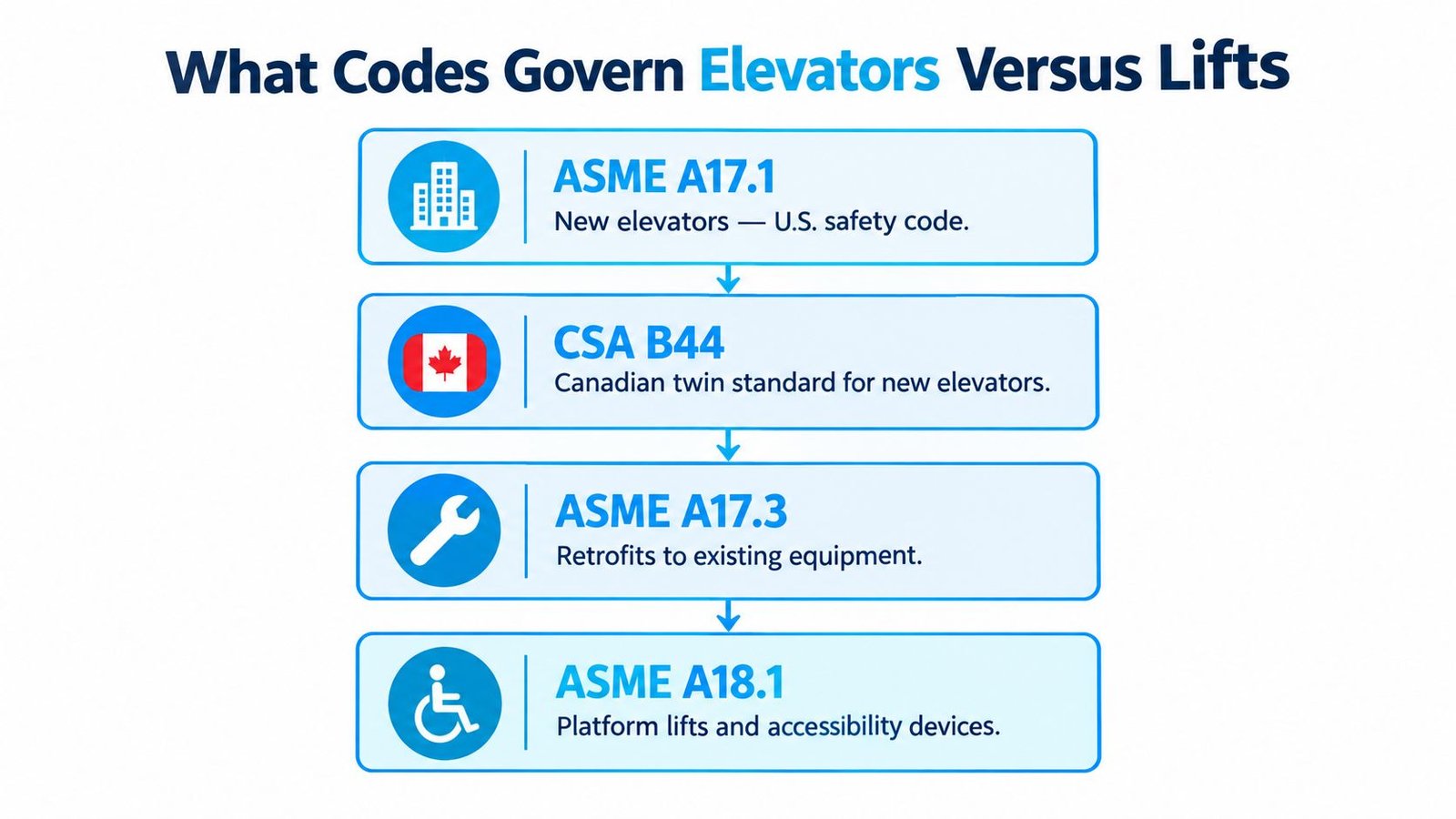
A contractor doesn't select the governing code from the name on the owner's email. The device's design, purpose, location, and use determine the code path. In broad terms, ASME A17.1/CSA B44 governs conventional elevators and related equipment, while ASME A18.1 applies to platform lifts and stairway chairlifts. That boundary affects engineering, permits, testing, inspection, and the equipment allowed to serve an accessible route.
ASME A17.1 covers passenger, freight, private-residence, and other elevator categories. Existing equipment and modernization work may also involve ASME A17.3, which addresses safety requirements for existing elevators and escalators. The exact edition adopted by the state or local authority matters. Michigan adopted the 2015 edition of A17.3 on June 27, 2023, so a modernization team should confirm the current Michigan Administrative Code and the authority's interpretation before finalizing drawings.
A U.S. specification that says “wheelchair lift” may point to an A18.1 vertical platform lift, an inclined platform lift, or another accessibility device. It shouldn't be assumed to mean an A17.1 passenger elevator. Conversely, calling a conventional elevator a “lift” doesn't move it into the A18.1 category. The technical classification controls.
For owners preparing a permit package, the elevator code requirements guide is a useful starting point, but it shouldn't replace confirmation with the applicable state and local officials. Ask the design team for these items before approving a proposal:
- Code edition: Identify the adopted edition of each applicable elevator, accessibility, building, and electrical standard.
- Equipment class: State whether the unit is passenger, freight, LULA, private-residence, platform, stairway chairlift, material, or another category.
- Rated load and speed: Specify the intended capacity and operating characteristics.
- Travel and doors: Document vertical travel, number of stops, entrance arrangement, landing doors, and clear openings.
- Inspection and testing: List acceptance tests, periodic tests, emergency communication checks, fire-service operation, and the responsible inspection authority.
ISO/TR 11071-2 reinforces the practical point: “lift” and “elevator” are interchangeable terms in the standards context, while the equipment details determine what gets designed and inspected. A contractor who cannot identify the code edition and device class hasn't provided a complete technical proposal.
Matching Equipment Type to Building Use
The same word can describe equipment with completely different jobs. A traction passenger elevator suits a multistory office with recurring tenant traffic. A hydraulic passenger elevator may fit a low-rise building where speed and high throughput are less demanding. A freight elevator is built around loading, impact, duty cycle, and protection of the car and hoistway, not just around moving people comfortably.
A Detroit industrial renovation may need a freight unit for palletized material and vehicle loading. An Ann Arbor office with limited travel and restricted shaft space may be a candidate for a LULA elevator. An existing Kalamazoo church with a difficult foundation or historic interior may need a vertical platform lift instead of a conventional passenger elevator, subject to the accessible-route and permit analysis.
Equipment classes at a glance
| Equipment Class | Governing Code | Typical Travel | Rated Load | Best-Fit Occupancy |
|---|---|---|---|---|
| Traction passenger elevator | ASME A17.1 | Multistory commercial travel | Passenger loads specified by design | Offices, apartments, hotels, healthcare |
| Hydraulic passenger elevator | ASME A17.1 | Low-rise to moderate building travel | Passenger loads specified by design | Small commercial buildings and residences |
| Freight elevator | ASME A17.1 | Industrial and commercial floor travel | Heavy goods and equipment loads | Warehouses, factories, service areas |
| LULA elevator | Applicable elevator requirements and local code | Limited low-rise travel | Limited passenger and mobility-device loads | Small offices, schools, churches |
| Vertical platform lift | ASME A18.1 | Short vertical accessibility routes | Wheelchair and occupant load | Existing entrances and level changes |
| Inclined platform lift | ASME A18.1 | Along a stair or inclined route | Wheelchair and occupant load | Buildings with stair-based constraints |
| Stairway chairlift | ASME A18.1 | Along a stair | Seated passenger only | Users who can transfer from a wheelchair |
| Material lift | Applicable equipment and building requirements | Service-level travel | Materials, not general passenger traffic | Retail, storage, production areas |
| Dumbwaiter | Applicable dumbwaiter requirements | Service-level travel | Small goods and food service items | Restaurants, homes, institutions |
| Private-residence elevator | ASME A17.1 category and local requirements | Home floor-to-floor travel | Residential passenger and mobility needs | Single-family homes and private residences |
“Typical travel” and “rated load” in this table are selection categories, not universal product specifications. The manufacturer, engineer, and authority having jurisdiction must confirm the actual configuration. A contractor should also distinguish a freight elevator from a material lift. If people need routine access, a material-only device isn't an acceptable substitute merely because it reaches the right floor.
Traffic performance deserves its own analysis. A vertical-transportation study defines interval as the time between successive car arrivals at a floor and handling capacity as the percentage of the assigned building population transported during a five-minute period. For destination-control projects, the study calls for simulation showing average waiting time at or below 80% of the nominated interval, as documented in this vertical transportation guidance.
Use those metrics when comparing cars, controls, or modernization options. Door dwell time, dispatch logic, car capacity, floor population, and the number of cars may affect service more than whether the owner calls the equipment a lift or an elevator. A practical guide to different types of lifts can help organize the initial list, but the final choice should come from the building's load and traffic profile.
Accessibility and ADA Rules for Lifts and Elevators
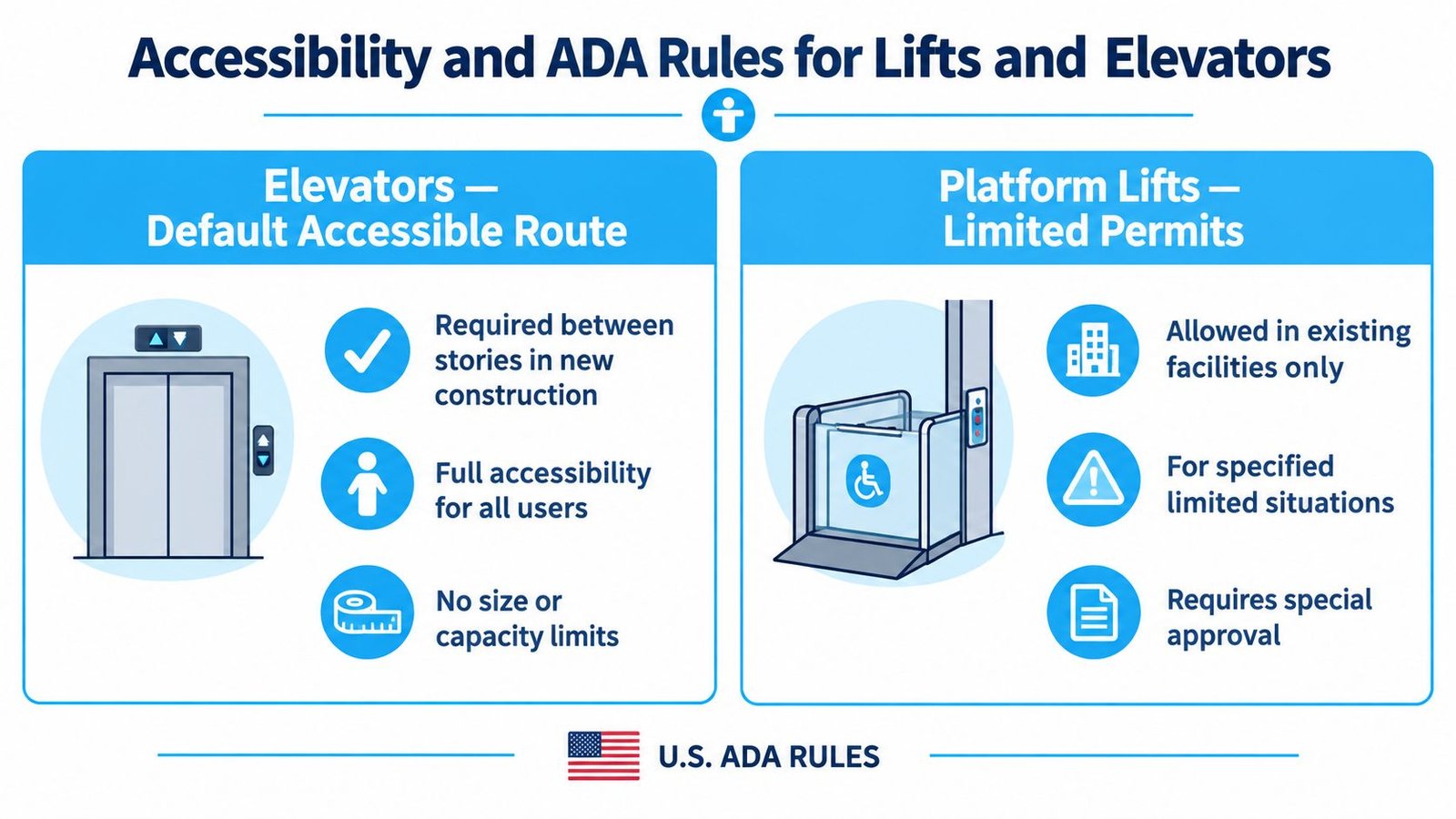
Accessibility is where casual vocabulary causes the most trouble. Under the U.S. Access Board's guidance, elevators are the typical accessible route between stories. Platform lifts may be permitted in specified existing facilities and limited situations, but the exception isn't a general invitation to replace every elevator with a smaller device. The owner must establish that the selected equipment creates the required route and satisfies the applicable building and accessibility rules.
A platform lift and a stairway chairlift aren't interchangeable. The Access Board states that a stairway chairlift isn't permitted where ADA standards require a platform lift, in part because a chairlift requires the user to transfer from a wheeled mobility device. That distinction matters in a Michigan school, an Ohio clinic, and a municipal building where visitors may arrive with different mobility devices and no attendant.
Questions to answer before substituting a platform lift
- Can the user enter and exit independently? Check the platform, gates, landing clearances, controls, and door operation as one complete route.
- Does the route work for the mobility device? Measure the occupied wheelchair, turning areas, approach, and destination, not just the platform.
- Does the route support standing users too? California guidance identifies an accessible route clearance requirement of 80 inches vertically, so a configuration that works for one user group may not suit both wheelchair users and standing users.
- Is this new construction or an alteration? Existing-building exceptions don't automatically apply to a new project, and an alteration may trigger permit, inspection, and route obligations.
- What happens during a failure? Consider emergency communication, entrapment response, backup arrangements, and the consequences of taking the only accessible route out of service.
Michigan Administrative Code requirements, adopted elevator standards, ADA provisions, and local building rules can intersect. The equipment may comply with ASME A18.1 and still fail to provide the route the building needs. Conversely, an A17.1 elevator may be technically suitable but impossible to install without resolving shaft, pit, overhead, structural, or fire-separation conditions.
Wheelchair lift: It may reduce construction impact and fit an existing building where a conventional elevator isn't practical, but it can impose platform, route, clearance, and operational limits.
Elevator: It generally offers broader long-term adaptability and a more complete passenger route, but it can demand more space, construction, and coordination.
The ADA elevator requirements guide can help an owner frame the questions, but the design team still needs to verify the specific project with the authority having jurisdiction.
Real-World Scenarios Across Michigan and Ohio
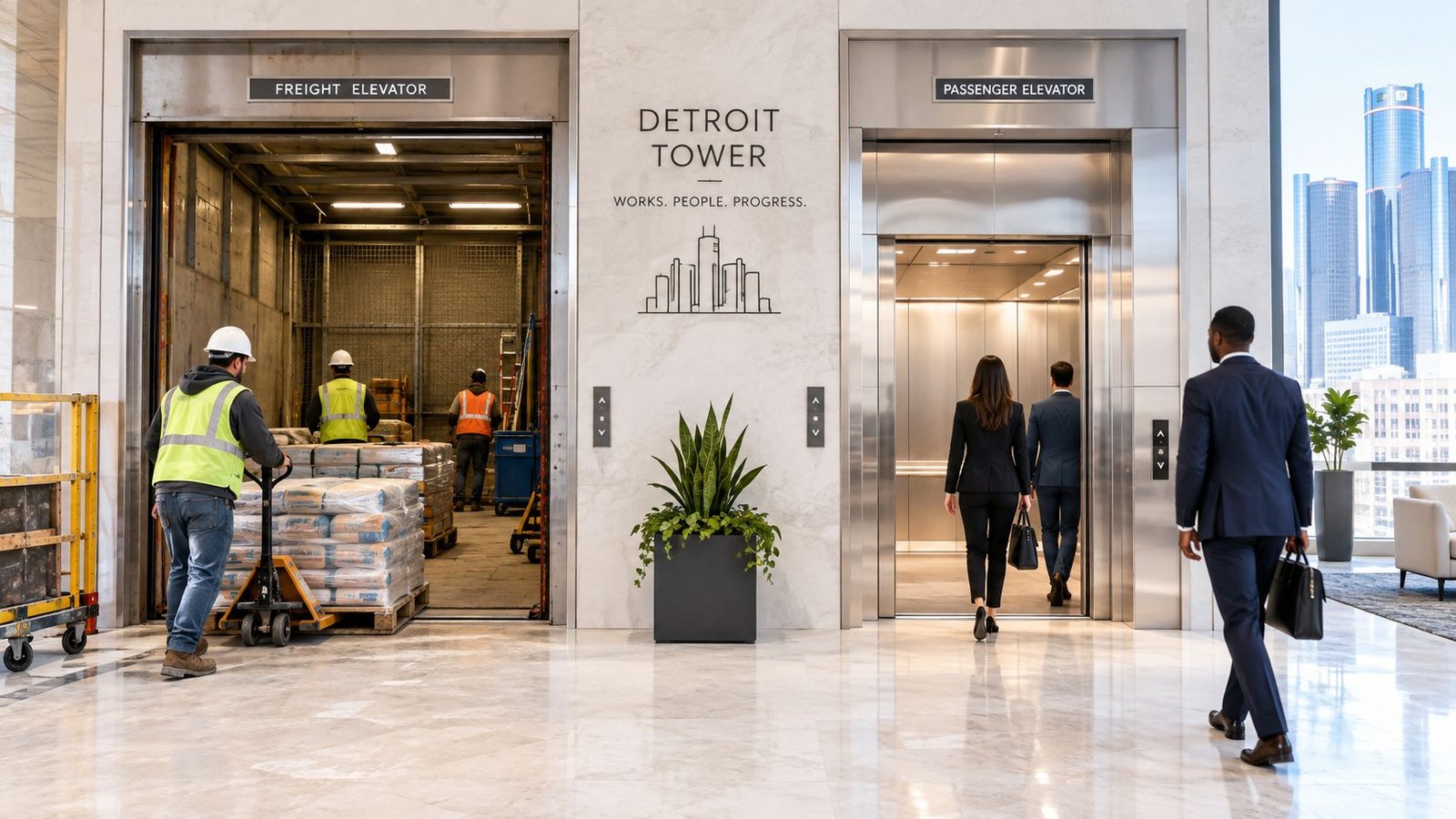
A Detroit office tower rarely has one vertical-transportation problem. During a renovation, the freight elevator may handle Class B loading while a separate passenger elevator serves tenants, visitors, and staff. The freight car needs the right loading method, protection, duty cycle, and scheduling. The passenger car needs reliable access and traffic performance. Calling both devices “lifts” hides the issue rather than solving it.
In Toledo, a homeowner caring for a parent may compare a private-residence elevator with a stairlift. If the parent can transfer safely to a seat and only needs stair travel, a stairlift may address the immediate barrier. If the parent must remain in a wheelchair or needs dependable access across multiple floors, a residential elevator may provide a more complete route. The decision turns on the person's mobility, the home's layout, and future use, not on whether a dealer calls the device a lift.
A Perrysburg school with a raised auditorium faces a different choice. A LULA elevator may offer a more integrated route where the school expects recurring users and has a suitable shaft location. A vertical platform lift may fit an existing building with severe structural or historic constraints. The school still has to verify independent operation, landing access, emergency features, permits, and whether the route serves the auditorium as a usable destination.
An Ann Arbor healthcare clinic adding equipment at an existing entrance has even less room for a casual substitution. A vertical platform lift may resolve a short entrance elevation change, but the clinic should examine weather exposure, patient mobility devices, staff assistance, outage procedures, and future remodeling. A device that works for today's entrance can become a bottleneck if the clinic expands services or changes the route.
New York City guidance draws the user distinction clearly: a platform lift transports a wheelchair and its occupant, while a stairlift transports only the passenger, not the wheelchair or mobility scooter, as explained in this platform-lift and elevator guidance.
Across these projects, the answer is consistent. The right number of devices and the right device type come from the use case, route, load, and code. Vocabulary never makes that decision.
Choosing and Maintaining the Right Device Over Its Lifetime
Installation is only the first decision. A lift, elevator, platform lift, freight car, or residential unit may remain in service for decades, and the cost of ownership depends heavily on maintenance access, parts availability, inspection readiness, and the contractor's ability to service the equipment after the warranty period.
Owners should ask how the service plan handles more than a callback. It should address preventive visits, door equipment, hydraulic systems, machine rooms, pits, car tops, emergency phones, fire-service operation, generator testing, safety tests, and violation corrections. A modernization proposal should identify whether replacement parts and controls are proprietary, whether another qualified provider can maintain the system, and which existing components can remain safely in service.
Crane Elevator Company is one Michigan and Ohio contractor that provides preventive maintenance, repairs, code-required inspections, and non-proprietary modernization for elevators and lifts, including hydraulic and traction elevators, wheelchair lifts, residential elevators, dumbwaiters, and material lifts. Its stated maintenance program includes a No Show, No Pay policy, machine-room, pit, and car-top clean-downs, and COP/PI bulb replacements.
Give the contractor a completion checklist
- Confirm the classification: The installed device matches the approved passenger, freight, residential, platform, or material specification.
- Verify testing: Required acceptance, safety, door, emergency communication, and fire-service tests are documented.
- Check the route: Every landing, threshold, gate, control, clearance, and destination works for the intended users.
- Review service access: The owner receives maintenance instructions, emergency contacts, test records, and a parts strategy.
- Record violations: Open corrections have an assigned party, a completion date, and confirmation from the inspection authority.
- Plan modernization: The owner understands which components are approaching obsolescence and whether a non-proprietary replacement is available.
The most reliable selection is the device that matches the building's service level and remains maintainable, not the device whose label sounds familiar. A low-traffic residence, a busy healthcare facility, a freight-intensive factory, and an existing church may all need vertical transportation, but they don't need the same machine or the same maintenance program.
Crane Elevator Company evaluates, maintains, repairs, inspects, and modernizes elevators and lifts across Michigan and Ohio, including passenger, freight, residential, wheelchair, material, and dumbwaiter equipment. Visit Crane Elevator Company for a project assessment, a second opinion, or a service plan built around the device your building needs.