
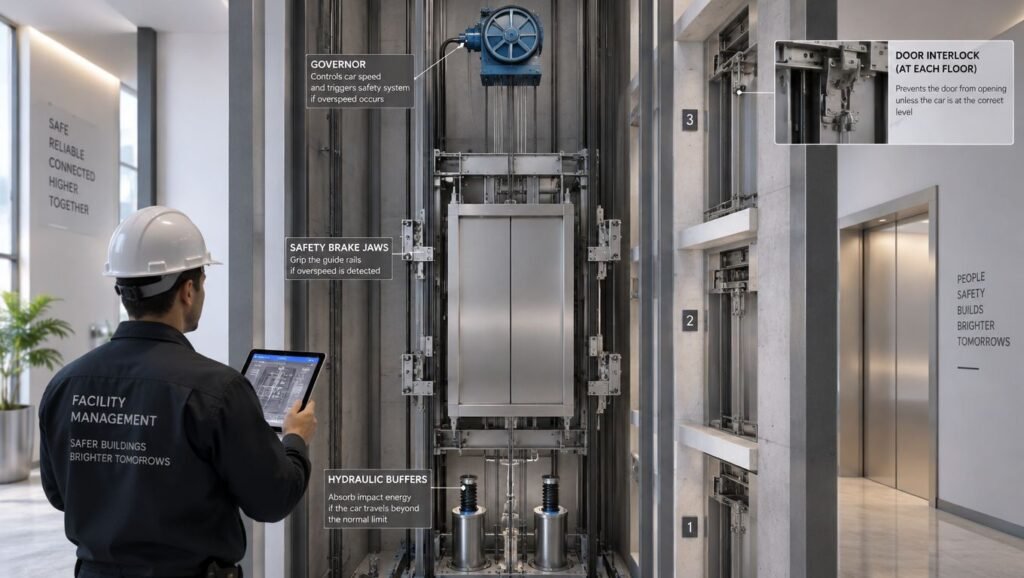
If you manage a building in Detroit, Lansing, Ann Arbor, or Grand Rapids, there's a good chance an elevator report has already landed on your desk with a note that sounds technical, urgent, and just vague enough to slow your day down. The hardest part usually isn't the repair itself, it's figuring out which elevator safety devices matter most, which ones protect passengers first, and which findings need attention before the next inspection window closes.
Crane Elevator Company works through that kind of confusion every day across Michigan and Ohio, from Toledo and Perrysburg to Flint, Kalamazoo, Dearborn, Livonia, Saginaw, Holland, Novi, and the surrounding communities. The right way to think about these systems is simple, they're the layer that stands between normal operation and the rare day when something goes wrong. passenger elevator maintenance
What a Facility Manager Actually Needs from Elevator Safety Devices
A first-time facility manager usually hears about an elevator problem the same way: a technician leaves a note, an inspector flags a device, or a tenant reports a car that didn't feel right. In that moment, the question isn't, “What's the technical name for this part?” The key question is, “What risk does this device remove, and how quickly do I need to act?”
That's why elevator safety devices deserve to be treated like a building's protection system, not a spare-parts catalog. One device prevents motion when a door isn't secure, another catches overspeed, another cushions a worst-case stop at the bottom of the hoistway, and another makes sure a trapped passenger can still reach help.
Practical rule: if a safety device only looks fine during a walk-through, that doesn't prove it will work under stress.
For owners and managers in Michigan and Ohio, the job is even more practical. Your elevator work has to fit the building's inspection cycle, permit rules, and the equipment's actual condition, not just the calendar. That's the frame Crane Elevator Company uses when it handles maintenance, repairs, modernization, inspections, and installations for passenger elevators, freight units, residential systems, wheelchair lifts, material lifts, and dumbwaiters across Detroit, Lansing, Ann Arbor, Grand Rapids, Flint, Kalamazoo, Toledo, and the smaller towns in between.
A good starting point is to read the maintenance record like a decision document. Which device failed, which one is nearing the end of its service life, and which upgrade removes the most risk for the least disruption? That mindset keeps owners from buying the wrong fix first and helps them plan work before a shutdown becomes a surprise.
How the Core Mechanical Safety Devices Actually Work
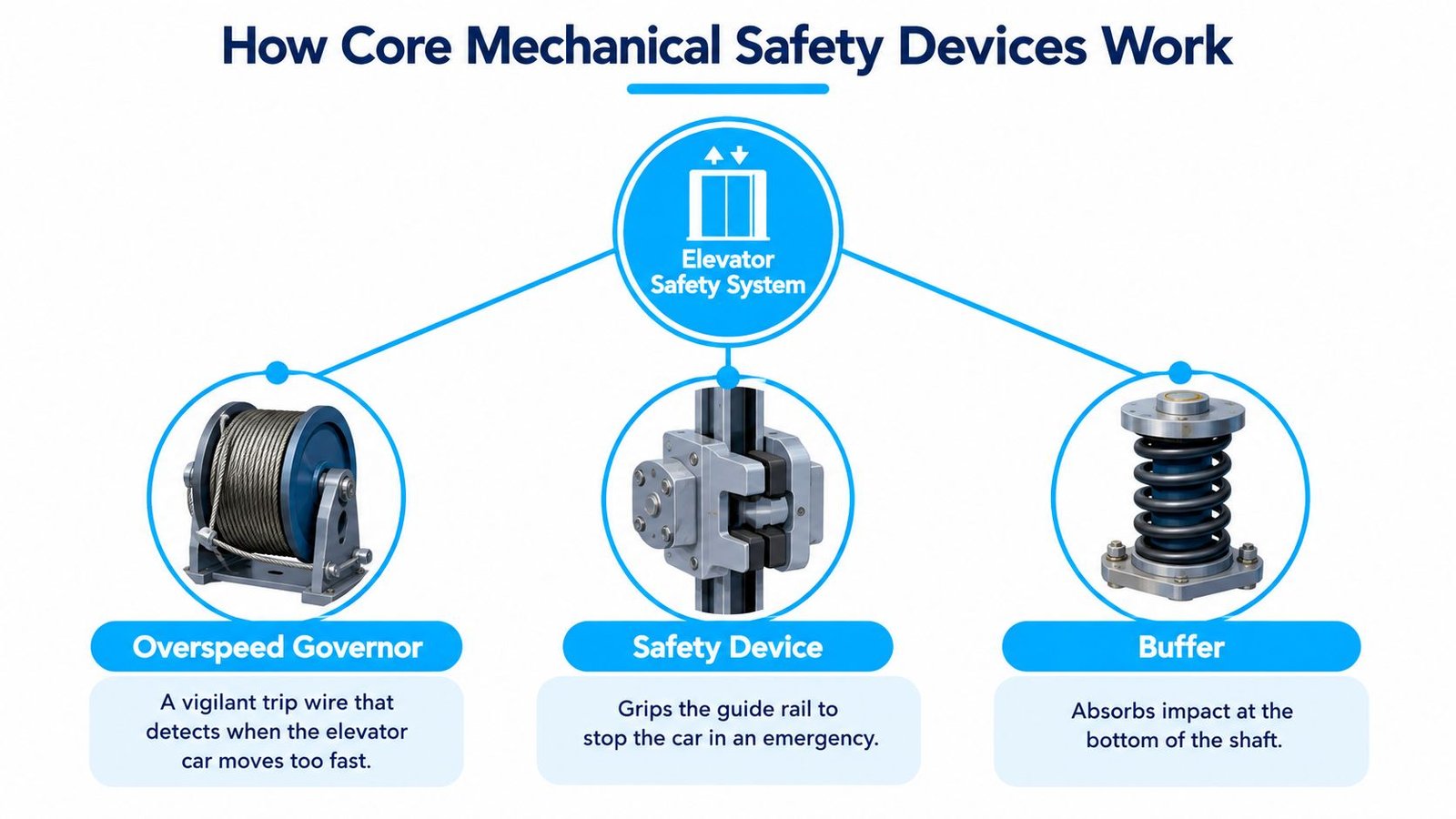
A facility manager does not need the shop-floor version of every part. You need the sequence. Which device notices trouble first, which one stops the car, and which one is there if the car goes past the normal travel limits.
The overspeed governor works like a trip wire. It watches the car's speed, and if the car runs faster than it should, it triggers the safety circuit. That simple job matters because passengers only trust a suspended car when they know the system can stop itself if normal suspension fails. The early automatic brake, first developed in 1852 and publicly demonstrated in 1854, became a milestone in passenger elevator history for that reason, and modern passenger elevators still rely on automatic safety action when speed control or suspension is lost Otis history.
Once the governor trips, the safety device clamps onto the guide rails and stops the car in a controlled way. The rail is not just a track. In an emergency, it becomes the surface the car can hold onto. That is why a service note about jaw adjustment, clearance, or rail condition is really a note about whether the car can be caught cleanly when something goes wrong.
The buffer sits at the bottom of the hoistway to absorb impact if the car overtravels downward. It is the last layer of protection, not the first. A buffer does not replace the governor or the safeties, and it is not meant to take the full burden of a failure. It reduces the severity of the final stop when the car reaches the lower end in an abnormal condition.
The door interlock belongs in the same mental picture, even though it acts earlier in the sequence. It keeps the lift from running unless the doors are properly secured. For an owner reading maintenance records, that matters because the safest-looking car on a walkthrough is not always the one with the best protection under stress.
A useful way to read a repair report is to ask one question at a time. Did the governor sense excess speed, did the safety device engage the rails, and does the buffer still recover the way it should? If you want a plain explanation of the safety brake side of that chain, see this elevator safety brake overview.
Why Governors, Safeties, and Buffers Behave as One System
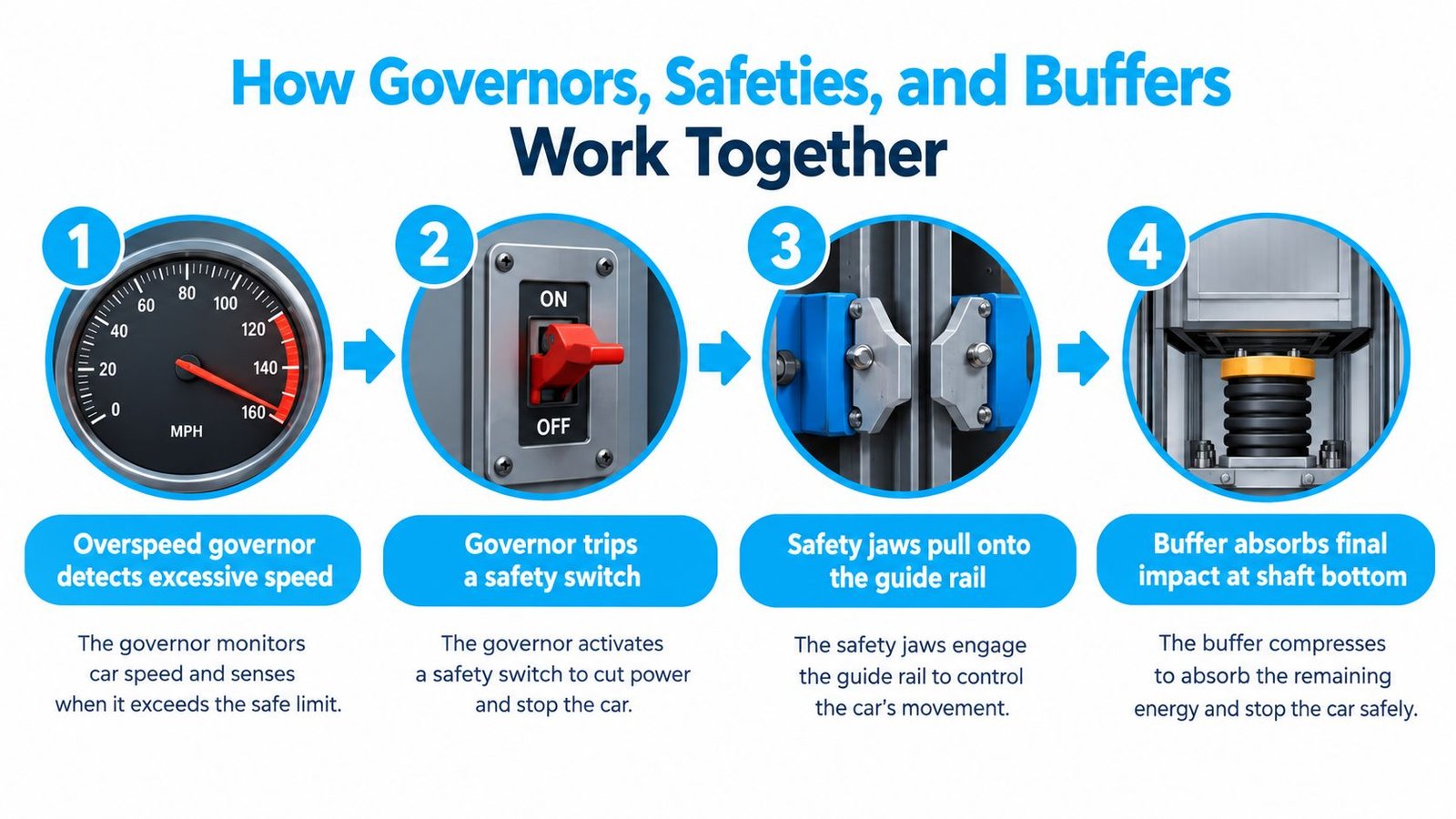
A lot of owners get tripped up by one simple assumption, if the governor looks intact, the whole protection system must be fine. The chain does not work that way. A governor can be in place and still fail to stop the car if rope tension is wrong, the jaw setting is off, the rail surface is contaminated, or the buffer does not recover the way it should.
The chain starts with detection
The governor's first job is to sense excessive speed and trip the safety circuit. From there, the system has to turn that signal into real mechanical action. The governor rope, switch operation, jaw engagement, rail slide, and buffer recovery are all part of the same event, not separate events.
That is why government test specifications require a record of both governor tripping speed and safety-jaw tripping speed, along with the resulting slide on the rails and buffer return time SAM elevator test specification. If any one of those pieces is wrong, the rest of the chain is less trustworthy than the equipment appearance suggests.
Visual inspection alone can miss the problem
A governor can look mechanically fine and still fail in a real event. That is the hard part for non-technical owners, because the equipment may appear clean, complete, and well mounted while still being out of calibration or affected by wear you cannot see. Visual inspection catches obvious deterioration, but it does not prove the coordinated stop sequence will happen correctly.
Annual no-load, slow-speed safety testing and periodic full-load, full-speed testing help expose seized components, contaminated rails, altered calibration, and clearance problems that a quick look will not catch, which is why ASME A17.1 requires periodic safety testing.
What a manager should listen for in a report
If a technician says the governor tripped but the jaws did not engage cleanly, that is not a minor note. If the safety slide was abnormal or buffer return was slow, the chain did not behave like it should have. The report is telling you whether the elevator safely completed the emergency sequence or merely got through the test without a full pass.
Practical rule: the safest elevator is the one whose failure path has been tested, not assumed.
Door Interlocks, Emergency Phones, and Power Backup Features
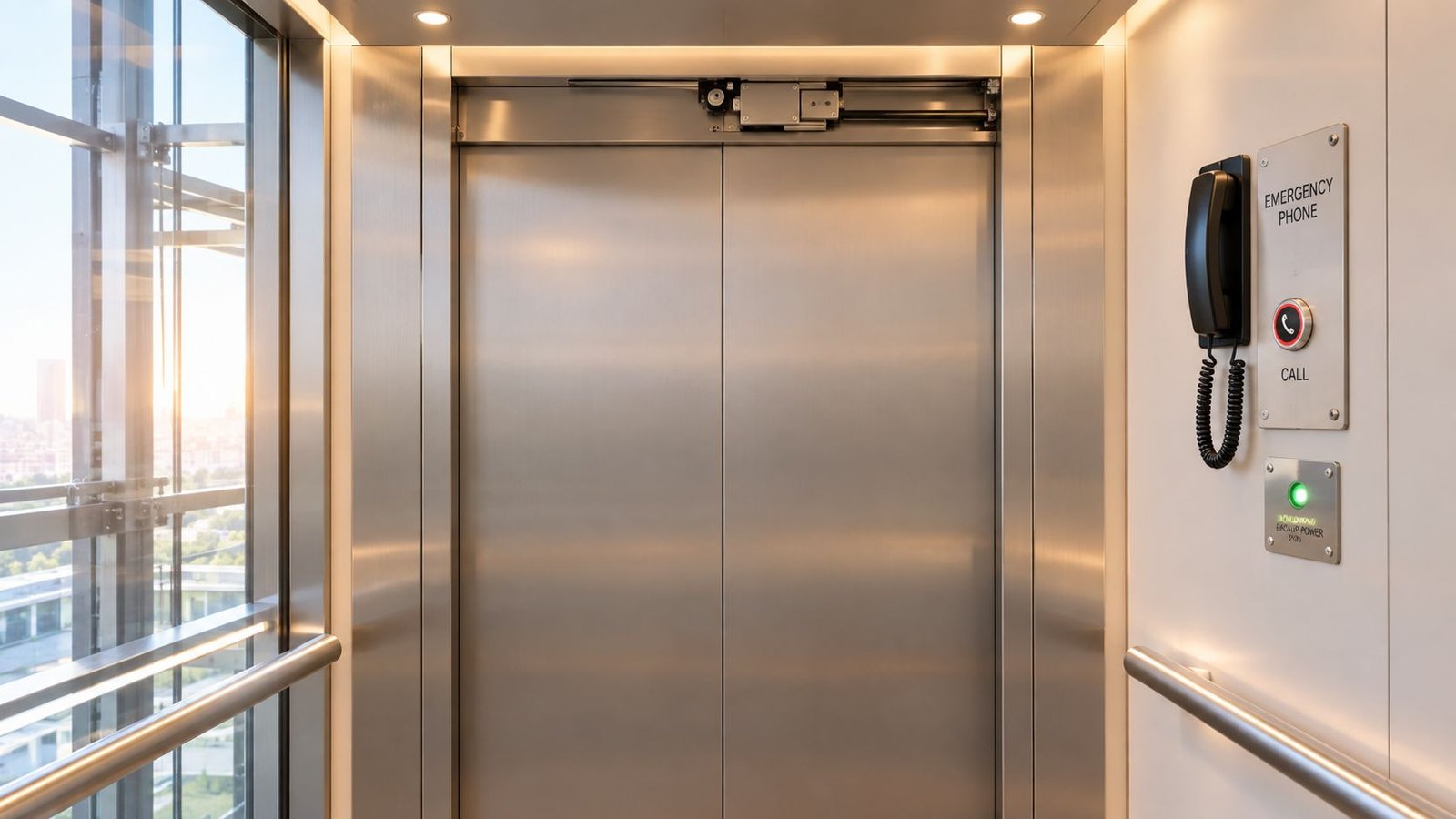
Door interlocks stop bad motion before it starts
The door interlock usually comes up only after someone says, “The car shouldn't have moved with that door open.” That's exactly what the device is there to stop. It blocks movement unless the doors are closed and locked, which keeps riders from entering or leaving a car while it's traveling.
For a manager, this is the most familiar safety story because it's visible and easy to understand. It also becomes one of the easiest places for wear, adjustment drift, or misalignment to show up. A door that doesn't close cleanly is not just an annoyance, it's a safety condition that deserves attention.
Emergency communication has become a real system
A trapped passenger needs more than a button on a panel. Modern emergency communication can include two-way voice, cellular gateways, remote monitoring, and accessibility features that make sure the call reaches someone who can respond. European requirements now also reflect the connected nature of these systems, with cybersecurity rules under the Radio Equipment Directive applying from August 2025 to connected lift communication equipment, including telephones, GSM gateways, and cloud-based monitoring platforms AVIRE on EN 18031-1 and the RED delegated act.
That raises practical questions building owners should already be asking. Who answers after hours? How is the emergency line tested when the cellular carrier changes? What happens if power, internet, or vendor systems go down? Those are life-safety questions, not IT side notes.
Backup power and seismic features protect the building when the building is under stress
Emergency power helps the elevator respond when the main building supply is unstable. Seismic features matter where building movement itself becomes part of the hazard, because the equipment has to behave differently when the structure is shaken or disturbed. These features don't replace the mechanical safeties, they support them when the building environment becomes part of the risk.
Michigan Codes and Inspection Intervals Owners Must Plan Around
Michigan treats elevator safety as a regulated duty, not a casual maintenance task. The state's Elevator Section inspects installations and alterations, conducts annual safety inspections, investigates accidents and violations, and checks that required permits have been issued Michigan Elevator Section. For owners in Detroit, Lansing, Ann Arbor, Grand Rapids, Flint, Kalamazoo, Toledo, and nearby towns, every repair and modernization plan has to fit the code path, not just the building calendar.
The standards set the framework
Michigan identifies ASME A17.1 for elevators and escalators, ASME A18.1 for platform lifts and stairway chairlifts, and ASME A90.1 for belt manlifts Michigan elevator permit information. That framework reaches freight elevators, residential units, wheelchair and platform lifts, stair lifts, material lifts, and related elevating devices.
A practical reading is straightforward. If the device carries people, freight, or accessibility traffic, it belongs in a code conversation. If a project changes the machine, controller, doors, or lifting system, it also belongs in a permit conversation.
The inspection cadence depends on the device
Most passenger, freight, mine, inclined, limited-use, special-purpose personnel, and rooftop elevators, along with material lifts, barrier-free lifting devices, escalators, moving walks, belt manlifts, and special elevating devices generally require inspection at least every 12 months Michigan inspection rules. Dumbwaiters, stairway chairlifts, one-person elevators, platform lifts, and power sidewalk elevators generally require inspection at least every 24 months, while personnel hoists generally require inspection at least every 30 days under the same Michigan inspection rules.
That timing matters because each device ages on a different schedule and works under a different load. A manager in Detroit or Grand Rapids who applies the same expectation to a lightly used platform lift and a high-use personnel hoist will miss the actual inspection rhythm for one of them.
Permits and emergency alterations can't be improvised
Michigan law requires a permit before an elevator is installed or altered, and the permit may be issued only to a licensed elevator contractor after approved plans and specifications are in place Michigan elevator permit law. Emergency alterations must receive a permit within 72 hours of the alteration, and a new, altered, or relocated elevator cannot be placed into service until it is inspected and tested in the presence of a general inspector, subject to statutory exceptions.
If a project changes the equipment's safety path, the paperwork matters as much as the wrench work.
A Practical Way to Prioritize Safety Upgrades on a Specific Car
On a specific elevator car, the first upgrade should not be the shiniest one. It should be the one that addresses the weakest point in the car's safety path, the part that would matter most if the building had to ride through a failure, a rescue, or a code review.
Ask four questions in order
- What failed or degraded first? Start with the item already flagged in the inspection report. A concern about door detection, emergency communication, or braking deserves a different response than worn finishes.
- How much life is left in the system around it? If the controller, door equipment, hydraulic system, or traction machine is nearing the end of service life, a single-device fix may not be the smartest use of money.
- What happens if you wait? A device that protects trapped riders or limits uncontrolled motion deserves a higher place in the queue than a convenience improvement.
- What else does the upgrade force you to touch? Some changes trigger new wiring, code review, testing, or authority approval, and that affects schedule as much as hardware.
Separate required corrections from elective risk reduction
A code-required correction follows a different path than an elective safety improvement. If the inspection or code requires the work, it is not optional. If the device is helpful but not yet mandated, the owner still needs engineering review, authority approval, testing, and documented maintenance before the upgrade can be closed out.
Michigan's newer door lock monitoring timeline belongs in that planning. The state's adoption of ASME A17.3-2015 is planned to tie into a January 1, 2028 compliance window for door lock monitoring [Michigan source], so owners should treat that as a planning date, not a surprise deadline. The practical move is to line up the upgrade order with the car's condition, the code path, and the cost of shutting the unit down.
A senior tech would sort the work the same way. First, the fault that affects safety. Second, the parts that are already wearing out around it. Third, the code item the inspector will expect to see addressed. Fourth, the work that would force extra testing or approvals.
Crane Elevator Company fits into that process as one option for owners who need inspections, testing, modernization, and non-proprietary service planning. The point is the order, not the sales pitch, fix the item that cuts the most risk on that specific car before asking for quotes on the rest.
Maintenance, Testing Records, and Choosing a Michigan Elevator Partner
A strong maintenance program doesn't just fix calls when something breaks. It keeps the machine room, pit, and car top clean, replaces COP and PI bulbs when needed, checks door lock monitoring, inspects hydraulic packing, and runs periodic safety tests so the next inspection isn't a scramble.
Good records prove the system is being cared for
If a contractor can't show what was tested, what was adjusted, and what was replaced, the elevator owner is left guessing. That's a bad position when inspectors ask questions or when the same fault keeps returning. The better record is a simple timeline, service visit, safety test, corrected defect, and the follow-up date.
Ask about the way a contractor handles the whole job
A credible partner should be able to explain response timing, documentation, and parts support in plain English. That means 24/7/365 availability, a clear no-show policy, non-proprietary parts when the building wants broader service access, and a process for second opinions before major work moves ahead.
The right maintenance relationship makes the next inspection calmer, not louder.
For owners and managers in Detroit, Lansing, Ann Arbor, Grand Rapids, Flint, Kalamazoo, Toledo, Perrysburg, and nearby communities, the value is consistency. When the same team can handle preventative maintenance, repairs, code-required inspections, modernization, and testing, the safety devices stop being mystery parts and become part of a documented system the owner can defend.
Common Questions Michigan Owners Ask About Elevator Safety Devices
A facility manager usually wants three clear answers: what gets checked, what happens if it fails, and what has to be fixed before the car goes back into service. In Michigan, most passenger elevators are generally on a 12-month inspection cycle, as noted earlier in the code.
If a safety device fails inspection, the issue has to be corrected, retested, and documented before the equipment can be treated as compliant again. That is the same kind of check-and-signoff process you would expect on a fire door or a backup generator.
Yes, owners should plan for the projected January 1, 2028 compliance window tied to Michigan's adoption of ASME A17.3-2015. Door lock monitoring is part of that planning.
Keep inspection reports, test results, permit paperwork, correction records, and maintenance logs. Those records show that the device was serviced, verified, and not just left on a work order.
If you need help sorting out which elevator safety devices should be tested, repaired, or upgraded first, Crane Elevator Company can review the equipment, the code path, and the maintenance record with you. Visit Crane Elevator Company to plan the next inspection, modernization, or compliance step with a team that works across Michigan and Ohio every day.