A shutdown usually hits at the worst time. Morning tenant traffic is stacking up in the lobby, a freight run is waiting on a production floor, or hotel guests are lining up with luggage while the front desk fields complaints.
That is why Metro Detroit Elevator Maintenance is not just a building service line item. It is an operational discipline. In Detroit and the surrounding areas, elevators support office towers, auto facilities, tech workplaces, hotels, healthcare campuses, municipal buildings, and mixed-use properties that cannot afford unreliable vertical transportation.
Commercial properties across Southern Michigan also face a more complex service environment than they did a few years ago. Providers are expanding, the market is consolidating, and code enforcement is not getting looser. Facility managers need more than a vendor who can answer a callback. They need a service strategy that protects uptime, keeps records in order, supports inspections, and gives them options when equipment ages out.
Your Partner in Metro Detroit Elevator Reliability
A property manager rarely calls about an elevator because everything is going smoothly. The call usually comes after a hard stop, a leveling complaint, a door operator issue, a stuck car, or a failed inspection item that suddenly becomes urgent.
In Metro Detroit, those failures carry different consequences depending on the building. In a medical office, accessibility becomes the immediate concern. In an industrial facility, movement between levels slows down operations. In a commercial tower, tenants start asking how long the outage will last and why the problem keeps returning.
The local market adds another layer. The elevator service industry in Metro Detroit is seeing continued consolidation. In September 2025, ESI, the parent company of City Elevator of Michigan, acquired Elevator Technology, a Detroit-based provider, expanding its presence in the area according to the acquisition announcement published by PR Newswire. Consolidation does not automatically reduce service quality, but it does make one question more important for building owners. Who is maintaining your equipment, and how direct is that service relationship?
A reliable service partner does more than dispatch mechanics.
What facility managers need from a contractor
They need a team that can handle:
- Preventative maintenance that reduces repeat shutdowns
- Repair work that addresses root causes, not just symptoms
- Code-required testing that supports inspection readiness
- Modernization planning before obsolescence turns into an emergency
- Support for all makes and models without forcing a narrow service path
What does not work
Reactive-only service creates avoidable risk. So does deferred maintenance on high-use equipment. Another common problem is fragmented responsibility, where one vendor handles maintenance, another handles testing, and no one owns the full condition of the unit.
Practical takeaway: The best maintenance relationships are the ones where the provider can explain what was done, what is wearing, what may fail next, and what should be budgeted now instead of later.
For Detroit-area buildings, elevator reliability comes from planning, documentation, and disciplined field work. When those pieces are in place, uptime improves and compliance becomes easier to manage.
Elevator Uptime in Metro Detroit’s Auto, Tech, and Hotel Sectors
Some buildings can tolerate inconvenience. High-traffic commercial properties usually cannot. In Metro Detroit’s core industries, elevator uptime affects operations, tenant confidence, and public perception every day.
Auto industry buildings
Detroit’s auto sector uses elevators in office campuses, engineering spaces, supplier buildings, testing support facilities, and manufacturing-adjacent environments. These properties often combine passenger traffic with equipment movement, deliveries, and controlled access areas.
A minor door issue in that setting is not always minor. If an elevator cannot reliably level, close, dispatch, or return to service after a callback, staff movement slows and internal schedules start slipping. Freight and service elevators matter even more. When they are unreliable, teams reroute materials and personnel through spaces that were not meant to absorb that load.
Auto facilities also tend to keep equipment in service for a long time. That increases the value of disciplined maintenance, because aging systems rarely fail in one dramatic moment. They usually show warning signs first.
Tech offices and innovation spaces
Tech companies expect building systems to work in the background. Employees, visitors, and recruiting candidates notice when they do not.
In a modern office environment, elevator reliability affects:
- Arrival experience for clients, partners, and prospective hires
- Internal movement between collaboration areas and secure floors
- Accessibility for staff and visitors who depend on the elevator
- Perception of the building as a well-managed workplace
Buildings that serve tech tenants also tend to move quickly on space planning and fit-outs. Elevator service has to keep up with that pace, especially when occupancy patterns shift and traffic concentrates at specific hours.
Hotels and high-traffic hospitality properties
Hotels feel elevator problems immediately. Guests do not separate the elevator contractor from the property brand. If the elevator is slow, unreliable, noisy, or out of service, the building gets blamed.
High-quality maintenance is essential in these environments because traffic is constant and user expectations are high. A hotel elevator has to handle guest movement, housekeeping, luggage carts, staff circulation, and service runs without recurring interruptions.
Why uptime needs a sector-specific plan
The same maintenance schedule should not be applied blindly to every building. Service must reflect how the elevator is used, when traffic spikes happen, and what the building cannot afford to interrupt.
For auto, tech, and hospitality properties, that usually means closer attention to doors, leveling, ride quality, communication devices, fire service functions, and wear points that show up under repeated daily use.
Preventative Maintenance Programs
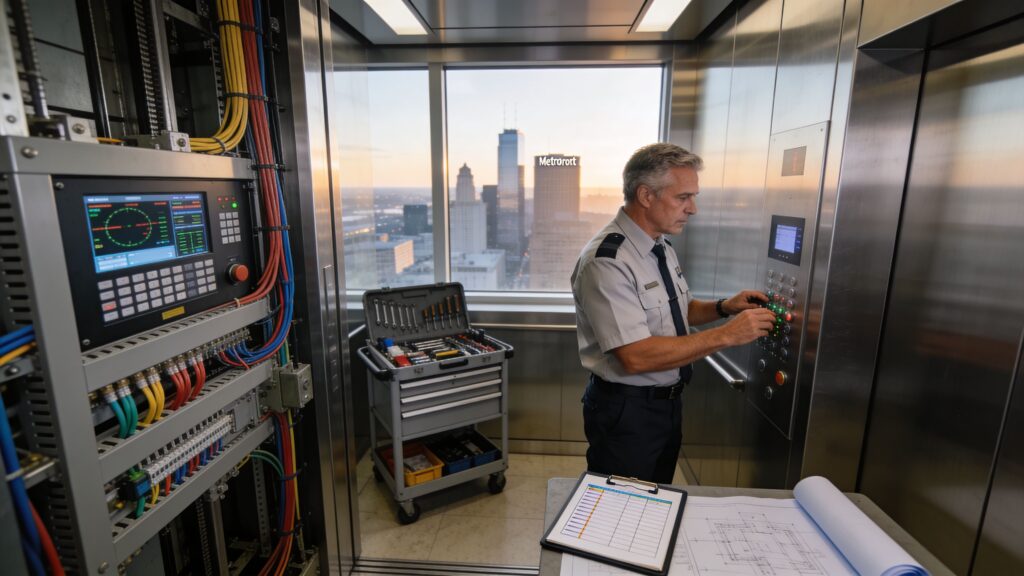
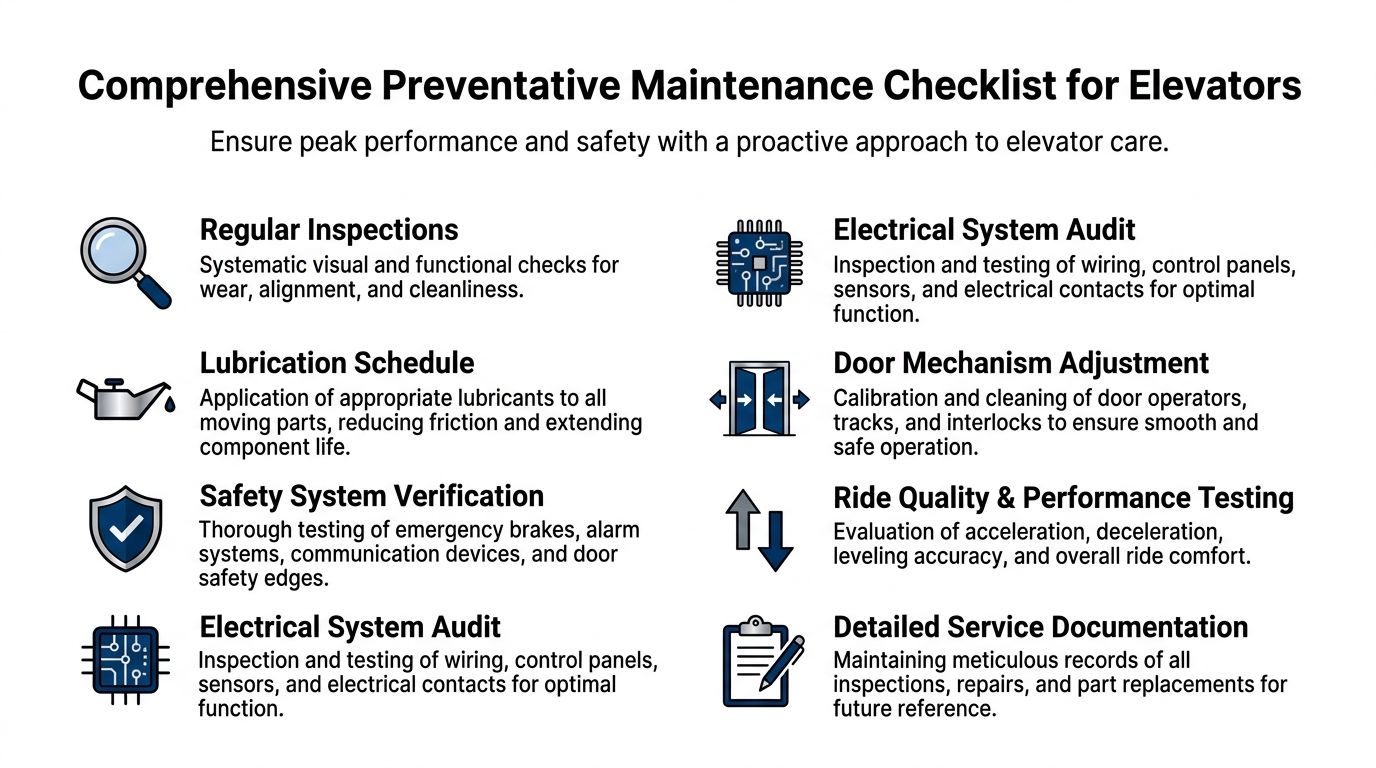
A real preventative maintenance program is not a quick monthly look-around. It is a structured process designed to find wear early, correct small issues before they become shutdowns, and keep the building ready for inspection.
Michigan sets a firm baseline. Michigan Administrative Code R. 408.7025 requires most power elevators to receive maintenance at least every 90 days by a licensed elevator journeyperson, and it also requires an ongoing written record of maintenance, repairs, and tests to be kept on-site according to the Michigan Administrative Code text.
What should be included
A proper maintenance visit should cover the equipment spaces, the car, the landing components, and the operating systems that create most callbacks.
That includes work such as:
- Machine room review to check cleanliness, heat, access, and signs of electrical or mechanical stress
- Pit and car top clean-downs because dirt, debris, and moisture create preventable service problems
- Door equipment service since doors are one of the most common sources of shutdowns and nuisance callbacks
- Control and signal checks to catch faults before they become intermittent failures
- COP and PI bulb replacement so building users are not left guessing whether a command registered
- Safety device verification for items that support compliant operation and reliable response
What property managers should expect in writing
The paperwork matters almost as much as the wrench time. If a contractor cannot show what was inspected, adjusted, replaced, or recommended, the owner is left exposed during inspections and internal reviews.
Good records should clearly show:
- Service date and scope
- Mechanic identity and licensing status
- Observed deficiencies
- Corrective action performed
- Recommended next steps
- Testing or callback notes
That is one reason many facility managers review providers against a stricter service standard, such as documented visits, visible clean-down work, and accountability measures like a no-show billing policy. One local option that lays out its maintenance scope publicly is Crane Elevator’s elevator maintenance service page.
What works and what does not
What works is consistency. Units that receive scheduled attention, clean equipment spaces, documented follow-up, and early part replacement tend to stay more stable.
What does not work is letting the elevator run until users complain. By the time complaints become frequent, the equipment has usually been signaling the problem for a while.
Tip: Ask to see the maintenance log kept on-site, not just an invoice summary. If the log is thin, vague, or missing callbacks and tests, the program is probably thin too.
A preventative program should help the owner budget better, prepare for inspections, and reduce the chance that a routine issue turns into a service interruption at the worst possible time.
Navigating Elevator Inspections and Category Testing
Maintenance keeps the equipment working. Inspections and category testing prove that critical functions still perform as required. Owners need both.
In Metro Detroit, inspection compliance is not optional. The regulatory environment requires regular oversight, and building teams are expected to keep detailed records. The City of Detroit’s Elevator Inspection Team handles functions that include inspections, licensing activity, complaint investigation, and elevator accident reporting. A 2025 industry summary also notes that most states require at least one full elevator inspection per year by a certified inspector, with some jurisdictions requiring more frequent visits depending on use and occupancy, and that owners should maintain records for a minimum of five years according to this review of elevator inspection requirements.
What annual inspections look for
A certified inspector is not there to perform your routine maintenance. The inspector is verifying whether the elevator and its records meet applicable requirements.
Common review areas include:
- Safety devices and operational condition
- Machine room and equipment space conditions
- Code compliance issues
- Previous violation status
- Documentation and record retention
If the unit has unresolved deficiencies, the inspection can trigger a correction timeline, a reinspection requirement, or a more serious enforcement issue.
Cat testing in practical terms
Facility managers often hear “Cat 1” and “Cat 5” without getting a clear explanation. These are periodic code-required tests that go beyond normal service calls.
In practice:
- Category 1 testing focuses on periodic operational and safety checks that confirm the elevator continues to perform properly between major test intervals.
- Category 5 testing is the heavier test cycle. It typically involves more extensive load and safety-system verification depending on equipment type.
The exact field procedure depends on the unit and applicable code, but the owner’s responsibility is straightforward. The test must be scheduled, performed by qualified personnel, documented correctly, and any resulting deficiencies must be addressed.
How to reduce inspection stress
The easiest inspections are the ones prepared well in advance.
A solid process usually includes:
- Reviewing prior violations so old items do not reappear
- Checking the maintenance record for completeness and on-site availability
- Verifying communication and fire service functions
- Scheduling required testing before due dates
- Correcting visible issues before the inspector arrives
For owners who want a clearer view of testing scope and scheduling, elevator testing services should explain how annual inspections, Cat testing, and follow-up corrections are coordinated.
Key point: Failed tests are rarely just a paperwork problem. They usually point to maintenance gaps, unresolved wear, or outdated components that now need attention.
The Strategic Advantage of Non-Proprietary Equipment
Many Metro Detroit properties do not have a neat, single-brand elevator portfolio. A hospital addition may have one manufacturer, an older office tower another, and a later modernization something else entirely. That is where a non-proprietary strategy becomes more than a technical preference.
A proprietary arrangement can limit who can service the equipment, who can access key diagnostics, and how flexibly the owner can bid maintenance or repair work. Over time, that lack of options affects budgeting and response planning.
Why mixed-brand buildings benefit most
Metro Detroit facility managers often oversee buildings with a mix of brands such as Otis, KONE, and Schindler. In that environment, a non-proprietary service strategy allows maintenance to be consolidated under one expert provider, which can streamline operations and reduce costs, instead of forcing separate brand-specific paths, as summarized in this market angle on mixed-brand service environments.
That matters in:
- Healthcare campuses with phased expansions
- Education facilities built over multiple decades
- Municipal portfolios with varied equipment histories
- Commercial properties acquired from different owners over time
What owners gain
Non-proprietary equipment and modernization strategies give owners more control.
That usually means:
- More service options when contracts renew
- Cleaner competitive bidding
- Less vendor lock-in
- A more practical path for long-term upgrades
- Better consistency across a mixed portfolio
The financial benefit is not just lower pricing pressure. It is also operational flexibility. If one contractor cannot support the building well, the owner has more realistic alternatives.
For property teams evaluating future upgrades, non-proprietary elevator solutions are worth reviewing before signing a long-term agreement that narrows service access.
A proprietary platform can still operate well. The issue is control. If the system leaves the owner with fewer choices on maintenance, repair, and modernization, that trade-off should be understood before the contract is signed.
Expert Elevator Repair Services When You Need Them Most
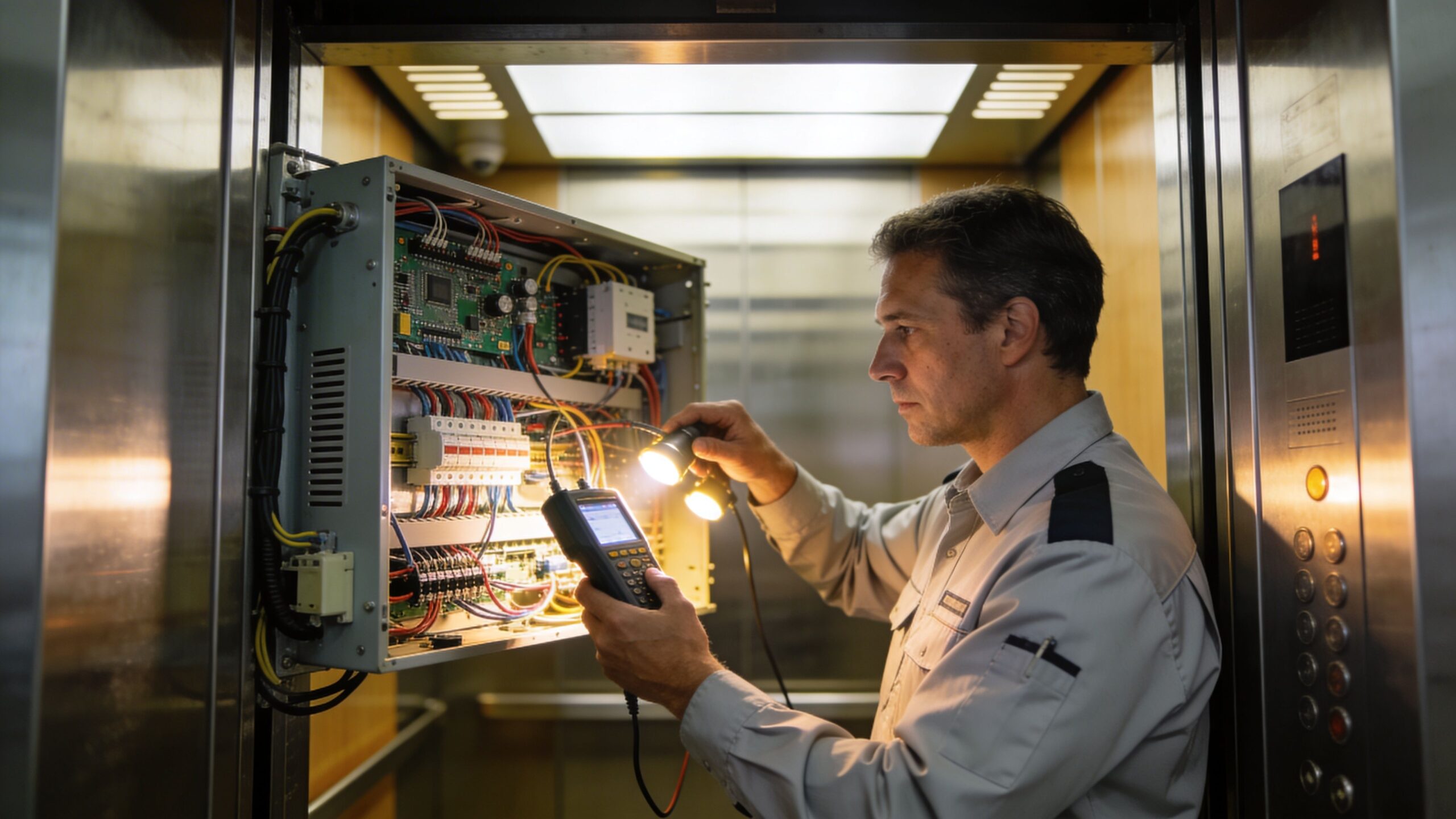
Repairs start where maintenance leaves off. Some calls are minor adjustments. Others reveal a component that is worn out, leaking, electrically unstable, or no longer dependable enough to keep in service.
The difference matters because a building owner should not treat every callback the same way. A door adjustment and a jack replacement are not in the same category. Neither are a nuisance fault reset and a motor or power unit replacement.
Common major repair categories
In commercial service, larger corrective work often involves items such as:
- Hydraulic packing replacement when leakage or performance issues appear
- Jack replacement for aging hydraulic systems with serious deterioration concerns
- Cable replacement where wear, damage, or code-related conditions require it
- Tank or power unit replacement when hydraulic performance becomes unreliable
- Motor, sheave, or machine replacement on traction equipment with advanced wear
- Door operator and interlock repair when recurring door faults are no longer solved by simple adjustments
These are not repairs owners want to discover during an emergency. They are easier to plan when the warning signs are documented early.
Cost of Running Reactive-Only
This approach clarifies the budget conversation. Industry data suggests emergency elevator repairs can cost 10 to 20 times more than the routine upkeep that would have prevented the failure, according to this Detroit-area maintenance comparison.
That gap is why experienced facility managers do not judge maintenance value only by the monthly contract amount. They judge it by avoided shutdowns, fewer urgent callouts, less tenant friction, and fewer surprise capital hits.
What a good repair partner does differently
A capable repair approach includes diagnosis, not just replacement.
That means the mechanic should be able to answer:
- Why did this part fail
- What wear pattern led to it
- Is this isolated or a system trend
- What else should be inspected now
- Would modernization be smarter than another major repair
Repair rule: If the same unit keeps generating expensive callbacks, stop treating each event as a stand-alone problem. The pattern usually says more than the individual failure.
Repairs are unavoidable in elevator service. Repeated emergencies are not. The strongest maintenance programs reduce how often a building finds itself making urgent decisions under pressure.
Planning for Elevator Modernization and Upgrades
Every elevator reaches the point where repairs stop being the best long-term answer. The system may still run, but parts become harder to source, downtime becomes less predictable, and compliance work gets more expensive.
That is when modernization moves from a “someday” project to an asset-planning decision.
Signs a building should start planning now
Owners usually start looking seriously at upgrades when they see a combination of these issues:
- Frequent outages that disrupt tenants or operations
- Obsolete controls or components that make repairs harder
- Ride quality complaints such as rough starts, poor leveling, or erratic doors
- Inspection pressure caused by recurring violations
- Aesthetic mismatch between the elevator and the rest of the property
Modernization does not always mean replacing everything. It can involve controls, door operators, fixtures, machines, communication systems, or a full system overhaul depending on condition and budget.
Dormant units create a special risk
Dormant elevators deserve attention before someone decides to “just put them back online.” Under Detroit’s 2019 City Elevator Code, reactivating a dormant elevator requires an alteration permit and upgrades to meet current ASME A17.3-2017 standards, not the code in place when the unit was originally installed, according to the MSBO elevator code presentation.
That can mean major work on safety systems, wiring, and related components. In other words, a dormant elevator is often a modernization project in disguise.
What a modernization plan should include
A practical modernization plan looks at both building operations and compliance exposure.
Key planning elements include:
- Condition assessment of controls, machines, doors, fixtures, and safety systems
- Scope definition so the owner knows what is being replaced and why
- Downtime planning around tenant use, production schedules, or guest activity
- Permit and inspection coordination
- Financing review if the owner wants to spread capital expense into a more predictable path
This video gives a useful visual reference for how modernization work can reshape an aging system.
Why planned upgrades outperform forced ones
Planned modernization gives owners choices. Emergency modernization usually removes them.
A building that budgets upgrades early can align scope with tenant needs, avoid rushed procurement, and move toward non-proprietary solutions if its current platform is too restrictive. It can also improve appearance, reliability, and maintainability in one project instead of funding repeated repair events that never solve the larger problem.
For hotels, office properties, auto-adjacent buildings, and older municipal facilities, modernization is often less about replacing old equipment for appearance alone and more about protecting the usefulness of the building itself.
Facility Manager’s Elevator Service Checklist
A service agreement can look complete on paper and still leave major gaps in the field. This checklist helps facility managers spot the common weak points.
Elevator Service & Compliance Self-Assessment
| Assessment Area | Check (Yes/No) | Action Item if 'No' |
|---|---|---|
| Maintenance visits meet required frequency for the equipment type | Review the service schedule and confirm it matches current code obligations | |
| On-site written records include maintenance, repairs, callbacks, inspections, and testing | Create a single on-site log process and require every visit to be documented | |
| Annual inspections and required category testing are scheduled before due dates | Build a compliance calendar and assign one person to track it | |
| The provider can service all elevator brands in the building portfolio | Evaluate whether contract consolidation would simplify operations | |
| Door equipment, leveling, communication devices, and fire service functions are reviewed regularly | Ask for a documented preventive checklist tied to these items | |
| The contract clearly distinguishes routine maintenance from billable repairs | Request written clarification before the next renewal | |
| The building has a plan for major repairs such as jack, cable, motor, or control replacement | Develop a capital forecast based on current equipment condition | |
| Dormant or little-used elevators have been reviewed for current code exposure before reactivation | Obtain a condition assessment before returning the unit to service | |
| The owner understands whether the equipment is proprietary or non-proprietary | Review service access, parts access, and future bidding flexibility | |
| Response expectations for entrapments, shutdowns, and urgent service are clearly defined | Set written escalation procedures with named contacts |
How to use the checklist
Do not treat this as paperwork only. Walk the building, inspect the machine room records, and compare the contract language against what your staff sees.
If several boxes come back “No,” the problem may not be one elevator. It may be the overall service model.
Why Crane Elevator is the Right Choice for Your Building
The right elevator contractor for a Metro Detroit property should bring three things to the table. Reliable field execution, strong compliance habits, and a service philosophy that keeps the owner in control.
That matters more now because building owners are dealing with mixed-brand equipment, tighter documentation expectations, aging infrastructure, and pressure to avoid avoidable downtime. A contractor has to be able to maintain equipment properly, repair it when major components fail, support testing and inspections, and advise when modernization is the smarter path.
Crane Elevator Company fits that type of engagement for Southern Michigan properties because its published service profile is built around proactive maintenance, code-required inspections and testing, major repair capability, and non-proprietary modernization across all makes and models. The company also states that it operates 24/7/365, offers free second opinions, competitive quotes, financing options, and a maintenance program that includes clean-downs of machine rooms, pits, and car tops along with a No Show, No Pay policy.
Why that combination matters
For facility managers, those points are practical, not marketing language.
- Non-proprietary service philosophy supports long-term flexibility
- Repair and modernization capability reduces handoff problems between vendors
- Round-the-clock availability matters when shutdowns affect building operations
- Transparent maintenance scope makes it easier to evaluate contract value
The best choice for any building still depends on the equipment, occupancy, and service expectations. But owners should favor contractors who can support the full life cycle of the elevator, not just one slice of it.
Frequently Asked Questions
How often does an elevator in Michigan need maintenance
For most power elevators, Michigan requires maintenance at least every 90 days by a licensed elevator journeyperson under the code requirement discussed earlier. Some equipment types have different intervals, so the schedule should match the specific installation.
What is the difference between maintenance and repair
Maintenance is planned service intended to keep the unit operating safely and consistently. Repair addresses a failed, worn, or damaged component after a problem has appeared or been identified.
What is Cat testing
Category testing refers to periodic code-required elevator tests. In day-to-day building operations, the most discussed are Category 1 and Category 5 tests. They are separate from normal maintenance visits and must be scheduled, documented, and supported by qualified personnel.
Can one contractor maintain multiple elevator brands in the same portfolio
Yes, if the provider has the technical capability and the equipment setup allows practical access. That is one reason many owners prefer a non-proprietary strategy in mixed-brand portfolios.
When should a building consider modernization instead of more repairs
Consider modernization when outages become frequent, parts are becoming difficult to support, inspection problems keep returning, or the cost and disruption of repeated repairs no longer make operational sense.
What happens if a dormant elevator is reactivated
The owner should not assume it can be turned back on. In Detroit, dormant elevator reactivation can trigger permit requirements and upgrades to current safety standards, which may involve significant work before the unit can return to service.
If your building needs a clearer plan for maintenance, testing, repair, or modernization, contact Crane Elevator Company for a practical review of your equipment, service records, and upgrade options. A second opinion can often identify where downtime risk, compliance exposure, or unnecessary vendor lock-in is costing more than it should.