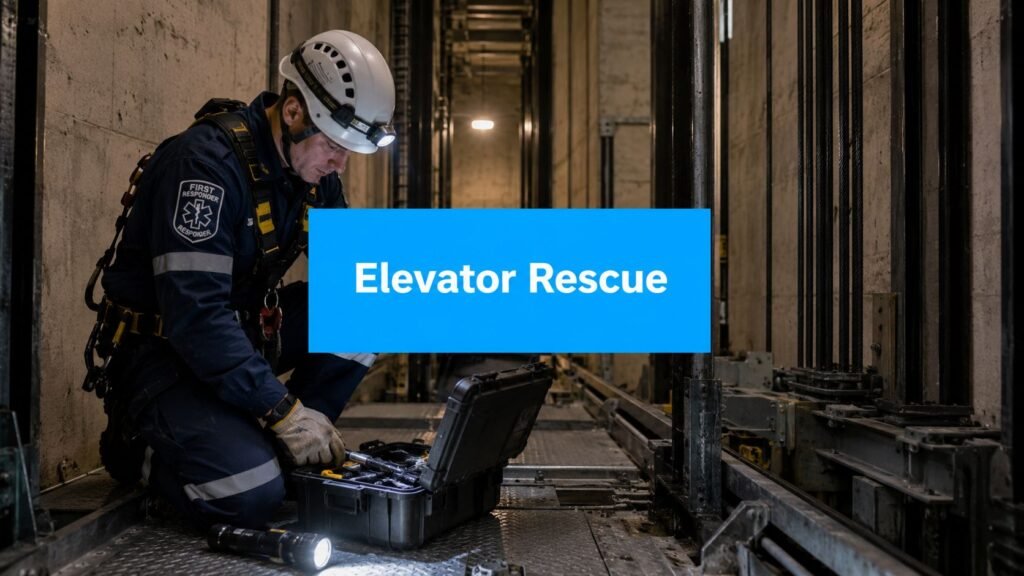
A stalled elevator changes a routine workday in seconds. A patient transport pauses in an Ann Arbor hospital, employees gather outside a car in a Toledo office building, and someone reaches for the landing doors before anyone has confirmed where the car is positioned. That instinct creates risk. The safest response starts with communication, scene control, and a clear decision about whether trained professionals or emergency services must take over.
The need for that preparation is practical, not theoretical. People in the United States travel more than 2.55 billion miles on elevators and escalators each year, according to the National Elevator Industry fact sheet. A smart-monitoring study found that lifts break down an average of at least four times per year, and each breakdown takes about four hours to repair. The same study found that one in six breakdowns traps passengers inside. The elevator reliability study makes the operational lesson clear: facility staff need a rescue plan before the alarm sounds.
Crane Elevator Company performs maintenance, repair, and modernization services throughout Michigan and Ohio, including Detroit, Toledo, Ann Arbor, Lansing, Perrysburg, Flint, Kalamazoo, and surrounding cities. The company's role is to keep building teams from improvising around energized equipment, open hoistways, or uncertain car positions.
When the Elevator Stops and People Are Trapped
A hospital elevator in Ann Arbor stops between floors during a busy shift. The lights remain on, the passengers can speak through the emergency phone, and nobody appears injured. That sounds manageable, but it still isn't a situation for someone to force a door or climb out without knowing the car's exact position. A small vertical gap can become a fall hazard, while unexpected movement can injure both passengers and rescuers.
The first priority is to treat the car as occupied and the equipment as potentially capable of movement. Keep people away from the landing doors, assign one staff member to communicate with the passengers, and have another contact the elevator contractor. If anyone reports chest pain, difficulty breathing, severe anxiety, a fall, smoke, fire, or another medical concern, emergency services should be contacted immediately.
Michigan and Ohio create a recurring compliance environment for building owners. In Michigan, most passenger, freight, rooftop, material-lift, escalator, moving-walk, belt-manhold, and similar devices must be inspected at least once every 12 months, while several lower-use devices follow 24-month cycles and personnel hoists are inspected every 30 days, as specified in the Michigan administrative rule. Ohio requires passenger elevators, escalators, moving walks, and freight elevators to be inspected twice every 12 months, while certain non-passenger lifting equipment must be inspected at least annually under the Ohio inspection statute.
Those schedules make maintenance records, emergency contacts, and response procedures part of normal facility operations. Crane Elevator's emergency elevator service supports building teams when an entrapment, shutdown, failed safety device, or inspection correction requires qualified attention.
Field rule: A calm passenger who can communicate is usually safer waiting inside the car than attempting an improvised exit.
Securing the Scene and Communicating with Occupants
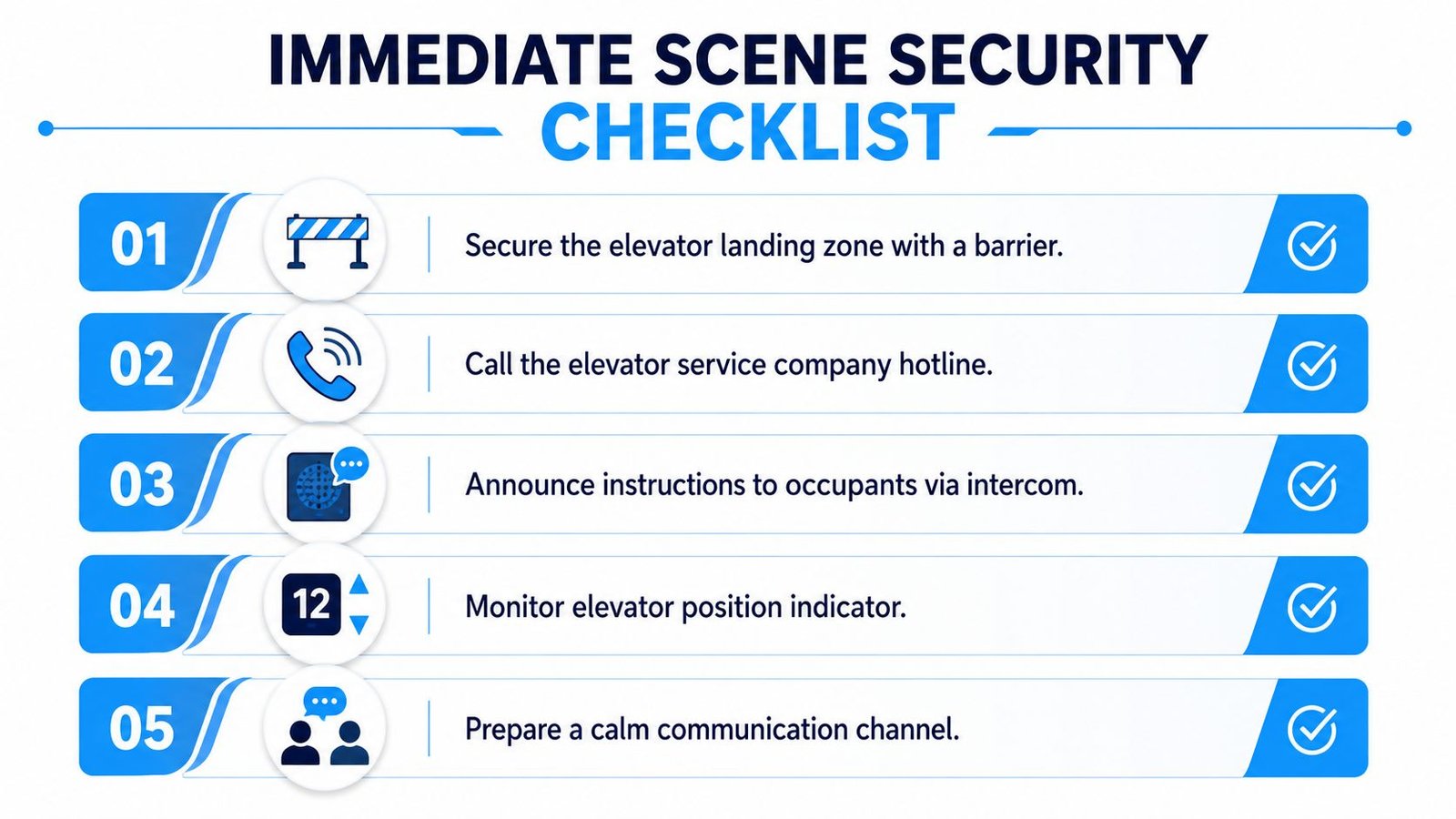
Before anyone discusses opening a door, secure the landing. Stop normal traffic near the elevator, place a barrier across the affected area, and keep curious occupants from operating hall stations. If several elevators share a bank, identify the affected car and prevent staff from assuming that another car is involved.
Call the elevator service provider and provide the building address, elevator number, landing location, and callback information. Crane Elevator operates an emergency response line 24/7/365, but the caller still needs to explain whether anyone is trapped, whether the car is moving, and whether a medical or fire condition exists.
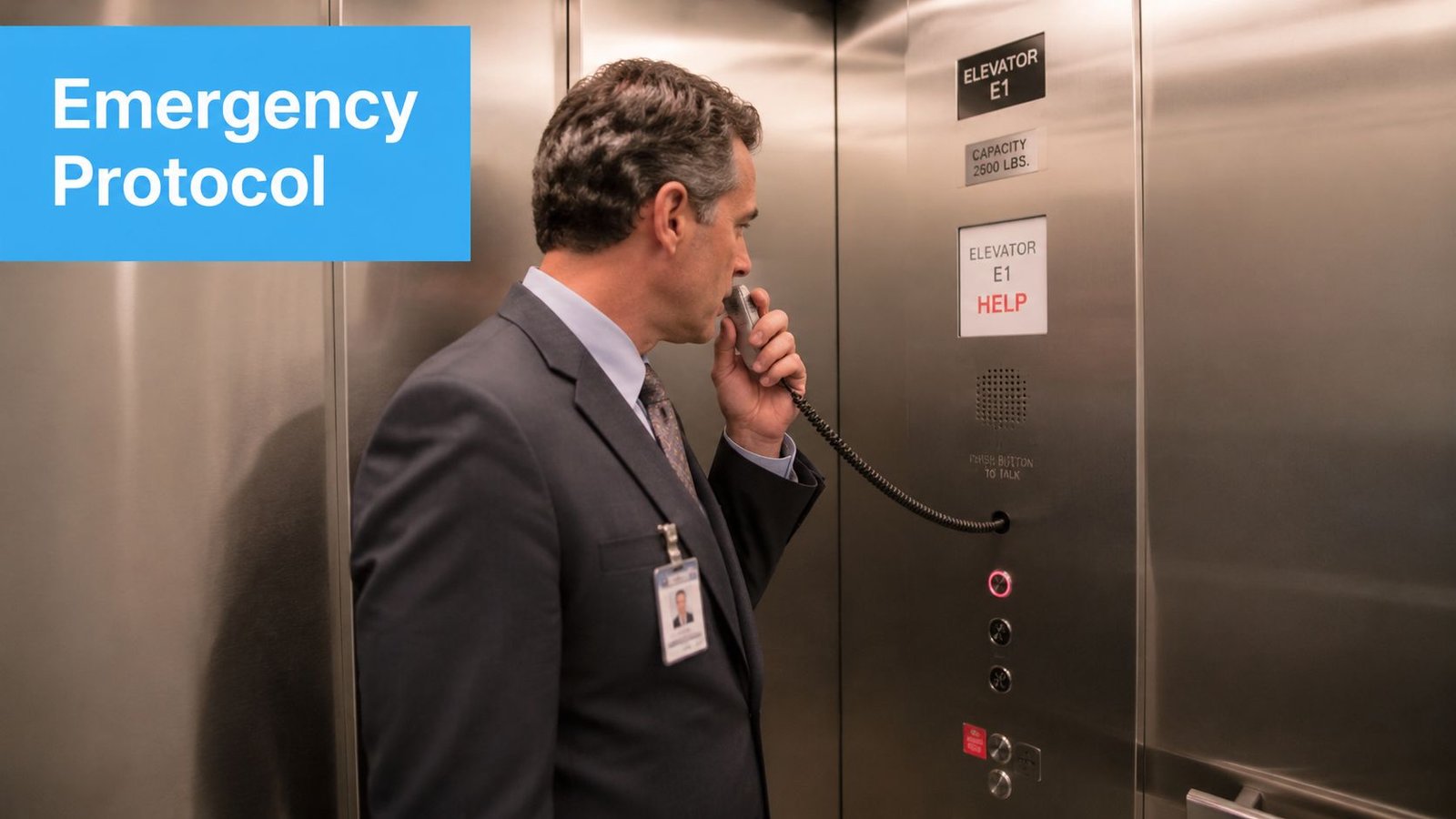
Use the emergency phone or intercom to establish a steady conversation. Ask simple questions rather than demanding that passengers try controls:
- Passenger count: Ask how many people are inside, including children, older adults, or anyone using mobility equipment.
- Health status: Ask whether anyone is injured, ill, panicking, or having trouble breathing.
- Car location: Ask what floor the indicator shows and whether the car is level with a landing.
- Conditions inside: Ask about unusual sounds, heat, smoke, water, odors, or loss of lighting.
- Communication plan: Tell occupants that help has been called and give updates without promising an arrival time you can't verify.
Place someone at the landing to monitor the position indicator and prevent unauthorized operation. A second person should document the time of the shutdown, calls made, messages received, visible conditions, and any actions taken. That record helps the responding technician understand the sequence and gives the owner a defensible account of the incident.
The elevator emergency phone installation service can address a weak or unreliable communication link before it becomes a rescue problem.
Untrained staff shouldn't use drop keys, bypass interlocks, enter a hoistway, or move the car. Those actions can expose people to moving machinery, electrical energy, and open-shaft hazards.
Executing the Physical Rescue Workflow Safely
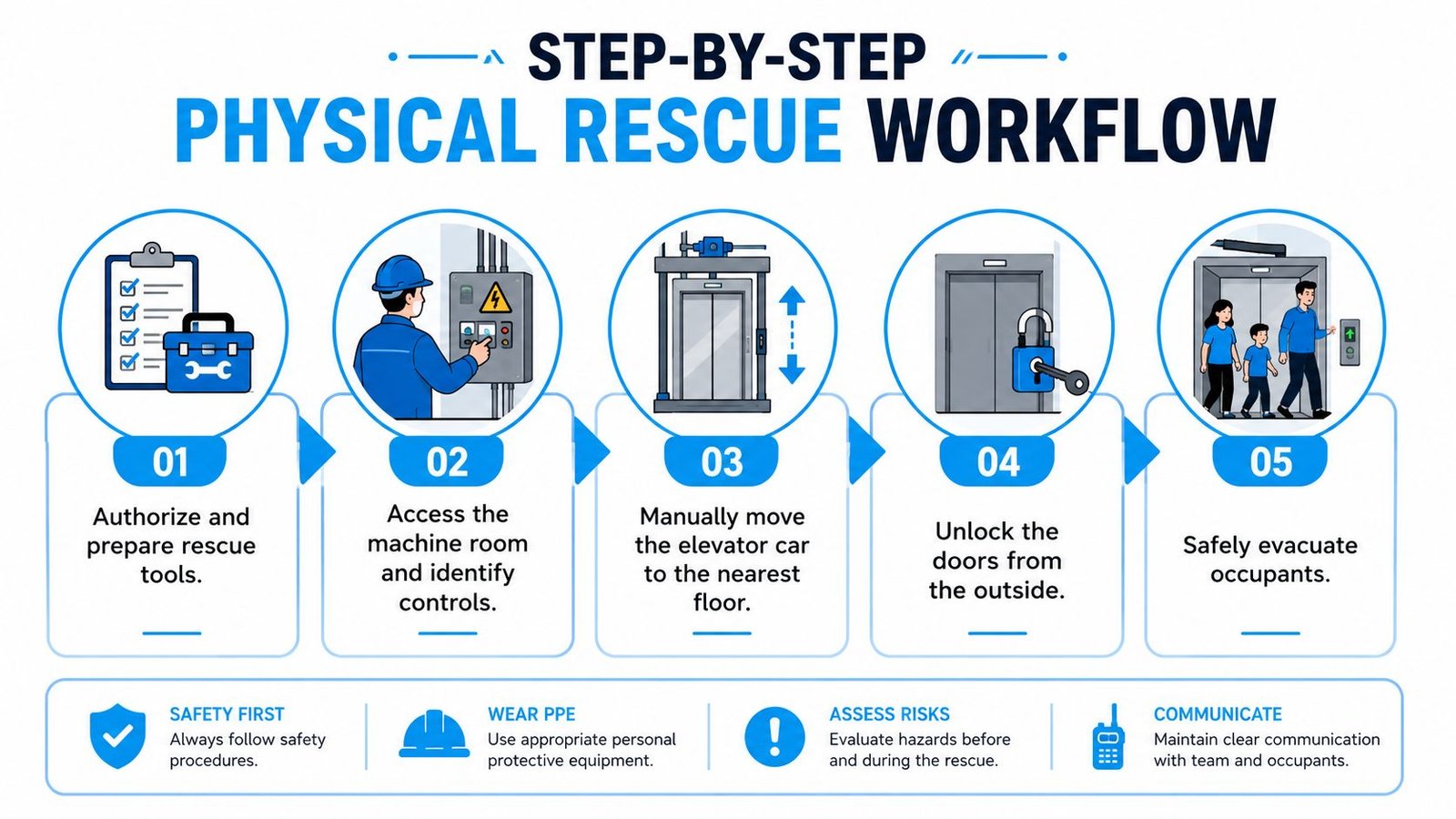
Physical rescue begins only after the responsible authority has authorized it and the people performing it have the training, tools, and equipment for that elevator type. A verbal request from a passenger or a manager's understandable urgency doesn't replace a controlled rescue decision.
Establish the car position first
Start by identifying the elevator, checking the position indicator, and confirming the car's location through approved means. The responder needs to know whether the car is at a landing, slightly above or below it, or substantially between floors. Never assume the visible gap tells the whole story.
If machine-room access is required, secure that room and identify the main disconnect, controller, brake controls, and any manufacturer-specific rescue instructions. Apply lockout and tagout when the procedure calls for de-energization. However, shutting off power without understanding the rescue sequence can remove needed control functions or create a harder recovery, so the person directing the rescue must make that decision based on the equipment and the hazard.
Move and open in a controlled sequence
A trained responder may manually move the car toward the nearest suitable landing using the approved procedure for that installation. The responder must verify movement, communicate with passengers before and during the action, and stop if the car behaves unexpectedly. The car should be positioned so occupants can leave without stepping into a dangerous vertical gap.
Once the car is properly positioned, the responder uses the correct hoistway door unlocking device. A landing door should never be forced with improvised tools, and an unlocked hoistway door must be controlled so nobody approaches the opening from the hallway. If the car doors don't open normally, the responder follows the elevator-specific procedure rather than reaching blindly into the entrance.
Extract passengers without rushing them
Before the first person exits, confirm that the car is stable, the landing is clear, and the door opening is fully controlled. Have occupants leave one at a time, with assistance for anyone who is unsteady or using a mobility device. Keep people away from the hoistway edge and close or secure the landing doors as soon as the evacuation is complete.
Rescue sequence: Authorize the response, identify the car, control energy and movement, verify level, control the doors, then evacuate.
A rescue isn't complete when the last passenger reaches the hallway. The elevator should remain out of service until a qualified technician evaluates the cause, checks safety circuits, documents the condition, and determines what testing or repair is required.
Required Tools PPE and Legal Code Considerations
An elevator rescue kit isn't a collection of convenient hand tools. It contains equipment selected for a specific installation and used by people who understand the hazards behind the landing doors.
Typical equipment includes approved hoistway door unlocking devices, elevator drop keys where authorized, a properly rated voltage tester, lockout/tagout hardware, communication equipment, and lighting. Personal protective equipment commonly includes a hard hat, safety glasses, protective gloves, suitable footwear, and fall protection when a person works near an open hoistway or another unprotected edge.
The presence of a tool doesn't authorize its use. A drop key in the hands of an untrained employee can create a more serious incident than the original entrapment. Building staff should maintain access to emergency information and contact numbers, while qualified elevator personnel or properly equipped first responders handle work that involves doors, controls, brakes, electrical energy, or hoistway entry.
Michigan compliance depends heavily on documentation. The state requires a Maintenance Control Program to be available at the time of inspection. Michigan's Elevator Division also clarified that, as of August 1, 2019, repairs involving anything other than a manufacturer like-for-like part, or work requiring adjustment, testing, or programming, are treated as alterations requiring a permit and inspection, as explained in the Michigan elevator industry guidance.
| Compliance issue | Practical facility response |
|---|---|
| Maintenance Control Program | Keep the current program accessible for inspection and technician review. |
| Non-like-for-like repair | Ask whether the work is an alteration requiring a permit and inspection. |
| Inspection correction | Track the violation, repair scope, testing, and closeout documents. |
| Emergency phone | Test communication and record failed or intermittent operation. |
Ohio requires periodic safety tests under the state's Safety Code for Elevators and Escalators. At least one test every five years must be a full-load safety test, according to the Ohio elevator safety testing code. That requirement makes test records and inspection readiness central to service planning, particularly in healthcare, education, industrial, and municipal facilities.
Owners should also ask whether proposed modernization leaves them dependent on one vendor for parts, diagnostics, and future repairs. Non-proprietary equipment can give qualified providers more service access, although compatibility, engineering, code approval, and technician familiarity still need careful review. The elevator code requirements service resource can help owners frame those questions before approving repair or modernization work.
Building a Culture of Preparedness Through Training and Maintenance
The least disruptive rescue is the one a building never needs. Preventive maintenance doesn't eliminate every failure, but it gives technicians a chance to find worn door components, poor housekeeping, oil leaks, damaged wiring, weak communication equipment, and inconsistent leveling before those conditions become an occupied-car event.
Crane Elevator's maintenance program uses a No Show, No Pay policy, full clean-downs of machine rooms, pits, and car tops, and COP/PI bulb replacements. Those details matter because technicians can see conditions more clearly when accumulated debris and neglected lighting don't hide problems. A dependable program also includes the routine adjustments, inspections, and documentation required for the specific equipment and jurisdiction.
Training should be practical rather than ceremonial. Staff should know who calls the contractor, who speaks with passengers, who meets responders, who controls the landing area, and who records the event. A drill can rehearse a stalled car, a passenger reporting a medical issue, a car stopped away from a landing, and a failed emergency phone.
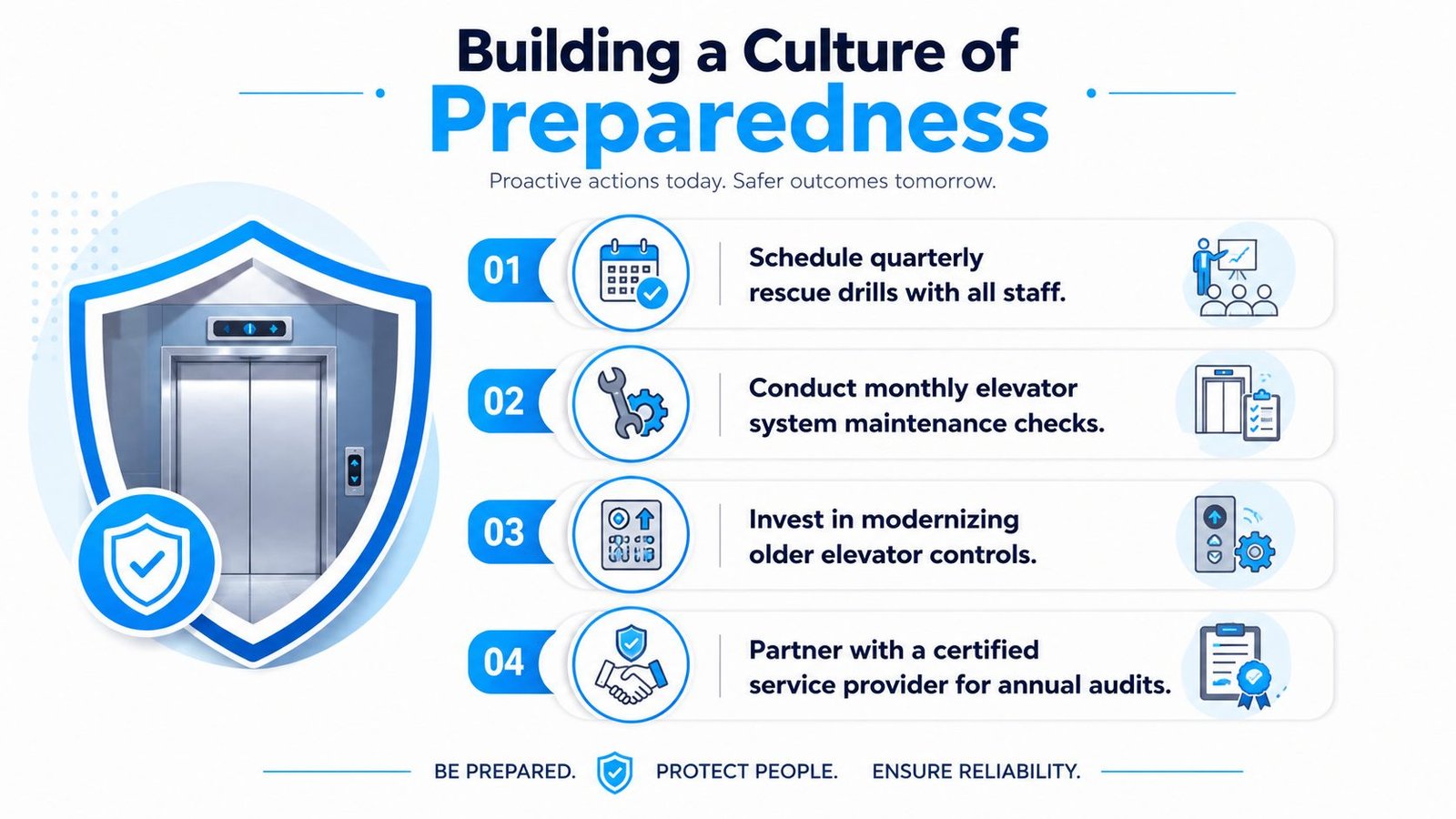
The exercise should end with corrections, not applause. Replace outdated contact sheets, repair blocked machine-room access, confirm that responders can reach the disconnect, and record who needs additional training. Staff shouldn't practice opening doors or moving cars unless the exercise is conducted by qualified personnel under a formal safety procedure.
Modernization deserves the same operational scrutiny. Industry coverage identifies a critical shortage of skilled field technicians and describes modernization as the fastest-growing segment through 2030, while market reporting places the elevator modernization market at USD 9.35 billion in 2024 and USD 10.15 billion in 2025 in its cited analysis at TechSci Research. For Michigan and Ohio owners, the relevant question isn't whether a control system has attractive features. It's whether the upgrade improves serviceability, keeps replacement parts available, and reduces dependence on a closed vendor system.
Maintenance standard: Clean equipment, documented inspections, tested communication, and accessible parts give responders a better starting point than an expensive system nobody can service promptly.
Knowing When to Call Crane Elevator or Emergency Services
Use a simple decision rule. If passengers are trapped, notify the elevator contractor immediately. If someone is injured, ill, exposed to smoke or fire, or at risk from a structural condition, call emergency services first and tell the elevator contractor what responders find.
A trained and authorized response team may handle a straightforward rescue when the car position is known, the correct tools are available, the landing can be controlled, and the rescue procedure matches the equipment. Building employees should stop and wait for professionals when they lack training, the car isn't level, the doors won't release normally, power conditions are unclear, the elevator has made unusual sounds, or the incident involves a failed safety circuit or suspected mechanical damage.
Crane Elevator serves Michigan and Ohio, including Toledo and surrounding communities, with emergency response, preventive maintenance, repair, code-required inspections, and non-proprietary modernization for many types of vertical transportation. The company also offers free second opinions, competitive quotes, a price-beat guarantee, and financing options for commercial elevator modernization.
A reliable plan has three parts: keep occupants calm, keep untrained people away from the equipment, and provide the responding technician with accurate information. That approach protects passengers today and gives the owner a clearer path toward the repair, testing, or modernization that prevents the next shutdown.
Crane Elevator Company provides 24/7/365 emergency response, preventive maintenance, repairs, code-required inspections, and non-proprietary modernization across Michigan and Ohio, including Toledo, Detroit, Ann Arbor, Lansing, Perrysburg, Flint, and Kalamazoo. Visit Crane Elevator Company to request service, a free second opinion, or a competitive quote before an elevator emergency tests your building's plan.