
An elevator can run perfectly, level cleanly, and still fail inspection because the emergency phone doesn't meet code. That happens more often in older Michigan buildings than owners expect. The car is fine. The controller is fine. Then the inspector tests the phone, the monitoring center can't identify the cab, or the old line is dead, and now a small overlooked device turns into a violation problem.
That situation gets worse in legacy properties. A lot of buildings still have older cab phones tied to copper service or aging cellular hardware that was installed years ago and forgotten. If the line was built around PSTN or a 3G gateway, the phone may look normal and still be functionally useless when someone gets trapped. That's the part owners usually find out too late.
Elevator emergency phone installation isn't just about putting a speakerphone in the car. It's about making sure the cab can reach a live person, during a power outage, through the right wiring path, with the correct location data, and in a way an inspector can verify. In Michigan, that's a practical building operations issue, not a paperwork issue.
Your Guide to Elevator Phone Compliance
A common inspection failure goes like this. The inspector presses the emergency button. The call goes out, but the answer point can't tell which cab is calling. Or the call doesn't complete because the old communication path was tied to a line the telecom carrier effectively left behind. The elevator itself may still be mechanically sound, but the phone failure can trigger fines and even a shutdown order.
The financial risk isn't abstract. Failure to install a compliant elevator emergency phone system can result in fines ranging from $500 to $2,500 per violation and potential immediate elevator shutdown orders, according to Data Insights Market's elevator emergency phone report.
That matters most in older buildings where the communication side was patched over for years instead of properly updated. A 1990s office building, a mid-century apartment property, or a municipal building with partial modernization often has a working elevator tied to outdated phone infrastructure. Owners assume the annual maintenance visit would've caught it. Sometimes it does. Sometimes the problem only shows up when the inspector runs the actual test.
Practical rule: If your building has an older elevator and nobody can clearly tell you what technology carries the emergency call today, treat that as an open compliance issue.
The right approach is straightforward:
- Confirm the code obligation: Know whether the elevator requires a compliant two-way emergency communication device.
- Check the communication path: Find out whether the system depends on landline, VoIP, or cellular hardware.
- Verify the monitoring service: The phone and the answer point have to work together.
- Review the installation details: Wiring, placement, and battery backup all matter.
- Set a testing routine: A phone that worked last year isn't enough.
Building owners don't need to become elevator technicians. They do need a clear plan, especially when the car is old and the phone pathway is even older.
What Is an Elevator Emergency Phone
A tenant gets stuck in an older Michigan elevator during a winter power event. The car light is dim, the rider presses the alarm button, and nothing useful happens because the building still depends on an old phone path nobody has checked since the last telecom change. That is the essential purpose of an elevator emergency phone. It is the in-car communication device that must connect a trapped passenger to help when the elevator is out of normal service.
In a code-compliant setup, the rider presses one button and gets two-way communication with a live answer point outside the hoistway. The phone is part of the elevator's life-safety function, not a convenience feature. Owners sometimes underestimate it because it remains dormant behind a panel for years. Inspectors and trapped passengers do not see it that way.
The distinction matters even more in older buildings. A lot of legacy Michigan properties still have elevator equipment installed long before anyone planned for the loss of traditional copper lines, and many early cellular replacements were built around 3G hardware that is no longer dependable. Retrofitting those systems is rarely plug-and-play. The phone inside the car, the traveling cable conductors, the machine room interface, and the outside communication path all have to work together.
It serves a specific code function
For passenger elevators covered by the code trigger, the in-car device must provide two-way conversation for emergency communication. That requirement comes from ASME A17.1. If you need the broader code context, review these elevator code requirements for Michigan buildings.
On older jobs, I see owners assume the elevator phone is equivalent to any other phone line in the building. It is not. A desk phone can fail and create an inconvenience. An elevator phone failure can create a citation, a shutdown order, or a serious problem during an entrapment.
What the passenger should experience
From the rider's side, the process should be simple. Press the button. Reach a live person. Speak clearly enough to be understood without repeating basic details three times.
A properly set up system should also identify the building and the car to the answering party. A trapped passenger may be a child, an elderly resident, a visitor, or someone in medical distress. Relying on that person to explain the property address, elevator location, and nature of the problem is poor setup, especially in a multi-car building.
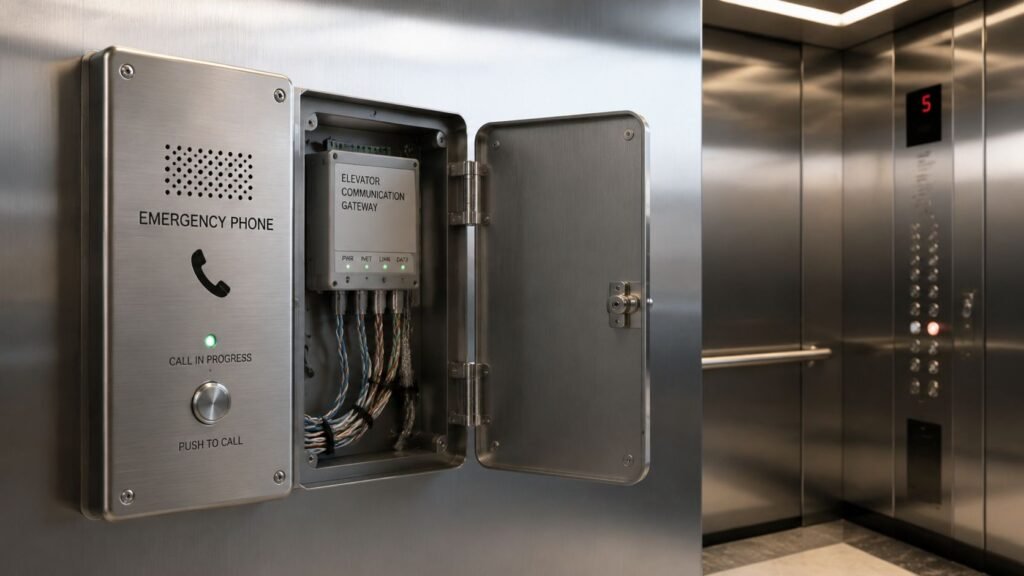
The hardware itself can vary. Some elevators use a flush-mounted speakerphone unit. Some older cabs still have handset-style equipment. The format matters less than dependable operation with the controller and communication path you have on site.
Why retrofits get complicated
In a newer building, the emergency phone is usually designed around current communication hardware from the start. In an older building, the phone may still be tied to a POTS line that the carrier wants to eliminate, or to a cellular unit installed during an earlier upgrade cycle that no longer has a supported network behind it. That is where owners run into trouble. The elevator equipment may still run fine, but the communication method behind the phone has aged out.
That is why an elevator emergency phone is never just the call button in the car. It is the full communication chain, including the in-car device, the interface hardware, the transmission method, the power arrangement, and the answering service on the other end. If one piece is outdated, the whole system is questionable.
Understanding Key Compliance and Code Requirements
A lot of Michigan owners find out they have a phone problem during an inspection, not during budgeting. The car phone still places a call, but the line feeding it was converted, the old gateway aged out with 3G, or the answering setup no longer meets current code expectations. In older buildings, that is the common retrofit trap.
Battery backup and live answering
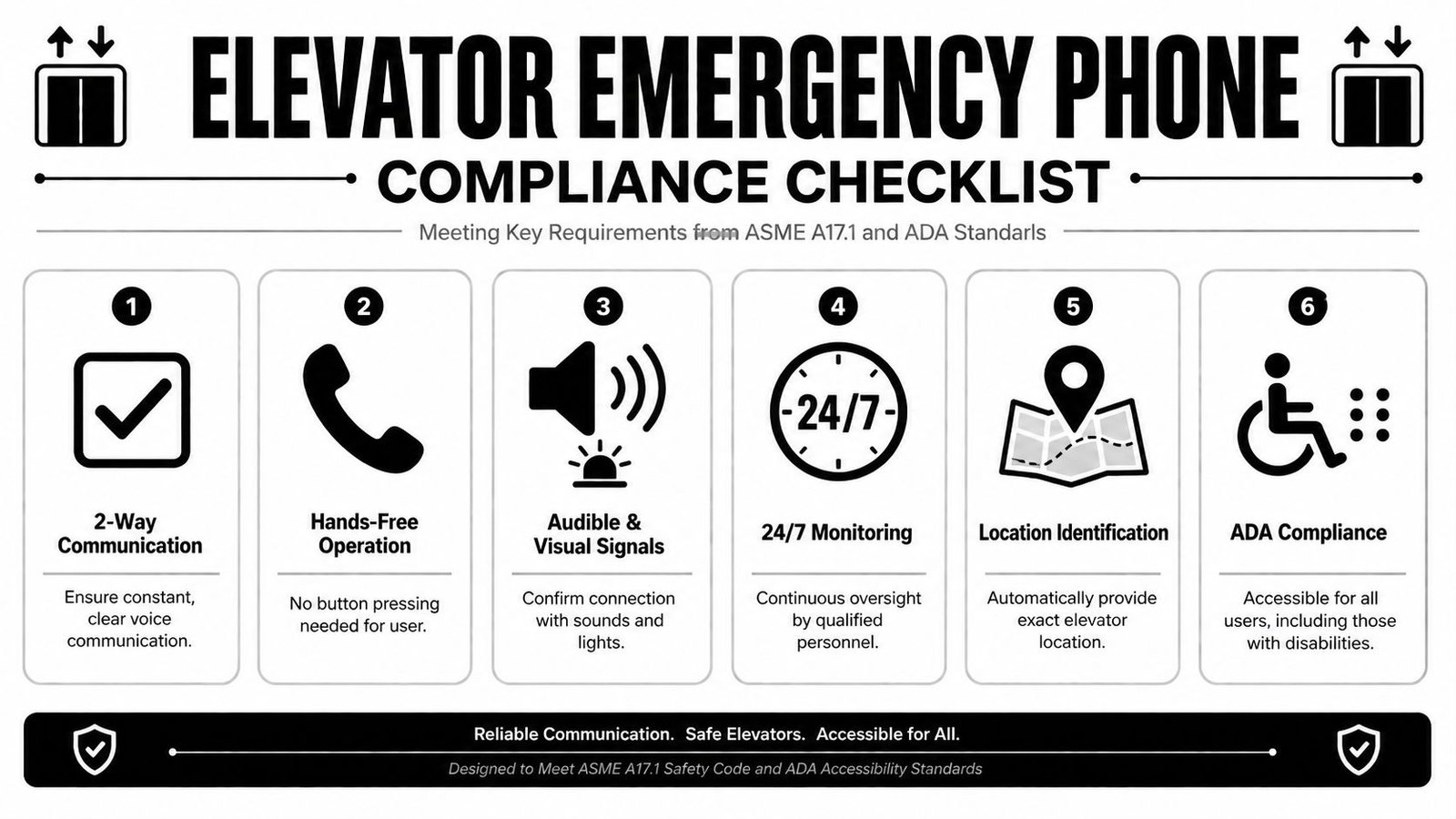
Inspectors do not care that the call box lights up under normal power. They care whether the full emergency communication system still works during an outage and whether a trapped passenger reaches a live person who can act.
Elevator emergency phone installations must provide a minimum of 4 hours of continuous talk-time battery backup during power outages, and the communication link must connect to a location continuously staffed by authorized personnel 24/7/365, prohibiting automated answering systems, according to ASHB installation guidance.
That has real retrofit consequences. In older Michigan buildings, the in-car phone may be usable, but the power supply, cellular gateway, or monitoring path often is not. A cheap gateway swap does not solve the problem if battery support is undersized or the calls route to voicemail after hours.
For owners sorting out local enforcement and inspection expectations, Crane Elevator's guide to elevator code requirements in Michigan is a good starting point.
Accessibility and physical mounting
The call device has to be reachable and operable by the passenger who needs it. Mounting height is one of the easiest items to miss on a cab renovation, especially when a newer phone is being fitted into an older panel layout.
Under the 2010 ADA Standards for Accessible Design, operable parts generally must fall within an accessible reach range. In practice, elevator emergency phone activation buttons are typically set so the highest operable part is within that allowed range.
That means field measurement matters. Shop drawings can look fine, then the installed faceplate lands too high because of an existing COP layout, added trim, or a poor retrofit choice. In older cabs, getting the mounting right sometimes takes panel modification, not just device replacement.
Communication performance in real conditions
Code compliance also depends on how the system behaves once the call is placed. The phone has to support clear two-way communication, and the answering party needs enough information to identify the building and the specific car without relying on the passenger to explain it.
This is another place older buildings get exposed. A legacy analog phone tied into a modern cellular converter may technically dial out but still produce low volume, echo, clipped audio, or failed location reporting. Those are installation problems, not paperwork problems.
Owners should also ask what happens if more than one car calls for help at the same time. In multi-car properties, the monitoring setup and line-sharing arrangement have to handle concurrent calls without dropping communication or confusing car identification.
Use this checklist before approving a retrofit proposal:
- Power loss operation: Confirm the phone, gateway, and associated power components remain functional for the required backup period.
- Live answering: Verify calls go to trained personnel at all times, not an auto attendant or general office line.
- Accessible mounting: Require field confirmation of button height and reach range after installation.
- Cab and building identification: Make sure the answering point receives clear location information for the correct elevator.
- Audio quality: Test speaker volume, microphone pickup, and two-way conversation from inside the cab.
- Multiple call handling: Ask for a clear explanation of how simultaneous emergency calls are managed.
- Inspection test: Require a full operational test under realistic conditions, including backup power if possible.
A phone that places a call is not automatically a compliant system. In older Michigan properties, the risk usually sits in the pieces around the cab station: the aging line, the unsupported wireless hardware, the battery arrangement, and the monitoring path. Those are the parts that fail inspections and create avoidable repair costs.
Comparing Phone Technologies POTS vs Cellular vs VoIP
The technology decision is where many retrofit jobs go right or wrong. In a newer building with modern infrastructure, you may have options. In an older building, the available path is usually narrower, and pretending otherwise wastes time.
Why legacy landlines are a poor retrofit plan
For years, POTS, or traditional landline service, was the standard answer. In older Michigan properties, you still see cab phones wired to communication paths built around copper service. The problem is that many owners are trying to preserve a path the telecom side is moving away from.
The retrofit problem gets sharper when the building uses older wireless conversion hardware. As copper (PSTN) lines are decommissioned and 3G gateways are no longer functional, older buildings face a "Gray Gap." If a legacy elevator phone system uses 3G, it is almost certainly no longer working, according to MobileCorp's discussion of lift emergency phone retrofits.
That Gray Gap is real in the field. The car station may still be fine. The existing pair through the traveling cable may still be usable. The dead part is the communication gateway or the service path outside the car. That's why "replace the whole elevator" is often the wrong answer. Many buildings need a gateway-only retrofit that keeps workable analog cab hardware and bridges it to a current communication method.
Side by side technology trade-offs
| Feature | POTS (Landline) | Cellular Gateway | VoIP |
|---|---|---|---|
| Fit for older retrofits | Poor long-term fit when copper service is disappearing | Often the most practical choice for legacy buildings | Can work, but depends on building network conditions |
| Dependency | Dependent on legacy carrier infrastructure | Independent of building internet network | Dependent on building internet and network equipment |
| Retrofit complexity | Can be difficult when old service is no longer available | Often integrates well with vintage analog phone interfaces | May require more coordination with IT and network power strategy |
| Best use case | Existing setup that is still active and supportable | Older buildings needing a modern path without full modernization | Buildings with robust network management and reliable support |
| Common failure risk | Carrier-side obsolescence | Poor setup if gateway and analog interface aren't matched correctly | Network outages, switch issues, or poorly planned backup arrangement |
What usually works best in older Michigan buildings
Cellular is often the cleanest answer in retrofits because it bypasses the building's fading dependence on old copper and avoids tying life-safety communication to the owner's IT environment. That doesn't mean every cellular installation is automatically compliant. The gateway still has to be integrated correctly with the elevator phone interface, monitoring setup, and backup power arrangement.
VoIP can be viable in the right building, especially where network reliability is strong and the owner understands the support burden. But in practice, older buildings with mixed equipment, uncertain wiring history, and no appetite for IT troubleshooting usually do better with a dedicated cellular gateway.
When a building owner says, "We only want to replace what's necessary," a cellular gateway retrofit is often the first option worth evaluating.
Key Installation and Wiring Considerations
A lot of retrofit jobs in older Michigan buildings go sideways after the equipment is ordered. The phone itself may be fine. The trouble usually starts with old traveling cable conductors, limited space in the controller area, or a new cellular gateway that does not play nicely with a legacy analog car station.
The wiring has to be right
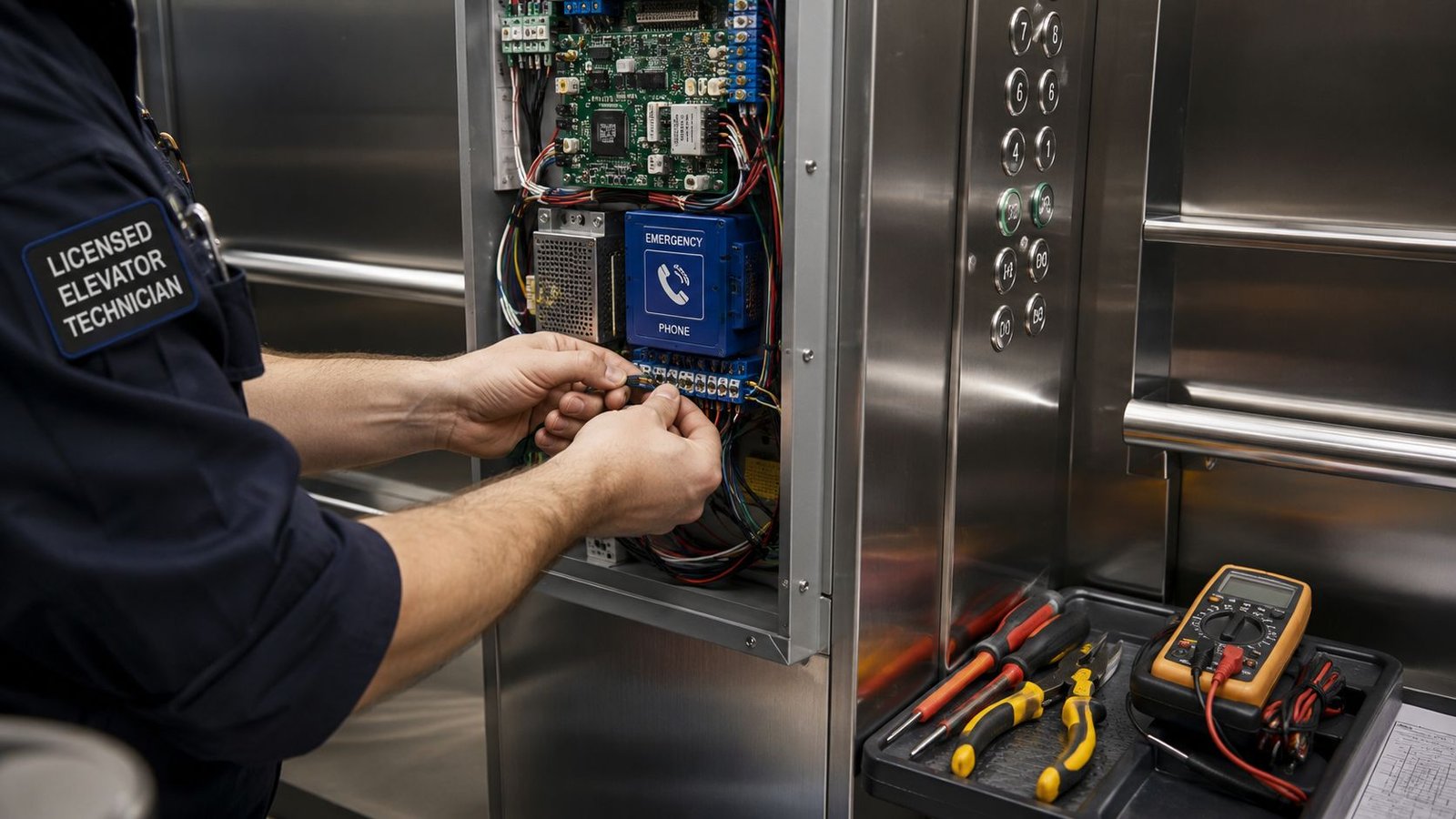
Elevator phone communication wiring is not a place to improvise. Installers typically use twisted, shielded low-voltage cable sized for the equipment, and they have to pay attention to routing, shielding, termination quality, and the condition of any conductors already in the traveling cable.
That matters in the field because elevator equipment creates electrical noise. Motors, controllers, door operators, and aging splices can all interfere with audio. The result is familiar: weak volume, noisy calls, dropped communication, or a system that passes a bench check and fails in actual service.
Older buildings add another layer of risk. I often find existing spare conductors that look usable on paper but fail once the car starts moving. Insulation dries out, old repairs get buried in the run, and undocumented modifications from past work create intermittent faults that waste hours in troubleshooting. A clean test before reuse saves money.
If the building is replacing a dead POTS line or an obsolete 3G communicator, the installer also has to confirm that the new cellular gateway can present the right analog line conditions to the elevator phone hardware. Some legacy units are picky about dial tone, line voltage behavior, or how the gateway handles disconnect supervision. That is one of the most common retrofit mistakes.
Physical layout and power planning affect the final result
The cab station still has to meet accessibility requirements. A perfectly clear call does not help if the button or handset is mounted where a passenger cannot reach it easily during an emergency.
Equipment location matters too. In retrofit work, there is rarely extra room in the car operating panel, controller space, or machine room. The installer has to decide where the gateway, interface, and power components will live, how they will be protected, and how service personnel will access them later without tearing apart finished work.
Power planning gets overlooked. Communication equipment needs to stay operating during an outage for the required period, and that means the phone path, gateway, and any supporting devices have to be matched to the building's backup strategy. Owners evaluating outage protection should also review how elevator backup power systems affect communication equipment and recovery planning.
The video below shows the kind of hands-on technical environment involved in elevator communication work.
What separates a solid installation from a shortcut
Watch for these field issues:
- Legacy analog mismatch: The gateway may power up and still fail to communicate correctly with an older elevator phone board.
- Bad reuse decisions: Existing traveling cable pairs can be noisy or intermittent, especially in buildings with decades of partial repairs.
- Poor location labeling: The monitoring side must receive the correct cab and building identification, not just a voice call.
- Shared-path assumptions: Elevator emergency communication should have a dedicated, reliable path, not an improvised connection treated like a convenience line.
- No live car test: Final testing has to happen from inside the cab, with the car in service, not only at the equipment location.
The best retrofit work in an older building keeps what is still dependable, replaces what has lost support, and verifies that the new cellular path works with the old elevator hardware before the inspector does.
Monitoring Services and Required Maintenance
The phone hardware gets most of the attention. The monitoring service is where many compliant-looking systems fail.
A building can have a new in-cab unit, fresh wiring, and a modern gateway, then still get written up because the answering service can't complete the required verification steps. That's why owners should think in terms of one system, not two separate vendors doing unrelated work.
The callback test is where weak setups get exposed
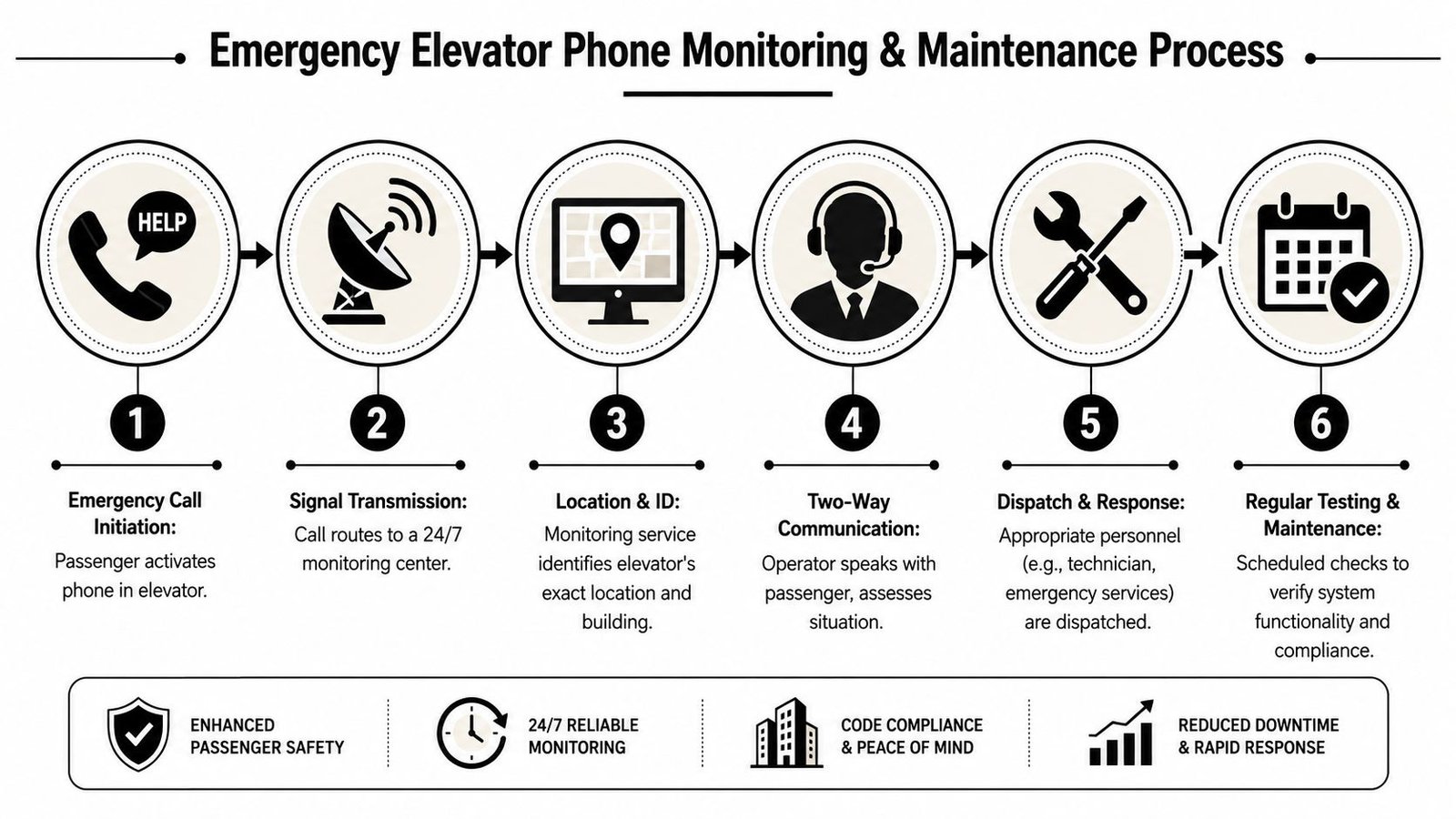
A major compliance failure point has nothing to do with a dead speaker or broken button. Many buildings face violations not because the phone is broken, but because the monitoring service fails the callback test or cannot identify the cab without aid from the caller, as explained in iFactory's elevator emergency phone monitoring compliance article.
That is exactly the sort of problem owners don't catch on their own. They press the button, someone answers, and they assume everything is fine. The inspector goes further. Can the operator identify the elevator without being told? Can they call back correctly? Can they handle the event the way code expects? If not, the installation can still fail.
A live answer isn't enough. The operator has to know where the call came from and be able to respond correctly without relying on a trapped passenger to explain it.
Maintenance is not optional
Per earlier code discussion, annual testing is part of the compliance picture, and many maintenance programs also include more frequent functional checks. The practical value of those checks is simple. They catch drift before an inspector or an emergency does.
A useful maintenance routine typically includes:
- Live call verification: Press the emergency button from the cab and confirm clear two-way audio.
- Location confirmation: Verify the monitoring center receives the right building and cab identification.
- Power review: Check that backup components are healthy and properly connected.
- Callback verification: Confirm the service can ring back to the correct elevator.
- Recordkeeping: Keep service records available for inspection and internal risk management.
What owners should ask the monitoring provider
Not every answering service is suitable for elevator emergency communication. Ask direct questions.
- Who answers the call: Is it live personnel at all times?
- What the operator sees: Does the screen identify the exact cab and building clearly?
- How callback works: Can the operator call back into the car reliably?
- How testing is handled: Will they support real acceptance and routine functional tests?
- How issues are escalated: Do they know who to contact for the building and elevator service side?
The strongest setup is boring in the best sense. Every test behaves the same way. Every operator can identify the car. Every record matches the field condition.
Budgeting for Installation and Finding a Provider
A lot of owners call after the cheap fix already failed. The old copper line was disconnected, the 3G unit aged out, or a cellular gateway was installed without checking whether the existing elevator phone could communicate with it. Then they pay for a second trip, a second round of programming, and sometimes a missed inspection.
That is why budgeting needs to start with the building you have, not a generic per-elevator number. In a newer property with clean wiring and a compatible cab phone, costs stay fairly controlled. In an older Michigan building, the price moves fast if the mechanic has to sort out abandoned phone pairs, poor machine-room signal, relay compatibility, line seizure problems, or a legacy car station that does not play well with modern cellular hardware.
What drives the price
The lowest quotes usually cover only the visible parts. Mount the device, power it up, make a test call, leave. That is not enough on many retrofits.
Ask every bidder to break out these items in writing:
- Cab equipment: New hands-free phone, interface module, or reuse of existing hardware if it is still compatible
- Communication method: Cellular gateway, VoIP interface, or another approved path that fits the building
- Signal work: Antenna placement, signal testing, and any added hardware needed to get reliable coverage in concrete or masonry structures
- Wiring and terminations: Reuse of existing traveling cable conductors when possible, or new wiring if the old path is unusable
- Programming and labeling: Correct car identification, callback setup, and monitoring center account configuration
- Acceptance testing: Live testing with the answering service and verification that the right location information appears
- Return visits: Who pays if the first inspection finds a problem with the phone path, programming, or monitoring setup
That last point matters. I have seen older buildings where the phone hardware was fine, but the actual failure was poor cellular reception in the machine room or a legacy autodialer that could not hold a stable connection through the new gateway. A low quote does not stay low if it skips that diagnosis.
Where older buildings get expensive
Older Michigan properties usually create the most surprises. Schools, municipal buildings, and pre-ADA commercial properties often have elevator equipment from one era, phone modifications from another, and building telecom changes layered on top over twenty or thirty years.
The main cost risk is compatibility. Replacing a dead PSTN or 3G path with a cellular unit sounds simple, but the field reality is more specific. Some legacy phones need extra interface parts. Some need full replacement. Some work electrically but fail on audio quality or callback once they are off the old analog line. If the provider does not test those points before installation, the owner becomes the test case.
A better approach is to budget for a site survey first, especially if the building still relies on old phone infrastructure or undocumented wiring.
How to choose the right provider
Choose a company that handles elevator communication as part of elevator compliance, not as a side job from the telecom world. The provider should be able to inspect the car phone, trace the wiring path, evaluate signal strength, coordinate the monitoring account, and explain how the retrofit will be tested before inspection day.
Look for these traits:
- Experience with legacy equipment: Older cars often need field judgment, not catalog ordering
- Comfort with PSTN and 3G replacements: The contractor should already be solving these conversions regularly
- Non-proprietary recommendations: Owners should not get locked into one vendor for future service
- Clear scope documents: Quotes should say what equipment is included, what is excluded, and who owns activation and monitoring coordination
- Michigan inspection familiarity: Local experience helps avoid preventable callback visits and compliance delays
If you are comparing firms, this list of Michigan elevator companies is a useful starting point.
Frequently asked questions
Do I need a dedicated phone line for my elevator?
You need a dedicated communication path for the elevator emergency phone. That path may be cellular or another compliant option, but it cannot depend on a tenant line or a casual building phone arrangement.
What happens during a power outage?
The system still has to communicate during the required backup period discussed earlier. The practical question for budgeting is whether the existing backup arrangement supports the new communication equipment or needs to be upgraded too.
Is a passenger's cell phone a compliant substitute?
No. The elevator needs its own installed emergency communication system.
The best budget decision usually is not the cheapest installation. It is the one that replaces aging phone service, works with the elevator you already own, and does not force another retrofit after the next telecom shutdown.