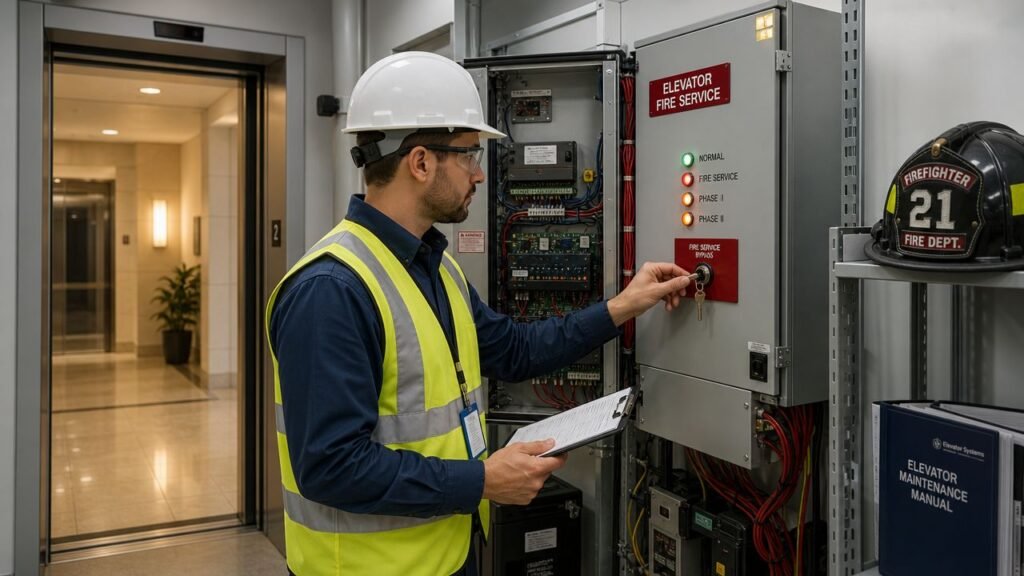
The call usually comes at the worst time. A fire alarm vendor has been on site. Your annual inspection is coming up. Or a state inspector asks for records and someone realizes the elevator fire service keys haven't been tested properly in months.
That's when many Michigan building owners find out they don't have a fire service program. They have an elevator that runs, a fire alarm that works most of the time, and a service history that may or may not prove compliance. Those are not the same thing.
Elevator fire service repair sits in the life-safety category, not the convenience category. If Phase I recall fails, the car may not return correctly for firefighter use. If Phase II fails, first responders may have a car that looks available but won't operate the way the code expects. In practice, that's where owners get exposed. Not just to violations, but to the risk of having a system that appears fixed and still fails when responders need it.
Why Elevator Fire Service Is a Non-Negotiable Safety System
A building can feel fully operational on Monday morning and still fail a fire service test that afternoon. I see that in the field when the elevator runs normally for tenants, but the moment someone turns the recall key or trips the correct alarm input, the car does the wrong thing, ignores the command, or returns with the wrong door behavior.
That matters because firefighter emergency operation is part of the life-safety system. During an alarm, the elevator has to transfer from normal automatic service to a code-required emergency mode that protects occupants and gives first responders predictable control. If that transfer fails, the problem is no longer a routine elevator issue. It is a compliance and safety issue that can stop an inspection or force corrective action.
Fire service repair means keeping emergency operation working
“Fire service repair” usually has nothing to do with post-fire damage. It means correcting the parts of the system that make recall and firefighter operation work as required. That includes the interface between the fire alarm system and the elevator, the key switches, the controller logic, the machine room and hoistway smoke detector inputs where required, door operation, signal response, and the records that show the system was tested properly.
In Michigan, owners should treat this the same way they treat other building safety controls. It needs the right diagnosis, code-based testing, and a paper trail that matches what the equipment does in the field. If your contractor repairs a relay, updates a parameter, or replaces a key switch, that work should be tied back to function. The elevator control system components that manage recall and fire service inputs are often where hidden failures start.
A common mistake is assuming that normal elevator operation proves fire service is fine. It does not. An elevator can answer hall calls all week and still fail recall because of a bad detector input, incorrect controller programming, mismatched keys, a damaged switch, or wiring problems between trades.
What this means for Michigan owners
For owners, the next step is practical.
Confirm that each car's fire service functions have been tested recently, that the test results were documented, and that the documentation identifies what was tested, who performed it, what defects were found, and how those defects were corrected. If those records are incomplete, fix that now, before a state inspection or annual test puts the gap on display.
The trade-off is straightforward:
- Delay repair work: You may avoid a service bill today, but you increase the chance of a failed inspection, repeat callbacks, and a car that does not respond correctly during an alarm.
- Repair and verify the system correctly: You pay for diagnosis, functional testing, and documentation, but you reduce exposure and give the state inspector a file that supports compliance.
Owners who stay ahead of this work usually keep a dedicated fire service file for each elevator. That file should include test records, repair tickets, any code-related corrections, and confirmation that the fire alarm and elevator contractor addressed interface issues together. That is what helps a building pass inspection with fewer surprises.
Phase I Recall and Phase II In-Car Control Explained
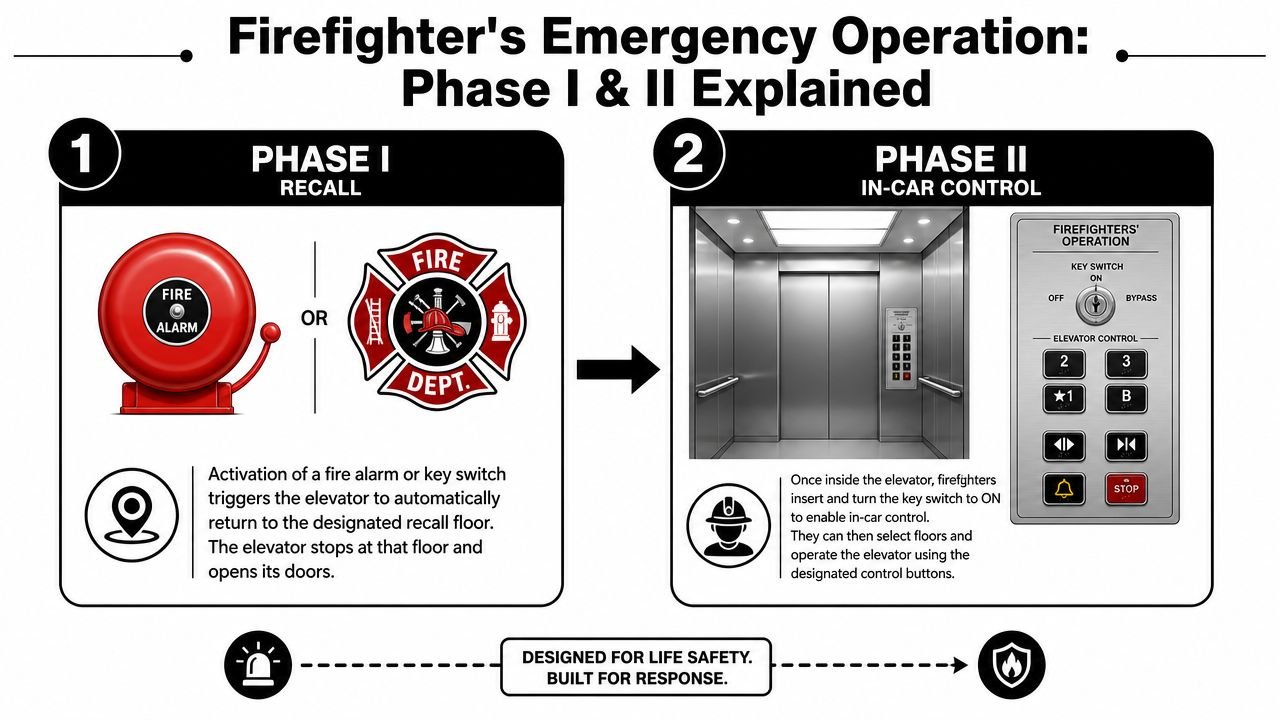
The easiest way to understand firefighter emergency operation is to treat it as a two-step transfer of control.
In Phase I, the elevator takes itself out of normal public use and returns to a designated floor. In Phase II, a firefighter takes over from inside the cab and runs the elevator manually.
How Phase I works
Think of Phase I as the automatic recall mode. A fire alarm input or keyed switch tells the elevator that normal service is over. The car is supposed to return to the designated egress floor, typically the main landing, and open its doors for emergency use.
That's not just an operational preference. It's the basis for getting the car out of regular passenger circulation and presenting it for firefighter use. The required testing protocol includes confirming that the elevator immediately returns to the main egress floor with doors open when Phase I is activated, as outlined in this fire service testing guidance from TK Elevator.
Owners often miss one important point here. A car that eventually comes back is not the same as a compliant recall. Delayed response, wrong landing, inconsistent door behavior, or failure to clear existing calls all indicate a problem that needs repair.
How Phase II works
Phase II starts inside the car. A firefighter inserts the proper key in the in-car switch and takes manual control. At that point, the elevator should only move on direct command. The doors should also behave differently from normal passenger mode.
Many weak repairs get exposed. The system has to support manual car operation, proper door open and door close hold behavior, and the expected response to floor selection and call cancellation. For owners comparing system behavior and control hardware, it helps to understand the underlying elevator control systems and components that coordinate recall, signaling, and in-car command logic.
A repaired recall switch means very little if the in-car controls still won't let firefighters run the cab the way the code requires.
The owner-level takeaway
If you only remember one distinction, remember this:
| Function | What it does | Who controls it |
|---|---|---|
| Phase I | Recalls the car to the designated floor and removes it from normal service | Building system or keyed hall switch |
| Phase II | Allows manual operation of the cab for emergency use | Firefighter inside the car |
A lot of confusion in the field comes from treating Phase I as the whole system. It isn't. A building owner can have a lobby key switch that appears to work and still have a noncompliant elevator because Phase II was never fully tested after a repair.
That's why fire service repair has to be approached as a complete functional sequence, not a single component replacement.
Navigating Michigan's Elevator Fire Service Codes
Michigan owners don't need to become elevator mechanics, but they do need to understand how code compliance is organized. The foundation is ASME A17.1, which governs firefighter emergency operation requirements and maintenance expectations for elevators. The part owners most often run into during service disputes is the testing requirement.
According to this summary of ASME A17.1 Section 8.6.11.1 and related jurisdictional variations, monthly testing is the baseline code requirement for elevator fire service, while some jurisdictions amend that schedule. That same source notes that completed repairs and tests must be logged in the Maintenance Control Program, or MCP, located in the machine room.
What Michigan owners should take from national and regional code practice
The most useful lesson for Michigan buildings is not that another state uses a different interval. It's that local enforcement matters. ASME sets the core framework, but authorities having jurisdiction can adopt, interpret, and enforce requirements in ways that affect the owner's actual compliance burden.
So if you own or manage property in Detroit, Ann Arbor, Lansing, Flint, Grand Rapids, Kalamazoo, or a smaller municipality, don't assume a generic national checklist is enough. Verify what your elevator contractor is testing, what your inspector expects to see, and whether your records show a complete fire service history.
For owners trying to align maintenance planning with enforcement, this overview of elevator code requirements in Michigan applications is a useful starting point.
The parts of the code that create the most confusion
Most fire service compliance problems fall into one of these buckets:
- Testing interval confusion: Owners assume annual inspection covers everything. It doesn't replace the required recurring fire service tests.
- Partial testing: Someone verifies recall but never runs a meaningful Phase II operational test.
- No machine room record: Work happened, but nobody entered it in the MCP.
- Wrong personnel: A building engineer or fire alarm vendor observes the system, but the corrective work still requires the right elevator trade involvement.
The same ASME-related guidance also identifies practical examples of defective fire service operation. A system may be defective if it fails to emit the required audible buzzing tone during Phase I activation or if, during Phase II, the doors don't remain closed while the DOOR CLOSE button is held and only respond as required when the control is released. Those are the kinds of details inspectors and qualified mechanics look for because they show whether the elevator will behave properly under emergency control.
What usually passes inspection and what usually doesn't
A compliant Michigan setup usually has three things in place:
- A current test history
- Repairs performed after deficiencies were found
- An MCP entry that documents the work clearly
A noncompliant setup often has service invoices but no proper machine-room log, or a record that says “fire service checked” without indicating what was tested.
State inspection problems often start as paperwork problems, but they end as operational problems. If the record is weak, the test usually was too.
For Michigan owners, the safe approach is to manage fire service as a code-controlled maintenance item with local verification, not as a one-time feature installed years ago and assumed to still work.
What Breaks and How to Spot the Warning Signs
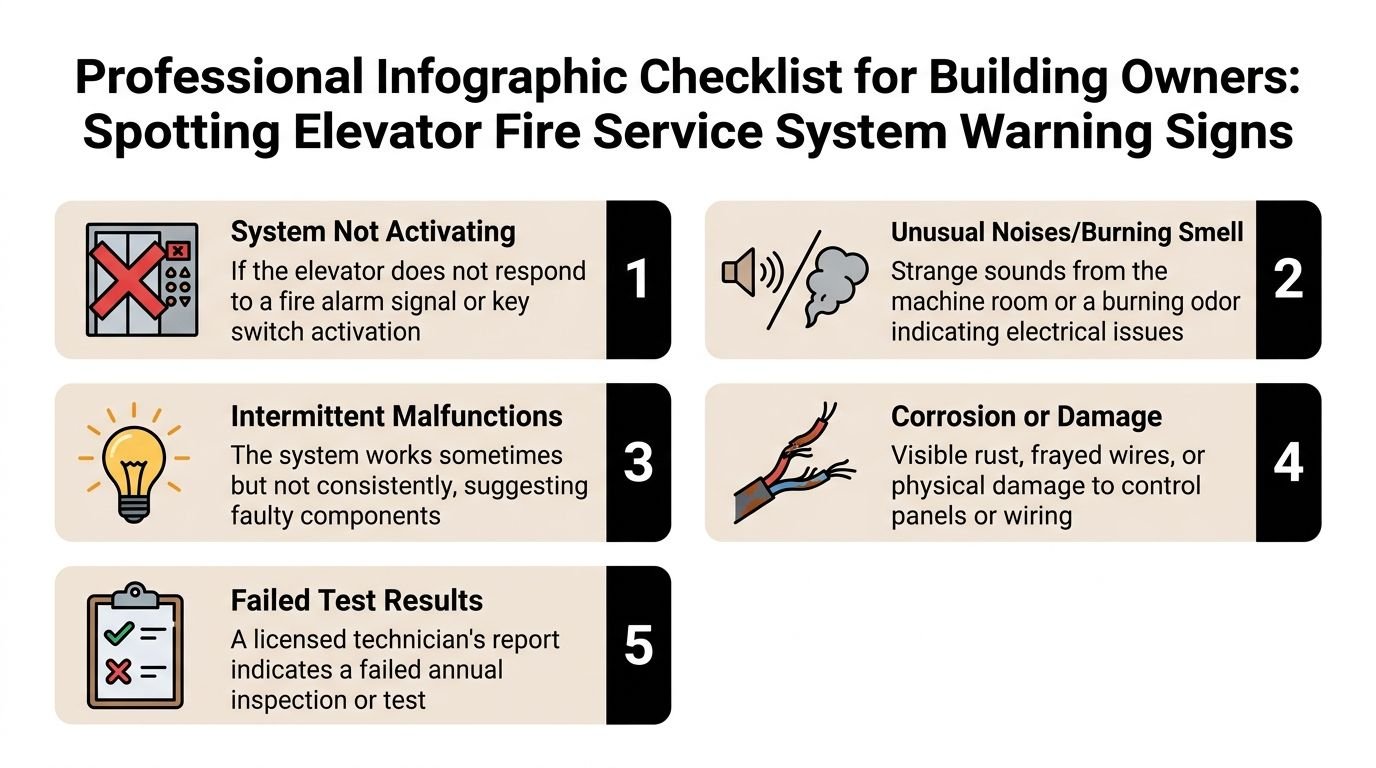
Most elevator fire service failures don't start with dramatic symptoms. They start with small inconsistencies. A key switch feels loose. Recall doesn't happen immediately. The buzzer or signal doesn't behave the way it should. Then the system fails when somebody finally runs a proper test.
That's why owners and facility managers should know what bad fire service looks like in the field, even if they're not the people doing the repair.
The failure points seen most often
Some defects are mechanical. Others are electrical or logic-related. In practice, the common problem areas include hall key switches, in-car key switches, signal wiring between the fire alarm system and the controller, relay logic, and controller inputs that don't process recall commands correctly.
You may also see failures tied to door operation. A system can appear to recall properly and still fail the emergency function because the doors don't respond correctly under Phase II control.
A frequently overlooked point in fire service repair is that a “fixed” switch is not enough. According to Fire Engineering's discussion of elevator use at high-rise fires, a system is not safe unless it passes the Phase II manual car control test, including proper door open and door close hold functionality. That same source notes that hoistway illumination must be at least 1 foot-candle (11 lux) during firefighter operation.
What an owner can observe without opening equipment
You don't need to diagnose circuitry to notice warning signs. Watch for behavior that suggests the system isn't completing the sequence correctly.
- Recall is slow or inconsistent: The car doesn't return promptly after activation, or it behaves differently from one test to the next.
- Signals are missing: Required visual or audible indications don't appear during activation.
- Door behavior is wrong: The cab doors don't hold closed properly during manual operation, or they respond like normal passenger doors.
- Key operation is unreliable: The switch turns roughly, sticks, or only works after repeated attempts.
- The test report is vague: If a technician says “fire service repaired” but can't describe the full Phase II check, assume more verification is needed.
What doesn't work in the field
Owners often get into trouble by accepting these shortcuts:
| Shortcut | Why it fails |
|---|---|
| Replacing only the hall key switch | Doesn't prove controller logic or in-car operation works |
| Relying on a fire alarm test alone | Doesn't confirm full elevator Phase II behavior |
| Treating intermittent operation as acceptable | Emergency systems can't be “usually fine” |
| Skipping lighting review | Firefighter use depends on conditions beyond the switch itself |
If a technician can't tell you how the car performed on call cancel, floor selection, and door hold under Phase II, the repair isn't finished.
Another practical issue from firefighting operations is travel strategy. Firefighters are advised to stop at least two floors below the fire floor during high-rise fire operations, which reinforces why the elevator must respond predictably and manually once they enter the cab, as discussed in the Fire Engineering source above.
For owners, the lesson is simple. Don't wait for an inspection failure. If the system acts erratically during any test, schedule a full fire service diagnosis.
From Diagnosis to a Compliant System
A state inspector does not care that a part was replaced last week. The inspector wants to see a fire service sequence that works from start to finish, on command, under test. That is the standard Michigan owners need to manage against.
Step one is controlled fault isolation
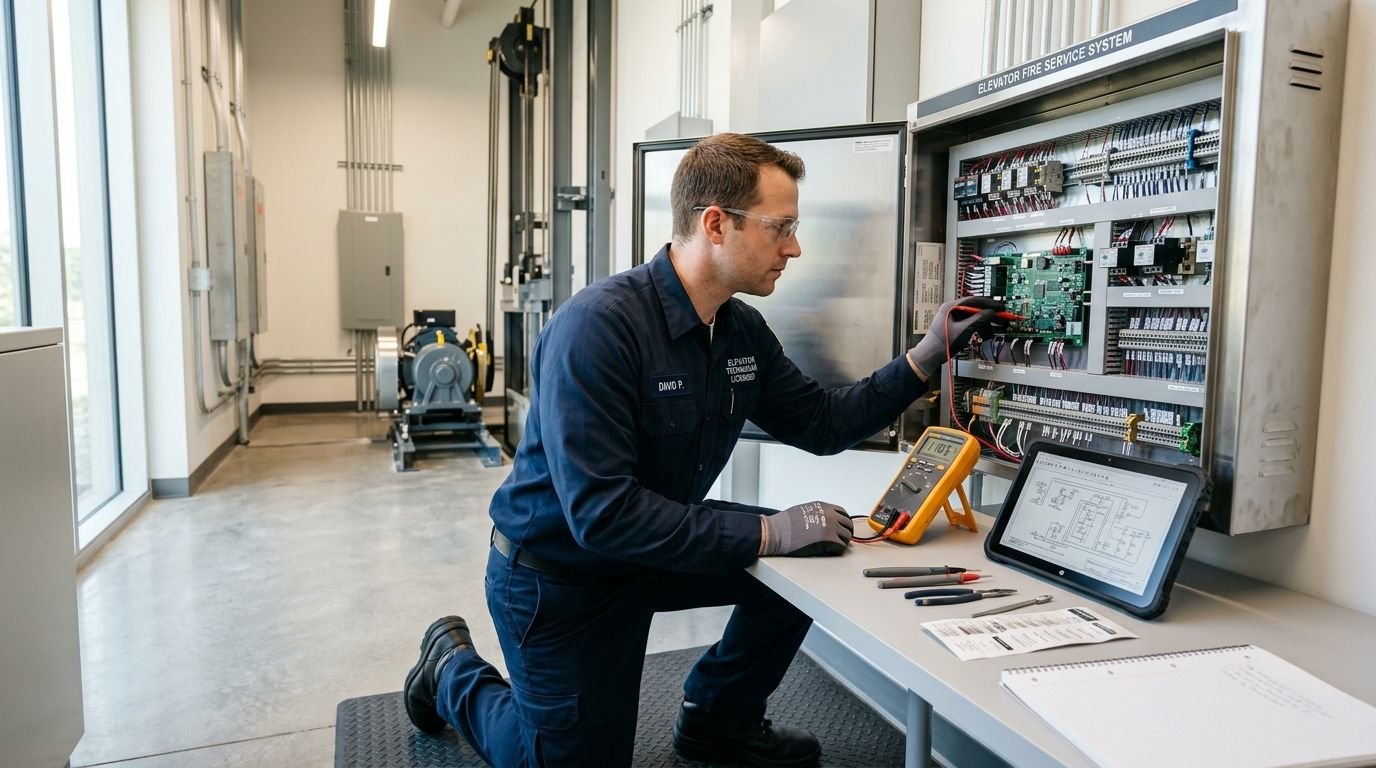
A proper repair starts with diagnosis. Fire service problems can originate at the hall key switch, the car key switch, the fire alarm interface, traveling cables, controller inputs, door operators, or software parameters inside the controller. If a mechanic replaces the first suspicious part without proving the fault path, the elevator may pass a quick spot check and still fail the full sequence.
The first job is to recreate the problem under controlled conditions and document exactly where the sequence breaks. In the field, I look for a specific failure point. Does recall initiate at all. Does the car go to the correct landing. Do the doors open and stay open when required. Does the car accept Phase II commands and respond properly to door open, door close, and call cancel inputs.
That distinction matters because each failure points to a different repair path.
Step two is correcting the actual cause
Once the fault is isolated, the repair can be narrow and defensible. That may involve replacing a worn key switch, repairing a broken conductor, correcting an input module, adjusting door operation under firefighter control, or fixing controller logic that is not processing the fire service input correctly.
Experience matters in this step. A mechanic has to know whether the visible failure is the root cause or only the symptom. A sticky hall switch may be real, but it may not be the reason recall failed. I have seen buildings approve a switch replacement, then fail inspection again because the controller never received a stable input or because the car logic was still mishandling Phase II operation.
Three repair categories show up repeatedly in Michigan service work:
Initiation path faults
The recall command never reaches the controller correctly because of switch failure, fire alarm interface trouble, wiring damage, or a bad termination.Controller execution faults
The controller sees the signal but does not perform the required recall sequence, does not prioritize the designated landing correctly, or drops out of fire service unexpectedly.In-car operation faults
The car enters Phase II, but floor selection, door hold behavior, call cancel, or door close operation does not respond the way firefighters need it to.
Step three is full sequence verification
The work is not complete when the original symptom disappears. The system has to be retested through the full fire service sequence. Owners should expect verification of recall, key operation, signal response, in-car control, and door operation under Phase II. A partial retest is a common reason repairs come back.
In Michigan, that retest should also match what the inspector is likely to ask the mechanic to demonstrate. If the contractor only verifies one switch input and leaves the rest to assumption, the owner is carrying the risk.
A useful post-repair check should confirm:
- Correct recall landing: The car returns to the designated level required by the configuration and opens as intended.
- Stable fire service activation: Hall and car key switches engage cleanly, without intermittent response.
- Proper car command response: Floor selections, call cancel, and manual door functions work correctly during Phase II.
- Predictable door behavior: Doors respond under firefighter control and do not revert to normal passenger timing.
- Clear deficiency closure: The service record states what failed, what was corrected, and what was retested.
Owners should ask one direct question before closing out the ticket. “What exact step in the fire service sequence failed, and how did you verify it now passes?” If the answer is vague, the repair is not ready for inspection.
The standard is simple. Diagnose the fault. Correct the cause. Retest the full sequence. Record the result clearly. If one of those steps is missing, the system is not ready to call compliant.
Your Role in Maintaining and Documenting Fire Service
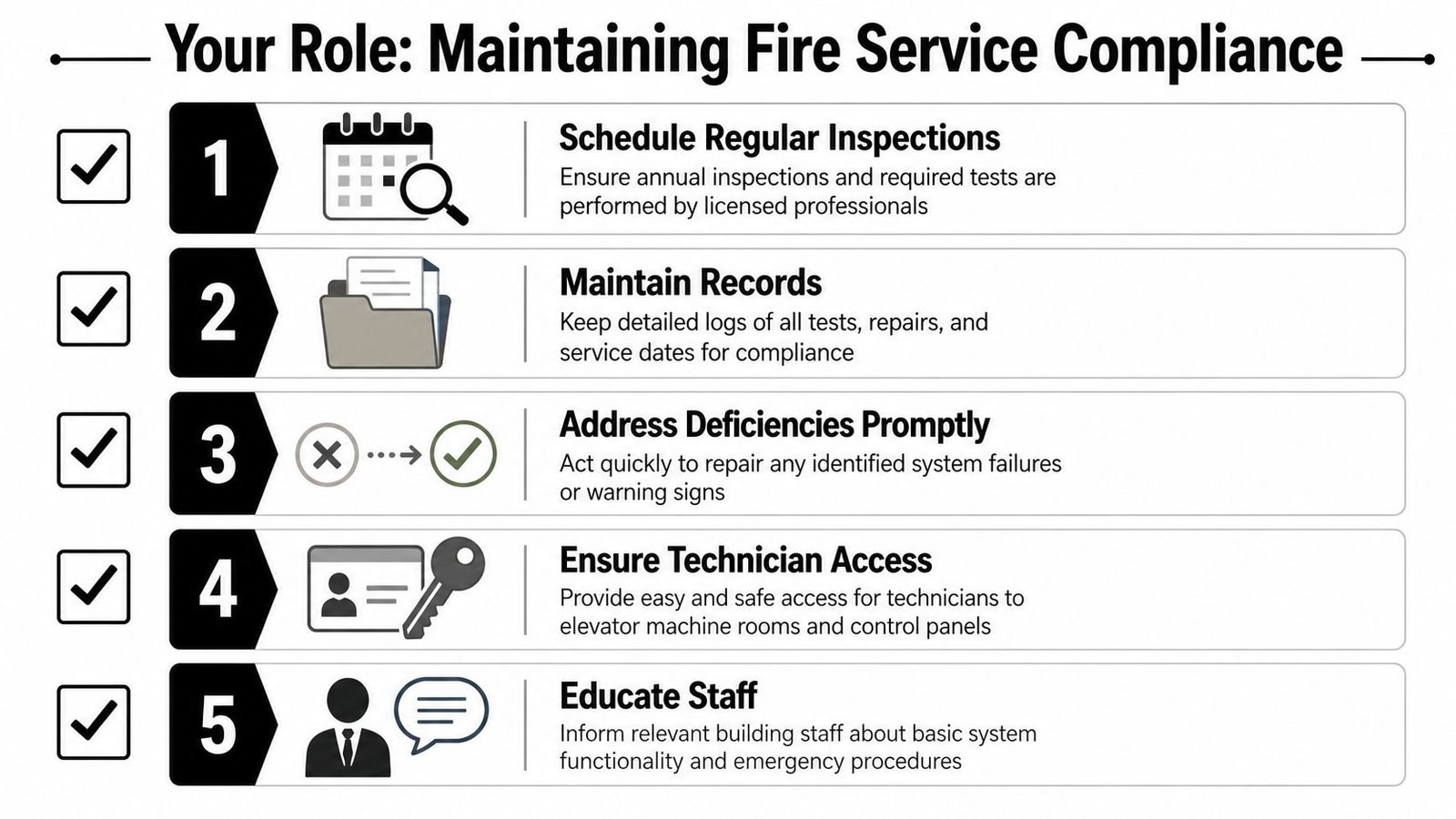
The owner isn't expected to perform the repair, but the owner is responsible for making sure the repair and testing program exists. That responsibility becomes very real during a state inspection, after a failed test, or after a complaint from tenants or staff about elevator behavior during alarm conditions.
The single most important document in this process is the Maintenance Control Program, or MCP. It's the on-site record that shows what was tested, what failed, what was repaired, and when the work occurred.
What building owners should verify every time
Don't assume the contractor handled the paperwork just because the elevator is back in service. Ask to see what was entered into the MCP and compare it to the service ticket.
A useful owner checklist looks like this:
- Confirm the date: Make sure the test or repair date is recorded clearly.
- Identify the mechanic: The record should show who performed the work.
- State the deficiency: “Adjusted switch” is weak documentation. The record should say what failed.
- Record the correction: The entry should describe the repair in a way an inspector can follow.
- Verify the retest: There should be a clear indication that fire service was retested after correction.
What inspectors usually want to see
In practice, owners get better inspection outcomes when records show a clean chain from test to deficiency to correction. Inspectors don't like gaps, vague language, or unsigned logs.
The MCP is your proof that the elevator wasn't just serviced. It was maintained under a code-based process.
Just as important, building staff need to support access. If machine rooms are blocked, keys are missing, or no one can provide prior records, even a competent contractor loses time and the owner loses control of the process.
For Michigan facilities, especially healthcare, education, municipal, and multi-tenant commercial properties, the best habit is to treat fire service records as part of the building's life-safety file. Keep invoices, test notes, deficiency reports, and the machine-room log aligned. That makes it much easier to answer inspection questions without scrambling.
How to Partner with a Qualified Elevator Contractor
A Michigan owner usually calls for help after one of three events. An annual test failed. The fire alarm contractor changed a device and the elevator no longer recalls correctly. Or a state inspector asked for records the building could not produce. At that point, the contractor you hire needs to do more than swap parts. The job is to identify the actual failure point, correct it in a code-compliant way, and leave a paper trail that will stand up during inspection.
That requires a contractor who understands fire alarm interface, elevator controls, door operation, recall logic, key switches, and MCP documentation. In the field, I see owners lose time and money when the service provider treats fire service as a generic callback. The elevator may run again, but the building still cannot show a clean test, a clear correction, and a retest.
What to ask before you authorize work
Start with questions that expose process, not sales language:
- How will you verify both Phase I and Phase II operation: The answer should include hall recall, alternate landing logic where applicable, in-car operation, door behavior, and return to normal service.
- What documents will you leave onsite: Ask for the service ticket, deficiency description, corrective action, and MCP entry details.
- How do you isolate intermittent faults: Good contractors describe how they trace smoke detector input, shunt trip conflicts, controller logic, and wiring issues that fail only during testing.
- Who can perform the work on this specific equipment: Some systems are straightforward. Others involve proprietary access, discontinued parts, or older relay logic. You need a direct answer.
- What is your plan if the repair changes the test outcome: The contractor should be prepared to retest and document the final status, not stop at a partial fix.
- Are you familiar with Michigan enforcement expectations: State rules control the inspection process, and local experience helps avoid preventable delays.
If you are comparing providers, look for a reliable elevator company serving Michigan properties that works across multiple manufacturers and can explain the limits of proprietary equipment before you approve the job.
Price still matters, but it is not the first screen. A low bid can turn into multiple callbacks if the mechanic fixes the symptom and misses the interface problem between the fire alarm system and the elevator controller. A better contractor will tell you upfront whether the issue appears to be in the elevator equipment, the initiating device, the machine room wiring, or the documentation.
What to do next
Use this order:
- Pull the MCP, latest test record, and last deficiency notice before the contractor arrives.
- Confirm building staff can provide machine room access, hoistway access if needed, and all required fire service keys.
- Ask for a fire service specific assessment, not a general maintenance visit.
- Require a written finding that states what failed, what was corrected, and what still needs outside trades such as fire alarm or electrical.
- Do not close the job until Phase I and Phase II are retested and the record is updated.
Owners get better results when they manage this as a life-safety correction, not a routine service call. That is the practical difference between getting the elevator running and getting the building through inspection.