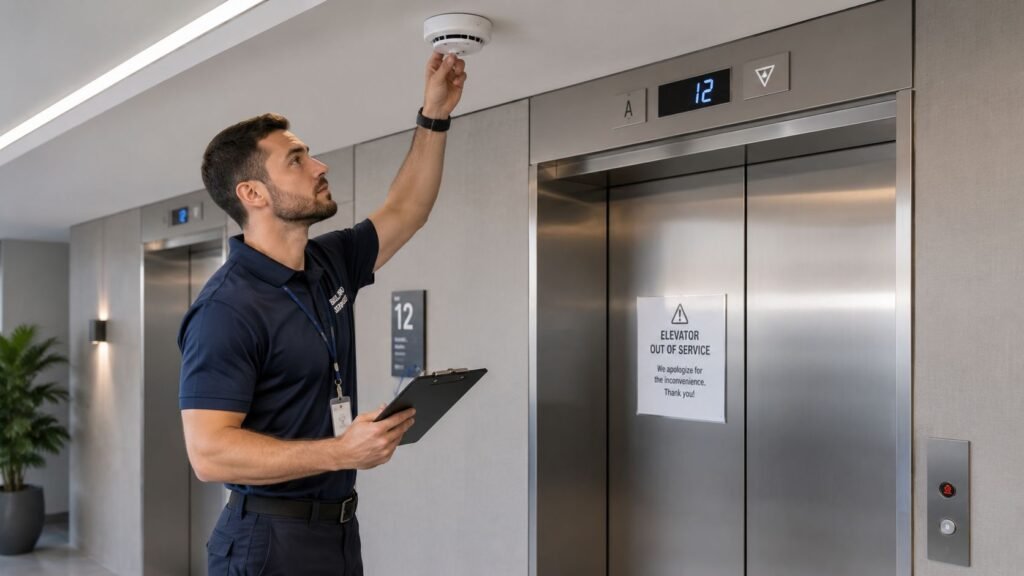
The call usually comes in the same way. An elevator is on recall, tenants are gathered in the lobby, someone wants an answer in five minutes, and the fire panel is showing a trouble or alarm that nobody in the office fully understands. At that moment, the physical detector matters, but the workflow around the outage matters just as much.
When an elevator goes down because of a smoke detector issue, building managers have to do three jobs at once. They have to protect life safety, keep the building compliant, and communicate clearly enough that residents, employees, visitors, and vendors know what to do next. If any one of those gets missed, a short outage turns into confusion, callbacks, and avoidable risk.
Elevator smoke detector repair is rarely just a repair ticket. It's a coordination problem between the elevator contractor, the fire alarm contractor, building staff, and the people trying to use the building.
First Response to an Elevator Smoke Detector Fault
The first mistake many buildings make is assuming the detector itself has failed. In real service work, that's often wrong. Only 15% of real-world elevator recall trouble cases are caused by the detector itself, while 85% arise from interface wiring, grounding issues, or fire alarm panel configuration errors, according to Vector Fire's explanation of elevator recall trouble.
That single point changes your first response. If you call only the elevator company and tell them to “replace the detector,” you may send the wrong trade to the site first and lose hours.
Start with life safety, not assumptions
If there is any sign of actual smoke, heat, or fire, follow your emergency procedures first. Don't treat an active event like a nuisance recall. Secure the area, keep people away from the affected landing, and involve emergency responders when needed.
If there is no sign of fire, move into triage mode. Your job in the first half hour is to collect enough detail that the right people can diagnose the problem fast.
Practical rule: Don't ask, “Is the detector bad?” Ask, “Where did the recall signal originate?”
What to gather in the first 30 minutes
Use a written checklist. Verbal reports get sloppy fast, especially when front desk staff, security, maintenance, and tenants are all reporting different things.
Identify the affected equipment
Record the elevator number or car designation. In a multi-car group, note whether one car recalled or all cars did.Read the fire alarm panel message exactly
Don't paraphrase. Take a photo if your procedures allow it. “Elevator lobby smoke,” “hoistway detector,” “pit detector,” and “recall interface trouble” lead to different next steps.Note the location of the initiating point
Was it the lobby outside the elevator, the hoistway, the machine room, or the pit? That matters for both code and dispatch.Ask what changed today
Dust-producing work, ceiling access, welding nearby, housekeeping activity, water intrusion, and panel work can all matter. Even routine vendor work can trigger false recall conditions.Confirm current elevator status
Is the car parked at recall level, shut down, showing fire service operation, or unavailable with doors open? That tells the elevator contractor what condition they're walking into.Assign one building contact
One person should talk to both contractors. Split communication causes duplicate dispatches and crossed instructions.
Get the right contractor on site first
If the fire panel is showing trouble tied to interface wiring or programming, the fire alarm contractor may need to lead diagnosis. If the elevator is in recall and the signaling path appears intact, the elevator contractor may need to verify how the controller is responding.
In practice, many outages need both trades. Say that plainly on the call. Tell each contractor the other has been contacted and ask for coordination, not isolated troubleshooting.
For urgent dispatch needs, building managers often rely on a dedicated elevator emergency repair team that can respond quickly while coordinating with the life-safety side of the building.
Secure the scene and begin documentation
Before any technician arrives, post temporary out-of-service messaging, stop people from attempting to use the car, and start an incident log. Include:
- Time of first report
- Who observed the condition
- Panel message or alarm description
- Immediate actions taken
- Contractors contacted and when
- Any tenant accessibility concerns reported
That log becomes the backbone of your compliance file later. It also keeps your evening shift from repeating the same questions your day team already answered.
Posting Compliant and Clear Breakdown Notices
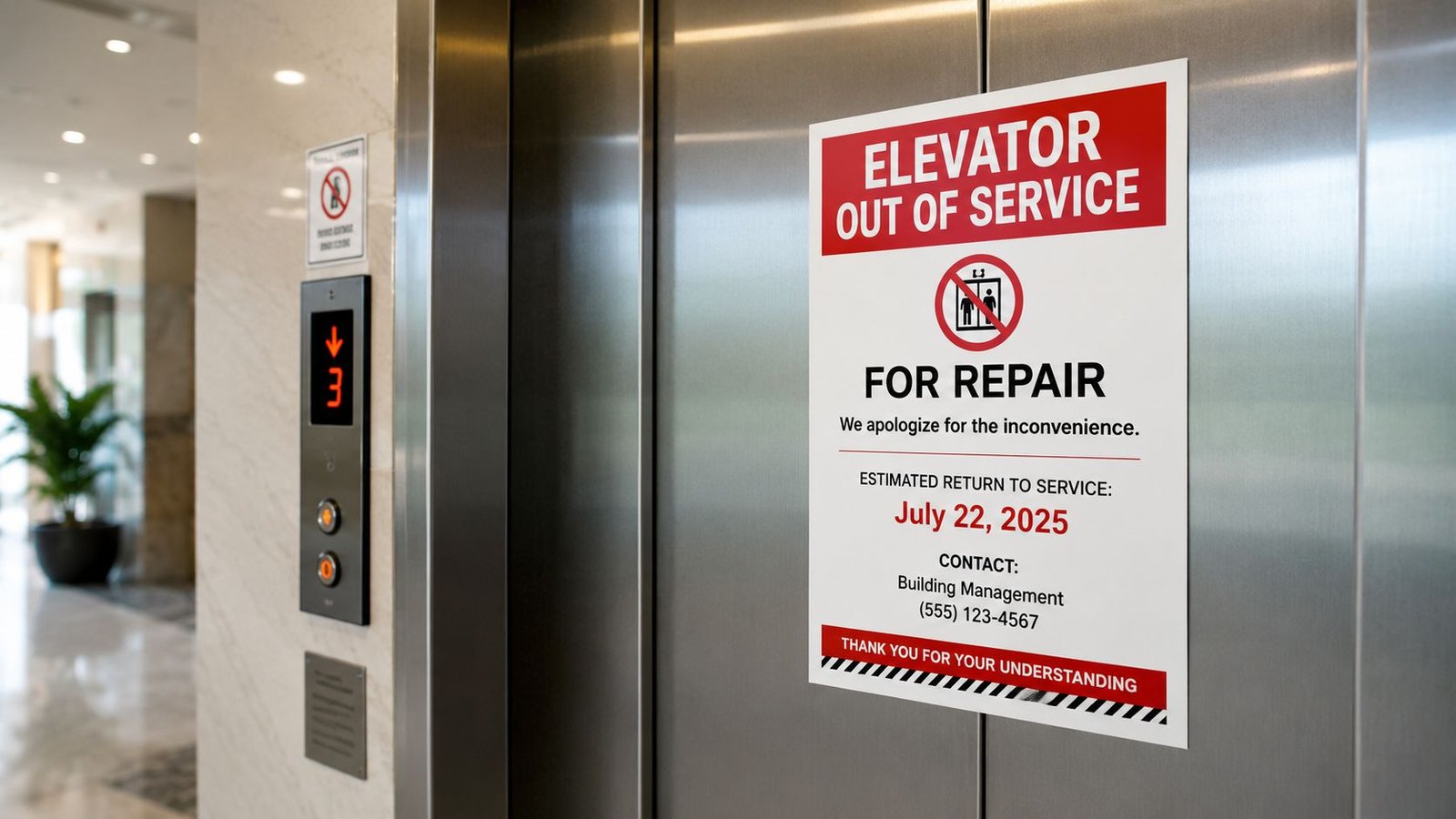
Once the elevator is confirmed out of service, a handwritten “USE OTHER ELEVATOR” note isn't enough. The notice has to do three things at once. It has to warn people, direct them, and answer the first questions they're going to ask.
That means clarity beats cleverness. Large type, plain language, strong contrast, and placement at the point of decision matter more than polished branding.
What the notice needs to say
A good notice tells occupants what's happening, what to do instead, and who to contact if they need help. Keep it short enough to scan while standing in a lobby.
Include these elements:
Clear status
State that the elevator is out of service. Don't use vague phrases like “temporarily unavailable” if the car can't be used.Reason in plain language
“Elevator shut down pending smoke detector and recall system service” is better than internal jargon.Alternative route
Point to another elevator, accessible entrance, stair tower, or staffed assistance point.Update timing
If you don't have a repair completion time yet, say when the next update will be posted.Contact method
Give the management office, concierge desk, security post, or maintenance line for questions.Accessibility instruction
Tell occupants how to request assistance if they can't use stairs.
Where to post it
The door sign is only one part of the job. People need information before they stand in front of a disabled elevator.
Use multiple locations:
- At every affected elevator entrance
- In the main lobby
- At accessible entrances
- In mail rooms, management offices, and package areas
- At security or reception desks
- Inside building apps or digital directories if available
If the outage affects travel to a clinic, school office, leasing office, or public counter, place notices there too. The less backtracking people do, the calmer the building stays.
A notice should answer the question a frustrated occupant is about to ask before they ask it.
Good notice versus bad notice
Bad notice
ELEVATOR DOWN. REPAIR IN PROGRESS.
Good notice
ELEVATOR OUT OF SERVICE
This elevator has been removed from service pending inspection of the smoke detector recall system.
Please use Elevator B on the north lobby side, or contact the management office for accessibility assistance.
Next status update will be posted by 3:00 PM.
Questions: Building Office, Security Desk, or posted tenant app alert.
The difference is simple. The bad notice tells people there is a problem. The good notice tells people what to do.
Keep the notice readable and accessible
For ADA-conscious communication, use high contrast, avoid dense paragraphs, and place the notice where a person approaching the elevator can read it without blocking traffic. If your building serves residents or visitors with vision, mobility, or language-access needs, pair the printed notice with staff support and digital communication.
If your team needs a baseline example of what an elevator outage posting should communicate, this elevator out of service notice reference is a useful starting point.
Also, date every notice. An undated sign makes people think the building lost control of the situation days ago, even if the issue started an hour ago.
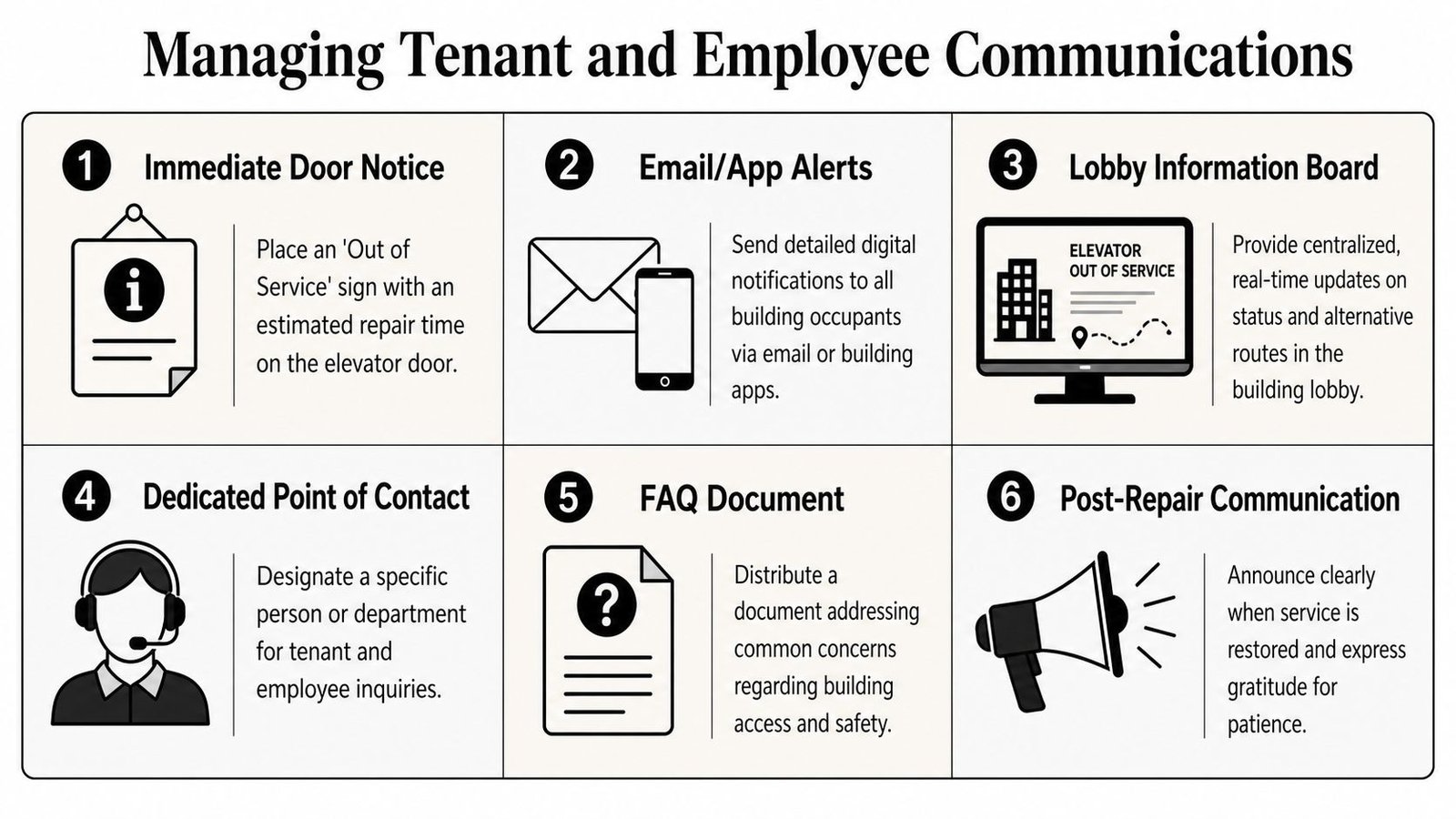
Managing Tenant and Employee Communications
A breakdown notice handles the doorway. It doesn't handle the building. Significant pressure starts when people ask whether they can reach their office, get a delivery upstairs, leave for lunch and come back, or access a unit if they can't use stairs.
Different occupants need different messages. The mistake is sending one generic blast and assuming it covers everyone.
Residential building example
In a residential property, the most urgent concern is usually access. A parent with a stroller, an older resident, or someone with a mobility limitation reads the outage differently than a tenant on the second floor.
Send a message that leads with access, not mechanics.
Template for residents
Subject: Elevator Out of Service Update
One elevator is currently out of service while contractors inspect the smoke detector recall system.
Building staff have posted notices at the elevator and lobby. If you need mobility assistance, please contact the management office or front desk immediately so staff can assist with access arrangements.
We'll send the next update by [time].
That wording avoids technical over-explaining while addressing the issue occupants care about first.
Office building example
In office properties, the problem is traffic flow and business interruption. Tenants need to know whether the remaining elevator capacity is stable, whether deliveries should be delayed, and whether visitors should enter through another lobby.
Template for office tenants
Subject: Elevator Service Interruption
Elevator [designation] is out of service pending contractor diagnosis related to the building fire recall system. Please direct staff and visitors to the alternate elevator bank until further notice.
If your suite has scheduled deliveries, client visits, or accessibility needs this morning, contact building management so we can coordinate routing and timing.
Next update will be issued by [time].
That message gives tenant companies something they can forward internally without rewriting it.
Retail, clinic, and public-facing example
Public visitors don't read long notices. They need short instructions in the channel they're already using, usually front desk staff, lobby signs, or appointment reminders.
Template for public-facing occupants
Elevator service is temporarily unavailable in this entrance lobby. Please use the alternate entrance or ask on-site staff for accessible routing assistance. Building management will post updates as service information becomes available.
Pick one voice and keep it consistent
The building should sound like one operator, not four departments. Security, front desk, leasing, maintenance, and management should all work from the same update text.
A simple communication sequence works well:
| Time | Action | Audience |
|---|---|---|
| Immediately | Door notice and lobby notice | Everyone on site |
| Shortly after confirmation | Email or app alert | Tenants, staff, residents |
| As needed | Direct calls to affected occupants | Accessibility cases, key tenants, scheduled visitors |
| After technician update | Revised ETA or status note | All affected parties |
| Return to service | Final all-clear | Entire building |
Use one contact point for replies. If residents call the front desk, office tenants email property management, and vendors text the chief engineer, nobody sees the full picture.
For buildings that want occupants to understand how repair response and follow-up usually work, a general elevator repair service overview can help support your internal messaging.
“We don't have a completion time yet” is acceptable. “We have no information” is what frustrates people.
Coordinating with Your Elevator Service Provider
A productive service call starts before the technician arrives. The better your handoff, the faster the diagnosis moves from guesswork to verification.
What the elevator provider needs from you isn't a theory. They need exact conditions. Which car is affected. What the fire panel shows. Whether the issue followed dust-producing work, water entry, or recent alarm work. Whether the car is sitting at recall level or fully shut down.
Ask compliance questions, not just repair questions
Smoke detector issues in elevator systems are tied to code function, not only device condition. The NFPA 72 requirement discussed by Security Sales notes that the 2013 edition of NFPA 72 mandated a smoke detector in an elevator pit if a sprinkler is also present in that pit, and section 21.3.7 requires that detector to initiate elevator recall. The same article notes that this requirement was retained in the 2019 edition.
For a building manager, the takeaway is practical. If a pit detector is being repaired or replaced, the conversation can't stop at “the new detector fits.” It has to include whether the detector is appropriate for that environment and whether recall function has been verified after the work.
What to tell the dispatcher
When you call, have this information ready:
- Building name and address
- Elevator number or bank designation
- Current elevator behavior
- Exact fire panel text or photo reference
- Detector location if known
- Whether a fire alarm contractor has been contacted
- Any access restrictions or escort requirements
- Whether occupants need priority accommodation
That level of detail helps the provider decide whether to send a route mechanic, a troubleshooter, a fire service specialist, or coordinate a two-trade visit.
What to ask before authorizing work
Building managers should ask questions that tie the repair back to operation and compliance.
Use questions like these:
- What are you seeing on the elevator side versus the fire alarm side?
- Is this a device issue, an interface issue, or do we still need the fire alarm contractor to confirm?
- If you clean or adjust the detector, what testing will confirm recall still operates correctly?
- If replacement is recommended, what code function needs to be reverified before return to service?
- What written documentation will I receive when the work is complete?
Those questions do two things. They slow down premature part-swapping, and they make it clear that return to service must be documented, not assumed.
Keep the two-trade relationship managed
These jobs often stall because each contractor says the issue is on the other side. The building manager has to control that loop. Ask for a direct technician-to-technician conversation while both are on site or available by phone.
If one contractor clears their side, ask for that in writing or in the service notes. That way the second contractor isn't starting from zero. It also keeps your internal record clean if the outage stretches across shifts or days.
Documenting Repairs and Managing Return to Service
The elevator isn't back until your paperwork is back. That's where many buildings get exposed. The car starts running again, the signs come down, and nobody has a clean record of what failed, what was tested, and what was verified.
For smoke detector-related outages, the file matters because this is a life-safety interaction, not an ordinary comfort complaint.
What your repair record should include
Get a written report from the service provider before you close the incident internally. That report should identify the condition found, the work performed, and the testing completed before return to service.
Your internal file should contain:
- Date and time of outage
- Who reported the issue
- Photos of posted notices
- Fire panel message or screenshot if permitted
- Elevator contractor work order
- Fire alarm contractor work order, if involved
- Description of parts cleaned, adjusted, or replaced
- Confirmation of operational testing
- Time returned to service
- Final communication sent to occupants
Record how cleaning was performed
This point gets missed. Fire Testing Solutions notes that NFPA 72 permits annual cleaning and sensitivity adjustment for addressable detectors, and it also warns that compressed air cleaning is prohibited because it can damage sensors.
That should appear in your records when cleaning is part of the corrective action. If the vendor cleaned and adjusted rather than replaced, the documentation should reflect that compliant methods were used and that the detector was tested afterward.
If the invoice says only “serviced detector,” ask for more detail before you file it away.
Return-to-service checklist
Don't reopen the elevator on assumption. Use a short release checklist.
Confirm both trades are clear
If the fire alarm contractor was involved, make sure their side is also closed out.Verify testing is complete
The repair should include the relevant functional confirmation, not only installation or cleaning.Remove outdated notices
A stale out-of-service sign left on a side entrance causes confusion even after the car is running.Send the all-clear
Use the same channels you used for the outage notice.Archive the file
Put the incident in the building's maintenance and compliance records, not just someone's inbox.
Close the communication loop
The final message doesn't need to be long. It needs to be definite.
A good example:
Elevator [designation] has been returned to service following contractor inspection and corrective work related to the smoke detector recall system. Posted outage notices have been removed. Thank you for your patience during the service interruption.
That final step reduces repeat calls, tells tenants management stayed on the issue, and gives your team a clean endpoint.
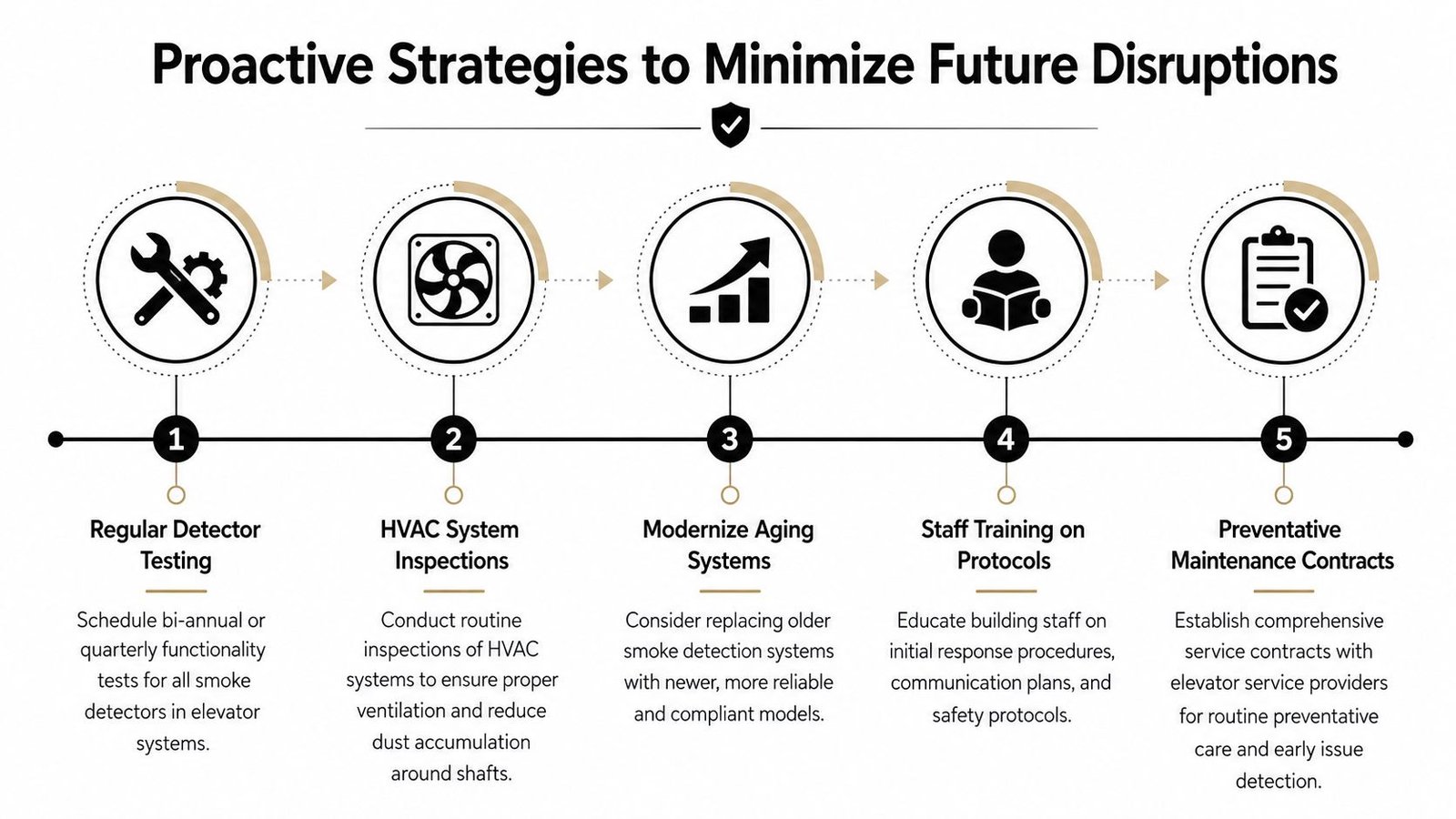
Proactive Strategies to Minimize Future Disruptions
Emergency response matters. Planning matters more. If a building treats elevator smoke detector issues as one-off surprises, the same disruption will keep coming back with a different date on the work order.
The strongest buildings build detector lifecycle planning into their maintenance and capital discussions. That's especially important in hoistways and similar environments where dust, vibration, and general conditions are tougher on devices.
Replace aging devices before they become outage events
The replacement timeline is one of the clearest ways to reduce avoidable recall problems. Pemberton's guidance on smoke alarm replacement states that smoke alarms have a 30% probability of failure within ten years, and for elevator hoistway detectors in harsh environments, industry guidelines suggest replacing all devices at the 15-year mark from installation.
For building managers, that changes the budget conversation. A planned replacement during scheduled service is easier to manage than a surprise shutdown on a busy day.
Build a practical prevention plan
A workable plan usually includes:
Age tracking
Keep an installation date list for detectors tied to elevator recall functions.Cross-trade review
Don't separate elevator maintenance records from fire alarm records when the systems interact.Dust and environment awareness
If your building has recurring construction, industrial residue, or chronic contamination around shafts and lobbies, flag that in maintenance planning.Staff training
Front desk, maintenance, and security teams should know what information to collect before they start calling vendors.Notice templates in advance
Prewritten outage and all-clear notices save time when the building is under pressure.
Shift from reactive to scheduled work
A building manager doesn't need every detector problem to become a same-day emergency. Many can be prevented by knowing device age, watching repeat false-recall history, and replacing components on schedule rather than hoping one more cleaning will carry them through.
That's the broader lesson in elevator smoke detector repair. The repair itself is only part of the job. The real work is controlling the event, communicating clearly, documenting the response, and planning early enough that the next outage never happens during your busiest week.
Crane Elevator Company helps building owners and managers handle the full lifecycle of elevator reliability, from emergency response and code-required service to preventative maintenance and modernization planning. If you need a responsive partner in Lower Michigan for elevator troubleshooting, compliance-focused repairs, or a second opinion on recurring shutdowns, contact Crane Elevator Company.