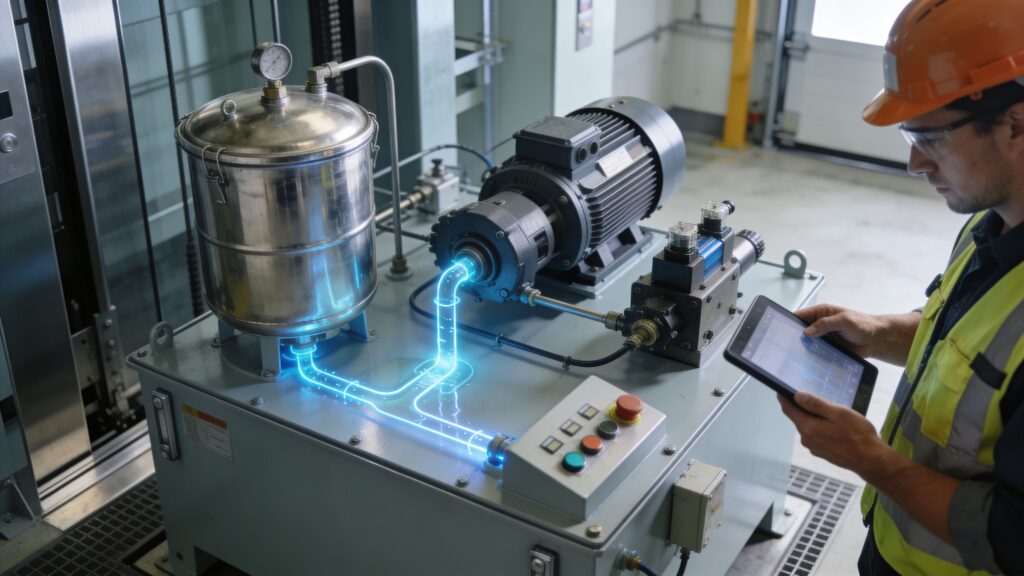
A lot of building owners call when the elevator still runs, but something feels off. The car shudders a little on the way up. It takes longer to answer a hall call. The machine room has a burnt-oil smell, or there’s a new groan at startup that nobody remembers hearing before.
That’s usually the point where the hydraulic elevator power unit deserves a hard look. This component is also called a pump unit or tank unit, and it’s the working heart of a hydraulic elevator. If it’s healthy, the ride is smooth, leveling is consistent, and the system stays dependable. If it’s worn out, everything around it starts getting more expensive.
Michigan’s #1 Elevator Power Unit Replacement Service
Michigan building owners don’t just need a repair price. They need to know what will hold up through daily use, what keeps tenants moving, and what replacement choice makes sense over the long haul. That matters even more in low-rise commercial buildings, medical offices, schools, apartment properties, and municipal facilities where hydraulic systems are common.
Your Guide to Michigan’s Elevator Power Units
The power unit is where hydraulic motion starts. It stores the oil, pressurizes it, and meters it so the elevator car can rise, stop, level, and return without drama. When a property manager says, “The elevator still works, but it doesn’t feel right,” this is one of the first places a technician checks.
In practical terms, the hydraulic elevator power unit is the assembly that includes the tank, motor, pump, and valve. Some people call the whole thing a pump unit. Others call it a tank unit because the reservoir is the visible part that anchors the system in the machine room. All three terms usually point to the same core assembly.
Why this part matters so much
A bad door operator creates obvious problems. A failing power unit creates expensive ones.
When the unit runs hot, pulls unevenly, leaks oil, or can’t hold pressure cleanly, the symptoms show up throughout the ride. You’ll see slow starts, rough acceleration, poor floor leveling, nuisance shutdowns, and more service calls. Over time, those issues affect tenant confidence, maintenance budgets, and downtime planning.
Practical rule: If the ride quality changes gradually, don’t wait for a shutdown to start asking questions.
Hydraulic systems have been around a long time for a reason. The hydraulic elevator power unit traces its foundation to the mid-19th century, beginning with Sir William Armstrong’s hydraulic crane in 1846, and the big shift to the modern oil-powered unit came in the 1950s, when oil reservoirs, motor-driven pumps, and electric-hydraulic controls made low-rise applications more reliable in markets like the U.S. (historical overview of elevator development).
What Michigan owners usually need to know
Most building managers aren’t looking for a lecture on fluid power. They need clear answers to a few practical questions:
- What is this unit doing? It creates and controls the hydraulic pressure that lifts the car.
- What are the warning signs? Noise, heat, leaks, slower travel, and leveling drift are common clues.
- Can it be repaired? Sometimes yes, especially if the problem is isolated.
- When is replacement smarter? When repairs keep stacking up, parts are difficult to source, or the old unit is draining money through downtime and repeat service.
The right decision usually comes down to safety, reliability, and total cost of ownership, not just the cheapest invoice today.
Key Components of a Hydraulic Power Unit
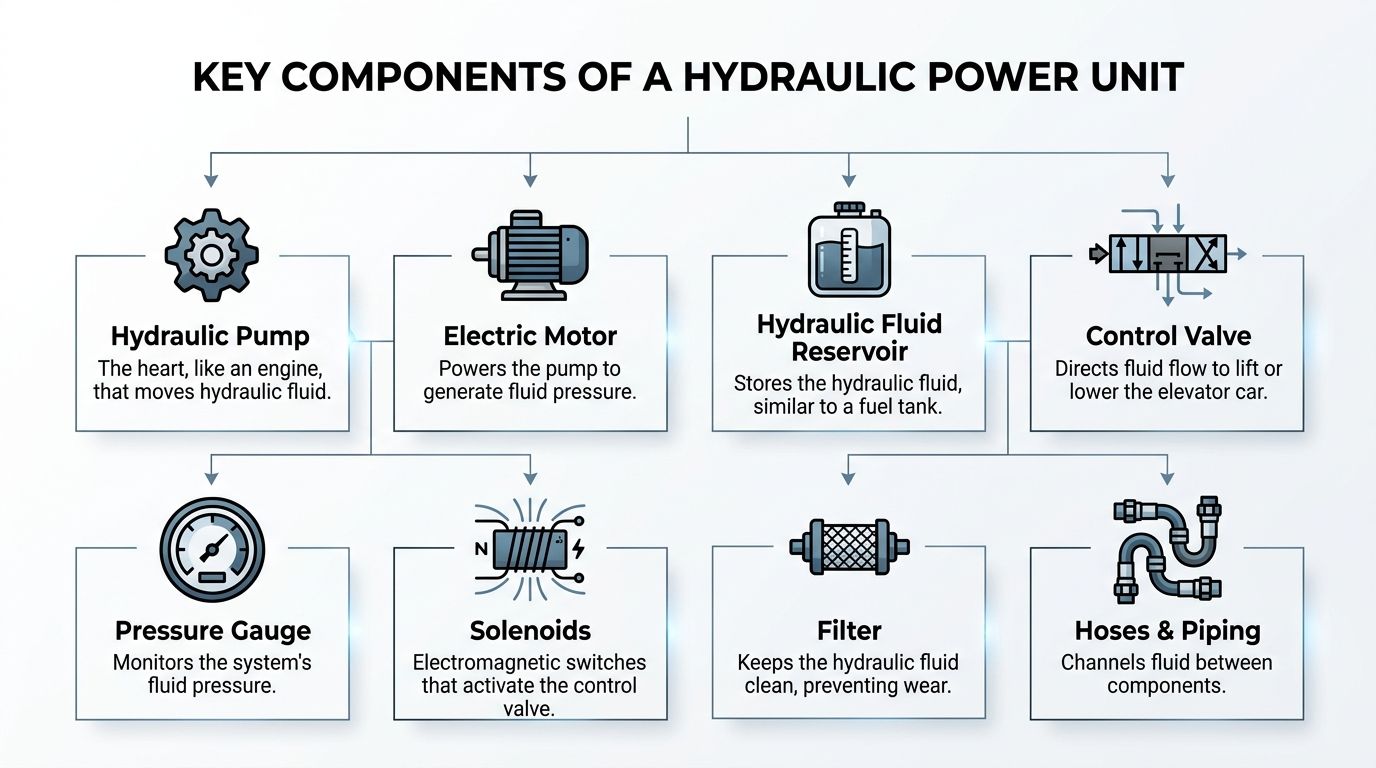
If you think of the elevator as a body, the power unit is the circulatory system. The motor provides force, the pump creates flow, the valve directs it, and the oil carries that force where it needs to go.
The tank, motor, pump, valve, and oil
The tank or reservoir stores hydraulic fluid. It also gives that oil a place to settle, cool, and return between runs. If the tank is contaminated, too low, or overheated, the rest of the system pays for it.
The motor is the muscle. It turns electrical energy into mechanical rotation to drive the pump. In a healthy unit, the motor starts cleanly, runs within its load range, and doesn’t overheat or sound strained.
The pump is the pressure-making component. In commercial hydraulic elevator work, submersible and belted pumps use positive displacement, three-screw designs, and commercial units typically pump 260 to 350 gallons per minute with motors ranging from 10 HP to 70 HP. Submersible motors are rated for 80 to 120 starts per hour (Vertical Express power unit specifications).
The control valve is where smoothness happens. It meters oil to raise the car, holds pressure at landing, and controls the descent. A worn or poorly adjusted valve can make a good pump and motor look bad.
The hydraulic fluid is the lifeblood. If it’s dirty, aerated, too hot, or breaking down, ride quality and component life both suffer.
Submersible versus dry-mount
This is one of the more important design choices in the field.
A submersible unit places the motor in the oil. These units tend to run quieter and are common in many low-rise applications. A dry-mount unit keeps the motor out of the oil and is often used where higher lifting ability or heavier-duty performance is needed.
For a building owner, the takeaway is simple:
- Submersible units often make sense where quiet operation and compact design matter.
- Dry units are often preferred when the elevator has demanding traffic, heavier loads, or a setup that benefits from stronger lifting performance.
If you want a broader look at how these systems fit into low-rise building applications, this overview of hydraulic elevators gives the larger context.
The smaller parts that still matter
A power unit also depends on supporting hardware that can’t be ignored:
- Pressure gauge: Shows how the system is behaving under load.
- Filter: Keeps contamination out of the pump and valve.
- Solenoids: Trigger valve functions electrically.
- Hoses and piping: Carry oil without leaks or pressure loss.
A power unit rarely fails because of one dramatic event. More often, one small issue gets ignored until it starts wearing out everything around it.
When a technician opens a machine room and sees dirt buildup, oily residue, loose wiring, and a unit running hot, that’s not cosmetic. It’s usually a warning that the whole assembly hasn’t been getting the attention it needs.
How Your Power Unit Lifts and Lowers the Car
The easiest way to understand a hydraulic elevator is to follow one trip.
A call comes in from an upper floor. The controller tells the power unit to get ready. The motor starts, the pump builds pressure, and oil begins moving toward the jack.
When the car needs to rise, the motor turns the pump. The pump takes oil from the reservoir and pushes it through the valve and into the hydraulic cylinder.
That pressurized oil moves the piston. The piston raises the car.
If the power unit is in good shape, the ride feels controlled from the first inch of movement. The start is clean, the acceleration is steady, and the car levels accurately at the landing.
If the power unit isn’t healthy, the upward ride usually tells on it first. You may notice:
- A delayed start after pressing the call button
- A rough launch instead of a smooth pickup
- A strained sound from the machine room
- A slow run compared with what the building is used to
Those symptoms often point back to oil condition, pump wear, motor strain, or valve performance.
What happens on the way down
Hydraulic elevators descend differently. On the way down, the motor generally doesn’t need to run.
Instead, the control valve opens in a controlled way and allows oil to return to the tank. The weight of the car pushes the oil back through the system. That’s why descent quality depends so heavily on valve condition and proper adjustment.
A good descent feels calm and predictable. A bad one feels jumpy, drifty, or soft at leveling.
This short visual helps non-technical owners see the sequence more clearly:
Why ride quality points back to the power unit
Owners sometimes assume poor ride quality means “the elevator is old.” That’s too vague to be useful.
In hydraulic equipment, ride quality often reflects how well the power unit is producing, controlling, and returning oil. If the car overshoots, sags, bumps into the floor, or takes too long to start moving, the tank unit is often part of that story.
The elevator car only shows the symptom. The power unit usually tells you the cause.
That’s why technicians listen carefully during startup, watch pressure behavior, inspect the oil, and check how the unit handles both travel directions. The problem isn’t always dramatic. Sometimes it’s just a pump losing efficiency, a valve drifting out of spec, or oil that has aged past the point where it can do its job cleanly.
Diagnosing Common Power Unit Problems and Failures
Most power unit failures announce themselves before they become emergencies. The signs are usually there in the machine room, in the ride, or on the floor near the equipment.
The mistake is assuming those signs are minor because the elevator still runs.
What technicians pay attention to first
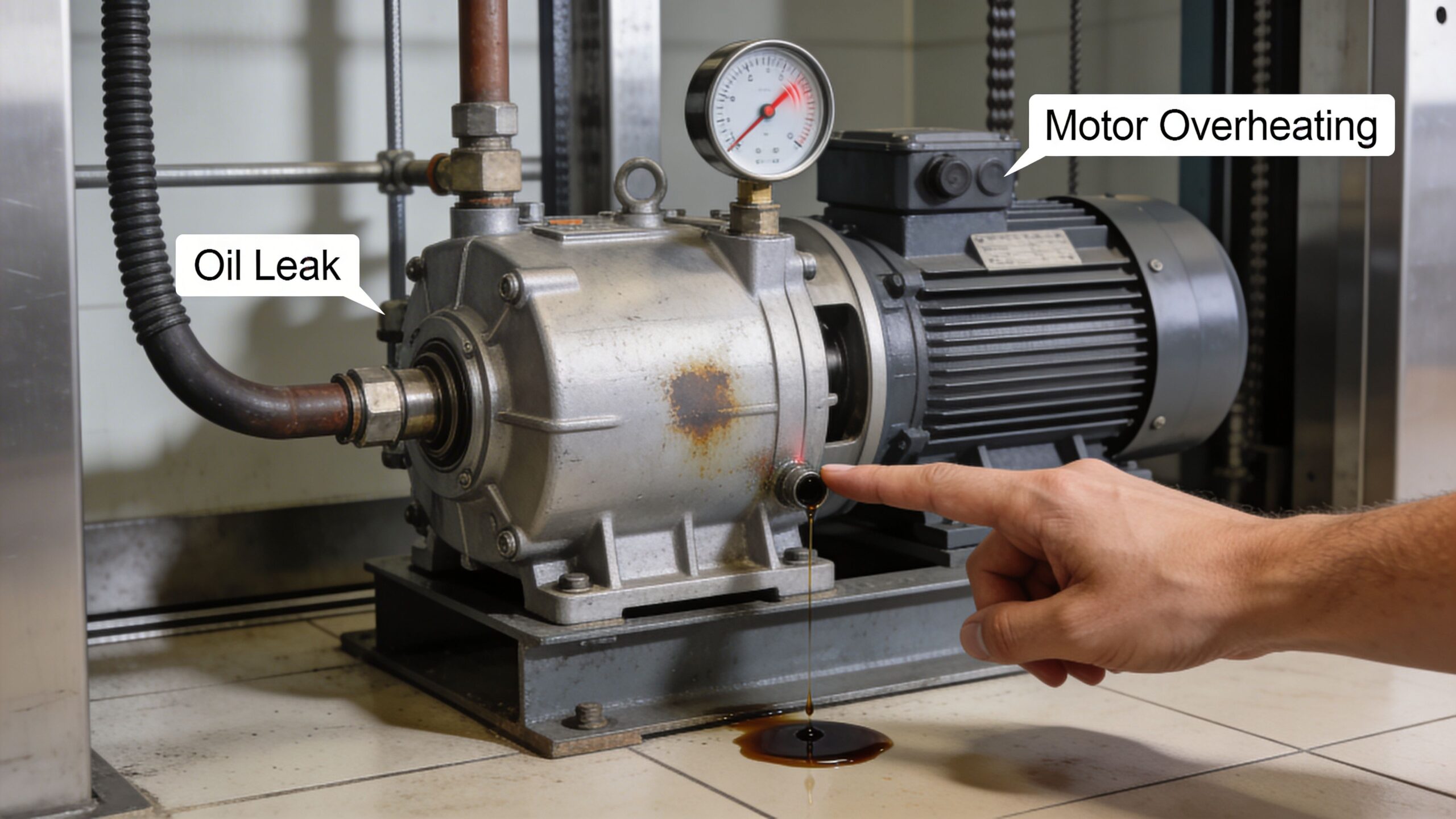
Noise matters. So does smell. So does oil where oil doesn’t belong.
A healthy pump unit has a recognizable operating sound. When that sound changes, a trained mechanic pays attention. Whining can point to aeration or pump issues. Gurgling can suggest air in the oil or a low fluid condition. Harsh clanking or chatter can indicate mechanical wear, loose mounting, or a pressure-control problem.
Performance changes matter just as much:
- Slow upward travel
- Uneven floor leveling
- Jerky starts or stops
- Spongy ride feel
- Nuisance shutdowns
- Oil leaks at fittings, seals, or around the tank
If you also have water problems in the pit, that needs attention quickly because oil leaks and water intrusion create a bad combination for long-term hydraulic reliability. This guide on a flooded elevator pit covers why that condition shouldn’t be left alone.
Common Hydraulic Power Unit Symptoms and Causes
| Symptom You Observe | Potential Power Unit Cause | What It Means |
|---|---|---|
| Elevator rises more slowly than normal | Pump wear, motor strain, pressure loss, or oil condition issues | The unit may no longer be building pressure efficiently |
| Car starts with a shudder or rough pickup | Valve control issue, aerated oil, or inconsistent pump output | Flow isn’t being delivered smoothly at startup |
| Elevator levels poorly at the floor | Valve drift, contamination, or pressure control problems | The system is struggling to meter oil precisely |
| Whining sound during upward travel | Aeration, restricted flow, or pump wear | The pump may be pulling oil poorly or working harder than it should |
| Gurgling or foaming in the tank | Air in the hydraulic fluid or low oil level | Air mixed with oil reduces stable performance |
| Oil visible on the floor or tank | Leaking fitting, hose issue, seal failure, or tank problem | The system is losing fluid and creating contamination risk |
| Unit feels unusually hot in the machine room | Overheating fluid, poor ventilation, or excessive workload | Heat is reducing oil performance and increasing wear |
| Elevator runs, but ride feels soft or spongy | Aeration, low fluid, or control instability | The system isn’t transferring force cleanly |
| Repeated service calls for different symptoms | Multiple aging components in the same unit | The problem may be the overall condition of the power unit, not one isolated part |
What these symptoms usually mean for cost
Small hydraulic issues don’t stay small for long. Dirty oil wears the pump and valve. Heat thins the oil and stresses the motor. Leaks lower fluid level, create housekeeping and environmental concerns, and can lead to poor ride quality that frustrates tenants before the car ever goes out of service.
A building manager doesn’t need to diagnose the exact failed part. But it helps to document what changed and when:
- When did the symptom start
- Is it happening on up travel, down travel, or both
- Has the machine room temperature changed
- Is there visible oil loss
- Has the unit needed repeat resets or repeat repairs
That information shortens troubleshooting time and often leads to a more accurate repair plan.
If the same hydraulic elevator power unit keeps producing different symptoms, stop treating each visit like a separate problem. Aging units often fail as a system.
Preventive Maintenance That Saves You Money
Preventive maintenance is cheaper than emergency response because it gives a technician time to catch wear before it turns into downtime. That’s not theory. It’s how hydraulic systems stay dependable.
A proper maintenance visit goes beyond a quick look at the tank and a wipe-down of visible oil. The work should verify how the unit is operating under real conditions and whether protective devices are still doing their job.
What good maintenance includes
A useful visit should include checks like these:
- Oil condition review: The technician looks for contamination, discoloration, odor changes, and signs of aeration.
- Temperature check: Heat is one of the fastest ways to shorten component life.
- Pressure and running behavior: Pressure stability, startup behavior, and valve response tell you a lot about internal wear.
- Motor inspection: Current draw, noise, vibration, and heat all matter.
- Leak inspection: Hoses, fittings, seals, tank surfaces, and valve areas need close attention.
- Housekeeping: A clean machine room makes leak detection and overheating issues easier to catch.
The thermal switch is not optional
One of the most important protections on a hydraulic power unit is the Thermal Switch Assembly (TSW-1). It is required by ASME A17.1/CSA B44 and must be factory preset at 145°F (63°C) to prevent overheating. Properly functioning thermal protection can extend power unit lifespan by 30% to 50% because it shuts the unit down before heat damages the pump, motor, and valves (thermal switch requirements and lifespan impact).
That matters a lot in Michigan where machine room conditions can swing with the season, building occupancy, and ventilation quality.
A technician should verify:
- Thermal switch calibration
- Secure wiring to the controller
- Signs of overheating in the oil or motor
- Whether airflow and room conditions are helping or hurting the unit
Why owners save money by being early
Owners often focus on the visible repair. The bigger savings come from what doesn’t happen.
Routine checks help prevent nuisance shutdowns, protect ride quality, reduce after-hours calls, and keep small leaks from becoming major cleanup jobs. They also make it easier to decide when a pump unit is still worth maintaining and when replacement is the smarter move.
The best maintenance programs are consistent, documented, and specific to the equipment in front of the mechanic. Generic checklists don’t do much for a hydraulic system that already has age, heat, contamination, or prior repair history working against it.
When to Repair Versus Replace Your Power Unit
Building owners can either stop a long string of repeat costs or keep feeding it.
A repair makes sense when the problem is isolated and the rest of the power unit is still in solid condition. A replacement makes more sense when the unit has become a collection of recurring issues, especially if each visit fixes one symptom and exposes the next.
Repair is usually reasonable when:
- The issue is localized to a valve component, motor issue, fitting, or leak point.
- The ride has been stable overall and this is not part of a pattern.
- Parts are available without long delays.
- The tank, pump, and motor base condition are still sound.
In those cases, a focused repair can restore service without forcing a full modernization decision too early.
When replacement starts making financial sense
Replacement deserves serious consideration when you’re dealing with a combination of these conditions:
- Repeat service calls tied to hydraulic performance
- Oil condition problems that keep returning
- Excessive noise or heat
- Poor leveling and declining ride quality
- Hard-to-source components
- A unit that has already had several meaningful repairs
At that point, the question isn’t “Can this be fixed again?” It usually can. The better question is whether continued repair is the cheapest path over the next several years.
Modern hydraulic power units with solid-state starters can offer significant energy savings over older models, and hydraulics still often hold a lower total cost of ownership in 2 to 4 stop buildings because installation and maintenance costs are generally lower than traction alternatives in that range (Elevator World on hydraulic power unit trade-offs).
If you’re comparing options, this page on an elevator power unit is a useful reference point for what replacement assemblies typically involve.
The long-term value of non-proprietary equipment
This is one of the biggest points owners miss.
A non-proprietary power unit gives you more service flexibility. Any qualified elevator contractor who works on that type of equipment can maintain, troubleshoot, and replace parts without you being locked into one vendor’s ecosystem.
That matters over the life of the unit because ownership cost isn’t just the purchase price. It includes:
- How easy parts are to get
- How many contractors can service it
- How quickly breakdowns can be resolved
- How predictable the maintenance budget becomes
A cheaper short-term repair can be the more expensive decision if it keeps an outdated unit in service past the point where it makes economic sense.
The practical comparison
| Option | What you gain | What you risk |
|---|---|---|
| Repair the existing unit | Lower immediate spend, less disruption if the fault is isolated | More repeat calls if the unit is aging overall |
| Replace the power unit | Better reliability, cleaner operation, updated controls, improved serviceability | Higher upfront project cost |
| Choose non-proprietary replacement | Service flexibility and easier long-term parts access | Requires careful specification up front |
The right answer depends on the building, the traffic pattern, the service history, and how much risk the owner wants to keep carrying.
Your Next Steps for a Reliable Elevator in Michigan
If your elevator has become noisier, slower, hotter, or less predictable, start with a direct assessment of the power unit. Don’t assume the problem will stay minor just because the car still moves.
For Michigan owners, the decision usually comes down to whether the current unit can deliver dependable service at a reasonable long-term cost. In many low-rise properties, keeping a hydraulic system and upgrading the tank unit is the practical move.
What to ask before approving work
Use these questions when talking with a contractor:
- Is the issue isolated or systemic
- What condition are the tank, pump, motor, and valve in overall
- Will this repair likely hold, or is it buying short time
- Are replacement parts for this setup still easy to source
- Would a non-proprietary replacement reduce future service risk
- What does the total cost look like over the next few years, not just this invoice
That last question matters most. Owners often compare the cost of a repair against the price of a replacement and stop there. A better comparison is repair cost plus likely repeat calls, downtime, tenant complaints, and the risk of after-hours failures.
Why modernization can pencil out
For a typical 2,500 lb. elevator, the annual energy cost difference between a modern hydraulic and a traction elevator can be as little as about $150 per year, and upgrading an older hydraulic power unit to one with modern AC/variable-voltage, variable-frequency technology can cost US$3,500 to $6,000, with payback often achieved in under three years through lower electricity bills (hydraulic power unit upgrade cost and payback details).
That’s why hydraulic modernization often makes more sense than owners expect, especially in low-rise buildings where the system layout already fits the property well.
What works well in practice
The best outcomes usually come from a few simple decisions:
- Replace chronic problem units before they force an emergency.
- Choose high-quality, non-proprietary components that qualified local mechanics can service.
- Insist on a clean machine room and documented maintenance, not just reactive repairs.
- Look at financing if capital planning is the only thing delaying a needed replacement.
Crane Elevator Company handles non-proprietary hydraulic power unit, pump unit, and tank unit replacement work in Lower Michigan, along with repairs, inspections, and modernization support for existing hydraulic systems.
Competitive rates matter. High quality matters more. The right replacement should lower service friction, improve reliability, and make future maintenance simpler, not more restrictive.
A building owner shouldn’t have to choose between keeping an old unit alive forever and overbuying a whole new elevator package. In many cases, replacing the hydraulic elevator power unit is the balanced option. It addresses the component doing the heavy work, improves day-to-day performance, and gives the property a more predictable operating path.
If your elevator is showing signs of power unit trouble, contact Crane Elevator Company for a no-obligation assessment. We can review whether repair still makes sense, whether a non-proprietary replacement is the better long-term move, and how to make the project predictable with competitive pricing and available financing options.